mermaidcamp
Keeping current in wellness, in and out of the water
You can scroll the shelf using ← and → keys
You can scroll the shelf using ← and → keys

Seal of Sandwich
My 12th great-grandfather was born in Sandwich, MA, on Cape Cod, in 1623. He served as a constable in Sandwich. There is some confusion about Myles Black/Michael Blackwell records in Sandwich, which seem to indicate they are one in the same man:
Title: MICHAEL BLACKWELL OF SANDWICH, MASS. (c. 1620-1710)
URL: http://members.dencity.com/ccblack/genealogy/micheal.html
Author: LYDIA B. (PHINNEY) BROWNSON, Of Duxbury, Mass. and MACLEAN W. MCLEAN, Of Pittsburgh, Pa
No attempt has been made by the present writers to investigate possible connections between Michael Blackwell and others of the name in England or America. It certainly would be interesting to know whether the Sandwich family was in any way related to the Rulling Elder Francis Blackwell of the Separatist Church whose recantation William Bradford criticized. Actually it is by no means certain that the family name was originally Blackwell. The Sandwich list of men between 16 and 60 able to bear arms in 1643 includes one Myles Black. James Savage in his Genealogical Dictionary of The First Settlers in New England, 1860, vol. 1, p. 191, says “hardly can I doubt that this man called by Savage
“Michael or Myles Blackwell” is he designated in the Col. list of those able to bear arms 1643, as Miles Black” (THE REGISTER, vol. 4, p. 257,
July 1850). This Question puzzled also Thomas Spooner, the compiler of the Memorial of William Spooner, 1871, who corresponded with the Rev. Frederick Freeman author of The History of Cape Cod, 1858. Spooner quotes Freeman as saying: “The Blackwells of Sandwich were generally called Black. Even since my remembrance the latter name was used for those who wrote the name Blackwell and in some early instances of recorthe same Liberty was taken. The progenitor himself is in one instance at least on record as Black” (p: 60:61 footnotes.It seems to us that the evidence, while not conclusive, strongly suggesthat Miles Black and Michael Blackwell were one and the same person. The reader may speculate for himself from the data available. Conclusive proof of identity doubtless would have been found in the Barnstable County land records, but these were destroyed in the 1827 fire. Fortunately Michael Blackwell and his son, and grandsons left wills and probate records which are unusually complete. The earliest reference we find has to do with Miles Blacke who was a creditor in the amount of 7 shillings due from the estate of William Swift, Sr., 29 Jan. 1642 (Plymouth Colony Probate, Liber 1, p. 44, in May. Des., 8:170, December 1900). This first reference, by the way, poses a second problem of confusion of identities, namely.the fact that there was in New England early date a gentleman of some wealth and influence called “Mr. John Blackwell.” This complication will be discussed under the account of John Blackwell. For the moment it is enough to point out the really extraordinary co-incidence that the Swift estate should have been indebted to both Miles Black of Sandwich and to “Mr. Blackwell,” since so far as we can find the latter was of Boston and co. Middlesex, England, and had no interest in Sandwich.In 1643 Miles Black’s name appears on the list of Sandwich men aged between 16 and 60, able to bear arms (The Register, Op. Cit.), but
Michael Blackwell’s name does not appear. Yet 7 June 1648 “Mycaell Blackwell” served on the grand inquest; and the following October “Micaell Blackwell” served as grand juror in the infanticide case of
Alice Bishop (Nathaniel B. Shurtleff, ed., Records of the Colony of New Plymouth . . . , 2:134, cf. p. 124, where his name appears as Mycaell Blackwell). An agreement was made 17 Jan. 1652 by the town of Sandwich “with Daniel Wing & Michael Blackwell for the taking of fish in Herring River” (Frederick Freeman, “Annals of Sandwich” in his History of Cape Cod, 1858, 2:50).
Note:
“Myles Blacke” was appointed, 3 June 1656, constable of Sandwich (Shurtleff, op. cit., 3: 100). On the 1658 list of Sandwich land holders the name of Michaell Blackwell appears, but not that of Miles Black
(Freeman, op. cit., 2:59). Yet it would seem unlikely that the town’s constable was not a land owner. It is interesting to note here that this Miles Black or Blackwell held the post of Constable in Sandwich
immediately preceding the inauguration in 1657 of what Amos Otis called “a system of terrorism” there, under the enthusiastic leadership of the notorious Sandwich Marshall George Barlow, to whom the Colony Court gave “full power to act as constable in all things in the town of Sandwich” (C.- F. Swift, Genealogical Notes of Barnstable Families, 1888, p. 258-259). No reference is made anywhere that we have seen which would indicate that Black or Blackwell was involved in persecution of the Quakers in this period, though the Blackwell family seems to have been active members of the Sandwich Congregational Church, and not to have had family connections with the Quaker element.
Note:
On 13 June 1660 “A parcell of meadow was granted to Myles BIacke att Mannomett.” And in the following March he and Thomas Burges, Sr., were brought to court for fraudulently obtaining meadow land there (Shurtlefop. cit., 3:194, 208). These entries are perhaps significant in view of the fact that Michael Blackwell’s will refers to land adjoyning Jacob Burges, principal heir to Thomas Burges, Sr.
Note:
We come now to two entries which refer to “Myles Blackwell.” The first shows that “Myles Blackwell” served on the Grand jury 4 Oct. 1664 (Shurtleff, op. cit., 7: 1 19). The second shows that Myls Blackwell was chosen surveyor of highways in Sandwich 3 June 1668. Oddly enough the same source shows that Miacaell Blackwell served on the Grand Jury 5 Ju 1667 (ibid., 4:148, 181). Micacll Blackwell served 5 June 1671 on a committee “to view damage done to the Indians by the horses and hoggs of the English” (ibid.-, 5:62).
Note:
In 1672 “Mr. Edmund Freeman Senr., William Swift, Thomas Wing Senr., Thomas Dexter Senr., Michaell Blackwell & William Newland were constituted a committee to go forward in settling & confirming the bounof the township with the Sachem of Mannomet . . .” (Freeman, op. cit., 2:67). Joseph Burges petitioned the Court, 5 June 1673, regarding “a way that goes through lands of Myles Blackwell … att Sandwich” (Shurtleff, op. cit., 5:116). The list of “all those who have just rights to the priviledges of the Town” in 1675 shows Michaell Blackwell and his son John Blackwell, and does -not show a Miles Black (Freeman, op. cit., 2:68) In 1680 Michaell Blackwell served once more on the Grand Inquest
and in 1672 he took the inventory of the estate of Edmund Freeman. His will shows that he deeded land in 1705 to his son Joshua and it is to be inferred that he had done the same for his elder son.
Note:
His will is of considerable genealogical value. Firstly, it proves that Michael Blackwell’s wife had predeceased him. It seems strange that there is not the slightest reference to the wife of either Miles Black or Michael Blackwell. Secondly, the testator in his intense desire to be the founder of a dynasty patterned upon the model of the landed gentold England gives proof of one or two relationships which otherwise would
have remained obscure, as will be seen. The Sandwich vital records in the town hall are copies of the originals. The entry of Michael Blackwell’s death reads 6 January, the date of the year having been torn away, but the careful copy made by the late George E. Bowman of the Massachusetts Society of Mayflower Descendants notes that 1710 was added – in pencil, and as we now see, this notation is correct (May. Des., 29: 22 footnote, January 1931). With the exception of the son Michael, no dates of the births or baptisms of Michael Blackwell’s children have been found. The order of birth of the sons is clear from the father’s will, although the daughter Jane (whose husband was born in 1644) may have be older than Michael.
Michael Blackwell (1623 – 1709)
is my 12th great grandfather
John Blackwell (1645 – 1688)
son of Michael Blackwell
Elizabeth Blackwell (1662 – 1691)
daughter of John Blackwell
Thomas Baynard (1678 – 1732)
son of Elizabeth Blackwell
Deborah Baynard (1720 – 1791)
daughter of Thomas Baynard
Mary Horney (1741 – 1775)
daughter of Deborah Baynard
Esther Harris (1764 – 1838)
daughter of Mary Horney
John H Wright (1803 – 1850)
son of Esther Harris
Mary Wright (1816 – 1873)
daughter of John H Wright
Emiline P Nicholls (1837 – )
daughter of Mary Wright
Harriet Peterson (1856 – 1933)
daughter of Emiline P Nicholls
Sarah Helena Byrne (1878 – 1962)
daughter of Harriet Peterson
Olga Fern Scott (1897 – 1968)
daughter of Sarah Helena Byrne
Richard Arden Morse (1920 – 2004)
son of Olga Fern Scott
Pamela Morse
I am the daughter of Richard Arden Morse
When he died he owned quite a bit of land around Sandwich:
Michael Blackwell’s will, dated 29 Nov 1709 of “Michael Blackwell of Sandwich” gives “… unto my grand son John Blackwell, the eldest son of my son John Blackwell, deceased, all those lands, marsh and meadow ground . . . in the town of Sandwich, lying on the Northeasterly side of Skussett River . . . on part of which upland ye dwelling house of my sd. Grand son now standeth . . . adjoyning in part upon the messuage in ye tenour or occupation of Jacob Burges . . . as well as one parcell of meadow lying adjoyning Jireh Swift . . . and by the land of Irish Swift . . . on condition that my said grand son John Blackwell dye leaveing a male heire surviving, lawfully begotton of his own bodie. And that he do also pay unto Caleb Blackwell his naturall brother, the sum of 5 pounds . . . And if it shall so happen” (that said John dies without a male heir, then the testator directs the youngest brother Nathaniel, shall inherit). The will then provides that if John Blackwell survives his brothers, Caleb and Nathaniel, and finally die without male issue, the then male children of my son Joshua Blackwell shall inherit all. “Item: . . . unton my grand son Benjamin Gibbs, on half part of all upland at Waynonsett . . . lands in Sandwich adjoying land formerly belonging to John Gibbs and other lands in Sandwich and lands I formerly bought of Robert Bartlett in Plymouth township. Item: . . . unto my grand son Samuel Blackwell, son on my son Joshua Blackwell, the other half of my lands before given to Benjamin Gibbs. Item: . . . unto my daughter Jane Gibbs, that nine pounds which her husband formerly borrowed and me and which he yet oweth to me. Item: . . . unto the three sons and six daughters of my son Joshua Blackwell or to so many of them as shall survive mee, all that shall remain of my personal estate . . . to be equally divided between them. Item: . . . to my said son Joshua Blackwell the other half of my land that I bought of Robert Bartlett . . . and I do confirm unto him and unto his son Michael Blackwell all those lands, swamp & meadow ground to which I have given by deed of gift, dated 3 Aug 1705, only that he pay to my grandson Nathaniel Blackwell 10 pounds & to each of the sisters of ye said Nathaniel Blackwell, being the daughters of my said son John Blackwell, deceased, the sum of 40s in current passable pay within one year after my decease.”
Michael’s son Joshua Blackwell was named sole executor. The will was signed by a mark and was witnessed by William Bassett, Sr., William Bassett, Jr., and Nathan Bassett. The witnesses were sworn 26 Jan and administration ordered 29 Jan. 1709/10. The date of Michael Blackwell’s death is 6 Jan 1710.
~New England Historic and Genelogical Register, July, 1963, pages 180-183
Flaunta was the second cousin of the goddess Aphrodite. She became the goddess of confidence. Her journey to her vocation to inspire and represent confidence was a story of self discovery. Aphrodite needed no outside assurance to know she was a great beauty. She exuded it. The young Flaunta was not convinced of her own powers, but passed through a jealousy of earth women who enjoyed and were confident in their own good looks. She studied the powerful and confident women, learning their secrets. Eventually her cousin would bestow the title and the powers of confidence goddess on Flaunta. She is active today in the complicated self image issues women face about appearance and competence. Being authentic and unique leads to the highest kind of confidence, as Tank Girl can attest. Confident women know:
Get to know Flaunta, and take her with you next time you need to look something or somebody right in the eye. Nothing says “I got this” like control of your gaze. Bluffing or not, the first impression you give will remain strong when you show self assurance.
The ancient world was more highly aware of the seasons than we are today because they had to make fire to stay warm or see at night. Religion, tradition, and regional provincialism are woven together at the winter solstice time. We have a food and drink festival that imitates Saturnalia and a birthday the resembles the birth of Mithra. I believe I have inherited some feelings for Christmas from the way my ancestors behaved. I have had the good fortune to be in other countries to celebrate the season, which opened my eyes to the wide variety and regional roots of the holiday practices. I choose the part I like and feel no pressure to perform now that my ancestors are all dead. I see the end of the year as a fun break before tax organization season, and a good excuse to party with friends. We give few gifts, but like to share extra food and drink with friends. I like to embrace it as an upside down time, a season for preparation and clearing. Spring will be right around the corner, when the harvest cycle can begin once more. For now, God Rest Ye Merry Gentlemen; it is time to party.
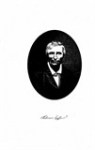
My 9th great-grandfather was one of the Quakers of Sandwich plantation who were heavily persecuted by the Pilgrims of Plymouth. He owned property when he died in New Jersey, which was controlled by the Dutch.
William Gifford arrived in New England after 1643, as he does not appear among those able to bear arms in that year. The first record of him is in the list of debts due on the inventory of Joseph Holiway of Sandwich dated 4 December 1647: “dew from Willi Gifford” 3s. 4d. On 4 June 1650 he served on the Grand Enquest. The original deed for the Sandwich plantation was executed by Governor William Bradford 22 May 1651. It ordered that Goodman (Thomas) Tupper, Goodman (Thomas) Burges, Sr., Nathaniel Willis, and William Gifford have the power to call a town meeting.Both Brown, and Daniels & McLean say that by 1651 he was married and had a family; that he probably married in England, and children John, Patience and Hannaniah were probably born in England. Birth records are available for only the last four of his nine children; the birth dates of the older children are estimated based upon the birth dates of their first children. There is a sizeable gap in these estimated dates between Hannaniah and William, suggesting William, Robert, Christopher and Mary may have been by a second wife. Only the last wife, Mary Mills, is of record; she is the mother of the last two children, Jonathan and James.
There is a record in England of a “Guilielm Gifford” (i.e., William Gifford) who married Elizabeth Grant on 11 February 1635 in St. Martin-in-the-Fields, London. Also, the London Merchant Taylors’ Guild shows a record: “William Gifford, son of Anthi (sic) Gifford of Dublin in the kingdom of Ireland, gentleman, apprenticed to Thomas Southerne of New Exchange, London, for a period of seven years from 7 December 1628.” Apprentices were forbidden to marry, so this would mean the apprenticed William Gifford would have been given his freedom 7 December 1635, in perfect time to be the one who married 11 February 1635/1636. Also, the records of St. Martin-in-the-Fields show that an Ananias Gifford married Maria Read on 18 November 1621. Ananias (also spelled Hananias, Hannaniah and Annaniah) is a relatively rare name. William named one of his sons Hannaniah, and the name has been carried down in the family. Also, the name occurs in the Giffords of Dry Drayton, county Cambridge, England. But it cannot be proven that these English records apply to the family of William Gifford of Sandwich.
Nor can the English ancestry of William Gifford of Sandwich be proven, according to Daniels & McLean. “English Giffords can be traced back to Normandy at the time of William the Conqueror when most branches usually spelled the name Giffard. Inevitably the temptation to connect the Sandwich Giffords with these celebrated families has produced a rash of printed accounts in which the connection is stated as fact but without solid references. (Cutter’s “Genealogical History of Western New York,” 2:901; “History of Bristol County, Mass.;” “Vineland (N.J.) Historical Magazine,” 3:32; “Seabury-Gifford Families,” Hartford (Conn.) 1941) In view of the fact that highly skilled professional genealogists have found no proof as yet of such connections, it can only be said that evidence has yet to be found to confirm these wishful thoughts.”
William Gifford of Sandwich was a Quaker, and as such, suffered persecution for his faith. “Little Compton Families” says “It is supposed that he was the William Gifford who in 1647 or earlier was ordered by the court at Stanford to be whipped and banished.” On 1 June 1658, he was one of a dozen men who “all of Sandwich were summoned, appeared to give a reason for theire refusing to take the Oath of Fidelitie to this government and unto the State of England, which again being tendered them in open court, they refused, saying they held it unlawful to take any oath att all.” At the court held 2 October 1658, they were fined L5 each. At the court held 1 March 1658/1659 George Barlow, Marshall for Sandwich, Barnstable and Yarmouth, complained against William Gifford and Edward Perry in an action of defamation, asking damages of L100, in saying he took a false oath. The defendants were ordered to pay 50s and make their acknowledgement publically, or else be fined L5 plus costs. As Quakers, they could not accept the verdict, and at the 2 October court William Gifford and 11 other Friends were fined L5 for refusing to take the Oath of Fidelitie. At the June 1660 court Gifford was again summoned to take the oath, again refused, and was again fined L5. In October 1660, for persisting in his refusal and for attending Quaker meeting, he was fined L57 — an enormous sum for those times. At this point he disappears from the records, and may have left Plymouth colony, but where he went is unknown. It has been suggested that he went to New Jersey which, like New Amsterdam, was then under the control of the Dutch. On 8 April 1665 William Gifford was one of the signers of the Monmouth (NJ) Patent, but there is no evidence he actually settled there; his sons Christopher and Hannaniah did, however. In a deed by his son Christopher William was described as a tailor.
On 10 November 1670 Mr. Gifford bought from mistress Sarah Warren of Plymouth, widow of Richard Warren, one half her share in the land at Dartmouth, which he gave equally to his sons Christopher and Robert by deed dated 6 May 1683. In 1673 William Gifford purchased land in Suckanesset (Falmouth) from the Indian Sachem, Job Noantico. Gifford continued to appear in Sandwich town records and in records of the Sandwich Friends meeting, and he married Mary Mills, also of Sandwich, at the Friends Meeting of 16 day 5 mo: 1683. Thirty witnesses signed the certificate, but none of William Gifford’s children signed the document, nor did James Mills, Mary’s brother.
William Gifford (1615 – 1687)
is your 9th great grandfather
John Gifford (1640 – 1708)
son of William Gifford
Yelverton Gifford (1676 – 1772)
son of John Gifford
Ann Gifford (1715 – 1795)
daughter of Yelverton Gifford
Frances Congdon (1738 – 1755)
daughter of Ann Gifford
Thomas Sweet (1759 – 1844)
son of Frances Congdon
Valentine Sweet (1791 – 1858)
son of Thomas Sweet
Sarah LaVina Sweet (1840 – 1923)
daughter of Valentine Sweet
Jason A Morse (1862 – 1932)
son of Sarah LaVina Sweet
Ernest Abner Morse (1890 – 1965)
son of Jason A Morse
Richard Arden Morse (1920 – 2004)
son of Ernest Abner Morse
Pamela Morse
I am the daughter of Richard Arden Morse

Ewer Coat of Arms
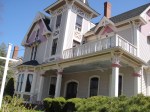
Henry Ewer moved his family from Plymouth to Sandwich, MA on Cape Cod to settle. The Pilgrims of Plymouth, right up the road, were religious nuts who banished and harassed those with whom they differed. The London contract that governor Brewster undertook allowed him to sell and or release lands to new settlers. He allowed the settlements on Cape Cod, but the church in Plymouth was in charge. The new towns on Cape Cod were subject to laws of the colony, and were treated harshly because of religious differences. The Cape Cod colonists, for instance, were to enforce observance of the Sabbath on the local native population, and make sure all the pigs had rings in their noses. They could be called up to Plymouth for infractions, and frequently were. In 1638 Henry and his wife were deemed unfit and told to leave the town, but their infractions were settled in an unknown way. Generations of Ewers continued to live in Sandwich and the surrounding area.





My 8th great-grandmother was born in Salisbury, Witlshire in 1633. She was baptized in St Thomas church in Salisbury. She was sailing on the ship James through a hurricane when she landed in America in 1635, as an infant traveling with her parents:
1635 voyage
The ship James of London sailed from Southhampton on April 5, 1635 and arrived in Massachusetts Bay on June 3,[5] 1635 with master William Cooper[disambiguation needed] at the helm.
The ship James left King’s Road in Bristol on May 23, 1635 with master John Taylor[disambiguation needed] at the helm. From England to Massachusetts in a fleet of five ships, the Angel Gabriel, the Elizabeth (Bess), the Mary and the Diligence.
On June 3, 1635, the James joined four other ships, and set sail for the New World with just over 100 passengers as part of a fleet of five ships, including the families of Richard Mather, Captain John Evered and John Ayer. As they approached New England, a hurricane struck and they were forced to ride it out just off the coast of modern-day Hampton, New Hampshire. According to the ship’s log and the journal of Increase Mather, whose father Richard Mather and family were passengers, the following was recorded;
“At this moment,… their lives were given up for lost; but then, in an instant of time, God turned the wind about, which carried them from the rocks of death before their eyes. …her sails rent in sunder, and split in pieces, as if they had been rotten ragges…”
They tried to stand down during the storm just outside the Isles of Shoals, but lost all three anchors, as no canvas or rope would hold, but on Aug 13, 1635, torn to pieces, and not one death, all one hundred plus passengers the James manages to make it to Boston Harbor two days later.
The Angel Gabriel was wrecked off the coast of Maine, but the smaller, faster ships, the Mary, the Bess, and the Diligence outran the storm, and landed in Newfoundland on August 15, 1635.
Mary Greene (1633 – 1686)
is my 8th great grandmother
Benoni Sweet (1663 – 1751)
son of Mary Greene
Dr. James Sweet (1686 – 1751)
son of Benoni Sweet
Thomas Sweet (1732 – 1813)
son of Dr. James Sweet
Thomas Sweet (1759 – 1844)
son of Thomas Sweet
Valentine Sweet (1791 – 1858)
son of Thomas Sweet
Sarah LaVina Sweet (1840 – 1923)
daughter of Valentine Sweet
Jason A Morse (1862 – 1932)
son of Sarah LaVina Sweet
Ernest Abner Morse (1890 – 1965)
son of Jason A Morse
Richard Arden Morse (1920 – 2004)
son of Ernest Abner Morse
Pamela Morse
I am the daughter of Richard Arden Morse
Her father was a physician and surgeon in Rhode Island. She married James Sweet when she was 17 and began a healing practice:
“This Sweet family is known as the Bone-Setting Sweets. This gift is said to be inherited from Mary Greene, wife of James Sweet 1622-1698, who was the daughter of Surgeon John Greene. They also had another gift, the faculty of compounding linaments and washes from the roots and barks found in almost every neighborhood, and are very efficacious in reducing inflammation and swellings and in preventing mortification.”
Her husband James had also arrived as a child with his parents, and was an early settler of Rhode Island.
Birth: 1622 Death: Jun. 18, 1698South Kingstown
Washington County
Rhode Island, USA
The second son of JOHN & MARY SWEET, James Sweet came with his parents to America in 1632. He worked at a grist mill with his step-father, Ezekiel Holliman. He was an inhabitant of Warwick in 1648, Commissioner in 1653/1658/1659, freeman in 1655, juryman in 1656 and lived at the estate of the late William Congdon at the foot of Ridge Hill. He married MARY GREENE, daughter of JOHN GREENE & JOANE (TATTERSOL) GREENE, about 1654 in Providence, RI. On Sept. 30, 1660, he sold to Thomas Greene, the lot he had received from the town of Warwick along with meadow land. Later, the family moved to Prudence Island in Portsmouth Twp. about four miles soutwest of Bristol in 1664 being one of the first families to live on the island from 1664 to about 1685. Several family members are buried in the old family burying ground in the center of the island.
On November 8, 1686, he deeded his land in Providence that he had inherited from his father to eldlest son, Philip of Prudence Island. On the same date, he deeded to son, Benoni, certain land in Mashiantatack, and to son, James of Prudence Island, Valentine of Kingstown, and Samuel & Mary Sweet living with their parents, land in Mashiantatack. In 1695, James deposed and gave his age as 73. He died at age 93 years.
All the “bone-setter” family lines originate with James Sweet and his wife, Mary, who learned the art of bone-setting from her surgeon father, JOHN GREENE. James Sweet & his brother, John Sweet were interpreters to the Indians for first settlers and their names can be found on early Indian deeds. James Sweet signed with his mark.
Family links:
Parents:
John Sweet (1603 – 1637)
Mary Periam Sweet (1600 – 1681)
Spouse:
Mary Greene Sweet (1633 – 1686)
Children:
Benoni Sweet (1663 – 1751)*
Valentine Sweet (1664 – 1725)*
Samuel Sweet (1667 – 1728)*
Burial:
Sweet – Austin Lot
North Kingstown
Washington CountyRhode Island, USA
The Count

his statue in Brussels
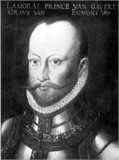
My 12th great grandfather was a count who was very political and fancy. He was beheaded in Brussels in front of the town hall. He is the ancestor of the Pilgrim Richard Sears, who was fancy and political in Plymouth Colony. He has been immortalized by Goethe and Beethoven. He came before William of Orange, and was a big part of the history of Dutch independence.
from Wikipedia: http://en.wikipedia.org/wiki/Lamoral,_Count_of_Egmont
Lamoral, Count of Egmont, Prince of Gavere (November 18, 1522 – June 5, 1568) was a general and statesman in Flanders just before the start of the Eighty Years’ War, whose execution helped spark the national uprising that eventually led to the independence of the Netherlands.
The Count of Egmont headed one of the wealthiest and most powerful families in the Low Countries. Paternally, a branch of the Egmonts ruled the sovereign duchy of Guelders until 1538. Lamoral was born in La Hamaide near Ellezelles. His father was John IV of Egmont, knight in the Order of the Golden Fleece. His mother belonged to a cadet branch of the House of Luxembourg, and through her he inherited the title prince de Gavere.[2] During his youth, he received a military education in Spain. In 1542, he inherited the estates of his elder brother Charles inHolland. His family’s stature increased further in 1544 when he wed, in the presence of the Holy Roman Emperor Charles V and of the Archduke Ferdinand Iat Spires, the Countess Palatine Sabine of Simmern, whose brother became theElector Palatine Frederick III.[1]
In the service of the Spanish army, he defeated the French in the battles of Saint-Quentin (1557) and Gravelines (1558). Egmont was appointed stadtholder of Flanders and Artois in 1559, aged only 37.
As a leading Flemish nobleman, Egmont was a member of King Philip II of Spain‘s official Council of State for Flanders and Artois. Together with William, Prince of Orange and the Count of Horn, he protested against the introduction of theinquisition in Flanders by the cardinal Antoine Perrenot Granvelle, bishop of Arras. Egmont even threatened to resign, but after Granvelle left, there was a reconciliation with the king. In 1565, Egmont went to Madrid to beseech Philip II, the king of Spain, for a change of policy in the Netherlands, but met with little more than courtesy.[1]
Soon thereafter, the Iconoclasm started, and resistance against the Spanish rule in the Netherlands increased. As a devout Catholic, Egmont deplored the iconoclasm, and remained faithful to the Spanish king.
After Philip II sent the Duke of Alba to the Netherlands, William of Orange decided to flee Brussels. Having always declined to do anything that smacked of lèse majesté, Egmont refused to heed Orange’s warning, thus he and Horn decided to stay in the city. Upon arrival, Alba almost immediately had the counts of Egmont and Horn arrested on charges of treason, and imprisoned them in a castle inGhent, prompting Egmont’s wife and eleven children to seek refuge in a convent. Pleas for amnesty came to the Spanish king from throughout Europe, including from many reigning sovereigns, the Order of the Golden Fleece, and the king’s kinsman the Emperor Maximilian II, all to no avail.
On 4 June Egmont and Horn were condemned to death, and lodged that night in the maison du roi. On June 5, 1568, both men, aged only 46 and 44 respectively, were beheaded in the Grote Markt in Brussels, Egmont’s uncomplaining dignity on the occasion being widely noted. Their deaths led to public protests throughout the Netherlands, and contributed to the resistance against the Spaniards. The Count of Egmont lies buried in Zottegem.[3]
Nowadays, a statue erected on the Petit Sablon / Kleine Zavel Square in Brussels commemorates the Counts of Egmont and Horn, in historical overview usually mentioned together as “Egmond en Hoorne” and hailed as the first leaders of the Dutch revolt, as the predecessors of William of Orange, who grew to importance and obtained the leadership after their execution, and who was assassinated in 1584 in Delft, having succeeded in liberating parts of The Netherlands in the early years of the Eighty Years’ War (1568–1648).
Egmont’s offices and vast estates were forfeited upon his execution. By inheritance he had been count of Egmont (or Egmond), prince de Gavre and van Steenhuysen, baron de Fiennes, Gaesbeke and La Hamaide, seigneur de Purmerent, Hoogwoude, Aertswoude, Beyerland, Sottenghien, Dondes, Auxy and Baer. Some of these lands were eventually returned to his heirs. By appointment, he was Captain General of the Lowlands under Charles V, knight of the Golden Fleece since 1546, and Imperial Chamberlain. Despite the taint of treason and the family’s impoverishment, his niece Louise of Lorraine-Mercouer, was chosen to became the Queen consort of Henry III of France in 1575.
Literary treatments
The Count of Egmont is the main character in a play by Goethe, Egmont. In 1810Ludwig van Beethoven composed an overture and incidental music for a revival of the play.
Phillip Lamoral VanEgmond (1530 – 1568)
is my 12th great grandfather
Marie L Egmond (1564 – 1584)
daughter of Phillip Lamoral VanEgmond
Richard Sears (1590 – 1676)
son of Marie L Egmond
Silas Sears (1638 – 1697)
son of Richard Sears
Silas Sears (1661 – 1732)
son of Silas Sears
Sarah Sears (1697 – 1785)
daughter of Silas Sears
Sarah Hamblin (1721 – 1814)
daughter of Sarah Sears
Mercy Hazen (1747 – 1819)
daughter of Sarah Hamblin
Martha Mead (1784 – 1860)
daughter of Mercy Hazen
Abner Morse (1808 – 1838)
son of Martha Mead
Daniel Rowland Morse (1838 – 1910)
son of Abner Morse
Jason A Morse (1862 – 1932)
son of Daniel Rowland Morse
Ernest Abner Morse (1890 – 1965)
son of Jason A Morse
Richard Arden Morse (1920 – 2004)
son of Ernest Abner Morse
Pamela Morse
I am the daughter of Richard Arden Morse


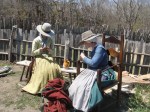
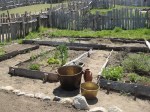
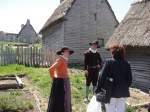
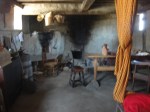
My ancestors attended the first Thanksgiving party in Plimouth Colony. Most of my heritage is English, and the Mayflower was full of my peeps. My 11th great-grandfather attended the feast as a representative of the Wampanoag people. When he first met the Pilgrims they gave him alcohol , which must have aroused his curiosity. The political system in New England was way different from the one in Europe. The local natives made friends with the Pilgrims with reservations (not the kind they have been granted by the US government). They had made contact with Brits before which had resulted in an outbreak of disease that killed a large number of the people. They saw the Mayflower, but kept a distance since they assumed these Brits would be diseased as well.
Quadequina is credited with bringing popcorn to the first Thanksgiving. The Wampanoags I met in Plymouth this year told me it was actually parched corn. Either way, there was a potluck dinner and Quadequina brought corn as his dish. He acted in good faith, was a respectful and polite guest, even allowing the Pilgrims to occupy his homeland and build a fort around their town. It was fairly impossible for the American natives to do due diligence on these religious Pilgrims who had arrived and planned to stay. Squanto, the famous translator, was about all the interface available. The Natives of New England were stuck with this highly unnatural situation through no fault of their own. They just happened to be where the Mayflower got stuck on the rocks. It was their luck.
When my 10th great-grandfather Gabriel Wheldon wanted to marry Quadequina’s daughter he gave his consent and helped the couple avoid disaster from the Pilgrims:
Gordon B. Hinckley, Shoulder for the Lord” by George M. McCune page 35- ” Two of the early immigrants to Plymouth colony were Gabriel Wheldon, of Arnold, Nottingham, England, and his brother (name unknown). Gabriel had been married in England before sailing to America but his first wife named Margaret evidentally was deceased at the time of his migration. Both brothers had a free spirit much like Stephen Hopkins and found their way to the camps of the Wampanoags. There they both fell in love with two of the daughters of chief Quadequina, younger brother of the Great Chief. They each married and Gabriel gave his second wife the English name ‘Margaret’ after his first spouse. The two counseled with their father-in-law and his older brother Massasoit regarding what to do. The Plymouth Colony would probably punish them for their intermarriage. Massasoit advised them to return to the colyn and all would be well. The Plymouth Colony tribunals saved face by banishing the couples from Plymouth for life but did not send them back to England. Gabriel and Margaret established their home in Barnstable where the Hinckleys came in late 1630’s and here Gabriel and Margaret raised a large family of girls. One of these was Catherine “Catone” Wheldon who married Stephen Hopkins'(First to build a house in Mattachesse Villiage/Yarmouth) oldest son Giles on October 9, 1639. Giles had been given the home his father had build in Yarmouth and the couple established their home and raised four children there. When Giles’ father Stephen passed away about July 1644, his father left an estate.. Some records give Margaret as the wife of Gabriel Wheldon. It seems she was his second wife, who, after his death, may have returned to England with Rev. Marmaduke Matthews and his wife. Other records state that Margaret was an Indian Princess, Wampanoag, and give her lineage for several generations. He _may_ have been Margaret’s brother. He immigrated 1638, aPreacher of the Church of Malden. He returned to England in 1655, and Several of the Malden Church members went with him. Of these returning pilgrims, the widow Margaret Wheldon, who left a law-suit over the estate of her deceased husband, Gabriel, also went to England. (from: Pg 155 The History of Malden, Massachusetts, 1633-1785). Rev Matthews died 1683 in England.
I don’t believe he is partial to either pecan or pumpkin pie. I think Quadequina would have liked to see us celebrate equal rights and justice each November. The story of Thanksgiving is mostly mythical, since very little was recorded at the time. Turkeys may not be the best logo for American seasonal gratitude. Popcorn deserves a place at the table.
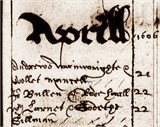
marriage record

coat of arms (with leg)

Goodith’s grave
My 12th great-grandmother arrived in Massachusetts Colony before 1632, and joined the church in Charlestown with her well respected husband. Her unusual first name is often misspelled in records, but it is an old English name.
Note: From “The Great Migration Begins…”: :’Goodith’ was a distinct given name, not to be confused with ‘Judith’, and not to be interpreted as ‘Goodwife,’ as has been done. “The Winthrop Society shows Goodith’s birth as circa 1585 and death as before 1632.
Judith Gillman was also known as Goodith Gillman. She was born in 1594 at Bermondsey, London, England. On 22 April 1606 at St. Olive, Southwork, Surrey, England, Judith married William Learned. Judith Gillman and William Learned were admitted to the church on 6 December 1632 at Woburn, Middlesex County, Massachusetts. Judith Gillman died on Friday, 24 June 1661 at Malden, Middlesex County, Massachusetts, at age 67 years.
[S466] Ancestral File. Family History Library, Salt Lake City, Salt Lake County, Utah, 1994. [S14] Wyman, Thomas Bellows. The Genealogies and Estates of Charlestown, Massachusetts 1629-1818. 1879. Reprint Somersworth, New Hampshire: New England History Press, 1982.
WILLIAM LEARNED d. Woburn, MA 1 Mar 1646, m. GOODITH GILMAN, d. 24 Jan 1661.
William Learned came from Bermondsey, Surrey, England and settled at Charlestown in the Massachusetts Bay in or before 1632, possibly in 1630 with the Winthrop fleet. He and his wife Judith were admitted to the First Church of Charlestown on Dec. 6, 1632, their names being the first two on the list of members. “1632, 10 mo., day 6, William Learned and Goodeth, his wife, were admitted”, being the first admissions after the separation from the Boston Church. He became a freeman on May 14, 1634 and a Selectman on Feb. 13, 1635-6. On March 2, 1637 he was chosen one of four to divide, for stinting, the common land, and on Feb. 12, 1637-8 he and Mr. Greene were appointed to settle the wages of the school-master.[2] On April 26, 1638 William Learned and five others were on a committee “to consider of some things tending toward a body of laws”
William was a subscriber to the town orders for Woburn, drawn up at Charlestown Dec. 18, 1640. In 1641 William moved to Woburn where he was one of the seven original members of the church on August 14, 1642. He was chosen constable April 13, 1643 and Selectman of Woburn in 1643 and 1645. These offices were only given to trusted and respected men.
Goodith Gillman (1592 – 1661)
is my 12th great grandmother
Sarah Learned (1604 – 1652)
daughter of Goodith Gillman
Mary Ewer (1637 – 1693)
daughter of Sarah Learned
Mehitable Jenkins (1655 – 1684)
daughter of Mary Ewer
Isaac Hamblin (1676 – 1710)
son of Mehitable Jenkins
Eleazer Hamblin (1699 – 1771)
son of Isaac Hamblin
Sarah Hamblin (1721 – 1814)
daughter of Eleazer Hamblin
Mercy Hazen (1747 – 1819)
daughter of Sarah Hamblin
Martha Mead (1784 – 1860)
daughter of Mercy Hazen
Abner Morse (1808 – 1838)
son of Martha Mead
Daniel Rowland Morse (1838 – 1910)
son of Abner Morse
Jason A Morse (1862 – 1932)
son of Daniel Rowland Morse
Ernest Abner Morse (1890 – 1965)
son of Jason A Morse
Richard Arden Morse (1920 – 2004)
son of Ernest Abner Morse
Pamela Morse
I am the daughter of Richard Arden Morse
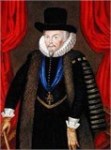


John Neville, 3rd Baron Neville de Raby
John Neville Baron Neville de Raby Spouse (s) Maud Percy
Elizabeth Latimer, 5th Baroness Latimer Issue Ralph Neville, 1st Earl of Westmorland
Thomas Neville, 5th Baron Furnivall
Elizabeth Neville
Alice Nevile
Maud Neville
Eleanor Neville
John Neville, 6th Baron Latimer
Elizabeth Neville Noble family House of Neville Father Ralph Neville, 2nd Baron Neville de Raby Mother Alice Audley Born 1328 Died 17 October 1388
John Neville, 3rd Baron Neville de Raby, KG (1328 – 17 October 1388) was born at Castle Raby, County Durham, England to Ralph Neville, 2nd Baron Neville de Raby and Alice de Audley. He fought in the Battle of Neville’s Cross on 17 October 1346 as a Captain in his father’s division. He was Knighted in 1360 and after his father’s death in 1367 he succeeded to the title of 3rd Baron Neville of Raby. In 1368 he served as the English ambassdor to France. He was Admiral of the King’s fleet and served in the wars against the Scots and French. He was made a Knight of the Garter in 1369. Neville married Maud Percy, daughter of Henry de Percy, 2nd Baron Percy and Idoine de Clifford. After Maud died in 1379 John married a second time to Elizabeth Latimer, daughter of William Latimer, 4th Baron Latimer.
Children
Six children by Maud Percy
Ralph de Neville, 1st Earl of Westmorland (1364–1425)
Thomas de Nevill, 5th Baron Furnivall (1377–1406)
Elizabeth de Neville (b. 1379)
Alice de Nevile (1379–1433)
Maud de Neville (b. 1379)
Eleanor de Neville (1379–1441), married Ralph de Lumley, 1st Baron Lumley. They were parents to Catherine de Lumley.
Two Children by Elizabeth Latimer
John de Neville, 6th Lord Latimer (1382–1430)
Elizabeth de Neville, Baroness Latimer (b. 1388)
Baron Percy
References
thePeerage.com Accessed May 13, 2007
Peerage of England Preceded by
Ralph Neville Baron Neville de Raby
1367–1388 Succeeded by
Ralph Neville
 mermaidcamp