mermaidcamp
Keeping current in wellness, in and out of the water
You can scroll the shelf using ← and → keys
You can scroll the shelf using ← and → keys

Colonel Augustine Warner II (1642-1681)
Colonel Augustine Warner II succeeded his father and became political friends with Nathaniel Bacon, who was educated at Oxford and a Barrister in London. Bacon staged the first actual American Revolution in 1676, as he organized an army of three hundred to four hundred pioneers to cope with the Indians North of the York River. He was involved in a private fur deal spanning the entire Virginia frontier. By the end of the decade, Bacon’s troops had taken care of all the Indian tribes. They marched on Jamestown as Governor William Burkeley fled, and sailed to the Eastern Shore. Nathaniel Bacon and his troops soon set up their headquarters at Warner Hall after the burning of Jamestown in 1676. This Virginia Colony was in charge of matters North of the York to the Potomac River. Beyond the Potomac, lay the Maryland Colony. It was at Warner Hall, where he sent notices for the people to assemble to take the “Oath of Fidelity” of his fellow countrymen. Bacon contracted Malaria and died within a year his troops then fleeing the Colony.
Augustine Warner II inherited Warner Hall at the death of his father in 1674. He married Mildred Reade, the daughter of George Reade, founder of Yorktown, and after her death, Elizabeth Martian. Augustine II was speaker of the House of Burgesses during Bacon’s Rebellion in 1676, and also was a member of the Council.
When Augustine Warner II died, he left three daughters his son dying June 19, 1681. Mary became the wife of John Smith, of Purton, on the York, and their son Augustine Smith was said to have been one of the Knights of the Golden Horseshoe with Governor Spotswood, on his famous expedition across the Blue Ridge in 1716. Mildred, another daughter of Augustine Warner II, married Lawrence Washington, of Westmoreland, and her second husband was George Gale. Her three Washington children were John, who built Highgate, Augustine, father of George Washington (first President of the United States), and Mildred. Augustine Washington married Mary Ball, and named his son George for his great grandfather, George Reade, who founded Yorktown.
Elizabeth, the third daughter of Augustine Warner II, became the wife of John Lewis and inherited Warner Hall. Their son, John Lewis II was a member of His Majesty’s Council, and was prominent in the county. For generations the Lewises lived here, and members of the family emigrated to all parts of the United States. Their descendants built Belle Farm, Eagle Point, Abingdon, Severby, and Severn Hall, all in Virginia. Elizabeth and John Lewis I’s grandson, Colonel Fielding Lewis, of Belle Farm, married Catherine Washington, and after her death married Elizabeth Washington, also known as Betty, sister of George. He built beautiful Kenmore for her, in Fredericksburg.
Ideally situated at the head of the Severn River in Gloucester County, the manor house at Warner Hall stands on a neck of land that has been occupied and built upon continually from the mid-17th century. Referred to as “Austin’s Desire” in the 1642-land patent, the original six hundred-acre plantation site was established by Augustine Warner as a “land grant” from the British Crown. Augustine Warner received the acreage in exchange for bringing twelve settlers across the Atlantic Ocean to the Jamestown Settlement, a colony desperately in need of manpower to survive in the New World.
The two families associated with the property from this early period until well into the 19th century, the Warners and the Lewises, were among the most prominent families in Colonial Virginia. Over the years, Warner Hall Plantation thrived, as did the descendants of Augustine Warner. Some of the most recognized names in American history are direct descendents of Augustine Warner – George Washington, the first president of the United States, Robert E. Lee, the most famous Civil War General and Captain Meriwether Lewis, renowned American explorer of the Lewis & Clark expedition. George Washington was a frequent visitor to his grandparent’s plantation.
Queen Elizabeth II, the current monarch of England, is a direct descendent of Augustine Warner through the Bowes-Lyon family and the Earl of Strathmore. In England, Warner Hall is referred to as “The home of the Queen’s American ancestors”. In 1957, in conjunction with her trip to Jamestown, VA, for the 350th anniversary of the settlement, Queen Elizabeth II visited Warner Hall Plantation. The Queen was photographed placing a wreath on the grave of Augustine Warner.
Warner Hall is also significant for the part it played in the drama of Bacon’s rebellion, one of the most important events in early Virginia history. After leading a 1676 rebellion against the British governor and burning Jamestown, Bacon retreated to Warner Hall Plantation. At the time, Augustine Warner II, who was Speaker of the House of Burgesses and a member of the King’s Council, was in residence and very likely agitated that his plantation was taken over by opponents of the Crown.
Today, Warner Hall consists of a Colonial Revival manor house (circa 1900) which was rebuilt on the earlier 17th and 18th century foundation. Like the previous structures at Warner Hall, all of which indicated the prominence of their owners, the Colonial Revival core is a grand architectural gesture. The original 17th century west wing dependency (the plantation schoolroom and tutor’s quarters) has been completely restored and offers a rare glimpse into the past. Historic outbuildings include 18th century brick stables, a dairy barn and smokehouse. The Warner-Lewis family graveyard, maintained by the Association for the Preservation of Virginia Antiquities, offers a remarkable collection of 17th and 18th century tombstones.
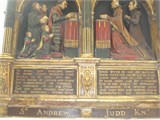
Sir Andrew Judde
My 14th great grandfather founded a famous school in Tonbridge in 1553. He was a trader, a risk taker, and an obvious negotiator. He was the Lord Mayor of London. He was a very wild thing. My father’s tree has many educators in the branches.
Andrew Judde** (1512 – 1586)
is my 14th great grandfather
In 1509 London apprenticed to John Buknell, “a Skinner and Merchant of the Staple of Calais” for 8 years. 23 Mar 1517 First evidence of him as Merchant of the Staple, so released at least a little early from his apprenticeship. On this date he paid the duty for a cargo of wool shipped to Calais. “Thereafter his name occurs frequently“.
In 1520 “took up his freedom as a member of the Skinners’ Company” London. 1520-1521 Fraternity of the Assumption of Our Lady, London; paid 4 shillings “entry money“; high on their list 1524. 1522-1523 Fraternity of Corpus Christi, London; “the account books of the Skinners show … that Andrew Judde paid 20 shillings on becoming one of the ‘Newe Brethern'”.
Mary Mirfyn was born circa 1521. Married Sir Andrew Judde in 1537, London. Died 14
Nov 1550. “Her funeral is entered both in Wriothesley’s Chronicle, and in Machyn’s Diary, both of which have been published by the Camden Society“.
In 1523 London co-executor of his father-in-law’s will with Mirfyn‘s own son. 1533 Master of the Skinners’ Co “and five times thereafter“. Merchant of the Staple of Calais. 12 Jul 1541 Alderman from this date ward of Farringdon without, London. Widowed before 1542? Had had five children with Mary; 2 not in his will. Married Agnes / Annys (—-) in 1542 London; 2nd wife, no children, nothing more known. In 1547 Treasurer of St Bartholomew’s Hospital, London, when it was remodelled. “Certainly one of the richest and most prominent of overseas merchants in early Tudor London“. 1550 Lord Mayor of London: “he had to deal with the problems caused by dearth and by the 1551 ‘calling down’ of the coinage“. One dau. survived from the 3rd marriage. In May 1553 Tonbridge School obtained letters patent for the erection of a free school with the Skinners’ Company as trustees. One of the Aldermen who signed the device of King Edward VI. In Sep 1555 Staple Inn, London, Felipe of Spain (consort of Queen Mary) passed the night at the Staple Inn, and “Sir Andrew presented the King with a purse containing a thousand marks in gold“. Circa 1556 Skinners Hall, London, Judde and Sir John Champneys donated money for the ceiling of the hall, and the Skinners had the arms of both carved as ornaments for the hall. Between 1556 and 1558 “At this time Sir Andrew was buying manors at Ashford and places adjoining from Sir Anthony Aucher, soon to lose his life at Calais. This estate passed to his daughter Alice and so to her son Sir Thomas Smyth, who in his turn was a benefactor of Tonbridge School“.
1557 and 1558 “Surveyor-general of all the London hospitals” London.
Before 1558 Resided at Eshetisford – Essetisford – Ashford, Kent. Will London; “Sir Andrew Jud, skinner, mayor 1551, erected one notable free school at Tunbridge in Kent, and alms houses nigh St. Helen’s church in London, and left to the Skinners lands to the value of 60 pounds 3 shillings and 8 pence the year; for the which they be bound to pay 20 pounds to the schoolmaster, 8 pounds to the usher, yearly, for ever, and four shollings the week to the six alms people, and 25 shillings and 4 pence the year in coals for ever“.
Buried Sep 1558, St Helen’s Bishopsgate, London. Probate Mar 1558 – 1605 Prerogative Court, Canterbury, Kent, Ref. 58 Noodes, 54 Welles (“De bonis non adm.”) grants, March 1558-9 & Aug 1605. Properties in St. Helene, London and Eshetisford, Kent, “etc.”
Sir Andrew, Six Times Master of the Skinner’s Company
Six times Master of the Skinners’ Company, Mayor of Calais and of London, Merchant Adventurer and Knight, Sir Andrew Judde was a man who took financial risks, grew wealthy and founded in Tonbridge one of the foremost public schools in England.
The Judde arms, with boars’ heads, and Skinners’ Company arms, with ermine, are displayed above the Porter’s Lodge entrance to Tonbridge School.
Judde (also often spelt Judd) was born about 1492, the youngest son of a significant Tonbridge landowner John Judde, whose lands were mainly to the south of the Medway, including Barden Park. His elder brothers inherited most of the estate, so Andrew went to London to seek his fortune. He was apprenticed between 1511 and 1517 to John Buknell, a man involved in both the fur trade, as a member of the Skinners’ Company, and the wool trade as a merchant of Calais – then a strategic port in English hands. Kentish wool was exported there and bought by foreign buyers, so that merchants of the ‘staple’, as Judde became in 1517, benefited from the profits in trade and in currency exchange.
Wool was not the only commodity traded through Calais. Sir Andrew’s name was also linked to trade in gold dust from Guinea, imports of oil and later also the fur trade with Russia. In 1533 he became Master of the Worshipful Company of Skinners, an annual post he was to hold six times. In 1550 he became Lord Mayor of London, when he was involved in a variety of problems ranging from the high price of larks to cases of treason. He was knighted by Edward VI at Westminster in the following year.
In his public life Sir Andrew attracted the favour of both Edward VI and Queen Mary despite the swing from Protestantism to Catholicism, through his overriding loyalty to the Crown. In spite of being nominally a Protestant, in Mary’s reign he was active in defending the city from Wyatt’s anti-Catholic rebellion.
The original building of Judde’s ‘Grammar School’ in Tonbridge, viewed from the High Street, as it was in 1836. (THS 12.003)
In 1553 there were two exciting developments in the life of Sir Andrew Judde. The first was that he received a charter from Edward VI to found a school in Tonbridge. Perhaps wishing to invest some of his wealth for the benefit of the town in which he grew up, he bought 30 acres of pasture land known as ‘sand hills’ just to the south of St. Pancras in London. The rents from this land were to provide funds for the new Tonbridge School, raising the sum of £13: 6s and 8d in 1558. Later, as this land was developed for housing the rents increased substantially, enabling the Skinners’ Company, who took over the management of the charity and governorship of the school on Sir Andrew’s death, to add to the Judde foundation a Workhouse (1720) and three more schools, including the Judd School in Tonbridge (1888) and Skinners’ School in Tunbridge Wells (1887).
The original foundation stone of Tonbridge School has been preserved and is now mounted above the Headmaster’s Entrance.
At its foundation, Tonbridge School was to be free, boarding and a grammar school. The last condition meant that the ‘three tongues’ of Latin, Greek and Hebrew should be taught. Another condition was that the school should be close to the Parish Church for regular worship and as Sir Andrew did not own land near enough, it is thought that he rented or bought land from his nephew Henry, who had just inherited land called ‘Houselands’ close to the centre of Tonbridge. The school opened there in 1553 with just 16 pupils, but now there are a total of about 3,200 children educated in Skinners’ Company schools.
The second important event in 1553 was the despatch of an expedition by the Merchant Adventurers Company of London, of which Sir Andrew was a prominent member. He and others financed the expedition to look for a north east passage through the Arctic to Asia, and to find new markets for English wool. Two of the three ships were lost near Lapland, but the third drifted by accident into the gulf of Archangel and its captain, Richard Chancellor, went on to make the difficult overland journey to Moscow to meet the tsar, Ivan the Terrible. He had with him a letter from the King and from that year the trade with Russia began and the Muscovy Company was created. Richard Judde, Sir Andrew’s son, was with Chancellor on his second expedition to Russia. On that occasion two of the four ships were lost which, with the first expedition, amounts to a less than fifty per cent rate of success. It was a risky enterprise but expeditions continued to be financed by the Company in which Sir Andrew played a leading role, and before long strict rules were drafted to improve safety and therefore the success of the expeditions. One expedition, to Guinea, brought back a rare trophy, the head of an elephant, which Sir Andrew kept in his house to show to visitors.
Sir Andrew Judde died in 1558 and was survived by his third wife, Mary, four sons and two daughters. He is buried in St. Helen’s Church on Bishopsgate in London, and a memorial there, thought to be commissioned by his heirs in about 1600, describes some aspects of his life. It is not thought to be very accurate since, because of his public duties, he never visited Russia and Guinea himself, though he was closely involved in the finance and organisation of expeditions there. The epitaph reads:
TO RVSSIA AND MVSCOVA / TO SPAYNE GYNNY WITHOVT FAYLE / TRAVELD HE BY LAND AND SEA / BOTHE MAYRE OF LONDON AND STAPLE / THE COMMONWELTHE HE NORISHED / SO WORTHELIE IN ALL HIS DAIES / THAT ECH STATE FULL WELL HIM LOVED / TO HIS PERPETVAL PRAYES
THREE WYVES HE HAD ONE WAS MARY / FOWER SUNES ONE MAYDE HAD HE BY HER / ANNYS HAD NONE BY HIM TRVLY / BY DAME MARY HAD ONE DOWGHTER / THVS IN THE MONTH OF SEPTEMBER / A THOWSANDE FYVE HVNDRED FYFTEY / AND EYGHT, DIED THIS WORTHIE STAPLAR / WORSHIPYNGE HIS POSTERYTYE
In addition to the Judd School, and Judd House at Tonbridge School, Sir Andrew’s name is commemorated by Judd Road in Tonbridge and Judd Street on what is now the Skinners’ Company Estate in St. Pancras.
Copies of An Essay on the Life of Sir Andrew Judde (1849) by George Maberley Smith and Sir Andrew Judde (1953) by H. S. Vere Hodge are in the Local Studies Collection at Tonbridge Reference Library.

Sir THOMAS
My 13th great grandfather pissed off the Tudors several times. It appears that the customs office of the queen was privately held somehow, like outsourcing. Elizabeth I gave him the job of collecting customs fees, but he was taken to court for shortages more than once. His son, Sir Thomas Smith was instrumental in colonizing the world from the British Isles. Just like my mother’s Taylors, these Smiths marry some other Smiths down the line, just to keep everyone guessing.
Sir Thomas SMITH was born 1522 in Weston Hanger, Kent Co, England. He died 7 Jun 1597 in Kent, England. Sir married Alice JUDDE on 1554 in Weston Hanger, Kent Co, England
The Harris and Smith families were interested in the discovery and development of Virginia. He is referred to as “Customer” Smith and rose from obscurity in Queen Elizabeth’s time by marrying the daughter of Sir Andrew Judd, the Lord Mayor, of humble origins himself. THOMAS SMYTHE of Corsham, Wiltsbire, England was born in 1522 and died 7 June 1591 leaving a will. He married ALICE JUDDE, daughter of Sir ANDREW and MARY Mirfyn/Mervyn JUDDE. “Item. I give and bequeath to the children of my sonne in law, WILLIAM HARRIS, Esquire,BR> which he hath or shall beget uppon the bodie of my daughter ALICE, his wife, the like somme of five hundred and fiftie pounds to be equally divided between them. And if any of them shall fortune to decease, then the parts and portion of such as shall decease to remayne and be paid and divided indifferently between the Survivors of them.”
27. Alice JUDDE was born 1535 in Weston Hanger, Kent, England. She died 1593 in England.
ALICE (Judde) SMYTHE, widow of THOMAS, dau of ANDREW and MARY JUDDE, left a will dated 10 July 1592 London, proved 1598 in Prerogative Court of Canterbury. “Item. I bequeath to my daughter HARRIS my Jewell Ringe, an of Diamonds, A table cloth of Damask of the Story of Samyell conteyn inge five yeards in length, A doble Lowell and two dozen of napkins and two chayres of crymson silk taffeta. “Item. I give to her sonne THOMAS HARRIS twentie pounds, and to Arthur, her sonne, tenne pounds to be paid at theire ages of twentie and one yeres. “item. To her daughter Al ice, twentie pounds, And to her daughter Dorathie tenne pounds to be payde to the same daughters at their marriages or ages of twentie and one yeres, whichsoever of the same time shall first happen.”
There are many records of my 10th Great Grandfather who ran away as soon as he got to America:
Gabriel Wheldon and brothers deserted ship at Plymouth. To escape punishment and being sent back to England in chains, they went inland to Massasoit’s village at Po ko net, and took to wife a daughter of a brother of Massasoit, although he had a wife in England. After children were born through the good offices of Massasoit and the English at Plymouth not wishing to offend him, consented to try Gaberial and his brothers at the Plymouth court.He was sentenced to dwell at Mattachees on land that was ceded by HighYannough at the request of Massasoit in lieu of certain annual tribute paid Massasoit by the Cape Tribes. One of Gabriel’s brothers went back to England and Gaberial and the other brother stayed in the Colonies. It was many years before Gaberial was made a freeman, and he had to go outside the jurisdiction to become one.
The first known Whelden in the line in America was Gabriel Whelden of Plymouth. He is believed to have been born in England, but the date and place are not proven. It is commonly stated that Gabriel Whelden originated in Nottinghamshire, but no records have been found to substantiate it. The author Pope reports he found a record of a land sale in Middlesex county files where Gabriel in 1653 sold land he owned in Nottingham to William Cross. The head archivist of these records, Elizabeth Bouvier has been unable to find any such record.
The Wheeldon/Wheelton family, which has not yet been connected to Gabriel Wheldon, finds the earliest spelling located to-date is Whyldon (christenings of sons of William Whyldon at Astbury, Cheshire: Matthew, 14 Dec 1574; John 14 Mar 1584; per LDS IGI ). In “Homes of Family Names in Great Britain”, Baltimore, MD: Genealogical Publishing Company, 1968) H. B. Guppy noted that the surname Wheelton as “peculiar” or “confined mostly to this county [Cheshire].” He indicated it was more specifically associated with Macclesfield. The surname is concentrated in the ancient Parish of Prestbury, which originally included Macclesfield. Additionally, “pockets” of Wheeldon ~ Wheelton individuals settled in the Cheshire / Derbyshire / Staffordshire border area known as “The Potteries.”
Was Margaret (Oguina) a Wampanoag?
Gabriel married Margaret Diguina (or Oguina), who may have been Gabriel’s second wife. Some say that Margaret was a Wampanoag Indian, although it is hotly disputed by many genealogists. Accordig to the Wampanoag theory Oguina was a child of 6 years in 1608 when a British fishing vessel picked her up along with other Wampanoags along a beach on Cape Cod. She was taken to England where she baptized and given the English name Margaret. She eventually married Gabriel Whelden.
Oguina was a daughter of Quadequina who in turn was a son of WAasaneginN. These geenrations were of the Algonkian nation of Massachusoi and tribe of Wampanoag.
Oguina’s descent is as follows:
1- WASANEGIN, born by 1554 begot 2-QUADEQUINA, born 1576. This year is determined from the fact that he was born in the year when the “Great Light” went out. European astronomers noted in 1576 that there was a Solar Eclipse. He, QUADEQUINA begot 3-OGUINA, born 1602 @ Wampanoag village in what is today Rhode Island.
Gabriel Whelden and Margaret (Oguina) had the following children:
Gabriel died January 1653/1654 in Malden, Massachusetts. Following is his Last Will and Testament:
In the name of God, and in obedience to his comand (according to my bounden duty) I, Gabriell Whelding, of the Towne and Church of Maulden, being weake and sicke in body, do make my last will. My body to be layd asleepe in the bed of the grave, in the Common buriing lace for the Inhabitants of this Towne. I give 10s as a Small testimony of my true Love to the Church of Maulden, to be payd into the hands of the Deacons within a month after my decease. i give all my estate in Maulden, consisting of house, Frame Lands, cattle, and corne, (together [with] what money is due unto me from William Croffts, of Linne, to Margaret Whelding, my wife, who I appoynt my sole executrix.
In the presence of: Nathaniell Vphame, James Larnard, Michaiah Mathews, with others.
The part that seems far fetched to me is that Margaret was taken to England as kidnapped child. However, a recent piece of good luck on this very blog has introduced me to a fellow descendant, Ron Turner, who has more information about the story. The clues are many, and my interest could not be higher.
My 9th great grandfather Richard Taylor, the tailor, of Plymouth Colony was described by an unknown source:
Richard was born in Europe and was three times the age of his wife, Ruth Wheldon. Ruth was ½ blood Wampanoag Indian, born at Yarmouth, daughter of Gaberial Wheldon and his wife Margaret, a full blood Wampanoag Indian. Margaret was the daughter of a Wampanoag Sagamore, a younger brother of Massasoit.
Richard TAYLOR (abt. 1620-1673), “tailor” Early settler of Yarmouth, Plymouth Colony. Not to be confused with his (possibly slightly younger) contemporary, also of Yarmouth: Richard Taylor (abt 1625-1703), farmer or husbandman of “The Rock”. Both were supposedly married to women by the name of Ruth. Vital statistics
Sex: Male
Born: about 1620 at England
Died: about 13 December 1673 at Yarmouth, Plymouth Colony, age at death unknown.
Interment: Probably at Yarmouth, Plymouth Colony
Richard Taylor’s origins and emigration are unknown. (But see below.)
Several histories and genealogies claim that Richard Taylor, tailor, married Ruth Whelden (abt 1625-1673), daughter of Gabriel Whelden, and that she was the “wife of Richard Taylor”, whose body was found in a boat, drowned, off Duxbury, MA about 3 December 1673. HOWEVER, the inquest records concerning the drowning do not provide her given name at all. They simply identify the body as “the wife of Richard Taylor, sometimes of Yarmouth.” This researcher (Jillaine 16:14, 28 July 2007 (UTC)) believes it’s just as likely that Ruth Whelden was married to Richard Taylor of the “Rock”– and that it is just as likely that the “Ruth, wife of Richard Taylor” who died in 1693 was the daughter of Gabriel Whelden. Older genealogies say that Richard “the Rock” Taylor was likely married to Ruth Burgess, but this has never been proven. So we have no proof of the name of Richard Taylor, tailor’s wife; but we do know that Richard Taylor, the “Rock” did have a wife Ruth who died in 1693.
Offspring
Ruth Taylor, b. July 29, 1647; buried in 1648.
Ann Taylor, b. Dec. 2, 1648; buried March 29, 1650, aged about 1-1/2 years.
Mary Taylor (1649-??), m. [Abijah Merchant (1651-?)]].
Martha (1650-1728), b. Dec. 18, 1650; m. Joseph Bearse of Barnstable Dec. 3, 1676; d. Jan. 27, 1727-8, aged 77, leaving issue.
John Taylor (1652-1721), m. 15 December 1674 Sarah Matthews, daughter of James Matthews.
Elizabeth Taylor (1655-1721), m. Dec. 20, 1680, Samuel Cobb (1651-?) of Barnstable; d. May 4, 1721, aged 66, leaving issue.
Hannah Taylor (1658-1743), m. as his 2d wife July 19, 1680, Deacon Job Crocker of Barnstable; d. May 14, 1743, in her 85th year, leaving issue.
Ann Taylor (1659-?), m. Josiah Davis, of Barnstable, June 25, 1679, and had issue.
Joseph Taylor (1660-?)
Sarah Taylor (?-1695); d. unmarried July 31, 1695. The inventory of Sarah Taylor of Barnstable was taken Aug. 16, 1695, and amount to £34 19s. Deacon Job Crocker and Samuel Cobb, brothers-in-law, were made administrators Sept. 23, 1695. The estate was, Sept. 13, 1695, ordered equally divided between the brothers and sisters of the deceased, given in the following order, to wit: John Taylor, Joseph Taylor, Mary Marchant, Martha Bearse, Elizbaeth Cobb, Hannah Crocker and Ann Davis. The inventory consisted of wearing apparel, five pounds of worsted yarn, a Bible, cattle, sheep and lambs, cash moneys due from Samuel Cobb and Joseph Bearse, &c.
Biography
The biographical information listed below could apply just as easily to Richard Taylor, the “Rock” with the exception of the 1674 will.
Early life and education Edit
There was a Richard Taylor, age 16, on the ship Truelove which departed Gravesend, England on 11 Jun 1635. Other Taylors on that ship were: James Taylor, 28; William Taylor, 17; Ann Taylor, 24.
Military service
1643 (August): He is first mentioned in the Colonial records as among those in Yarmouth between 16 and 60 years of age able to bear arms.
Career Edit
1648 (June 7): was a surveyor of highways for Yarmouth.
1651 (June 6): was sworn as a member of the grandjury.
1656 (May 30): with Edmond Hawes, Richard Taylor was witness to a deed of Samuel Mayo to John Phinney of Barnstable.
1656 (June 3): he was constable of Yarmouth.
1657 (June 3): he was one of the surveyors of highways there. That year he took the oath of fidelity.
Family life
1647 (Oct 28): Gabriel Whelden gave his assent for one Richard Taylor (many believe this one, but without documentation) to marry his daughter, Ruth Whelden.
1655 (May 28; July 27): Richard Taylor, tailor, among others suing widow Margaret Whelden, for a share of the estate left by Gabriel Whelden.
1673 (Dec 3): Richard’s wife, not named, was discovered drowned in a boat off Duxbury. Richard died within a couple of weeks.
Will of Richard Taylor Edit
(Source: James W. Hawes, “Richard Taylor, Tailor, and Some of His Descendants” in ‘Library of Cape Cod History & Genealogy’, No. 48, 1914.) (Transcribed with original spelling maintained.)
The Court (March) 4, 1673-4, made the following order:
“Mr. John Gorum and Mr. John Thacher are joyned with John Taylor ( for the disposing of the estate of Richard Tayler to his children, and for the paying and receiving of debts according to order of Court. Concerning the estate of Richard Tayler, late of Yarmouth, deceased, this Court doth order, first, that the eldest son of the said Tayler shall have his fathers housing, and two thirds of the land, both upland and marsh, and the rest of his portion out of what of the estate Mr. Gorum and Mr. John Thacher shall judge most suitable for him, hee being by order of Court to have a dubble portion. 2condly, it is ordered, that the hay, and what provisions was or is upon the invoice of the estate that is now spent, or shalbe judged convenient for the family to spend betweixt this and the first of the next August, shall not be accounted to the estate, as like-wise what woole and flaxe hath bing spon by the daughters sence theire parents death shalbe accompanted theirs that spon it. The rest of the estate to be devided betweixt the second son and the five daughters, everyone an equall proportion, to bee set out to them as maybe most suitable for them, by the discretion of their eldest brother, and Mr. John Gorum, and Mr. John Thacher. The second son to have the other third of his father’s land, besides his portion equall to his sisters. Lastly, that nothing that hat bin already given or betowed by the said Taylor on any of this children, shall not be considered in the devision, but everyone of to have an equall proportion, after the payment of debts due from the estate.”
His inventory taken Dec. 13, 1673, and submitted to the Court under oath March 6, 1673-4, amounted to L199 4s 11d. The debts of the estate were L18 1s. 2d. Included in the inventory were 12 acres of upland, nine of meadow and three of marsh, which together with houses and some grain sown amounted to L60. The children named are John, Joseph, Martha and Mary. The inventory shows that he possessed a considerable many cattle, shep and hogs, one horse, corn, wheat, flax, provisions, 21 yards of cloth, lumber and household articles. There were due to him 38.5 barrels of tar, and John Blake of Boston owed him money. Some things had been given to the children in his life time.
Contributors:
Jillaine
Sources:
Richard Taylor, Tailor and Some of His Descendants, by James W. Hawes; C.W. Swift, publisher, Yarmouthport, Mass.: 1914.
Barnstable Probate Records
Plymouth Colony Records, Volume 5; pp. 122-123
Plymouth Colony Wills
NEHGS Register, Volume 3, 1849, p. 189 citing CR, Volume II, p. 18
NEHGS Register, Volume 4, 1850, p. 258.
NEHGS Register, volume 14, 1860, p. 354
The history of Cape Cod : annals of thirteen towns of Barnstable County, p. 182; p. 193.
History of Barnstable County, Massachusetts, edited by Simeon L. Deyo. 1890. New York: H. W. Blake & Co.; CHAPTER XVII, pages 453-506. Town of Yarmouth, by Hon. Charles F. Swift.
James Savage, Vol. IV, p. 263
Torrey, Clarence Alman, New England Marriages, Genealogical Publishing Co., 1985; p. 730
Court Files of Middlesex County, Mass., 1649-1675 (through NEHGS web site)
Middlesex Court Files Folio 11; HLS #409 and 411.
History of Yarmouth, 1884, p. 88
black sheep in dreadlocks
When a family member does something disgraceful or distasteful the general way it is handled is by denial. The person who commits suicide or bigamy or general black sheepery is dropped from the story. Three of my grandfathers, fall into this category. My paternal great-grandfather, Edward Ewing Scott, married another woman while he was married to my great-grandmother who had 4 young daughters at home. My other paternal great-grandfather , Jason A Morse, was referred to as a bum, had a wild Cherokee wife purported to be a witch (after his boy’s mother died), and was never mentioned favorably to me. I very recently have seen his picture which was sent to me by a cousin. My mother’s father, George H Taylor, killed himself at home leaving his 10 kids orphaned during the depression. I have never seen a picture of George H, and did not know about his suicide until I was a teenager. One of my first cousins had a very elaborate suicide downtown Houston in the 1960’s which brought the subject back to light. I remember thinking how weird it was that nobody had ever told me. His wife, my grandmother, had died at home as well, in childbirth. I knew about that, but not his suicide. This denial makes it very hard to find information about the black sheep and how they blackened themselves.
This is your shadow family. This is the information that has specifically not been given to you in an effort to protect you in some way. This is the nature that is hidden in an effort to improve the self-image of the family through spin. Everyone wants to believe that his or her family represents the best and most worthy genetic material. If you can remember your parents being imperfect, then you can extrapolate how imperfect your entire tree really may be. If you look closely you may be frightened that we all descend from loonies. If you look more closely you will see how this evens out over time. The concept of the family curse is as real as the family glory and royalty. We have all arrived at this point in history together because of a long line of imperfect beings who survived and tweaked the story along the way.
John Steinbeck wrote American novels that richly described in detail the place and time. His final book was about greed and ethics. The title, Winter of our Discontent, was taken from a line in William Shakespeare’s Richard III. When I look back in history by studying my ancestors I see a constant struggle, sometimes ignorant, sometimes violent, about greed and ethics. Our current crossroads and choices are similar to the ones found in history. “There may be better times, but this one is ours.” J P Sartre. We have to go with what we’ve got.
Since nobody has free time for an epic Greek drama, or even Shakespeare, our morality play has to be formatted for a smart phone and be shorter than 2 minutes to have impact. I admire Alan Simpson as an artist and a scholar. The essence of his distinguished career as a statesman and public servant could not possibly be summed up better than his dance with the can. The medium is the message. He knows how to communicate. Get down on it, Alan.
Plymouth
It is enlightening to track my personality archetypes while I track my ancestors. There are similarities, highs and lows, temporary dead ends in both. You can’t change the ancestors and you can’t change your archetypes, in the same way that you can not rearrange the stars in the sky. When I was new in the genealogy game I went to Tulsa to meet a cousin based on only family legend and no facts to discover/confirm our Cherokee bloodline. We had a great time, but came up empty on the Native American theory. We both wanted it to be true, but my cousin’s husband was insanely convinced without any evidence. He really wanted a Cherokee wife. He was the worst detective I have ever seen.
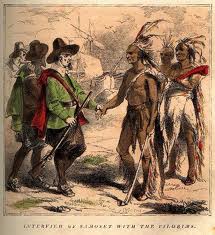
While searching it is important to be open to discovering that for which what you were not looking. When I find a Plymouth Colony ancestor I am generally excited, fill in the blanks with some black britches and some assumptions. Richard Taylor was no regular Pilgrim. He fell in love and married a Wampanoag chief’s daughter. I have a tribe in Massachusetts. I never would have guessed this, but I am thrilled out of my mind. My 12th great-grandfather,Great Sachem, had been exposed to English fishermen, and had learned some language from them. He walked into the Pilgrim camp and said “Welcome Englishmen”, to the great surprise of the Englishmen.
Wasanequin Great Sachem Wampanoag tribe (1554 – 1617)
is my 12th great grandfather
Quadequina Wampanoag (1576 – 1623)
Son of Wasanequin Great Sachem
Margaret Diguina Weeks (1613 – 1651)
Daughter of Quadequina
Ruth Whelden (1625 – 1673)
Daughter of Margaret Diguina
John TAYLOR (1651 – 1690)
Son of Ruth
Abigail Taylor (1663 – 1730)
Daughter of John
Martha Goodwin (1693 – 1769)
Daughter of Abigail
Grace Raiford (1725 – 1778)
Daughter of Martha
Sarah Hirons (1751 – 1817)
Daughter of Grace
John Nimrod Taylor (1770 – 1816)
Son of Sarah
John Samuel Taylor (1798 – 1873)
Son of John Nimrod
William Ellison Taylor (1839 – 1918)
Son of John Samuel
George Harvey Taylor (1884 – 1941)
Son of William Ellison
Ruby Lee Taylor (1922 – 2008)
Daughter of George Harvey
Pamela Morse
I am the daughter of Ruby Lee
I am very interested in my tribe, and have already had contact from a fellow descendant who has some proof of our Nativeness. I am looking forward to his input and learnring more about my roots. Ironically these people helped the Pilgrims survive, but the tribe has no reservation today. This is an overview of my First Nation Family:
Pokanoket is a tribe of Native Americans who trace their their lineage back thousands of years beyond the colonial days of the United States of America. We trace our ancestry through the bloodlines and the written and oral history of our people. We are the people of Massasoit Ousamequin, Massasoit Wamsutta, and Massasoit Metacom. We are Philip’s people, the people of Metacom. We are the people who celebrated the First Thanksgiving with the Pilgrims in 1621. We are the people who have endured much and who have returned, after a long journey through history to the present day and continue to look forward to the future.
Pokanoket is also a Nation. The Nation of Tribes you may have heard of referred to as Wampanoag ( pronounced wahm – peh – noe – ahg ) was known to our ancestors as the Pokanoket Nation. The Pokanoket Nation, also known as the Pokanoket Confederacy or Pokanoket Country, was comprised of a multitude of Tribes.
Each Tribe was comprised of Bands and Villages and the Pokanoket Tribe was the Headship of the Pokanoket Nation.
Pokanoket is also our home. Prior to the time of the pilgrim’s arrival in Plymouth, which used to be Patuxet, the realm of the Pokanoket included portions of Rhode Island and much of southeastern Massachusetts, including the surrounding islands around Cape Cod and Martha’s Vineyard.
The Pokanoket social organization developed in a manner that differed from neighboring Native American Tribes, since Pokanoket was more socially structured and layered, as well as more politically complex.
Unique to the Pokanoket Tribe were the spirtual and military elite, know as the Pineese (Pineese Warrior), who protected and served the Massasoit (Great Leader). They are the spiritual guardians of Pokanoket Nation.
Pokanoket believed seven to be the perfect number of completeness, for we still believe in the Seven Spirits of the Creator.
Natives of New England
It is with great excitement that I have found an ancestor from my mother’s side in Plymouth Colony. Most of her forefathers sailed to Virginia or below, but this particular Taylor branch had some distinctions. Margaret Diguina Weeks is said to be the Wampanoag daughter of Quadequina. There is dispute about this, but I do hope I can confirm these facts. My 11th great-grandfather, Quadequina, introduced popcorn to the Pilgrims at the first Thanksgiving.
It becomes complicated because there were two Richard Taylors, both married to women named Ruth. I have not traced them back in England to know if they match up in the old country with the other Taylors. Ruth Wheldon’s father officially objected to her marriage to my Mr. Taylor, helping us narrow down some of the facts. If Ruth Wheldon had a full-blooded Wampanoag mother, Ruth was a kind of Pocahontas of the north. I need to do some research on this to see what I can learn. The story is amazing.
Quadequina Wampanoag (1576 – 1623)
is my 11th great-grandfather
Margaret Diguina Weeks (1613 – 1651)
Daughter of Quadequina
Ruth Whelden (1625 – 1673)
Daughter of Margaret Diguina
John TAYLOR (1651 – 1690)
Son of Ruth
Abigail Taylor (1663 – 1730)
Daughter of John
Martha Goodwin (1693 – 1769)
Daughter of Abigail
Grace Raiford (1725 – 1778)
Daughter of Martha
Sarah Hirons (1751 – 1817)
Daughter of Grace
John Nimrod Taylor (1770 – 1816)
Son of Sarah
John Samuel Taylor (1798 – 1873)
Son of John Nimrod
William Ellison Taylor (1839 – 1918)
Son of John Samuel
George Harvey Taylor (1884 – 1941)
Son of William Ellison
Ruby Lee Taylor (1922 – 2008)
Daughter of George Harvey
Pamela Morse
I am the daughter of Ruby Lee
Here is one account of the story of Margaret Diguina and her tribe:
“Gordon B. Hinckley, Shoulder for the Lord” by George M. McCune page 35- ” Two of the early immigrants to Plymouth colony were Gabriel Wheldon, of Arnold, Nottingham, England, and his brother (name unknown). Gabriel had been married in England before sailing to America but his first wife named Margaret evidently was deceased at the time of his migration.
Both brothers had a free spirit much like Stephen Hopkins and found their way to the camps of the Wampanoags. There they both fell in love with two of the daughters of Chief Quadequina, younger brother of the Great Chief. They each married and Gabriel gave his second wife the English name ‘Margaret’ after his first spouse. The two counseled with their father-in-law and his older brother Massasoit regarding what to do. The Plymouth Colony would probably punish them for their intermarriage. Massasoit advised them to return to the colony and all would be well.
The Plymouth Colony tribunals saved face by banishing the couples from Plymouth for life but did not send them back to England. Gabriel and Margaret established their home in Barnstable where the Hinckleys came in late 1630’s and here Gabriel and Margaret raised a large family of girls.
One of those girls was Ruth Wheldon. This is a score!!

Sears Cemetery, Barnstable
You do not need to hold a seance to contact the spirits of the dead. You can use a few facts, or many facts if you have them, to query your ancestors. These are not fictional characters of history, but your DNA connection to the past. The novels you have read in your life can not possibly match the drama of the story of your particular historical survival. Your ancestors handed down to you an ethical will. Those who left no written document have nonetheless passed values to the future, with less precision. You are now actively creating the history and the ethics you want to survive in the world.
I started to study my ancestry to learn about the ethical will of my people, whoever they were. My mother had never described her family in any racial terms. I was taught that the Taylors were, in no uncertain terms, Confederate Rebels. My mother, Ruby Taylor’s very large family all lived in Texas. They were involved in religion to a much greater degree than our family living in Pittsburgh. The went to church at least three times a week, including Wednesday. They did a bit of holy rolling and other practices foreign to me. Indeed, my great grandfather Taylor fought in the civil war and received a Confederate pension in Texas in his old age. He was a farmer and preacher in the Church of Christ. This story was the known history of the Taylor tribe, and even this information was never retold to the Taylors of the 1960’s.
What nobody knew at the Taylor family reunion in Houston on the 4th of July each year in the 1960’s was that our Taylor forefather and his wife’s uncle had been burned at the stake as Protestant martyrs in England. Now that is what I call a Rebel. The roots of each family feed the ethical expression (also known as fruit) of the family spirit. The tongue speaking, chicken frying Taylors of Humble/Houston all shared a particular extreme view of the Bible that freaked me out when I was young. The Pentecostal experience, when I was exposed to it, frightened me. Now that I know about the stake burning it all makes perfect sense.
My forefathers and mothers in the grave yard pictured above lived in Holland, then sailed to Plymouth to build a shining city on a hill, creating a strong, complex ethical will. They had a lot to say about the way they thought all cosmology worked in harmony with government. They had strong convictions by which they lived and died. Now that I know more about the lives of these elders in my tribe I have a greater responsibility. I can no longer look at Thanksgiving as a bunch of stuffing. I need to discover the meaning of the Puritan Ethic they created. The values they held are more significant than the physical goods they once owned in old Cape Cod.
On the surface they all seem to use the Bible as an excuse for their own human folly. Just under the surface is the fact that humans have always indulged in folly to learn the folly of our ways. What did they learn? How can we acquire wisdom from their knowledge?
 mermaidcamp