mermaidcamp
Keeping current in wellness, in and out of the water
You can scroll the shelf using ← and → keys
You can scroll the shelf using ← and → keys
The ship Planter, under Master Nicholas Trerice/Travice, sailed from London April 2 or 11, 1635, arriving at Boston June 7, 1635. My tenth great-grandfather was 21 years old when he sailed to America on that ship.
Lt. Francis Peabody, the ancestor of the American Peabodys, was born at St. Albans, Hertfordshire, England, in 1614. He came to America in 1635 ; lived first in Lynn, and then in Ipswich, in then Massachusetts Bay colony. In 1639, he removed to Hampton, N.H., where he lived until 1657, when he came to Topsfield, Mass. He was useful in the new place, and was chosen to the office of selectman, as well as town clerk, both of which offices he held many years.
March 4, 1664, the town voted that Lt. Peabody have liberty ” to set up a grist mill and to flow so much of the town’s common as is needful for a mill so long as the mill does stand and grind for the town.”
The next year (1665), Mr. Peabody established the mill on Pyebrook. Who can estimate the joy of the inhabitants at that early period of having a grist mill to accommodate them in the grinding of their rye and corn! It marked a new era in the history of the Topsfield commoners.
March 7, 1671, the town voted that it was “willing that Lieut. Peabody shall set up a saw mill provided it does not do damage to any of the townsmen in their meadows.” The saw mill was built in 1672.
So far as the writer is able to learn, everything pertaining to these mills went along smoothly until 1691, when, the business having increased on account of the growth of the surrounding district, there was not a sufficient head of water during a part of the year to run the mills. Hewlett’s brook, a branch of Pye brook, left the latter stream and ran off to the northeastward, a short distance above the Peabody mills. As, at that time, there was no mill on Hewlett’s brook, Mr. Peabody was granted by the town the privilege of building a dam across this branch a few rods below its parting from the main stream, providing he pay satisfactory damages to the adjoining owners by reason of his flowing their meadows. The records speak of damages being received the following year by Thomas Dorman and sons, who had in 1690 erected a house within a few rods of the parting of the brook.* There was probably water power enough at the mills after the building of the dam as there are no papers showjng the want of it for more than fifty years afterwards.
During the year 1698 (?), after faithfully serving his day and generation, Lt. Francis Peabody passed away full of years and honors. By his will, dated Jan. 20, 1695, he gives his son Isaac Peabody the mills and mill-yard, the dwellinghouse by the mill, and other property.
Lieut Francis Peabody (1614 – 1697)
10th great-grandfather
Lydia Peabody (1640 – 1715)
daughter of Lieut Francis Peabody
Mary Howlett (1664 – 1727)
daughter of Lydia Peabody
John Hazen (1687 – 1772)
son of Mary Howlett
Caleb Hazen (1720 – 1777)
son of John Hazen
Mercy Hazen (1747 – 1819)
daughter of Caleb Hazen
Martha Mead (1784 – 1860)
daughter of Mercy Hazen
Abner Morse (1808 – 1838)
son of Martha Mead
Daniel Rowland Morse (1838 – 1910)
son of Abner Morse
Jason A Morse (1862 – 1932)
son of Daniel Rowland Morse
Ernest Abner Morse (1890 – 1965)
son of Jason A Morse
Richard Arden Morse (1920 – 2004)
son of Ernest Abner Morse
Pamela Morse
I am the daughter of Richard Arden Morse
 Frances Peabody’s signature
Constant Southworth in the Colony
Constant Southworth was born circa 1614 at Leyden, So. Holland, Netherlands. He married Elizabeth Collier, daughter of William Collier and Jane Clarke, on 2-Nov-1637 at Duxbury, Plymouth County, Massachusetts. Constant Southworth died on 10-Mar-1678/79 at Duxbury, Plymouth County, Massachusetts.
Constant Southworth, the son of Edward and Alice (Carpenter) Southworth, was probably born at Leiden ca. 1614-16, for his parents married there 28 May 1613 (Leiden Records, as in MD 10:2). The same records show that Edward Southworth had a brother Thomas then living in Leiden. Edward Southworth died, and his widow Alice came to Plymouth and married Gov. William Bradford on 14 August 1623.
Constant came to Plymouth in 1628, probably on the White Angel, and a contemporary account shows that the Plymouth Company paid twenty shillings for his passage and four shillings, eight pence per week for eleven weeks for his food (MHS Collections, 3rd Series, 1:199). It is assumed that he, and his brother Thomas, who must have come over later, lived with their mother and step-father, Governor Bradford. The Southworth family was apparently of gentle birth, but claims that Edward Southworth was identical with the Edward Southworth, son of Thomas and Rosamond (Lister) Southworth, or Samlesbury Hall, Lancashire, are not adequately supported. Constant Southworth married Elizabeth Coller daughter of William Collier (PCR 1:68). In his will, dated 27 February 1678/79, inventory 15 March 1678/79, he named his wife Elizabeth, son Edward; son Nathaniel; son William; daughter Mercy Freeman; daughter Alice Church, daughter Mary Alden daughter Elizabeth Southworth provided she did not marry William Fobes; daughter Priscilla Southworth; grandson Constant cousin Elizabeth Howland; and his brother Thomas. Constant held many important posts, including treasure, and ensign in the Duxbury military company.
Constant Southworth (1615 – 1679)
10th great-grandfather
Alice Southworth (1645 – 1719)
daughter of Constant Southworth
Elizabeth Church (1665 – 1691)
daughter of Alice Southworth
William Little Jr (1685 – 1756)
son of Elizabeth Church
Jane Jeanette Little (1713 – 1764)
daughter of William Little Jr
Andrew Armour (1740 – 1801)
son of Jane Jeanette Little
William Armor (1775 – 1852)
son of Andrew Armour
William Armer (1790 – 1837)
son of William Armor
Thomas Armer (1825 – 1900)
son of William Armer
Lucinda Jane Armer (1847 – 1939)
daughter of Thomas Armer
George Harvey Taylor (1884 – 1941)
son of Lucinda Jane Armer
Ruby Lee Taylor (1922 – 2008)
daughter of George Harvey Taylor
Pamela Morse
I am the daughter of Ruby Lee Taylor
Constant Southworth was born about 1614, based on his date of marriage. He died on March 11, 1678/9, in Duxbury. His ship was possibly White Angel, 1628
He lived in Holland. Constant Southworth was the son of Edward and Alice (Carpenter) Southworth, married in Leiden on May 28, 1613. His father was a say worker [weaver] there.
The family attempted to emigrate to New England in 1620, but apparently abandoned the voyage at London. In August 1620, Robert Cushman wrote a letter to Edward Southworth, the father, addressing it to Heneage House in London. It is unclear whether Edward Southworth died there or returned to Leiden.
Alice Southworth, the mother, emigrated to Plymouth Colony in 1623, leaving her two sons behind, either in England or Leiden. She probably left them with their Aunt Julia, the aunt who brought them both over in 1628. Alice Southworth married Governor William Bradford as his second wife that same year, soon after arriving.
Constant came to Plymouth in 1628, where he was admitted a freeman on January 1, 1637/8.
Constant Southworth married Elizabeth Collier on November 2, 1637, in Plymouth and had eight children. She died after February 20, 1678/9.
Constant’s brother, Thomas, is my paternal 10th great-grandfather. Their mother, Alice Carpenter, came to Plymouth a widow and married Governor Bradford in the first year after arrival.
Thomas Southworth (1617 – 1669)
10th great-grandfather
Elizabeth Southworth (1645 – 1716)
daughter of Thomas Southworth
Elizabeth Howland (1673 – 1724)
daughter of Elizabeth Southworth
Eleazer Hamblin (1699 – 1771)
son of Elizabeth Howland
Sarah Hamblin (1721 – 1814)
daughter of Eleazer Hamblin
Mercy Hazen (1747 – 1819)
daughter of Sarah Hamblin
Martha Mead (1784 – 1860)
daughter of Mercy Hazen
Abner Morse (1808 – 1838)
son of Martha Mead
Daniel Rowland Morse (1838 – 1910)
son of Abner Morse
Jason A Morse (1862 – 1932)
son of Daniel Rowland Morse
Ernest Abner Morse (1890 – 1965)
son of Jason A Morse
Richard Arden Morse (1920 – 2004)
son of Ernest Abner Morse
Pamela Morse
I am the daughter of Richard Arden Morse
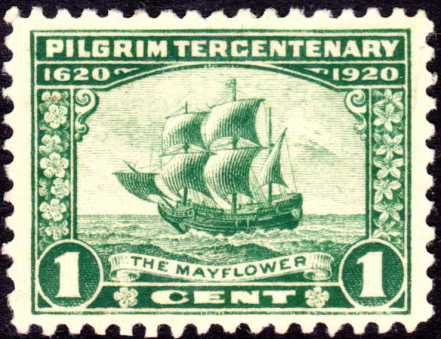
Mayflower
The ship was grounded on the shoals
The Pilgrims had not yet achieved their goals
The crowd was hungry, tired, depressed and sick
There was no welcoming party with a magic trick
To heal the suffering and recover moral fortitude
All the tribe had to offer was comfort and food
With great trepidation they approached the invaders
Dressed in high hats and collars of religious crusaders

London
Sarah Allerton was born in London in 1588, and died in Plymouth Colony in 1633. She arrived in the new world on the ship Anne with her third husband in 1632 after my 13th great-grandfather had sailed on the Mayflower then died shortly after arrival in the colony. Her brother Isaac was a signer of the Mayflower Compact as well, and assistant to Governor Bradford in America. Isaac later disgraced himself, moved to New Amsterdam, and became known as the first Yankee trader.
Sarah Allerton’s parents are not given but information is provided by unknown sources. Her parents would have been Edward Allerton, b. 1555 St. Dionis, Backchurch, London, England, died 1590 England, and Rose Davis, b. ca. 1559 in St. Peters, Corningshire, died June 1596 in England. Edward’s father was William Allerton, b. 1529. Sarah however certainly had at least two brothers. Isaac’s will also mentions a “brother Breuster”. The two siblings were:
1) Isaac Allerton, b. ca. 1586. He was one of the more famous of the Pilgrim Fathers. He was originally a tailor in London and was married in Leyden, the same day as his sister, 4 November 1611, to Mary Norris of Newbury, England, b. ca. 1588.
He came over on the Mayflower, with his wife and three children, and became First Assistant (1621 to ca. 1631) to Governor Bradford. Mary Norris died in childbirth, with a stillborn son, the first winter. She died 25 February 1620/1 on the Mayflower, while the first houses were still being built at Plymouth. In ca. 1626 he married Fear Brewster, b. 1606 at Scrooby, England , daughter of William and Mary Brewster, William being one of the most famous Pilgrims. Fear had arrived in Plymouth in July 1623, on the Anne, the same ship that brought Mary Priest and her two children.
Isaac was well known for his unscrupulous dealings with fellow Pilgrims and eventually left the colony in disgrace in the 1630’s when he lost the support of William Brewster. “A most enterprising man, he engaged in commercial pursuits at Marblehead and in Maine and later resided at New Amsterdam.” . He is often remembered as “the first Yankee trader”. Fear died in Plymouth before 12 December 1634. Isaac Allerton was probably married a third time to Joanna Swinnerton, before 1644, probably New Haven, CT. There were no known children from this marriage. He died insolvent between 1 and 12 February 1658/9 in New Haven, CT. Joanna was still living in 1684. Isaac’s children were (Sarah and Isaac were by his second wife):
Bartholomew, b. ca. 1612, in Leyden, Holland. Bartholomew returned to England. He first married Margaret _____ and then Sarah Fairfax, prob. in Rumbough, Suffolk, England. He died between 15 October 1658 and 19 February 1658/9, prob. at Bramfield, Suffolk, England. Four children are recorded.
Remember, b. ca. 1614 in Leyden. She m. Moses Maverick, before 6 May 1635 and died between 12 Sept. 1652 and 22 Oct. 1656. Moses lived in Lynn, Salem, and at Marblehead (all MA) in the time they were married. They had seven children, born at Lynn and Salem. Moses remarried in Boston to Eunice (Cole) Roberts by whom he had four children.
Mary, b. June 1616, m. Thomas Cushman, ca. 1636, in Plymouth, MA. Cushman came to Plymouth in 1621 on the Fortune. They had eight children. She died 28 November 1699, Plymouth, MA, the last survivor of those who came on the Mayflower. One of her grandchildren, Allerton Cushman, married in 1726 to Elizabeth Sampson, cousin of Benjamin Sprague.
Child, buried St. Peters, Leyden, 5 February 1620.
Stillborn son, b. 22 December 1620 on the Mayflower, Plymouth Harbor.
Sarah, b. ca. 1627 in Plymouth, died young before 1651.
Isaac Allerton, Jr., b. between 22 May 1627 and 1630, Plymouth, MA. He married first to Elizabeth _____, ca. 1652 (2 children) and then to Elizabeth Willoughby, a widow of Overzee and Colclough, ca. 1663, in Norfolk County, VA. Elizabeth was born in 1635 in England (12). They had three children, all born in Westmoreland Co, VA. Isaac became the first Plymouth student at Harvard (he graduated according to in 1650) and later went into business and made a fortune himself. He died Westmoreland Co., VA in 1702.
As is the case for Degory Priest, a General Society of Mayflower Descendents book is available on the first five generations of Isaac Allerton’s descendents. A somewhat earlier and shorter version, covering four generations, was published in 1996. Isaac Allerton has apparently a relatively small number of descendants compared to other Mayflower passengers, but is an ancestor to Presidents Zachary Taylor and Franklin D. Roosevelt (the latter also descended from Degory Priest through Sarah). The presidents are both thus our very remote (!) relatives: President Zachary Taylor (1784-1850), through Isaac Allerton Jr., was a 5th cousin to Mary (Scott) Wisdom; President Franklin D. Roosevelt (1882-1945), through Degory Priest, was an 8th cousin to Paul Graham.
2) Sarah Allerton, b. ca. 1588 at London . She was first married to John Vincent and then married to Degory Priest as noted above. Having received word of her husband’s death, she remarried on 13 November 1621 in Leyden, to Godbert Godbertson (name used in but also often called Cuthbert Cuthbertson). They arrived in July-August of 1623 on the Anne with their three children (two by Degory Priest). It is possible that there were two additional children with them by the first marriage of Godbertson (I think there is a reference to five children that arrived with them in and see also mention of three Cuthbertson below). Francis Sprague, another of my ancestors, was also a passenger. Godbert (ca. 1590-633), a Dutch Walloon, was a hat-maker in Leyden. He had been married previously in 1617 to Elizabeth Kendall. He became a “purchaser”, i.e., a shareholder in the Pilgrim Company when it was formed in 1626. He died seven years later, in Plymouth, of “infectious fever”. She died in Plymouth before 24 October 1633. On 11 November 1633 their son-in-law Phineas Pratt was appointed “to take possession of the personal property of Cuthbert Cuthbertson and his wife Sarah”.

Mayflower Compact
My 13th great-grandfather was a hatter who sailed to America on the Mayflower, but did not survive the first winter. His wife and children came to Plymouth in 1623 to take over his allotment in the colony.
Degory Priest was one of the Pilgrim passengers on the Mayflower in 1620. His wife, Sarah Allerton, and children Mary and Sarah stayed behind in Holland in Leiden where some of the Pilgrims had moved to escape religious persecution in England. He died during that first desperate winter in Plymouth. His wife and children came to North America on the Anne in 1623. At least one of his grandchildren was an early resident of Nantucket Island. Alternate spellings of his name are “Gregory”, “Degorie”, or “Digorie” Priest. Sarah Allerton’s brother Isaac Allerton and his family were also passengers on the Mayflower.
Degory and Sarah have many notable descendants including Franklin Delano Roosevelt, Maria Mitchell, Pete Seeger, Richard Gere, Dick Van Dyke, and Orson Scott Card.
Degory PRIEST (1579 – 1621)
13th great-grandfather
Mary Priest (1613 – 1689)
daughter of Degory PRIEST
Daniel Pratt (1640 – 1680)
son of Mary Priest
Henry Pratt (1658 – 1745)
son of Daniel Pratt
Esther Pratt (1680 – 1740)
daughter of Henry Pratt
Deborah Baynard (1720 – 1791)
daughter of Esther Pratt
Mary Horney (1741 – 1775)
daughter of Deborah Baynard
Esther Harris (1764 – 1838)
daughter of Mary Horney
John H Wright (1803 – 1850)
son of Esther Harris
Mary Wright (1816 – 1873)
daughter of John H Wright
Emiline P Nicholls (1837 – )
daughter of Mary Wright
Harriet Peterson (1856 – 1933)
daughter of Emiline P Nicholls
Sarah Helena Byrne (1878 – 1962)
daughter of Harriet Peterson
Olga Fern Scott (1897 – 1968)
daughter of Sarah Helena Byrne
Richard Arden Morse (1920 – 2004)
son of Olga Fern Scott
Pamela Morse
I am the daughter of Richard Arden Morse
Degory Priest deposed that he was 40 years old in a document signed in Leiden in April 1619; this would place his birth at about 1579 in England. On 4 November 1611, he was married to Sarah (Allerton) Vincent, the widow of John Vincent, and the sister of Mayflower passenger Isaac Allerton; Isaac Allerton was married to his wife Mary Norris on the same date.
It has been suggested that Degory Priest of the Mayflower may have been the Degorius Prust, baptized 11 August 1582 in Hartland, Devon, England, the son of Peter Prust. However, given that the baptism appears to be about 3 years too late, and the fact that none of the Leiden Separatists are known to have come from Devonshire, I doubt this baptism belongs to the Mayflower passenger. Degory Priest was one of the earliest to have arrived in Leiden, so it is more reasonable to suspect he is from the Nottinghamshire/Yorkshire region, the Sandwich/Canterbury region, the London/Middlesex region, or the Norfolk region: all of the early Separatists in Leiden appear to have come from one of these centers.
Degory and wife Sarah had two children, Mary and Sarah. Degory came alone on the Mayflower, planning to bring wife and children later after the colony was better established. His death the first winter ended those plans. His wife remarried to Godbert Godbertson in Leiden, and they had a son Samuel together. Godbert, his wife Sarah, their son Samuel, and his step-children Mary and Sarah Priest all came on the ship Anne to Plymouth in 1623.
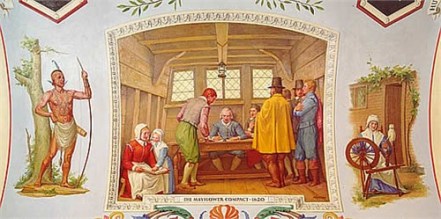
Mayflower Compact
My 9th great-grandfather was a baker who arrived in Connecticut in 1638. He was an original settler in that colony. He landed in Massachusetts then moved to New Haven. He signed the New Haven Plantation Covenant on June 4, 1639.
“The Story of the Early Settlers of Stamford, Connecticut, 1641 – 1700” by Jeanne Majdalany (including genealogies comp. with Edith M. Wicks), page 152: “Peter Brown was born 1610, died 1658, married 1 Elizabeth Smith(d1657); m2 1658 Unice/Unica Buxton…Peter Brown was of Concord, MA in 1632 and of New Haven in 1639 where he was a baker. In 1647 he was in Stamford. He probably was a brother of Francis. He lived on the west side of “River Street”.

Brown Coat of Arms
Peter Brown (1610 – 1658)
9th great-grandfather
Deliverance Brown (1656 – 1727)
son of Peter Brown
Rachel Brown (1700 – 1716)
daughter of Deliverance Brown
Mary Mead (1724 – 1787)
daughter of Rachel Brown
Abner Mead (1749 – 1810)
son of Mary Mead
Martha Mead (1784 – 1860)
daughter of Abner Mead
Abner Morse (1808 – 1838)
son of Martha Mead
Daniel Rowland Morse (1838 – 1910)
son of Abner Morse
Jason A Morse (1862 – 1932)
son of Daniel Rowland Morse
Ernest Abner Morse (1890 – 1965)
son of Jason A Morse
Richard Arden Morse (1920 – 2004)
son of Ernest Abner Morse
Pamela Morse
You are the daughter of Richard Arden Morse
Peter Brown was one of the Governor Theophilus Eaton and Rev. John Davenport Company, that made a settlement at New Haven in the spring of 1638. This company was partly from the City of London, where Rev. John Davenport had been a celebrated minister, and partly from the counties of York, Hertford, Kent, Surry and Sussex, and sailed from London, England, in the ship Hector, which arrived at Boston on the twenty-sixth day of June, 1637. Peter Brown signed the compact appertaining to the government of the New Haven Colony, in 1639. He sold out in 1647, and removed to Stamford, Connecticut, where his wife, Elizabeth, died Sept. 21, 1657, and his son, Ebenezer, Aug. 19, 1658. He married again at Stamford, May 25, 1658, Unity, widow of Clement Buxton, and died there Aug. 22, 1658. His widow afterwards married, March 9, 1659, Nicholas Knapp.
From the book One Life at a Time: A New World Narrative by R. Thomas Collins, Joseph Wood
Peter Brown was born 1610 in Hastings, England. A baker, Peter was a member of the immigrant company organized by London merchant Theophilus Eaton and the Puritan divine, Rev. John Davenport. Peter Brown was one of the signatories of the New Haven Plantation Covenant on June 4, 1639.
Peter Brown was one of the many townsmen to seek opportunity elsewhere after the failure of the Great Shippe. In 1647, Peter moved to Stamford. Peter, who died in 1648, and his first wife had at least one son, Hackaliah (#51). Peter’s second wife, Unity, widowed, later married Nicholas Knapp (#2) in Stamford.
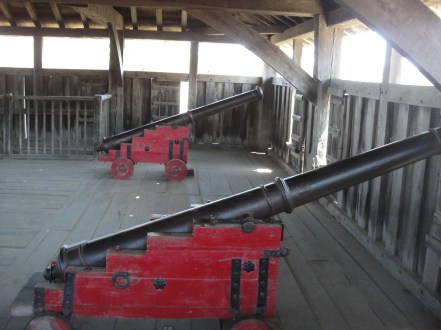
cannons above church Plymouth

Pilgrims

Pilgrim
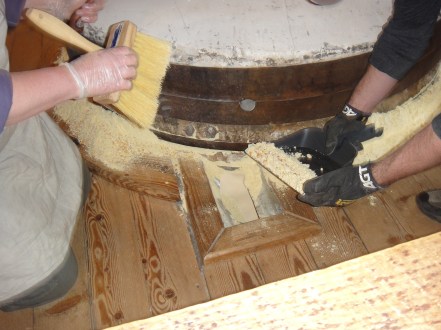
miller’s take
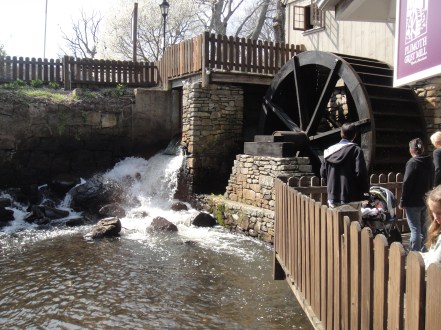
mill pond
When I visited Plymouth Plantation to see how my ancestors had lived the Mayflower was out of town being repaired. That did not bother me. I filled my day visiting at the museums of the living culture, including the grain mill extension in town. The details are fabulous and the actors doing the recreation are very knowledgeable and professional at their work. My personal ancestors were not on hand the day I went, but I did see the recreations of their homes. I also spent time in the cemetery and the church. The whole town is kind of preserved, with a definite Mayflower Pilgrim theme.
I was most interested in the Wampanoag section of the display. I thought for years I was a descendant of Quadequina, a member of the first Thanksgiving party. I was thrilled to be a Wamp, but later my first cousin discovered an error in my research. I had to cut that branch from the tree and begin again in the 1700s in South Carolina. I was super distressed at this news, which at first I was unwilling to accept. I was furious at my cousin, but had to face the reality that I had based my conclusions on specious data. I had mistaken one John Taylor in South Carolina for another, and that was all it took to lead me astray. It was a bummer. I was just a wanna be Wampanoag after all. It was a sad day when I had to admit that.
I stayed on Cape Cod where many of my ancestors moved after they had had it with the Plymouth bureaucracy and religious police. The whole area is filled with history. Even though my dreams of being a Wampanoag were dashed I enjoyed learning about the tribe and their struggle today. My relationship to them is purely intellectual, but I still love the People of The First Light. I love them more than I love the Pilgrims, who turned out to be pretty religious crazy. That whole story about religious freedom and Plymouth has been stilted quite a bit. They had no use for religious freedom other than their own specific brand of religious practice. They forced everyone to go to their church and obey their church’s rules. That is why many of my ancestors left for Cape Cod and later for Rhode Island. Those oppressive Pilgrims were just too intrusive to have as neighbors.
I hope to go back to Plymouth some day. I now have done more research and more people to find in the vicinity. I also hope I will revisit Williamsburg, VA because many of my ancestors were living down there in the 1600’s too. If you have a chance to go see the exhibits at Plimouth Plantation Thanksgiving will never be the same for you. You will see a clearer picture of what really happened in history.

The original painting hangs at the Pilgrim Hall Museum in Plymouth, Massachusetts. Mayflower Compact, Image from painting by Edward Percy Moran (1862-1935), showing Myles Standish, William Bradford, William Brewster and John Carver signing the Mayflower Compact in a cabin aboard the Mayflower while other Pilgrims look on, ca. 1900.
My eleventh great-grandfather sailed on the Mayflower as a paying customer, not part of the Leiden religious Pilgrims. He was a merchant who sailed from England without his wife and daughters, sending for them to join him after he was established in Plymouth. As we travel in time toward Thanksgiving I like to deconstruct some of the misconceptions we have about these Mayflower pioneers. They were not all religious and they did not all survive very well in the new world. Things were not as rose as they were presented to us back in elementary school. It was not all turkey and dressing. The Plymouth story is a complicated tale of cultural clashes that continue to this day.
Richard Warren (1580 – 1628)
11th great-grandfather
Anna Warren (1612 – 1675)
daughter of Richard Warren
William Little (1640 – 1731)
son of Anna Warren
William Little (1660 – 1740)
son of William Little
William Little Jr (1685 – 1756)
son of William Little
Jeanette Little (1713 – 1764)
daughter of William Little Jr
Andrew Armour (1740 – 1801)
son of Jeanette Little
William Armor (1775 – 1852)
son of Andrew Armour
William Armer (1790 – 1837)
son of William Armor
Thomas Armer (1825 – 1900)
son of William Armer
Lucinda Jane Armer (1847 – 1939)
daughter of Thomas Armer
George Harvey Taylor (1884 – 1941)
son of Lucinda Jane Armer
Ruby Lee Taylor (1922 – 2008)
daughter of George Harvey Taylor
Pamela Morse
I am the daughter of Ruby Lee Taylor
Richard Warren (c.1580 1628) a passenger on the Mayflower, old “May Floure,” in 1620, settled in Plymouth Colony and was among 10 passengers of the Mayflower landing party with Myles Standish at Cape Cod on November 11, 1620. Richard Warren co-signed the Mayflower Compact and was one of 19 among 41 signers who survived the first winter. His wife Elizabeth, nee Walker, baptised 1583 in Baldock, Hertfordshire, England, died October 2, 1673. She and his first five children, all daughters, came to America in the ship “Anne” in 1623. Once in America, they then had two sons before Richard’s untimely death in 1628. Clearly a man of rank, Richard Warren was accorded by Governor William Bradford the prefix “Mr.”, pronounced Master, used in those times to distinguish someone because of birth or achievement. From his widow’s subsequent land transactions, we can assume that he was among the wealthier of the original Plymouth Settlers.” In Mourt’s Relation, published in 1622, we learn that Warren was chosen, when the Mayflower stopped at Cape Cod before reaching Plymouth, to be a member of the exploring party among 10 passengers, and 8 crew, and he was described as being “of London” among 3 men. Charles Edward Banks, in Ancestry and Homes of the Pilgrim Fathers writes: “Richard Warren came from London and was called a merchand of that city, by Mourt.” He was not of the Leyden, Holland, Pilgrims, but joined them in Southampton, England to sail on the Mayflower. Richard Warren received his acres in the Division of Land in 1623. In the 1627 Division of Lands and Cattle, in May of 1627, “RICHARD WARREN of the Mayflower” was given “one of the black heifers, 2 she-goats, and a grant of 400 acres of land” at the Eel River in Plymouth, Massachusetts. The Warren house built in that year, 1627, stood at the same location as the present house; it was re-built about 1700, at the head of Clifford Road, with its back to the sea, and later owned by Charles Strickland, in 1976. However, Richard Warren died a year after the division, in 1628, the only record of his death being found as a brief note in Nathaniel Morton’s 1669 book New England’s Memorial, in which Morton writes: “This year [1628] died Mr. Richard Warren, who hath been mentioned before in this book, and was an useful instrument ; and during his life bore a deep share in the difficulties and troubles of the first settlement of the plantation of New Plimouth.” -Nathaniel Morton, New England’s Memorial (Boston : John Usher, 1669) Source: http://en.wikipedia.org/wiki/Richard_Warren The Mayflower Compact was the first governing document of Plymouth Colony. It was drafted by the “Pilgrims” who crossed the Atlantic aboard the Mayflower, seeking religious freedom. It was signed on November 11, 1620 in what is now Provincetown Harbor near Cape Cod. The Pilgrims used the Julian Calendar which, at that time, was ten days behind the Gregorian Calendar, signing the covenant “ye .11. of November.” Having landed at Plymouth, so named by Captain John Smith earlier, many of the Pilgrims aboard realized that they were in land uncharted by the London Company. For this reason the Mayflower Compact was written and adopted, based simultaneously upon a majoritarian model and the settlers’ allegiance to the king. Many of the passengers knew that earlier settlements in the New World had failed due to a lack of government, and the Mayflower Compact was in essence a social contract in which the settlers consented to follow the rules and regulations of the government for the sake of survival. The government, in return, would derive its power from the consent of the governed. The compact is often referred to as the foundation of the Constitution of the United States, in a figurative, not literal, way. The list of 41 male passengers who signed was supplied by Bradford’s nephew Nathaniel Morton in his 1669 New England’s Memorial include: Richard Warren Source: Mayflower Compact, Image from painting by Edward Percy Moran (1862-1935), showing Myles Standish, William Bradford, William Brewster and John Carver signing the Mayflower Compact in a cabin aboard the Mayflower while other Pilgrims look on, ca. 1900. Source: http://en.wikipedia.org/wiki/Mayflower_Compact
My 11th great-grandfather was probably born in Hertford, England. He married Elizabeth Walker, 14 April 1610, Great Amwell, Hertford, England, daughter of Augustine Walker. He died in 1628, in Plymouth. Children: Mary, Ann, Sarah, Elizabeth, Abigail, Nathaniel, and Joseph.
Richard Warren’s English origins and ancestry have been the subject of much speculation, and countless different ancestries have been published for him, without a shred of evidence to support them. Luckily in December 2002, Edward Davies discovered the missing piece of the puzzle. Researchers had long known of the marriage of Richard Warren to Elizabeth Walker on 14 April 1610 at Great Amwell, Hertford. Since we know the Mayflower passenger had a wife named Elizabeth, and a first child born about 1610, this was a promising record. But no children were found for this couple in the parish registers, and no further evidence beyond the names and timing, until the will of Augustine Walker was discovered. In the will of Augustine Walker, dated April 1613, he mentions “my daughter Elizabeth Warren wife of Richard Warren”, and “her three children Mary, Ann and Sarah.” We know that the Mayflower passenger’s first three children were named Mary, Ann, and Sarah (in that birth order).
Very little is known about Richard Warren’s life in America. He came alone on the Mayflower in 1620, leaving behind his wife and five daughters. They came to him on the ship Anne in 1623, and Richard and Elizabeth subsequently had sons Nathaniel and Joseph at Plymouth. He received his acres in the Division of Land in 1623, and his family shared in the 1627 Division of Cattle. But he died a year later in 1628, the only record of his death being found in Nathaniel Morton’s 1669 book New England’s Memorial, in which he writes: “This year [1628] died Mr. Richard Warren, who was an useful instrument and during his life bare a deep share in the difficulties and troubles of the first settlement of the Plantation of New Plymouth.”
All of Richard Warren’s children survived to adulthood, married, and had large families: making Richard Warren one of the most common Mayflower passengers to be descended from. Richard Warren’s descendants include such notables as Civil War general Ulysses S. Grant, President Franklin D. Roosevelt, and Alan B. Shepard, Jr. the first American in space and the fifth person to walk on the moon.
6 September 1620 Richard was one of the 102 passengers that embarked on the Mayflower, leaving Plymouth, England on this day. Many people are aware that the passengers of the Mayflower were fleeing religious persecution. What most people don’t realize is that over half the passengers were “strangers” picked up from London, whose passage to America on the Mayflower helped the religious separatists pay the excessive expenses involved with sending a ship to the New World. Those in the Leyden contingent are the “religious separatists” and those of the London contingent are the “strangers”.
9 November 1620 The passengers and crew aboard the Mayflower sighted land.
11 November 1620 The passengers and crew of the Mayflower made landfall in America. The group of 102 passengers who crowded aboard the Mayflower for the crossing was not homogenous. Many of the passengers were members of the Leiden congregation, but they were joined by a number of English families or individuals who were hoping to better their life situations, or were seeking financial gain. These two general groups have sometimes been referred to as the “saints” and “strangers.” Although the Leiden congregation had sent its strongest members with various skills for establishing the new colony, nearly half of the passengers died the first winter of the “great sickness.” Anyone who arrived in Plymouth on Mayflower and survived the initial hardships is now considered a Pilgrim with no distinction being made on the basis of their original purposes for making the voyage.

Andrew Armour’s fort
I recently started to study the matches that Ancestry.com has found for me. I took the test long ago and had paid little attention to that section of the website. I was asked to help a living person who is trying to find his birth father. He contacted me through the message system in Ancestry because he saw I was related to a DNA match he has. This man has done more research and has a much broader understanding of the various kinds of DNA testing available, and how to apply them to answer mystery ancestry questions. I have taken some time to look through the surnames he and I share with no luck in finding a connection. We are waiting for a y chromosome test from my brother to be processed at Ancestry to see if that reveals more. The match may come from as far back as 10 generations, so the whole thing is pretty complicated. I hope we find the answer my distant adopted cousin is seeking. In the process I am learning more about DNA testing and how helpful it can be.
I have had an excellent breakthrough on my maternal side by searching through all the matches and reading the trees. Some of the folks with whom I am matched have no tree. I am not sure what there are doing there. They are not much use until they get some data to go with the genetics. By following my matches in the Armer line I have found very early colonists from Plymouth and more new connections yet to be researched in Massachusetts. I have found Andrew Armour, 5th great-grandfather, born in Scotland 1740, died in Georgia, 1801. This line is also rich with history and original documents galore. The map above is of Andrew’s fort. I also have his will and testament in his own beautiful hand. I always love seeing the ancestors’ handwriting.
In the never ending research to learn more about my ancestors I appreciate any and all breakthroughs that help me verify my family members. The time spent studying my matches has given me a major breakthrough that will yield much more data as I dig into it. I will soon write more bios of this new/old branch of Scotsmen. If you have access to the Ancestry DNA database I believe you will learn something significant from taking the test. If you are already studying genealogy I recommend paying attention to the DNA section for possible happy consequences.
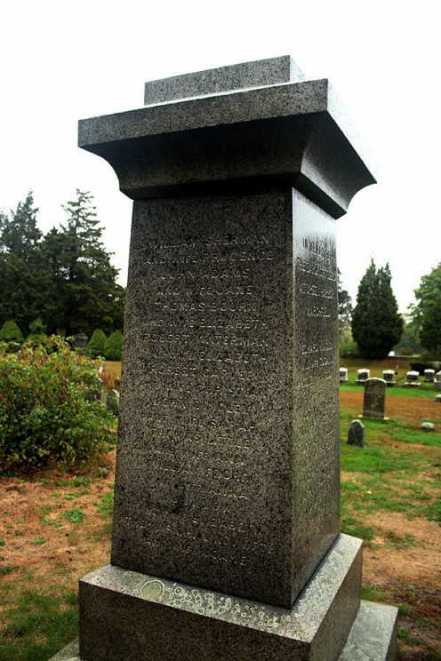
His name is on the monument dedicated to the early settlers of Green Harbor at the Winslow Cenetery in Marshfield, Mass.
The first record of Thomas Little in the new world was on the tax list of March 25, 1633. It is not known on which ship he had arrived. He moved to Marshfield, which is 14 miles from Plymouth. In the 1600’s 14 miles was a very long distance to travel. He was the constable in Marshfield, MA, in June of 1662.
Thomas married Anna Warren on April 19, 1633, in Plymouth Colony. They were the parents of about nine children.

Thomas Little, lawyer
Thomas Little was born in England before 1608 based on his marriage (Anderson, Great Migration). The Ancestral file, without documentation, lists his origin as Devon which is also known as Devonshire with Exeter as the county seat. According to many writers, he arrived at Plymouth, Massachusetts in 1630, but it is not positively known when, or on what ship he came. The earliest date in the Plymouth records is January 2nd, 1632/3, when he was taxed. He married, April 19th, 1633, Ann, born in England about 1612, daughter of Richard and Elizabeth Warren, who were Mayflower passengers (Avery 127, 129; NEHGR XIII, 279). Avery writes that Thomas Little came from England to Plymouth in 1630. He was a lawyer, and his coat of arms is still preserved at the old homestead in the house of Luther Little at Sea View, Massachusetts known as Littletown (Avery 126-127).
Thomas Little and Ann Warren had nine children as listed by Avery, Anderson in the “Great Migration,” and various others. Abigail married Josiah Keene; Patience married Joseph Jones; Ruth apparently unmarried; Hannah married Stephen Tilden; Mercy married John Sawyer; Isaac married Bethia Thomas; Ephraim married at Scituate Mary Sturtevant; Thomas died in King Phillips War; and Samuel married Sarah Gray (Anderson, Great Migration).
Thomas Little bought a shallop in 1633, and was enrolled for military service in August, 1643, at Plymouth, as was every other male in the Colony between 16 and 60 on that date (Avery 129-130).
His first residence was at Plymouth where he was a “Keeper of the Colony of New Plymouth books.” He was assessed 18 shillings in Plymouth tax lists of 1633 and 1634. In 1647, he had five acres of upland meadow on “Indian Brook,” listed as within the limits of the township of Plymouth, retaining that land in 1655. But in 1664, Jonathan Morey expressed an interest in the land that was “sometimes Thomas Little’s. Prior to that, in 1652, Thomas Little and his wife Ann sold a house and land on the Eel river in the township of Plymouth (a former residence). On 3 June 1662, Thomas Little had rights confirmed to a farm at Marshfield, and on 3 October 1665 was granted a hundred acres on which he settled title by 1 May 1666. Back in June 1662, he was a Marshfield Constable (Anderson, Great Migration, quoting Plymouth Records).
In his will, dated 17 May 1671, Thomas Little, Sr. bequeathed to “my loving wife all my housing and all of my land, upland and meadow on that side of the brook I now dwell, except only the meadow I purchased of Thomas Tildin and Morris Trewant.” He left land to sons Isacke and Ephraim land on the other side of the brook; all his land at Namassakett upland and meadow to his younger sons Thomas and Samuel, excepting an identified upland to grandson John Jones; a featherbed and furniture to Ephraim; the whole stock of cattle to be equally divided amongst all his children; and other dispositions. Administration of the estate was granted to Anna Little, his wife, on 14 August, 1662.(Anderson, Great Migration listing sources).
Thomas Little was buried at Marshfield, March 12, 1671. His widow died after February 19, 1675 (Avery 129-130).
There is some confusion from 28 October 1633 when a grant of land to Richard Warren was returned to court for failure to erect a building; the land was to be regranted to a Mr. Ralph Fogg upon his satisfactory payment to Widow Warren for her fence remaining there (PCR 1:18). But on 7 March 1636, “it is agreed upon, by the consent of the whole court, that Elizabeth Warren, widow, the relict of Mr. Richard Warren, deceased, shall be entered, and stand, and be purchaser instead of her said husband, as well because that (he dying before he had performed the said bargain) the said Elizabeth performed the same after his decease, and also for the establishing of the lots of lands givern formerly by her unto her sons-in-law Richard Church, Robert Bartlett, and Thomas Little, in marriage with their wives, her daughters” [PCR 1:54; 2:177]. On 5 May 1640, “Richard Church, Rob(er)te Bartlett, Thomas Little, and Mrs. Elizabeth Warren are granted enlargements at the heads of their lots to the foot of the Pyne Hills, leaving a way betwixt them and the Pyne Hills, for cattle and carts to pass” (PCR: 1:52). Ann Warren born est 1613, m. Thomas Little at Plymouth 19 April 1633 (PCR 1:13)
Thomas Little (1609 – 1675)
10th great-grandfather
William Little (1640 – 1731)
son of Thomas Little
William Little (1660 – 1740)
son of William Little
William Little Jr (1685 – 1756)
son of William Little
Jeanette Little (1713 – 1764)
daughter of William Little Jr
Andrew Armour (1740 – 1801)
son of Jeanette Little
William Armor (1775 – 1852)
son of Andrew Armour
William Armer (1790 – 1837)
son of William Armor
Thomas Armer (1825 – 1900)
son of William Armer
Lucinda Jane Armer (1847 – 1939)
daughter of Thomas Armer
George Harvey Taylor (1884 – 1941)
son of Lucinda Jane Armer
Ruby Lee Taylor (1922 – 2008)
daughter of George Harvey Taylor
Pamela Morse
I am the daughter of Ruby Lee Taylor
 mermaidcamp