mermaidcamp
Keeping current in wellness, in and out of the water
You can scroll the shelf using ← and → keys
You can scroll the shelf using ← and → keys
family history
My tenth great-grandfather was part of the Great Migration. He moved to Cape Cod in January of 1639. Many Pilgrims who moved out to Cape Cod got in trouble with the Plymouth church. In those days reaching villages on Cape Cod was a long hard journey from Plymouth. Some of my ancestors who lived on Cape Cod became (or already were) Quakers, and some moved to Rhode Island to escape the oppressive Pilgrim Fathers.
On January 7, 1639 the court record refers to the land grant to the first settlers John Crow, Thomas Howes, and Anthony Thacher as “the lands of Mattacheeset, now called Yarmouth”. This is considered the first usage of the name.
“Yarmouth” to represent the new township to the east of Barnstable.
Plymouth Colony: Its History and People 1620-1691 Part One: Chronological Histories Chapter 3: The Founding of Towns (1633-1643) Yarmouth On 7 January 1638/39, the Court of Assistants granted lands at “Mattacheeset, now called Yarmouth” to Mr. Anthony Thatcher, Mr. Thomas Howes, Mr. John Crow, and John Coite “to be enquired of.” Coite might have been the man of that name of Marblehead, but apparently he did not move to Plymouth Colony. Thatcher, Howes, and Crow were proposed [p.66] as freemen of Yarmouth, along with Mr. Marmaduke Mathews, Philip Tabor, William Palmer, Samuel Rider, William Lumpkin, and Thomas Hatch. It was also specifically noted that “Old Worden (dead),” Burnell, Wright, and Wat Deville were “Psons there excepted against,” probably meaning they were not eligible to be given freemen status, and showing that some form of settlement had already been in existence. In fact, on 4 September 1638 the General Court ordered the inhabitants of Sandwich and “Mattacheese or Yarmouth” to build a bridge over the Eel River (which was just a bit south of Plymouth town, and had to be crossed for travel between Plymouth and the Cape). On 5 March 1638/39 William Palmer was authorized by the General Court to be the one at Yarmouth who would exercise inhabitants in arms, and William Chase was elected constable there. It is apparent that earlier the Plymouth Court had granted land at Yarmouth to others also, for on 1 April 1639 it noted that lands at Mattacheese (another confusion of the names, for it should have been Mattacheeset) were granted to persons who should have inhabited there long ago, but did not, and the grantees “are not likely to come to inhabite there in their owne persons, and lest such as are there should receive in unto them unworthy persons, whereof the Court hath lamentable experience …, the Court doth order that onely such of them wch at present are there shall remayne & make use of some lands for their present necessity, but shall not divide any portions of lands there either to themselves or any others
American Genealogical-Biographical Index (AGBI)
John Sr Crowell (1590 – 1673)
10th great-grandfather
Yelverton Crowell (1621 – 1683)
son of John Sr Crowell
Elishua Crowell (1643 – 1708)
daughter of Yelverton Crowell
Yelverton Gifford (1676 – 1772)
son of Elishua Crowell
Ann Gifford (1715 – 1795)
daughter of Yelverton Gifford
Frances Congdon (1738 – 1755)
daughter of Ann Gifford
Samuel Thomas Sweet (1765 – 1844)
son of Frances Congdon
Valentine Sweet (1791 – 1858)
son of Samuel Thomas Sweet
Sarah LaVina Sweet (1840 – 1923)
daughter of Valentine Sweet
Jason A Morse (1862 – 1932)
son of Sarah LaVina Sweet
Ernest Abner Morse (1890 – 1965)
son of Jason A Morse
Richard Arden Morse (1920 – 2004)
son of Ernest Abner Morse
Pamela Morse
I am the daughter of Richard Arden Morse
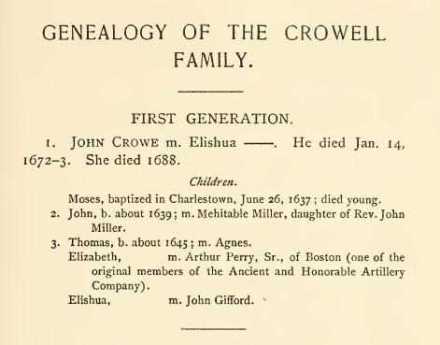
The Crowell family in North Dennis is descended from John Crow, who came, it is said, from Wales in 1635, to Charlestown, where he and his wife, Elishua, joined the church. It is probable that they sojourned there until 1639, when Mr. Crow came with Anthony Thacher and Thomas Howes to Yarmouth, with a grant from the court, having previously taken the oath of allegiance. All the first settlers
selected spots for their homes adjacent to good springs of water. The brook that flows through the village of North Dennis had numerous fine flowing springs to supply the need of the first comers. John Crow built his home north of the center of the present village, near the spot where the late Philip Vincent lived. His land, much of which is still owned by his descendants, was east of Indian Fields, and extended from the shore to the top of the hills back of the settlement. John Crow was a man of character and influence in the infant town of Yarmouth, filling many important offices. He died in 1673. His sons were: John, Samuel and Thomas. John married Mehitable. daughter of Rev. John Miller of Yarmouth. A grandson of John Crow, sr., whose name was John, was the first person buried in the North Dennis cemetery. He died in 1727. The name about that time had developed into Crowell. The offspring of John Crow are now to be found in all parts of the country, occupying important positions, with honor and credit to the name. Those who have remained upon the hereditary acres have produced in every generation men of ability and distinction. The late Hon. Seth Crowell and his cousin, Capt. Prince S. Crowell, and Mr. William Crowell, the well-known cranberry grower and seller, are illustrations of the character of the Crowells in the seventh generation. The family has never been large in North Dennis. Two pews in the old church sufficed to accommodate their needs for sitting room. Many of the family, before the old meeting house was torn down in 1838, had become desciples of John Wesley and left the church of their fathers.
Mr. Jeremiah Crowell, a descendant in the fourth generation from the grantee, John Crow, was for two generations a village celebrity. He lived in what was called “Crow Town,” just outside the western limits of Indian Field. The public highway went no farther east than his house in his day. The county road went through the woods south of Scargo hill. Mr. Crowell constructed a globe with the four quarters of the earth marked upon it. This was received by the Nobscusset children with open-eyed wonder. It was to be seen only, however, upon payment of one cent per head. He had besides a mammoth kite with a string a mile long, with a tail of wondrous length. He kept a daily journal of passing events, such as the capture of a whale, the arrival home of the Cod fishermen, the state of the weather, and the direction of the wind. But his great effort was the building of a pair of wings and attempting to fly. This was an achievement beyond his power to accomplish. The flying he regarded as practical and easy, but the alighting was difficult. He died at an advanced age, about the close of the last century.

Masterson Coat of Arms
My 10th great-grandfather was a deacon of the church in Leiden, Holland. He arrived in Plymouth in 1629 and died four years later.
Richard Masterson lived in Sandwich, Kent. He and several others were brought before church courts for criticizing the Church of England and the Book of Common Prayer, as well as for non-attendance at services. He was excommunicated several times. Richard Masterson was in Leiden by 7 Oct 1611. He was a wool comber by occupation. He bought a house on the Uiterstegracht on 2 Jan 1614, the sale of which was the subject of years of negotiation by his wife’s second husband. With four others, he wrote a letter from Leiden to William Bradford in 1625 about their hopes of emigrating to New England. From Michael Paulick’s research, it would seem that Masterson traveled between Leiden and Sandwich. Richard Masterson arrived in New England in 1629 from Leiden. Nathaniel Morton in his history of the Plymouth church described Masterson as a “holy man” and “experienced saint,” “the said Richard Masterson having bin officious with parte of his estate for publick Good; and a man of Abillitie as a second steven to defend the truth by sound argument Grounded on the scriptures of truth…” He died in 1633 in the epidemic of infectious fever and Mary Masterson married Rev. Ralph Smith, the minister for Plymouth until 1636. They moved to Manchester by 1645, and Ipswich by 1652.
Richard Masterson (1590 – 1633)
10th great-grandfather
Sarah Masterson (1612 – 1714)
daughter of Richard Masterson
Margaret Wood (1635 – 1693)
daughter of Sarah Masterson
Elizabeth Manchester (1667 – 1727)
daughter of Margaret Wood
Dr. James Sweet (1686 – 1751)
son of Elizabeth Manchester
Thomas Sweet (1732 – 1813)
son of Dr. James Sweet
Samuel Thomas Sweet (1765 – 1844)
son of Thomas Sweet
Valentine Sweet (1791 – 1858)
son of Samuel Thomas Sweet
Sarah LaVina Sweet (1840 – 1923)
daughter of Valentine Sweet
Jason A Morse (1862 – 1932)
son of Sarah LaVina Sweet
Ernest Abner Morse (1890 – 1965)
son of Jason A Morse
Richard Arden Morse (1920 – 2004)
son of Ernest Abner Morse
Pamela Morse
I am the daughter of Richard Arden Morse
Richard and Mary were among the Puritans in Leyden, Holland, but did not immigrate until 1629 on the second “Mayflower.” Their nephew John Ellis also made the voyage.
!Initial source: Family group sheet in the FGRA collection of the Family History Library, Salt Lake City, Utah, submitted by Edith Haddon
Littleford, 330 E 19th St, Idaho Falls, Idaho. Her source: Rec of Jewell David, Rt1 Box 822, Kent, Washington.
In “NEHGR” vol. 119 pg 162 is the extracted record of the marriage, “Archives of Leyden – Banns: the 1st; Nov. 9, 1619 – Richard
Masterson,woolcomber from Sandwich in England, accompanied by Wiliam Talbot and John Ellis, his brother-in-law with Mary Goodall, spinster, from Leiston , in England acc. by Elisabeth Keble and Mary Wing her acquaintnces.” The second banns were published Nov. 16th, the third banns Nov. 23rd and the marriage was performed “before Alpphen and Tetrolde, bailiffs this XXiii November 1619.” There is an article in “NEHGR” vol 144 (1990) pg 24, titled “The Mary Atwood Sampler”. It has an account of Richard and Mary (Goodall) Masterson which says “Richard Masterson, who was in Leyden, Holland, as early as 1611, was a woolcomber from Sandwich, England, according to the record of his marriage in Leyden 23 November 1619 to Mary Goodall, a spinster from ‘Leessen,’ England [perhaps Leiston in Suffolk?] (D. Plooij and J. Rendel Harris, “Leyden Documents Relating to the Pilgrim Fathers” [Leyden, 1920], IX, XL).
Richard died in 1633 when an ‘infectious fever of which many fell very sick and upwards of 20 persons died’ struck the Plymouth settlement (Samuel Eliot Morison, “Of Plymouth Plantation: 1620-1647 by William Bradford” [New York, 1975], 160). Mary (Goodall) Masterson married, second, before 1 July 1633 Rev. Ralph Smith of Plymouth. Mary, who ‘in 1650, according to a note of [Ralph] Smith, was sixty years old, died in 1659’ (D. Plooij, “The Pilgrim Fathers from the Dutch Point of View” [New York, 1932], 116.
An article, “The Sandwich Separatists”, by Michael R. Paulick, published in”NEHGR” vol 154 pg 353-369, names, on page 355, the wife of John Ellis, who was called brother-in-law in the Leiden marriage record of Richard Masterson. It quotes the parish register of St. Peter’s, Sandwich, Kent, England, giving the marriage of John Ellys and Blandyna Maistersonne. However, it says no baptismal record has been found for either of them but the baptisms of six of their children were listed. This article gives more detail about the separatist” movement in Sandwich and some of the activities of Richard Masterson. It quotes a 1977 history of Kent by Peter Clark that “by 1600 there was a signigicant group of vociferous left-wing radicals and separatists standing outside the mainstream of Kentish Puritanism.”
On page 358 is a quote from the records of the Sandwich Deanery: “To the 2 and 3 article wee presente Thomas Allen and Thomas Baker and
Richard Masterson for affirming that the forme of gods worshipp in the Churche of England established by lawe and contained in the booke of Common Prayer and administracion of the sacraments is a corrupt & unlawfull worshipp and repugnant to the scriptures and that the rites and ceremonyes in the Churche of England by lawe established are wicked anechristin & superstitious and suche as religiows godlie menn cannott neather maye with good conscience use or approve of. To the 65 article wee presente the saide Thomas Allen Thomas Baker
Richard Masterson & Abigaell Atkins for not frequenting there parishe churche one sondayes to heere divine service.
To the 66 (article) wee presente the saide Thomas Allen Thomas Baker & Richard Masterson & Abigaell Atkins for recusants which forebears to come to churche to common prayer & to heere gods word preached.” The article goes on to say “Richard Masterson was summoned but failed
to appear on 2 and 26 July, 22 October, 3 and 13 December 1613, and was excommunicated 17 January 1613/14 along with Allen, Baker, and
Atkins, the sentence delivered 13 February 1613[/14] by Harimus White, minister. [“Comperta and Detecta Book,” Sandwich Deanery, f59v,
ff59v-60r, f60v, f61r.]”
“The Book of Common Prayer established the form of Protestant worship and was enforced by the 1559 Act for the Uniformity of Common Prayer and Divine Service. This Act required ‘strict church attendance and rigid adherence to the Book of Common Prayer.’ All ministers of any parish were required to follow the written order of service for matins (morning service), evensong, and the administration of the sacraments. Substantial fines were imposed on any citizen who declared or spoke ‘anything in the derogation, depraving, or despising of the same book…’ or who refused to attend church services. [David Cressy and Lori Anne Ferrell, “Religion & Society in Early Modern England” (…1996), 56-59.] Separatists held the view that only services that were contained in the scriptures should be followed and all other forms of worship of man’s invention were ‘antechristin’.”
It quotes a letter written by the rector of St. Peter’s and other Sandwich ministers in 1613 to the Privy Council of James I, which said “many notablesectes and heresies” were being spread among the people “by such as have recourse unto the towns of Amsterdam, and other partes beyond the seaes” and among the “chiefest sowers” were “Richard Masterson the ellder and Richard Masterson the younger, Thomas Allen and John Ellis”
The article says “The reference to two Richard Mastersons is puzzling; so far, examination of the parish registers of Sandwich shows no trace of a Richard Masterson elder or younger. These terms were commonly – but by no means always – used for father and son or uncle and Nephew. Richard Masterson of St. Peter’s appears only in the ecclesiatical court records. Richard of Leiden was unmarried until 1619 so he had no children to baptize.[36] The note indicated by this number says “It should be noted that the St. Peter’s and St. Mary’s registers are particularly difficult to read, illegible in some areas. A John Maisterson is named in St. Peter’s parish register but his will of 1620 does not indicate any connection with Richard or Blandyna …” “It is possible that the Privy Council confused a Richard Marston with Richard Masterson. The pronunciation of both names with an English long ‘a’ might have sounded similar and perhaps led to a mix-up. Marston apparently had a Separatist reputation….”
The article went on to quote a warning letter to the mayor and stated that the law prohibited these activities and that those accused were fortunate in receiving only an “admonishon and reprehension”. However, “Richard Masterson was summoned 4 and 14 November 1614, and
excommunicated on 28 November 1614.” Still he continued and “had soon returned from Leiden as a professed Brownist or Separatist.” He
was summoned again 10 June 1616 with the following: “To the 2 article wee have one Richard Masterson whoe refuseth to come to our church
traduceth our service and ceremonyes ys a professed Brownest or Separest and hathe formerlye ben often presented and stubbornelye hath stood longe excommunicated and continuallye endeavoreth to infecte others with the same leavin soe that we are greived that the
performaunce of our duetyes herein hat noe better effecte.” He was excommunicated again on the 28th, and yet again on 20 December.
Further in the article it says “When Richard Masterson died in 1633 he was described by Bradford as one of the ‘ancient friends which have lived in Holland.’ If there was a single Richard Masterson, there is evidence that he might have been moving between Leiden and Sandwich. He is recorded in both locations at various times as follows:
7 Oct. 1611 betrothat in Leiden; called acquaintance of Isaac Allerton
2 July 1613 excommunicated in Sandwich with Allen, Baker, and Atkins
4 Nov. 1614 At Sandwich, ‘Lyeinge at Mr. Varall’s,’ excommunicated
22 Jan 1614/15 Leiden, various lawsuits 1612-1615 [Register 143:206]
Jan. 1615 Leiden, purchased house from Roger Wilson 10 Jun 1616 Sandwich, excommunicated as ‘Brownist or Separatist’ Dec. 1616 Sandwich, excommunicated with Mary Plofer for slander 4 Sept. 1618 Letter from Sabin Staresmore in London to John Carver March 1619 Leiden, certificate of good behavior includes Roger Wilson Perhaps his master, Christopher Verrall, who was wealthy and had powerful connections in Sandwich, had actually ‘underhand may[n]teyned and protected the offendors,’ as the Privy Council had accused him of doing. If Richard Masterson was not working with Verrall’s permission it is difficult to understand how he could maintain employment as a servant and travel back and forth between Sandwich and Leiden before Verral’s death in 1615. It is unlikely that any of those who had ‘recourse’ to Leiden made the trip between the two countries without the full knowledge of the other Leiden Separatists.”
The will of Christopher Verral is included in “Appendix” at the end of the article. It is long and difficult to understand but one sentence says “I do forgive my man Richard Masterson all the money which he oweth me and I give him 20s. to make him a ring in token of my good will.”
Letter sent to William Bradford and William Brewster by Richard Masterson and others
To our most dear, and entirely beloved bretheren, Mr. William Bradford and Mr. William Brewster, grace mercy and true peace be multiplied, from God our Father, through our Lord Jesus Christ. Amen.
Most dear christian friends and brethren, as it is no small grief Unto you, so is it no less unto us, that we are constrained to live thus disunited each from other, especially considering our affections each unto other, for the mutual edifying and comfort of both, in these evil days wherein we live: if it pleased the Lord to bring us again together, than which as no outward thing could be more comfortable unto us, or is more desired of us, if the Lord see it good; so see we no hope of means of accomplishing the same, except it come from you, and therefore, must with patience rest in the work and will of God, performing our duties to him and you assunder; whom we are not any way able to help, but by our continual prayers to him for you, and sympathy of affections with you, for the troubles which befal you; till it please the Lord to reunite us again. But our dearly beloved brethren, concerning your kind and respective letter, howsoever written by one of you, yet as we continue with the consent (at least in afection) of you both, although we cannot answer your desire and expectation, by reason it hath pleased the Lord to take to himself out of this miserable world our dearly beloved pastor, yet for ourselves we are minded as formerly, to come unto you, when and as the Lord affordeth means, though we see little hope thereof at present, as being unable of ourselves, and that our friends will help us we see little hope. And now, brethren, what shall we say further unto you; our desires and prayers to God, is (if such were his good will and pleasure) we might be reunited for the edifying and mutual comfort of both, which, when he sees fit, he will accomplish. In the mean time, we commit you unto him and to the word of his grace; whom we beseech to guide and direct both you and us, in all his ways, according to that, his word, and to bless all our lawful endeavours, for the glory of his name and good of his people. Salute, we pray you, all the church and brethren with you to whom we would have sent this letter. If we knew it could not be prejudicial unto you, as we hope it cannot; yet fearing the worst, we thought fit either to direct it to you, our two beloved brethen, leaving it to your goodly wisdom and discretion, to manifest our mind to the rest of our loving friends and brethren, as you see most convenient. And thus intreating you to remember us in your prayers, as we also do you; we for this time command you and all your affairs to the direction and protection of the Almighty, and rest,
Your assured loving friends
And brethren in the Lord,
FRANCIS JESSOPP,
THOMAS NASH,
THOMAS BLOSSOM,
ROGER WHITE,
RICHARD MAISTERSON.
Thomas Coat of Arms
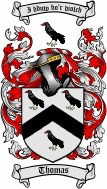
David Thomas is thought to have been born in Wales about 1620, David probably arrived in America about 1640-1 on the ship “Sampson”. It certainly is a fact that a session of the Quarterly Courts at Salem on 8th July 1645 “David Thomas” is a witness in a suit for defamation of character brought by John Bartoll against Alice, wife of John Peach, Jr, for having said that the plaintiffs wife, Parnell Bartoll, had “committed adultery with the Boatswain of the ship “Sampson” in the cabin of Parnell about four years ago.” This is the first record that we know of for David Thomas in America.
David lived in that part of Salem which is about to become the town of Marblehead. David left Marblehead probably early 1661, and removed to the part of Salem which later became Beverly. Two known maps showed the location of the Salem property of David Thomas agree that David owns Lot 16, which seems to have had no dwellings on it while David owned it.
It is significant that his wife Joanna executed her consent to the sale of the Beverly property by an instrument dated at Plymouth 14th July 1669. (Essex County Deeds book 3, pages 57 and 189). It seems this must have been the year David and Joanna Thomas moved to Middleborough. The birth of his son Edward Thomas on 6th February 1669 is the first entry in the Town Records of Middleborough, even though that entry may have been made at a later date, since the Town Records are said to have been destroyed by the Indians during King Philip’s War of 1675.
David is a Farmer at “Middlebury” and his family is one of the 16 families that constituted this Town in 1675. During this year when Indians attacked “Middlebury’s” new white inhabitants, forcing these settlers back into the Old Plymouth Colony Village. After this war ended these early settlers returned and 28th June 1677 those who had owned lands there, numbering 68 persons, met and agreed to re-settle “Middlebury” presently what is now called Middleborough.
David Thomas’s house at Middleborough (not standing anymore) is a little distance southeast of the town proper at the end of what is now Thomas Street at the area that became well known as “Thomastown”.
David Thomas (1620 – 1689)
9th great-grandfather
Mary Thomas (1664 – 1754)
daughter of David Thomas
Ann Northup (1696 – 1772)
daughter of Mary Thomas
Ann Gifford (1715 – 1795)
daughter of Ann Northup
Frances Congdon (1738 – 1755)
daughter of Ann Gifford
Samuel Thomas Sweet (1765 – 1844)
son of Frances Congdon
Valentine Sweet (1791 – 1858)
son of Samuel Thomas Sweet
Sarah LaVina Sweet (1840 – 1923)
daughter of Valentine Sweet
Jason A Morse (1862 – 1932)
son of Sarah LaVina Sweet
Ernest Abner Morse (1890 – 1965)
son of Jason A Morse
Richard Arden Morse (1920 – 2004)
son of Ernest Abner Morse
Pamela Morse
I am the daughter of Richard Arden Morse
David Thomas and his wife came from Salem to Middleboro soon after 1668, the of he selling his land in Salem. They settled in Thomastown, where their descedants are still living. He bought into the Twenty-six Men’s purchase.
He had sveral children, David, Joanna, William, Jeremiah, and Edward, the last born February 6 1669, the first birth in the early records of the town.
Source: History of the Town of Middleboro.
Atwood Coat of Arms
John Wood, the oldest immigrant ancestor of the Wood family, came to Massachusetts in 1635 aboard the ship Matthew. Most of his adult children followed him to America soon after.
John Wood is also known as John Atwood in some records; his baptismal name is “Johanem Wood” according to E. F. Atwood; however, I have yet to locate that record, so it may be a mistake. In the Sanderstead parish birth records his name is recorded as “Johannes” (not Johanem) with a date of 4 Feb 1582. Johannes is the Latinized version of John, often used in official records. He was a twin to Dericke who died in infancy. His baptism was recorded in both Sanderstead and Gatton parishes. It is not known why his birth was recorded at Gatton (a parish that is also located in Surrey, about three miles from Reigate), but it leads me to speculate that John’s mother may have originally come from that parish.
From the Sanderstead Parish Register of baptism records:
1582 Feb 4, Johannes t Dericke Woode gemille Nicholaj Woode
translation: 1582 Feb 4, John and twin Derick Wood born to twin bearing (father) Nicholas Wood
Since John Wood was baptised in Sanderstead, Surrey, England on 4 February 1582, it is likely that he was born about that time because it was customary to baptise infant children. He was probably born in Sanderstead since that is where his father, Nicholas and mother Olive (Harman) had a home. The Wood family had been associated with Sanderstead since about 1400 and had constructed a manor house there known as “Sanderstead Court.” The title to the lands in Sanderstead are somewhat confusing at this point in time and it is not entirely clear whether the family was actually living at Sanderstead Court or in one of the other houses in the parish.
John Wood married Joan Coleson of Saint Martin’s Parish, London in the summer of 1612. They had at least seven children, all born in England, five were sons and two were daughters. Johanna and Agnes are questionable children; they are included here until their ancestry is confirmed fully. Philip is sometimes included as a child of John and Joan, however, this is not the case. Most of the other children were baptised at St. Martins in the Fields church in London. E. F. Atwood believes that after the birth of his second son, John (in 1613), he and his family moved to Chancery Lane in London. He does not provide documentation for this assertion, however.
John was a “leather seller” in England. A notation in The Gentleman’s Magazine in 1848 indicates that John Atwood was a member of the Leatherseller’s Company on 22 January 1628; he sponsored a man with a highly unusual name to membership in the guild–Praysgod Barbone. Leather sellers were involved in selling, whiting, sorting and staking leather, and they belonged to a guild in London that regulated the trade; their guild hall was a large and elaborate building and they derived both social and financial benefits from belonging to the guild. Leather craftsmen making leather goods and parchment could also belong to this guild. Leather was an essential product with many uses during this time.
When John’s father, Nicholas, died in 1586, he left his estate to his youngest son Richard. Normally the oldest son would inherit his father’s estate, so this was an unusual bequest. Richard died 17 years later in about 1603 and his estate was inherited by the oldest brother in the family, Harman. According to court documents summarized by E. F. Atwood in Ancestry of Harman Atwood, John sued his older brother on 1 Feb 1631 saying he should be the heir of the estate, not Harman:
“Harman Atwood doth confess that he hath a copy of a Court role, dated 37 Henry 8 (1546-47) which proves that Nicholas Wood was the heir, that Thomas Wood, a young son, had certain manor lands settled on him by his father, John Wood, and that on the death of said Thomas, Nicholas Wod was possessed of said lands, according to the custom of said manor.”
Atwood maintains that this proceeding was used to simply sort out ownership of various Wood/Atwood lands, and that it was not filed in anger over John’s perceived disinheritence. King Henry had taken some lands belonging to the Wood/Atwood family some years before when he dissolved the monastaries in England. The land the Wood/Atwood family owned had previously belonged to the monastary, and it may well have been a legal maneuver by the Wood/Atwood family to clarify their rightful ownership of lands in Sanderstead parish and elsewhere. It is probably from this incident that E. F. Atwood says that some of John’s descendants claim he left for America after being disinherited.
I believe that Atwood is probably correct because if John was unhappy with his brother Harman after Richard’s death it seems unlikely that he would have named his own son “Harman” in 1612. E. F. Atwood’s conclusion is that this suit was merely a legal technicality to sort out ownership rights of Sanderstead. This conclusion would indicate that John did not leave England because of dissatisfaction with his inheritance, but for other reasons–possibly religious, possibly financial, or possibly for adventure.
It is not known what prompted John to leave England for the new colonies in America in 1635, but we can make a few guesses based on John’s personal circumstances as well as the political and religious climate in England at the time. James I, the English King (1566 – 1625), faced opposition on many fronts. James did not trust the growing Puritan movement in England, and viewed it as a threat to his royal control of the church. Tensions continued to increase after James was succeeded by his son, Charles I, and finally reached a breaking point with the English Civil Wars.
Many Puritans, who became known as Dissenters, faced discrimination and persecution in England. They sought to “purify” the Church of England and objected to many of its ceremonies such as exchanging rings during marriage, inviting “evil doers” to share in communion, using the sign of the cross in baptism, etc. Many of the Dissenters’ preachers were driven to ruin by the King through excessive taxation. This persecution lead to the first of several exoduses of Puritans, the first of which was to Leyden, Netherlands in about 1605. Most Puritans only stayed in the Netherlands for 10-15 years, however, and many eventually moved to America. The first group of Puritans arrived on the Mayflower in 1620 and founded the Plymouth Colony.
John may have well have been prompted by religious convictions to leave his English homeland and settle in the predominatly Puritan Plymouth Colony. We know that three of his sons married into staunch Puritan families after arriving in America. At least one leather seller in London was persecuted by the King for his beliefs and burned at the stake while John lived in London.
John may have also been motivated by financial considerations. As a younger son, John had been forced to fend for himself financially. It seems that his older brother, also named John (born 1576) had knowledge of the Plymouth Colony for he was recognized by the Treasurer of the stock company that funded the colony as a “special friend.” John’s brother’s relationship to the Plymouth Colony may have had an impact on John. It is also possible that since he had not been successful in his law suit against his brother Harman for a share in his father’s estate, John may have felt that the New World offered more oppotunity than London.
It is believed that John left England on 21 May 1635 aboard the Matthew. John’s name appears in the ship’s register in London, with 131 others; they were first transported to Saint Christopher’s Island (now known as St. Lucia), an island in the Leeward chain in the Caribbean. Richard Goodladd, owner and master of the Matthew per a warrant from the Earl of Carlisle. Before they were allowed to leave England they were compelled to take an oath of allegiance that they would be loyal to their King and their mother country.
Shortly after arriving in Plymouth, he was admitted as a freeman on 3 Jan 1636 which meant that he took an oath of allegiance to the Colony and could vote in elections and participate in the governemntal life of the colony:
“Mr. John Atwood, John Jenkin, John Weekes, Josiah Cooke, Willm Paddy, Robte Lee, Nathaniell Morton, Edward Forster, Georg Lewes, and Barnard Lumbard were made free this Court and sworn accordingly.” (The Wood family relationship with the Morton family would continue for many years.)
John’s wife, Joan, also came to America, but it appears that she did not sail with him on the Matthew since her name is not listed on the ship’s manifest. She came over on a later voyage, however, it is not clear which ship brought her.
From records of land transactions we know that John purchased land in Plymouth next to John Dunham shortly after his arrival. The land was granted to John Wood on 7 November 1636:
“had divers porcons allowed them, 3 acres in breadth & two in length, next to the land of John Dunham the elder…” The others were John Dunham Jr., John Wood, Samuell Eedy, Web Addy, Josiah Cooke, Thomas Atkinson, and Joshua Pratt, “All wch psons haue or are to build in the towne of Plym., and these lands to belong to their dwelling howses there, & not to be sold fro their howses.”
Citation: 7 Nov 1636 Plymouth Colony Records, Vol. 1:46
The following summer, in 1638, William Bradford describes an interesting incident that undoubtedly would have made an impression on John:
“This year, aboute the 1. or 2 or June, was a great and fearfull earthquake; it was in this place heard before it was felte. it came with a rumbling noyse, or low murmure, like unto remoate thunder; it came from the norward, and passed southward. As the noyse aproached nerer, they earth began to shake, and came at lenght with that violence as caused platters, dishes, and such like things a stoode upon shelves to clatter an d fall downe; yea, persons were afraid of the houses themselves. It so fell oute that at the same time diverse of the cheefe of this towne were mett together at one house, conferring withsome of their friends that wre upon their removall from the place, (as if the Lord would herby shew the signes of his displeasure, in their shaking a peeces and removalls one from an other.) How ever it was very terrible for the time, and as the men were set talking in the house, some women and others were without the dores, and the earth shooke with that vilence as they could not stand without catching hould of the posts and pails that stood next them; but the vilence lasted not long. And about halfe an hower, or less, came an other noyse and shaking, but nether so loud nor strong as the former, but quickly passed over; and so it ceased. it was not only on the sea coast, but the Indeans felt it with in land; and some ships that wre upon the coast were shaken by it. So powerfull is the mighty hand of the Lord, as to make both the earth and sea to shake, and the mountaines to tremble before him, when he pleases; and who can stay his hand?”
Citation: Bradford, Of Plymouth Plantation
Four of John’s adult sons also came to America after him:
Stephen went to Eastham, Mass. in about 1648-50
John to Plymouth, Mass. in about 1636
Henry to Middleborough, Mass. in about 1641
Harman to Boston, Mass. in about 1642
It is possible that his other son, William, also came to Charlestown, Mass. (this is based on speculation by E. F. Atwood in Ye Atte Wode Annals).
Three of John’s sons married into prominent Puritan families:
John Wood married Sarah Masterson in 1642 in Plymouth. She was the daughter of Richard Masterson who had been a Deacon at Leyden, Holland, the first home of the Puritans.
Henry married Abigail Jenney in 1644 in Plymouth. She was the daughter of Capt. John Jenney and Sarah Carey who had first gone to Leyden, Holland before coming to America.
Stephen married Abigail Dunham in 1644 in Plymouth. She was the daughter of John Dunham and Abigail Barlow who had originally gone to Leiden, Holland and married there on 22 Oct 1622.
John only lived eleven years in his new American homeland. He died on 27 Feb 1644 in the Plymouth Colony. His will is dated 20 Oct 1643, and was proved on 5 Jun 1644.
E. F. Atwood in Ye Atte Wode Annals (1930) has provided a copy of the suit John filed against Harman in London in 1631. In this suit he is identified as the son of Nicholas and is also identified as a “leather seller:”
Chrles iw. 15-33. Wood Alias Atwood Vs. Atwood. Feb 1, 1631.
Humbly comlayning, your orator, John Wood, alias Attwood, of the City of London, leather seller, that whereas Nicholas Wood, alias Attwood, late of Sanderstead cum Longhurst, County Surrey, deceased father to your orator, was siezed of lands, etc., in Sanderstead, and did, about 28 Elizabeth [1586], convey on parcel of lands called Mancocke and another parcel lying by Parkland, in the bottom towards Comes Wood Head, and a parcel lying by Mitheley, Great Burye, called Opeley, and one close lying at Ledowne, and one parcel abutting upon the house of Henrie Best, all which lands, the said Nicholas Wood alias Atwood, did convey for the use of Oliphe, his wife, for her life, and for the use of Ritchard Wood alias Attwood, his youngest sonne, and after the death of the said Nicholas and Ritchard, the said Oliphe, about 1603, also died; after whose death, the lands descended unto your orator, as youngest sonne of the said Nicholas. But now Harman Wood, alias Attwood, being the eldest son of your orator’s father, and lord of the said manor of Sanderstead cum Longhurst, hath entered the said premises and pretends to disenherit your orator of the same.
ANSWER of Harman Atwood, Gent., Says bill of complaint it devised by the complainant without just cause and denies that he combined with Thomas Collett, the steward of said manor, concerning any controversy and says the complainant has no right or title to said premises. he doth confess that he hath a copy of a Court Role, dated 37 Henry 8 (1546-7) which proves that Nicholas Wood was the heir, that Thomas Wood, a younger son, had certain manor lands settled on him by this father, John Wood, and that on the death of said Thomas, Nicholas Wood was possessed of said lands, according to the custom of said manor.
Note [by E. F. Atwood]: “The above is merely an abstract made for genealogical purposes, hence does not always conform to exact wording of the original. It seems clear that the leather seller was never meant by Nicholas to inherit these lands, but thence comes our traditions of disinheritance, etc. As (Sanderstead manor was confiscated a few years earlier, yet John and Nicholas were left undisturbed in possession of lands bought by Peter in 1346, a Court Roll was necessary to avoid confusion as to titles of the two lands called Sanderstead Manor, one owned by the Greshams and one by the Wood-Atwoods.”
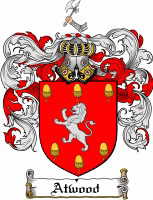
Born John Attwood, John was was the last in his direct line to have a coat of arms. He was descended from knights of the shire, bodyguards of English kings and members of parliament. He was a younger son of his father, Nicolas Atwood. Therefore, he did not expect to inherit an estate. John chose to seek his fortune in the American colony of Plymouth. When John learned that his older brothers had died without eligible issue for his father’s title, he sailed to England to claim it. But his youngest brother, who had remained in England, had secured it from the courts before John was able to to gain his rightful title and estate. John returned to Plymouth, and his name was changed to Wood. Some of his American relatives kept the the name Atwood. He, his son Henry Wood, and grandson John Wood were sometimes called Atwood and confused with people
John Atwood (1582 – 1644)
10th great-grandfather
John Thomas Wood (1614 – 1675)
son of John Atwood
Margaret Wood (1635 – 1693)
daughter of John Thomas Wood
Elizabeth Manchester (1667 – 1727)
daughter of Margaret Wood
Dr. James Sweet (1686 – 1751)
son of Elizabeth Manchester
Thomas Sweet (1732 – 1813)
son of Dr. James Sweet
Samuel Thomas Sweet (1765 – 1844)
son of Thomas Sweet
Valentine Sweet (1791 – 1858)
son of Samuel Thomas Sweet
Sarah LaVina Sweet (1840 – 1923)
daughter of Valentine Sweet
Jason A Morse (1862 – 1932)
son of Sarah LaVina Sweet
Ernest Abner Morse (1890 – 1965)
son of Jason A Morse
Richard Arden Morse (1920 – 2004)
son of Ernest Abner Morse
Pamela Morse
I am the daughter of Richard Arden Morse
My tenth great-grandfather immigrated to American in 1635 in the Pilgrim ship the “Mathew”.
John Wood, imigrant ancestor, 1635, arrived at Plymouth Colony; married Joan Coleson of Saint Martin’ England, who did not come with her husband, but later ship. John’s name appears in the register in London, with others; they were first transported to Saint Christophers, in the ship, Mathew, Richard Goodladd, owner and master, 21st May 1635. Before they were allowed to leave England they were compelled to take the oath of allegiance that they would be true to their mother country– “ye oath of allegiance supreme”. During the reign of Queen Elizabeth the Puritans fared badly in England, many men and women being arrested and thrown into prison because they sought to retain their own religious beliefs which were deemed contrary to the teachings of the Church of England. Many of them fled to Holland. On the death of Queen Elizabeth, she was succeeded by King James who was more lenient with the Puritans and freely allowed them to emigrate to America, the first settlement etablished in Virginia being called Jamestown. Later (1620) the Puritans came to Plymouth. Still later, many settled in Boston and Boston became the capital of Massachusetts Bay Colony.
John Wood landed first at Boston, but soon removed to Plymouth. The record of his baptism in England gives the date 24th December 1614. He became “propr.” of Plymouth Massachusetts, 1635-36; he owned land, was constable and on the grand jury. March 25th was recognized as New Year in England and her colonies. His wife Joan Coleson dying soon thereafter he removed to another section of Plymouth which later became the town of Plympton. While there the son John Wood married Sarah Masterson, daughter of Richard Masterson, who had been a deacon at Leyden, Holland, and whose wife was Mary Goodsell of Lancaster (married 26th November 1619). John Wood later moved to Portsmouth on the Island of New Port which was then a part of Massachusetts. Children of John and Sarah (Masterson) were: Thomas, Henry, Walter, William, John, Elizabeth. The records most frequently mention the sons Thomas and John. The father died in 1643-44, The son John Wood, died about 1675.

Immigrant
My 7th great-grandfather was a gentleman and a trader in Massachusetts Colony. Another descendant paid a professional genealogist to research his history. The results that follow are fascinating because she takes steps to figure out which of the various William Thomas’s my ancestor was. I have made big mistakes in my own tree on the ancestors with very common names like John Taylor. Record keeping varies from place to place and time to time. I am impressed and pleased with this expert research. I once paid for research to be done by the Somerset PA Historical Society, which I visited in person. They stiffed me and did no investigation for the fee they charged. This experience burned me on the idea of paid experts. This example is very well done. The lady who did the work is:
Diane Rapaport, Historical Consultant/Attorney Quill Pen Historical Consulting, P. O. Box 204, Lexington, MA 02420 Tel.: 781-698-7884 (866-QUILLPEN) – Fax: 781-861-6744 (888-QPFAXES) Email: diane@quillpenhistorical.com Web: http://www.quillpenhistorical.com
She does very thorough work. Thanks to James Crawford for making this public information. We appreciate your contribution, cousin.
William Thomas (1695 – 1733)
7th great-grandfather
Mary Thomas (1729 – 1801)
daughter of William Thomas
Joseph Morse III (1756 – 1835)
son of Mary Thomas
John Henry Morse (1775 – 1864)
son of Joseph Morse III
Abner Morse (1808 – 1838)
son of John Henry Morse
Daniel Rowland Morse (1838 – 1910)
son of Abner Morse
Jason A Morse (1862 – 1932)
son of Daniel Rowland Morse
Ernest Abner Morse (1890 – 1965)
son of Jason A Morse
Richard Arden Morse (1920 – 2004)
son of Ernest Abner Morse
Pamela Morse
RESEARCH REPORT for JAMES CRAWFORD
May 31, 2010
By Diane Rapaport
Research Objective
Documentation of the parents and origins of William Thomas:
b. 1695, Marlborough, MA (or Wales?)
d. 25 July 1733, Marlborough, MA
m. 19 June 1721, to Lydia Eager (b. 03 July 1696, Marlborough, MA, d. 12 Oct 1735, Marlborough, MA)
Their children:
Lovina Thomas, b. 15 Aug 1721, Marlborough, MA, d. Shrewsbury, MA
Sophia Thomas, b. 28 July 1723, Marlborough, MA, d. 24 Aug 1745
William Thomas, b. 19 Mar 1724, Marlborough, MA [Note: Per Marlborough Vital Records, year should be 1725; see below.]
Lydia Thomas, b. 30 Sep 1727, Marlborough, MA
Mary Thomas, b. 16 Feb 1729, Framingham, MA [Note: Marlborough Vital Records suggest that the birthplace was Marlborough; see below.]
Odoardo Thomas, b. 7 May 1731, Marlborough, MA
[Note: The information about William Thomas and his family, which you provided by .ged file, is unsourced. The Ancestry record “hints” in other public trees include only “OneWorldTree” and “Massachusetts Marriages” database, which are not authoritative sources.]
Summary of Research Results
Jim, I searched numerous record sources—vital records, probate records, land records, trial court records, and secondary sources (which I found online and at the Massachusetts Archives, the Middlesex County Registry of Deeds, and the New England Historic Genealogical Society)—for clues to the life and origins of William Thomas. I found much documentation about William (which I am providing to you as PDF and JPG files, posted at the “Files and Messages” page of our project at Ancestry’s Expert Connect – scroll down to the bottom of that page, where you will find the files, which you can read or download to your computer).
The search revealed other men named William Thomas in Middlesex County, Massachusetts, during the relevant time period, including a Native American from the town of Natick, the son of a blacksmith from Newton, and a “husbandman” (the colonial term for a farmer or laborer) from Lambstown in Worcester County (where, as it turns out, your William had connections). But I was able to distinguish these other men from your William Thomas, who was identified consistently in the records as a “gentleman” (and in a few instances as a “trader”), suggesting that he was of a high social rank. I also discovered in the Middlesex County Court records that he was a licensed “retailer” and probably operated a store in Marlborough; the license was transferred to his wife Lydia after his death.
I discovered that William purchased land in Framingham, the town next to Marlborough, in 1720, just before his marriage to Lydia; at the time of that land purchase, he was identified in the deed as being of Framingham, suggesting that he already lived there. I could not find any record of his purchasing property in Marlborough (although the probate records indicate that he owned real estate in the town); it is possible, since Framingham adjoins Marlborough, that the land was actually the same that he purchased in 1720, and that the town boundaries changed. (I found no evidence of other Thomas families in Framingham before that date.) And, I discovered documentation in the Worcester County land records, as well as in the Middlesex County probate records, that William began buying land in Shrewsbury, Worcester County, shortly before his death.
In the 8 hours authorized for this project, I was unable to determine more about William’s origins. I did find evidence, in the guardianship records of his children (after the death of William and his wife), that William’s sons chose an uncle from Shrewsbury, Asa Bouker, to be their guardian. I did not have time to do any research about Asa Bouker or his connections with either William or Lydia. I found evidence in land and probate records of other people with the Thomas surname in early Middlesex County and elsewhere in Massachusetts (see my notes, below), but I did not have time to follow up on those leads. One promising name might be Nathaniel Thomas of Plymouth (identified as “Esquire,” suggesting that he was a “gentleman” like William), who had some connection with a wealthy Elizabeth Thomas who died in Medford, Middlesex County, in 1729. Perhaps William was indeed of Wales, as you suggested. Also intriguing is the name of his son, Odoardo, which my quick Google search indicates is an Italian name, and may suggest some cosmopolitan origins for your William Thomas.
The next step that I would recommend is to search for more information about Asa Bouker of Shrewsbury, Nathaniel Thomas, and other early Thomas families in Massachusetts, as well as resources about early Boston, since William Thomas or his family (like many families of high social rank) may have spent time there upon arriving in New England. I also would recommend a more review of the probate and land records that I have obtained (I provided you with copies, but have not made a thorough study), to see if there are any other clues about family members. I would be happy to continue the search, if you would like to consider authorizing more time!
Sources Consulted
VITAL RECORDS
Massachusetts Vital Records to 1850 (database of the New England Historic Genealogical Society)
Searched Thomas surname in Marlborough, MA:
In published Marlborough Vital Records, earliest entry is marriage of William and “Lidia” Eager in 1721 (see copy, Thomas Wm & Eager Lidia marriage.pdf), followed by their children’s births (see copy, Thomas Wm children births.pdf), and the deaths of William, his wife Lydia, and their daughter Sophia (see copy, Thomas Wm Lydia Sophia deaths.pdf). [Note: According to the vital records, son William was born 1725, not 1724, and daughter Mary was born in Marlborough, not Framingham, but otherwise all the dates match up with the information in your family tree (except there is no record or date for William Sr.’s birth).]
Searched Thomas surname in Middlesex County to 1721:
In published Newton Vital Records, marriage record of:
Thomas, William and Anna Loverin, Aug. 29, 1695, in Watertown (see copy, Newton VRs marriages.pdf). But note that William and Anna had a daughter in 1695. However, it appears that this William Thomas of Newton and a first wife, Elizabeth, had a son William in 1687; see below.
Thomas, Joanna, ch. William and Ann (second w.), Oct. 28, 1695.
Thomas, William, s. William and Elizabeth, Aug. 31, 1687. (See copy, Newton VRs births.pdf.) Probably this is the William Thomas, blacksmith, and his son, and no relation to your William Thomas. See notes re: probate records, below.
Searched Thomas surname in Worcester County to 1721:
Found only a Sarah Thomas who married in Mendon in 1707.
Searched Thomas surname in Framingham:
No early Thomas entries
Note: I have not made an exhaustive search of the available published vital records. Many births were not recorded with the town officials, however, but evidence can be found in collateral records, such as church, land, probate, etc. I did not have time to search church records.
LAND RECORDS
(Reviewed at Middlesex County Registry of Deeds and on microfilm at New England Historic Genealogical Society)
As you will see, I reviewed some deed records for dates afterWilliam Thomas’ death, since sometimes deeds are not recorded until years after the conveyance.
Middlesex County, MA
Grantee Index, 1639-1799 (microfilm)
(and I briefly searched deed book volumes, where indicated)
I searched for early entries with the Thomas surname, before William’s death in 1733, which I noted, since the index did not refer to the town, and reviewing the records might show connection with Marlborough or William Thomas:
1685, July 20, Thomas, Ales & Benjamin, from E. Corlett, 9: 411 – Ales Thomas of Boston & Benjamin his son, purchased land in Cambridge
1686, Oct 20, Thomas, John &al from F. Hinchman, 10: 7 – no Thomas found on this page
1687, March 9, Thomas, Edward, agent, from W. Cutter, 10: 33 – Mentions Edward Thomas of Boston
1697, Nov 23, Thomas Edward, from C. Morton, 12: 106 – no Thomas found on this page
1701, Dec 12, Nathaniel Jr from J. Croade, 13: 89 – Nathaniel Thomas Jr. of Plymouth buys land in Groton
1719, May 11, Thomas, Joshua, from M. Meeds, atty, 20: 333 – Joshua Thomas of Boston
1720, March 30, Thomas, John & Solomon, Samuel’s est., deposition 12: 733 – no Thomas found on this page
1721, Aug 18, Thomas John &al, deposition, 21: 412 – re: John Thomas of Natick, Indian
Entries for William Thomas, all after his death date:
1735, Feb 27, Thomas, William, from Edward Clap, 36: 516 – This seems likely to be your William Thomas, since it refers to him as “gentleman” and the conveyance in Framingham occurred in 1720, before his marriage. (Copy, Thomas Wm deed Mdsx v36p516.jpg and Thomas Wm deed Mdsx v36p517.jpg.)
1739 March 12, Thomas, William, from B. Tray, 39: 642 –William Thomas of Natick, Indian
1742, Dec 11, Thomas, William, from T. Bowman, 44: 51 – William Thomas of Natick
1745, Apr. 2, Thomas, William, from M. Speen, 45: 97
1747, Feb. 10, Thomas, William, from S. Abram, 46: 429
1752, Feb 8, Thomas, William, from M. Tom, 49: 357
Other William Thomas entries after this date, but not until 1782; no entries found for Lydia Thomas
Grantee Index, 1639-1799, A-G
Found several entries for surname Eager (Eagar, Augur, Egar), who might be relatives of Lydia Eager, but no entries for Lydia.
Grantor Index, 1639-1799, S-Z
(and I briefly searched deed book volumes, where indicated)
No entries for a William Thomas until 1738:
1738, Feb 19, Thomas, William, to D. Morse and J. Carver, 39: 542, 547 – William Thomas of Natick, Indian
No other entries for William Thomas until 1749:
1749, July 24, Thomas, William, to J. Loring, 49: 61
Worcester County, MA
Grantee Index, 1731-1839, P-Z (microfilm)
(and briefly searched deed books, where indicated)
1734, Thomas, William, from Gerstrom Keyes, Nahum Ward and Eleaser Rice, 4: 432-437, Shrewsbury deeds (Copies, Thomas Wm deed Worcester v4p433.jpg, Thomas Wm deed Worcester v4p434.jpg, Thomas Wm deed Worcester v4p435a.jpg, Thomas Wm deed Worcester v4p435b.jpg, Thomas Wm deed Worcester v4p436.jpg, Thomas Wm deed Worcester v4p437.jpg) – These land purchases occurred in 1730 and 1733, and refer to William as “of Marlborough,” “Gentleman” and “Trader.” No other people surnamed Thomas are mentioned, and no obvious clues to his origins, although it is possible that he may have been related to some of the people involved.
1734, Thomas, William, from Saml Smith, 5: 161, Hardwick – William Thomas of Lambstown, husbandman, 1734
1736, Thomas, William, from Saml March, 9:25, Hardwick –William Thomas of Lambstown, husbandman, 1736
1737, Thomas, William, from John Jordan, 9: 73, Hardwick –William Thomas of Lambstown, husbandman, 1736
1740, Thomas, William, from Amos Thomas, 13: 141, Hardwick –William Thomas, husbandman, of Lambstown, Worcester County, and Amos Thomas, husbandman of same town. Deed signed 1739, so obviously not your William Thomas.
1746, Thomas, William, from Amos Thomas, 20: 556, Hardwick
1746, Thomas, William, from Amos Thomas, 22: 1, Hardwick
And more William Thomas entries after this date, to 1838
No entries for Lydia Thomas
Grantor Index, 1731-1839, T-Z (microfilm)
1735, Thomas, William, to Stephen Harrington, 7:17
1740, Thomas, William, to Ebenr Foskett, 13: 68
1740, Thomas, William Jr., to Ebenr Foskett, 13: 68
1742, Thomas, William, to Amos Thomas, 16: 207
And more William Thomas entries after this date, to 1836
The only Lydia Thomas entry was:
1787, Thomas, Lydia, to Fos Fayerweather, 102: 20
PROBATE RECORDS
(Reviewed at Massachusetts Archives)
Early Thomas records in Middlesex probate:
William, Newton, 1698, Will, 22416
Will refers to this William Thomas as a blacksmith, and he signs will with mark. Leaves estate to widow for her life, and then to son William. Small estate, about 50 pounds.
William, Newton, 1699, Guardian, 22417
Papers say he is about 12 years old in 1699. Nathaniel Hancock appointed guardian.
William, Marlborough, 1734, Administration, 22418. This is your William Thomas. See copy, Thomas Wm Mdsx probate.pdf. Note: I did not have time to make a thorough study of these records for further clues.
William, Marlborough, 1740, Guardian, 22421. This is the son of your William Thomas. See copy, Thomas Wm Jr Mdsx guardianship.pdf.
Lydia, Marlborough, 1735, Administration, 22406. This is the wife of your William Thomas. See copy, Thomas Lydia Mdsx probate.pdf.
Lydia, Marlborough, 1743, Guardian, 22419. Mary, Marlborough, 1743, Guardian, 22419. Sophia, Marlborough, 1743, Guardian, 22419. These are William and Lydia’s daughters. See copy, Thomas Wm daughters Mdsx guardianship.pdf.
Odoardo, Marlborough, 1743, Guardian, 22420. This is the son of your William Thomas. See copy, Thomas Odoardo Mdsx guardianship.pdf.
Elizabeth, Medford, 1729, Will, 22399
Leaves most of property to nephew Henry Dunster, etc.; gives gold ring to Nathanil Thomas Esqr., but mentions no other Thomas heirs; apparently wealthy [consider copying re: freed slave Tonney]
Paul, Natick, 1746, Administration, 22408
Solomon, Natick, 1736, Administration, 22412
Solomon Jr., Natick, 1737, Administration, 22413
Early Thomas entries in Worcester County probate:
Aaron, Hardwick, 1748, Guardianship, 58837
Amos, Hardwick, 1754, Will, 58844
Israel, Hardwick, 1748, Guardianship, 58869
William, Leominster, 1746, Administration, 58910
William, Hardwick, 1747, Administration, 58911
OTHER COURT RECORDS
Middlesex County Court Folio Collection index
Thomas, Lydia, Concord 1733-127-A-II
Paid excise tax
Thomas, Lydia, Marlborough, 1733-129-A-3
Granted retailer’s license
Thomas, William, 1725-86x-III
Marlboro retailer
Thomas, William & Jonathan How, 1730, 119-A-2
Renewed license
Thomas, William, 1727-252-2
Marlboro licensed retailer
Thomas, William, 1726-107x-4
Marlboro licensed retailer
Thomas, William, 1685-117-6
Bond for administrator of Mark Woods & Strattons’ Est.
TOWN HISTORIES
Mary E. Spalding, for Franklin P. Rice, Colonial Records of Marlborough, Mass. (Boston: NEHGS, 1909) – Early records, only to 1660s
Charles Hudson, History of the Town of Marlborough, Middlesex County, Massachusetts, from its First Settlement in 1657 to 1861, with a Brief Sketch of the Town of Northborough. . . (Boston, Press of T. R. Margin, 1862). Brief entry for William Thomas family on p. 458. (No new information.)
Marlborough, Massachusetts, Burial Ground Inscriptions: Old Common, Spring Hill, and Brigham Cemeteries (Worcester, Mass.: Franklin P. Rice, 1908). No inscriptions for surname Thomas.
Note: Marlborough town records, 1666-1847, are available from FHL on microfilm.
Blue laws in Plymouth Colony were created to keep Sabbath exactly the way the Puritans wanted it to be kept. The Puritans had no tolerance for other religious views, or for slacker Puritans. The criminal justice system was used to fine and persecute those found guilty of profaning the Lord’s day. It did not take much to arouse the ire of these founding fathers. The laws evolved very slowly over time, but still represent a will to control what happens on Sunday. In Plymouth you would be fined for walking anywhere but to church from Saturday at sundown until Sunday at sundown. This was a no laughing/no smiling kind of religious day and they were serious about preserving it. The Pilgrims of the Mayflower would freak right out about the televised football games, a tradition many associate with Thanksgiving.
Howes Coat of Arms
My 13th great-grandmother was arrested in London for her religious beliefs. She moved to Barnstable, on Cape Cod with her extended family.
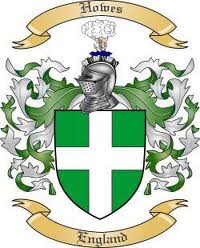
It is claimed that this family descends from one John de Huse who had a large manorial property in Basthorpe, Norfolk, England in 1065.
Penninahs father was a Reverend, Rector of Eastwell, Kent. Penninah and her brother Samuel Howes were arrested in 1632 in London in connection with the prosecution of Rev John Lothrop and his flock of Dissenters who had been meeting in Blackfriars, London. Penninah Howes was called and required to take her oath but she refused. The prosecutor asked “Will you trust Mr Lathropp and believe him rather than the Church of England?” She replied “I referre myself to the Word of God, whether I maie take this oath or now.”
Jemimah Peninah Howse (1589 – 1633)
is my 13th great grandmother
Sarah Linnell (1603 – 1652)
daughter of Jemimah Peninah Howse
Thomas Ewer (1593 – 1638)
son of Sarah Linnell
Mary Ewer (1637 – 1693)
daughter of Thomas Ewer
Mehitable Jenkins (1655 – 1684)
daughter of Mary Ewer
Isaac Hamblin (1676 – 1710)
son of Mehitable Jenkins
Eleazer Hamblin (1699 – 1771)
son of Isaac Hamblin
Sarah Hamblin (1721 – 1814)
daughter of Eleazer Hamblin
Mercy Hazen (1747 – 1819)
daughter of Sarah Hamblin
Martha Mead (1784 – 1860)
daughter of Mercy Hazen
Abner Morse (1808 – 1838)
son of Martha Mead
Daniel Rowland Morse (1838 – 1910)
son of Abner Morse
Jason A Morse (1862 – 1932)
son of Daniel Rowland Morse
Ernest Abner Morse (1890 – 1965)
son of Jason A Morse
Richard Arden Morse (1920 – 2004)
son of Ernest Abner Morse
Pamela Morse
I am the daughter of Richard Arden Morse
The Howes, Lothrops, and Linnells of Kent and London, England, and Scituate
and Barnstable, Massachusetts
By Dan R. McConnell
Published by the Cape Cod Genealogical Society Bulletin, Fall 2007
The family of Reverend John Howes [also House, Howse], whose children, kin, and friends, were brought before the Royal Court of the High Commission in London, England in the 1630’s, were persecuted and imprisoned for their religious beliefs. These beliefs also had political effects, which we will explain. Some fled to America, first to Scituate, then Barnstable, both of which were in Plymouth Colony in that time, a place friendly to their Separatist beliefs. Others remained in England and played a key role in the emergence of non-conformist churches, the disputes in Parliament, and the English Civil War.
In the 17th Century, for ordinary people, a lengthy confinement in London prisons such as Newgate, Clink, Fleet or Bridewell was tantamount to a death sentence due to crowded, filthy, disease-ridden conditions. Such dangerous confinement, for religious non-conformity, under the arbitrary rules of the High Commission, became a driving force for like minded people to flee to America. English resentment to the many breaches of Common Law led to the rise of Parliament in opposition, and ultimately to the abolishment of the High Commission in 1641 and the Civil war in the 1640’s. After the “Glorious Revolution’ in 1688, the English Bill of Rights was enacted to specifically forbid such practices, echoed famously in our own Bill of Rights, the First Ten Amendments to the U.S Constitution.
For the Howes family and their kin, the road to prison and to America began in Kent. The Reverend John Howes matriculated at St. John’s College, Cambridge in 1590. He is listed in the Alumni Cantabrigienes as such with the further note that he was rector at Eastwell, Kent in 1610. In the Bishop’s Transcripts for Canterbury he is also given as Curate for Egerton, 1592-6. From his location at the time of the baptism of his children, he is likely to have also been Curate for Eastwell from 1603 to his death in 1630. He performed the marriage ceremony for his daughter Hannah, in her marriage to Rev. John Lothrop [also Lothropp] in Eastwell, 16 October, 1610. In his will, dated 1630, he is described as Minister, Eastwell. In his will, his wife’s name is given as Alice.
Children of the Reverend John Howes:
Elizabeth Howes, Bapt, unkn. Married, Eastwell to John Champion, of Little Chart, 28 September 1607
Hannah Howes, Bapt. Egerton, 5 May, 1595. Died between 1632 and 1634, London, while her husband, Rev Lothrop, was in prison. Married,Eastwell to Rev. John Lothrop, 16 October 1610.
Peninah Howes, Bapt, Egerton, 11 April, 1596. Died after 1669, Barnstable, Massachusetts.
Married between 1632 and 1638 to Robert Linnell, probably in London.[The will of her brother Thomas Howes, in 1643 gives her name as Peninah Linnell [also Lynell]. In the High Commission proceedings in 1632, she is given as Peninah Howes].
Druscilla Howes. Bapt., unkn. Married, Eastwell, to Simon Player 17 April 1637 John Howes. Bapt. Eastwell 19 June, 1603. Married Eastwell to Mary Osborn of Ashford, 18 September, 1623.
Priscilla Howes. Bapt Eastwell 25 August, 1605. Buried, Eastwell 28 Nov 1618
Thomas Howes. Bapt. Eastwell, 21 August, 1608. Died 1644 London. In his will, dated 18 October 1643, he lists his wife Elizabeth, his brother Samuel [of Scituate and Barnstable, Mass. See Great Migration Series, Vol. III, I634-5, page 424-8], his sister Peninah Lynell, his sister Druscilla Player.
He also lists as administrators, the famous Puritan Praise God Barbon [Speaker of Parliament during the Commonwealth period, known as “Barebones Parlaimant”, and William Granger, who was brought up before the High Commission along with Barbon’s wife Sara. All were members of Rev. Lothrop’s congregation in London]
Samuel Howes. Bapt Eastwell, 10 June, 1610. Died 12 September 1667, Mass. Married about April 1636 to Ann Hammond of Watertown, Mass. He emigrated to America in 1634, joined Rev Lothrop’s church in Scituate then Barnstable, and returned to Scituate.
Henry Howes. Bapt. Eastwell, 28 June, 1612.
Note. There has been great confusion in the American record to the effect that Robert Linnell’s first wife was a Jemimah Howes, presumably another daughter to Rev. John Howes. This has been compounded by an LDS record of the supposed marriage of a Jemimah Howes to Robert Linnell in 1621 in Ashford, Kent. There are no records to support this.
John Lothrop, son of Thomas Lothrop, bapt, Etton, Yorkshire, 20 Dec, 1584, first entered Oxford, then withdrew and matriculated at Queen’s College, Cambridge, graduating with a B.A 1606, M.A. 1609. He was curate at Little Chart 1609, Egerton 1610, serving until his resignation between 1621 and 1624. In 1625, he succeeded Henry Jacob as Minister to the first Independent Church in London, founded in 1616, and one of the five oldest independent [non-conformist]
churches in England. The principles or covenant of the Jacob/Lothrop church were essentially Separatist and were very close to those of the Rev. John Robinson in Leiden [Pilgrims]. During a period of exile before 1616, Henry Jacob resided with the Robinson congregation in Leiden. These
churches were illegal, as the Church of England, under the King and his appointed Archbishop of Canterbury was the only legal church. The Jacob/Lothrop church met in private, in the homes of congregants. These secret meetings for the purpose of praying preching and interpreting the Bible, were called conventicles.
In 1632, Rev. Lothrop was arrested in the house of one of his congregants along with 42 of his congregation, and was brought before the Court of the High Commission. He, and they, were charged with sedition and holding conventicles. The political nature of the charge of sedition [“an insurrection against established authority”], and the antique language of “conventicle’ [ a
private meeting to hear illegal preaching] renders the charges unclear to modern ears. The charges were, however, deadly serious and the court proceedings unimaginable. The accused had none of the rights of modern citizens. The court was an inquisition, where the accused were forced to testify against themselves, with our counsel. The process was so intimidating that many people were driven to flee. It was one of the driving forces in the Great Migration to New England.
It was no dispute over prayer books and vestments. It was about life, death, and salvation. First, what was the Court of the High Commission? It, along with the Court of the Star Chamber, was a Royal Prerogative Court [King’s Rights], originally created in the time of Henry VII [1485-1509]. These courts were separate from the Civil Courts, or Common Law Courts, which
operated on the basis of precedent, and the rights of English people under the Common Law.
Originally, these courts were established under the King’s right to protect individuals from abuse in Common Law Courts. Under the Elizabeth I and the Stuart Kings [James I and Charles I], these courts were used by the Church of England to suppress those who sought to reform the church, or to seek a different path to salvation, using court rules that were in clear violation with the Common Law. They came down, with extreme severity, on Separatists in particular. Because of
their covenant relationship, Separatists believed that every congregation could be a church unto itself, and could elect it’s own Ministers, by vote of it’s elders, based upon the model of the early Christian church [pre-Constantine]. To do so meant they had no need of the Church of England, and did not accept the authority of the Bishops. This was unacceptable to the Crown. As famously said by King James I, “ No Bishop, no King”. Since the King was the head of the Church of England,
and appointed the Archbishop, he wanted one church with order and conformity. To the King, the Separatists position implied anarchy and chaos, and must be stopped. As James I said further, “ I will harry them out of the land”.
Under Charles I and his Archbishop, William Laud, the screws were tightened much more. Laud was the Chief Judge of the High Commission. In his zeal to suppress nonconformists, he scrapped several principles of English Common Law, including [1] protection against selfincrimination, 2] the right to confront one’s accusers, [3] the right to produce witnesses in one’s
own defense, [4] the right to a prompt hearing in court, so one did not languish in a dangerous jail without a trial, and [5] cruel and unusual punishments. All of these rights were suspended for those, such as the members of Rev. Lothrops congregation, who were brought before the Court of the High Commission in May 1632.
The Ministers and there flock faced brutal treatment. For the high crime of publishing tracts critical of the Bishops many ministers had their ears cut off, their faces branded and were confined to prison for life, which meant death within a few months or a few years at most. When one was brought before the court, the requirement was to sign an oath of Allegiance to the
Church of England, to forswear any contrary belief or practice and to answer any question posed by the judges,consisting of Laud and five other Bishops. To do so meant to abandon their right to choose their own Minister, to hear preaching and to attend Bible study with a Minister of their choice. They believed their own souls to be at stake. They were not allowed any of the basics of a fair trial, and certainly faced cruel punishment. So what did they do? They refused to swear the oath and were jailed. Some died in prison, some were released and fled to America, and some fought for Parliament in the English Civil War.
Now, hear the voices of Archbishop Laud, of Rev. John Lothrop and of the Howes and their friends [from the Proceedings of the Court of the High Commission]:
“ 5 May, 1632. This day were brought to the court out of prison diverse persons whixh were taken on Sunday last at a conventicler met at the House of Barnet, a brewer’s clerk, dwelling in the precinct of Black Friars: By name, John Lothrop, their Minister, Humphrey Barnard, Henry Dod, Samuel Eaton, William Granger, Sara Jones, Sara Jacob, Peninah Howes, Sara Barbon, Susan Wilson and diverse others”—
Statement by the Archbishop—“ You show your selves to be unthankful to God, to the King and to the Church of England, that when, God bbe praised, through his Majesties care and ours that you have preaching in every church, and men have liberty to join in prayer and participation in the sacrements and have catechizing to enlighten you, you in an unthankful manner cast off all this yoke, and in private unlawfully assemble yourselves together making rents and divisions in the church.—You are unlearned men that seek to make up a religion of your own heads!”—“you are desperately heretical”
“Then came in Mr. Lothrop, who is asked by what authority he had to preach and keep this conventicler.” Laud,–“How many women sat cross legged upon the bed, while you sat on one side and preached and prayed most devoutly?” Lothrop. “I keep no such evil company” “Will you lay your hand upon the book and take your oath?’ Lothrop. “I refuse the oath.”
Peninah Howes “ I dare not swear this oath till I am better informed of it, for which I desire time”;;;”I will give an answer of my faith, if I be demanded, but not willingly forswear myself”
Sara Barbon “ I dare not swear, I do not understand it. I will tell the truth without swearing”
Then they were then all taken to the New Prison.
“8 May, 1632. Laud to Sara Jones—“ This you are commanded to do of God who says you must obey your superiors.” Sara Jones “That which is of God is according to God’s Word and the Lord will not hold him guiltless that takes His name in vain”
‘Lothrop. I do not know that that I have done anything which might cause me justly to be brought before the judgement seat of man, and for this oath, I do not know the nature of it”
Laud “You are accused of Schism”
To Samuel Howes ‘Will you take your oath?’ Howes I am a young man and do not know what this oath is”
Peninah Howes is then asked to take the oath, but she refused. Laud “Will you trust Mr Lothrop and believe him rather than the Church of England?’
Because women were not able to hold property she had to sue the court in 1669 for her husband’s estate:
Robert, called “my Brother,” by Mr. John Lothrop, adm. chh. scituate with his wife Sept. 16. 1638, “having a letter of dismission from the church in London.: Took oath of allegaince 1 Feb. 1638. Propr. at Barnstable 22 jan 1638-9. ch. Hannah (m. 15 March, 1648, John Davis of Bar.,) Abigail, (m. May 1650, Joshua Lombard,) David, (m. March 9, 1652, Hannah Shelley).
He made will 23 Jan. 1662, prob. 12 March, 1662-3; beq. to wife; to son David; to Abigail and Bethys; to John Davis. The widow Penninnah petitioned the Court 29 Oct. 1669, to recover the house her husband had left her from the hands of David L.
Book of Sports
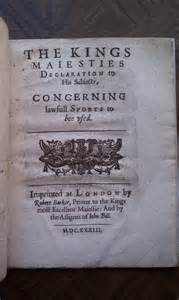
When James I of England published the Book of Sports in 1617 it caused an uproar from the Puritans. The belief that no work or pleasure should take place on the sabbath was much debated at that time in Britain. The book was published after King James had his very own translation of the Bible released. Trouble was brewing in the British Isles that would eventually lead to the settlement of Plymouth Colony. The Puritans believed that all citizens must be required to attend religious services on Sunday, and they wanted them mandatory morning and evening on that day. Many of my own ancestors left England to live in Holland for a decade about that time, before sailing on the Mayflower to America. All the countries in Europe posed problems to their ideals except the Netherlands. There they could practice their severe brand of religion. There they built up strength to go to the new world.
The concept is taught to American children that these people came to America for religious freedom. That is only partially the case. They wanted to be free to dominate others and force them to follow Puritan rules. The freedom was just for their own religious beliefs, but did not apply to the beliefs of others. They were convinced of the righteousness of their logic. This made life in the new colony very contentious. It was easy to run afoul of the Pilgrim fathers who were all about sabbath and strict adherence.
Charles I reissued the Declaration of Sports in 1633, continuing the tradition of requiring attendance to religious services (in the Church of England) to qualify to dance, leap, or play sports on Sunday. There were a few sports not permitted on the sabbath such as bear and bull baiting and bowling. Charles I expanded the merriment to include local fairs and festivals on the list of sanctioned Sunday activities. England was trending Puritan in the 1630’s. In 1643 the book was publicly burned. When Charles II was restored to the throne after the English Civil War in 1660 the country was liberated from the strict sabbath rules and could once again party on Sunday afternoons.
When we think about sports and religion in America today we observe a very different story. Church attendance and membership are dropping off dramatically, but sports dominate the public attention. It is ironic to think that our initial colony was founded to make sure that Sunday would be sport free for everyone. I wonder what the Pilgrim fathers would think of the NFL and the NBA.
My 11th great-grandfather was born in England in 1590, and died in Bridgewater, Massachusetts in 1667. He was active in service to the colony.
Descendants of John Peabody[From Ancestors and Anecdotes Genealogy Blog, posted 17 Jan 2007 by JEM]
JOHN1 PEABODY was born 1590 in St. Albans, Hertfordshire, England, and died 1667 in Bridgewater, Mass. He married ISABEL HARPER Bet. 1608 – 1638. She was born 1592 in St. Albans, England, and died Bet. 1624 – 1686. The name Peabody is said to have originated during the reign of Nero, when Queen Broadicia was located at Icena, Briton. This Brave Queen opposed the Romans in their invasion of the country and with her son Boadie, took refuge in the craggy heights of Wales. Among his Britain’s “Boadie” signified a man of great strength and Pea meant “hill or mountain”. Consequently the name Peabody was applied to a mountain man. This name became the name of a tribe and in some branches of the family, “Boadie” became anglicized to the name Mann and Pea into the well-known name of Hill.In later times the name was spelled in different ways; Pbodie,Paybody, and Peabody. One of the earliest settlers in America of this name was William Pabodie who was a member of Captain Miles Standish’s military company of Mass. in 1643. John Peabody was another early settler who was active colonist of the Bay State, serving as its ensign, captain and deputy to the general court. More About JOHN PEABODY:Came to America: 1635, Bridgewater, Mass Isabell married John Peabody in 1608 in Stafford Stafford England. (John Peabody was born in 1589-1590 in St Albans Hertfordshire England, christened about 1635 in St AlbansHertfordshire England, died in Apr 1667 in Bridgewater Plymouth MA and was buried on 27 Apr 1667 in Boston Suffolk MA.More
Note to Reader: This genealogical narrative is drawn from my many years of research on the Peabody family and related families. It is presented here, for what help it might be to other researchers, in the same format as it was first published on my website in about 1998. No effort has been made to update this material or to incorporate more recent genealogical discoveries published on Ancestry.com or elsewhere. The list of sources at the end may prove especially helpful. This narrative is archived at http://web.archive.org/web/20001018124830/www.pbdy.com/begin.html -Velton Peabody
JOHN PAYBODY1 was born about 1590 in England. He probably arrived in the Plymouth Colony in 1635 or 1636, for his name appears on the list of freemen of the colony dated March 7, 1636/37, and he was admitted and sworn with others whose names were on that list on Jan. 2, 1637/8. He married Isabel Harper, sister of Thomas Harper of London, England.John Peabody received a grant of 10 acres of land Jan. 1, 1637/8, “on Duxburrow side, lying betwixt the lands of William Tubs on the north side and those of Experience Mitchell on the south side, and from the sea in the west; and from Blew Fish River in the easte.” Another tract, granted him Nov. 2, 1640, was 30 acres “with meadow to it” at North River. He was a member of the jury that convicted three young Englishmen of the murder of an Indian on Sept. 4, 1638, and of the “Grand Inquest” at the court June 4, 1639. He was one of the sureties on a neighbor’s bond June 4, 1645.In 1645, John Paybody and his son, William, were among the original proprietors of Bridgewater, Mass. He was a witness with Thomas Winterton against Edward Richards when he was tried in court at Salem 4:9:1645, on a charge of making a false statement to them concerning shipboard killings. Richards was convicted and fined 10 shillings and ordered to acknowledge his sin before the congregation at Lynn.John’s will, dated July 16, 1649, at Duxbury, was proved Apr. 27, 1666/7 at Boston:“In and about the sixteenth of July in the yeare of our Lord 1649 I John Paybody of Duxbrook in the Collonie of New Plymoute planter being in prfect health and sound in memory God be blessed for it doe ordaine and make this my last Will and Testament In maner and forme as foloweth;“Imprimis I bequeath my soule to God that gave it hopeing to be saved by the Meritt of Christ my blessed Saviour and Redeemer; as for my worldly goods as followeth“Item I give and bequeath unto Thomas my eldest sonne one shilling“Item I give and bequeath unto ffrancis Paybody my second son one shilling.“Item I give and bequeath unto William Paybody my youngest son one shilling.“Item I give and bequeath unto Annis Rouse my daughter one shilling.“Item I give and bequeath unto John Rouse the son of John Rouse my lands att Carswell in Marshfield after my wifes decease;“Item I give unto John Pabodie the son of William my lott of Land att the new plantation,“Item I give and bequeath all the Rest of my goods that are my mine liveing and dead unto my wife Isabell Paybody whome I make my sole executrix of this my last Will and Testament; memorandum all these legasyes before sett downe are to yayed by William Paybody my youngest son when they shallbe demanded John PaybodyJohn ffernesyde Boston in New England the 27th of April, 1667“Mr John ffernesyde came before mee under written and deposed that by order of Paybody above written and mentioned: hee wrote what is above written and Read it to the said John Paybody on the day of the date thereof and declared the same to be his Last Will and that when hee soe did hee was of a sound disposing mind to his best knowlidg and alsoe subscribed his name thereunto John ffernesyde as a witness; As Attesteth Edward Rawson Recorder”Children, probably all born in England: i. Thomas,2 b. about 1612 #2 ii. Francis, b. about 1614#3 iii. William, b. 1619 iv. Annis or Annie, b. about 1620; m. Jan. 7, 1638/9, in Marshfield, John Rouse of Marshfield; John was a Quaker, he was a town officer in Marshfield in 1645; he d. Dec. 16, 1684, in Marshfield, and she d. before Sept. 12, 1688, when he will was proved; children: Mary Rouse, John Rouse, Simon Rouse, George Rouse, Elizabeth Rouse, Anna Rouse.Sources: Records and Files of the Quarterly Courts of Essex County, [Mass.], I, 1911; “Plymouth Colony Wills and Inventories,” Mayflower Descendant XVII:1 (January 1915); Justin Winsor, History of the Town of Duxbury, Massachusetts, 1849; Eugene Willard Montgomery, Willard Peabody Genealogy, 1915; Charles Henry Pope, Pioneers of Massachusetts, 1900; William Richard Cutter and William Frederick Adams, Genealogical and Personal Memoirs Relating to the Families of the State of Massachusetts, II, 1910; C.M. Endicott, Genealogy of the Peabody Family, 1867, revised and corrected by William S. Peabody with a partial record of the Rhode Island Branch by B. Frank Peabody, cited hereafter as Peabody Genealogy, 1867; Selim Hobart Peabody, Peabody (Paybody, Pabody, Pabodie) Genealogy, 1909, cited hereafter as Peabody Genealogy, 1909; Leon Clark Hills, History and Genealogy of the Mayflower Planters (Cape Cod Series), I, 1975 reprint of 1936 1941 ed.; Dorothy A. Sherman Lainson, John Paybodie (Peabody) English Immigrant to Plymouth Duxbury, 1635, 1972; Goldie Peabody Brownyard and Theodore Lucius Brownyard, Ancestors and Descendants of Charles Elmer Peabody, 1980; Richard Gentry, Gentry Family in America, 1909; Detroit Society for Genealogical Research Magazine XXX:3 (Spring 1967); Family History Library; William R. Marsh, Ancestors and Descendants of F.A. Marsh and Ivy Crites, 1990; Nahum Mitchell, History of the Early Settlement of Bridgewater, in Plymouth County, Massachusetts, 1840.
CaptainJohnPabodie
John Peabody and descendants
The PEABODY Family of St. Albans, Hertfordshire, Hampton, Rockingham, NH and Topsfield, Essex, MASend comments and corrections to anneb0704@yahoo.co.ukJOHN PAYBODY (d. by 1649) of St. Albans and Duxbury m. Isabel Harper|FRANCIS PEABODY (abt 1614 – 1698) of Hampton and Topsfield m. Lydia Unknown|WILLIAM PABODIE (c. 1620 – 1707) m. Elizabeth Alden|LYDIA PEABODY (bp. 1640 – 1715), wife of Thomas Howlett 2LYDIA PABODIE (1667 – 1748) m. Daniel Grinnell
History of the Town of Duxbury, Massachusetts with Genealogical Registers
Seventeenth Century Colonial Ancestors, Vol. I
Elizabeth (Alden) Pabodie and descendants
A genealogy of the Peabody family
John Capt Peabody Pabodie (1590 – 1667)
is my 11th great grandfather
Lieut Francis Peabody (1614 – 1697)
son of John Capt Peabody Pabodie
Lydia Peabody (1640 – 1715)
daughter of Lieut Francis Peabody
Mary Howlett (1664 – 1727)
daughter of Lydia Peabody
John Hazen (1687 – 1772)
son of Mary Howlett
Caleb Hazen (1720 – 1777)
son of John Hazen
Mercy Hazen (1747 – 1819)
daughter of Caleb Hazen
Martha Mead (1784 – 1860)
daughter of Mercy Hazen
Abner Morse (1808 – 1838)
son of Martha Mead
Daniel Rowland Morse (1838 – 1910)
son of Abner Morse
Jason A Morse (1862 – 1932)
son of Daniel Rowland Morse
Ernest Abner Morse (1890 – 1965)
son of Jason A Morse
Richard Arden Morse (1920 – 2004)
son of Ernest Abner Morse
Pamela Morse
I am the daughter of Richard Arden Morse
buried in Plymouth
My 13th great-grandmother arrived in Plymouth Colony in 1623 on the ship Ann. Her husband was a Mayflower Compact signer. She lived a long and, for her time, independent life. We know a lot about her:
A WOMAN OF VALOR : ELIZABETH WARREN OF PLYMOUTH COLONY by Peggy M. Baker
Director & Librarian, Pilgrim Society & Pilgrim Hall Museum
“A woman of valor, who can find? Far beyond pearls is her value… Give her the fruit of her hands, and she will be praised at the gates by her very own deeds.”
Proverbs 31:10
The “Pilgrim Mothers” are mysteries. These intrepid women of 17th century Plymouth Colony are known by their husbands and known by their children. Their own lives, however, are seen only in glimpses, pale images reflected off the activities of the families which revolved around them. The women themselves are almost invisible. While the court records of Plymouth Colony reveal much about the daily activities of the law-abiding men of the Colony, they tell us little about the women (except for those few women who broke the law). There was, in fact, no officially recognized role for the law-abiding married woman. The activities and contributions of those women, although vital to the survival and success of the Colony, are nowhere registered or officially acknowledged.
According to the accepted legal convention of the times, all married women, even those conducting business independently, were regarded as representatives of their husbands. Only widows could be legally recognized as agents in their own right. Very few widows availed themselves of the privileges and the responsibilities that such independent status would entail.
One Pilgrim woman, however, breaks through the patriarchal conventions of 17th century society. By the longevity of her widowhood and by the independence of her actions, Elizabeth Warren emerges from the collective category of “Pilgrim Mother” as a highly individual woman.
Elizabeth Warren appears full-grown on the shores of American history. Nothing is known of her English background, apart from her marriage to Richard Warren. Richard was one of the 102 passengers on the Mayflower, that sailed into Plymouth Harbor in December 1620.
Many of the Mayflower passengers traveled as families. Some families, however, with many young children or other family responsibilities, or those thought (in Pilgrim William Bradford’s words) “most unfit to bear the brunt of this hard adventure,” separated. The men sailed in 1620 and the women and children delayed their sailing, planning on joining their menfolk after the Colony was established. Richard Warren was among the men who sailed alone in 1620.
According to family tradition, Richard Warren brought with him on the Mayflower a particularly treasured (and very portable) family possession – a large linen damask napkin, woven in the Netherlands c.1600, now on display at Pilgrim Hall Museum in Plymouth, Massachusetts.
The napkin’s woven design forms horizontal bands. One band shows a series of symbols – maces encircled by laurel branches and flanked by winged cherubs — representing the city of Amsterdam, with the words “Amster Dam” appearing beneath each symbol. Another band shows the city with houses, churches and canal bridges. The harbor below has rows of small boats with festive figures that appear to be dancing among barrels and boxes on the near shore.
The Warren family was separated for three years. One small ship, the Fortune, arrived in Plymouth in 1621 carrying a number of “lusty young men, and many of them wild enough” to supplement the fledgling Colony’s manpower. It was not until 1623 that two ships, the Anne and the Little James, arrived in Plymouth carrying 80-some new immigrants to Plymouth Colony, including members of the separated families. Among them were Fear and Patience Brewster, the daughters of Mayflower passengers William and Mary Brewster, as well as Samuel Fuller’s wife Bridget. Francis Cooke, who had voyaged on the Mayflower with his teenage son John, was joined by his wife, Hester, and their three younger children Jane, Jacob and Hester. Richard Warren was reunited by his wife Elizabeth and the five Warren daughters, Mary, Anna, Sarah, Elizabeth and Abigail.
The Warrens joined in the life of the small but growing agricultural community : Richard would have played a role in public affairs and worked the fields. Elizabeth would have run the large household that included not only the immediate family but also their farm workers and hired help. On occasion, she would have joined Richard in the fields. The Warren home would have been small and modestly furnished.
Very little furniture survives from the early years of Plymouth Colony. Most pieces were simple and sturdy, suited to life in a frontier community. The Warren “joint stool,” so-named for its joined mortise-and-tenon construction, would have been used both as seating furniture and as a table. The Warren stool is now in the collections of Pilgrim Hall Museum.
Two sons were born to the Warrens after Elizabeth’s 1623 arrival in Plymouth Colony. Their birth dates are not recorded but evidence of their presence can be found in the “1627 Division of Cattle.”
In 1627, the Colony’s livestock, formerly held in common, was divided among the Colony’s residents. Every person living in Plymouth in 1627 was assigned to a “Lot,” generally arranged by family group, and the name of every resident was individually recorded in Plymouth Colony Records Volume I. Listed there we find not only Richard and Elizabeth and their five daughters, but also the names of their two young sons, Nathaniel and Joseph Warren.
Richard Warren died in 1628. Elizabeth, left a widow with 7 children (five young women, ranging from early teens to probably early twenties, and two small boys under the age of 5), never remarried. Elizabeth outlived her husband Richard by 45 years.
Unlike the majority of Plymouth Colony women, Elizabeth Warren’s name appears regularly in the records of Plymouth Colony during the long period of her widowhood. She appears first as paying the taxes owed by all heads of household. She appears next as executor of her husband’s estate.
Elizabeth then appears as one of the Plymouth Colony “Purchasers.” In 1626, 53 (male) citizens of Plymouth Colony agreed to underwrite some of the Colony’s debt in a complicated arrangement with its financial backers. Richard Warren was one of the original 1626 Purchasers. The list of the names of the Purchasers did not appear in the Plymouth Colony Records, however, until several years had passed. During that time, Richard Warren had died. In a startling break with tradition, the list of Purchasers does not contain the name of Richard Warren but, instead, “Elizabeth Warren, widow.” The Court felt it necessary to explain this unprecedented move, noting that Elizabeth was listed in Richard’s stead because Richard, “dying before he had performed the bargain, the said Elizabeth performed the same after his decease.”
In 1635, Elizabeth Warren appears in the Records of Plymouth Colony in a totally new role. No longer seen as acting to fulfill the obligations of her long-deceased husband Richard, Elizabeth now enters the recorded life of the Colony as a totally independent agent. We have not only a court case involving Elizabeth, we hear an echo of her actual words.
Elizabeth brought her servant Thomas Williams before the Court for “speaking profane & blasphemous speeches against the majesty of God.” In a disagreement between mistress and servant, Elizabeth Warren had exhorted Thomas Williams “to fear God and do his duty. He answered, he neither feared God, nor the devil.” Although Governor William Bradford advocated “bodily punishment,” the judgment of the Court was that a reproof was sufficient, Williams having “spoken in passion and distemper,” and making “humble acknowledgment of his offense.”
Elizabeth’s activities continue to be documented to an unusual extent in theRecords of Plymouth Colony. In the late 1630s, she appears in the Records deeding land from the Warren holdings in Plymouth’s Eel River Valley to her sons-in-law.
The Warren daughters had matured and married: Mary to Anne passenger Robert Bartlett, Anna to Thomas Little, Sarah to Mayflower passenger John Cooke, Elizabeth to Richard Church and Abigail to Anthony Snow. Relations within the large extended family seemed amicable.
In 1652, however, trouble suddenly loomed! Elizabeth’s deeds to her sons-in-law, deeds that had been executed 15 years previously, were challenged by persons unnamed. The Plymouth Colony Records report a petition brought by Elizabeth’s son-in-law Robert Bartlett asking for clarification of Elizabeth’s right to deed land because “sundry speeches have passed from some who pretend themselves to be the sole and right heirs unto the lands on which the said Robert Bartlett now liveth, at the Eel River, in the township of Plymouth, which he, the said Robert, had bestowed on him by his mother-in-law Mistress Elizabeth Warren.”
The Court decided, unequivocally, in Elizabeth’s favor, finding that she had the power to give the land, since she had been “by an order of Court bearing date March the 7th, 1637, and other acts of the Court before, invested into the state and condition of a Purchaser.”The Court once again ratified and confirmed her status as a Purchaser and specifically ruled that Elizabeth Warren had the right to dispose of her lands, including the gifts of land she had made to her sons-in-law. Even this clear-cut Court ruling was insufficient to settle the quarrel. And as the dispute continued, the identity of those “who pretend themselves to be the sole and right heirs” was revealed to be Elizabeth’s own son Nathaniel Warren and his grandmother-in-law Jane Collier.
Nathaniel, now married and in his mid-to-late 20s, claimed that he “hath right unto as heir unto the lands of Mr. Richard Warren, deceased.” The two sides in the quarrel agreed to submit the argument to arbitration, each choosing 2 members to sit on the 4-man arbitration panel. Elizabeth Warren chose William Bradford and Thomas Willett. Nathaniel Warren chose Thomas Prence and Myles Standish.
The arbitration panel came swiftly to its unanimous conclusion. Nathaniel Warren received an acknowledgment of his right to share in the Warren lands. The panel confirmed what had never seemed to be in doubt, namely that Nathaniel could continue to hold the land he currently possessed. Nathaniel was also granted 2/3 of the Warren “Purchase Lands” which had not as yet been assigned and possession, after Elizabeth’s death, of 3 acres of land near his current holdings.
The major finding of the arbitration panel, however, must have come as a severe shock to young Nathaniel! The expected outcome by law and by custom would certainly have favored Elizabeth’s son. But, far from vindicating his patriarchal claims, the panel issued a stunning and resounding confirmation of Elizabeth’s status as head of her household and of her authority to act as an independent agent. The panel not only found that she “shall enjoy all the rest of her lands and all of them to whom she hath already at any time heretofore disposed any part thereof by gift, sale or otherwise, or shall hereafter do the same, to them and their heirs for ever without any trouble or molestation” but severely rapped Nathaniel’s unfilial knuckles. The Court concluded by bidding Nathaniel to
forever cease all other or further claims, suits, questions, or any molestations or disturbance at any time hereafter concerning the premises, but that his said mother and all her children, or any other to whom she has any way disposed any lands or shall hereafter do the same, but that they may quietly and peaceably possess and enjoy the same.
Elizabeth Warren seems, indeed, to have quietly and peaceably enjoyed the remainder of her days. When she died in 1673, this remarkable woman received the unprecedented but well-earned tribute of a eulogy in the Records of Plymouth Colony
Mistress Elizabeth Warren, an aged widow, aged above 90 years, deceased on the second of October, 1673. Who, having lived a godly life, came to her grave as a shock of corn fully ripe.

layout of the plots
Elizabeth Jouatt Walker (1583 – 1673)
is my 13th great grandmother
Nathaniel Warren (1624 – 1667)
son of Elizabeth Jouatt Walker
Sarah Warren (1649 – 1692)
daughter of Nathaniel Warren
Elizabeth Blackwell (1662 – 1691)
daughter of Sarah Warren
Thomas Baynard (1678 – 1732)
son of Elizabeth Blackwell
Deborah Baynard (1720 – 1791)
daughter of Thomas Baynard
Mary Horney (1741 – 1775)
daughter of Deborah Baynard
Esther Harris (1764 – 1838)
daughter of Mary Horney
John H Wright (1803 – 1850)
son of Esther Harris
Mary Wright (1816 – 1873)
daughter of John H Wright
Emiline P Nicholls (1837 – )
daughter of Mary Wright
Harriet Peterson (1856 – 1933)
daughter of Emiline P Nicholls
Sarah Helena Byrne (1878 – 1962)
daughter of Harriet Peterson
Olga Fern Scott (1897 – 1968)
daughter of Sarah Helena Byrne
Richard Arden Morse (1920 – 2004)
son of Olga Fern Scott
Pamela Morse
I am the daughter of Richard Arden Morse
Richard & Elizabeth Warren appear often in the records of the 17th century:
Richard Warren : Mayflower passenger
“The names of those which came over first, in the year 1620, and were by the blessing of God the first beginners and in a sort the foundation of all the Plantations and Colonies in New England ; and their families … “Mr. Richard Warren, but his wife and children were left behind and came afterwards.”
William Bradford, Of Plymouth Plantation 1620-1647, ed.
Samuel Eliot Morison (New York : Knopf, 1991), p. 441-3.
It is possible that Elizabeth Warren and her daughters were also part of the original group that meant to travel to America. William Bradford notes that, when the Speedwell was determined to be unseaworthy,
“…it was resolved to dismiss her [the Speedwell] and part of the company, and proceed with the other ship [the Mayflower]. The which (though it was grievous and caused great discouragement) was put into execution. So after they had took out such provision as the other ship could well stow, and concluded both what number and what persons to send back, they made another sad parting; the one ship [the Speedwell] going back for London and the other [the Mayflower] was to proceed on her voyage. Those that went back were for the most part such as were willing so to do, either out of some discontent or fear they conceived of the ill success of the voyage, seeing so many crosses befall, and the year time so far spent. But others, in regard of their own weakness and charge of many young children were thought least useful and most unfit to bear the brunt of this hard adventure; unto which work of God, and judgment of their brethren, they were contented to submit.”
William Bradford, Of Plymouth Plantation 1620-1647, ed. Samuel Eliot Morison (New York : Knopf, 1991), p. 53.
Richard Warren : Signer of the Mayflower Compact
“I shall … begin with a combination made by them before they came ashore; being the first foundation of their government in this place. Occasioned partly by the discontented and mutinous speeches that some of the strangers amongst them had let fall from them in the ship: That when they came ashore they would use their own liberty, for none had power to command them, the patent they had being for Virginia and not for New England … And partly that such an act by them done, this their condition considered, might be as firm as any patent, and in some respects more sure. “The form was as followeth : IN THE NAME OF GOD, AMEN. We whose names are underwritten, the loyal subjects of our dread Sovereign Lord King James, by the Grace of God of Great Britain, France and Ireland King, Defender of the Faith, etc. Having undertaken, for the Glory of God and advancement of the Christian Faith and Honour of our King and Country, a Voyage to plant the First Colony in the Northern parts of Virginia, do by these presents solemnly and mutually in the presence of God and one of another, Covenant and Combine ourselves together into a Civil Body Politic, for our better ordering and preservation and furtherance of the ends aforesaid; and by virtue hereof to enact, constitute and frame such just and equal Laws, Ordinances, Acts, Constitutions and Offices, from time to time, as shall be thought most meet and convenient for the general good of the Colony, unto which we promise all due submission and obedience. In witness whereof we have hereunder subscribed our names at Cape Cod, the 11th of November, in the year of the reign of our Sovereign Lord King James, of England, France and Ireland the eighteenth, and of Scotland the fifty-fourth. Anno Domini 1620.”
William Bradford, Of Plymouth Plantation 1620-1647, ed. Samuel Eliot Morison (New York : Knopf, 1991), p. 75-76.
Richard Warren and the “First Encounter”
This story appears both in Mourt’s Relation, published in London in 1622, and (in a condensed version) in William Bradford’s Of Plymouth Plantation.
“Wednesday, the sixth of December [1620]. It was resolved our discoverers should set forth … So ten of our men were appointed who were of themselves willing to undertake it, to wit, Captain Standish, Master Carver, William Bradford, Edward Winslow, John Tilley, Edward Tilley, John Howland, and three of London, Richard Warren, Stephen Hopkins, and Edward Doten, and two of our seamen, John Alderton, and Thomas English. Of the ship’s company there went two of the master’s mates, Master Clarke and Master Coppin, the master gunner, and three sailors …
Mourt’s Relation, ed. Jordan D. Fiore (Plymouth, Mass. :
Plymouth Rock Foundation, 1985), p. 27-28.
” … the 6th of December [1620] they sent out their shallop again with ten of their principal men and some seamen, upon further discovery, intending to circulate that deep bay of Cape Cod. The weather was very cold and it froze so hard as the spray of the sea lighting on their coats, they were as if they had been glazed. Yet that night betimes they got down into the bottom of the bay, and as they drew near the shore they saw some ten or twelve Indians very busy about something. They landed about a league or two from them … they made themselves a barricado with logs and boughs as well as they could in the time, and set out their sentinel and betook them to rest, and saw the smoke of the fire the savages made that night. When morning was come they divided their company, some to coast along the shore in the boat, and the rest marched through the woods to see the land, if any fit place might be for their dwelling. They came also to the place where they saw the Indians the night before, and found they had been cutting up a great fish like a grampus …
“So they ranged up and down all that day, but found no people, nor any place they liked. When the sun grew low, they hasted out of the woods to meet with their shallop … of which they were very glad, for they had not seen each other all that day since the morning. So they made them a barricado as usually they did every night, with logs, stakes and thick pine boughs, the height of a man, leaving it open to leeward, partly to shelter them from the cold and wind (making their fire in the middle and lying round about it) and partly to defend them from any sudden assaults of the savages, if they should surround them; so being very weary, they betook them to rest. But about midnight they heard a hideous and great cry, and their sentinel called “Arm! arm!” So they bestirred them and stood to their arms and shot off a couple of muskets, and then the noise ceased. They concluded it was a company of wolves or such like wild beasts, for one of the seamen told them he had often heard such noise in Newfoundland.
“So they rested till about five of the clock in the morning; for the tide, and their purpose to go from thence, made them be stirring betimes. So after prayer they prepared for breakfast, and it being day dawning it was thought best to be carrying things down to the boat …
“But presently, all on the sudden, they heard a great and strange cry, which they knew to be the same voices they heard in the night, though they varied their notes; and one of their company being abroad came running in and cried, “Men, Indians! Indians!” And withal, their arrows came flying amongst them. Their men ran with all speed to recover their arms, as by the good providence of God they did. In the meantime, of those that were there ready, two muskets were discharged at them, and two more stood ready in the entrance of their rendezvous but were commanded not to shoot till they could take full aim at them. And the other two charged again with all speed, for there were only four had arms there, and defended the barricado, which was first assaulted. The cry of the Indians was dreadful, especially when they saw their men run out of the rendezvous toward the shallop to recover their arms, the Indians wheeling about upon them. But some running out with coats of mail on, and cutlasses in their hands, they soon got their arms and let fly amongst them and quickly stopped their violence …
“Thus it pleased God to vanquish their enemies and give them deliverance; and by his special providence so to dispose that not any one of them were either hurt or hit, though their arrows came close by them and on every side [of] them; and sundry of their coats, which hung up in the barricado, were shot through and through. Afterwards they gave God solemn thanks and praise for their deliverance, and gathered up a bundle of their arrows and sent them into England afterward by the master of the ship, and called that place the FIRST ENCOUNTER.”
William Bradford, Of Plymouth Plantation 1620-1647, ed. Samuel Eliot Morison (New York : Knopf, 1991), p. 68-72.
Richard Warren & the 1623 Division of Land
The 1623 Division of Land marked the end of the Pilgrims’ earlier system of land held in common by all. Governor Bradford explains it in this way: “And so assigned to every family a parcel of land, according to the proportion of their number, for that end, only for present use (but made no division for inheritance) and ranged all boys and youth under some family. This had very good success, for it made all hands very industrious, so as much more corn was planted than otherwise would have been by any means the Governor or any other could use, and saved him a great deal of trouble, and gave far better content. The women now went willingly into the field, and took their little ones with them to set corn; which before would allege weakness and inability; whom to have compelled would have been thought great tyranny and oppression.” William Bradford, Of Plymouth Plantation 1620-1647, ed.
Samuel Eliot Morison (New York : Knopf, 1991) p. 120
Plymouth Colony Records, Deeds, &c Vol. I 1627-1651 is the oldest record book of the Plymouth settlement. It begins with the 1623 Division of Land, recorded in the handwriting of Governor William Bradford. The lands of Richard Warren were among those designated as “their grounds which came first over in the May Floure, according as thier lotes were case” and are described in this way “these lye one the north side of the towne next adjoyning to their gardens which came in the Fortune.”
Richard Warren & the 1627 Division of Cattle
Plymouth Colony Records, Deeds, &c, Vol. I 1627-1651 also tells of the 1627 Division of Cattle:
“At a publique court held the 22th of May it was concluded by the whole Companie, that the cattell wch were the Companies, to wit, the Cowes & the Goates should be equally devided to all the psonts of the same company … & so the lotts fell as followeth, thirteene psonts being pportioned to one lot … ” “The ninth lot fell to Richard Warren & his companie Joyned with (2) him his wife Elizabeth Warren (3) Nathaniell Warren (4) Joseph Warren (5) Mary Warren (6) Anna Warren (7) Sara Warren (8) Elizabeth Warren (9) Abigall Warren (10) John Billington (11) George Sowle (12) Mary Sowle (13) Zakariah Sowle. To this lott fell one of the 4 black heyfers that came in the Jacob caled the smooth horned Heyfer and two shee goats.”
Richard Warren : a 1626 Purchaser
In 1621, King James I authorized the Council for New England to plant and govern land in this area. This Council granted the Peirce Patent, confirming the Pilgrims’ settlement and governance of Plymouth. Peirce and his associates, the merchant adventurers, were allotted 100 acres for each settler the Company transported. The Pilgrims had a contract with the Company stating all land and profits would accrue to the Company for 7 years at which time the assets would be divided among the shareholders. Most of the Pilgrims held some stock. The Pilgrims negotiated a more favorable contract with the Company in 1626. In 1627, 53 Plymouth freemen, known as “The Purchasers,” agreed to buy out the Company over a period of years. In turn, 12 “Undertakers” (8 from Plymouth and 4 from London) agreed to pay off Plymouth’s debts in return for trade benefits.
The list we have of the 1626 Purchasers comes from the Plymouth Colony Records (Vol. 2, p. 177). Because of some discrepancies in the names, it is usually assumed that the list was compiled several years after the actual agreement was negotiated. The Plymouth Colony Records do not list Richard Warren; instead “Elizabeth Warren, widdow” is listed even though Richard Warren was still living in 1626/1627.
Richard Warren : his death
“And seeing it hath pleased Him to give me [William Bradford] to see thirty years completed since these beginnings, and that the great works of His providence are to be observed, I have thought it not unworthy my pains to take a view of the decreasings and increasings of these persons and such changes as hath passed over them and theirs in this thirty years … “Mr. Richard Warren lived some four or five years and had his wife come over to him, by whom he had two sons before [he] died, and one of them is married and hath two children. So his increase is four. But he had five daughters more came over with his wife, who are all married and living, and have many children.”
William Bradford, Of Plymouth Plantation 1620-1647, ed.
Samuel Eliot Morison (New York : Knopf, 1991), p. 443-7.
“1628.
“This year died Mr. Richard Warren, who hath been mentioned before in this book, and was an useful instrument ; and during his life bore a deep share in the difficulties and troubles of the first settlement of the plantation of New Plimouth.”
Nathaniel Morton, New England’s Memorial
(Boston : John Usher, 1669)
Richard Warren’s burial site is unknown.
Elizabeth Warren in the Records of Plymouth Colony
1631 [a bequest in the will of Mary Ring] : “I give unto mrs Warren one woodden cupp with a foote as a token of my love.”
Mayflower Descendant, Vol. 1, p. 29-30.
1633 : “a misted [meerstead] that was granted formerly to Richard Warren, deceased, & forfeited by a late order, for want of building, the said misted was granted to Mr. Raph Fog & his heires forever, provided the said Raph w’thin twelve moneths build a dwelling howse upon the same, & allow the widow Warren so much for her fence remayning thereon …”
Plymouth Colony Records, Vol. 1, p. 18.
1633 : “According to an order in Court held the 2d of January, in the seaventh yeare of the raigne of o’r soveraigne lord, Charles, by the grace of God King of Engl., Scotl., France, & Irel., defendr of the faith, &c, the psons heere under menconed were rated for publike use … to be brought in by each pson as they are heere under written, rated in corne at vi [pence] bushell … Widow Warren … 12 s[hilling]s.”
Plymouth Colony Records, Vol. I, p. 9-10.
In 1634, she was also “rated” : “Widow Warren …. 9 [shillings].”
Plymouth Colony Records, Vol. 1, p. 26-27.
1633 [inventory] : “John. Thorp debtor to … To mrs Warren 01 10 08.”
Mayflower Descendant, Vol. 1, p. 160.
1635 : “At this Court, Thomas Williams, ye sarvant of widow Warren, was accused for speaking profane & blasphemous speeches against ye mauestie of God, which wer these : ther being some discention betweene him & his dame, shee, after other things, exhorted him to fear God & doe his duty ; he answered, he neither feared God, nor the divell ; this was proved by witneses, and confesed by himselfe. This, because ye Courte judged it to be spoken in passion & distemper, with reprove did let him pass, upon humble acknowledgmente of his offence ; though ye Gove’r would have had him punished wth bodly punishmente, as ye case seemed to require.”
Plymouth Colony Records, Vol. 1, p. 35.
1635 : “Thomas Clarke was plaintive against widow Warren, for taking a boat of his, which was lost in ye Eele River, wher she left it, by an extraordinary storme, in ye same place ; for which he demanded 15 [pounds] damage ; but ye jury aquite ye defendante, finding ye boat to be borowed, & laid in an ordinary place of saftie ; yet, for other considerations, they gave ye said Thomas Clarke 30 [shillings].”
Plymouth Colony Records, Vol. 1, p. 36.
1636/37 : “It is agreed upon, by the consent of the whole Court, that Elizabeth Warren, widdow, the relict of Mr. Richard Warren, deceased, shalbe entred, and stand, and bee purchaser instead of her said husband, as well because that (hee dying before he had pformed the said bargaine) the said Elizabeth pformed the same after his decease, as also for the establishing of the lotts of land given formly by her unto her sonnes in law, Richard Church, Robert Bartlett, and Thomas Little, in marriage with their wives, her daughters.”
Plymouth Colony Records, Vol. 1, p. 54.
1637 : “That Mrs Elizabeth Warren of the Eele River Widdow for and in consideracon of a Marriage already solempnized betwixt John Cooke the yeonger of the Rockey Noocke and Sarah her daughter doth acknowledge that shee hath given granted enfeoffed and confirmed unto the said John Cooke one lot of land lying at the Eele River containeing eighteene acrees or thereabouts and lying on the North side of Robert Bartletts lott formly also given the said Robert in Marriage w’th Mary another of the sd Mrs Warrens daughters …”
Plymouth Colony Records, Vol. 12, p. 27.
1637 : “whereas John Cooke hath a lott of land at the Eele River lying next to Robert Barlet containeing by estimacon eighteene acrees or thereabout given him by Mrs. Elizabeth Warren in marriage w’th his wyfe and Robte Bartlett hath a lott of land of like quantitie lying on the Duxborrow side … the said John Cooke & Robert Bartlett have exhcaunged the said lotts w’th eich other …”
Plymouth Colony Records, Vol. 12, p. 28.
1639 : “M’ris Elizabeth Warren Widdow for and in consideracon of a marriage already consummate betwixt Anthony Snow & Abigall her daughter Hath freely & absolutely given granted assigned & made over unto the said Anthony Snow All that her house scituate nere the place called Wellingsly (alis) Hobs Hole …”
Plymouth Colony Records, Vol. 12, p. 53.
1640 : “Richard Church, Robte Bartlett, Thomas Little, & Mrs Elizabeth Warren are graunted enlargement at the head of their lotts to the foote of the Pyne Hills, leaveing a way betwixt them and the Pyne Hills, for cattell & cart to passe by.”
Plymouth Colony Records, Vol. 1, p. 152.
1644 [from the will of Stephen Hopkins] : “I do bequeath by this my will to my sonn Giles Hopkins my great Bull w’ch is now in the hands of m’ris Warren Also I do give to Stephen Hopkins my sonn Giles his sonne twenty shillings in m’ris Warrens hands for the hire of the said Bull”
Mayflower Descendant, Vol. 2, p. 12.
1651 : “The Names of those that have Interest and proprieties in the Townes land att Punchkateesett over against Road Iland … Mistris Elizabeth Warren.”
Records of the Town of Plymouth, Vol. 1, p. 36
1652 : “petition was prefered by Robert Bartlet unto the Court holden att Plymouth the 7th of October, 1652, therin requesting that wheras sundry speeches have pased from som who pretend themselves to bee the sole and right heires unto the lands on which the said Robert Barlet now liveth, at the Eelriver, in the townshipp of Plymouth, which hee, the said Robert, had bestowed on him by his mother in law, Mis Elizabeth Warren, in marriage with her daughter … doe therby find that Mis Elizabeth Warren, who gave the said lands unto the said Robert and others in like condicion, had power soe to doe, as being by an order of Court bearing date March the 7th, 1637, and other actes of Court before, envested into the state and condicon of a purchaser, as in the said order is expressed ; the said Court doth by these presents, therefore, further ratify and confeirme the aforesaid actes of Court wherby the said Elizabeth Warren is declared to have right to despose of the aforsaid lands, approveing and allowing of the abovesaid gift of land unto the said Robert Barlet and others in like condicon with him, to bee called …”
Plymouth Colony Records, Vol. 3, p. 19.
1653 : “An Obligation appointed to bee recorded ;
“Wheras there hath been a Difference Depending betwixt Mis Elizabeth warren and her sonn Nathaniell Warren about certaine lands which the said Nathaniell conceiveth hee hath right unto as heire unto the lands of Mr Richard Warren Deceased ; These are therfore to Declare and certify unto the court by Mis Jane Collyare in the behalfe of her grandchild Sara the wife of the said Nathaniell Warren and an other petition formerly prefered to the court by Robert Bartlett sonn inlaw of the said Elizabeth wArren by each petitions the prties requesting Justice in the prmises ; the said Mis Elizabeth Warren and Mis Jane Collyare and Nathaniell Warren haveing agreed to refer the said Difference unto such of the bench as they have chosen ; viz Mis Elizabeth Warren hath chosen Mr William Bradford and captaine Willett and Mis Jane Collyare and Nathaniell Warren haveing Chosen Mr Thomas Prence and capt : Myles Standish and they the said Elizabeth Jane and Nathaniell Doe bind them selves heerby videlecett Elizabeth Warren in the summe of an hundred pounds and the said Jane Collyare and Nathaniell Warren in the summe of an hundred pounds to stand to whatsoever they shall Doe and finally Determine in the prmises or the Maior prte of them ; and incase they can not agree they are to chose a fift to bee Umpire in the case In Witnesse wherof they have heerunto sett theire hands The eleventh of June 1653.”
Mayflower Descendant, Vol. 2, p. 64.
1653 : “These are to signifye that upon a claime made by Nathaniell Warren as heire to the lands of Richard Warren late of Plymouth and by Reason alsoe of a petition prefered to the court held att Plymoth the seaventh of June 1653 by mis Jane Collyare in behalfe of her grandchild the wife of the said Nathaniell Warren conserning sundry passages and Discourses between her and mis Elizabeth Warren ye mother of the said Nathaniell Warren about the time of theire contract ; by which the said mis Collyare Did conceive her grandchild should by promise have been Invested and entersed in more lands then the said mis Warren Doth now acknowlidge By Reason wherof many great and sad Differences were like to arise between the prties abovsaid and the said mis Warren and her other children to whom shee had Desposed som prte of her lands to theire great Discontent if not undoeing ; The case was Refered by both prties ; videlecett the said Nathaniell Warren and mis Jane Collyare on the one prtie and mis Elizabeth Warren on the other prtie To Mr Willam Bradford Mr Thomas Prence captaine Myles Standish and captaine Thomas Willett as arbetrators chosen Indiffrently by them to end Deside Issue and finnally Determine all contraversies Differences and claimes about this matter that hath arisen or may for ever arise heerafter for which end the prties abovesaid were all and every of them bound in an assumsett of an hundred pounds apeece to stand to theire award which is as followeth
“first That the said Nathaniell Warren shall enjoy to him and his heires for ever all that land which hee is now possess of ; and moreover shall have two thirds of those lands called purchase lands as yett unlayed out ;
“2’condly And mis Warren shall enjoy that three acres of land bee it more or lesse lying neare to the lotts of Nathaniell Warren ; Dureing his life ; but after her Decease it shall come to Nathaniell Warren
“3’dly shee and her children (viz mis Warren aforsaid) shall quietly enjoy all the Rest of her lands and all of them to whom shee hath alreddy att any time heer(to)fore Desposed any prte therof by gift sale or otherwise or shall heerafter Doe the same To them and theire heires for ever without any trouble or molestacon ;
“4’ly Lastly the said Nathaniell Warren shall for ever cease all other or further claimes suites questions or any molestations or Disturbance att any time heerafter conserning the pr’mises ; but that his said mother and all her children or any other to whom shee hath any way Desposed any lands or shall heerafter Doe the same ; But that they may quietly and peacably posesse and enjoy the same they and theire heires for ever without any molestation from him and his att any time heerafter ; This Determination and award wee have signed under our hands The eleventh of June 1653.
Willam Bradford, Thomas Prence, Myles Standish, Thomas Willett.”
Mayflower Descendant, Vol. 3, p. 141-142.
1660 re the Purchasers of Dartmouth : “Att a generall meeting of the Purchasers att Plymouth the seaventh of march 1652 It was ordered and fully agreed unto and Concluded by the whole that all that Tract and tracts of lands lying from the Purchassers bounds on the west side of Acoughcusse to a river called Accusshaneck and three miles to the Eastwards of the same ; with all Ilands meddows woods waters rivers Creekes and all appurtenances therunto belonging Should bee given to those whose names are heerunder written Containing thirty four shares and was then given alloted Assigned and sett over to them by the whole to have and to hold to them and their heires and Assignes for ever ; to Devide and Dispose of the same as they should see good ; and they are to Satisfy the Indians for the Purchase therof and to beare all other Due Charges that shall any way arise about the same According to their severall proportions… mistris Warren, [et al.]…Wheras these Purchasers whoe by agreement of the whole had theire proportions of Purchase land falling unto them in the places above mencioned whoe by agreement had theire severall names entered into a list (together with some other old Comers) under the hand of the honored Gov’r : late Deceased they Did Desire that the list of theire Names might bee recorded ; but the above written originall list of Names and the agreement Could not bee found in some yeares ; soe that it was Judged lost These purchasers notwithstanding still Desiring that what was theire right might bee recorded ; wherupon order was given by the aforsaid Gov’r that it might bee Done …
“The names of those whoe by order of the Purchasers mett att Plymouth the seaventh Day of march 1652 whoe by Joyne consent and agreement of the said purchasers are to have theire prtes shares or proportions att the place or places commonly called and knowne by the names of Acushena alias acquessent which entereth in att the western end of Neckatay and to Coaksett alisa acoakius and places adjacent ; the bounds of which Tract fully to extend… The said Tract or tract[s] of Land soe bounded as abovesaid which is purchased of the Indians which were the right propriators therof ; as appeers by a Deed under theire hands with all the mershes meddows rivers waters woods Timbers ; and all other profitts privilidges emunities comodities and appurtenances belonging to the said Tract or Tracts above expressed or any prte or prcell therof to belonge unto the prties whose names are underwritten (whoe are in number thirty four whole prtes or shares and noe more) to them and their heires and assignes for ever …Mis Warren one whole share, [et al.]”
Mayflower Descendant, Vol. 4, p. 185-188.
1673 : “Mistris Elizabeth Warren, an aged widdow, aged above 90 yeares, deceased on the second of October, 1673, whoe, haveing lived a godly life, came to her grave as a shocke of corn fully ripe. Shee was honorably buried on the 24th of October aforsaid.” Plymouth Colony Records, Vol. 8, p. 35.
 mermaidcamp