mermaidcamp
Keeping current in wellness, in and out of the water
You can scroll the shelf using ← and → keys
You can scroll the shelf using ← and → keys


My 10th great-grandfather made the trip from England to America in 1639, establishing himself before sending for his wife and children. He was one of the first settlers in Barnstable, MA, where he and his wife are buried.
James Hamlin (Hamblen) was living in London, England, in 1623. He came to New England and settled in Barnstable, Massachusetts, where he was a proprietor. He was admitted a freeman March 1, 1641-1642 and was on the list of those able to bear arms in 1643. He was a town officer.
James arrived at Barnstable in 1639. (Source: Virkus, “Abridged Compendium”). HAMBLEN, or HAMLIN, came from London. He first came to America without his family, in 1639, and they came later. It is believed that he was obliged to flee England due to religious persecution. He was a Puritan, and member of Rev. Lothrop’s church in Barnstable. He became a Freeman 1 MAR 1641-42. He was appointed constable soon after. He and his wife were members of the church in Barnstable at the settlement of Mr. Jonathon Russell in 1683.
James Hamblen (1606 – 1690)
is my 10th great grandfather
Eleazer Hamblen (1648 – 1698)
son of James Hamblen
Isaac Hamblin (1676 – 1710)
son of Eleazer Hamblen
Eleazer Hamblin (1699 – 1771)
son of Isaac Hamblin
Sarah Hamblin (1721 – 1814)
daughter of Eleazer Hamblin
Mercy Hazen (1747 – 1819)
daughter of Sarah Hamblin
Martha Mead (1784 – 1860)
daughter of Mercy Hazen
Abner Morse (1808 – 1838)
son of Martha Mead
Daniel Rowland Morse (1838 – 1910)
son of Abner Morse
Jason A Morse (1862 – 1932)
son of Daniel Rowland Morse
Ernest Abner Morse (1890 – 1965)
son of Jason A Morse
Richard Arden Morse (1920 – 2004)
son of Ernest Abner Morse
Pamela Morse
I am the daughter of Richard Arden Morse
James Hamblen, so far as has been ascertained, was the first of the name who settled in America. He came from London and settled in Barnstable, Massachusetts, in the Spring of 1639. Of his earlier life very little has been learned; records exist, however, from which some traces of him are supposed to have been discovered. The name of Hamblen appears frequently in th records of Plymouth Colony. The first mention is “March 1, 1741-2. James Hamblen was propounded for Freeman.”March 15, 1657, James Hamblen served on inquest on the body of a child, Simeon Davis.June 3, 1657, James Hamblen was sick and could not serve on the Grand Enquest.The name of James Hamblen appears in the list of Freemen of Barnstable in 1658.June 7, 1670, James Hamblen served on Grand Enquest; same day he was member of a trial jury.May 29, 1670, James Hamblen, Juni, and James Hamblen Seni, in list of Freeman.March 6, 1671, James Hamblen served on a jury.June 3, 1679, James Hamblen served on a jury in the case betgween Capt. John Williams and Edward Jenkins.July 7, 1681, James Hamblen served on juries.July 6, 1682, James Hamblen summoned to serve on a jury, and served.In the list of Freemen of Barnstable for 1689, among others appear the names of James Hamblen, James Hamblen, Jr., John Hamblen, Eleazar Hamblen. From Genealogy of James Hamblen and His Descendents and The Hamlin Family
As nearly all the first settlers of Barnstable came from London and the County of Kent, it is probable that James Hamblen,the ancestor, came from that city, as stated by Mr. David Hamblenin the New England Historic and Genealogical Journal. Ofhis early history, little is known. He appears to have been anearly member of Mr. Lothrop’s Church,’ though the date, is notfound on tie record. His son Bartholemew was baptized April24, 1642, but the baptism of his older children, James and Hannah,do not appear on the record. It is probable that they wereborn in England, and that neither they nor their mother cameover so early as the father. This was a common occurrence inearly times. The father came over, and when he had provided ahome sent for his family.He was one of the earliest settlers, and was in Barnstable inthe spring of 1639. His houselot, containing eight acres, was at Coggin’s Pond, and was one of those that I presume were laid outunder the authority of Mr. Collicut. It was bounded northerlyby the lot of Gov. Hinckley, easterly by the Commons, (now the ancient graveyard) southerly by the Commons, and westerly by the highway, which at that time after crossing the hill on the westturned to the north on the borders of the pond to Gov. Hinckley’sold house, which stood near the pond, and thence turnedeasterly, joining the present road at the head of Calve’s PastureLane. In 1686 the present road was laid out through Hamblen’s lot, and leaving a triangular shaped portion of it on the north ofthe road. Afterwards, in 1693, the location of the road havingbeen changed, the Hamblens were allowed to enclose that part of the old road situate between their land and the pond, and adjoining to Gov. Hinckley’s. The westerly portion of the roadwhich was discontinued, opposite the south end of the pond, wasreserved as a public watering-place, and is so occupied to thisday.His other lands were six shares and six acres of upland in$he Calves Pasture, twenty acres of upland, and the meadow onthe north, bounded easterly by the land of Henry Bourne, andwesterly by the land of Dea. John Cooper. His great lot of fifty acres was bounded south-westerly by the great Indian Pond, southerly by the lot of Thomas Lothrop, and northerly by theCommons. It was the most northerly of the Indian Pond lots,and his son John built a house thereon. The Hamblens were among the first settlers in that part of the town, and that region of country is now known as Hamblen’s Plain.In 1686 James Hamblen, Senior’s, house is described as standingon his twenty acre lot, on the north side of the highway, between the houses of Mr. Russell (known in modern times as Brick John Hinckley’s) and Dea. John Cooper’s, now owned by Mr.William Hinckley and others. In the year 1653 this land is calledon the records Mr. Groom’s land, but in the following year, 1654,Goodman Hamblen’s.James Hamblen, Sen’r, died in 1690. In his will dated Jan.23, 1683-4, he names his wile Anne and all his children. To Jame she gave £10, to Bartholemew, £5, and to his daughter Hannah,”according to ye desire of my mother,” £5. All the rest of his esta-te he gave to his wife during her natural life, and after her deathto be divided equally among his children He had a large real estate.His personal estate was appraised at £19,17.3.Goodman Hamblen was not much in public life. He was anhonest man, a, good neighbor, and a sincere christian. He was industriousand prudent in his habits, and, brought up his children to walk in his footsteps. His descendants have, with few exceptions,inherited the good qualities pf their ancestor. The Hon. HannibalHamlin, Vice President of the United States, is the only one amongthem who has been eminent in public life. To give a full genealogyof the family would require a volume. I cannot use all the materialI have collected without transcending the limits of a newspaper article.Several of this name came over early. Capt. Giles Hamlin, ofMiddletown, was a shipmaster, an,d a man of note in his time.There was a Clement Hamlin of Boston, in 1776,. James, of Barnstable,is supposed to have been a brother of Giles, but I have seen no evidence that renders it probable. Capt. Giles wrote his name Hamblin; James Hamblin. This is not conclusive evidence ; but if they were brothers the probability is they would have written their names in the same manner. On the Colony Records, except in two instances, his name is written, Hamlen. The exceptions are aninstrument to which he affixed his own signature, and, an exemptipnin 1657 from serving on the grand jury in consequence of sickness.His sons wrote their name Hamblen, Rev. Mr. Lothrop wrote the name uniformly, Hamling; Rev. Mr. Russell Hamblin. In 1642 James Hamlin ws admitted a freeman of the Colony, and in 1643 was constable of the town of Barnstable. The usual spelling is Hamblin, but the descendants of James are not uniform. Eleazer,the great-grandfather of Vice President Hamlin, dropped the b as a useless letter, and his descendants have continued to do so.
Family of James Hamblen.
His son James and daughter Hannah were probably born in England, his other children in Barnstable.I. JamesII, HannahIII. Bartholemew, 11th April, 1642, bap. April 24IV. John, 26th June, 1644, bap. June 30V. Sarah, 7th Nov. 1647, bap. same dayVI. Eleazer, 17th March, 1649-50, bap. same dayVII. Israel, 25th June, 1652, bap. same day This record shows that Goodman Hamblen was very exact in the performance of what he believed to be a religious duty, that none of his children should die unbaptised.
sources:
U.S., New England Marriages Prior to 1700
The Hamlin family : a genealogy of James Hamlin of Barnstable, Massachusetts, eldest son of James Hamlin, the immigrant
Geneological and Personal History of the Allegheny Valley, Pennsylvania. By John Woolf Jordan. Lewis Historical Pub. Co., 1913 – 1162 pages.
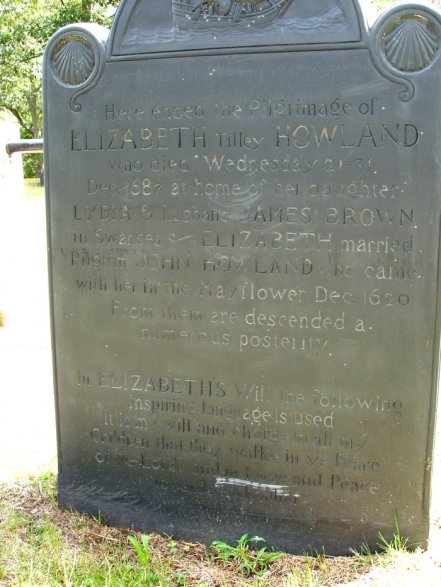
End Of Elizabeth’s pilgrimage
Elizabeth Tilley was born Aug. 30, 1607 in Henlow,Bedfordshire, England. She died Dec. 21, 1687 in
Swansea, Bristol County,Massachusetts. Elizabeth came to the new world with her parents on the Mayflower. Her parents did not survive the first winter at Plimouth Colony, leaving her an orphan.
For 15 years—or almost 20 percent of her life—Elizabeth Tilley Howland was a widow. She never remarried after her husband and fellow Mayflower passenger died on Feb. 23, 1672/3 and instead played the useful role of grandma while living with her daughter Lydia Brown in Swansea. Elizabeth was 65 when John died, probably still vivacious and attractive enough to say “yes” to a second husband, but she preferred to remain a widow until she died on Dec. 22, 1687. The Brown household was ideal for a grandma. When Elizabeth was widowed, the Brown children included James who was 17 years old, Dorothy who was six, and Jabez who was a lively five. Daughter Lydia was born in 1633 so she was 39 when her father died. Elizabeth had barely settled in at the Brown home when King Phillip’s War erupted in 1673. She was forced to flee as Swansea became the storm center of the war. At one point the little community founded only a few years before was almost deserted as residents scurried to safer places such as Barnstable which boasted a population of 3000 compared with 2600 for Plymouth.Three of Elizabeth’s children—Desire, John and Hope—lived in Barnstable when the Widow Howland moved there. Not far away in Plymouth were three other offspring of the Mayflower couple—Isaac lived in nearby Middleborough and Hannah made her home in Swansea, but Elizabeth had gone to far-away Oyster Bay, Long Island.There were many other Howlands in Barnstable, including scores of grandchildren who kept Elizabeth busy with her grandmother duties. Desire Howland was born in Plymouth about 1625, married to John Gorham about 1643 and moved to Barnstable after 1652. Gorham owned a grist mill and tannery there. He was a captain in the militia during King Philip’s War and died in 1676 as a result of war wounds. Five of the Gorham children were born in Barnstable—Jabez, Mercy, Lydia, Hannah and Shubael.John Howland, second child of John and Elizabeth, was born in 1627 and in 1651 he wed Mary, daughter of Robert Lee of Barnstable. Of their 10 children, the last eight were Barnstable babies. They were Isaac, Hannah, Mercy, Lydia, Experience, Anne, Shubael and John. Both John Howland Jr. and his wife Mary Lee died in the cape town.Hope Howland, who was born in 1629, married when she was about 17. Her husband was John Chipman who came in 1630 from Barnstaple, Devonshire, England. (Note that the English spelled Barnstaple with a P while the Americans spelled it with a B.)All of the 11 children probably were born in Barnstable. They were Elizabeth, Hope, Lydia, John (he lived only about 15 months), Hannah, Samuel, Ruth, Bethia, Mercy, John and Desire.So many grandchildren must have taxed Elizabeth’s memory for there were three Lydias, three Hannahs, three Mercys, three Johns, two Isaacs and two with the name Shubael. How could she keep them all straight?And just imagine Grandma Howland baking birthday cakes with magic candles for all these grandchildren. Elizabeth’s son-in-law, James Brown, was one of the most prominent of the early settlers in Swansea. He was a leader in the war against Philip, serving as a major. He also was one of the original members of the Swansea church and was fined five pounds for setting up a Baptist church in Rehoboth.He tried his best to bring peace to Plymouth Colony and went twice to see the Indian leader but found Philip “very high and not p’suadable to peace.”Large families usually have their tragedies and the Howlands had theirs. Three of Elizabeth’s children—Desire Gorham, Hope Chipman and Ruth Cushman—died before she did.The war didn’t last any great length of time and in the end Philip lost his head. The Indian chief was shot by another Indian and his head cut off. The bloody skull was taken in triumph to Plymouth where it was mounted on a pike. It remained there for 20 years, a souvenir of savagery. Birds make it a favorite resting place and finally the Rev. Increase Mather too the jawbone.With fighting over, Elizabeth returned to Swansea where she kept busy helping with the cooking, sewing, cleaning, gardening—caring for family members.Everyone dies once in a lifetime and for Elizabeth death came on Dec. 22, 1687. She was buried in Little Neck Cemetery in what is now east Providence, Rhode Island. The monument and grave are maintained by the Pilgrim John Howland Society. In her final will Elizabeth Tilley Howland gave her possessions to her children and grandchildren and expressed her deep religious faith: “And first being penitent & sorry from ye bottom of my heart for all my sins past most humbly desiring forgiveness for ye same I give & commit my soule unto Almighty God my Savior & Redeemer in whome & by ye merits of Jesus Christ I trust & believe assuedly to be saved & to have full remission & forgiveness of all my sins & that my Soule wt my Body at the generall day of resurrection shall rise againe wt Joy & through meritts of Christ’s Death & passion possesse & inherit ye Kingdome of Heaven…” She concluded:“It is my Will & Charge to all my Children that they walke in ye Feare of ye Lord, and in Love and peace towards each other…”
U.S., Sons of the American Revolution Membership Applications, 1889-1970
Elizabeth Tilley (1607 – 1687)
is my 10th great grandmother
Joseph Howland (1640 – 1703)
son of Elizabeth Tilley
Elizabeth Howland (1673 – 1724)
daughter of Joseph Howland
Eleazer Hamblin (1699 – 1771)
son of Elizabeth Howland
Sarah Hamblin (1721 – 1814)
daughter of Eleazer Hamblin
Mercy Hazen (1747 – 1819)
daughter of Sarah Hamblin
Martha Mead (1784 – 1860)
daughter of Mercy Hazen
Abner Morse (1808 – 1838)
son of Martha Mead
Daniel Rowland Morse (1838 – 1910)
son of Abner Morse
Jason A Morse (1862 – 1932)
son of Daniel Rowland Morse
Ernest Abner Morse (1890 – 1965)
son of Jason A Morse
Richard Arden Morse (1920 – 2004)
son of Ernest Abner Morse
Pamela Morse
I am the daughter of Richard Arden Morse
Her will is recorded:
Elizabeth Tilley Howland Will
Elizabeth Tilley Howland Will http://www.mayflowerfamilies.com/wills/elizabeth_howland_will.htm [MD 3:54+] Elizabeth (Tilley) Howland, widow of John Howland and daughter of John Tilley, died at Swansea on Wednesday, 21/31 December, 1687, at the house of her daughter Lydia, the wife of James Brown. Her will is recorded in the Bristol County, Mass., Probate Records, Volume 1, pages 13 and 14. No inventory is on record and the original will has disappeared from the files.In ye Name of God Amen I Elizabeth Howland of Swanzey in ye County of Bristoll in ye Collony of Plymouth in New Engld being Seventy nine yeares of Age but of good & perfect memory thanks be to Allmighty God & calling to Remembrance ye uncertain Estate of this transitory Life & that all flesh must Yeild unto Death when it shall please God to call Doe make constitute & ordaine & Declare This my last Will & Testament, in manner & forme following Revoking and Anulling by these prsents all & every Testamt & Testamts Will & Wills heretofore by me made & declared either by Word or Writing And this to be taken only for my last Will & Testament & none other. “And first being penitent & sorry from ye bottom of my heart for all my sinns past most humbly desiring forgivenesse for ye same I give & Comitt my soule unto Allmighty God my Saviour & Redeemer in whome & by ye meritts of Jesus Christ I trust & believe assuredly to be saved & to have full remission & forgivenesse of all my sins & that my Soule wt my Body at the generall Day of Resurrection shall rise againe wt Joy & through ye meritts of Christs Death & passion possesse & inheritt ye Kingdome of heaven prepared for his Elect & Chosen & my Body to be buryed in such place where it shall please my Executrs hereafter named to appoint And now for ye settling my temporall Estate & such goodes Chattells & Debts as it hath pleased God far above my Deserts to bestow upon me I Do Dispose order & give ye same in manner & forme following (That is to say) First that after my funerall Expences & Debts paid wc I owe either of right or in Conscience to any manner of person or persons whatsoever in Convenient tyme after my Decease by my Execrs hereafter named I Give & bequeath unto my Eldest Son John Howland ye sum of five pounds to be paid out of my Estate & my booke called Mr Tindale’s Workes & also one pair of sheetes & one prof pillowbeeres & one pr of Bedblanketts, Item I give unto my son Joseph Howland my Stillyards & also one pr of sheetes & one pt of pillobeeres Item I give unto my son Jabez Howland my ffetherbed & boulster yt is in his Custody & also one Rugg & two Blanketts yt belongeth to ye said Bed & also my great Iron pott & potthookes Item I give unto my son Isaack Howland my Booke called Willson on ye Romanes & one pr of sheetes & one paire of pillowbeeres & also my great Brasse Kettle already in his possession Item I give unto my Son in Law Mr James Browne my great Bible Item I give & bequeath unto my Daughter Lidia Browne my best ffeatherbed & Boulster two pillowes & three Blanketts & a green Rugg & my small Cupboard one pr of AndyIrons & my lesser brasse Kettle & my small Bible & my booke of mr Robbinsons Workes called Observations Divine & Morrall & allso my finest pr of Sheetes & my holland pillowbeeres, Item I give unto my Daughter Elisabeth Dickenson one pr of Sheetes & one pr of pillowbeeres & one Chest Item give unto my Daughter Hannah Bosworth one pr of sheets & one pr of pillowbeeres, Item I give unto my Grand Daughter Elizabeth Bursley one paire of sheets and one paire of Pillowbeeres Item I give & bequeath unto my Grandson Nathanael Howland (the son ofJoseph Howland) and to the heires of his owne Body lawfully begotten for ever all that my Lott of Land with ye Meadow thereunto adjoyning & belonging lying in the Township of Duxbury neare Jones River bridge, Item I give unto my Grandson James Browne One Iron barr and on Iron Trammell now in his possession, Item I give unto my Grandson Jabez Browne one Chest Item I give unto my Grand Daughter Dorothy Browne My best Chest & my Warming pan Item I give unto my Grand Daughter Desire Cushman four Sheep, Item I give & bequeath my wearing clothes linnen and Woollen and all the rest of my Estate in mony Debts linnen or of what kind or nature or sort soever it may be unto my three Daughters Elisabeth Dickenson, Lidia Browne and Hannah Bosworth to be equally Devided amongst them, Item I make constitute and ordaine my loving Son in Law James Browne and my loving son Jabez Howland Executors of this my last Will and Testament, Item it is my Will & Charge to all my Children that they walke in ye Feare of ye Lord, and in Love and peace towards each other and endeavour the true performance of this my last Will & Testament In Witnesse whereof I the said Elisabeth Howland have hereunto sett my hand & seale this seventeenth Day of December Anno Dm one thousand six hundred Eighty & six.The mark of Elisabeth E H Howland (sigittu)Signed Sealed & Delivd in ye prsence of Us WittnessesHugh ColeSamuel VyallJohn BrowneKnow all men that on ye tenth Day of Janry Anno Dm 1687/8 Before me Nathanl Byfield Esqr Judge of his Majties Inferiour Court of Plea’s for ye County of Bristoll, present Jno Walley Esqr one of ye Members of his Majties Councill in New England & Capt Benjam Church Justice of Peace The abovewritten Will of Elizabeth Howland was proved approved & allowed And ye Administracon of all & singuler ye goodes Rights and Creditts of ye said Deced was Committed unto James Browne & Jabez Howland Execrs in ye same Will named well & truly to Administer ye same according to the Will of ye Deced In Testimony whereof I have hereunto Sett ye Seale of ye Office for Probate of Wills & granting Lettrs of Admincon ye yeare & Day by me abovewritten(Sigittu officij) Nathanael ByfieldThus Entred & ingrossed this 26: of Janry Anno Dm
Elizabeth Tilley Howland Birth: Aug. 30, 1607HenlowBedfordshire, EnglandDeath: Dec. 21, 1687SwanseaBristol CountyMassachusetts, USAOriginal Mayflower Passenger. Wife of Mayflower Passenger John Howland. Elizabeth was orphaned in the New World, at the age of thirteen, after her parents died the first winter in Plymouth. (bio by: Thomas Mick) Family links: Parents: John Tilley (1571 – 1621) Joan Hurst Tilley (1568 – 1621) Spouse: John Howland (1591 – 1673) Children: Desire Howland Gorham (1623 – 1683)* John Howland (1627 – ____)* Hope Howland Chipman (1629 – 1683)* Elizabeth Howland Hicks Dickinson (1631 – 1692)* Lydia Howland Brown (1633 – ____)* Hannah Howland Bosworth (1637 – 1705)* Joseph Howland (1640 – 1704)* Jabez Howland (1644 – ____)* Ruth Howland Cushman (1646 – 1679)* Isaac Howland (1649 – 1723)* *Calculated relationship Burial: Ancient Little Neck Cemetery East ProvidenceProvidence CountyRhode Island, USAPlot: Brown family plot Maintained by: Find A GraveOriginally Created by: Ronald KeyesRecord added: Sep 15, 2007 Find A Grave Memorial# 21561583

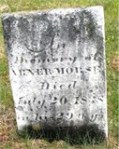
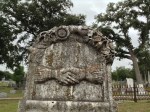
During the exciting and educational April #NaPoWriMo I managed to kick out 30 poems in 30 days. I will follow the poets I met because they make my days richer with only short bursts of time invested. I can read a poem for a minute or two and ponder it forever. I love the community that develops around the special poetry writing month and plan to keep my connection to it. I have learned that the process of writing poems is therapeutic . While engaged in poetic efforts I happened to digitally meet new people who are as interesting to me as the poets. Much to my surprise, my niche geek group, family history freaks, is alive and meeting regularly to share data and support.
This new group found me, or I found it on Facebook. New England Family Genealogy and History is a special interest group for those of us who study these subjects. I am delighted to find people as obsessed with history as I am. Some of them still carry the Mayflower pilgrim family names. There have been wonderful pictures and stories posted in which I have identified members as having common ancestors. This is a full time party of like minded genealogy freaks I can join on line any time. Be still my heart! People who have much more direct information and verification are there to help anyone with inquiries. The first ancestor I found I had in common with other members was my famous poet, Ann Dudley Bradstreet, who may be my favorite ancestor of all. In a few weeks I have met others with whom I share different progenitors. A recent discussion revealed that others share perhaps Native ancestry. Like me, few can definitively prove a connection to a tribe.
Some of the active participants are professional genealogists or family archivists of large collections. Plenty are DAR and Mayflower Society members. Many live in New England now and are connected to local societies for the preservation of everything under the sun. I enjoy learning about some of the old buildings that have stayed in family hands for hundreds of years. I feel a tinge of jealousy when they go off to Providence to a genealogy convention for the weekend. Then I remember that to live in New England one must endure snow and other unpleasantries. I may return to Cape Cod and Rhode Island on a history hunt one day. For now I am very pleased to be in touch with history fans who share interest, passion, and loads of information about New England and the people who have lived there. I can digitally visit every day. You can too if New England History is an interest of yours.

Howland home in Plymouth
Mayflower passengers John Howland and Elizabeth Tilley were married in 1623/4. John was about thirty-one and Elizabeth was about sixteen. They spent their entire lives in Plymouth, and between them participated in every aspect of the Pilgrim experience from its beginning in Leiden up to the merger of the Bay and Plymouth colonies. This article is a retrospective summary of their lives and their contribution to Plymouth.
John was born about 1592 to Henry and Margaret Howland of Fenstanton, nine miles northeast of Cambridge, England. Elizabeth Tilley was the youngest of several children born to John and Joan (Hurst) Tilley. She was baptized in 1607 in Henlow, Huntingdonshire, England. John Tilley and his family, and the family of his brother Edward Tilley and wife Ann (Cooper), were members of John Robinson’s congregation in Leiden.
John Howland, John and Joan and Elizabeth Tilley, and Edward and Ann Tilley were passengers on the Mayflower. John Howland had at least five siblings. Arthur (d. 1675), his older brother, arrived in Plymouth after 1627 while Henry (d. 1671), his younger brother, arrived as early as 1633. Arthur Howland soon moved to Marshfield where he became a major landholder. Henry Howland was one of the original settlers of Duxbury and was chosen constable in 1635.
At age twenty-eight John Howland was recruited in England by John Carver to join his household and be his assistant in moving the Leiden congregation to America. Also included in Carver’s household were a servant-girl Desire Minter (age fifteen), a servant-lad, William Lantham, and several other servants. During a storm in the crossing, John Howland was pitched overboard, but luckily was able to catch hold of a halliard and was hauled back aboard the Mayflower. John was the thirteenth signer of the Mayflower Compact. While in Cape Cod Harbor, John Howland, John and Edward Tilley and others explored the New England coast for several days and chose Plymouth to begin a settlement.
Elizabeth Tilley’s parents and aunt and uncle died in the winter of 1621. John Carver took Elizabeth in as one of his household. After John and Katherine Carver died in the spring of 1621, John Howland became the head of the household containing Elizabeth Tilley, Desire Minter, and William Lantham. The living arrangements for this household are unknown. After John married Elizabeth, he received four acres of land as the head of household in the 1623 Division of Land.
Desire Minter was the daughter of William and Sarah Minter, members of the Leiden congregation. Desire’s father died in 1618, and she joined John Carver’s family. Her mother remarried in 1622, and her new parents established an endowment that Desire would inherit at the age of twenty-one. After a few years in Plymouth, Desire returned to England to assume her inheritance. John and Elizabeth Howland were very fond of Desire and named their first child Desire in her honor. They had ten children: Desire, John, Hope, Elizabeth, Lydia, Hannah, Joseph, Jabez, Ruth and Isaac.
In 1625 John Howland accompanied Edward Winslow on an expedition of the Kennebec River in Maine to explore trading opportunities with the Indians. In 1626 John was asked to be one of the “Undertakers” to buy out the colony’s debt to the “Merchant Adventurers” who had invested in the venture to establish Plymouth Colony.
In the 1627 division of Cattle agreement, John Howland acquired twenty acres for each member of his household. In addition, the colonists were organized in “companies” of thirteen members each. The livestock of the colony was divided equally among the companies. Listed in John’s “company” were John and Elizabeth and their two children, John and Priscilla Alden and their two children, and five unattached men.
Isaac Allerton (1586-1658/9) negotiated a patent that granted Plymouth the exclusive right to trade with the Indians and to establish a trading station on the Kennebec River. In 1627 Governor Bradford placed John Howland in charge. In 1628 a trading station was built at Cushnoc (now called Augusta) on the east side of the Kennebec River. A year later, a permanent log-house was built, and Howland, then Assistant Governor, was asked to manage the trading station. For approximately seven years John Howland was in charge of the station. It is not known if Elizabeth and their family of three children lived at the station permanently or for short periods of time. During the time that John operated the station Elizabeth gave birth to three more children, but it is not known whether she gave birth while she was living at the trading station or in Plymouth.
The trading station in Cushnoc was very successful. The Pilgrims traded corn and manufactured goods with the Indians for beaver, otter and other furs. The proceeds of this trade enabled the Undertakers to settle their debts with the Merchant Adventurers. In 1643 a colony in Piscataqua at the mouth of the Kennebec River under the control of London investors attempted to trade with Indians on the Kennebec River. Howland and men from Plymouth told the Piscataqua men under the command of John Hocking to leave since they were trespassing and the patent granted Plymouth exclusive trading rights. The Piscataqua men refused to pull up anchor and leave, and John Hocking shot and killed one of Howland’s men. One of Howland’s men returned fire and killed John Hocking. A meeting called by the General Courts of Plymouth and Bay Colony established that the Piscataqua men were trespassers and that Hocking’s killing was justified. Following this, the two colonies agreed to honor each other’s patents and to curtail the activities of settlements poaching on these patents. It was feared that if the issue was not resolved satisfactorily, Parliament might appoint a single governor of all New England, which none of the colonies wanted.
In 1633 John (age forty-one) was admitted a freeman in Plymouth. John and Elizabeth acquired land and in time became major landholders in Plymouth and the surrounding towns. For nearly forty years, John Howland was actively involved in the governance of Plymouth through elected or appointed positions, viz. one of the seven Plymouth Assistant Governors—1632-35, 1638-39; one of the four Plymouth Deputies to the General Court for nearly thirty years—1641, 1645, 1647-56, 1658, 1659, 1661-68, 1670; one of the five selectmen of Plymouth—1665-66; one of the Plymouth Assessors—1641, 1644, 1647-51; committee on fur trading—1659; surveyor of highways—1650.
In 1637 John received forty acres of land, and in 1639 he was given a choice of additional land for himself or his heirs around Yarmouth, Dartmouth and Rehoboth. Part of the land he chose was in Yarmouth, which he gave to his son John and daughters Desire and hope and their respective families. In 1639 John purchased land and a house in Rocky Nook, where he spent the rest of his life. Also living in Rocky Nook were Thomas and Mary (Allerton) Cushman and their family.
Quaker missionaries arrived in Plymouth between 1655 and 1662 and attracted a considerable number of converts. Quakers opposed Puritan authority and religious beliefs and practices. They refused to attend church services, would not recognize ministers and magistrates or fidelity oaths, and would not support the church financially. They criticized Puritan beliefs and practices publicly and in such scathing terms as to anger the General Court. Governor Bradford had died in 1657 and was succeeded by Thomas Prence (1600-73), who would not tolerate Quaker criticism and took unusually strong measures to suppress Quaker activities, through fines, whipping, excommunication and expulsion from the colony. In the Bay Colony punishment was more severe, and included hangings.
Quakers wished to separate themselves from the prevailing religious beliefs and practices, just as the Pilgrims had done some fifty years earlier in England. Thus, the Quakers were to Plymouth what the Separatists were to England, except that now the Pilgrims were on the receiving end. Governor Prence and the General Court punished Plymouth residents who attended Quaker services or gave them support and protection.
The families of John Howland’s brothers, Arthur and Henry, were two Plymouth families most identified as practicing Quakers. The families ceased attending Plymouth religious services and allowed their homes for the conduct of Quaker meetings. Arthur, Henry and Henry’s son Zoeth were called before the General Court in 1657 and fined for using their homes for Quaker meetings. In 1660 Henry was again fined. In 1659 Arthur Jr.’s freeman status was revoked and in 1684 he was imprisoned in Plymouth. Throughout his life, John Howland remained faithful to Separatist belief and practice, but his compassion for Quakers is not known.
John and Elizabeth were highly respected citizens of Plymouth. In 1657 and again in 1664, serious issues concerning members of John Howland’s family came before the Court of Governor’s Assistants that resulted in judicial sanctions. John Howland was only a deputy for Plymouth to the General Court, and while he did not have to act on these cases personally, there is not way his standing in Plymouth could avoid being affected.
Governor Prence’s actions toward Quakers took an ironic twist that can be appreciated by parents today. In 1657 Arthur Howland Jr., an ardent Quaker, was brought before the court. Thomas Prince’s daughter and Arthur Howland Jr., fell in love. The relationship blossomed and matrimony seemed inevitable. However, it was illegal and punishable by court sanction for couples to marry without parental consent. Thomas Prence urged Elizabeth to break off the relationship, but to no avail. He then used powers available to him as Governor. Arthur Howland, Jr., was brought before the General Court and fined five pounds for “inveigling of Mistris Elizabeth Prence and making motion of marriage to her, and prosecuting the same contrary to her parents likeing, and without theire mind and will…[and] in speciall that hee desist from the use of any meanes to obtaine or retaine her affections as aforesaid.” On July 2, 1667 Arthur Howland, Jr., was brought before the General Court again where he “did sollemly and seriously engage before the Court, that he will wholly desist and never apply himself for the future as formerly he hath done, to Mistris Elizabeth Prence in reference unto marriage.” Guess what happened! They were married on December 9, 1667 and in time had a daughter and four sons. Thus a reluctant Thomas Prence acquired a Quaker son-in-law, Quaker grandchildren and innumerable Quaker in-laws of Henry Howland.
The second case involving John Howland’s family occurred in 1664 when Ruth Howland (b. 1646), his youngest daughter, was the subject of a morals case brought before the Court of Governor’s Assistants. Sexual mores, including chastity before marriage, were issues about which were strict codes of conduct. Ruth Howland fell in love with Thomas Cushman, Jr. (1637-1726), the first son of Plymouth’s Ruling Elder Thomas Cushman (1607-91), and Mary (Allerton) Cushman (1616-1699), a Mayflower passenger. In 1664/5 Thomas Jr. was fined five ponds by the Court for carnal behavior “before marriage, but after contract.” Once again John Howland was Deputy to the General Court for Plymouth and not involved personally in sentencing. Twenty-five years earlier punishment could have been severe, e.g. excommunication, fines, stocks for women and whipping for men. However, in 1664 harsh physical sentencing had been relaxed, and the social meeting of the parties became a factor in sentencing. In 1664 Thomas Jr. and Ruth were married. In addition to John Howland’s embarrassment, Thomas Cushman, Jr. squandered the opportunity to be considered to succeed his father as Ruling Elder. In 1694, Thomas’ younger brother Isaac was chosen to succeed his father as Ruling Elder. Thomas Jr. and Ruth remained in Plymouth. Ruth died as a young woman sometime after 1672, and Thomas Jr. married Abigail Fuller in 1679.
John Howland died either in his home at Rocky Nook or at his son Jabez’ house on February 23, 1672/3 at the age of eighty. He was buried in an unmarked grave in Burial Hill. In 1897, a headstone was erected on Burial Hill by the Howland Society. Elizabeth Howland spent her declining years and died on December 21, 1687 at the age of eighty in the home of her daughter Lydia Brown, in Swansea. Elizabeth is buried in East Providence, Rhode Island, with a memorial marker.
While not political leaders of Plymouth, John and Elizabeth were pillars of the community and played a major part in the colony’s governance and development. They lived through every aspect of the Pilgrim experience beginning in Leiden—the Mayflower, the harsh first winter, the Undertakers, the trading station in Maine, the Quakers, King Philip’s War—up to the merger of the Bay and Plymouth colonies. Descendants of John, Henry and Arthur Howland multiplied in number and influence to become one of New England’s famous pioneer families.–by Robert Jennings Heinsohn, PhD
John Howland (1601 – 1673)
is my 10th great grandfather
Joseph Howland (1640 – 1703)
son of John Howland
Elizabeth Howland (1673 – 1724)
daughter of Joseph Howland
Eleazer Hamblin (1699 – 1771)
son of Elizabeth Howland
Sarah Hamblin (1721 – 1814)
daughter of Eleazer Hamblin
Mercy Hazen (1747 – 1819)
daughter of Sarah Hamblin
Martha Mead (1784 – 1860)
daughter of Mercy Hazen
Abner Morse (1808 – 1838)
son of Martha Mead
Daniel Rowland Morse (1838 – 1910)
son of Abner Morse
Jason A Morse (1862 – 1932)
son of Daniel Rowland Morse
Ernest Abner Morse (1890 – 1965)
son of Jason A Morse
Richard Arden Morse (1920 – 2004)
son of Ernest Abner Morse
Pamela Morse
I am the daughter of Richard Arden Morse
Because John and Elizabeth were so well known they are also well documented. We have a copy of his last will and testament:
Last Will & Testament of John Howland, 1672
The Last Will and Testament of mr John howland of Plymouth late Deceased, exhibited to the Court held att Plymouth the fift Day of March Anno Dom 1672 on the oathes of mr Samuell ffuller and mr William Crow as followeth
Know all men to whom these prsents shall Come That I John howland senir of the Towne of New Plymouth in the Collonie of New Plymouth in New England in America, this twenty ninth Day of May one thousand six hundred seaventy and two being of whole mind, and in Good and prfect memory and Remembrance praised be God; being now Grown aged; haveing many Infeirmities of body upon mee; and not Knowing how soon God will call mee out of this world, Doe make and ordaine these prsents to be my Testament Containing herein my last Will in manor and forme following;
Imp I Will and bequeath my body to the Dust and my soule to God that Gave it in hopes of a Joyfull Resurrection unto Glory; and as Concerning my temporall estate, I Dispose thereof as followeth;
Item I Doe give and bequeath unto John howland my eldest sonne besides what lands I have alreddy given him, all my Right and Interest To that one hundred acres of land graunted mee by the Court lying on the eastern side of Tauton River; between Teticutt and Taunton bounds and all the appurtenances and privilidges Therunto belonging, T belonge to him and his heirs and assignes for ever; and if that Tract should faile, then to have all my Right title and Interest by and in that Last Court graunt to mee in any other place, To belonge to him his heires and assignes for ever;
Item I give and bequeath unto my son Jabez howland all those my upland and Meadow That I now posesse at Satuckett and Paomett, and places adjacent, with all the appurtenances and privilidges, belonging therunto, and all my right title and Interest therin, To belonge to him his heires and assignes for ever,
Item I Give and bequeath unto my son Jabez howland all that my one peece of land that I have lying on the southsyde of the Mill brooke, in the Towne of Plymouth aforsaid; be it more or lesse; and is on the Northsyde of a feild that is now Gyles Rickards senir To belonge to the said Jabez his heirs and assignes for ever;
Item I give and bequeath unto Isacke howland my youngest sonne all those my uplands and meddows Devided and undivided with all the appurtenances and priviliges unto them belonging, lying and being in the Towne of Middlebery, and in a tract of Land Called the Majors Purchase near Namassakett Ponds; which I have bought and purchased of William White of Marshfeild in the Collonie of New Plymouth; which may or shall appeer by any Deed or writinges Together with the aformentioned prticulares To belonge to the said Isacke his heirs and assignes for ever;
Item I give and bequeath unto my said son Isacke howland the one halfe of my twelve acree lott of Meddow That I now have att Winnatucsett River within the Towne of Plymouth aforsaid To belonge to him and said Isacke howland his heires and assignes for ever,
Item I Will and bequeath unto my Deare and loveing wife Elizabeth howland the use and benifitt of my now Dwelling house in Rockey nooke in the Township of Plymouth aforsaid, with the outhousing lands, That is uplands uplands [sic] and meddow lands and all appurtenances and privilidges therunto belonging in the Towne of Plymouth and all other Lands housing and meddowes that I have in the said Towne of Plymouth excepting what meddow and upland I have before given To my sonnes Jabez and Isacke howland During her naturall life to Injoy make use of and Improve for her benifitt and Comfort;
Item I give and bequeath unto my son Joseph howland after the Decease of my loveing wife Elizabeth howland my aforsaid Dwelling house att Rockey nooke together with all the outhousing uplands and Medowes appurtenances and privilidges belonging therunto; and all other housing uplands and meddowes appurtenances and privilidges That I have within the aforsaid Towne of New Plymouth excepting what lands and meadowes I have before Given To my two sonnes Jabez and Isacke; To belong to him the said Joseph howland To him and his heires and assignes for ever;
Item I give and bequeath unto my Daughter Desire Gorum twenty shillings
Item I give and bequeath To my Daughter hope Chipman twenty shillings
Item I give and bequeath unto my Daughter Elizabeth Dickenson twenty shillings
Item I give and bequeath unto my Daughter Lydia Browne twenty shillings
Item I give & bequeath to my Daughter hannah Bosworth twenty shillings
Item I give and bequeath unto my Daughter Ruth Cushman twenty shillings
Item I give to my Grandchild Elizabeth howland The Daughter of my son John howland twenty shillings
Item my will is That these legacyes Given to my Daughters, be payed by my exequitrix in such species as shee thinketh meet;
Item I will and bequeath unto my loveing wife Elizabeth howland, my Debts and legacyes being first payed my whole estate: vis: lands houses goods Chattles; or any thing else that belongeth or appertaineth unto mee, undisposed of be it either in Plymouth Duxburrow or Middlbery or any other place whatsoever; I Doe freely and absolutly give and bequeath it all to my Deare and loveing wife Elizabeth howland whom I Doe by these prsents, make ordaine and Constitute to be the sole exequitrix of this my Last will and Testament to see the same truely and faithfully prformed according to the tenour therof; In witness whereof I the said John howland senir have heerunto sett my hand and seale the aforsaid twenty ninth Day of May, one thousand six hundred seaventy and two 1672
Signed and sealed in the
prsence of Samuel ffuller John Howland
William Crow And a seale
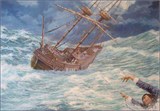
man overboard
John Howland survived falling off the Mayflower, and all the perils of colonial life to be the last of the Mayflower Pilgrim fathers to die. His headstone in Plymouth reads:
“Here was a godly man and an ancient professor in the ways of Christ. Hee was one of the first comers into this land and was the last man that was left of those that came over in the Shipp called the Mayflower that lived in Plymouth.”

headstone
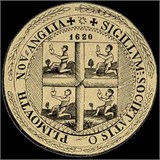
Mayflower seal
My 15th great-grandfather was a big adventurer in the New World. He sailed to Jamestown in 1609, and was on the ill fated voyage to Bermuda that inspired William Shakespeare to write the Tempest. His wife died while he was in Virginia, so he returned to England to care for his three children. He brought his family to Plymouth on the Mayflower. As an experienced colonist he was an important part of the Pilgrim’s diplomatic mission to the Wampanoag tribe. He fell from grace when he opened a shop selling alcohol. He went down a slippery slope from allowing drinking and shuffleboard playing on Sunday to selling beer for twice what it was worth. He managed to stay in town, but did some jail time for defying the court. I am thankful to you, Grandpa Stephen, for attempting so many grand adventures and defying your odds of survival.
Stephen Hopkins was from Hampshire, England. He married his first wife, Mary, and in the parish of Hursley, Hampshire; he and wife Mary had their children Elizabeth, Constance, and Giles all baptized there. It has long been claimed that the Hopkins family was from Wortley, Gloucester, but this was disproven in 1998. Stephen Hopkins went with the ship Sea Venture on a voyage to Jamestown, Virginia in 1609 as a minister’s clerk, but the ship wrecked in the “Isle of Devils” in the Bermudas. Stranded on an island for ten months, the passengers and crew survived on turtles, birds, and wild pigs. Six months into the castaway, Stephen Hopkins and several others organized a mutiny against the current governor. The mutiny was discovered and Stephen was sentenced to death. However, he pleaded with sorrow and tears. “So penitent he was, and made so much moan, alleging the ruin of his wife and children in this his trespass, as it wrought in the hearts of all the better sorts of the company”. He managed to get his sentence commuted. Eventually the castaways built a small ship and sailed themselves to Jamestown. How long Stephen remained in Jamestown is not known. However, while he was gone, his wife Mary died. She was buried in Hursley on 9 May 1613, and left behind a probate estate which mentions her children Elizabeth, Constance and Giles. Stephen was back in England by 1617, when he married Elizabeth Fisher, but apparently had every intention of bringing his family back to Virginia. Their first child, Damaris, was born about 1618. In 1620, Stephen Hopkins brought his wife, and children Constance, Giles, and Damaris on the Mayflower (child Elizabeth apparently had died). Stephen was a fairly active member of the Pilgrims shortly after arrival, perhaps a result of his being one of the few individuals who had been to Virginia previously. He was a part of all the early exploring missions, and was used almost as an “expert” on Native Americans for the first few contacts. While out exploring, Stephen recognized and identified an Indian deer trap. And when Samoset walked into Plymouth and welcomed the English, he was housed in Stephen Hopkins’ house for the night. Stephen was also sent on several of the ambassadorial missions to meet with the various Indian groups in the region. Stephen was an assistant to the governor through 1636, and volunteered for the Pequot War of 1637 but was never called to serve. By the late 1630s, however, Stephen began to occasionally run afoul of the Plymouth authorities, as he apparently opened up a shop and served alcohol. In 1636 he got into a fight with John Tisdale and seriously wounded him. In 1637, he was fined for allowing drinking and shuffleboard playing on Sunday. Early the next year he was fined for allowing people to drink excessively in his house: guest William Reynolds was fined, but the others were acquitted. In 1638 he was twice fined for selling beer at twice the actual value, and in 1639 he was fined for selling a looking glass for twice what it would cost if bought in the Bay Colony. Also in 1638, Stephen Hopkins’ maidservant got pregnant from Arthur Peach, who was subsequently executed for murdering an Indian. The Plymouth Court ruled he was financially responsible for her and her child for the next two years (the amount remaining on her term of service). Stephen, in contempt of court, threw Dorothy out of his household and refused to provide for her, so the court committed him to custody. John Holmes stepped in and purchased Dorothy’s remaining two years of service from him: agreeing to support her and child. Stephen died in 1644, and made out a will, asking to be buried near his wife, and naming his surviving children.
Pilgrim Stephen Hopkins (1581 – 1644)
is my 15th great grandfather
Constance HOPKINS (1600 – 1677)
daughter of Pilgrim Stephen Hopkins
Sarah Snow (1632 – 1704)
daughter of Constance HOPKINS
Sarah Walker (1622 – 1700)
daughter of Sarah Snow
Sarah Warren (1649 – 1692)
daughter of Sarah Walker
Elizabeth Blackwell (1662 – 1691)
daughter of Sarah Warren
Thomas Baynard (1678 – 1732)
son of Elizabeth Blackwell
Deborah Baynard (1720 – 1791)
daughter of Thomas Baynard
Mary Horney (1741 – 1775)
daughter of Deborah Baynard
Esther Harris (1764 – 1838)
daughter of Mary Horney
John H Wright (1803 – 1850)
son of Esther Harris
Mary Wright (1816 – 1873)
daughter of John H Wright
Emiline P Nicholls (1837 – )
daughter of Mary Wright
Harriet Peterson (1856 – 1933)
daughter of Emiline P Nicholls
Sarah Helena Byrne (1878 – 1962)
daughter of Harriet Peterson
Olga Fern Scott (1897 – 1968)
daughter of Sarah Helena Byrne
Richard Arden Morse (1920 – 2004)
son of Olga Fern Scott
Pamela Morse
I am the daughter of Richard Arden Morse
Richard and his second wife had a child born at sea on the Mayflower. They named her Oceanus.
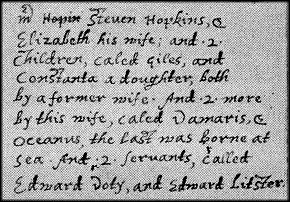
Mayflower record

descendants of Massasoit
The Thanksgiving story is told in November to commemorate the precarious situation in which the Pilgrims of Plymouth Colony found themselves. By the good graces of the local tribe these English people managed to survive very far from home. They were not ready for the harsh winter and new surroundings. They were able to negotiate a treaty for mutual protection with Massasoit, the leader in the area. The meal shared to celebrate the treaty has been told for centuries, but there are a few written words from the time documenting this meeting. Most of us have an image from our school days of happy well dressed Pilgrims entertaining Native Americans at an extensive potluck supper. There is some mention that the Wampanoags supplied all the vittles, but we tend to gloss that over while we celebrate our highly revised impression of history and the Pilgrims.
These Pilgrim heroes soon broke down into all kinds of crazy religious infighting and banished each other for infractions. My own ancestors were banished to Sandwich and other little settlements on Cape Cod. Some had to leave because they had been secret Quakers, and one was banished to Barnstable for marrying a Native woman. We imagine Plymouth as some pure attempt at religious freedom because we have not looked very closely at what happened. Many of my ancestors went to Rhode Island to look for religious freedom and fair dealings with the Native Americans. I had several ancestors who fought on both sides of King Philip’s War, which I am sure we did not study in school. We just move on quickly to Boston and tea party and America without stopping to think what became of those people who gave the Pilgrims dinner and protection.
The big news that has been edited is all about that treaty. The pact worked for a while, but as time passed the English population grew and the agreements became strained. The English proved to be less than honorable when it came to keeping their word. The Wampanoags who survived King Philip’s War were shown no mercy. I have extra interest in the Native version of this event because I went to Cape Cod expecting to find traces of my Wampanoag family tree. I found that records do not exist to trace it although my Mayflower ancestors are very well documented. Intermarriage was very common so I am not the only one with a mystery branch in my tree. There is a very small group of people who are members of the Wampanoag tribe today, and their last names came from England. Survival for them meant adapting. This year, for a change, imagine the entire Thanksgiving story from the perspective of the original people.


Planting by the moon is a simple way to increase your luck at growing anything. By planting annuals bearing fruit above the ground during the waxing phase of the moon ( new to full), and sewing plants that bear under the ground during the waning moon ( full to new) we follow ancient traditions of horticulture. To easily determine in what phase of the moon you find yourself, remember this rule: Crescent moon makes the shape of the letter C when the moon is on the wane. The moon has the shape of a capital D when it is on the rise. Think DOC–first D– then full moon–then C to remember the sequence.
Medicine was tightly constrained by local botany in history, limited to plants available and known. The natures of the plants were studied and knowledge of remedies was shared. However, before transport of goods became easy people used local plants as medicine because they had both access and some empirical evidence of the medicinal qualities. Astrology was part of pharmacology and medicine. Gardens and buildings were designed with healing and astrology in mind. Today there are ways to incorporate the heavens into garden design. The medicine wheel is one way to express the seasons and the heavenly connections. At Plimouth Plantation in Plymouth, MA a humoural garden is planted to display the relationship the Pilgrims had with plants and healing. They considered the relationship of the plants to the humors of the body. They had to rely on the plants they brought with them and those that the native people showed them.
Some gardens are designed to feature the four directions, or the elements. If you had unlimited time and money to create a symbolic garden what would you plant in it? What kind of medicine would you practice? I am fond of all the aromatic plants, so I have a vast array of herbs and flowers that can be used in tea, baths, cooking, and now in bitters. The creativity you invest in a garden returns to you many times.

Hammond Coat of Arms
My 10th great-grandfather was born and went bankrupt in England. His family sailed to America at different times, William himself probably arriving in 1631 on the ship Lyon. He lived in Watertown, MA. raising animals. We have a record of his will.
William Hammond (1575 – 1662)
is my 10th great grandfather
Elizabeth Hammond (1620 – 1703)
daughter of William Hammond
Elishua Crowell (1643 – 1708)
daughter of Elizabeth Hammond
Yelverton Gifford (1676 – 1772)
son of Elishua Crowell
Ann Gifford (1715 – 1795)
daughter of Yelverton Gifford
Frances Congdon (1738 – 1755)
daughter of Ann Gifford
Thomas Sweet (1759 – 1844)
son of Frances Congdon
Valentine Sweet (1791 – 1858)
son of Thomas Sweet
Sarah LaVina Sweet (1840 – 1923)
daughter of Valentine Sweet
Jason A Morse (1862 – 1932)
son of Sarah LaVina Sweet
Ernest Abner Morse (1890 – 1965)
son of Jason A Morse
Richard Arden Morse (1920 – 2004)
son of Ernest Abner Morse
Pamela Morse
I am the daughter of Richard Arden Morse
William HammondBirth: 1575, Lavenham, Suffolk, England.
Baptized: 30 Oct 1575, Lavenham, Suffolk, England.
Death: 8 Oct 1662, Watertown, Massachusetts. “Aged about ninety-four [sic].
Father: Thomas Hammond, born and died in England.
Mother: Rose Trippe, born and died in Lavenham, Suffolk, England.
1629: On 26 Feb 1629/30, William Hammond was declared bankrupt in England.
1629: On “the 20th of November after that date, he departe[d] the land and fleeth into New England. Information from a 1656 law suit against William Hammond, citing this occurance. This would place him on the “Lyon” which sailed from Bristol on 1 Dec 1630/1631, and arriving in New England the following February.
Emigration: 1631. See above.
The Hammond family came to New England in at least three stages. In late 1630 or early 1631, John Winthrop Jr. noted receipt of £7 5s. from “Goody Hammond to send her husband.” This supports the conclusion that William Hammond was a passenger on the “Lyon” when it sailed from Bristol in late 1631.
On 26 Sept 1633, Governor John Winthrop, wrote to Sir Simonds D’Ewes, informing him that “Yours by young Hamond I received,” indicating that William Hammond Jr. probably sailed for New England in one of the ships that arrived in the fall of 1633. His sister Anne and brother Thomas may also have come at this time, because they are not included, a year later, in the passenger list of the “Francis”, which sailed from Ipswich, in the spring of 1634, with Elizabeth Hammond, (aged 47); Elizabeth Hammond, (aged 15); Sarah Hammond, (aged 10); and John Hammond, (aged 7) on board.
First Residence: William’s first residence was Watertown, Massachusetts.
Occupation: Husbandman.
Religion: Admitted to Watertown Church prior to 25 May 1636, (implied by freemanship.)
1636: Admitted as a Freeman, 25 May 1636.
1636: In his record of admissions to Scituate Church, Rev. John Lathrop, entered on 14 Apr 1636, “Elizabeth Hammon, my sister, having a dismission from the church at Watertown.”
1636: On 25 Jul 1636, William Hammond was granted forty acres in the Great Dividend.
1637: Granted eight acres in the Remote Meadows, 26 Jun 1637.
1641: Granted a farm of one hundred fifty-five acres, 10 May 1642.
1645: In the “year 1645 Rose his mother dyeth … but now in the year 1647 his son Thomas come from New England to be admitted to the land.”
1647: On 22 Nov 1647, “W[illia]m Hamond granted a letter of attorney unto Thomas Hamond, his son, to ask demand of the lord of the manor the possession of certain lands in Lavenham, in Suffolk which were the possession of Rose Steward, his mother.”
1647: William was a Watertown Selectman, 8 Nov 1647.
1656: Along with Isaac Stearns, William was an arbiter in a dispute between John Wincoll and Benjamin Crisp.
1656: “Old Goodman Hammond” was appointed to a committee to assign seats in the meeting house, 17 Nov 1656.
1660: On 6 Non 1660, Watertown Selectmen sent the constables to “Old Hamond to let him know, that contrary to order of town, he had entertained into his family such a person as is likely to prove chargeable, do therefore desire him to rid the town of such an encumbrance or otherwise to bear the burden thereof himself.”
In William’s will, dated 1 Jul 1662 and proved 16 Dec 1662:
“William Hammond of Watertowne … now about ninety years of age” bequeathed to “my loving dear wife Elizabeth Hammond my whole estate” for life;
and after her death, to “my son John Hammond all my houses, lands;”
to “Thomas Hammond son of my son Thomas Hammond, deceased,” £40 when twenty-one, but if he dies before that then “the £40 to be equally divided between the children of my daughter House, daughter Barnes, [i.e., Barron’s], children”; to “daughter Barnes” £30;
to “the four children of my daughter Elizabeth House deceased” £5 apiece; to “Adam Smith son of my daughter Sarah … one mare colt”
and to “my daughter Sarah Smith” £5.
The inventory of the estate of William Hammond totalled £467 16s. 9d., including £318 in real estate:
one dwelling house, an orchard £24;
23 acres of pasture land, £69;
11 acres of broken-up land, £48;
15 acres of meadow, £90;
8 acres of meadow remote, £15;
18 acres of land in lieu of township, £6;
1 Great Dividend, 40 acres, £40;
1 farm, 160 acres, £20; and
a part of a barn, £6.
His inventory also included “one great Bible and 3 other books” valued at 13s.
Married: Elizabeth Paine, baptized in Lavenham 22 Sep 1586. She was the daughter of William and Agnes Neves Paine. Elizabeth arrived in New England in 1634 on the “Francis” with her three youngest children. Elizabeth died 27 Sep 1670, in Watertown, Massachusetts, “aged about ninety years [sic].”
Marriage: 9 Jun 1605, in Lavenham, Suffolk, England.
Children of William Hammond and Elizabeth Paine Hammond:

Netherlands
Mary Priest was born in the Netherlands. Her father Degory was a hatter who sailed to America on the Mayflower, and died in Plymouth Colony shortly after his arrival. His wife and children, including Mary, came later to Plymouth to inherit his allotment:
DEGORY PRIEST
ORIGIN: Leiden, Holland
MIGRATION: 1620 on Mayflower
FIRST RESIDENCE: Plymouth
OCCUPATION: Hatter (when admitted as a citizen of Leiden) [Leiden 216].
ESTATE: In the 1623 Plymouth land division “Cudbart Cudbartsone” received six acres as a passenger on the Anne in 1623 [ PCR 12:6]; four of these six shares would be for the deceased Degory Priest, his widow Sarah and his two daughters. In the 1627 Plymouth cattle division “Marra Priest” and “Sarah Priest” were the tenth and eleventh persons in the second company, just after their mother and stepfather [PCR 12:9].
BIRTH: About 1579 (aged about forty in 1619 [ Dexter 630]).
DEATH: Plymouth 1 January 1620/1 [ Prince 287].
MARRIAGE: Leiden 4 November 1611 [NS] “Sara Vincent, widow of Jan Vincent” [ MD 7:129-30; Leiden 216]; Priest is said to be of London. She was sister of ISAAC ALLERTON and married (3) Leiden November 1621 (betrothed 25 October 1621 [NS]) GODBERT GODBERTSON [Leiden 101].
CHILDREN:
i MARY, b. say 1612; m. by about 1630 PHINEAS PRATT.
ii SARAH, b. say 1614; m. by about 1632 JOHN COOMBS.
COMMENTS: Bradford includes “Digory Priest” in his list of those on the Mayflower, and in his accounting of 1651 says that Priest “died soon after … arrival in the general sickness,” but “had his wife and children sent hither afterwards, she being Mr. Allerton’s sister” [ Bradford 443, 447].
In 1957 John G. Hunt published the 1582 baptism for a “Digorius Prust” in Hartland, Devonshire [ NEHGR 111:320]; although there is nothing to connect this with Degory Priest of London, Leiden and Plymouth, it is a useful clue.
BIBLIOGRAPHIC NOTE: Degory Priest and his descendants have been given full and definitive treatment in the eighth volume of the Five Generations project of the General Society of Mayflower Descendants, compiled by Mrs. Charles Delmar Townsend, Robert S. Wakefield and Margaret Harris Stover, and edited by Robert S. Wakefield (Plymouth 1994). The Great Migration Begins
Sketches
PRESERVED PURITAN View Full Context

Mayflower increase
Mary Priest (1613 – 1689)
is my 12th great grandmother
Daniel Pratt (1640 – 1680)
son of Mary Priest
Henry Pratt (1658 – 1745)
son of Daniel Pratt
Esther Pratt (1680 – 1740)
daughter of Henry Pratt
Deborah Baynard (1720 – 1791)
daughter of Esther Pratt
Mary Horney (1741 – 1775)
daughter of Deborah Baynard
Esther Harris (1764 – 1838)
daughter of Mary Horney
John H Wright (1803 – 1850)
son of Esther Harris
Mary Wright (1816 – 1873)
daughter of John H Wright
Emiline P Nicholls (1837 – )
daughter of Mary Wright
Harriet Peterson (1856 – 1933)
daughter of Emiline P Nicholls
Sarah Helena Byrne (1878 – 1962)
daughter of Harriet Peterson
Olga Fern Scott (1897 – 1968)
daughter of Sarah Helena Byrne
Richard Arden Morse (1920 – 2004)
son of Olga Fern Scott
Pamela Morse
I am the daughter of Richard Arden Morse
She married Phineas Pratt, a joiner, who was part of a group that got into trouble with both Pilgrims and Natives:
Phineas Pratt was a member of a company of men sent from England by Thomas Weston. They arrived in New England in 1622 on three ships : the Sparrow, Charity and Swan (Pratt was a passenger on the Sparrow, the first to arrive). The approximately 67 men, many of them ailing, arrived with no provisions. The Pilgrims supported them throughout the summer of 1622.
In the fall of 1622, the Weston men left to colonize an area north of Plymouth called Wessagusset. They soon fell into difficulties through behaving, generally, in a very foolish and improvident fashion. They also severely angered the local Native Americans by stealing their corn.
Massasoit, sachem of the Wampanoags, informed the Plymouth colonists that there was a conspiracy among the Natives of the Wessagusset area to massacre the Weston men. Myles Standish prepared to head north with a small company of Plymouth men to rescue Weston’s men.
The same message was also delivered by one of Weston’s men, who came to Plymouth in March of 1623 “from the Massachusetts with a small pack at his back.”
Phineas Pratt was the man with the backpack. He had secretly snuck out of the Wessagusset settlement, traveling for several days without food through a snowy landscape on his 25-mile journey.
Myles Standish and a small contingent (minus Phineas, who was still recovering from his arduous journey) headed to Wessagusset to recognize Weston’s men. The Plymouth contingent killed several Native Americans in the process (for which, they were roundly scolded by their pastor, John Robinson). Soon afterwards, Weston’s group abandoned Wessagusset. Sometime in late 1623, Phineas joined the Plymouth settlement.
Sometime before May of 1648, when he purchased a house and garden in Charlestown (now a part of Boston), Pratt left Plymouth. In 1662, Pratt presented to the General Court of Massachusetts a narrative entitled “A declaration of the affairs of the English people that first inhabited New England” to support his request for financial assistance. The extraordinary document is Phineas Pratt’s own account of the Wessagusset settlement and its downfall.
Phineas Pratt was by profession a “joiner.” “Joining” was the principle method of furniture construction during the 17th century. “Joiners” were highly skilled craftsmen who specialized in this work; their skills were valued more highly than those of a carpenter.
Phineas Pratt married Mary Priest, daughter of Degory and Sarah Allerton Vincent Priest (the sister of Mayflower passenger Isaac Allerton, Sarah had been married to Jan Vincent and widowed before she married Degory Priest). Degory Priest journeyed to Plymouth on the Mayflower, his wife and two daughters intended to join him later. Priest died during the first winter. Before sailing for America, the widowed Sarah Allerton Vincent Priest married Godbert Godbertson, who became Mary Priest’s stepfather. The family (mother, stepfather and two daughters) were among the passengers of the Anne and Little James, arriving in Plymouth in 1623.
Phineas was probably born about 1593, Mary was probably born about 1612. It seems likely, given the probably age of their oldest child at the time of her death, that they married about 1631 or 1632. Phineas and Mary Pratt had 8 children.
According to his gravestone in the old Phipps Street Cemetery, in the Charlestown area of Boston, “Phinehas Pratt, agd about 90 yrs, decd April ye 19, 1680 & was one of ye first English inhabitants of ye Massachusetts Colony.” (Mayflower Descendant, Vol. 6, p. 1-2).

Priest and Pratt
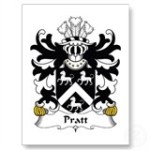
My 11th great-grandfather was born in Plymouth Colony in 1640. His father was a joiner who was well known in the colony. We know little about his life. He died in Providence, Rhode Island the same year his second child, a daughter,was born. It was common for people to move to Rhode Island from Plymouth for religious reasons. Later some members of the family are Quakers, and this may have been Daniel’s persuasion also.
Daniel Pratt (1640 – 1680)
is my 11th great grandfather
Henry Pratt (1658 – 1745)
son of Daniel Pratt
Esther Pratt (1680 – 1740)
daughter of Henry Pratt
Deborah Baynard (1720 – 1791)
daughter of Esther Pratt
Mary Horney (1741 – 1775)
daughter of Deborah Baynard
Esther Harris (1764 – 1838)
daughter of Mary Horney
John H Wright (1803 – 1850)
son of Esther Harris
Mary Wright (1816 – 1873)
daughter of John H Wright
Emiline P Nicholls (1837 – )
daughter of Mary Wright
Harriet Peterson (1856 – 1933)
daughter of Emiline P Nicholls
Sarah Helena Byrne (1878 – 1962)
daughter of Harriet Peterson
Olga Fern Scott (1897 – 1968)
daughter of Sarah Helena Byrne
Richard Arden Morse (1920 – 2004)
son of Olga Fern Scott
Pamela Morse
I am the daughter of Richard Arden Morse
 mermaidcamp