mermaidcamp
Keeping current in wellness, in and out of the water
You can scroll the shelf using ← and → keys
You can scroll the shelf using ← and → keys
Most luxury goods from ice cream to cars are marketed as being self-indulgent. The idea that we deserve some luxury is a tried and true method used to sell overpriced goods. Obviously luxury has to mean different things to each one of us, and our fortunes limit what we include in our worldly possessions. We do have to choose and over time our choices change. We move into a new phase or environment or hobby and find that what was a big treat in the past is not even interesting now. We may own something we thought we needed and wanted that now we no longer like. This is natural.
I am in favor of self-indulgence if it is done in a true spirit of enhancing the self. Self care and self-awareness are valid and necessary for a healthy balanced personality. To make good long-term investments in self ask yourself:
There may be another element to consider when finding a reward for yourself that will reap future dividends. Would I enjoy this time/money/thing more if I gave it away or shared it with others in some other way? I personally can think of at least a million things I would rather own than the yacht A, and a million people who could make good use of a more reasonable boat. Everything is relative. To each her own. Choose wisely, gentle reader.

exchange of gold coins
My 28th great-grandfather was a Count of Barcelona who fought the Moors in northern Spain:
Ramon Berenguer I the Old (née in French: Ramond Berenger LeVieux, in Catalan: el Vell) (1023–1076 AD) was Count of Barcelona in 1035–1076. He promulgated the earliest versions of a written code of Catalan law, the Usages of Barcelona.
Born in 1024, he succeeded his father, Berenguer Ramon the Crooked in 1035. It is during his reign that the dominant position of Barcelona among other Catalan counties became evident.
Ramon Berenguer campaigned against the Moors, extending his dominions as far west as Barbastro and imposing heavy tributes (parias) on other Moorish cities. Historians claim that those tributes helped create the first wave of prosperity in Catalan history. During his reign Catalan maritime power started to be felt in Western Mediterranean. Ramon Berenguer the Old was also the first count of Catalonia to acquire lands (counties of Carcassonne and Razés) and influence north of the Pyrenees.
Another major achievement of his was beginning of codification of Catalan law in the written Usatges or Usatici of Barcelona which was to become the first full compilation of feudal law in Western Europe. Legal codification was part of the count’s efforts to forward and somehow control the process of feudalization which started during the reign of his weak father, Berenger Ramon. Another major contributor was the Church acting through the institution of the Peace and Truce of God. This established a general truce among warring factions and lords in a given region for a given time. The earliest extant date for introducing the Truce of God in Western Europe is 1027 in Catalonia, during the reign of Ramon Berenguer the Old.
Ramon Berenguer I together with his third wife Almodis also founded the Romanesque cathedral of Barcelona, to replace the older basilica presumably destroyed by Almanzor. Their velvet and brass bound wooden coffins are still shown in the Gothic cathedral which replaced Ramon Berenguer’s building.
He was succeeded by his twin sons Ramon Berenguer II and Berenguer Ramon II.
Family and issue
First wife, Isabel/Elisabeth of Narbonne or of Béziers
Berenguer (died young)
Arnau (died young)
Pere Ramon (1050-1073?), murdered his father’s wife, Almodis, and was exiled
Second wife, Blanca de Narbonne , daughter of Wolf Ato Zuberoa and Ermengarda of Narbonne.
Third wife, Almodis de La Marche, countess of Limoges
Berenguer Ramon II, Count of Barcelona the Fratricide (1053/54-1097)
Ramon Berenguer II, Count of Barcelona the Towhead (1053/54-1082)
Agnes, married Guigues II of Albon
Sancha, married William Raymond, count of Cerdanya
References
Charles Julian Bishko (1968–9), “Fernando I and the Origins of the Leonese-Castilian Alliance with Cluny,” Studies in Medieval Spanish Frontier History (Variorum Reprints), 40.
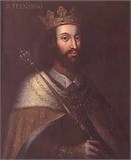
Ramon
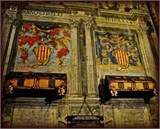
caskets
Ramon Berenguer I of Barcelona (1023 – 1076)
is my 28th great grandfather
Ramon Berenguer II Barcelona (1055 – 1082)
son of Ramon Berenguer I of Barcelona
Ramon Berenguer III (“the Great”) Count of Barcelona, Girona and Osana (1080 – 1131)
son of Ramon Berenguer II Barcelona
Berenguela Raimundo De Barcelona (1113 – 1148)
daughter of Ramon Berenguer III (“the Great”) Count of Barcelona, Girona and Osana
Sancha of Castile (1139 – 1177)
daughter of Berenguela Raimundo De Barcelona
Blanche Of Navarre (1180 – 1229)
daughter of Sancha of Castile
Teobaldo I Navarre (1201 – 1253)
son of Blanche Of Navarre
Henry I Enrique I LeGros Navarre (1244 – 1274)
son of Teobaldo I Navarre
Joan I Navarre (1273 – 1305)
daughter of Henry I Enrique I LeGros Navarre
Lady Isabella England D Capet (1292 – 1358)
daughter of Joan I Navarre
Edward Plantagenet (1312 – 1377)
son of Lady Isabella England D Capet
John Gaunt Plantagenet (1340 – 1399)
son of Edward Plantagenet
Elizabeth Plantagenet (1364 – 1425)
daughter of John Gaunt Plantagenet
John Holland (1395 – 1447)
son of Elizabeth Plantagenet
Henry Holland (1430 – 1475)
son of John Holland
Henry Holland (1485 – 1561)
son of Henry Holland
Henry Holland (1527 – 1561)
son of Henry Holland
John Holland (1556 – 1628)
son of Henry Holland
Francis Gabriell Holland (1596 – 1660)
son of John Holland
John Holland (1628 – 1710)
son of Francis Gabriell Holland
Mary Elizabeth Holland (1620 – 1681)
daughter of John Holland
Richard Dearden (1645 – 1747)
son of Mary Elizabeth Holland
George Dearden (1705 – 1749)
son of Richard Dearden
George Darden (1734 – 1807)
son of George Dearden
David Darden (1770 – 1820)
son of George Darden
Minerva Truly Darden (1806 – 1837)
daughter of David Darden
Sarah E Hughes (1829 – 1911)
daughter of Minerva Truly Darden
Lucinda Jane Armer (1847 – 1939)
daughter of Sarah E Hughes
George Harvey Taylor (1884 – 1941)
son of Lucinda Jane Armer
Ruby Lee Taylor (1922 – 2008)
daughter of George Harvey Taylor
Pamela Morse
I am the daughter of Ruby Lee Taylor

Elisabeth of Tirol
Elisabeth of Gorizia-Tyrol was a Queen of Germany whose husband was murdered by his nephew. After his murder she joined a monastery.
Consort Elisabeth the Romans Carinthia (1263 – 1313)
is my 19th great grandmother
Albrecht Albert II ‘The Wise’ Duke of Austria Habsburg (1298 – 1358)
son of Consort Elisabeth the Romans Carinthia
Leopold III “Duke of Austria” Habsburg (1351 – 1386)
son of Albrecht Albert II ‘The Wise’ Duke of Austria Habsburg
Ernst I “Ironside” Archduke of Austria Habsburg (1377 – 1424)
son of Leopold III “Duke of Austria” Habsburg
Katharina Archduchess Austria Von Habsburg (1420 – 1493)
daughter of Ernst I “Ironside” Archduke of Austria Habsburg
Christof I VanBaden (1453 – 1527)
son of Katharina Archduchess Austria Von Habsburg
Beatrix Zahringen (1492 – 1535)
daughter of Christof I VanBaden
Sabine Grafin VonSimmern (1528 – 1578)
daughter of Beatrix Zahringen
Marie L Egmond (1564 – 1584)
daughter of Sabine Grafin VonSimmern
Richard Sears (1590 – 1676)
son of Marie L Egmond
Silas Sears (1638 – 1697)
son of Richard Sears
Silas Sears (1661 – 1732)
son of Silas Sears
Sarah Sears (1697 – 1785)
daughter of Silas Sears
Sarah Hamblin (1721 – 1814)
daughter of Sarah Sears
Mercy Hazen (1747 – 1819)
daughter of Sarah Hamblin
Martha Mead (1784 – 1860)
daughter of Mercy Hazen
Abner Morse (1808 – 1838)
son of Martha Mead
Daniel Rowland Morse (1838 – 1910)
son of Abner Morse
Jason A Morse (1862 – 1932)
son of Daniel Rowland Morse
Ernest Abner Morse (1890 – 1965)
son of Jason A Morse
Richard Arden Morse (1920 – 2004)
son of Ernest Abner Morse
Pamela Morse
I am the daughter of Richard Arden Morse
Tenure
1299-1 May 1308
Spouse
Albert I of Germany
Issue
Rudolph I of Bohemia
Frederick the Fair
Leopold I, Duke of Austria
Albert II, Duke of Austria
Otto, Duke of Austria
Anna, Duchess of Breig
Agnes, Queen of Hungary
Elisabeth, Duchess of Lorraine
Catherine, Duchess of Calabria
Judith, Countess of Öttingen
House
House of Habsburg
Father
Meinhard, Duke of Carinthia
Mother
Elisabeth of Bavaria
Born
c.1262
Died
28 October 1312
Monastery of Königsfelden
Burial
Monastery of Königsfelden
Elisabeth of Gorizia-Tyrol (c. 1262 – 28 October 1312 was Queen of the Romans, Queen of Germany and Duchess of Austria by marriage. She is also known as Elisabeth of Tirol.
Family
She was the eldest daughter of Meinhard, Duke of Carinthia, Count of Gorizia and Tyrol.
Her mother was Elisabeth of Bavaria, daughter of Otto II Wittelsbach, Duke of Bavaria and his wife Agnes, herself daughter of Henry V, Count Palatine of the Rhine and Agnes of Hohenstaufen. Her mother was also the widow of Conrad IV of Germany. Therefore, the young Elisabeth was a half-sister of Conradin, King of Jerusalem and Duke of Swabia.
Marriage
She was married in Vienna on 20 December 1274 to the future Albert I of Germany, one of the founders of the House of Habsburg, thus becoming daughter-in-law of the King of the Romans. Her husband, then a Count of Habsburg, was invested as Duke of Austria and Styria in December 1282 by his father King Rudolf. They solidified their rule in what was to become the Habsburg patrimony, also with the help of Elisabeth’s father who in his turn in 1286 was created Duke of Carinthia.
Elisabeth was in fact better connected to powerful German rulers than her husband: a descendant of earlier kings, for example Henry IV, Holy Roman Emperor, she was also a niece of dukes of Bavaria [1], Austria’s important neighbours.
In 1298, her husband was finally elected king upon the end of the reign of Adolf of Nassau. In 1299 she was Nuremberg was crowned Queen of Germany and the Romans. Her husband was murdered on 1 May 1308 by his nephew John “the Parricide” in Windisch, located in modern-day Switzerland.
After the murder of her husband, Elisabeth joined the monastery of Königsfelden were she died 28 October 1312 and was later buried.
Elisabeth was a shrewd and enterprising woman who had some commercial talents. The construction of the Saline plant in Salzkammergut goes back to her suggestion.
Their children were:
Rudolph III (ca. 1282–4 July 1307, Horazdiowitz), Married but line extinct and predeceased his father.
Frederick I (1289–13 January 1330, Gutenstein). Married but line extinct.
Leopold I (4 August 1290–28 February 1326, Strassburg).
Albert II (12 December 1298, Vienna–20 July 1358, Vienna).
Heinrich (1299–3 February 1327, Bruck an der Mur). Married but line extinct.
Meinhard, 1300 died young.
Otto (23 July 1301, Vienna–26 February 1339, Vienna). Married but line extinct.
Anna 1280?, Vienna–19 March 1327, Breslau), married:
in Graz ca. 1295 to Margrave Hermann of Brandenburg;
in Breslau 1310 to Duke Heinrich VI of Breslau.
Agnes (18 May 1281–10 June 1364, Königsfelden), married in Vienna 13 February 1296 King Andrew III of Hungary.
Elisabeth (d. 19 May 1353), married 1304 Frederick IV, Duke of Lorraine.
Catherine (1295–18 January 1323, Naples), married 1316 Charles, Duke of Calabria.
Jutta (d. 1329), married in Baden 26 March 1319 Count Ludwig VI of Öttingen.

Albert I King of Germany
My 19th great grandfather was born in current day Switzerland and married well:
Albert I of HabsburgKing of Germany
(formally King of the Romans)Reign27 July 1298 – 1 May 1308CoronationUncrownedGermanAlbrecht I, römisch-deutscher König, Herzog von Österreich und der Steiermark, Markgraf von MeißenTitlesDuke of Austria
Duke of Styria
Margrave of MeißenBornJuly , 1255
Rheinfelden, Free Imperial CityDiedMay 1, 1308 (aged 52)
Königsfelden, Breisgau, Further AustriaPredecessorAdolf of NassauSuccessorHenry VII, Count of LuxembourgConsortElisabeth of Gorizia-TyrolOffspringRudolph I, King of Bohemia
Frederick the Fair, King of the Romans
Leopold I, Duke of Austria
Albert II, Duke of Austria
Anna, Duchess of Brieg
Agnes, Queen of Hungary
Elisabeth, Duchess of Lorraine
Catherine, Duchess of Calabria and three others Royal HouseHouse of HabsburgFatherRudolph I, King of the RomansMotherGertrude of Hohenburg
Albert I of Habsburg (German: Albrecht I) (July 1255 – May 1, 1308) was King of the Romans, Duke of Austria, and eldest son of German King Rudolph I of Habsburg and Gertrude of Hohenburg.
He was the founder of the great house of Habsburg invested with the duchies of Austria and Styria, together with his brother Rudolph II, in 1282. In 1283 his father entrusted him with their sole government, and he appears to have ruled them with conspicuous success. Rudolph I was unable to secure the succession to the German throne for his son, and on his death in 1291, the princes, fearing Albert’s power, chose Adolf of Nassau-Weilburg as king. A rising among his Swabian dependents compelled Albert to recognize the sovereignty of his rival, and to confine himself for a time to the government of the Habsburg territories.
He did not abandon his hopes of the throne, however, which were eventually realised. In 1298, he was chosen German king by some of the princes, who were dissatisfied with Adolf. The armies of the rival kings met at the Battle of Göllheim near Worms, where Adolf was defeated and slain. Submitting to a new election but securing the support of several influential princes by making extensive promises, he was chosen at Frankfurt on July 27, 1298, and crowned at Aachen on August 24.
Albert married Elisabeth, daughter of Meinhard II, count of Gorizia and Tyrol, who was a descendant of the Babenberg margraves of Austria who predated the Habsburgs’ rule. The baptismal name Leopold, patron saint margrave of Austria, was given to one of their sons. Elisabeth was in fact better connected to mighty German rulers than her husband: a descendant of earlier kings, for example Emperor Henry IV, she was also a niece of dukes of Bavaria, Austria’s important neighbors.
Although a hard, stern man, Albert had a keen sense of justice when his own interests were not involved, and few of the German kings possessed so practical an intelligence. He encouraged the cities, and not content with issuing proclamations against private war, formed alliances with the princes in order to enforce his decrees. The serfs, whose wrongs seldom attracted notice in an age indifferent to the claims of common humanity, found a friend in this severe monarch, and he protected even the despised and persecuted Jews. Stories of his cruelty and oppression in the Swiss cantons did not appear until the 16th century, and are now regarded as legendary.
Albert sought to play an important part in European affairs. He seemed at first inclined to press a quarrel with France over the Burgundian frontier, but the refusal of Pope Boniface VIII to recognize his election led him to change his policy, and, in 1299, he made a treaty with Philip IV of France, by which his son Rudolph was to marry Blanche, a daughter of the French king. He afterwards became estranged from Philip, but in 1303, Boniface recognized him as German king and future emperor; in return, Albert recognized the authority of the pope alone to bestow the imperial crown, and promised that none of his sons should be elected German king without papal consent.
Albert had failed in his attempt to seize Holland and Zeeland, as vacant fiefs of the Empire, on the death of Count John I in 1299, but in 1306 he secured the crown of Bohemia for his son Rudolph on the death of King Wenceslaus III. He also renewed the claim made by his predecessor, Adolf, on Thuringia, and interfered in a quarrel over the succession to the Hungarian throne. His attack on Thuringia ended in his defeat at Lucka in 1307 and, in the same year, the death of his son Rudolph weakened his position in eastern Europe. His action in abolishing all tolls established on the Rhine since 1250, led the Rhenish archbishops and the count palatine of the Rhine to form a league against him. Aided by the towns, however, he soon crushed the rising.
He was on the way to suppress a revolt in Swabia when he was murdered on May 1, 1308, at Windisch on the Reuss River, by his nephew John of Swabia, afterwards called “the Parricide” or “John Parricida”, whom he had deprived of his inheritance.
Titles
Albert, by the grace of God king of the Romans, duke of Austria and Styria, lord of Carniola, over the Wendish Mark and of Port Naon, count of Habsburg and Kyburg, landgrave of Alsace
Family
Albert and his wife Elizabeth had twelve children:
Rudolph III (ca. 1282 – 4 July 1307, Horažďovice), Married but line extinct and predeceased his father.
Frederick I (1289 – 13 January 1330, Gutenstein). Married but line extinct.
Leopold I (4 August 1290 – 28 February 1326, Strassburg). Married, had issue.
Albert II (12 December 1298, Vienna – 20 July 1358, Vienna).
Heinrich (1299 – 3 February 1327, Bruck an der Mur). Married but line extinct.
Meinhard, 1300 died young.
Otto (23 July 1301, Vienna – 26 February 1339, Vienna). Married but line extinct.
Anna 1280?, Vienna – 19 March 1327, Breslau), married:
in Graz ca. 1295 to Herman, Margrave of Brandenburg-Salzwedel;
in Breslau 1310 to Duke Henry VI the Good.
Agnes (18 May 1281 – 10 June 1364, Königsfelden), married in Vienna 13 February 1296 King Andrew III of Hungary.
Elisabeth (d. 19 May 1353), married 1304 Frederick IV, Duke of Lorraine.
Catherine (1295 – 18 January 1323, Naples), married Charles, Duke of Calabria in 1316.
Jutta (d. 1329), married Ludwig V, Count of Öttingen in Baden, 26 March 1319.
Ancestry
Ancestors of Albert I of Germany 16. Albert III, Count of Habsburg 8. Rudolph II, Count of Habsburg 17. Ida von Pfullendorf 4. Albert IV, Count of Habsburg 18. Gottfried von Staufen 9. Agnes of Staufen 2. Rudolph I of Germany 20. Hartmann III, Count of Kiburg and Dillingen 10. Ulrich, Count of Kiburg and Dillingen 21. Richenza von Lenzburg 5. Heilwig of Kiburg 22. Berthold IV, Duke of Zähringen 11. Anna von Zähringen 23. Heilwig of Frohburg 1. Albert I of Germany 24. Burckhard III, Count of Hohenburg 12. Burckhard IV, Count of Hohenburg 6. Burckhard V, Count of Hohenburg 3. Gertrude of Hohenburg 28. Rudolph I, Count Palatine of Tübingen 14. Rudolph II, Count Palatine of Tübingen 29. Mechtild of Gleiberg, Countess of Giessen 7. Mechtild of Tübingen 30. Henry, Margrave of Ronsberg 15. unnamed 31. Udilhild of Gammertingen [edit] References and external linksWikimedia Commons has media related to: Albert I of Habsburg
This article incorporates text from a publication now in the public domain: Chisholm, Hugh, ed (1911). Encyclopædia Britannica (Eleventh ed.). Cambridge University Press.
Albert I of Germany
House of Habsburg
Born: 1255 Died: 1308German royaltyRegnal titlesPreceded by
AdolfKing of Germany(formally King of the Romans)
1298–1308Succeeded by
Henry VIIMargrave of Meißen
1298–1307
With: Dietrich II (1291–1307)Friedrich I (1291–1323)Succeeded by
Friedrich IIPreceded by
King Rudolph IDuke of Austria and Styria
1282–1308
With: Rudolph II (1282–83)Rudolph III (1298–1307)Succeeded by
Frederick III the Fairand Leopold I
Albert I King of Germany Habsburg (1248 – 1308)
is my 19th great grandfather
Albrecht Albert II ‘The Wise’ Duke of Austria Habsburg (1298 – 1358)
son of Albert I King of Germany Habsburg
Leopold III “Duke of Austria” Habsburg (1351 – 1386)
son of Albrecht Albert II ‘The Wise’ Duke of Austria Habsburg
Ernst I “Ironside” Archduke of Austria Habsburg (1377 – 1424)
son of Leopold III “Duke of Austria” Habsburg
Katharina Archduchess Austria Von Habsburg (1420 – 1493)
daughter of Ernst I “Ironside” Archduke of Austria Habsburg
Christof I VanBaden (1453 – 1527)
son of Katharina Archduchess Austria Von Habsburg
Beatrix Zahringen (1492 – 1535)
daughter of Christof I VanBaden
Sabine Grafin VonSimmern (1528 – 1578)
daughter of Beatrix Zahringen
Marie L Egmond (1564 – 1584)
daughter of Sabine Grafin VonSimmern
Richard Sears (1590 – 1676)
son of Marie L Egmond
Silas Sears (1638 – 1697)
son of Richard Sears
Silas Sears (1661 – 1732)
son of Silas Sears
Sarah Sears (1697 – 1785)
daughter of Silas Sears
Sarah Hamblin (1721 – 1814)
daughter of Sarah Sears
Mercy Hazen (1747 – 1819)
daughter of Sarah Hamblin
Martha Mead (1784 – 1860)
daughter of Mercy Hazen
Abner Morse (1808 – 1838)
son of Martha Mead
Daniel Rowland Morse (1838 – 1910)
son of Abner Morse
Jason A Morse (1862 – 1932)
son of Daniel Rowland Morse
Ernest Abner Morse (1890 – 1965)
son of Jason A Morse
Richard Arden Morse (1920 – 2004)
son of Ernest Abner Morse
Pamela Morse
I am the daughter of Richard Arden Morse
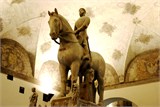
Bernabo
My 18th great-grandfather probably poisoned his brother for territory. He was surely excommunicated, and was the object of the anger of the Holy Roman Emperor, Charles IV. This is exactly when my knowledge of Euro history is fuzzy. Venice was once a giant kingdom that included much of Austria….Bernabo was born in Milan. Holy Roman Empire, Batman, this is confusing!!!!!
Bernabo Lord Milan di Visconti (1319 – 1385)
is my 18th great grandfather
Veridis Duchess Austria Visconti (1352 – 1414)
daughter of Bernabo Lord Milan di Visconti
Ernst I “Ironside” Archduke of Austria Habsburg (1377 – 1424)
son of Veridis Duchess Austria Visconti
Katharina Archduchess Austria Von Habsburg (1420 – 1493)
daughter of Ernst I “Ironside” Archduke of Austria Habsburg
Christof I VanBaden (1453 – 1527)
son of Katharina Archduchess Austria Von Habsburg
Beatrix Zahringen (1492 – 1535)
daughter of Christof I VanBaden
Sabine Grafin VonSimmern (1528 – 1578)
daughter of Beatrix Zahringen
Marie L Egmond (1564 – 1584)
daughter of Sabine Grafin VonSimmern
Richard Sears (1590 – 1676)
son of Marie L Egmond
Silas Sears (1638 – 1697)
son of Richard Sears
Silas Sears (1661 – 1732)
son of Silas Sears
Sarah Sears (1697 – 1785)
daughter of Silas Sears
Sarah Hamblin (1721 – 1814)
daughter of Sarah Sears
Mercy Hazen (1747 – 1819)
daughter of Sarah Hamblin
Martha Mead (1784 – 1860)
daughter of Mercy Hazen
Abner Morse (1808 – 1838)
son of Martha Mead
Daniel Rowland Morse (1838 – 1910)
son of Abner Morse
Jason A Morse (1862 – 1932)
son of Daniel Rowland Morse
Ernest Abner Morse (1890 – 1965)
son of Jason A Morse
Richard Arden Morse (1920 – 2004)
son of Ernest Abner Morse
Pamela Morse
I am the daughter of Richard Arden Morse
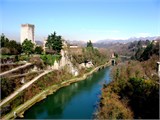
Visconti castle
Bernabò Visconti (also called Barnabò) (1323 – 18 December 1385) was an Italian soldier and statesman, who was Lord of Milan.
Life
He was born in Milan, the son of Stefano Visconti and Valentina Doria. From 1346 to 1349 he lived in exile, until he was called back by his uncle Giovanni Visconti. On 27 September 1350 Bernabò married Beatrice Regina della Scala, daughter of Mastino II, Lord of Verona and Taddea da Carrara, and forged both a political and cultural alliance between the two cities. His intrigues and ambitions kept him at war almost continuously with Pope Urban V, the Florentines, Venice and Savoy. In 1354, at the death of Giovanni, he inherited the power of Milan, together with his brothers Matteo and Galeazzo. Bernabò received the eastern lands (Bergamo, Brescia, Cremona and Crema), that bordered the Veronese territories. Milan itself was to be ruled in turn by the three brothers. The vicious Matteo was murdered in 1355 at the order of his brothers, who divided his inheritance between them.
In 1356, after having offended the emperor, he pushed back a first attack upon Milan by the imperial vicar Markward von Raudeck, imprisoning him. In 1360 he was declared heretic by Innocent VI at Avignon and condemned by Emperor Charles IV. The ensuing conflict ended with a dismaying defeat at San Ruffillo against the imperial troops under Galeotto I Malatesta (29 July 1361). In 1362, after the death of his sister’s husband, Ugolino Gonzaga, caused him to attack also Mantua. Warring on several different fronts, in December of that year he sued for peace with the new pope, Urban V, through the mediation of King John II of France. However, having Barnabò neglected to return the papal city of Bologna and to present himself at Avignon, on 4 March 1363 he was excommunicated once more, together with his children, one of whom, Ambrogio, was captured by the Papal commander Gil de Albornoz. With the peace signed on 13 March 1364, Visconti left the occupied Papal lands, in exchange for the raising of the ban upon a payment of 500,000 florins.
In spring 1368 Visconti allied with Cansignorio della Scala of Verona, and attacked Mantua, still ruled by Ugolino Gonzaga. The situation was settled later in the year through an agreement between him and emperor. Two years later he besieged Reggio, which he managed to acquire from Gonzaga in 1371. The following war against the Este of Modena and Ferrara raised again Papal enmity against the Milanese, now on the part of Gregory XI. In 1370, he ordered the construction of the Trezzo Bridge, then the largest single-arch bridge in the world.
In 1373, the pope sent two papal delegates to serve Bernabò and Galeazzo their excommunication papers (consisting of a parchment bearing a leaden seal rolled in a silken cord). Bernabò, infuriated, placed the two papal delegates under arrest and refused their release until they had eaten the parchment, seal, and silken cord which they had served him. He managed to resist, despite also the outbreak of a plague in Milan, whose consequences he suppressed with frantic energy.[2] In 1378 he allied with the Republic of Venice in its War of Chioggia against Genoa. His troops were however defeated in September 1379 in the Val Bisagno.
Bernabò, whose despotism and taxes had enraged the Milanese — he is featured among the exempla of tyrants as victims of Fortune in Chaucer’s[3] Monk’s Tale as “god of delit and scourge of Lumbardye” — was deposed by his nephew Gian Galeazzo Visconti in 1385. Imprisoned in the castle of Trezzo, he was poisoned in December of that year.
The funerary monument of Bernabò Visconti, with an equestrian statue, together with that of his consort, had been made beforehand, in 1363. The sculptures by Bonino da Campione were intended for the church of San Giovanni in Conca. They now stand in the Castello Sforzesco in Milan.
Children
Bernabò was an ally of Stephen II, Duke of Bavaria: three of his daughters were married with Stephen’s descendants. His issue include:
Viridis (1352- 1414), married Leopold III, Duke of Inner Austria and were the parents of Ernest, Duke of Austria the father of Frederick III, Holy Roman Emperor.
Agnese (1362- executed 1391), married Francesco I Gonzaga
Taddea (1351-28 September 1381), married Stephen III, Duke of Bavaria. She was the mother of Louis VII of Bavaria and Isabeau of Bavaria.
Marco (November 1353- 1382), married Elisabeth of Bavaria.
Ludovico (1358- 7 March 1404), married Violante Visconti (1353- November 1386), daughter of Galeazzo II Visconti, and widow of Lionel of Antwerp.
Rodolfo (d.1388), Lord of Parma
Carlo (September 1359- August 1403), married Beatrice, daughter of John II of Armagnac and sister of John III of Armagnac.
Valentina (d.1393), married Peter II of Cyprus
Caterina (1361- poisoned 17 October 1404,[4]) married her cousin Gian Galeazzo Visconti as his second wife. She was the mother of Gian Maria Visconti and Filippo Maria Visconti, successive dukes of Milan. She acted as regent for her son Gian Maria during his minority.
Lucia Visconti (1372- 14 April 1424), betrothed 1. Louis II of Anjou and married 2. Edmund Holland, 4th Earl of Kent
Maddalena (1366- 17 July 1404), married Frederick, Duke of Bavaria and was mother of Henry XVI of Bavaria.
Mastino (d.1404), married Antonia della Scala (d. 1400), daughter of Cangrande II della Scala.
Anglesia (d.12 October 1439), married Janus of Cyprus
Giammastino (1370- 19 June 1405), married Cleofa (d.1403) daughter of Cangrande II della Scala.
Elisabetta (1374- 2 February 1432), married Ernest, Duke of Bavaria and was the mother of Albert III, Duke of Bavaria.
Antonia (1360-26 March 1405), married Eberhard III, Count of Württemberg
His illegitimate offspring by Donnina del Porri, legitimated in a ceremony after the death of his wife in 1384,[5] were as follows:
Palamede (d. 1402).
Lancelloto.
Sovrana, married Giovanni da Prato.
Ginevra, married Leonardo Malaspina (d. 1441).
Enrica, married Franchino Rusca.
In addition, Bernabò had other illegitimate offspring by other mistresses:[6]
—With Beltramola Grassi:
Ambrogio (1343 – killed in battle Caprino Bergamasco, 17 August 1373), condottiero and Governor of Pavia.
Isotta (d. 1388), married in 1378 to Count Lutz von Landau, condottiero under the name of Lucio Land (d. 1398).
Ettore (d. 1413), who briefly took the Lordship of Milan (16 May – 12 June 1412), married Margherita Infrascati.
Riccarda, married Bernard, Seigneur de La Salle (d. 1391).
—With Montanina de Lazzari:
Sagramoro (d. 1385), Lord of Brignano, married Achiletta Marliani.
Donnina (1360 – 1406), married in 1377 to Sir John Hawkwood.
—With Giovanolla Montebretto:
Bernarda (d. 1376), married Giovanni Suardi.
Valentia, married Antonio Gentile Visconti, Lord of Belgioioso.
Bibliography
Pizzagalli, Daniela (1994). Bernabò Visconti. Milan: Rusconi.
Footnotes
^ Girolamo Porro, engraved title page in Scipion Barbuo, Sommario delle vite de’ duchi di Milano, cosi Visconti, come Sforzeschi (Venice: Girolamo Porro, 1574)
^ For his plague regulations for Milan, see Rosemary Horrox, The Black Death(1994) III.65, p 203.
^ Chaucer had been sent to Lombardy in 1378 on behalf of the young King Richard II to seek the support of Bernabò and Sir John Hawkwood on behalf of the English war effort against France. His epistola metrica III.29 was tacitly addressed to Bernabò (Ernest H. Wilkings, The ‘Epistolae Metricae’ of Petrarch, (Edizioni di Storia e Letteratura), p. 11.
^ Charles Cawley, Medieval Lands, Lords of Milan
^ ” Bernabò Visconti seems to have gone through some sort of marriage ceremony to legitimate his children by Donnina del Porri” (H.S. Ettlinger, “Visibilis et Invisibilis: The Mistress in Italian Renaissance Court Society”, Renaissance Quarterly, 1994.
^ Complete Genealogy of the House of Visconti
Persondata Name Bernabò Visconti Alternative names Short description Lord of Milan Date of birth 1323 Place of birth Date of death Place of death 1385 Preceded by
Cardinal Giovanni Visconti, Archbishop of Milan Lord of Milan
1349–1385 Succeeded by
Gian Galeazzo Viscont
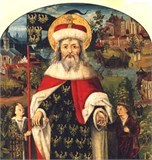
Leopold III
I was trained by Austrian Tourism as an expert in Austria. The training included classroom study for two full days and extensive travel around the country. In the classroom we learned about the Habsburgs who married all the most eligible monarchs in Europe to expand their holdings. I did not suspect at the time that these were my people. However, I specifically noticed that Austrian over-the-top castles and music halls thrilled me, whereas French over-the-top design always made me think of them as wasteful. I did have a certain strong feeling for the architecture, especially in Vienna and Salzburg.
Monarchs of the House of Habsburg
A word about the coats of arms: the Habsburg Empire was never composed of a single unified and unitary state as Bourbon France, Hohenzollern Germany, or Great Britain was. It was made up of an accretion of territories that owed their historic loyalty to the head of the house of Habsburg as hereditary lord. The Habsburgs had mostly married the heiresses of these territories, most famously of Spain and the Netherlands. They used their arms then as a statement of their right to rule all these territories. As there were many territories, so their arms were complex and reflected the waxing and waning position of the Habsburgs within European power politics. It was not until the 19th century (see below Arms of Dominion of the Austro-Hungarian Empire) that the arms began to take on their own life as symbols of a state which may have an existence outside of the Habsburg dynasty.

Leo
Leopold III “Duke of Austria” Habsburg (1351 – 1386)
is my 17th great grandfather
Ernst I “Ironside” Archduke of Austria Habsburg (1377 – 1424)
son of Leopold III “Duke of Austria” Habsburg
Katharina Archduchess Austria Von Habsburg (1420 – 1493)
daughter of Ernst I “Ironside” Archduke of Austria Habsburg
Christof I VanBaden (1453 – 1527)
son of Katharina Archduchess Austria Von Habsburg
Beatrix Zahringen (1492 – 1535)
daughter of Christof I VanBaden
Sabine Grafin VonSimmern (1528 – 1578)
daughter of Beatrix Zahringen
Marie L Egmond (1564 – 1584)
daughter of Sabine Grafin VonSimmern
Richard Sears (1590 – 1676)
son of Marie L Egmond
Silas Sears (1638 – 1697)
son of Richard Sears
Silas Sears (1661 – 1732)
son of Silas Sears
Sarah Sears (1697 – 1785)
daughter of Silas Sears
Sarah Hamblin (1721 – 1814)
daughter of Sarah Sears
Mercy Hazen (1747 – 1819)
daughter of Sarah Hamblin
Martha Mead (1784 – 1860)
daughter of Mercy Hazen
Abner Morse (1808 – 1838)
son of Martha Mead
Daniel Rowland Morse (1838 – 1910)
son of Abner Morse
Jason A Morse (1862 – 1932)
son of Daniel Rowland Morse
Ernest Abner Morse (1890 – 1965)
son of Jason A Morse
Richard Arden Morse (1920 – 2004)
son of Ernest Abner Morse
Pamela Morse
I am the daughter of Richard Arden Morse

Leopold III
Duke Leopold III of Austria (November 1, 1351 – July 9, 1386) from the Habsburg family, was Duke of Austria from 1365 to 1379, and Duke of Styria and Carinthia (Inner Austria) in 1365–1386.
Life
Born in Vienna, Leopold was a younger son of Duke Albert the Wise, and younger brother of the Dukes Rudolf the Founder and Albert the Pigtail. His mother, Joanna of Pfirt, was 51 when she gave birth to him and died shortly after. He was firstly the administrator of Tyrol, and was jointly charged with the rule of the Habsburg lands with Albert after Rudolf’s death. However, by the Treaty of Neuberg of September 9, 1379, he became the exclusive ruler of Styria (including Wiener Neustadt), Carinthia, Carniola, the Windic March, Gorizia, the Habsburgs’ possessions in Friuli, Tyrol and Further Austria. In 1368 he acquired Freiburg im Breisgau, in 1375 Feldkirch and in 1382 Trieste.
However, his attempts to expand his position in Switzerland and Swabia failed, when he died in the Battle of Sempach in 1386.
Family and children
He was married, on 23 February 1365, to Viridis Visconti (1352–1414), second daughter of Barnabò Visconti, Lord of Milan, and Beatrice Regina della Scala, and had the following children:
William the Courteous
Leopold the Fat
Ernest the Iron
Frederick of the Empty Pockets
Elisabeth (1378–1392)
Catherine (1385–?), Abbess of St. Klara in Vienna
He was succeeded by his eldest son William. Other sons included Leopold, future Duke of Further Austria, Ernest the Iron, future Duke of Inner Austria, and Frederick, future Duke of Further Austria.
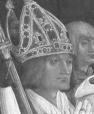
Jakob I
My 16th great-grandfather was from Baden-Baden, Germany. I have been to Baden by Vienna and Baden by Zurich, both fabulous historical hot springs. I have not visited the fancy German double Baden, but have always wanted to go. Now I have all the more reason:
Jacob I of Baden (15 March 1407, Hachberg–13 October 1453, Mühlburg), was Margrave of Baden-Baden from 1431 to 1453.
He was the elder son of Bernard I, Margrave of Baden-Baden and Anna von Oettingen. Jacob I was a man of deep religious beliefs, well-known as a founder of churches. He founded the monastery at Fremersberg and was a major benefactor of the Stiftskirche at Baden-Baden.
According his father’s precepts, only two of his sons were to be considered heirs of the margravate. Therefore only Karl and Bernhard received a secular education; the other children had a strict religious upbringing. Georg, after making a religious profession in his youth, returned briefly to the world, but in 1454 reverted to holy orders and later became Bishop of Metz.
Jacob I was the opposite of his father; Enea Silvio de Piccolomini (Pope Pius II) characterized him as famous among the Germans for his justice and intelligence.
In his early years he was ruler of the family possessions in Hohenberg, until at the age of 24 he succeeded to the government of Baden. He was described as a pugnacious knight and a frugal father of the state and was popular among the princes as a mediator. Both Emperor Sigismund and Emperor Frederick III, under whom he served, thought highly of him.
When as the result of a miscarriage his sister Agnes fled in the middle of a conflict about inheritance, the Margrave lost his claim to the Duchy of Schleswig. He was so angry that he confined Agnes for the rest of her life in the castle of Alt-Eberstein. (The incident is remembered as the “Double Disaster of Gottorf”).
When in 1427 the Treaty of Sponheim came into force, he gained possessions on the Moselle. In 1442 he bought for 30,000 guilders from the descendants of Walter von Geroldseck half the lordship of Lahr and Mahlberg.
Family and children
He married 25 July 1422 Catherine of Lorraine, daughter of Charles II, Duke of Lorraine and Margaret of the Palatinate. They had the following children:
Charles I, Margrave of Baden-Baden (d. 24 February 1475, Pforzheim).
Bernard II, Margrave of Baden-Baden (later beatified) (1428–12 July 1458, Moncalieri).
Johann (1430–9 February 1503, Ehrenbreitstein), Archbishop of Trier.
George (1433–11 February 1484, Moyen), Bishop of Metz.
Markus (1434–1 September 1478), abbot in Liège.
Margarete (1431–24 October 1457, Ansbach), married 1446 to Albert III, Margrave of Brandenburg.
Matilde (d. 1485), Abbess of Trier.
He also had an illegitimate son, Rudolf of Baden.
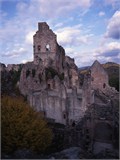
castle of birth
Jakob I Von Baden (1407 – 1453)
is my 16th great grandfather
Karl I Von Baden (1424 – 1475)
son of Jakob I Von Baden
Christof I VanBaden (1453 – 1527)
son of Karl I Von Baden
Beatrix Zahringen (1492 – 1535)
daughter of Christof I VanBaden
Sabine Grafin VonSimmern (1528 – 1578)
daughter of Beatrix Zahringen
Marie L Egmond (1564 – 1584)
daughter of Sabine Grafin VonSimmern
Richard Sears (1590 – 1676)
son of Marie L Egmond
Silas Sears (1638 – 1697)
son of Richard Sears
Silas Sears (1661 – 1732)
son of Silas Sears
Sarah Sears (1697 – 1785)
daughter of Silas Sears
Sarah Hamblin (1721 – 1814)
daughter of Sarah Sears
Mercy Hazen (1747 – 1819)
daughter of Sarah Hamblin
Martha Mead (1784 – 1860)
daughter of Mercy Hazen
Abner Morse (1808 – 1838)
son of Martha Mead
Daniel Rowland Morse (1838 – 1910)
son of Abner Morse
Jason A Morse (1862 – 1932)
son of Daniel Rowland Morse
Ernest Abner Morse (1890 – 1965)
son of Jason A Morse
Richard Arden Morse (1920 – 2004)
son of Ernest Abner Morse
Pamela Morse
I am the daughter of Richard Arden Morse
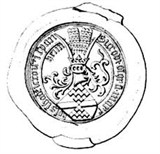
seal of Jakob I

Sabine VonSimmern
My 12th great-grandmother was born in Germany and died in Belgium. She had a very long royal name: Sabine von Pfalz-Simmern (Wittelsbach, Pfalz-Simmern) (Sabine von Pfalz-Simmern) durch Heirat Gräfin von Egmond und Fürstin von Gavere. This did not help her when she begged to spare her knight husband’s life. Such was the fickle finger of royal fate in those days.
Sabine was the daughter of the Count Palatine and Duke John II of simmern (1492-1557) from his marriage to Beatrix (1492-1535), daughter of Margrave Christoph I of Baden. She was a sister of the Elector Friedrich III of the Palatinate.
On April 8, 1544, she married Egmond Lamoral, Prince of Gavre (1522-1568). The wedding was in the Diet of Speyer in the presence of Emperor Charles V and numerous other German imperial princes. The marriage was of great political importance but was described as extremely happy. Due to his link with the German Empire princess (Sabine was called “Bavaria” in the Netherlands), Egmond ranked among the Knights of the Golden Fleece, in 1546.
Sabine begged on her knees to the Duke of Alba to spare the life of her husband but he was beheaded in 1568 in Brussels. After Egmond’s death, Sabine and her children lived in poverty. She was buried beside her husband in Sottegem. The place Oud-Beijerland in the Netherlands is named after Sabine.
I lived in Venezuela in the early 1960s. My father was manager of operations for Mene Grande Oil Company, aka Gulf Oil. I lived in San Tomé in a remote petroleum camp in the llanos. I lived as a petroleum princess and listened to Radio Havana because it was the only station that came in clearly. We lived an opulent life surrounded by fences and guards. Trinidadians usually worked as servants in our homes because they were bilingual. We had one very high lifestyle in every respect.
John Kennedy was shot before I moved to South America, which was unsettling. Race riots were taking place in the states, but we were isolated from that reality hanging out at our private social club in the tropics. We lived in extreme segregation, but thought nothing of it. The seeds of revolution are planted many years before they mature. The wealth discrepancy in South America was shocking, but since it was all to our advantage we were told it was inevitable. These experiences all became part of my knowledge of the world and later part of my politics. I distrust all imperialists and their motives.
With a simplistic agenda to end unbearable insecurity the students began to march last week in all the cities in Venezuela. The outcome of this battle will be significant and was long in the making.
MGO employee handbook
I did not start studying genealogy with the expectation of spending years involved with my family tree. I did not expect to find much data, and thought I would be finished in a couple of weeks. In my sixth year of tracing my family back in time I could not imagine life without this research. I have now relearned history by tracing my own DNA through it. Believe me it becomes more interesting when you picture your own ancestors in events. The timeline is an important tool in life to assess progress and enlightenment. The same can be said of a much longer timeline, such as human history. I am starting to understand the mass migrations caused by religions that have shaped the political world. My people were motivated to take great risks and leave their known environments to follow religious convictions. They crossed the Atlantic in rickety boats with nothing but beer to drink. They froze and starved in the early American colonies. They adventured way out west to Ohio and beyond after the Revolutionary War. They fought on both sides of every British and American war, which is most revealing.
Ancestry.com is run by humans and therefore human error is part of it. The site has gathered and continues to gather public records to share as well as trees published by members who make them public. Often an unsubstantiated piece of data will be shared and repeated in the public tree arena. Fortunately there are also wizards who find some errors, and advise the owners of bogus trees to double check the data. I have twice needed to erase several generations of mistaken identity when I was given more information by a fellow family member. Bittersweet, erasing..I had become fond of the ancestors who were not really my own. It was a horrible blow to be wrong about them, but this study is about verification and facts, not just being up in your tree.
I have been asked which are my favorite ancestors, to which I generally reply I like them all for surviving so I could be here now. There are a few that I might love more than the others:
They are either well known or unknown, but all important to me and my existence. If you take the two week trial I bet you will find something remarkable in your own family history.
 mermaidcamp