mermaidcamp
Keeping current in wellness, in and out of the water
You can scroll the shelf using ← and → keys
You can scroll the shelf using ← and → keys
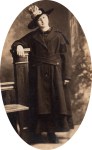
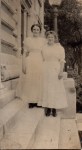

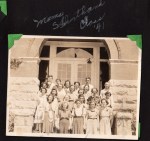


My grandmother, Olga Scott Morse, was a teacher of business skills. She graduated with her masters in education after she had four kids. She left them at home on the oil lease with their dad during the week to attend classes at Oklahoma State University. I believe that in the 1930s this was a bold feminist move. After graduation from OSU she taught typing and shorthand at a junior college near their home in Tonkawa,OK. Learning to type was a bold femenist move, believe it or not. Her students learned shorthand and typing and other current secretarial skills. The school to day is called Northern Oklahoma College. I stopped at the campus when I went to Oklahoma on an ancestry hunt a few years ago. I found her name in an old yearbook in the library, which was fun. I also looked through a lot of photos from the history of the school, where my dad and his brothers were students, but I did not find them. I walked around on campus, taking a break in my drive. Later, I found a picture of her with her students in the 1930’s in front of the central building at my uncle’s house in Wichita. I easily recognized the building since I had just been there.
Her mother, Sarah Helena Byrne, was a teacher and her great-grandfather , Amos Nichols,was also. My father was a university professor. The teacher archetype is all over my father’s family. I wonder if this is a DNA situation or all the reading and discipline that teachers represent. She was a farmer when I met her, having long since retired, but I remember her typewriter on the farm that had black keys..no letters. She could wail on that thing, but she had little reason to to so. I asked her to because I liked to watch her do it. She was a woman of many skills and talents, including flower and vegetable gardening. Most of the fruits and vegetables we ate in the winter in Pittsburgh were grown on my grandparents’ farm in Arkansas and frozen. I picture her in a sun bonnet, like all her friends wore, on the farm. Visiting the college where she taught before I was born was a really cool experience that showed me a part of her I never knew. For her day and place she was super highly educated and accomplished.
Olga Fern Scott (1897 – 1968)
British flag
Hannah Mead was widowed in England before she sailed to America. She arrived in Boston in 1637 with her son Isaac:
John BEECHER was born on 28 Mar 1594 in Kent, England. He died in 1637/38 in New Haven, Connecticut. He immigrated on 26 Jun 1637 to Boston Harbor. Arrived April 26, 1637 from Steldhurst County, Kent, England. In Governor Eaton’s Company. The first Beecher to reach New England was John Beecher, who came from Kent, England in 1637. He was in the company led by Rev. John Davenport and Theophilus Eaton who had been the Ambassador to Denmark and Deputy-Governor of India. The company crossed the ocean on the “Hector” and another sister-ship. These two ships, after a two month voyage, dropped anchor in Boston harbor. The company consisted of 50 men and 200 women and children and was the most prosperous that ever arrived in New England. Unfortunately, they landed in the midst of a quarrel about Anne Hutchinson who had set herself up as a preacher, irregardless of her sex. Not wishing to become involved, they sent out a scouting party to find another location to settle. They decided upon Quinnipiack on the Long Island Sound, the site of present day New Haven, Conn. The party built a hut and left seven of their men to hold the post for the winter and to prepare for the arrival of the rest of the company in the spring. John Beecher was one of the seven and he failed to survive the winter. Hannah arrived in the spring with her son Isaac and found her husband in an unmarked grave. Since she was the only midwife among them, and thus relied upon by the others in the company, she was given her husband’s allotment of land for herself and her son Isaac. One hundred and twelve years later, in 1750, when David Beecher was a boy of twelve, workmen who were digging a cellar for a house at the corner of George and Meadow Streets in New Haven came upon human bones, believed to be those of John Beecher.
(43) Hannah Beecher sailed from England with her son Isaac and was a widow at the time she left England. Husband John Beecher, one of the seven whom Eaton sent to New Haven in advance of the colony ,died before the colony arrived. He did not survive the first winter. It is established that this ship load of people was rather wealthy landowners from Steldhurst County, Kent, England. Since the company was rather young, it was felt that Hannah’s services of midwife would be greatly needed. She therefore was offered her husband’s land right in the new world if she would agree to go and fulfill this need, which she did. ——————————————————————————The will of Hannah Beecher was proved April 5, 1659 and is recorded in first part, vol i., p 80 of New Haven Probate Records as follows: “I Hannah Beecher of New Haven, expectying my great change do make this my last will and testament, I bequeath my soul unto the hands of my Lord Jesus Christ by whose meritt I hope to be saved and my body to be burried at the discretion of my Son William Potter my Executor. And for my worldly goods I give unto John Potter my Grand child twenty shillings and to Hannah Blackly, my Grand child twenty shillings to be paid to them within three months after my decease. And for the rest of my estate I give one third part to my son Isaac Beecher and two thirds to my eldest son William Potter, making him my Executor, desiring him to be as a father to his younger brother and his children. And in dividing my goods my will is that my son William should have my feather bed with that belongeth to it, unto his part and that the rest be divided at the discretion of my Overseers with the assistance of Sister Wakeman and sister Rutherford and I desire my loving friends Mr Mathew Gilbert and Job Wakeman to be overseers of this my last will whereunto I have set my hand this 13th day of June, Anno 1657. Witnesses, the mark of Mathew Gilbert, Hannah Becher John Wakeman, Sarah Rutherford. This source also indicates that the inventory of Hannah’s estate following her death in 1659 amounted to 55 pounds, 5 shillings, and 6d. ——————————Hannah (Potter) Beecher appears in early New Haven as a widow with sons: John Potter, William Potter, and Isaac Beecher. She has been considered to be the mother of Isaac Beecher, for she calls him her son in her will and gave him one third of her property, but recent investigations (source unproven ) suggest that Isaac was a step son, the son of her second husband by a former wife. SEE NOTE ON ISAAC BEECHER ENTRY. ————————————————– Note: There was in New Haven, says G.F. Tuttle, as early as 1641, a widow Hannah Potter, known as widow Potter the midwife. In 1643 she had two persons in the family, thirty pounds estate and twenty and one quarter acres of land. She is called “sister Potter the midwife,” in seating the meeting house in 1646. She is supposed to have been akin to the other Potters, but there is no record to show it. She has often been confounded with the widow Hannah Beecher, but the records clearly show that they were two different persons. ————————————————— Per “Families of Ancient New Haven”
Hannah Mead (1584 – 1659)
is my 10th great grandmother
William Potter (1608 – 1684)
son of Hannah Mead
Hannah Potter (1636 – 1700)
daughter of William Potter
Benjamin Mead (1666 – 1746)
son of Hannah Potter
Mary Mead (1724 – 1787)
daughter of Benjamin Mead
Abner Mead (1749 – 1810)
son of Mary Mead
Martha Mead (1784 – 1860)
daughter of Abner Mead
Abner Morse (1808 – 1838)
son of Martha Mead
Daniel Rowland Morse (1838 – 1910)
son of Abner Morse
Jason A Morse (1862 – 1932)
son of Daniel Rowland Morse
Ernest Abner Morse (1890 – 1965)
son of Jason A Morse
Richard Arden Morse (1920 – 2004)
son of Ernest Abner Morse
Pamela Morse
I am the daughter of Richard Arden Morse
The question of Hannah’s parents is not fully resolved:
Mrs. BEECHER was voted a portion of land by the New Haven colony for her services as physician and midwife. The land remained in the BEECHER family until 1879. The New Haven Hospital, built in the late 1800s stood on part of it, about a half mile west of the old Green.
SURNAME CONFUSION
One researcher has Hannah’s surname as BEECHER. But it is clear that she married a BEECHER, and I think someone confused BEECHER as her surname. I believe that Hannah was a MEAD who married a POTTER before BEECHER.
But another source claims she was Ann/Hannah LANGFORD. This Hannah was also born in Kent, ENG. But she died FEB 1658 in New Haven, New Haven, Connecticut, USA. (I need to determine which was the right Hannah. They were both listed as midwives.
Hannah was widowed in England and married a second time there. She is believed to have married John Beecher who was a member of the advance party which was sent to prepare for the settling of New Haven, CT. John died in New Haven before the arrival of the colony. The well known Beecher family (Henry Ward Beecher and Harriet Beecher Stowe, being two of the clan) descend from Hannah’s son Isaac Beecher.
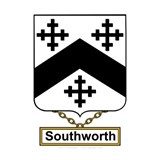
Southworth Coat of Arms

Plimouth Colony
My 9th great-grandmother was born and died in Plymouth Colony. She married Joseph Howland, who was also born in Plymouth.
Joseph Howland [Parents] was born about 1637 in Plymouth, Mass.. He died in Jan
1703 in Plymouth, Mass.. He married Elizabeth Southworth on 7 Dec 1664 in
Plymouth, Ma..
  NOTE: Hubert Kinney Shaw, Families Of The Pilgrims; ; Massachusetts Society of
  Mayflower Descendants; pg. 6; ;
  MARRIAGE:Hubert Kinney Shaw, Families Of The Pilgrims; ; Massachusetts
  Society of Mayflower Descendants; pg. 6; ;
Elizabeth Southworth [Parents] was born in 1645. She died in Mar 1717 in
Plymouth, Ma.. She married Joseph Howland on 7 Dec 1664 in Plymouth, Ma..
  NOTE: Hubert Kinney Shaw, Families Of The Pilgrims; ; Massachusetts Society of
  Mayflower Descendants; pg. 6; ;
  MARRIAGE:Hubert Kinney Shaw, Families Of The Pilgrims; ; Massachusetts
  Society of Mayflower Descendants; pg. 6; ;
They had the following children:
         MiThomas Howland
         MiiJames Howland
         FiiiSarah Howland was born in 1673 in Plymouth, Ma.. She died on 23 Dec
        1703 in Plymouth, Ma..
         FivLydia Howland
         FvElizabeth Howland
         FviMercy Howland
         MviiNathaniel Howland
         MviiiBenjamin Howland was born on 7 Sep 1689 in Plymouth, Ma.. He died
        on 7 Sep 1689 in Plymouth, Ma..
         MixJoseph Howland was born on 8 Jul 1689 in Barnstable, Ma.. He died on
        8 Jul 1689 in Barnstable, Ma..
         FxMary Howland
         FxiElizabeth Howland was born in 1665 in Plymouth, Ma.. She died on 15
        Feb 1723.
Elizabeth Southworth (1645 – 1716)
is my 9th great grandmother
Elizabeth Howland (1673 – 1724)
daughter of Elizabeth Southworth
Eleazer Hamblin (1699 – 1771)
son of Elizabeth Howland
Sarah Hamblin (1721 – 1814)
daughter of Eleazer Hamblin
Mercy Hazen (1747 – 1819)
daughter of Sarah Hamblin
Martha Mead (1784 – 1860)
daughter of Mercy Hazen
Abner Morse (1808 – 1838)
son of Martha Mead
Daniel Rowland Morse (1838 – 1910)
son of Abner Morse
Jason A Morse (1862 – 1932)
son of Daniel Rowland Morse
Ernest Abner Morse (1890 – 1965)
son of Jason A Morse
Richard Arden Morse (1920 – 2004)
son of Ernest Abner Morse
Pamela Morse
I am the daughter of Richard Arden Morse
We see that she is a progenitor of Teddy Roosevelt, and that her roots are Plantagenetial:
1. Theodore Delano Roosevelt 1882-1945 32nd United States President
2. James Roosevelt 1828-1900
3. Mary Rebecca Aspinwall 1809-1886
4. Susan Howland 1779-1852
5. Joseph Howland 1749-1836
6. Nathaniel Howland 1705-1766
7. Nathaniel Howland 1671-1746
8. Elizabeth Southworth 1645-1717
9. Thomas Southworth 1616-1669
10. Edward Southworth 1590-1621
11. Thomas Southworth 1548-1616
12. Sir John Southworth 1526-1595
13. Margarey Boteler 1500-1546
14. Sir Thomas Boteler 1461-1522
15. Margaret Stanley 1433-1481
16. Joan Goushill 1404-1460
17. Elizabeth Fitzalan 1366-1385
18. Elizabeth De Bohun 1350-1385
19. William De Bohun 1312-1360
20. Elizabeth Plantagenet 1282-1316
21. Edward I Longshanks King of Enlgand, Plantagenet 1239-1397
22. Henry III King of England, Plantagenet 1207-1272
23. John of Lackland King of England, Plantagenet 1167-1216
24. Henry II King of England, Plantagenet 1132-1189

British flag
My 8th great-grandfather came from England to Virginia in the 1600’s. We don’t know much about him except that he arrived early in America. He was a large landowner and his wife inherited land from her brother as well. These early settlers in Virginia had plenty of obstacles to overcome to just survive.
Capt John Gregory born: 1623 in Stockwith, England died: 1676 Rappahannock County, Virginia Officer in the Colonial Militia. Emigrated to Virginia prior to 1656; settled on the north side of the James River in Charles County. 20 February 1663 had a grant of 600 acres in Rappahannock County. Vestryman in 1665.
Capt John Gregory(1623 – 1676)
is my 8th great-grandfather
Mary Gregory (1665 – 1747)
daughter of Capt John Gregory
John Taylor (1685 – 1776)
son of Mary Gregory
John Taylor (1727 – 1787)
son of John Taylor
John Taylor (1747 – 1781)
son of John Taylor
John Nimrod Taylor (1770 – 1816)
son of John Taylor
John Samuel Taylor (1798 – 1873)
son of John Nimrod Taylor
William Ellison Taylor (1839 – 1918)
son of John Samuel Taylor
George Harvey Taylor (1884 – 1941)
son of William Ellison Taylor
Ruby Lee Taylor (1922 – 2008)
daughter of George Harvey Taylor
Pamela Morse
I am the daughter of Ruby Lee Taylor


While studying my tree I noticed that one of the branches had some discrepancies. The Sweet family of Rhode Island is a favorite of mine now that I have visited the state. Consulting family written documents, my suspicions were confirmed that I had the wrong Sweet in the wrong spot. I was sad because I had become attached to these people who would no longer be related to me, which itself is a ridiculous thought. Now I have spent time to repair the error, and with a bit of luck I did get back to the correct ancestor in just 3 generations. I had listed his brother John in this generation, an erroneous idea I found in other profiles on ancestry.com. Lucky for me, I do have family written references on this part of my fam. My new, revised 8th great grandfather is from a Sweet family of famous physicians known as the bonesetters. They carried on for generations in this capacity. I am now just as happy with the doctors as I was with the fancy politicians I gave up in the process. I have also been informed about Rhode Island history, which is fascinating.
James Sweet (1622 – 1695)
is my 8th great-grandfather
Benoni Sweet (1663 – 1751)
son of James Sweet
Dr. James Sweet (1686 – 1751)
son of Benoni Sweet
Thomas Sweet (1732 – 1813)
son of Dr. James Sweet
Thomas Sweet (1759 – 1844)
son of Thomas Sweet
Valentine Sweet (1791 – 1858)
son of Thomas Sweet
Sarah LaVina Sweet (1840 – 1923)
daughter of Valentine Sweet
Jason A Morse (1862 – 1932)
son of Sarah LaVina Sweet
Ernest Abner Morse (1890 – 1965)
son of Jason A Morse
Richard Arden Morse (1920 – 2004)
son of Ernest Abner Morse
Pamela Morse
I am the daughter of Richard Arden Morse
The second son of JOHN & MARY SWEET, James Sweet came with his parents to America in 1632. He worked at a grist mill with his step-father, Ezekiel Holliman. He was an inhabitant of Warwick in 1648, Commissioner in 1653/1658/1659, freeman in 1655, juryman in 1656 and lived at the estate of the late William Congdon at the foot of Ridge Hill. He married MARY GREENE, daughter of JOHN GREENE & JOANE (TATTERSOL) GREENE, about 1654 in Providence, RI. On Sept. 30, 1660, he sold to Thomas Greene, the lot he had received from the town of Warwick along with meadow land. Later, the family moved to Prudence Island in Portsmouth Twp. about four miles soutwest of Bristol in 1664 being one of the first families to live on the island from 1664 to about 1685. Several family members are buried in the old family burying ground in the center of the island.On November 8, 1686, he deeded his land in Providence that he had inherited from his father to eldlest son, Philip of Prudence Island. On the same date, he deeded to son, Benoni, certain land in Mashiantatack, and to son, James of Prudence Island, Valentine of Kingstown, and Samuel & Mary Sweet living with their parents, land in Mashiantatack. In 1695, James deposed and gave his age as 73. He died at age 93 years.All the “bone-setter” family lines originate with James Sweet and his wife, Mary, who learned the art of bone-setting from her surgeon father, JOHN GREENE. James Sweet & his brother, John Sweet were interpreters to the Indians for first settlers and their names can be found on early Indian deeds. James Sweet signed with his mark.
I am in a chat group with some people who have been to est training or the Landmark Forum, but I have not done that. I enjoy their point of view, but am amused by much of the jargon. Recently somebody in that group asked if others had alienated others with special transformational language. I had to laugh and think of what my own transformational groups and languages have been:
There are sub groups,but these are the majors. I have recently been united with my early childhood neighbors and school friends, one of whom went to summer camp with me. I have also gotten in touch with many old friends and neighbors who lived in San Tomé, Venezuela in the early 1960’s. This mostly bilingual group has a language and a culture that is unique. I am not in contact with any high school or college friends, but a small group with whom I worked in a theater company in Cherokee, NC in 1968 has been drawn together through social media. The hippies, spa bunnies, swimmers, and vegetarians all switch places and morph into the current culture. I know a few of each group from the past. I stay in touch with Swiss friends, although I have not visited for a few years now.
The language, slang, and meaning of these transformational groups imprint on us as individuals, and as a collective groupthink. We share memories that fit together like jigsaw puzzles. In the last month I have been amazed to learn some of the things my elementary classmates remember about me, and what I know about them. The past plays back like a very funny movie, missing lots of dialog and motive. What seemed insignificant is memorable, and what was important at the time has lost significance. We do have a thread of common language, and some common ideas. Although we may no longer be a group who hangs out in real life, we somehow are still transforming each other. Even learning about the death of some of our old comrades shakes the foundation of mortality, the ultimate transformation.

Thomas Kerr
Thomas Kerr was devoted to the interests of Mary, Queen of Scots, who was in turn, devoted to the martyrdom of my maternal 10th great-grandfather, Rowland Taylor. My family has been opposed to itself in history more than once. As a child in suburban Pittsburgh I lived very near a family named Kerr of fabulous, robber baron wealth of some kind. I now wonder if I was a distant relative of the Kerrs in my childhood neighborhood. They had a castle and loads of fine stuff they shared generously with all the kids in the area. I suppose I will never know. We do know quite a bit about Thomas, including his ruffled fashion statement:
Thomas Kerr (Carr) became the 9th Baron of Ferrniehirst Castle. He was also noted for his involvement with Mary Stuart, Queen of Scots. (From notes of David W Carr)The name of Carr, Kerr or Karre is as old as the Norman Conquest by William of Normandy in 1066. One of the followers of William I is recorded in the Roll Of The Gattle Abbey as the name of Karre.The early descendants of this Norman soldier and succeeding generations spread on both sides of the border of England and Scotland.Direct lines can be traced through various peerage books of England and Scotland to Andrew Kerr I, the 6th Baron of Fennehurst, Scotland. He was born in 1450 , created Baron in 1480 and knighted in 1483. He and his son Andrew II, 7th Baron of Fennehurst, were remarkable men for talent and undaunted courage, conspicious in reigns of James IV and James V. Andrew Kerr II, died in 1543. His son Sir John Kerr, 8th Baron of Fennehurst, did great service against the English and rescued Queen Mary from incursions by the English against the Scots. Sir Thomas, 9th Baron and son of Sir John, was also devoted to Queen Mary’s interests. (Quoted from Watson’s “The House of Carr”1926)
Thomas Kerr (1529 – 1586)
is my12th great grandfather
William Carr (1542 – 1655)
son of Thomas Kerr
Benjamin Carr (1592 – 1635)
son of William Carr
Caleb Carr (1623 – 1695)
son of Benjamin Carr
Sarah Carr (1682 – 1765)
daughter of Caleb Carr
John Hammett (1705 – 1752)
son of Sarah Carr
MARGARET HAMMETT (1721 – 1753)
daughter of John Hammett
Benjamin Sweet (1722 – 1789)
son of MARGARET HAMMETT
Paul Sweet (1762 – 1836)
son of Benjamin Sweet
Valentine Sweet (1791 – 1858)
son of Paul Sweet
Sarah LaVina Sweet (1840 – 1923)
daughter of Valentine Sweet
Jason A Morse (1862 – 1932)
son of Sarah LaVina Sweet
Ernest Abner Morse (1890 – 1965)
son of Jason A Morse
Richard Arden Morse (1920 – 2004)
son of Ernest Abner Morse
Pamela Morse
I am the daughter of Richard Arden Morse
Sir John’s son, Sir Thomas Kerr of Ferniehirst, was noted for his loyalty to Mary Queen of Scots, for whom he built a fortified house in the centre of Jedburgh. He raised the Royal Standard for her in Dumfries, helping her and her husband Darnley to put down an insurrection by a group of her nobles (she won at the time but was forced into exile a few years later). Subsequently he sheltered her English supporters after the rising of the Northern Earls (1568) and rescued Lady Northumberland, stranded by illness in a Liddesdale outlaw’s hide-out. He helped his father-in-law, Kirkcaldy of Grange, to defend Edinburgh Castle in the Queen’s name; when it was taken he lost precious family documents which were never seen again, but at least he escaped with his life (Kirkcaldy was beheaded) and fled abroad for some years. He was re-instated in his lands by James VI when the young King came of age and took power into his own hands. The townsmen of Jedburgh supported the Regent Morton (later also beheaded) against Mary; they “debagged” and publicly caned a herald sent out by Ferniehirst to read out a proclamation of loyalty to the Queen, also compelling him to eat his document.
From her English prison, Mary wrote to Sir Thomas, thanking him for his past services and encouraging him to keep up his loyalty. She seems to have taken a particular liking to his young son Andrew, the first Lord Jedburgh, and may have knighted him while still a child, for she asks in particular to be remembered to “Sir Andrew”.
Briefly imprisoned after the fall of Edinburgh Castle, Sir Thomas was in exile and unable to perform his duties as Warden at the time of the last major clash on the Border, the Raid of Redeswire. This incident developed on one of the “days of truce” when the Wardens or their deputes met to resolve various local problems and to exchange or hang wanted criminals. On this occasion the English Warden complained that the Scots had failed to hand over a thief known as “Farnstein” (not a German refugee or mercenary, as one might think, but an Englishman whose real name was Robson). This led to mutual insults, no doubt aggravated by the fact that both sides had been liquidating a great deal of liquid. The argument grew into a scuffle and the scuffle grew into a fight. Eventually the Jedburgh men arrived in strength and dispersed the English, killing a few and capturing others, who were later released without ransom.
Though he missed this particular incident, Sir Thomas was involved in a similar but smaller affray, on almost the same spot, ten years later. By then he was back in office as Warden of the Middle March; Forster, now 84, was still in charge on the other side, and Forster’s son-in-law, who was also a son of the Earl of Bedford, was killed. Elizabeth Tudor was not amused, and insisted on Ferniehirst’s punishment, though the rights and wrongs of the whole affair were by no means clear. Being anxious to succeed to the English throne, James VI sought to ingratiate himself with her, and exiled Sir Thomas to Aberdeen, where he died within a year. The inscription on his memorial in Jedburgh Abbey reads “Sir THOMAS KERR of Fernyherst, Warden of the Marches, Provost of Edinburgh and Jedburgh, Father of Andrew Lord Jedburgh, Sir James Kerr of Creylin (Crailing) and Robert Earl of Somerset. He died at Aberdeen on March 31, 1586 and lies buried before the Communion Table. He was a man of action and perfit loyaltie and constancie to Queen Marie in all her troubles. He suffered 14 years’ banishment besides forfaulter (forfeiture) of his lands. He was restored to his estates and honours by King James the Sext.”
Sir Thomas married twice. His children by his first wife, Janet Kirkcaldy, included Sir Andrew of Ferniehirst, first Lord Jedburgh (see below) and William, who took the name of Kirkcaldy to continue his mother’s line; his children, however, reverted to Kerr, having failed to inherit the Grange property. By his second marriage, to Janet Scott, Sir Thomas was the father of Sir James Kerr of Crailing (father of the second Lord Jedburgh) and of Robert Can, Earl of Somerset (see below). He had several other children by both his wives.


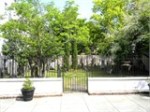
Simon Hirons was born in Delaware, which would later become part of Pennsylvania. I have his father’s name, but have not traced any more information about the parents. He moved to South Carolina, where he was married at age 19 in 1747. He and his wife, Grace Raiford, are buried at the Charleston First Baptist Church. The inscription on his grave says he died while attending a conference in Charleston.
Simon Hirons (1728 – 1778)
is my 5th great grandfather
Sarah Hirons (1751 – 1817)
daughter of Simon Hirons
John Nimrod Taylor (1770 – 1816)
son of Sarah Hirons
John Samuel Taylor (1798 – 1873)
son of John Nimrod Taylor
William Ellison Taylor (1839 – 1918)
son of John Samuel Taylor
George Harvey Taylor (1884 – 1941)
son of William Ellison Taylor
Ruby Lee Taylor (1922 – 2008)
daughter of George Harvey Taylor
Pamela Morse
I am the daughter of Ruby Lee Taylor

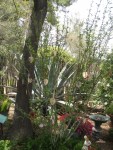
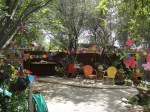


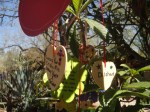


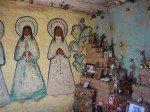
Milagro means miracle, and it also means a specific symbol used to make an offering. Offerings have meaning in the context in which they were made. Churches around the world have tokens left in hope, remembrance, or gratitude. In Ted DeGrazia’s Virgin of Guadalupe chapel people have left these symbols for many years. The oldest chapel I have seen like this has many offerings from sailors that include hats. It is in Cap D’Antibes, France. The chapel of Notre Dame de Garoupe is enchanting as well as historic. In Tucson we also have shrines known as El Tiradito and the Virgin shrine at San Javier del Bac Mission:
An offering can be made in nature, in a chapel, or in a garden. Altars exist in every form. The meaning is in the heart of the person making the offering. Milagros express hope, faith, and dedication. They tell the history of people’s aspirations, tragedies, and triumphs. The spirit of the place is reflected in the objects left on the altar. The altar assumes a collective consciousness by making space for all the offerings and their symbolic powers. It becomes an archive of religion.
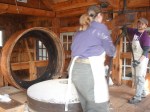
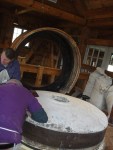

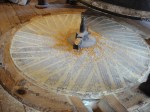


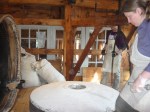


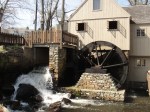
One of the most fascinating displays maintained by Plimouth Plantation is the grist mill. A recent acquisition, the mill grinds corn to show visitors how water powered mills made life possible in the colonies. Because the space is intimate the employees can be very helpful and informative. I learned a lot from my brief visit, and was given some good references to lean more. They employees are very well trained and seem to enjoy working with the visiting public.
 mermaidcamp