mermaidcamp
Keeping current in wellness, in and out of the water
You can scroll the shelf using ← and → keys
You can scroll the shelf using ← and → keys

Providence, RI
John was born ca 1617 based on his age at the time of death, probably in England. In 1632 he came to Dorchester, Massachusetts, in service to Israel Stoughton, carpenter. He married by about 1640, Sarah . Since John was a young, unmarried servant when he first arrived in Dorchester, it is not surprising that he does not appear in the records very often during the 1630s. However, he also generated remarkably few records between 1640 and 1658, during which period he lived in Dorchester as a married man.
On October 3, 1632 the General Court ordered that “Alex: Miller & John Wipple shall give iijs iiijd apiece to their master, Israell Stoughton, for their wasteful expense of powder & shot”. On January 2, 1637/8 John was granted eight acres in Dorchester about the mill. “John Whiplle” was the last of the Dorchester proprietors to sign his name to an agreement submitting to arbitration a dispute over the fencing and division of land.
In 1641, John and Sarah became members of the Dorchester church. On November 15, 1658 “John Whiple of Dorchester…carpenter” sold to George Minot of Dorchester “his now dwelling house and housements scituate and being in Dorchester near the River Naponset together with thirty-seven acres of upland more or less thereto adjoining,” also “eight acres of salt marsh more or less lying near the place commonly called the penny ferry”; “Sarah the wife of the said John Whiple” relinquished her dower rights.” John then moved his family to Providence, Rhode Island.
On July 27, 1659, he was received in Providence as a purchaser. On February 3, 1661/2 John Whipple Sr. petitioned for a piece of land next to his orchard, but his will was referred to the next court. On July 27, 1662 John Whipple Sr. was permitted to exchange sixty acres at Mashapauge Pond for lands at Loquasqussuck. These lands were probably the eights acres at Loquasqussuck laid out to him by Thomas Harris Sr. on April 13, 1667. On November 23, 1663 John Whipple Sr. of Providence deeded to “my son John Whipple” a houselot formerly owned by William Arnold excepting two acres, two shares of meadow, six acres of upland, sixty acres of land at Loquasqussuck. On February 19 John Whipple Sr. drew lot #45 in the division of lands east of Seven Mile Line.
On November 13, 1666 John Whipple Sr. was granted permission to exchange his sixty acres at Tare Breech Plain. On February 24, 1674 John Whipple St. gave a deed of gift to his “son Eliezer Whipple”. On April 12, 1675 he drew lot #43 in the lands on the west side of Seven Mile Line. On January 27, 1674/5 John Whipple Sr. was granted permission to change a fifty-acre division of upland. On May 24, 1675 he drew lot #91 in the land on the east side of Seven Mile Line. He was among those who “stayed and went not away” in 1676 and as such was entitled to share in the disposition of Indian captives, whose services were sold for a term of years. On June 6, 1681 John Whipple Sr. was granted permission to exchange his twenty-five acres at Goatum valley “which he bought of Mr. Benedict Arnold”. On March 4, 1683/4 John Whipple Sr. made a deed of gift to his “son David Whipple”.
John was a carpenter and tavern-keeper. In 1669 John Whipple, Sr. was paid 10s. to allow the town council to meet at this house. In 1670 the amount was raised to 20s. He took the Oath of allegiance (freeman) May 31, 1666.
John held several offices in Providence. He was Deputy to the General Court, September 4, 1666. He served on a Petit jury October 19, 1670. John was a Providence selectman, 1670, 1674, and on April 27, 1676 he was made moderator. He served as Treasurer, June 1, 1668 and Surveyor, June 6, 1670-71. John was on the Committee to run the line, January 27, 1663/4 and on the Committee to consider building a new town house. He was on a jury, May 12, 1663. He was appointed to confer about mending a bridge, January 27, 1664/5, October 28, 1667. He was appointed to a Committee to arbitrate over fences, December 2, 1666. John was an arbiter in the matter of the estate of Resolved Waterman, deceased, January 9, 1700/1. He served on the Committee to “demand & receive at every garrison what was taken from the Indians,” September 7, 1676 and on the Committee to lay out a common, April 27, 1678.
John died on May 16, 1685 at Providence. Sarah predeceased him, dying sometime in 1666.
In his will, dated May 8, 1682 and proved May 27, 1685, John Whipple Sr. of Providence “being in a great measure of health…having many children & to prevent all differences that otherwise may hereafter arise…having formerly given unto three of my sons all my lands…namely Samuell, Eliazer & William equally to be divided among them…only excepting thirty acres which I gave unto my son John at the northwest end”; to “my three aforenamed sons, namely Samuell, Eliazer & William, each of them a quarter part of one right of commoning for pasturing, cutting of timber, & firewood”; to “my son Benjamin a right of lands in the late division which is already laid out unto him”; to “my son Jonathan one division of lands”; to “my son Joseph my dwelling house & my three home lots & the garden next the river, also a six acre lot…also twenty acres near Thomas Clemence his dwelling, also I give unto my son Joseph my share of meadow near Solletarey Hill & two six acre lots…also a five acre lot lying near where William Wickenden formerly dwelt; also one division beyond the Seven Mile Line…also I do give unto my son Joseph all other divisions which shall hereafter belong unto two rights throughout”; to “my sons John, Samuell, Eliazer, William, Benjamin, David & Jonathan unto these seven twelve pence to every of them”; to “my three daughters (namely) Sarah, Mary & Abigall unto every of them ten shillings”; to “my son Joseph all my right of lands in the Narragansett Country”; to “my son Joseph” residue; “my son Joseph my executor.”
In May of 1685, Thomas Olney, Town Clerk of Providence, deposed that he had gone to John Whipple, at his request, and obtained clarification of some of the bequests:
That upon ye sixteenth day of this instant may John whipple senior of the aforesaid towne of Providence sent for to speake with him; This deponant sayth he Emediatly went to him: the said John whipple then shewed him this paper & the writeing which on ye other side of this said paper is written down, desireing this deponant to peruse it. This deponant saith he then did peruse it, & haveing well perused it, he asked the said John whipple what his mind was concerning ye lands which in ye said writeing he had desposed of to his severall sons, whether or no he did intent by that writeing, or will that ye said lands should be unto his said sons & theire Heirs & Assignes for Ever, or only unto his said sons for terme of life, he Emediatly made this Answer; That how Ever it was worded in ye said writeing yet his mind & will was that his sons Each one of them should have those lands house & Rights which hee in ye said writeing unto Each one of them had desposed, to be unto them, theire Heirs & Assignes for Ever to despose ye same or any part thereof at any time as they see cause. & that ye same was his Mind & Will when ye said will was written: And further, that whereas in ye said Will it was omitted to be inserted that his son Jonathan should have one of his Rights of land & Comoning on ye west side of ye seven mile line, yet that was his mind & will; That his son jonathan whipple should have one of his Rights of land & Comoning on ye west side of ye seven mile line to be unto him his Heires & Assignes for Ever; and that was his mind when ye said will was written, how Ever by ye scribe it was omitted. And whereas in ye first part of ye said Will there is an Exception made only of thirty acres of land to his son John by him formerly given, that he owned to be a mistake, & that ye Exception must be of sixty acres which formerly by deede of Gift he had given to his son John whipple; and all the remainder of his said farme lieing about Loquasqussuck should be devided Equally betweene his said three sons (viz) Samuell, Eliezer, & william; This saith this deponant is trueth, & that hee tooke it Emediatly from ye said John whipple his mouth & wrott it downe. And also that whereas the said Will Expresseth a quarter part of a Right of Comoning to Each of his three sons, (namely) Samuell, Eliezer & william, he said his Meaneing intent & will was that it should be so farr westward as ye Seven mile line & no further; And that the said John whipple was then when hee did declare the Same of Sound mind & of Good memory May ye 27th: 1685 upon Oath…
The inventory of John Whipple Sr. was taken May 22, 1685 and totaled £41 11s. 10d., including no real estate, viz: yoke of oxen, 2 cows, 2 yearlings, 2 two years, 2 calves, steer, 3 swine, feather bed, 7 pewter platters, 5 pewter porringers, 3 old spoon, chisel, gauge, augurs, etc.
Captain John Whipple is buried in the Whipple family plot in the North Burial Ground on Main Street in Providence, Rhode Island. Some sources indicate that John and his wife Sarah were initially buried in the garden burial site near their home. Their bodies were moved to the North Burial Ground when it was established in 1700. The headstones of John and his wife Sarah are located approximately 48 feet west-south-west of the “Dahlia Path” sign in the cemetery. On the tomb stones of John and Sarah Whipple, in the north burial ground in Providence, are the following inscriptions:
In Memory ofCapt. John Whipple, whowas born in England &Died in Providence Townye 16th Day of May AnnoDom. 1685. About 68years of age
In Memory of Mrs. SarahWhipple, wife of Capt.John Whipple. She wasborn in Dorchester, inNew England, & Died inProvidence, Anno Dom.1666. Aged about 42years
Many published genealogies state John Whipple married Sarah They or Darling ca 1639. (He would have been 22-23, she 15-16.) No evidence has been found to confirm that Sarah’s maiden name was either They or Darling. Neither appears among early Dorchester surnames; the closest being Thayer. Sarah’s tombstone states she was born in Dorchester and died in Providence in 1666, aged about 42 years. The stones do not appear to be very ancient and may have been erected fifty years or more after the decease of Capt. Whipple and his wife. But if the year and age are correct, she would have been born ca 1624. Thus, she could not have been born in Dorchester, unless she was a Neponset Indian, since Dorchester wasn’t founded until 1630. English settlers didn’t marry Indians in those days, so we can presume she was white. With a birth date of 1624, we can be sure that if she was born in New England, it must have been in Plymouth, which was settled in 1620. Travel by a ferry at a cost of a penny per person between Dorchester and Plymouth was common in 1638.
“My friends, it is wise to nourish the soul, otherwise you will breed dragons and devils in your heart.” ~Carl Jung, Red Book, Page-232.
Carl Jung changed the history and the practice of psychiatry. His work is used today by some who are not even aware of his influence or the story of his life. The Red Book was published posthumously after being locked in a bank vault in Switzerland for many years. Finally out of the shadows itself, the book serves as a deep reference as well as an artistic guide to the underworld. How would the Red Book of your soul look? When do you plan to create it?

Drawing Red Book

Ship Bevis log

Old Rehoboth Cemetery
William Carpenter was a notable town clerk of Rehoboth, Massachusetts. He is from the Carpenter family that became large and influential in Rhode Island and southeastern Massachusetts by the 1700s.
Early Life
William Carpenter, Jr. was baptized on November 22, 1631. His parents were William Carpenter, III and Abigail Briant (sometimes erroneously reported as Bennett or Sale/Seals/Searles), both originally from Wiltshire. Since his family was able to bring a servant with them to Plymouth Colony, it is likely that they came from some affluence.
Carpenter’s place of baptism is variously recorded as Shalbourne, Berkshire, England or Southampton, Wiltshire, England. (Sources also differ on whether it was the Shalbourne in Berkshire, Wiltshire, or the non-existent “Whitshire.”) Professional genealogist Eugene Cole Zubrinsky, author of the Carpenters’ Encyclopedia, maintains that it was Shalbourne, Berkshire based on primary source records. The confusion could be blamed on Shalbourne having been split between Berkshire and Wiltshire around 1841, since it had straddled the line, with some records going to one county and some going to the other. Southampton, meanwhile, was the family’s departure port from England, explaining why some list Carpenter as having been born there.
Arrival in America
By May 2, 1638, Carpenter and his family set sail from Southampton, Hampshire, England on the Bevis, arriving at Boston in July or July. (The passenger list said that by May 2, “they had been some Dayes gone to sea,” so the exact date of departure is unknown.) The family’s full entry said:
William Carpenter 62 Carpenter of Horwell, William Carpenter Jr. 33 Carpenter of Horwell, Abigael Carpenter 32 and 4 children 10 and under, Tho: Banshott 14 Servant
A scan of the log can be seen in the “Photos” section of this profile; a more legible transcription is available throughOlive Tree Genealogy.
The family first settled in Weymouth, and then moved to Rehoboth in 1644.
Marriages & Children
Carpenter’s first marriage was to Priscilla Bennett on October 5, 1651 at Rehoboth. It is unclear whether she was the daughter or widow of Edward Bennett of Weymouth, Massachusetts Bay Colony. She died on October 20, 1663 in Rehoboth.
His second marriage was to Miriam Sale on February 10, 1663/4. (It is sometimes recorded as December since the original record, following the old calendar, called February the “12 month.”) She was born c. 1645 and died on May 1, 1722 at Rehoboth. She was the daughter of Edward sale of Weymouth and Rehoboth and was approximately 20 years old at the time of her marriage.
With his first wife, Carpenter had (all in Rehoboth):
John Carpenter, b. October 19, 1652, d. probably April 9, 1713 in Dedham, Massachusetts
William Carpenter, b. June 20, 1659, d. March 10, 1718/9 in Attleborough, Massachusetts
Priscilla Carpenter Sweet, b. July 24, 1661, d. 1745 in East Greenwich, Rhode Island
Benjamin Carpenter, b. October 20, 1663, d. April 18, 1738 in Coventry, Connecticut
With his second wife, Carpenter had (all in Rehoboth):
Josiah Carpenter, b. December 18, 1664, d. February 28 or 29, 1727/8 in Rehoboth
Nathaniel Carpenter, b. May 12, 1667, d. Rehoboth or Attleborough
Daniel Carpenter, b. October 8, 1669, d. September 14, 1721 in Rehoboth
Noah Carpenter, b. March 28, 1672, d. Attleborough
Miriam Carpenter Bliss, b. October 26, 1674, d. May 21, 1706 in Rehoboth
Obadiah Carpenter, b. March 12, 1677/8, d. October 25, 1749 in Rehoboth
Lt. Ephraim Carpenter, b. April 25, 1681, d. April 30, 1743 in Rehoboth
Hannah Carpenter Chaffee, b. April 10, 1684, d. after January 19, 1767 probably in Rehoboth
Abigail Carpenter Perrin, b. April 15, 1687, d. January 15, 1781 in Rehoboth
The Carpenter family house was on the left-hand side of the road from Rehoboth to the East Providence meetinghouse, “some 50 or 60 rods from the crossing of the Ten Mile river.”
Professional Life
Carpenter was propounded on June 6, 1660 in Weymouth but not admitted as a freeman until June 1, 1663.
Fitting with his surname, Carpenter was originally a carpenter. Records show him owning a “long Cross cutt saw” that he used at his home and which he later willed, along with assorted tools, to his son John, also a carpenter.
For nearly 35 years, Carpenter served as the town clerk of Rehoboth. His records are notable due to his exceptional handwriting and general literacy, which point to some formal education in his background. He also owned a small library of mostly theological books.
Records show that, while serving as clerk, he oversaw the highways, served as constable and juryman, was appointed to settle boundary disputes, helped hired the schoolmaster, served as magistrate, and was otherwise involved in all aspects of local governance.
Deacon or Deputy?
In his 1898 genealogy, Amos Carpenter said that William Carpenter was a deacon of the Rehoboth church and a deputy to the General Court of Plymouth Colony in 1668. Although these “facts” continue to be passed down through some branches of the family, Zubrinsky has conclusively shown that neither could have been true. Although Carpenter’s father served as deputy to the General Court in 1656, Carpenter himself never appears on any list of deputies. Furthermore, the original records of the Rehoboth church list a Deacon Cooper, not Carpenter. Even though he served as neither deacon nor deputy, he continues to be popularly known as “Deacon” simply due to the number of years for which the myth was propagated.
Death & Legacy
Carpenter’s will was dated November 10, 1702 and was proved April 20, 1703. His entire estate, including housing and lands, was worth £215 5s. 4d., or roughly £16,500/US$27,700 in 2011 figures.
Carpenter was buried at Newman Cemetery, one of the oldest (established in 1643) in present-day Rhode Island but which was, at the time of its founding, part of Rehoboth and Plymouth Colony. His parents are also buried in the same cemetery.
Additional Reading
Zubrinsky’s profile of William is perhaps the best available. It is uploaded in the “Documents” section of this profile.
The Wikipedia on the Rehoboth Carpenter family is a good starting point for learning about the family’s spread and influence over time.
Amos Carpenter’s A Genealogical History of the Rehoboth Branch of the Carpenter Family in America, often referred to as “The Carpenter Memorial,” was printed in 1898 and serves as the basis for most modern genealogies. Press of Carpenter & Morehouse, Amherst, Mass., 1898) However, due to the problems noted above with his biographical sketch of Carpenter, it must be read with caution.
Sources
Beers, J. H. Representative Men and Old Families of Southeastern Massachusetts. Chicago: J. H. Beers & Co., 1912.
Carpenter, Amos B. A Genealogical History of the Rehoboth Branch of the Carpenter Family in America. Amherst, Mass.: Carpenter & Morehouse Press, 1898.
Zubrinsky, Eugene Cole. “William Carpenter of Rehoboth, Massachusetts.” Carpenters’ Encyclopedia, updated January 18, 2011.
This biographical profile was written in May 2011 by J. Ashley Odell for Geni. It should not be reposted elsewhere without full attribution.

Grave of William Carpenter
Julia Sweeney of SNL fame performed the opening of her show “Letting Go of God” for this TED talk. She is witty and insightful as she talks about her childhood exposure to religion. We all had different parental models. My parents were not religious but they belonged to a church they rarely attended. They got the big idea that I needed to go to this Presbyterian church when I was about 11. They made no bones about the purpose of my Sunday school enrollment. It was punishment. I am not sure what the infraction was, but I was to atone by being a Sunday school student. It fully sucked. I successfully physically fought off my mother in the ladie’s room the first time she tried to leave me at Sunday school, but eventually I had to go for a couple of years. I even was baptized and confirmed at the same time, since in infancy I was not baptized. My overall impression is that it was a drag, but I do know some of the songs still today. I asked my father why I had to go and they did not. I always remember his answer. He said, “I believe in God, but not like that.” Why they thought I should be indoctrinated like that is still odd to me.

Pawtuxet, Rhode Island
My 9th grandfather was a founder of the town of East Greenwich, Rhode Island. I am excited to find that in Warwick, RI there is an historical village of Pawtuxet where I will be able to visit the Malachi Rhodes home. It will be a huge thrill. I love preserved history, and am so pleased that the Rhode Islanders decided to preserve entire villages of Rhode’s stuff. The village is the oldest in the US, and contains historic buildings that model the past. This will be my kind of village because the Rhodes are not the only family to whom I am related. Ghost tourism at the highest levels will be savored. These people still dress up and guard the village with a militia..can’t wait!!
Malachi Rhodes (1650 – 1682)
is my 9th great grandfather
Malachi Rhodes (1676 – 1714)
Son of Malachi
Dorothy Rhoades (1705 – 1705)
Daughter of Malachi
MARGARET HAMMETT (1721 – 1753)
Daughter of Dorothy
Benjamin Sweet (1722 – 1789)
Son of MARGARET
Paul Sweet (1762 – 1836)
Son of Benjamin
Valentine Sweet (1791 – 1858)
Son of Paul
Sarah LaVina Sweet (1840 – 1923)
Daughter of Valentine
Jason A Morse (1862 – 1932)
Son of Sarah LaVina
Ernest Abner Morse (1890 – 1965)
Son of Jason A
Richard Arden Morse (1920 – 2004)
Son of Ernest Abner
Pamela Morse
I am the daughter of Richard Arden
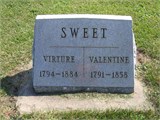
Virtue and Valentine Sweet
Valentine Sweet was born on 14 Feb, 1791 in New York. The Sweet family had come from Rhode Island. Virtue Kelly, an Irish woman no doubt, married Valentine in New York in 1811. They moved to Polo, Ogle, Illinois between 1850 and 1859. Polo had a tunnel for the underground railroad. Their daughter Sarah married her husband Daniel Morse in Illinois in 1858. Daniel and his young bride and first born son returned to New York in 1860 because he thought he might be drafted to fight in the Civil War. After the war Sarah and Daniel moved to Kansas to farm.
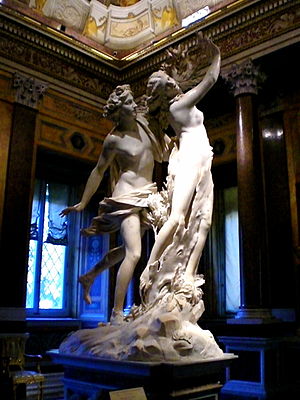
Apollo and Daphne
The myth of Daphne is an illustration of fate and revenge of the gods. She was part of cruel power play between two archers, Apollo and Eros. The proud Apollo bullied Eros who shot two arrows, one tipped in gold and the other in lead to find revenge. Eros, the son of Aphrodite enchanted his arrows to cause total lust and desire in the golden arrow victim, and total hatred in the recipient of the lead tipped arrow. Apollo was hit with the golden arrow, and the object of his desire, Daphne, was struck by the lead one. The struggle between lust and chastity is ended when Daphne turns into a laurel tree. She begged her father to transform her body forever in order to escape Apollo’s desire for her.
Eros is the god of sexual desire. He marries Psyche, a goddess/human representing the human soul. They have one daughter Hedone. Hedone is the quest for pleasure with only good consequences. The English word hedonism is derived from this word, but has a meaning far from the original. Eros is also known in Rome as Cupid. We know this god as a logo for Valentine’s Day, a time when we honor a Christian martyr by consuming mass quantities of cheap chocolate. Neither Valentine nor Cupid will be impressed nor honored with a mindless mandatory purchase of tacky gifts. That is neither pleasurable nor sexy. Eros, Apollo, Daphne, and Aphrodite are archetypes that exist in the human pantheon of possibility. Which one will you play on Valentine’s Day?

tatted doilie
My grandmother did tatting, a lace work done with a tiny plastic shuttle which produced doilies. I have a large variegated doilie that she made but it is in the closet. In my house it would be a big dust collector. When I was young I did crochet, embroidery and some knitting. I taught myself to sew at boarding school when I was 14. When I was 17 I learned to weave on a loom. I like the art and enjoyment of crafting things for my own fashion purposes. My mother was an advanced self styler creating matching hats, shoes and belts to go with her dresses. All of these activities are so satisfying until…..you make a mistake. Then you find there is only one way out of your predicament..rip it out and start again. The entire time you are ripping it out you must take care not to damage the materials, which requires that you not enter rip out rage too deeply. This was agony to me, so I became a potter. If you blow your creation before firing you simply quickly turn it back into mud. If my pots were ugly and I did not want them to live I put them in a bush in the desert and shot them with a 22 pistol. There was no ripping and remorse. A different kind of patience is required to make pots. You just accept that a certain percentage will fail and that is fine.
Last week I opened a message on Ancestry.com from a common descendant of Swain Smith. I am always happy to hear from my fam on Ancestry because they bring extra data and sometimes have documents and pictures to share. This cousin pointed out to me that I had an obvious error in my tree. Swain’s father married twice, and I had listed his mother as the second wife. Since he had been born before the second marriage my mistake was easy to spot. I have revised my tree, and now have no clue about the pedigree of Swain’s real mother. I can only rip out the branches of the tree that I built on a specious assumption and start again. I am so totally back in crochet world. I have to go back to the place where I skipped the loop of my 4th great-grandmother, Sarah Archer, born in New Jersey in 1787. She is my new mystery woman.

Crown of Hungary
Stephen V (Hungarian: V. István, Croatian: Stjepan VI., Slovak: Štefan V) (before 18 October 1239, Buda, Hungary – 6 August 1272, Csepel Island, Hungary), was King of Hungary [1] from 1270[1] to 1272.
Early years
He was the elder son of King Béla IV of Hungary and his queen, Maria Laskarina, a daughter of the Emperor Theodore I Lascaris of Nicaea.
In the second year following his birth, on 11 April 1241, the Mongolian troops defeated his father’s army in the Battle of Mohi. After the disastrous battle, the royal family had to escape to Trau, a well-fortified city in Dalmatia. They could only return to Hungary after the unexpected withdrawal of the Mongol forces from Europe.
Junior King of Hungary
In 1246 Stephen was crowned as junior King and his father entrusted him with the government of Croatia, Slavonia and Dalmatia, but the three provinces were de facto governed by the Ban Stephen Gut-Keled. Stephen’s father, attempting to bind the powerful but pagan Cuman tribes more closely to the dynasty, arranged for Stephen’s marriage, as a youth (about 1253), to Elizabeth, the daughter of a Cuman chieftain Köten.
In 1257, Stephen demanded that his father divide the kingdom between themselves and recruited an army against the senior king. Finally, in 1258, King Béla IV was obliged to cede to him the government of Transylvania.
Duke of Styria
Stephen took part in his father’s military campaign against the Styrians, who had rebelled against the rule of the King of Hungary, in 1258. After the successful campaign, King Béla IV appointed him to Duke of Styria.
His government, however, was unpopular among his new subjects, who rebelled against him with the support of King Ottokar II of Bohemia. Stephen and his father started an attack against Ottokar’s lands, but their troops were defeated on 12 July 1260 in the Battle of Kroissenbrunn. Following the battle, the two Kings of Hungary ceded the Duchy of Styria to the King of Bohemia in the Peace of Pressburg.
Struggles with his father
Shortly after the peace, Stephen took over the government of Transylvania again. In 1261, Stephen and his father conducted a joint military campaign against Bulgaria, but their relationship became more and more tense, because the senior king had been favouring his younger son, Duke Béla of Slavonia and his daughter, Anna, the mother-in-law of the King of Bohemia.
Finally, with the mediation of Archbishops Fülöp of Esztergom and Smaragd of Kalocsa, Stephen and his father signed an agreement in the summer of 1262 in Pozsony. Based on their agreement, Stephen took over the government of the parts of the kingdom East of the Danube. However, the two kings’ reconciliation was only temporary, because their partisans were continuously inciting them against each other. In 1264, Stephen seized his mother’s and sister’s estates in his domains, but his father sent troops against him. Stephen’s wife and son were captured by his father’s partisans, and he had to retreat to the castle of Feketehalom. However, he managed to repel the siege and to commence a counter-attack.
In March 1265, he gained a strategic victory over his father’s army in the Battle of Isaszeg. After his victory, he concluded a peace with King Béla IV. Based on the provisions of the peace, he received back the government of the Eastern parts of the kingdom. On 23 March 1266, father and son confirmed the peace in the Convent of the Blessed Virgin on the Nyulak szigete (‘Rabbits’ Island’). Shortly afterwards, Stephen V led his army to Bulgaria and forced Despot Jakob Svetoslav of Vidin to accept his overlordship.
In 1267, the “prelates and nobles” of the Kingdom of Hungary held a joint assembly in Esztergom, and their decisions were confirmed by both Stephen and his father.
To secure foreign support, he formed a double matrimonial alliance with the Angevins, chief partisans of the pope. The first of these was the marriage, in 1270, of his daughter Maria to the future King Charles II of Naples[2] The second alliance was the marriage of Stephen’s infant son, Ladislaus to Charles II’s sister Elisabeth.
King of Hungary
After his father’s death (3 May 1270), Stephen inherited the whole Kingdom of Hungary, although the deceased senior king had entrusted his daughter, Anna and his followers to King Ottokar II of Bohemia in his last will, and they had escaped to Prague before Stephen arrived to Esztergom.
Before his (second) coronation, Stephen granted the County of Esztergom to the Archbishop. In August 1270, Stephen had a meeting with his brother-in-law, Prince Bolesław V of Poland in Kraków where they concluded an alliance against the King of Bohemia. In September 1270 he visited the village Miholjanec, where was discovered an unknown ancient castle and a sword, this sword he got as a gift, in which he and his priests acknowledged the “Holy War Sword of the Scythians” and he saw that he was determined to master the world. He attended the place of the find, where he met a hermit who told him: “Scourge of God”. Stephen also had a meeting with Ottokar on 16th October on an island of the Danube near Pozsony where they concluded a truce for two years.
However, following smaller skirmishes on the border, the war broke out soon after and the King of Bohemia lead his armies against Hungary. Stephen was defeated in two smaller battles, but finally won a decisive victory on 21 May 1271 over the Czech and Austrian troops of Ottokar II of Bohemia. In the subsequent peace the King of Bohemia handed back the fortresses occupied during his campaign, while Stephen renounced his claim to the Hungarian royal treasury that his sister, Anna had taken to Prague after their father’s death.
In the summer of 1272, Stephen left for Dalmatia, where he wanted to meet King Charles I of Sicily, when he was informed that Joachim Gut-Keled had kidnapped his infant son, Ladislaus, and hid in Koprivnica. Stephen was planning to raise an army to rescue his infant son when he died suddenly.
Marriage and children
In about 1253, he married Elisabeth (1240 – after 1290), daughter of a chieftain of the Cuman tribes, they settled in Hungary and had the following children:
Elisabeth (1255 – 1313/1326), wife firstly of Záviš of Falkenštejn and secondly of King Stefan Uroš II Milutin of Serbia
Catherine (1255/1257 – after 1314), wife of King Stefan Dragutin of Serbia
Maria (c. 1257 – 25 March 1325), wife of King Charles II of Naples
Anna (c. 1260 – c. 1281), wife of the Emperor Andronikos II Palaiologos
King Ladislaus IV (August 1262 – 10 July 1290)
Andrew, Duke of Slavonia (1268 – 1278)
Ancestry [show]A ncestors of Stephen V of Hungary [ edit] Titles
King of Hungary, Dalmatia, Croatia, Rama, Serbia, Galicia, Lodomeria, Cumania and Bulgaria; Duke of Styria (1258–1260)
I have always loved paprika and the Danube.
The moon, the way we view it ,and the power it holds have been studied for all of history. The phases of the moon are significant in agriculture as well as business. Lunar calendars were used to measure time until the Catholics went Gregorian on the Euros. Since the Julian calendar , created by Julius Caesar in 46 BC was inaccurate in terms of the planets, the Pope became concerned that Easter was sliding into summer. Catholic calendar year is key to the liturgy practice and costuming. The whole system supporting the Easter Bonnet was slowly slipping away with each new year. Astronomers were hired to deal with the issue. The Greek Orthodox religion uses the Julian calendar now, as do the Berbers, the Ethiopians, and others concerned with historical continuity.
The Pope as a symbol was resisted by the Protestants. The idea that Pope Gregory would now change the way they counted time was not going to go over with the new religions that sprung up precisely to combat Popery. At his death the Vatican treasury was empty, but Gregory XIII had left his mark on time. For this reason the Gregorian style was not adopted at the same time. The Swiss used both calendars simultaneously for more than 100 years. The Catholic cantons adopted it when they got the bull from the Pope in 1582. The Protestants kept the Julian style rather than agree with a Catholic concept. The Protestant cantons gave in to the new calendar in 1700. The canton of St Gallen was the last hold out, continuing on the lunar side of life until 1724. The Chinese succumbed in 1949, but they still use their own lunar calendar.
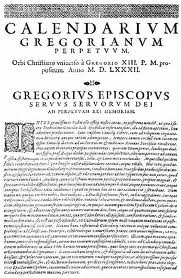
News from Pope Gregory XIII
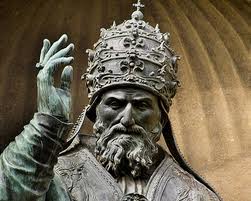
Gregory XIII in elaborate Easter Bonnet
 mermaidcamp