mermaidcamp
Keeping current in wellness, in and out of the water
You can scroll the shelf using ← and → keys
You can scroll the shelf using ← and → keys
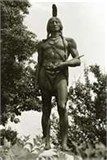
Ousameequin Massasoit
The First Thanksgiving, 1620, was a time of warm feelings and friendly relations between the Plymouth Colonists and the Indians of America. On March 22, 1621, Samoset, an Indian who spoke English appeared on the scene. He once had been kidnapped and taken to London where he learned pigeon English. He helped the Colonists to sow seed and manure the land with fish for a bountiful harvest. He then arranged a meeting between Massasoit, the revered chief of the Wampanoags, a tribe of the Algonoquin Indians, and the leaders of the Plymouth Colony and a Peace Treaty was signed. The Colonists, as hosts at the First Thanksgiving, could speak no Algonguian, the language of the Indians, and the Indians, except Samoset, could speak no English. There must have been much smiling, nodding of heads, pats on the shoulders, and hearty grunting. Of course a three day party where the English shared their new supply of beer certainly was expected to engage many friendships. It is particularly significant that the peace treaty drawn during the feast was never broken during the remaining forty years of Massasoit’s life! From the writings of two of the settlers, Govenor William Bradford and Edward Winslow, as compiled for “The Pilgrim Reader” by George F. Willison: “Our harvest being gotten in, our Governor sente four men out fowling that so we might, after a more special manner, rejoyce together after we had gathered the fruit of our labours. These four, in one day, killed as much fowl as, with a little help besides, served the company almost a week, at which time, amongst other recreations, we exercised out armes, many of the Indians coming amonst us. And amongst the rest, their greatest King, Massasoit, with some ninety men, whom, for three days, we entertained and feasted. And they went out and killed five deer, which they brought to the Plantation, and bestowed on our Governor and upon the Captaine and others. And although it be not always so plentiful as it was at this time with us, yet, by the goodness of God, we are so farr from wante that we often wish you partakers of our plentie.” 2. Various chroniclers at the time of the First Thanksgiving described Massasoit as being very tall and slender, typical of the Wampanoags, “a very lusty man in his best years, an able body, grave of countenance, and spare of speech”. His clothing, or lack thereof, did not differ from that of his followers, “only in a great chain of white bone beads about his neck” and “Behind his neck hangs a little bag of tobacco, which he drank and gave us to drink; his face was painted with a sad, red like mulberry, he was oiled both head and face and looked greasy, a long knife hanging on a lace at his breast was his only weapon”
After such a warm welcome, things went sour for the tribe. Today they want to build a casino, so the legal battles continue for the People of the First Light.
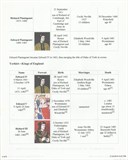
House of York
The British royals married as many people as possible, I think, and procreated with yet others. There were battles and schemes to take power from each other which I had never studied. I knew my maternal great grandmother from Selma Alabama was a descendant of these Plantagenet people. My brother once saw QE II in a convertible in Tobago in 1966 when he was less than 3 years old. The Queen and Price Philip stayed very near my parents at the Crown Point Hotel, right next to the airport. Little Ricky formed a highly unnatural interest the Queen. He had a little flag from that royal moment that he kept forever. None of them knew as they waved at Her Highness that both my parents are historically royally mixed up with the crown of Britain. Now that Richard III has been exhumed I looked into my relationship with him. On my mother’s side he is my uncle:
Richard III King of England Plantagenet (1452 – 1485)
is my 13th great grand uncle
Richard Plantagenet (1411 – 1460)
Father of Richard III King of England
Anne Plantagenet (1490 – )
Daughter of Richard
Henry Holland (1527 – 1561)
Son of Anne
John Holland (1556 – 1628)
Son of Henry
Francis Gabriell Holland (1596 – 1660)
Son of John
John Holland (1628 – 1710)
Son of Francis Gabriell
Elizabeth Holland (1652 – 1737)
Daughter of John
Richard Dearden (1645 – 1747)
Son of Elizabeth
George Dearden (1705 – 1749)
Son of Richard
George Darden (1734 – 1807)
Son of George
David Darden (1770 – 1820)
Son of George
Minerva Truly Darden (1806 – )
Daughter of David
Sarah E Hughes (1829 – 1911)
Daughter of Minerva Truly
Lucinda Jane Armer (1847 – 1939)
Daughter of Sarah E
George Harvey Taylor (1884 – 1941)
Son of Lucinda Jane
Ruby Lee Taylor (1922 – 2008)
Daughter of George Harvey
Pamela Morse
I am the daughter of Ruby Lee
Than again Richard III is my 14th great grandfather. I shudder to think how many different ways I may find to be his relative….I found another version in which he is my 1st cousin 17 x removed..He may well be all those things…
The celebration of Women’s History Month will take place in March, 2013 with a theme about innovation and imagination. A salute to women in engineering, math and science must include the women who broke into those and other fields after a struggle to be educated. By following a timeline we can see the contributions women have made. The Queen archetype, both in history and in mythology has power to rule with wisdom when she is at her best. Queens inherit the power and responsibility of ruling people wisely. The shadow queen is ruled by her own heart and lacks boundaries.
It is obvious that without women there could be no history, no men, and no archetypes. Our collective consciousness is full of both reality and projections. To create a better and more wholesome future it behooves us to sort out delusions in order to enlighten both men and women. When archetypes are understood well the need to perceive the world by using stereotypes can vanish. Stereotypes are cliche. Archetypes are infinitely instructive. When you look around the world do you notice examples of both? How do you avoid being a stereotype?
The Wampanoag tribe is known as the People of the First Light because they lived, hunted, fished and made wampum along the outer banks of New England before the Pilgrims landed. The dawn as viewed on this side of the Atlantic assures one that Europe is distant. New dawn in a new world is powerful natural medicine. As goes the story all across the nation, that medicine proved to be easily hackable by flim flam Euros. The First Light, and all the real estate with a fine view of same was desired by colonial imperialists as soon as they found it. Bare naked greed was employed to occupy the territory, form a government, and launch right into a big fat slave trade with big fat profits. Early in the disagreements King Philip, a native with a following, attempted to oust the invaders. This was used by the colonists as an excuse to starve and otherwise decimate the surviving native inhabitants in order to occupy all their real estate.
These same religious zealots who gave us the Salem witch trials used the Harvard Indian College as a political ploy to gain financial support in England for conversion of whatever was left of the heathen native people. This institution in Cambridge, like the Indian boarding schools in the western US, was designed to strip the natives of language and culture in order to make them good Christian citizens. Why colonize a place if you can’t decimate the population and make good fearful Christians of the survivors?

Mayflower document
My family in history is LOADED with Pioneers, including my own parents. I find that almost all of my people left Europe in the early 1600’s to come to America. They had both the sense of adventure and the wherewithal to make it happen. Before that they were running around Europe doing daring stuff, but the whole idea of sailing in a ship across the Atlantic to live in the New World was extremely bold. As soon as they arrived in Plymouth there was quibbling about religion, which lead to some banishment and some abandonment of the first settlements. Here we have at work both the light and the shadow aspects of the Pioneer. A passion for innovation and creativity can have the shadow aspect of a compulsive need to keep moving with no anchor.
My 11th great-grandfather, John Tilley sailed on the Mayflower, signed the Mayflower Compact, then promptly dropped dead. He did his pioneer thing and died in Plymouth Colony. Lucky for me, his daughter Elizabeth survived.
John was a singer of the Mayflower compact which was done November 11, 1620. Therefore, if the day and month aqre correct he must have died in 1621.
John Tilley (1571 – 1620 or 1621) was one of the settlers who traveled from England to North America on the Mayflower and signed the Mayflower Compact. Tilley died shortly after arrival in New England.
Overview
Tilley was christened in Henlow, Bedfordshire, England on 19 December 1571. He was the eldest child of Robert and Elizabeth Tilley. He had four sisters (Rose, Agnes, Elizabeth, and Alice) and three brothers (George, William, and Edward or Edmund). Research done by Robert Ward Leigh, using probate records, show that Tilley’s paternal grandparents were William and Agnes Tylle, his great-grandparents were Thomas and Margaret Tylle, and great-great-grandparents were Henry and Johann[a]? Tilly, all of Henlow.
On 20 September 1596 in Henlow, John married Joan Hurst Rogers, the daughter of William and Rose Hurst and the widow of Thomas Rogers of Henlow. Joan had had one daughter from her previous marriage. John and Joan had five children between 1597 and 1607. At least one child died young. Research by George Ernest Bowman shows that John was not the Jan Tellij that married Prijntgen Van den Velde in Leyden.
In September 1620, John and Joan embarked on the Mayflower along with their teenage daughter Elizabeth and John’s brother Edward Tilley and his wife Ann or Agnes (Cooper) Tilley. Edward and Ann brought along Ann’s relatives Henry Sampson and Humility Cooper. They left behind their older children, who were married by this time. They arrived at what would become Plymouth in November. John and brother Edward were amongst the men who signed the Mayflower Compact.
Unfortunately, the first winter after their arrival was extremely difficult and a number of the settlers died. Amongst these were John, wife Joan, brother Edward, and sister-in-law Ann. William Bradford reported, “…Edward Tillie, and his wife both dyed soon after their arrivall; and the girle Humility their cousen, was sent for unto Ento England, and dyed ther But the youth Henery Sampson, is still liveing, and is married, & hath .7. children. John Tilley and his wife both dyed, a litle after they came ashore…” This left daughter Elizabeth the only surviving member of the Tilley family in America. The orphan was taken in by John Carver but he and his wife both died that spring. Elizabeth later married John Howland, Carver’s former servant, and left many descendants. I am one.
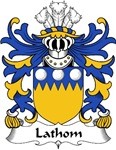
Latham Coat of Arms
Birth: Feb. 15, 1609KempstonBedfordshire, England
Death: Sep. 2, 1677NewportNewport CountyRhode Island, USA
Frances Latham (Dungan Clarke Vaughn) is known as the “Mother of Governors”. Her third husband was the Reverent William Vaughn. She had four children by her first husband; from the descendants of these children are many distinquished statesmen. There are seven children born of her second marriage, and these too have given many governors to the country. Each one of Frances Latham Clarke’s sons served his country, or church, with public service, and each daughter married men who did the same. “She was undoubtedly a very attractive woman, her three marriages would indicate. One can only imagine the gathering of distinquished men and women in the “Common Burial Ground” of Newport when Frances Vaughn, recently widowed for the third time was laid in her grave.There was her eldest Clarke son, then governor, her daughter Mary, with her husband, then Deputy-Governor John Cranston and later governor; and their son Samuel, who before the century closed would also be governor; her daughter Sarah, sometime the wife of Governor Caleb Carr; Barbara with her husband, James Baker, to be chosen the next year as deputy governor; Frances and her husband, Major Randall Holden, ancestors of several of Rhode Island’s governors and one of Washington: Weston Clarke, then attorney-general; James, Latham, and Jeremiah Clarke, with their sons and daughters, and Rev. Thomas Dungan, who perhaps was the one to say the last sacred words over his mother’s grave “Mother of Governors”Her father was Sargeant Falconer Lewis Latham to King Charles I.Children not listed below: John Dungan (died young), William Dungan, Frances Dungan Holden, Elizabeth Dungan (died young), Walter Clarke, Latham Clarke and Jeremiah Clarke Spouses: Married four times1st Lord Weston2nd William Dungan3rd Capt. Jerimah Clark4th Rev. William Vaughn Family links: Spouses: William Dungan (1606 – 1636) Jeremy Clarke (1605 – 1652) Children: Barbara Dungan Barker (1628 – 1677)* Thomas Dungan (1635 – 1688)* Mary Clarke Stanton (1640 – 1711)* Weston Clarke (1648 – 1730)* James Clarke (1649 – 1736)* Sarah Clarke Pinner Carr (1651 – 1706)* Inscription:Here Lyeth ye Body of Mrs. Frances Vaughn, Alias Clarke, ye mother of ye only children of Capt’n Jeremiah Clarke. She died ye 1 Week in Sept. 1677 in ye 67th year of her age.” Burial:Common Burying Ground NewportNewport CountyRhode Island, USA.

Caleb Carr at Rest
I must amend this post because I made an error in my tree. After I had the good luck to visit Caleb, I learned that I had the wrong Sweet in the 1600s. I have corrected the error, but will am leaving this here for his fans. He is not my 9th great grandfather, but is my relative.
Gov. Caleb Carr , born in London, Eng., Dec. 9, 1616, came to America with his brother Robert, on the ship Elizabeth Ann, which sailed from London May 9, 1635. He settled in Newport, R.I., with his brother Robert about 1640. He held many offices of public trust and honor during his lifetime, and accumlated considerable property. He was general treasurer from May 21, 1661 to May 22, 1662. In 1687-8, he was justice of the General Quarterly Session and Inferior Court of Common Pleas. He was governor of the colony in 1695, which last office he held till his death, which occured on the 17th day of December, of the same year. He was drowned. In religious belief he was a Friend or Quaker.
He had seven children by his first wife Mercy, (probably Mercy Vaughan) who died Sept. 21, 1675, and was buried in the family burying ground. The inscription on her gravestone reads as follows: “Here lieth interred ye body of Mercy Carr, first wife of Caleb Carr, who departed this life ye 21st day of September, in ye 45th year of her age, and in the year of our Lord, 1675.” His second wife was Sarah Clarke, (Widow Pinner) daughter of Jeremiah Clarke, and sister of Gov. Walter Clarke, and by whom he had four children. She was born in 1651 and died in 1706.
He died Dec.17, 1695, and was buried in the family burying ground on Mill street, beside his first wife. The inscription on his tombstone reads: “Here lieth interred the body of Caleb Carr, governor of this colony, who departed this life ye 17th day of December, 1695, in ye 73rd (79) year of his age.”
Caleb Carr (1623 – 1695)
is my 9th great grandfather
Sarah Carr (1682 – 1765)
Daughter of Caleb
John Hammett (1705 – 1752)
Son of Sarah
MARGARET HAMMETT (1721 – 1753)
Daughter of John
Benjamin Sweet (1722 – 1789)
Son of MARGARET
Paul Sweet (1762 – 1836)
Son of Benjamin
Valentine Sweet (1791 – 1858)
Son of Paul
Sarah LaVina Sweet (1840 – 1923)
Daughter of Valentine
Jason A Morse (1862 – 1932)
Son of Sarah LaVina
Ernest Abner Morse (1890 – 1965)
Son of Jason A
Richard Arden Morse (1920 – 2004)
Son of Ernest Abner
Pamela Morse
I am the daughter of Richard Arden
On May 9, 1635 the ship Elizabeth and Ann slipped her moorings and put out from London, England under the command of Roger Cooper, Master. Her destination was New England. On board were on hundred and two passengers bearing permission to emmigrate to the new world that lay on the western shore of their ocean.
Among these passengers two should command our attention. These are listed in the old records as Robert and Caleb Carr. The notation of “Taylor” is appended to the name of Robert designating his trade. A later writer, Dr. Turner of Newport, refers to them as from Scotland. As yet we do not know exactly from whence they came.
Sometime in the following June (early midsummer, one account says) the ship arrived in Boston harbor and our ancestors were in America.
For the next two years we have to guess as to the residence of the two passengers on the Elizabeth and Ann. For the remainder of their lives Robert and Caleb Carr were close associates of William Coddington who came from Boston, Lincolnshire, England as of of the original members of the Mass. Bay Company in 1629 and was a leading merchant in Boston, Mass. during this period. Robert and Caleb landed at Boston and two years later left Boston. Adding all these facts together are w not permitted to assume that our ancestors were for these first two years of the living on this side the Atlantic in the rapidly growing town of Boston.
Early in 1637 a group of Boston people led by William Coddington left Boston because of religious differences. They went to Providence and conferred with Roger Williams as to settling in those parts. With the active aid of Mr. Williams the group purchased from the Indians the large town of Quidnick and immediately proceeded to the business of founding the town of Pocassit (later called Portsmouth). It is thought that the Carrs left Boston with this group. Certainly they were early at the Pocassit settlement for on Feb. 21, 1638 Robert Carr was listed as an inhabitant. It is my thought that Caleb who was still but a child of fourteen accompanied Robert.
Many seem to have come to the new settlement at Pocassit that summer of 1638 and the following winter for in the spring of the next year William Coddington and a small group of the leading men removed to the south end of the island to lay out a new settlement leaving at Pocassit a goodly company to carry on.
Again the Carrs followed William Coddington and like him remained at the new settlement the rest of their days. the name which they gave this new home was remained unchanged all these years. It is still Newport.
Lying in the mouth of Narragansett Bay off shore from Newport is the sizable island of Conanicut (known now as Jamestown). In contrast with the forested shores of Aquidnick, Conanicut had some cleared land where the Indians had for generations summered and grown their corn and vegetables. This area of hay, pasturage and vegetable land appealed to the forest bound inhabitants of Newport. Thus in 1659 we find William Coddington, Benedict Arnold, William Brenton, Caleb Carr and Richard Smith leading a company of Newport citizens in arranging the transfer of Conanicut and the small adjoining islands of Gould and Dutch to themselves. Chief Quisaquam made the transfer on the part of the Indians.
Both Robert and Caleb were among the ninety-eight original purchasers of the island. It is thought that neither of the brothers resided on the island. This move was left to their children.
It is thrilling to plan travel on various levels. I adore museums and classy architecture. Gardens, formal and botanical, please me greatly. The culinary delights of a new terroir and culture top my list. I am such a fan of farmer’s markets, known in most of the world as simply the market, that I literally plan to eat everything in season and local wherever I go. One of my favorite festivals in Europe is Spargelfest, the over the top celebration of asparagus harvest. I love the stuff, both white and green, although I can’t really see why they bother with the white. Do not express that feeling about white asparagus in a German speaking country unless you are ready to be lectured. After all, these are the Spargelfest people, and they know a thing or two about spargel. Restaurants feature special menus that highlight the seasonal star in all possible ways. I have not seen spargel desserts or beer, but I would not be surprised to find that they exist. Roadside and city corner stands are set up for the purpose of streaming spargel farm to table. These temporary businesses are swamped with asparagus fans getting festive with both green and white.
I am really excited to learn that when I visit Rhode Island there will be fresh asparagus!!! They promise kale all year. The wintertime farmers’ market in Providence will hook me up with what I need. There is also a slight chance of rhubarb in the harvest forecast for early May. Now that would just put the icing on the cake. I love alliteration as well as asparagus and rhubarb. I can really relish a Rhode Island Rhubarb extravaganza. Fiddlehead ferns, which I have never knowingly eaten, will be ready as well as alliterative all by themselves. Perhaps most intriguing is the fact that Anthony Bordain will perform live at the Providence Center for the Performing Arts, talking with Eric Rippert, another chef, about food. The name of this show is Good vs Evil. I believe I must see that performance. I have very few heroes in show biz, and Mr. Bordain is one of them. I just now became acquainted with Mr. Rippert, and think there is major potential. The theater itself just hit the national news for allowing producers to decide if tweeting is permitted during each show, and then strictly mandating that those in the tweet seats ( at the back) lower the lights of their phones. The folks in Providence have a long history of tolerance, but draw the line at performance tweeting. How very civilized!!
Wampum, or shell beads has been used for centuries in New England. After colonists arrived in America a currency exchange value was set to convert it European currency. This forever changed the meaning and trade value of what was a Native American tradition and source of historical pride. Once it was adopted by Dutch and English as currency it was manufactured in New York on Long Island as well as by Native tribes that dominated the newly created market for trading currency. Since both Native and Europeans could trade with it, it’s use thrived until the end of the 17th century. Counterfeiting was a problem during colonial times as it was more widely used. It was eventually phased out in favor of metal coins as the official currency of New England.
Before the colonists changed the meaning and tradition wampum was used in ceremonies and agreements.It is important as a covenant record and means of communication. Language was commonly understood in terms of wampum color. Messages and agreements were sealed by way of wampum belts created for the specific meaning. White shells had a brighter meaning and dark purple shells indicated heavier subjects. The tapestry woven into a wampum belt was a story. I am looking forward to seeing the new wampum being made today and perhaps some of the historical pieces. I will be visiting museums as well as living wampum artists. It is a fascinating subject.
Jeremiah Clarke, my 10th great grandfather, nickname Jeremy Clarke, b. 1605 in East Farleigh, Kent, England, d. Jan 1652 in Newport, Newport County, Rhode Island, buried in Newport, Newport County, Rhode Island, resided 1638 in Aquidneck and Portsmouth.

Jeremy Clarke president governor
Newport County, Rhode Island, resided 1640 in Newport, Newport County, Rhode Island, immigrated ABOUT 1637 in (Probably) Rhode Island, event in Member of Lincoln’s Inn ?, military Captain, occupation 1647 – 1649 Treasurer of Rhode Island, occupation 1648 Acting Governor of the colony. From the Plantagenet Ancestry book, it’s not clear whether it was Jeremiah Clarke or Thomas that was a member of Lincoln’s Inn. “Jeremy Clarke, baptised East Farleigh, Kent 1 Dec. 1605, emigrated about 1637, resided Newport, Rhode Island, freeman 16 Mar.1640/1, treasurer of Rhode Island; buried Newport 11 mo., [Jan.] 1651/2;married, in England, about 1637 to Frances (Lathaum) Dungan, baptised at Kepston, Co. Bedford, 15 Feb. 1609/10, died September 1677, buried Newport, widow of Thomas Dungan, Gent., of Lincoln’s Inn, Middlesex, and daughter of Lewis Latham, Gent., Sergeant Falconer to King Charles I, by his wife Elizabeth. She married, third, before 18 Jan. 1656 to Rev. William Vaughan, died on or before 2 Sep 1677.” Arms of Jeremy Clarke: Gold on a bend engrailed azure a cinqfoil of the field. Note: maybe the arms for father William.) East Farleigh has a fine medieval bridge over which General Fairfax marched in 1648 to the Battle of Maidstone. Jeremiah may have died 11 Jan 1651. He married Frances LATHAM, married ABOUT 1637 in England.
 mermaidcamp