mermaidcamp
Keeping current in wellness, in and out of the water
You can scroll the shelf using ← and → keys
You can scroll the shelf using ← and → keys
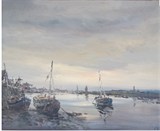
Norfolk, England
My 9th Great Grandfather was probably the earliest Brit settler in Yarmouth, on Cape Cod. He was from Norfolk, England:
On the south side, West Yarmouth became populated with the descendants of the earliest settler Yelverton Crowe(ll). (Crowell remained the most prominent surname in the village well into the 20th century.) Although the Crowells were joined by other families, and married into many of the northside families, the village itself remained small and rural in nature. Homes with large acreage for subsistence farming dotted the county road (now Route 28) which ran from Parker’s River to Hyannis’ Main Street. A fulling mill in the village, established in the late 17th century, was the first known mill in Yarmouth. The Baxters, who operated the mill, also built a gristmill along the shores of Mill Creek in West Yarmouth — a mill which is still in working order and now an historic site owned by the town. Stores, however, were few and tradesmen were fewer. Many villagers transacted business in nearby Hyannis or in Yarmouth Port. Since the village remained rural and undeveloped throughout much of the 18th and 19th century, it presented a blank palette for developers who were to arrive with the turning of the twentieth century.
Yelverton Crowell (1621 – 1683)
is my 9th great grandfather
Elishua Crowell (1643 – 1708)
daughter of Yelverton Crowell
Yelverton Gifford (1676 – 1772)
son of Elishua Crowell
Ann Gifford (1715 – 1795)
daughter of Yelverton Gifford
Frances Congdon (1738 – 1755)
daughter of Ann Gifford
Thomas Sweet (1759 – 1844)
son of Frances Congdon
Valentine Sweet (1791 – 1858)
son of Thomas Sweet
Sarah LaVina Sweet (1840 – 1923)
daughter of Valentine Sweet
Jason A Morse (1862 – 1932)
son of Sarah LaVina Sweet
Ernest Abner Morse (1890 – 1965)
son of Jason A Morse
Richard Arden Morse (1920 – 2004)
son of Ernest Abner Morse
Pamela Morse
I am the daughter of Richard Arden Morse
He fought in King Philip’s War against my Wampanoag ancestors:
According to the book “History of Cape Cod: Annals of Barnstable County, Vol 2 by author Frederick Freeman: Both John Crowell and Yelverton Crowell fought with Distinction in King Phillip’s war at the battle of Mount Hope in the year 1675. John Crowell is listed as having lost one horse.

headstone
My 12th great-grandfather was born in London and died in the Massachusetts Colony. He arrived under dire circumstances and established himself as a joiner, or furniture maker. He was famous for an act of courage walking 25 miles in the snow to tell Miles Standish his village was in peril of being attacked.
May, 1622 The Sparrow, at Maine from England, sent passengers in a boat to Plymouth, New England.
Fishing vessel, Master Rogers
A boat arrived at the Plymouth Plantation from the Sparrow
(fishing vessel at Maine, hired and sent out by Thomas Weston and
John Beauchamp, salter of London, for their personal profit) with
7 men passengers sent by Weston to work for him in New England.
They remained at Plymouth until the Charity and the Swan
moved them to “Wessagusset” (Weymouth, Massachusetts) where they were
to establish a settlement.
Weston’s settlers, May, 1622 – June 1622
In 1622 Thomas Weston sent a fishing vessel, the Sparrow, to Massachusetts Bay, with a small party of seven men to find the most suitable place for a colony. They were to prepare for the arrival of a large group of single men whom he proposed to send out. Weston was one of the leaders of the London merchant adventurers who sponsored the establishment of Plymouth Colony, but who was now independently setting up his own. The site eventually chosen was at Wessagusset (modern Weymouth, some thirty miles north of Plymouth). The ship anchored at the Damaris Cove Islands off the coast of Maine, and a group of ten, including some crew from the Sparrow, sailed down to Plymouth in a shallop, arriving there on May 31, 1622, just as Massasoit’s men were demanding that Squanto be handed over to them for execution. They brought letters to the Governor from Weston, but no provisions for which the settlement was in desperate need. Phineas Pratt was one of Weston’s settlers, and he and his six companions were given hospitality in Plymouth until the Charity and the Swan arrived with the main party of Weston’s settlers at the end of July or early August 1622.
The two ships, the Charity and the Swan, temporarily added sixty more “lusty men” to the eighty-odd colonists living in Plymouth village. They stayed for the months of July and August. The settlement at Weymouth was a failure, and the men had to be rescued by Capt. Standish and some of his men. Phineas Pratt, on the breakup of the settlement moved to Plymouth, and later married Mary Priest, niece of Isaac Allerton.
Weymouth Settlement Edit
In July 1622, two ships, (Swan and Charitie) arrive at Plymouth with a different group of adventures. They stay a couple of months before moving to establish a nearby at Weymouth (or Wessagusset). This groups is financed by Mr Wesson. They are joined by a 3rd ship (Sparrow). This groups fares badly with the Indians and is forced to abandon their settlement after a rescue by Plymouth militia.
In Sept 1623, the ship Katherine arrives with a group of settlers financed by Sir Ferdinando Gorges. They stop shortly at Plymouth before continuing onwards to the Weymouth Settlment.
One settler from the Sparrow, Phineas Pratt (1590-1680), after the breakup of the first Weymouth settlment, joins the group at Plymouth and marries Mary Priest, a niece of Isaac Allerton (1586-1658).
Phineas Pratt was a member of a company of men sent from England by Thomas Weston. They arrived in New England in 1622 on three ships : the Sparrow, Charity and Swan (Pratt was a passenger on the Sparrow, the first to arrive). The approximately 67 men, many of them ailing, arrived with no provisions. The Pilgrims supported them throughout the summer of 1622.
In the fall of 1622, the Weston men left to colonize an area north of Plymouth called Wessagusset. They soon fell into difficulties through behaving, generally, in a very foolish and improvident fashion. They also severely angered the local Native Americans by stealing their corn.
Massasoit, sachem of the Wampanoags, informed the Plymouth colonists that there was a conspiracy among the Natives of the Wessagusset area to massacre the Weston men. Myles Standish prepared to head north with a small company of Plymouth men to rescue Weston’s men.
The same message was also delivered by one of Weston’s men, who came to Plymouth in March of 1623 “from the Massachusetts with a small pack at his back.”
Phineas Pratt was the man with the backpack. He had secretly snuck out of the Wessagusset settlement, traveling for several days without food through a snowy landscape on his 25-mile journey.
Myles Standish and a small contingent (minus Phineas, who was still recovering from his arduous journey) headed to Wessagusset to recognize Weston’s men. The Plymouth contingent killed several Native Americans in the process (for which, they were roundly scolded by their pastor, John Robinson). Soon afterwards, Weston’s group abandoned Wessagusset. Sometime in late 1623, Phineas joined the Plymouth settlement.
Sometime before May of 1648, when he purchased a house and garden in Charlestown (now a part of Boston), Pratt left Plymouth. In 1662, Pratt presented to the General Court of Massachusetts a narrative entitled “A declaration of the affairs of the English people that first inhabited New England” to support his request for financial assistance. The extraordinary document is Phineas Pratt’s own account of the Wessagusset settlement and its downfall.
Phineas Pratt was by profession a “joiner.” “Joining” was the principle method of furniture construction during the 17th century. “Joiners” were highly skilled craftsmen who specialized in this work; their skills were valued more highly than those of a carpenter.
Phineas Pratt married Mary Priest, daughter of Degory and Sarah Allerton Vincent Priest (the sister of Mayflower passenger Isaac Allerton, Sarah had been married to Jan Vincent and widowed before she married Degory Priest). Degory Priest journeyed to Plymouth on the Mayflower, his wife and two daughters intended to join him later. Priest died during the first winter. Before sailing for America, the widowed Sarah Allerton Vincent Priest married Godbert Godbertson, who became Mary Priest’s stepfather. The family (mother, stepfather and two daughters) were among the passengers of theAnne and Little James, arriving in Plymouth in 1623.
Phineas was probably born about 1593, Mary was probably born about 1612. It seems likely, given the probably age of their oldest child at the time of her death, that they married about 1631 or 1632. Phineas and Mary Pratt had 8 children.
According to his gravestone in the old Phipps Street Cemetery, in the Charlestown area of Boston, “Phinehas Pratt, agd about 90 yrs, decd April ye 19, 1680 & was one of ye first English inhabitants of ye Massachusetts Colony.” (Mayflower Descendant, Vol. 6, p. 1-2).
Mary Pratt outlived her husband; the date of her death is not certain but she did receive stipends from the Town of Charlestown in 1683/4 and 1686/7 (Robert Charles Anderson, The Great Migration Begins, Vol. 3, p. 1516
Phineas PRATT (1590 – 1680)
is my 12th great grandfather
Daniel Pratt (1640 – 1680)
son of Phineas PRATT
Henry Pratt (1658 – 1745)
son of Daniel Pratt
Esther Pratt (1680 – 1740)
daughter of Henry Pratt
Deborah Baynard (1720 – 1791)
daughter of Esther Pratt
Mary Horney (1741 – 1775)
daughter of Deborah Baynard
Esther Harris (1764 – 1838)
daughter of Mary Horney
John H Wright (1803 – 1850)
son of Esther Harris
Mary Wright (1816 – 1873)
daughter of John H Wright
Emiline P Nicholls (1837 – )
daughter of Mary Wright
Harriet Peterson (1856 – 1933)
daughter of Emiline P Nicholls
Sarah Helena Byrne (1878 – 1962)
daughter of Harriet Peterson
Olga Fern Scott (1897 – 1968)
daughter of Sarah Helena Byrne
Richard Arden Morse (1920 – 2004)
son of Olga Fern Scott
Pamela Morse
I am the daughter of Richard Arden Morse

Seal of Sandwich
My 12th great-grandfather was born in Sandwich, MA, on Cape Cod, in 1623. He served as a constable in Sandwich. There is some confusion about Myles Black/Michael Blackwell records in Sandwich, which seem to indicate they are one in the same man:
Title: MICHAEL BLACKWELL OF SANDWICH, MASS. (c. 1620-1710)
URL: http://members.dencity.com/ccblack/genealogy/micheal.html
Author: LYDIA B. (PHINNEY) BROWNSON, Of Duxbury, Mass. and MACLEAN W. MCLEAN, Of Pittsburgh, Pa
No attempt has been made by the present writers to investigate possible connections between Michael Blackwell and others of the name in England or America. It certainly would be interesting to know whether the Sandwich family was in any way related to the Rulling Elder Francis Blackwell of the Separatist Church whose recantation William Bradford criticized. Actually it is by no means certain that the family name was originally Blackwell. The Sandwich list of men between 16 and 60 able to bear arms in 1643 includes one Myles Black. James Savage in his Genealogical Dictionary of The First Settlers in New England, 1860, vol. 1, p. 191, says “hardly can I doubt that this man called by Savage
“Michael or Myles Blackwell” is he designated in the Col. list of those able to bear arms 1643, as Miles Black” (THE REGISTER, vol. 4, p. 257,
July 1850). This Question puzzled also Thomas Spooner, the compiler of the Memorial of William Spooner, 1871, who corresponded with the Rev. Frederick Freeman author of The History of Cape Cod, 1858. Spooner quotes Freeman as saying: “The Blackwells of Sandwich were generally called Black. Even since my remembrance the latter name was used for those who wrote the name Blackwell and in some early instances of recorthe same Liberty was taken. The progenitor himself is in one instance at least on record as Black” (p: 60:61 footnotes.It seems to us that the evidence, while not conclusive, strongly suggesthat Miles Black and Michael Blackwell were one and the same person. The reader may speculate for himself from the data available. Conclusive proof of identity doubtless would have been found in the Barnstable County land records, but these were destroyed in the 1827 fire. Fortunately Michael Blackwell and his son, and grandsons left wills and probate records which are unusually complete. The earliest reference we find has to do with Miles Blacke who was a creditor in the amount of 7 shillings due from the estate of William Swift, Sr., 29 Jan. 1642 (Plymouth Colony Probate, Liber 1, p. 44, in May. Des., 8:170, December 1900). This first reference, by the way, poses a second problem of confusion of identities, namely.the fact that there was in New England early date a gentleman of some wealth and influence called “Mr. John Blackwell.” This complication will be discussed under the account of John Blackwell. For the moment it is enough to point out the really extraordinary co-incidence that the Swift estate should have been indebted to both Miles Black of Sandwich and to “Mr. Blackwell,” since so far as we can find the latter was of Boston and co. Middlesex, England, and had no interest in Sandwich.In 1643 Miles Black’s name appears on the list of Sandwich men aged between 16 and 60, able to bear arms (The Register, Op. Cit.), but
Michael Blackwell’s name does not appear. Yet 7 June 1648 “Mycaell Blackwell” served on the grand inquest; and the following October “Micaell Blackwell” served as grand juror in the infanticide case of
Alice Bishop (Nathaniel B. Shurtleff, ed., Records of the Colony of New Plymouth . . . , 2:134, cf. p. 124, where his name appears as Mycaell Blackwell). An agreement was made 17 Jan. 1652 by the town of Sandwich “with Daniel Wing & Michael Blackwell for the taking of fish in Herring River” (Frederick Freeman, “Annals of Sandwich” in his History of Cape Cod, 1858, 2:50).
Note:
“Myles Blacke” was appointed, 3 June 1656, constable of Sandwich (Shurtleff, op. cit., 3: 100). On the 1658 list of Sandwich land holders the name of Michaell Blackwell appears, but not that of Miles Black
(Freeman, op. cit., 2:59). Yet it would seem unlikely that the town’s constable was not a land owner. It is interesting to note here that this Miles Black or Blackwell held the post of Constable in Sandwich
immediately preceding the inauguration in 1657 of what Amos Otis called “a system of terrorism” there, under the enthusiastic leadership of the notorious Sandwich Marshall George Barlow, to whom the Colony Court gave “full power to act as constable in all things in the town of Sandwich” (C.- F. Swift, Genealogical Notes of Barnstable Families, 1888, p. 258-259). No reference is made anywhere that we have seen which would indicate that Black or Blackwell was involved in persecution of the Quakers in this period, though the Blackwell family seems to have been active members of the Sandwich Congregational Church, and not to have had family connections with the Quaker element.
Note:
On 13 June 1660 “A parcell of meadow was granted to Myles BIacke att Mannomett.” And in the following March he and Thomas Burges, Sr., were brought to court for fraudulently obtaining meadow land there (Shurtlefop. cit., 3:194, 208). These entries are perhaps significant in view of the fact that Michael Blackwell’s will refers to land adjoyning Jacob Burges, principal heir to Thomas Burges, Sr.
Note:
We come now to two entries which refer to “Myles Blackwell.” The first shows that “Myles Blackwell” served on the Grand jury 4 Oct. 1664 (Shurtleff, op. cit., 7: 1 19). The second shows that Myls Blackwell was chosen surveyor of highways in Sandwich 3 June 1668. Oddly enough the same source shows that Miacaell Blackwell served on the Grand Jury 5 Ju 1667 (ibid., 4:148, 181). Micacll Blackwell served 5 June 1671 on a committee “to view damage done to the Indians by the horses and hoggs of the English” (ibid.-, 5:62).
Note:
In 1672 “Mr. Edmund Freeman Senr., William Swift, Thomas Wing Senr., Thomas Dexter Senr., Michaell Blackwell & William Newland were constituted a committee to go forward in settling & confirming the bounof the township with the Sachem of Mannomet . . .” (Freeman, op. cit., 2:67). Joseph Burges petitioned the Court, 5 June 1673, regarding “a way that goes through lands of Myles Blackwell … att Sandwich” (Shurtleff, op. cit., 5:116). The list of “all those who have just rights to the priviledges of the Town” in 1675 shows Michaell Blackwell and his son John Blackwell, and does -not show a Miles Black (Freeman, op. cit., 2:68) In 1680 Michaell Blackwell served once more on the Grand Inquest
and in 1672 he took the inventory of the estate of Edmund Freeman. His will shows that he deeded land in 1705 to his son Joshua and it is to be inferred that he had done the same for his elder son.
Note:
His will is of considerable genealogical value. Firstly, it proves that Michael Blackwell’s wife had predeceased him. It seems strange that there is not the slightest reference to the wife of either Miles Black or Michael Blackwell. Secondly, the testator in his intense desire to be the founder of a dynasty patterned upon the model of the landed gentold England gives proof of one or two relationships which otherwise would
have remained obscure, as will be seen. The Sandwich vital records in the town hall are copies of the originals. The entry of Michael Blackwell’s death reads 6 January, the date of the year having been torn away, but the careful copy made by the late George E. Bowman of the Massachusetts Society of Mayflower Descendants notes that 1710 was added – in pencil, and as we now see, this notation is correct (May. Des., 29: 22 footnote, January 1931). With the exception of the son Michael, no dates of the births or baptisms of Michael Blackwell’s children have been found. The order of birth of the sons is clear from the father’s will, although the daughter Jane (whose husband was born in 1644) may have be older than Michael.
Michael Blackwell (1623 – 1709)
is my 12th great grandfather
John Blackwell (1645 – 1688)
son of Michael Blackwell
Elizabeth Blackwell (1662 – 1691)
daughter of John Blackwell
Thomas Baynard (1678 – 1732)
son of Elizabeth Blackwell
Deborah Baynard (1720 – 1791)
daughter of Thomas Baynard
Mary Horney (1741 – 1775)
daughter of Deborah Baynard
Esther Harris (1764 – 1838)
daughter of Mary Horney
John H Wright (1803 – 1850)
son of Esther Harris
Mary Wright (1816 – 1873)
daughter of John H Wright
Emiline P Nicholls (1837 – )
daughter of Mary Wright
Harriet Peterson (1856 – 1933)
daughter of Emiline P Nicholls
Sarah Helena Byrne (1878 – 1962)
daughter of Harriet Peterson
Olga Fern Scott (1897 – 1968)
daughter of Sarah Helena Byrne
Richard Arden Morse (1920 – 2004)
son of Olga Fern Scott
Pamela Morse
I am the daughter of Richard Arden Morse
When he died he owned quite a bit of land around Sandwich:
Michael Blackwell’s will, dated 29 Nov 1709 of “Michael Blackwell of Sandwich” gives “… unto my grand son John Blackwell, the eldest son of my son John Blackwell, deceased, all those lands, marsh and meadow ground . . . in the town of Sandwich, lying on the Northeasterly side of Skussett River . . . on part of which upland ye dwelling house of my sd. Grand son now standeth . . . adjoyning in part upon the messuage in ye tenour or occupation of Jacob Burges . . . as well as one parcell of meadow lying adjoyning Jireh Swift . . . and by the land of Irish Swift . . . on condition that my said grand son John Blackwell dye leaveing a male heire surviving, lawfully begotton of his own bodie. And that he do also pay unto Caleb Blackwell his naturall brother, the sum of 5 pounds . . . And if it shall so happen” (that said John dies without a male heir, then the testator directs the youngest brother Nathaniel, shall inherit). The will then provides that if John Blackwell survives his brothers, Caleb and Nathaniel, and finally die without male issue, the then male children of my son Joshua Blackwell shall inherit all. “Item: . . . unton my grand son Benjamin Gibbs, on half part of all upland at Waynonsett . . . lands in Sandwich adjoying land formerly belonging to John Gibbs and other lands in Sandwich and lands I formerly bought of Robert Bartlett in Plymouth township. Item: . . . unto my grand son Samuel Blackwell, son on my son Joshua Blackwell, the other half of my lands before given to Benjamin Gibbs. Item: . . . unto my daughter Jane Gibbs, that nine pounds which her husband formerly borrowed and me and which he yet oweth to me. Item: . . . unto the three sons and six daughters of my son Joshua Blackwell or to so many of them as shall survive mee, all that shall remain of my personal estate . . . to be equally divided between them. Item: . . . to my said son Joshua Blackwell the other half of my land that I bought of Robert Bartlett . . . and I do confirm unto him and unto his son Michael Blackwell all those lands, swamp & meadow ground to which I have given by deed of gift, dated 3 Aug 1705, only that he pay to my grandson Nathaniel Blackwell 10 pounds & to each of the sisters of ye said Nathaniel Blackwell, being the daughters of my said son John Blackwell, deceased, the sum of 40s in current passable pay within one year after my decease.”
Michael’s son Joshua Blackwell was named sole executor. The will was signed by a mark and was witnessed by William Bassett, Sr., William Bassett, Jr., and Nathan Bassett. The witnesses were sworn 26 Jan and administration ordered 29 Jan. 1709/10. The date of Michael Blackwell’s death is 6 Jan 1710.
~New England Historic and Genelogical Register, July, 1963, pages 180-183
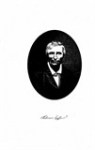
My 9th great-grandfather was one of the Quakers of Sandwich plantation who were heavily persecuted by the Pilgrims of Plymouth. He owned property when he died in New Jersey, which was controlled by the Dutch.
William Gifford arrived in New England after 1643, as he does not appear among those able to bear arms in that year. The first record of him is in the list of debts due on the inventory of Joseph Holiway of Sandwich dated 4 December 1647: “dew from Willi Gifford” 3s. 4d. On 4 June 1650 he served on the Grand Enquest. The original deed for the Sandwich plantation was executed by Governor William Bradford 22 May 1651. It ordered that Goodman (Thomas) Tupper, Goodman (Thomas) Burges, Sr., Nathaniel Willis, and William Gifford have the power to call a town meeting.Both Brown, and Daniels & McLean say that by 1651 he was married and had a family; that he probably married in England, and children John, Patience and Hannaniah were probably born in England. Birth records are available for only the last four of his nine children; the birth dates of the older children are estimated based upon the birth dates of their first children. There is a sizeable gap in these estimated dates between Hannaniah and William, suggesting William, Robert, Christopher and Mary may have been by a second wife. Only the last wife, Mary Mills, is of record; she is the mother of the last two children, Jonathan and James.
There is a record in England of a “Guilielm Gifford” (i.e., William Gifford) who married Elizabeth Grant on 11 February 1635 in St. Martin-in-the-Fields, London. Also, the London Merchant Taylors’ Guild shows a record: “William Gifford, son of Anthi (sic) Gifford of Dublin in the kingdom of Ireland, gentleman, apprenticed to Thomas Southerne of New Exchange, London, for a period of seven years from 7 December 1628.” Apprentices were forbidden to marry, so this would mean the apprenticed William Gifford would have been given his freedom 7 December 1635, in perfect time to be the one who married 11 February 1635/1636. Also, the records of St. Martin-in-the-Fields show that an Ananias Gifford married Maria Read on 18 November 1621. Ananias (also spelled Hananias, Hannaniah and Annaniah) is a relatively rare name. William named one of his sons Hannaniah, and the name has been carried down in the family. Also, the name occurs in the Giffords of Dry Drayton, county Cambridge, England. But it cannot be proven that these English records apply to the family of William Gifford of Sandwich.
Nor can the English ancestry of William Gifford of Sandwich be proven, according to Daniels & McLean. “English Giffords can be traced back to Normandy at the time of William the Conqueror when most branches usually spelled the name Giffard. Inevitably the temptation to connect the Sandwich Giffords with these celebrated families has produced a rash of printed accounts in which the connection is stated as fact but without solid references. (Cutter’s “Genealogical History of Western New York,” 2:901; “History of Bristol County, Mass.;” “Vineland (N.J.) Historical Magazine,” 3:32; “Seabury-Gifford Families,” Hartford (Conn.) 1941) In view of the fact that highly skilled professional genealogists have found no proof as yet of such connections, it can only be said that evidence has yet to be found to confirm these wishful thoughts.”
William Gifford of Sandwich was a Quaker, and as such, suffered persecution for his faith. “Little Compton Families” says “It is supposed that he was the William Gifford who in 1647 or earlier was ordered by the court at Stanford to be whipped and banished.” On 1 June 1658, he was one of a dozen men who “all of Sandwich were summoned, appeared to give a reason for theire refusing to take the Oath of Fidelitie to this government and unto the State of England, which again being tendered them in open court, they refused, saying they held it unlawful to take any oath att all.” At the court held 2 October 1658, they were fined L5 each. At the court held 1 March 1658/1659 George Barlow, Marshall for Sandwich, Barnstable and Yarmouth, complained against William Gifford and Edward Perry in an action of defamation, asking damages of L100, in saying he took a false oath. The defendants were ordered to pay 50s and make their acknowledgement publically, or else be fined L5 plus costs. As Quakers, they could not accept the verdict, and at the 2 October court William Gifford and 11 other Friends were fined L5 for refusing to take the Oath of Fidelitie. At the June 1660 court Gifford was again summoned to take the oath, again refused, and was again fined L5. In October 1660, for persisting in his refusal and for attending Quaker meeting, he was fined L57 — an enormous sum for those times. At this point he disappears from the records, and may have left Plymouth colony, but where he went is unknown. It has been suggested that he went to New Jersey which, like New Amsterdam, was then under the control of the Dutch. On 8 April 1665 William Gifford was one of the signers of the Monmouth (NJ) Patent, but there is no evidence he actually settled there; his sons Christopher and Hannaniah did, however. In a deed by his son Christopher William was described as a tailor.
On 10 November 1670 Mr. Gifford bought from mistress Sarah Warren of Plymouth, widow of Richard Warren, one half her share in the land at Dartmouth, which he gave equally to his sons Christopher and Robert by deed dated 6 May 1683. In 1673 William Gifford purchased land in Suckanesset (Falmouth) from the Indian Sachem, Job Noantico. Gifford continued to appear in Sandwich town records and in records of the Sandwich Friends meeting, and he married Mary Mills, also of Sandwich, at the Friends Meeting of 16 day 5 mo: 1683. Thirty witnesses signed the certificate, but none of William Gifford’s children signed the document, nor did James Mills, Mary’s brother.
William Gifford (1615 – 1687)
is your 9th great grandfather
John Gifford (1640 – 1708)
son of William Gifford
Yelverton Gifford (1676 – 1772)
son of John Gifford
Ann Gifford (1715 – 1795)
daughter of Yelverton Gifford
Frances Congdon (1738 – 1755)
daughter of Ann Gifford
Thomas Sweet (1759 – 1844)
son of Frances Congdon
Valentine Sweet (1791 – 1858)
son of Thomas Sweet
Sarah LaVina Sweet (1840 – 1923)
daughter of Valentine Sweet
Jason A Morse (1862 – 1932)
son of Sarah LaVina Sweet
Ernest Abner Morse (1890 – 1965)
son of Jason A Morse
Richard Arden Morse (1920 – 2004)
son of Ernest Abner Morse
Pamela Morse
I am the daughter of Richard Arden Morse

Ewer Coat of Arms
Henry Ewer moved his family from Plymouth to Sandwich, MA on Cape Cod to settle. The Pilgrims of Plymouth, right up the road, were religious nuts who banished and harassed those with whom they differed. The London contract that governor Brewster undertook allowed him to sell and or release lands to new settlers. He allowed the settlements on Cape Cod, but the church in Plymouth was in charge. The new towns on Cape Cod were subject to laws of the colony, and were treated harshly because of religious differences. The Cape Cod colonists, for instance, were to enforce observance of the Sabbath on the local native population, and make sure all the pigs had rings in their noses. They could be called up to Plymouth for infractions, and frequently were. In 1638 Henry and his wife were deemed unfit and told to leave the town, but their infractions were settled in an unknown way. Generations of Ewers continued to live in Sandwich and the surrounding area.

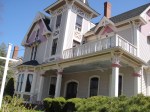




My 8th great-grandmother was born in Salisbury, Witlshire in 1633. She was baptized in St Thomas church in Salisbury. She was sailing on the ship James through a hurricane when she landed in America in 1635, as an infant traveling with her parents:
1635 voyage
The ship James of London sailed from Southhampton on April 5, 1635 and arrived in Massachusetts Bay on June 3,[5] 1635 with master William Cooper[disambiguation needed] at the helm.
The ship James left King’s Road in Bristol on May 23, 1635 with master John Taylor[disambiguation needed] at the helm. From England to Massachusetts in a fleet of five ships, the Angel Gabriel, the Elizabeth (Bess), the Mary and the Diligence.
On June 3, 1635, the James joined four other ships, and set sail for the New World with just over 100 passengers as part of a fleet of five ships, including the families of Richard Mather, Captain John Evered and John Ayer. As they approached New England, a hurricane struck and they were forced to ride it out just off the coast of modern-day Hampton, New Hampshire. According to the ship’s log and the journal of Increase Mather, whose father Richard Mather and family were passengers, the following was recorded;
“At this moment,… their lives were given up for lost; but then, in an instant of time, God turned the wind about, which carried them from the rocks of death before their eyes. …her sails rent in sunder, and split in pieces, as if they had been rotten ragges…”
They tried to stand down during the storm just outside the Isles of Shoals, but lost all three anchors, as no canvas or rope would hold, but on Aug 13, 1635, torn to pieces, and not one death, all one hundred plus passengers the James manages to make it to Boston Harbor two days later.
The Angel Gabriel was wrecked off the coast of Maine, but the smaller, faster ships, the Mary, the Bess, and the Diligence outran the storm, and landed in Newfoundland on August 15, 1635.
Mary Greene (1633 – 1686)
is my 8th great grandmother
Benoni Sweet (1663 – 1751)
son of Mary Greene
Dr. James Sweet (1686 – 1751)
son of Benoni Sweet
Thomas Sweet (1732 – 1813)
son of Dr. James Sweet
Thomas Sweet (1759 – 1844)
son of Thomas Sweet
Valentine Sweet (1791 – 1858)
son of Thomas Sweet
Sarah LaVina Sweet (1840 – 1923)
daughter of Valentine Sweet
Jason A Morse (1862 – 1932)
son of Sarah LaVina Sweet
Ernest Abner Morse (1890 – 1965)
son of Jason A Morse
Richard Arden Morse (1920 – 2004)
son of Ernest Abner Morse
Pamela Morse
I am the daughter of Richard Arden Morse
Her father was a physician and surgeon in Rhode Island. She married James Sweet when she was 17 and began a healing practice:
“This Sweet family is known as the Bone-Setting Sweets. This gift is said to be inherited from Mary Greene, wife of James Sweet 1622-1698, who was the daughter of Surgeon John Greene. They also had another gift, the faculty of compounding linaments and washes from the roots and barks found in almost every neighborhood, and are very efficacious in reducing inflammation and swellings and in preventing mortification.”
Her husband James had also arrived as a child with his parents, and was an early settler of Rhode Island.
Birth: 1622 Death: Jun. 18, 1698South Kingstown
Washington County
Rhode Island, USA
The second son of JOHN & MARY SWEET, James Sweet came with his parents to America in 1632. He worked at a grist mill with his step-father, Ezekiel Holliman. He was an inhabitant of Warwick in 1648, Commissioner in 1653/1658/1659, freeman in 1655, juryman in 1656 and lived at the estate of the late William Congdon at the foot of Ridge Hill. He married MARY GREENE, daughter of JOHN GREENE & JOANE (TATTERSOL) GREENE, about 1654 in Providence, RI. On Sept. 30, 1660, he sold to Thomas Greene, the lot he had received from the town of Warwick along with meadow land. Later, the family moved to Prudence Island in Portsmouth Twp. about four miles soutwest of Bristol in 1664 being one of the first families to live on the island from 1664 to about 1685. Several family members are buried in the old family burying ground in the center of the island.
On November 8, 1686, he deeded his land in Providence that he had inherited from his father to eldlest son, Philip of Prudence Island. On the same date, he deeded to son, Benoni, certain land in Mashiantatack, and to son, James of Prudence Island, Valentine of Kingstown, and Samuel & Mary Sweet living with their parents, land in Mashiantatack. In 1695, James deposed and gave his age as 73. He died at age 93 years.
All the “bone-setter” family lines originate with James Sweet and his wife, Mary, who learned the art of bone-setting from her surgeon father, JOHN GREENE. James Sweet & his brother, John Sweet were interpreters to the Indians for first settlers and their names can be found on early Indian deeds. James Sweet signed with his mark.
Family links:
Parents:
John Sweet (1603 – 1637)
Mary Periam Sweet (1600 – 1681)
Spouse:
Mary Greene Sweet (1633 – 1686)
Children:
Benoni Sweet (1663 – 1751)*
Valentine Sweet (1664 – 1725)*
Samuel Sweet (1667 – 1728)*
Burial:
Sweet – Austin Lot
North Kingstown
Washington CountyRhode Island, USA
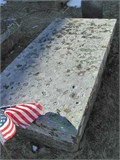
grave

Dr John
My 9th great-grandfather bought Shawomet, Warwick, RI for 144 fathoms of wampum:
Dr. John Greene was the fourth and youngest son of Sir Richard Greene, of Bowridge Hall. He was born in 9 Feb 1597 at Salisbury, Wiltshire, England. He came to Warwick, Rhode Island, sailing on the ship “James” 5 April 1635, arriving in Boston, Massachusetts, 3 June 1635. He moved his family to Providence, Rhode Island in 1637 all four of his sons being born in England. John born 15 Aug 1620, Peter born 10 Mar 1622, James born 21 Jun 1626, Thomas born 4 Jun 1628. His wife and sons all lived out their lives and are buried in Warwick, Rhode Island. He was one of the original 12 members of the Baptist Church. In January 1643, he and 10 others bought from Miantonimoh, Chief of the Narrowgansets (Native American Tribe), for 144 fathoms of Wampun, the tract of land called Shawomet (Warwick, Rhode Island). — A fathom (six feet of strung beads) of white wampum was worth ten shillings and double that for purple beads. A coat andBuskins “set thick with these Beads in pleasant wild works and a broad Belt of the same (Josselyn 1988: 101)” belonging to King Philip (Wampanoag) was valued at Twenty pounds. Even in the 1600s there was noted distinctiveness of Native-made wampum and the inability of others to counterfeit it, although attempts at imitations included beads of stone and other materials. — In 1644 Dr. John Greene went to England with Samuel Gorton and Randall Holden, returning in 1646, their mission successful. John Greene was Commissioner from 1654-57, Deputy Governer 1654. He married his first wife, Joan Tattersall, at Salisbury, England in St. Thomas Church, 4 Nov. 1619. Dr. John Greene died 11 Mar 1658. He is buried next to his wife Joan.
He married often and well:
JOHN GREENE, Surgeon, the progenitor of the Warwick Greenes, was the son of Richard and Mary (Hooker) Greene, and was born on his father’s estate at Bowridge Hill in the parish of Gillingham, County Dorset, England, about 1590. Though not so recorded, dates before and after him would seem to determine this as the year of his birth. His father, Richard, grandfather Richard, and great-grandfather, Robert, had for nearly one hundred years before him resided at Bowridge Hill, and were undoubtedly a branch of the Northamptonshire family of Greene through a younger son.
The mother of John Greene, surgeon, Mary Hooker, was the daughter of John Hooker (alias Vowell), who was born at Exeter, England, about 1524, his father, Robert Hooker, having been mayor of that city in 1520.
John Greene removed early to Sarum (Salisbury), the county town of Wiltshire, and was there married at St. Thomas’s Church,’ November 4, 1619, to Joanne Tattershall (or, as it was written on the church register, “Tatarsole”). Nothing is definitely known of her English connections. The name is frequently found in early records among post-mortem examinations, parliamentary writs, and charters, and is variously written Tatersall, Tateshall, Tatashall, Tatershal, and Tattershall. The first of the family of whom we have mention came in with William the Conqueror and obtained the lordship of Tattershall in Lincolnshire, where he seated himself and from which he took his surname. His descendants were seated in Berkshire and Norfolkshire, and were held in high repute. It is probable that other branches located in other counties, and it is not improbable to suppose that Joanne the wife of John Greene, who emigrated to America from Salisbury, County Wilts, was a connection of the family of George Tattershall, who was seated at Stapleford, County Wilts, which is about five miles distant from his Salisbury home ; but as yet this relationship has not been proved. The following note, recently received by the compiler in answer to an inquiry about records at Stapleford, may be of interest in this connection
“Stapleford Vicarage, Salisbury,” October 18, 1900.
“Madam: I have received your letter of the 25th September, but regret to say that I cannot help you in your research, as the Stapleford Register begins only with the year 1637. “J. F. D. HOERNLE, “Vicar of Stapleford.” [Joanne Tattershall ‘s marriage date was 1619, eighteen years earlier.]
The marriage of John Greene and the baptisms of all his seven children, recorded in the Parish Register of St. Thomas’s Church at Salisbury, England, are still extant. He is therein styled “Mr.” and “Gent,” a mark of some distinction at that date.” He resided at Salisbury with his family, following his profession, for about sixteen years. On April 6, 1635, he was registered for embarkation at Hampton, England with his wife and six children (one having probably died in England before this date),” in the ship James, of 200 tons, William Cooper, Master, for New England.” After a voyage of fifty-eight days he arrived at Boston, Mass., June 3, 1635. He first settled at Salem, Mass., where he was associated with Roger Williams, purchasing or building a house there, but soon after Mr. Williams’s flight from Salem (1636) he sold it and, joining Williams at Providence, secured his home lot, No.15, on the main street. He was one of eleven men baptized by Roger Williams, and one of the twelve original members of the first Baptist church on this continent, organized at Providence, R. I. He was the first professional medical man in Providence Plantations. He is alluded to in Goodwin’s Pilgrim Republic (p. 407) as “one of the two local surgeons” at Providence in 1638, though we are told “the people of Providence relied solely upon him for surgical aid long after his removal to Warwick in 1643.”
His first wife, Joanne Tattershall , the mother of all his children, died soon after his removal to Rhode Island and it is supposed was buried at Conimicut, Old Warwick (?). He married (2) ” Ailsce (Alice) Daniels, a widow” (recorded as proprietor of a home lot in Providence, 1637). They removed to Warwick, 1642-3. At the time of the persecution of the Shawomet pioneers (October, 1643), when “forty mounted and armed men,” sent from Boston to arrest them, fired over their houses, the women and children fled to the woods. Fright and exposure caused the death of the (second) wife of John Greene. (It seems more probable that this was the wife who was buried at Conimicut.) Samuel Gorton wrote of this attack of the Massachusetts troops: ” Afflicting our wives and children, forcing them to betake themselves some into the woods among the Indians, suffering such hardships as occasioned the death of divers of them, as the wife of John Greene, as also the wife of Robert Potter.” Judge Staples, in his Annals of Providence, mentions the fact that the second marriage of John Greene was not recorded, but he found evidence in Probate Records, where mention is made of the son of Alice Daniels as “John Greene’s stepson.”
Evidence of this marriage is also given in the following item:
“In the division of 52 House lots John Greene senior had lot between Thomas James on the North and John Smith on the South, and he inherited the lot of Alice Daniels his second wife between Wm. Harris on the North and John Sweet on the South” {Rhode Island Colonial Records [Printed], vol. i., p. 24).
In files. City Clerk’s office. Providence, is a book containing “A revised List of Lands and Meadows as they were originally lotted for the beginning of the Plantations of Providence in the Narragansett Bay in New England unto the [then] inhabitants of the said Plantations until anno i6—-.”
First in order are the “home lots,” beginning at the Mile-end Cove, south end of town, between Fox Point and Wickenden Streets, lots all bounded by Town (Main) Street on the west and by what is now Hope Street on the east. The name of Alice Daniels is found on this list.
Mr. Greene was married (3) in London, England, about 1644, to Phillippa (always written Phillip), who returned with him to Warwick, R. I., 1646. Her family name is not known. She died at Warwick, March 11, 1687, aged about eighty-seven years, having survived her husband for nearly thirty years.’ In further support that his third wife was from London we quote the words of Samuel Gorton, who, in a letter from Warwick addressed ” to Edward Calverly at his house by the east end of Christ Church in Newgate Market, London,” and dated November 20, 1649, wrote of this last wife of John Greene: ” Your auld neighbour, our loving friend, Mrs. Greene, hath writ a letter of advise to you [which] made me laugh not a little, which I heartily wish may come to your hands. She laies out the benefights of these parts better than I could have advised to have done. She takes well with the country and cheerfully performs her place [part], hath the love of all, non can open their mouth against her, which is a rare thing in these parts.”
Excerpt from the Book Title: The Greenes of Rhode Island, with historical records of English ancestry, 1534-1902 Author: General George Sears Greene (1801-1899) Publisher: Knickerbocker press Published in: New York Date of Publication: 1903 The Excerpt is Pages 54 – 56 The Document was retrieved from http://www.archive.org/details/greenesofrhodeis00gree


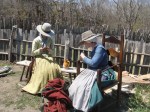
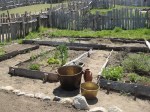
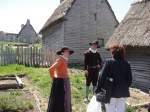
My ancestors attended the first Thanksgiving party in Plimouth Colony. Most of my heritage is English, and the Mayflower was full of my peeps. My 11th great-grandfather attended the feast as a representative of the Wampanoag people. When he first met the Pilgrims they gave him alcohol , which must have aroused his curiosity. The political system in New England was way different from the one in Europe. The local natives made friends with the Pilgrims with reservations (not the kind they have been granted by the US government). They had made contact with Brits before which had resulted in an outbreak of disease that killed a large number of the people. They saw the Mayflower, but kept a distance since they assumed these Brits would be diseased as well.
Quadequina is credited with bringing popcorn to the first Thanksgiving. The Wampanoags I met in Plymouth this year told me it was actually parched corn. Either way, there was a potluck dinner and Quadequina brought corn as his dish. He acted in good faith, was a respectful and polite guest, even allowing the Pilgrims to occupy his homeland and build a fort around their town. It was fairly impossible for the American natives to do due diligence on these religious Pilgrims who had arrived and planned to stay. Squanto, the famous translator, was about all the interface available. The Natives of New England were stuck with this highly unnatural situation through no fault of their own. They just happened to be where the Mayflower got stuck on the rocks. It was their luck.
When my 10th great-grandfather Gabriel Wheldon wanted to marry Quadequina’s daughter he gave his consent and helped the couple avoid disaster from the Pilgrims:
Gordon B. Hinckley, Shoulder for the Lord” by George M. McCune page 35- ” Two of the early immigrants to Plymouth colony were Gabriel Wheldon, of Arnold, Nottingham, England, and his brother (name unknown). Gabriel had been married in England before sailing to America but his first wife named Margaret evidentally was deceased at the time of his migration. Both brothers had a free spirit much like Stephen Hopkins and found their way to the camps of the Wampanoags. There they both fell in love with two of the daughters of chief Quadequina, younger brother of the Great Chief. They each married and Gabriel gave his second wife the English name ‘Margaret’ after his first spouse. The two counseled with their father-in-law and his older brother Massasoit regarding what to do. The Plymouth Colony would probably punish them for their intermarriage. Massasoit advised them to return to the colyn and all would be well. The Plymouth Colony tribunals saved face by banishing the couples from Plymouth for life but did not send them back to England. Gabriel and Margaret established their home in Barnstable where the Hinckleys came in late 1630’s and here Gabriel and Margaret raised a large family of girls. One of these was Catherine “Catone” Wheldon who married Stephen Hopkins'(First to build a house in Mattachesse Villiage/Yarmouth) oldest son Giles on October 9, 1639. Giles had been given the home his father had build in Yarmouth and the couple established their home and raised four children there. When Giles’ father Stephen passed away about July 1644, his father left an estate.. Some records give Margaret as the wife of Gabriel Wheldon. It seems she was his second wife, who, after his death, may have returned to England with Rev. Marmaduke Matthews and his wife. Other records state that Margaret was an Indian Princess, Wampanoag, and give her lineage for several generations. He _may_ have been Margaret’s brother. He immigrated 1638, aPreacher of the Church of Malden. He returned to England in 1655, and Several of the Malden Church members went with him. Of these returning pilgrims, the widow Margaret Wheldon, who left a law-suit over the estate of her deceased husband, Gabriel, also went to England. (from: Pg 155 The History of Malden, Massachusetts, 1633-1785). Rev Matthews died 1683 in England.
I don’t believe he is partial to either pecan or pumpkin pie. I think Quadequina would have liked to see us celebrate equal rights and justice each November. The story of Thanksgiving is mostly mythical, since very little was recorded at the time. Turkeys may not be the best logo for American seasonal gratitude. Popcorn deserves a place at the table.

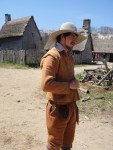




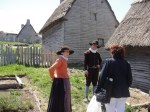
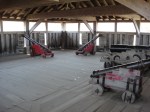

Since last November I have visited my ancestral homeland at Plimouth Colony in Massachusetts. The museum and displays helped me to more vividly picture what those Pilgrims were doing in the 1600s. I have many ancestors who arrived on the Mayflower, and I am not overly impressed with that fact. I am, however, truly grateful to learn that I am Wampanoag. I study history by learning about my family tree. Thanksgiving, as taught in elementary school, has very little to do with the real events that took place at the time. There was a feast and celebration, and there was a great deal of unease about these English people who built a fort around their town and put cannons on the second story of their church. These Pilgrims, who are depicted to children as seeking religious freedom, only believed in religious freedom for themselves. They had been repressed in Holland for their beliefs and wanted a place where their somewhat radical thinking would not clash with any royal Euros. They did not propose to extend religious freedom and tolerance to the native people they encountered in America. They proposed to convert them to Christianity, their own style of Christianity.

Thomas Dudley
Harvard was endowed and sustained in business by conversion of native people. The Indian College was used to educate and convert natives. If they had not come up with donations based on this premise, Harvard may never have become the institution it is today. My tenth great grandfather Thomas Dudley signed the charter for Harvard because he was the colonial governor when it opened. His daughter and my 9th great grandmother, Anne Bradstreet, was a poet and wife of Simon Bradstreet, also a colonial governor.

Harvard College Charter
I am not as proud of them as I am of Quadequina. I have taken sides in the Thanksgiving story. I think the Pilgrims were rude to say the least. We build it up as a story about peace and religion, but it was a story of imperialism. When I learned that all the historic wampum belts have gone to England to be kept in museums I became angry. A very cool Wampanoag elder who worked at Plimouth gave me some very wise advise about that. She told me there was no point in being angry about the past. She is obviously correct, but my feelings have changed about history, Massachusetts Colony and all that it meant, and the fable of Thanksgiving. There is more bitterness that the peach pie reveals. It makes me wonder exactly how my tribe feels when they celebrate this holiday. It looks like the tribe may open a casino on Martha’s Vineyard. It is fair to give them access to the wealth and the weakness of the white people on that island. There is plenty for everyone. Turn about is fair play, even if it comes hundreds of years later.
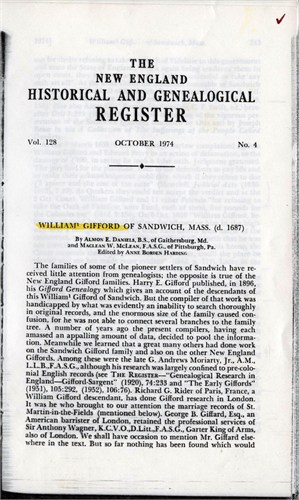
Gifford Genealogy
My 9th great grandfather was born in England and died in Sandwich, MA. He was a Quaker who was persecuted for his faith. He refused to sign the oath of fidelity to England, so he hd a hard time with the colonial authorities.
There is a record in England of a “Guilielm Gifford” (i.e., William Gifford) who married Elizabeth Grant on 11 February 1635 in St. Martin-in-the-Fields, London. Also, the London Merchant Taylors’ Guild shows a record: “William Gifford, son of Anthi (sic) Gifford of Dublin in the kingdom of Ireland, gentleman, apprenticed to Thomas Southerne of New Exchange, London, for a period of seven years from 7 December 1628.” Apprentices were forbidden to marry, so this would mean the apprenticed William Gifford would have been given his freedom 7 December 1635, in perfect time to be the one who married 11 February 1635/1636. Also, the records of St. Martin-in-the-Fields show that an Ananias Gifford married Maria Read on 18 November 1621. Ananias (also spelled Hananias, Hannaniah and Annaniah) is a relatively rare name. William named one of his sons Hannaniah, and the name has been carried down in the family. Also, the name occurs in the Giffords of Dry Drayton, county Cambridge, England. But it cannot be proven that these English records apply to the family of William Gifford of Sandwich.
Nor can the English ancestry of William Gifford of Sandwich be proven, according to Daniels & McLean. “English Giffords can be traced back to Normandy at the time of William the Conqueror when most branches usually spelled the name Giffard. Inevitably the temptation to connect the Sandwich Giffords with these celebrated families has produced a rash of printed accounts in which the connection is stated as fact but without solid references. (Cutter’s “Genealogical History of Western New York,” 2:901; “History of Bristol County, Mass.;” “Vineland (N.J.) Historical Magazine,” 3:32; “Seabury-Gifford Families,” Hartford (Conn.) 1941) In view of the fact that highly skilled professional genealogists have found no proof as yet of such connections, it can only be said that evidence has yet to be found to confirm these wishful thoughts.”
William Gifford of Sandwich was a Quaker, and as such, suffered persecution for his faith. “Little Compton Families” says “It is supposed that he was the William Gifford who in 1647 or earlier was ordered by the court at Stanford to be whipped and banished.” On 1 June 1658, he was one of a dozen men who “all of Sandwich were summoned, appeared to give a reason for theire refusing to take the Oath of Fidelitie to this government and unto the State of England, which again being tendered them in open court, they refused, saying they held it unlawful to take any oath att all.” At the court held 2 October 1658, they were fined L5 each. At the court held 1 March 1658/1659 George Barlow, Marshall for Sandwich, Barnstable and Yarmouth, complained against William Gifford and Edward Perry in an action of defamation, asking damages of L100, in saying he took a false oath. The defendants were ordered to pay 50s and make their acknowledgement publically, or else be fined L5 plus costs. As Quakers, they could not accept the verdict, and at the 2 October court William Gifford and 11 other Friends were fined L5 for refusing to take the Oath of Fidelitie. At the June 1660 court Gifford was again summoned to take the oath, again refused, and was again fined L5. In October 1660, for persisting in his refusal and for attending Quaker meeting, he was fined L57 — an enormous sum for those times. At this point he disappears from the records, and may have left Plymouth colony, but where he went is unknown. It has been suggested that he went to New Jersey which, like New Amsterdam, was then under the control of the Dutch. On 8 April 1665 William Gifford was one of the signers of the Monmouth (NJ) Patent, but there is no evidence he actually settled there; his sons Christopher and Hannaniah did, however. In a deed by his son Christopher William was described as a tailor.
On 10 November 1670 Mr. Gifford bought from mistress Sarah Warren of Plymouth, widow of Richard Warren, one half her share in the land at Dartmouth, which he gave equally to his sons Christopher and Robert by deed dated 6 May 1683. In 1673 William Gifford purchased land in Suckanesset (Falmouth) from the Indian Sachem, Job Noantico. Gifford continued to appear in Sandwich town records and in records of the Sandwich Friends meeting, and he married Mary Mills, also of Sandwich, at the Friends Meeting of 16 day 5 mo: 1683. Thirty witnesses signed the certificate, but none of William Gifford’s children signed the document, nor did James Mills, Mary’s brother.
 mermaidcamp