mermaidcamp
Keeping current in wellness, in and out of the water
You can scroll the shelf using ← and → keys
You can scroll the shelf using ← and → keys

Providence RI
Making travel plans is a study in availability. As a seasoned professional I like planning trips almost as much as taking them. I can enjoy a spontaneous jaunt as well as the next person, but planning can make the difference between a mediocre and a memorable travel experience. It is good to have purpose, even if it is simply to change the scenery. It is also very smart to have all the essentials covered so you can virtually do whatever strikes your fancy while you are at your destination. I enjoy studying maps more than almost anything, so all kinds of maps inform my decisions. I like the freedom of a car but not the hassle of parking and driving in heavy traffic. Details of transportation and accommodation need to match the budget and the preferences of the traveler. Providence is foresight. Providence involves taking care of the details in advance. When you do your part, the divine Providence takes over and creates magic.
Details contain not only the devil, but also a great deal of delight if handled correctly. There are some basic outlines to create good vacations, but the key is to make the details cater to the taste of the traveler. That is where I excel. I have many years of experience in travel of all kinds. More importantly, I am specific, particular, and discriminating in my personal preferences. I do know what I like, and know how to procure it at the price I want to pay. I also know that many people would be uncomfortable in a museum all day, or in a hot spring all night, so I am happy to travel sometimes alone. This means I am free to linger or to cancel plans on my own whims. I have hit the road with various groups in the past. I believe I have done my penance in that regard, and can travel for my own purposes now. Often groups isolate themselves from the local culture, not intentionally, but because they are involved with each other all the time. It can be a huge turn off to find yourself anywhere with a large tourist group you had not planned to encounter.
Find great value by shopping for exactly what you want instead of seeking the cheapest trip. Using a credit card to pay for travel you can’t afford to take will almost inevitably end in heartache. Buyer’s remorse is debtor’s remorse when your holiday fun is digging a hole in your credit rating and peace of mind. Prepay for the hotel. You can get fabulous discounts for a non refundable prepayment. Better yet, when you take the trip it feels like the lodging is free. It is very liberating.
I am planning a trip to Plymouth Colony and the vicinity in April. I am finding so much to do in a very small area, that the research is really a blast for me. It looks like the right trip to discover Providence, RI. My ancestors are all over the place, and I have never been there. This is my kind of adventure.
The Romans had a pantheon similar to the Greeks. Fortuna represents wealth, commercial success, and abundance of all kinds. She is intimate with the infinite source of wealth, and acts as a conduit, bringing it to life on earth. Lakshmi is busy doing the same thing for the Hindu pantheon. In America, unfortunately, the Puritans have directly linked wealth to purity of behavior (as described by them). This narrow view of abundance is a vicious cycle of a bummer drag. They arrived in Plymouth Colony and were greeted by sophisticated and generous souls. Since the hospitable tribes did not read the Bible the Puritan fathers decided it would be fine to totally rip them off for everything they had. Things have gone downhill from that point.
As a priestess of Fortuna, you are required to make friends with money. She is the power behind all propitious events. It is possible to procure her guidance through meditation. You can ask questions with your dominant hand doing the writing, then pass the pen to Fortuna in your non dominant hand and let her answer. The handwriting may be very bad, but let it go. You are the only one who will read and interpret it. If you really wonder about your fate, your fortune, your lot in life, ask. Ask deeply, and you will find the answer. Oracles did some gas inhaling at you will not need in this exercise, but the concept is the same. Ask and you shall receive. Knock and the door will open. Same deal. Don’t allow some Puritan nerd from the past to rob you of your right to know. Be still, know. The truth will set you free….a whole lot freer than Salem during the witch trials, anyhow. Speak to Fortuna. She has something to tell you.
My Dead Peeps
I have traveled in person only once to visit my dead ancestors and look for local records of their lives. I went to Tulsa, where I was born, and my grandparents are buried, but I can not find their graves. After my cousin went back to Iowa I did more investigation in the town where my father was born, Independence, KS. I drove to the small rural town of Ladore, where many of my ancestors settled when they came from Ohio and New York. I found the grave of one of my 2nd great grandmother while looking for somebody else. It made the hair stand up on my neck even in sweltering humid July in Kansas. I have been all over the world on all kinds of journeys, but this is a whole new way to look at travel…visiting history by combining the ancestors and geography. Kinky, and very cool.
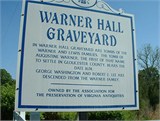
I have accumulated and am trying to geographically arrange data on ancestors around Plymouth Colony, MA and around Jamestown, VA. I will go to both destinations eventually, but have to choose one to be the first. The peeps are mostly very fancy in both places and we know how to find many of the graves, some homes, etc. I am not really into them for the royal blood and fame, I just like them because they survived. It is nothing like visiting living relatives. They are past judgement and are all very low maintenance. They are what you might call spooky. I just learned from a local that Virginia is a vortex for ticks, which makes graves in Massachusetts instantly sound so much more appealing. I am thinking now of flying to tick free, but cold Boston. Someday I will procure the right tick graveyard gear to safely visit my Virginians…like Mary, who is in the private and elite graveyard at Warner Hall with a lot of my other ancestors:
The walled family cemetery of the Warner and Lewis families is located on the Warner Hall property, southeast of Warner Hall. Access to the Graveyard is from the road North of Warner Hall and not from Warner Hall or the Driveway to Warner Hall located West of the Graveyard. The cemetery is the final resting place for many of the Warner and Lewis family members. The family cemetery, is also the resting place for such well known ancestors of George Washington, Robert E. Lee, The Queen Mother of England, and Queen Elizabeth II. Queen Elizabeth has visited Gloucester where she placed a wreath upon her ancestor’s grave. The cemetery has thirteen graves and plaques in memory of all the family. The cemetery is owned and maintained by the Association for Preservation of Virginia Antiquities (A.P.V.A.). The A.P.V.A. acquired the cemetery at Warner Hall in 1903, since which time the Association’s Gloucester Branch, now known as the Joseph Bryan Branch, has zealously maintained it.
There are thirteen graves in the Warner Hall Grave Yard. they are:1 Mary Warner (believed to be Mary Towneley Warner), 1614 – 16622 Augustine Warner I, 1611 – 16743 Augustine Warner II, 1642 – 16814 Mildred Reade Warner (wife of Augustine Warner II), 16945 Augustine Warner III, 1666 – 16866 Elizabeth Warner Lewis (d/o Augustine Warner II w/o Col John Lewis), 1672 – 17197 Col John Lewis (s/o John & Isabella Lewis h/o Elizabeth Warner), 1669 – 17258 Mary Chiswell Lewis (d/o John & Elizabeth Randolph Chiswell w/o Warner Lewis II, 1748 – 17769 Warner Lewis II (s/o Warner Lewis I & Eleanor Bowles Gooch Lewis & grandson of Col John Lewis & Elizabeth Warner Lewis), 1747 – 179110 Juliana Clayton (d/o Dr. Thomas & Isabella Lewis Clayton), 1731 – 173411 Isabella Lewis Clayton (d/o Col John Lewis & Elizabeth Warner w/o Dr. Thomas Clayton), 1706/7 – 1742 (the dates 1706/7 is exactly what is engraved on her stone)12 (Dr.) Thomas Clayton (h/o Isabella Lewis), 1701 – 173913 Caroline Lewis Barrett (d/o Warner Lewis II), 1783 – 1811

Private Graveyard at Warner Hall
There are many records of my 10th Great Grandfather who ran away as soon as he got to America:
Gabriel Wheldon and brothers deserted ship at Plymouth. To escape punishment and being sent back to England in chains, they went inland to Massasoit’s village at Po ko net, and took to wife a daughter of a brother of Massasoit, although he had a wife in England. After children were born through the good offices of Massasoit and the English at Plymouth not wishing to offend him, consented to try Gaberial and his brothers at the Plymouth court.He was sentenced to dwell at Mattachees on land that was ceded by HighYannough at the request of Massasoit in lieu of certain annual tribute paid Massasoit by the Cape Tribes. One of Gabriel’s brothers went back to England and Gaberial and the other brother stayed in the Colonies. It was many years before Gaberial was made a freeman, and he had to go outside the jurisdiction to become one.
The first known Whelden in the line in America was Gabriel Whelden of Plymouth. He is believed to have been born in England, but the date and place are not proven. It is commonly stated that Gabriel Whelden originated in Nottinghamshire, but no records have been found to substantiate it. The author Pope reports he found a record of a land sale in Middlesex county files where Gabriel in 1653 sold land he owned in Nottingham to William Cross. The head archivist of these records, Elizabeth Bouvier has been unable to find any such record.
The Wheeldon/Wheelton family, which has not yet been connected to Gabriel Wheldon, finds the earliest spelling located to-date is Whyldon (christenings of sons of William Whyldon at Astbury, Cheshire: Matthew, 14 Dec 1574; John 14 Mar 1584; per LDS IGI ). In “Homes of Family Names in Great Britain”, Baltimore, MD: Genealogical Publishing Company, 1968) H. B. Guppy noted that the surname Wheelton as “peculiar” or “confined mostly to this county [Cheshire].” He indicated it was more specifically associated with Macclesfield. The surname is concentrated in the ancient Parish of Prestbury, which originally included Macclesfield. Additionally, “pockets” of Wheeldon ~ Wheelton individuals settled in the Cheshire / Derbyshire / Staffordshire border area known as “The Potteries.”
Was Margaret (Oguina) a Wampanoag?
Gabriel married Margaret Diguina (or Oguina), who may have been Gabriel’s second wife. Some say that Margaret was a Wampanoag Indian, although it is hotly disputed by many genealogists. Accordig to the Wampanoag theory Oguina was a child of 6 years in 1608 when a British fishing vessel picked her up along with other Wampanoags along a beach on Cape Cod. She was taken to England where she baptized and given the English name Margaret. She eventually married Gabriel Whelden.
Oguina was a daughter of Quadequina who in turn was a son of WAasaneginN. These geenrations were of the Algonkian nation of Massachusoi and tribe of Wampanoag.
Oguina’s descent is as follows:
1- WASANEGIN, born by 1554 begot 2-QUADEQUINA, born 1576. This year is determined from the fact that he was born in the year when the “Great Light” went out. European astronomers noted in 1576 that there was a Solar Eclipse. He, QUADEQUINA begot 3-OGUINA, born 1602 @ Wampanoag village in what is today Rhode Island.
Gabriel Whelden and Margaret (Oguina) had the following children:
Gabriel died January 1653/1654 in Malden, Massachusetts. Following is his Last Will and Testament:
In the name of God, and in obedience to his comand (according to my bounden duty) I, Gabriell Whelding, of the Towne and Church of Maulden, being weake and sicke in body, do make my last will. My body to be layd asleepe in the bed of the grave, in the Common buriing lace for the Inhabitants of this Towne. I give 10s as a Small testimony of my true Love to the Church of Maulden, to be payd into the hands of the Deacons within a month after my decease. i give all my estate in Maulden, consisting of house, Frame Lands, cattle, and corne, (together [with] what money is due unto me from William Croffts, of Linne, to Margaret Whelding, my wife, who I appoynt my sole executrix.
In the presence of: Nathaniell Vphame, James Larnard, Michaiah Mathews, with others.
The part that seems far fetched to me is that Margaret was taken to England as kidnapped child. However, a recent piece of good luck on this very blog has introduced me to a fellow descendant, Ron Turner, who has more information about the story. The clues are many, and my interest could not be higher.
My 9th great grandfather Richard Taylor, the tailor, of Plymouth Colony was described by an unknown source:
Richard was born in Europe and was three times the age of his wife, Ruth Wheldon. Ruth was ½ blood Wampanoag Indian, born at Yarmouth, daughter of Gaberial Wheldon and his wife Margaret, a full blood Wampanoag Indian. Margaret was the daughter of a Wampanoag Sagamore, a younger brother of Massasoit.
Richard TAYLOR (abt. 1620-1673), “tailor” Early settler of Yarmouth, Plymouth Colony. Not to be confused with his (possibly slightly younger) contemporary, also of Yarmouth: Richard Taylor (abt 1625-1703), farmer or husbandman of “The Rock”. Both were supposedly married to women by the name of Ruth. Vital statistics
Sex: Male
Born: about 1620 at England
Died: about 13 December 1673 at Yarmouth, Plymouth Colony, age at death unknown.
Interment: Probably at Yarmouth, Plymouth Colony
Richard Taylor’s origins and emigration are unknown. (But see below.)
Several histories and genealogies claim that Richard Taylor, tailor, married Ruth Whelden (abt 1625-1673), daughter of Gabriel Whelden, and that she was the “wife of Richard Taylor”, whose body was found in a boat, drowned, off Duxbury, MA about 3 December 1673. HOWEVER, the inquest records concerning the drowning do not provide her given name at all. They simply identify the body as “the wife of Richard Taylor, sometimes of Yarmouth.” This researcher (Jillaine 16:14, 28 July 2007 (UTC)) believes it’s just as likely that Ruth Whelden was married to Richard Taylor of the “Rock”– and that it is just as likely that the “Ruth, wife of Richard Taylor” who died in 1693 was the daughter of Gabriel Whelden. Older genealogies say that Richard “the Rock” Taylor was likely married to Ruth Burgess, but this has never been proven. So we have no proof of the name of Richard Taylor, tailor’s wife; but we do know that Richard Taylor, the “Rock” did have a wife Ruth who died in 1693.
Offspring
Ruth Taylor, b. July 29, 1647; buried in 1648.
Ann Taylor, b. Dec. 2, 1648; buried March 29, 1650, aged about 1-1/2 years.
Mary Taylor (1649-??), m. [Abijah Merchant (1651-?)]].
Martha (1650-1728), b. Dec. 18, 1650; m. Joseph Bearse of Barnstable Dec. 3, 1676; d. Jan. 27, 1727-8, aged 77, leaving issue.
John Taylor (1652-1721), m. 15 December 1674 Sarah Matthews, daughter of James Matthews.
Elizabeth Taylor (1655-1721), m. Dec. 20, 1680, Samuel Cobb (1651-?) of Barnstable; d. May 4, 1721, aged 66, leaving issue.
Hannah Taylor (1658-1743), m. as his 2d wife July 19, 1680, Deacon Job Crocker of Barnstable; d. May 14, 1743, in her 85th year, leaving issue.
Ann Taylor (1659-?), m. Josiah Davis, of Barnstable, June 25, 1679, and had issue.
Joseph Taylor (1660-?)
Sarah Taylor (?-1695); d. unmarried July 31, 1695. The inventory of Sarah Taylor of Barnstable was taken Aug. 16, 1695, and amount to £34 19s. Deacon Job Crocker and Samuel Cobb, brothers-in-law, were made administrators Sept. 23, 1695. The estate was, Sept. 13, 1695, ordered equally divided between the brothers and sisters of the deceased, given in the following order, to wit: John Taylor, Joseph Taylor, Mary Marchant, Martha Bearse, Elizbaeth Cobb, Hannah Crocker and Ann Davis. The inventory consisted of wearing apparel, five pounds of worsted yarn, a Bible, cattle, sheep and lambs, cash moneys due from Samuel Cobb and Joseph Bearse, &c.
Biography
The biographical information listed below could apply just as easily to Richard Taylor, the “Rock” with the exception of the 1674 will.
Early life and education Edit
There was a Richard Taylor, age 16, on the ship Truelove which departed Gravesend, England on 11 Jun 1635. Other Taylors on that ship were: James Taylor, 28; William Taylor, 17; Ann Taylor, 24.
Military service
1643 (August): He is first mentioned in the Colonial records as among those in Yarmouth between 16 and 60 years of age able to bear arms.
Career Edit
1648 (June 7): was a surveyor of highways for Yarmouth.
1651 (June 6): was sworn as a member of the grandjury.
1656 (May 30): with Edmond Hawes, Richard Taylor was witness to a deed of Samuel Mayo to John Phinney of Barnstable.
1656 (June 3): he was constable of Yarmouth.
1657 (June 3): he was one of the surveyors of highways there. That year he took the oath of fidelity.
Family life
1647 (Oct 28): Gabriel Whelden gave his assent for one Richard Taylor (many believe this one, but without documentation) to marry his daughter, Ruth Whelden.
1655 (May 28; July 27): Richard Taylor, tailor, among others suing widow Margaret Whelden, for a share of the estate left by Gabriel Whelden.
1673 (Dec 3): Richard’s wife, not named, was discovered drowned in a boat off Duxbury. Richard died within a couple of weeks.
Will of Richard Taylor Edit
(Source: James W. Hawes, “Richard Taylor, Tailor, and Some of His Descendants” in ‘Library of Cape Cod History & Genealogy’, No. 48, 1914.) (Transcribed with original spelling maintained.)
The Court (March) 4, 1673-4, made the following order:
“Mr. John Gorum and Mr. John Thacher are joyned with John Taylor ( for the disposing of the estate of Richard Tayler to his children, and for the paying and receiving of debts according to order of Court. Concerning the estate of Richard Tayler, late of Yarmouth, deceased, this Court doth order, first, that the eldest son of the said Tayler shall have his fathers housing, and two thirds of the land, both upland and marsh, and the rest of his portion out of what of the estate Mr. Gorum and Mr. John Thacher shall judge most suitable for him, hee being by order of Court to have a dubble portion. 2condly, it is ordered, that the hay, and what provisions was or is upon the invoice of the estate that is now spent, or shalbe judged convenient for the family to spend betweixt this and the first of the next August, shall not be accounted to the estate, as like-wise what woole and flaxe hath bing spon by the daughters sence theire parents death shalbe accompanted theirs that spon it. The rest of the estate to be devided betweixt the second son and the five daughters, everyone an equall proportion, to bee set out to them as maybe most suitable for them, by the discretion of their eldest brother, and Mr. John Gorum, and Mr. John Thacher. The second son to have the other third of his father’s land, besides his portion equall to his sisters. Lastly, that nothing that hat bin already given or betowed by the said Taylor on any of this children, shall not be considered in the devision, but everyone of to have an equall proportion, after the payment of debts due from the estate.”
His inventory taken Dec. 13, 1673, and submitted to the Court under oath March 6, 1673-4, amounted to L199 4s 11d. The debts of the estate were L18 1s. 2d. Included in the inventory were 12 acres of upland, nine of meadow and three of marsh, which together with houses and some grain sown amounted to L60. The children named are John, Joseph, Martha and Mary. The inventory shows that he possessed a considerable many cattle, shep and hogs, one horse, corn, wheat, flax, provisions, 21 yards of cloth, lumber and household articles. There were due to him 38.5 barrels of tar, and John Blake of Boston owed him money. Some things had been given to the children in his life time.
Contributors:
Jillaine
Sources:
Richard Taylor, Tailor and Some of His Descendants, by James W. Hawes; C.W. Swift, publisher, Yarmouthport, Mass.: 1914.
Barnstable Probate Records
Plymouth Colony Records, Volume 5; pp. 122-123
Plymouth Colony Wills
NEHGS Register, Volume 3, 1849, p. 189 citing CR, Volume II, p. 18
NEHGS Register, Volume 4, 1850, p. 258.
NEHGS Register, volume 14, 1860, p. 354
The history of Cape Cod : annals of thirteen towns of Barnstable County, p. 182; p. 193.
History of Barnstable County, Massachusetts, edited by Simeon L. Deyo. 1890. New York: H. W. Blake & Co.; CHAPTER XVII, pages 453-506. Town of Yarmouth, by Hon. Charles F. Swift.
James Savage, Vol. IV, p. 263
Torrey, Clarence Alman, New England Marriages, Genealogical Publishing Co., 1985; p. 730
Court Files of Middlesex County, Mass., 1649-1675 (through NEHGS web site)
Middlesex Court Files Folio 11; HLS #409 and 411.
History of Yarmouth, 1884, p. 88
Plymouth
It is enlightening to track my personality archetypes while I track my ancestors. There are similarities, highs and lows, temporary dead ends in both. You can’t change the ancestors and you can’t change your archetypes, in the same way that you can not rearrange the stars in the sky. When I was new in the genealogy game I went to Tulsa to meet a cousin based on only family legend and no facts to discover/confirm our Cherokee bloodline. We had a great time, but came up empty on the Native American theory. We both wanted it to be true, but my cousin’s husband was insanely convinced without any evidence. He really wanted a Cherokee wife. He was the worst detective I have ever seen.
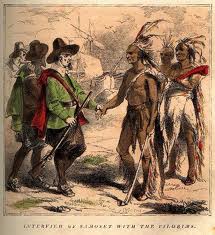
While searching it is important to be open to discovering that for which what you were not looking. When I find a Plymouth Colony ancestor I am generally excited, fill in the blanks with some black britches and some assumptions. Richard Taylor was no regular Pilgrim. He fell in love and married a Wampanoag chief’s daughter. I have a tribe in Massachusetts. I never would have guessed this, but I am thrilled out of my mind. My 12th great-grandfather,Great Sachem, had been exposed to English fishermen, and had learned some language from them. He walked into the Pilgrim camp and said “Welcome Englishmen”, to the great surprise of the Englishmen.
Wasanequin Great Sachem Wampanoag tribe (1554 – 1617)
is my 12th great grandfather
Quadequina Wampanoag (1576 – 1623)
Son of Wasanequin Great Sachem
Margaret Diguina Weeks (1613 – 1651)
Daughter of Quadequina
Ruth Whelden (1625 – 1673)
Daughter of Margaret Diguina
John TAYLOR (1651 – 1690)
Son of Ruth
Abigail Taylor (1663 – 1730)
Daughter of John
Martha Goodwin (1693 – 1769)
Daughter of Abigail
Grace Raiford (1725 – 1778)
Daughter of Martha
Sarah Hirons (1751 – 1817)
Daughter of Grace
John Nimrod Taylor (1770 – 1816)
Son of Sarah
John Samuel Taylor (1798 – 1873)
Son of John Nimrod
William Ellison Taylor (1839 – 1918)
Son of John Samuel
George Harvey Taylor (1884 – 1941)
Son of William Ellison
Ruby Lee Taylor (1922 – 2008)
Daughter of George Harvey
Pamela Morse
I am the daughter of Ruby Lee
I am very interested in my tribe, and have already had contact from a fellow descendant who has some proof of our Nativeness. I am looking forward to his input and learnring more about my roots. Ironically these people helped the Pilgrims survive, but the tribe has no reservation today. This is an overview of my First Nation Family:
Pokanoket is a tribe of Native Americans who trace their their lineage back thousands of years beyond the colonial days of the United States of America. We trace our ancestry through the bloodlines and the written and oral history of our people. We are the people of Massasoit Ousamequin, Massasoit Wamsutta, and Massasoit Metacom. We are Philip’s people, the people of Metacom. We are the people who celebrated the First Thanksgiving with the Pilgrims in 1621. We are the people who have endured much and who have returned, after a long journey through history to the present day and continue to look forward to the future.
Pokanoket is also a Nation. The Nation of Tribes you may have heard of referred to as Wampanoag ( pronounced wahm – peh – noe – ahg ) was known to our ancestors as the Pokanoket Nation. The Pokanoket Nation, also known as the Pokanoket Confederacy or Pokanoket Country, was comprised of a multitude of Tribes.
Each Tribe was comprised of Bands and Villages and the Pokanoket Tribe was the Headship of the Pokanoket Nation.
Pokanoket is also our home. Prior to the time of the pilgrim’s arrival in Plymouth, which used to be Patuxet, the realm of the Pokanoket included portions of Rhode Island and much of southeastern Massachusetts, including the surrounding islands around Cape Cod and Martha’s Vineyard.
The Pokanoket social organization developed in a manner that differed from neighboring Native American Tribes, since Pokanoket was more socially structured and layered, as well as more politically complex.
Unique to the Pokanoket Tribe were the spirtual and military elite, know as the Pineese (Pineese Warrior), who protected and served the Massasoit (Great Leader). They are the spiritual guardians of Pokanoket Nation.
Pokanoket believed seven to be the perfect number of completeness, for we still believe in the Seven Spirits of the Creator.
Natives of New England
It is with great excitement that I have found an ancestor from my mother’s side in Plymouth Colony. Most of her forefathers sailed to Virginia or below, but this particular Taylor branch had some distinctions. Margaret Diguina Weeks is said to be the Wampanoag daughter of Quadequina. There is dispute about this, but I do hope I can confirm these facts. My 11th great-grandfather, Quadequina, introduced popcorn to the Pilgrims at the first Thanksgiving.
It becomes complicated because there were two Richard Taylors, both married to women named Ruth. I have not traced them back in England to know if they match up in the old country with the other Taylors. Ruth Wheldon’s father officially objected to her marriage to my Mr. Taylor, helping us narrow down some of the facts. If Ruth Wheldon had a full-blooded Wampanoag mother, Ruth was a kind of Pocahontas of the north. I need to do some research on this to see what I can learn. The story is amazing.
Quadequina Wampanoag (1576 – 1623)
is my 11th great-grandfather
Margaret Diguina Weeks (1613 – 1651)
Daughter of Quadequina
Ruth Whelden (1625 – 1673)
Daughter of Margaret Diguina
John TAYLOR (1651 – 1690)
Son of Ruth
Abigail Taylor (1663 – 1730)
Daughter of John
Martha Goodwin (1693 – 1769)
Daughter of Abigail
Grace Raiford (1725 – 1778)
Daughter of Martha
Sarah Hirons (1751 – 1817)
Daughter of Grace
John Nimrod Taylor (1770 – 1816)
Son of Sarah
John Samuel Taylor (1798 – 1873)
Son of John Nimrod
William Ellison Taylor (1839 – 1918)
Son of John Samuel
George Harvey Taylor (1884 – 1941)
Son of William Ellison
Ruby Lee Taylor (1922 – 2008)
Daughter of George Harvey
Pamela Morse
I am the daughter of Ruby Lee
Here is one account of the story of Margaret Diguina and her tribe:
“Gordon B. Hinckley, Shoulder for the Lord” by George M. McCune page 35- ” Two of the early immigrants to Plymouth colony were Gabriel Wheldon, of Arnold, Nottingham, England, and his brother (name unknown). Gabriel had been married in England before sailing to America but his first wife named Margaret evidently was deceased at the time of his migration.
Both brothers had a free spirit much like Stephen Hopkins and found their way to the camps of the Wampanoags. There they both fell in love with two of the daughters of Chief Quadequina, younger brother of the Great Chief. They each married and Gabriel gave his second wife the English name ‘Margaret’ after his first spouse. The two counseled with their father-in-law and his older brother Massasoit regarding what to do. The Plymouth Colony would probably punish them for their intermarriage. Massasoit advised them to return to the colony and all would be well.
The Plymouth Colony tribunals saved face by banishing the couples from Plymouth for life but did not send them back to England. Gabriel and Margaret established their home in Barnstable where the Hinckleys came in late 1630’s and here Gabriel and Margaret raised a large family of girls.
One of those girls was Ruth Wheldon. This is a score!!

Sears Cemetery, Barnstable
You do not need to hold a seance to contact the spirits of the dead. You can use a few facts, or many facts if you have them, to query your ancestors. These are not fictional characters of history, but your DNA connection to the past. The novels you have read in your life can not possibly match the drama of the story of your particular historical survival. Your ancestors handed down to you an ethical will. Those who left no written document have nonetheless passed values to the future, with less precision. You are now actively creating the history and the ethics you want to survive in the world.
I started to study my ancestry to learn about the ethical will of my people, whoever they were. My mother had never described her family in any racial terms. I was taught that the Taylors were, in no uncertain terms, Confederate Rebels. My mother, Ruby Taylor’s very large family all lived in Texas. They were involved in religion to a much greater degree than our family living in Pittsburgh. The went to church at least three times a week, including Wednesday. They did a bit of holy rolling and other practices foreign to me. Indeed, my great grandfather Taylor fought in the civil war and received a Confederate pension in Texas in his old age. He was a farmer and preacher in the Church of Christ. This story was the known history of the Taylor tribe, and even this information was never retold to the Taylors of the 1960’s.
What nobody knew at the Taylor family reunion in Houston on the 4th of July each year in the 1960’s was that our Taylor forefather and his wife’s uncle had been burned at the stake as Protestant martyrs in England. Now that is what I call a Rebel. The roots of each family feed the ethical expression (also known as fruit) of the family spirit. The tongue speaking, chicken frying Taylors of Humble/Houston all shared a particular extreme view of the Bible that freaked me out when I was young. The Pentecostal experience, when I was exposed to it, frightened me. Now that I know about the stake burning it all makes perfect sense.
My forefathers and mothers in the grave yard pictured above lived in Holland, then sailed to Plymouth to build a shining city on a hill, creating a strong, complex ethical will. They had a lot to say about the way they thought all cosmology worked in harmony with government. They had strong convictions by which they lived and died. Now that I know more about the lives of these elders in my tribe I have a greater responsibility. I can no longer look at Thanksgiving as a bunch of stuffing. I need to discover the meaning of the Puritan Ethic they created. The values they held are more significant than the physical goods they once owned in old Cape Cod.
On the surface they all seem to use the Bible as an excuse for their own human folly. Just under the surface is the fact that humans have always indulged in folly to learn the folly of our ways. What did they learn? How can we acquire wisdom from their knowledge?
Sears COA
My 11th Great grandfather was so totally kicked out of England:
JOHN BOURCHIER, so named after his father, “he married MARIE L. daughter of PHlLIP VAN EGMONDE, of that city, and acquired with her a large fortune, principally in money. With this he was enabled to purchase property in Essex, adjoining the lands which he hoped soon to recover as his lawful patrimony. Amongst the estates thus bought were Bourchier and Little Fordham Manors, both of which had in former times belonged to his ancestors. But his return to England was resisted by those who were deeply interested in keeping at a distance so formidable a claimant to many of their broad acres. Strenuous and energetic were the efforts JOHN BOURCHIER SEARS made to remove the obstacles which intervened to keep him in exile; but all to no purpose. His opponents were inexorably hostile, and even threatened him with a prosecution, as a participator in the gunpowder plot, if he ventured to set foot in England. The attainder, it must be remembered, which hung over his grandfather, had never been removed, and still impended over the family at the time of his death in 1629.”
He left two sons and two daughter, RICHARD, JOHN, MARIE, and JANE, the three latter settled in Kent; the eldest son
“worn out by his parents’ want of success to recover their English possessions, determined at his father’s death to quit England for ever. He accordingly took passage, with a party of Puritans, for New England in America, and landed at Plymouth in Massachusetts on the 8th of May, 1630. Here he became the founder of a family which has attained wealth and honours in the New World, and died in 1676, leaving behind him three sons, KNYVET, PAUL, and SYLAS. “In the year 1851, a descendant of this family, the Honourable DAVID SEARS, of Boston, visited Colchester in company with a friend, Mr. H. G. SOMERBY, of London, and inspected with much interest the monuments in St. Peter’s Church. With a view to perpetuate the recollection of the ties that attached his family to the town of Colchester, Mr. SEARS caused a brass tablet to be engraved, and obtained the permission of the late Vicar (the Rev. S. CARR), for its erection on the North wall of the Church.”
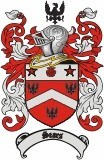
This brass is divided into three columns, with the copies of the memorials on either side. The central column is headed by a coat of arms bearing the mottoes “EXALTAT HUMILES” and “HONOR ET FIDES”. Beneath is repeated the motto “Exaltat humiles” and the following:
Worth is better than wealth, Goodness better than nobility, Excellence better than distinction. To their Pilgrim Fathers, a grateful posterity. The outer columns transcribe the following memorials: Sacred to the Memory of Richard Sears, son of John Bouchier Sears and Marie L. Van Egmont in lineal descent from Richard Sears of Colchester and Ann Bouchier Knyvet, England. he landed at Plymouth in 1630, Married Dorothy Thacher and died in Yarmouth in 1676. Sacred to the Memory of Knyvet Sears eldest son of Richard Sears of Yarmouth, born in 1635, married Elizabeth Dymoke and died in England in 1686. Sacred to the Memory of Paul Sears, second son of Richard Sears born in 1637, married Deborah Willard and died in Yarmouth in 1707. Sacred to the Memory of Sylas Sears, third son of Richard Sears, born in 1639, married and died in Yarmouth in 1697. Sacred to the Memory of Daniel Sears, son of Knyvet Sears of Yarmouth born in 1682, married Sarah Hawes and died in Chatham in 1756. Sacred to the Memory of Daniel Sears II son of Daniel Sears of Chatham born in 1712, married Fear Freeman and died at Chatham in 1761. Sacred to the Memory of David Sears I son of Daniel Sears II of Chatham born in 1752, married Ann Winthrop and died in Boston in 1816. An explanation for this plate is given along the bottom edge: ON GRANITE MONUMENTS IN THE GRAVEYARDS OF YARMOUTH, AND CHATHAM, IN MASSACHUSETTS, NEW ENGLAND, IN NORTH AMERICA, ARE THE ABOVE INSCRIPTIONS TO THE MEMORY OF THE DESCENDANTS OF THE SAYERS OF ALDHAM, AND COLCHESTER. 1830.

Richard Sears
Richard Sears was born in Holland because his father was exiled from England. We know a lot about the life of Richard Sears because of the fine record keeping of Plymouth Colony and the Massechusetts Bay Company. There are many facts recorded:
MIGRATION: 1633FIRST RESIDENCE: PlymouthREMOVES: Marblehead by 1637, Yarmouth by 1639OCCUPATION: Husbandman.FREEMAN: Oath of fidelity at Yarmouth, 1639 [PCR 8:185]. Propounded for freemanship, 3 June 1652 [PCR 3:7]. Admitted a freeman, 7 June 1653 [PCR 3:31]. On the 1658 and 29 May 1670 lists of freemen from Yarmouth [PCR 5:274, 8:200].EDUCATION: His inventory included “1 Great Bible and other books” valued at £1 3s.OFFICES: Deputy (from Yarmouth), 3 June 1662 [PCR 4:14]. Grand jury, 7 June 1652 [PCR 3:9]. Tax collector, 1 March 1658/9 [PCR3:155]. Yarmouth constable, 6 June 1660 [PCR 3:188]. In Yarmouth section of 1643 Plymouth Colony list of men able to bear arms [8:194].ESTATE: Assessed 9s. in Plymouth tax list of 25 March 1633 [PCR 1:11]; omitted from list of 27 March 1634. On 1 January 1637/8 “Richard Seeres” was included in a Salem rate list for the “inhabitants of Marblehead” [STR 1:63]. On 14 November 1638 “Rich[ard] Sears” was granted four acres at Marblehead “where he had planted formerly” [STR 1:74]. On 23 November 1664 “Allis Bradford the widow of William Bradford” sold to “Richard Sares” of Yarmouth, husbandman, two tracts of twenty acres each “at a place commonly called … Sasuet,” one of which had been the lot of William Bradford deceased and the other of which had been the lot of Experience Mitchell [MD 34: 23, citing PCLR 3:18]. In his will, dated 10 May 1667, with a codicil dated 3 February 1675/6, and proved 5 March 1675/6, “Richard Sares of Yarmouth” bequeathed to “Sylas Sares my younger son … all my land, that is all the upland upon the Neck where his house stands in which he now dwells … after mine and my wife’s decease,” provided that “my son-in-law Zachery Paddock” shall have the house where he dwells and two acres within the above tract “during the life of Deborah his now wife”; also to “the said Sylas Sares” a tract of meadow and half of “my land called Robins as is undivided”; to “my elder son Paule Sares all the rest and remains of my lands whatsoever”; to “Dorothy my wife” all lands and goods during her natural life, she to be sole executrix, and “do entreat my brother Thacher with his two sons as friends in trust” as overseers; to “my son-in-law Zachery Paddock” two acres from land called Robins before it is divided between Silas and Paul Sears, and this two acres, along with the two acres mentioned above, to go to Ichabod Paddock, son of Zachary, at the death of Zachary’s wife; witnessed by Anthony Thacher and Anthony Frey; in the codicil, dated 3 February 1675/6, Richard Sears bequeathed to “my eldest son Paul Sares … the house which I now live in” and various moveables; witnessed by John Thacher and Judah Thacher; on 5 March 1675/6 deposed that he and his brother witnessed the codicil, and that when “my uncle signed this appendix,” he asked him [John Thacher] to redraw the will and “to leave out of the new draft the legacy of land that is given to Ichabod Paddock, for saith he I have answered it in another way,” but Thacher never did produce this new draft [PCPR 3:2:53-54]. The inventory of the estate of “Richard Sares,” taken 8 October 1676 and presented at court on 15 November 1676 by “Dorethy Sares the relict of Richard Sares and Paul Sares his eldest son,” was untotalled and included “his house and lands,” valued at £220 [PCPR 3:2:55; PCR 5:213].BIRTH: About 1595 based on age at death.DEATH: Yarmouth 5 September [1676] “age 81y 4m” [YarVR 126].MARRIAGE: By 1637 Dorothy Jones. She was born about 1603, daughter of George and Agnes (_____) Jones of Dinder, Somerset [TAG 58:244-46]. “Cady [i.e., Goody] Seares was buried the 19th of March [16]78[/9]” at Yarmouth [YarVR 125].CHILDREN:
| i PAUL, b. about 1637 (d. Yarmouth 20 February 1707/8 in 70th year [gravestone]); m. by 1659 Deborah (eldest child aged thirteen on 3 July 1672 [YarVR 1], said to be daughter of George Willard. |
| ii DEBORAH, b. about 1639 (d. Yarmouth 17 August 1732 “within about one month of 93 years of age” [YarVR 155]); m. by 1661 Zachariah Paddock (eldest child aged seventeen on 2 February 1678 [YarVR 6]). |
| iii SILAS, b. say 1641; m. by about 1665 Anna, probably daughter of James Bursell of Yarmouth [PCR 5:212]. |
ASSOCIATIONS: Dorothy (Jones) Sears, wife of Richard, was sister of Richard Jones of Dorchester and of Elizabeth (Jones) Thacher, wife of Anthony Thacher of Yarmouth [TAG 58:244-46].COMMENTS: Although the earliest record of Richard Sears in Marblehead is in 1637, he may have moved there as early as 1634, since he is in the 1633 Plymouth tax list, but not in the list of 1634. On 2 October 1650, with a large number of other men, “Richard Seares” brought an action against William Nickerson for slander [PCR 7:50].BIBLIOGRAPHIC NOTE: Various publications of the middle of the nineteenth century set forth an English pedigree for Richard Sears, and partly on the basis of this pedigree assigned to Richard Sears a son Knyvett Sears. In 1886 Samuel Pearce May carefully examined and analyzed this pedigree, and found it to have no merit; he further demonstrated that the proposed son Knyvett did not exist [NEHGR 40:261-68]. Four years later May published a genealogy of the family [The Descendants of Richard Sares (Sears) of Yarmouth, Mass., 1638-1888 (Albany 1890)]. In 1948 Donald Lines Jacobus prepared a brief account of the family of Richard Sears [Brainerd Anc 257-58].
It is possible to see in the above bibliographic note how shaky recorded information can be. We are relying on both the accuracy of the recording agency/person and the lack of any evidence to the contrary. I am always happy that the founding of our nation was a business venture, ad therefore created factual records of various kinds. This is why the ancestry detective has a fun and never ending game of fact finding. The entire study highlights human inaccuracy, and a constant desire to edit/spin history hiding the dark side and featuring the best of the family history. The detective notices bogus sources as well as plain old human ignorance and error. Some of my other ancestors are in the above story as well, so I can double check what I know about them. The jigsaw puzzle of history is so fascinating when it is personal.
Richard Sears (1590 – 1676) We can find his grave:

Richard Sears, 10th Great Grandfather
is my 10th great grandfather
Silas Sears (1638 – 1697)
Son of Richard
Silas Sears (1661 – 1732)
Son of Silas
Sarah Sears (1697 – 1785)
Daughter of Silas
Sarah Hamblin (1721 – 1814)
Daughter of Sarah
Mercy Hazen (1747 – 1819)
Daughter of Sarah
Martha Mead (1784 – 1860)
Daughter of Mercy
Abner Morse (1808 – 1838)
Son of Martha
Daniel Rowland Morse (1838 – 1910)
Son of Abner
Jason A Morse (1862 – 1932)
Son of Daniel Rowland
Ernest Abner Morse (1890 – 1965)
Son of Jason A
Richard Arden Morse (1920 – 2004)
Son of Ernest Abner
Pamela Morse
I am the daughter of Richard Arden
 mermaidcamp