mermaidcamp
Keeping current in wellness, in and out of the water
You can scroll the shelf using ← and → keys
You can scroll the shelf using ← and → keys
Jeremiah Clarke, my 10th great grandfather, nickname Jeremy Clarke, b. 1605 in East Farleigh, Kent, England, d. Jan 1652 in Newport, Newport County, Rhode Island, buried in Newport, Newport County, Rhode Island, resided 1638 in Aquidneck and Portsmouth.

Jeremy Clarke president governor
Newport County, Rhode Island, resided 1640 in Newport, Newport County, Rhode Island, immigrated ABOUT 1637 in (Probably) Rhode Island, event in Member of Lincoln’s Inn ?, military Captain, occupation 1647 – 1649 Treasurer of Rhode Island, occupation 1648 Acting Governor of the colony. From the Plantagenet Ancestry book, it’s not clear whether it was Jeremiah Clarke or Thomas that was a member of Lincoln’s Inn. “Jeremy Clarke, baptised East Farleigh, Kent 1 Dec. 1605, emigrated about 1637, resided Newport, Rhode Island, freeman 16 Mar.1640/1, treasurer of Rhode Island; buried Newport 11 mo., [Jan.] 1651/2;married, in England, about 1637 to Frances (Lathaum) Dungan, baptised at Kepston, Co. Bedford, 15 Feb. 1609/10, died September 1677, buried Newport, widow of Thomas Dungan, Gent., of Lincoln’s Inn, Middlesex, and daughter of Lewis Latham, Gent., Sergeant Falconer to King Charles I, by his wife Elizabeth. She married, third, before 18 Jan. 1656 to Rev. William Vaughan, died on or before 2 Sep 1677.” Arms of Jeremy Clarke: Gold on a bend engrailed azure a cinqfoil of the field. Note: maybe the arms for father William.) East Farleigh has a fine medieval bridge over which General Fairfax marched in 1648 to the Battle of Maidstone. Jeremiah may have died 11 Jan 1651. He married Frances LATHAM, married ABOUT 1637 in England.
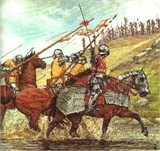
Battle of Blore Heath
My 15th great grandfather was a knight involved with Brit royalty. He lost his life defending it in a battle called Blore Heath. They were fighting about roses (red and white, although I am still not sure what the symbols meant) and the right to the throne. They were royals. They were angry. Things got bloody nasty:
The Battle of Blore Heath
September 23, 1459
After four years of uneasy peace the King presided over a wasting realm. No parliament had been summoned for three years, the country was sadly divided and distressed. The Yorkists were armed, armies were marching across all England. Lord Audley had recently raised a Lancastrian army centered round Market Drayton, and the Queen -through whom the King ruled- sent him orders to intercept Lord Salisbury, who was marching from Yorkshire to join the Duke of York at Ludlow. The two armies met head on two and a half miles east of Market Drayton at a place called Blore Heath. Salisbury, with 3,000 troops, was outnumbered by more than two to one, but could not avoid giving battle.
Audley took up a position just west of a little stream that crossed the Market Drayton-Newcastle-under-Lyme road, and Salisbury’s men were drawn up about 150 yards east of the present Audley Cross, which marks the spot where Lord Audley fell. The Yorkist left rested upon the boggy edge of a wood, but their right was in the air, and Salisbury made a laager of his wagons to protect this flank. Whether Salisbury feigned retreat in order to draw Audley on is not certain, but the Lancastrian commander was definitely the one to attack. Two cavalry charges were repulsed, the first with heavy loss to the Lancastrians, and then they mounted an infantry attack up the hill to the Yorkist position. But this too failed; there was no support from the cavalry, Lord Audley had already fallen and 500 Lancastrians chose this moment to desert to the enemy. Salisbury’s victory was complete and in the pursuit, which continued for two miles, the slaughter was very heavy. Possibly 2,000 Lancastrians perished in this battle, but fewer than 200 Yorkists fell.
For more information on the Battle of Blore Heath, contact Blore Heath 1459 online at http://www.bloreheath.org
YORKISTS LANCASTRIANS
Sir Christopher Conyers of Sokebourne, Durham
Sir Henry Bromflete, Wymington, Bedford
Sir John Conyers of Hornby, Yorkshire
Sir Robert del Booth of Wilmslow, Cheshire (killed in battle)
Sir Walter Devereux of Weobley, Herefordshire (killed in battle)
Sir John Bourchier of West Horsley, Surrey
Sir Richard Grey of Powis, Powis
Sir Hugh Calveley of the Lea, Cheshire (killed in battle)
Sir Richard Hamerton of Hamerton, Yorkshire
Sir William Catesby (Sr.) of Ashby St. Legers, Northamptonshire
Sir Thomas Harrington, Lancashire
Sir John Dawne of Cheshire
Sir Roger Kynaston of Hordley, Shropshire
Sir Jerkin Done of Wickington, Cheshire (killed in battle)
Sir Thomas Lumley of Lumley, Durham
Sir Robert Downes of Shrigley, (killed in battle)
Thomas Meering of Tong
Sir Thomas Dutton of Dutton, Cheshire (killed in battle)
Sir James Metcalfe of Nappa, Yorkshire
Sir John Dwnn of Cheshire, killed in battle
Sir John Middleton of Belsay Castle, Northumberland
Sir John Egerton of Egerton, Cheshire (killed in battle)
Sir Thomas Mountford of Hackforth, Yorkshire
Sir Nicholas of Eyton of Eyton, Shropshire
Sir Richard Neville (Earl of Salisbury) of Middleham, Yorkshire (fled to Calais)
Sir Richard Fitton of Gawsforth, Cheshire
Sir Richard Neville (Earl of Warwick) of Middleham, Yorkshire (fled to Calais)
Thomas Fitton, fate unknown
Sir Thomas Neville of Thornton Bridge, Durham
Sir John Haigh, killed in battle
Sir Robert Ogle of Ogle, Northumberland
Sir Edmund Hampden of Hampden, Buckinghamshire
Sir Thomas Parr of Kendal, Westmoreland
Sir Thomas Hesketh of Rufford, Lancashire
Richard Plantagenet, Duke of York, fled to Ireland
Sir Henry Holland of Darlington, Devon
Sir William Pudsey of Selaby, Durham
Sir John Legh of Booths, Cheshire (killed in battle)
Sir James Strangeways of Whorlton, Yorkshire
Sir Philip Maunsell of Scrurlage, Glamorgan
Sir Walter Strickland of Sizergh, Westmoreland
Sir Richard Molyneux of Sefton, Lancashire (killed in battle)
Sir John Wandesford of Kirklington, Yorkshire
Sir John Neville of Raby, Durham
Sir John Wenlock of Wenlock, Shropshire
Sir Ralph Shirley of Shirley, Sussex
Sir Walter Wrottesley of Wrottesley, Shropshire
Sir John Skidmore of Mochas, Herefordshire
Sir John Stanley of Pipe, Staffordshire
Sir Edmund Sutton of Dudley, Westmoreland
Sir John Sutton of Dudley, Westmoreland
Sir William Troutbeck of Dunham-on-the-Hill, killed in battle
James Touchet (Lord Audley) of Markeaton, Derbyshire (killed in battle)
Sir Hugh Venables of Kinderton (killed in battle)
©The Richard III Foundation, Inc.
Sir Richard Earl Sefton Molyneux (1422 – 1459)
is my 15th great grandfather
Thomas Sir 8th Earl of Sefton Molyneux (1445 – 1483)
Son of Sir Richard Earl Sefton
Lawrence Castellan of Liverpool Mollenaux (1490 – 1550)
Son of Thomas Sir 8th Earl of Sefton
John Mollenax (1542 – 1583)
Son of Lawrence Castellan of Liverpool
Mary Mollenax (1559 – 1575)
Daughter of John
Francis Gabriell Holland (1596 – 1660)
Son of Mary
John Holland (1628 – 1710)
Son of Francis Gabriell
Elizabeth Holland (1652 – 1737)
Daughter of John
Richard Dearden (1645 – 1747)
Son of Elizabeth
George Dearden (1705 – 1749)
Son of Richard
George Darden (1734 – 1807)
Son of George
David Darden (1770 – 1820)
Son of George
Minerva Truly Darden (1806 – )
Daughter of David
Sarah E Hughes (1829 – 1911)
Daughter of Minerva Truly
Lucinda Jane Armer (1847 – 1939)
Daughter of Sarah E
George Harvey Taylor (1884 – 1941)
Son of Lucinda Jane
Ruby Lee Taylor (1922 – 2008)
Daughter of George Harvey
Pamela Morse
I am the daughter of Ruby Lee

Elizabeth Darcy
My 19th great grandmother came from County Meath, Ireland, just like the O’Byrnes of the potato famine on my father’s side. She was a fancy lady with very famous ancestors herself. She was described by an historian as a wise and honorable lady.
Elizabeth Darcy (1331 – 1390)
is my 19th great grandmother
Johanna Hertforth (1345 – 1428)
Daughter of Elizabeth
Ellen Urswick (1364 – 1459)
Daughter of Johanna
Richard Molyneux (1386 – 1460)
Son of Ellen
Sir Richard Earl Sefton Molyneux (1422 – 1459)
Son of Richard
Thomas Sir 8th Earl of Sefton Molyneux (1445 – 1483)
Son of Sir Richard Earl Sefton
Lawrence Castellan of Liverpool Mollenaux (1490 – 1550)
Son of Thomas Sir 8th Earl of Sefton
John Mollenax (1542 – 1583)
Son of Lawrence Castellan of Liverpool
Mary Mollenax (1559 – 1575)
Daughter of John
Francis Gabriell Holland (1596 – 1660)
Son of Mary
John Holland (1628 – 1710)
Son of Francis Gabriell
Elizabeth Holland (1652 – 1737)
Daughter of John
Richard Dearden (1645 – 1747)
Son of Elizabeth
George Dearden (1705 – 1749)
Son of Richard
George Darden (1734 – 1807)
Son of George
David Darden (1770 – 1820)
Son of George
Minerva Truly Darden (1806 – )
Daughter of David
Sarah E Hughes (1829 – 1911)
Daughter of Minerva Truly
Lucinda Jane Armer (1847 – 1939)
Daughter of Sarah E
George Harvey Taylor (1884 – 1941)
Son of Lucinda Jane
Ruby Lee Taylor (1922 – 2008)
Daughter of George Harvey
Pamela Morse
I am the daughter of Ruby Lee
Elizabeth Darcy
Elizabeth Darcy, Countess of Ormond (3 April 1332- 24 March 1390), was the wife of James Butler, 2nd Earl of Ormond, and the mother of his six children, including James Butler, 3rd Earl of Ormond.
Family and lineageElizabeth Darcy was born on 3 April 1332 at Platten, County Meath, Ireland, the daughter of Sir John Darcy, 1st Baron Darcy of Knaith, Justiciar of Ireland, and his second wife Joan de Burgh. Sir John was a veteran of the Battle of Crecy. He held the offices of Constable of Nottingham Castle, Constable of the Tower of London, and Sheriff of Lancashire. From 1341- 1346, he was Chamberlain to King Edward III. Elizabeth had a brother Sir William Darcy, who married Catherine FitzGerald, by whom he had issue. She also had numerous half-siblings from her parents’ previous marriages. Her father’s first wife was Emeline Heron, by whom he had eight children, including his heir, John Darcy, 2nd Baron Darcy of Knaith. Elizabeth’s mother’s first husband had been Thomas FitzGerald, 2nd Earl of Kildare, by whom she had three sons, John FitzGerald, Richard FitzGerald, 3rd Earl of Kildare, and Maurice FitzGerald, 4th Earl of Kildare.Elizabeth’s paternal grandparents were Roger Darcy and Isabel d’Aton. Her maternal grandparents were Richard de Burgh, 2nd Earl of Ulster and Margaret de Burgh, daughter of Sir John de Burgh and Hawise of Lanvaley.One of her maternal aunts was Elizabeth de Burgh, wife of Robert the Bruce.Marriages and childrenOn 15 May 1346 in Ormond, Ireland, when Elizabeth was fourteen, she married her first husband James Butler, 2nd Earl of Ormond (4 October 1331- 18 October 1382), the son of James Butler, 1st Earl of Ormond and Lady Eleanor de Bohun. He was Lord Justice of Ireland in 1359, 1364, and 1376. He was also Constable of Dublin Castle in 1349. He was known as the Noble Earl, however, the Irish called him The Chaste.Upon her marriage to the Earl, Elizabeth assumed the title of Countess of Ormond.James and Elizabeth had six children: 1. Ralph Butler 2. Eleanor Butler (died 1392), married Gerald FitzMaurice FitzGerald, 3rd Earl of Desmond, by whom she had issue, including the 4th and 6th Earls of Desmond. 3. James Butler, 3rd Earl of Ormond (died 6 September 1405), before 17 June 1386, married firstly, Anne Welles, Countess of Ormond, daughter of John Welles, 4th Lord Welles and Maud de Ros, by whom he had issue, including James Butler, 4th Earl of Ormond. He married secondly, Katherine FitzGerald of Desmond, by whom he had further issue. In 1391, he purchased Kilkenny Castle. 4. Thomas Butler 5. Catherine Butler (born 1361), married firstly, Thomas Reade, by whom she had one son, Richard, and secondly, Thomas Fleming of Slane. 6. Joan Butler, married Tiege O’ Carroll
James Butler, 2nd Earl of Ormond, died on 18 October 1382 in Knocktopher and was buried in Gowran Church, Co. Kilkenny. Elizabeth married secondly, Sir Robert de Hereford, Seneschal of the Liberty of Tipperary, between 28 December 1383 and 30 March 1384.
DeathElizabeth Darcy died on 24 March 1390. She was not quite fifty-eight years old.
References 1. ^ Douglas Richardson, Kimball G. Everingham,Magna Carta Ancestry: A Study in Colonial and Medieval Families. p.161 2. ^ Charles Cawley, Medieval Lands, Earls of Ormond * http://www.Tudorplace.com.ar/DARCY.htm * http://www.Tudorplace.com.ar/BUTLER.htm * Charles Cawley, Medieval Lands, Earls of Ormond * Elizabeth Darcy at ThePeerage.com
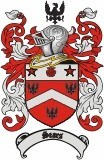
Sears COA
My 11th Great grandfather was so totally kicked out of England:
JOHN BOURCHIER, so named after his father, “he married MARIE L. daughter of PHlLIP VAN EGMONDE, of that city, and acquired with her a large fortune, principally in money. With this he was enabled to purchase property in Essex, adjoining the lands which he hoped soon to recover as his lawful patrimony. Amongst the estates thus bought were Bourchier and Little Fordham Manors, both of which had in former times belonged to his ancestors. But his return to England was resisted by those who were deeply interested in keeping at a distance so formidable a claimant to many of their broad acres. Strenuous and energetic were the efforts JOHN BOURCHIER SEARS made to remove the obstacles which intervened to keep him in exile; but all to no purpose. His opponents were inexorably hostile, and even threatened him with a prosecution, as a participator in the gunpowder plot, if he ventured to set foot in England. The attainder, it must be remembered, which hung over his grandfather, had never been removed, and still impended over the family at the time of his death in 1629.”
He left two sons and two daughter, RICHARD, JOHN, MARIE, and JANE, the three latter settled in Kent; the eldest son
“worn out by his parents’ want of success to recover their English possessions, determined at his father’s death to quit England for ever. He accordingly took passage, with a party of Puritans, for New England in America, and landed at Plymouth in Massachusetts on the 8th of May, 1630. Here he became the founder of a family which has attained wealth and honours in the New World, and died in 1676, leaving behind him three sons, KNYVET, PAUL, and SYLAS. “In the year 1851, a descendant of this family, the Honourable DAVID SEARS, of Boston, visited Colchester in company with a friend, Mr. H. G. SOMERBY, of London, and inspected with much interest the monuments in St. Peter’s Church. With a view to perpetuate the recollection of the ties that attached his family to the town of Colchester, Mr. SEARS caused a brass tablet to be engraved, and obtained the permission of the late Vicar (the Rev. S. CARR), for its erection on the North wall of the Church.”
This brass is divided into three columns, with the copies of the memorials on either side. The central column is headed by a coat of arms bearing the mottoes “EXALTAT HUMILES” and “HONOR ET FIDES”. Beneath is repeated the motto “Exaltat humiles” and the following:
Worth is better than wealth, Goodness better than nobility, Excellence better than distinction. To their Pilgrim Fathers, a grateful posterity. The outer columns transcribe the following memorials: Sacred to the Memory of Richard Sears, son of John Bouchier Sears and Marie L. Van Egmont in lineal descent from Richard Sears of Colchester and Ann Bouchier Knyvet, England. he landed at Plymouth in 1630, Married Dorothy Thacher and died in Yarmouth in 1676. Sacred to the Memory of Knyvet Sears eldest son of Richard Sears of Yarmouth, born in 1635, married Elizabeth Dymoke and died in England in 1686. Sacred to the Memory of Paul Sears, second son of Richard Sears born in 1637, married Deborah Willard and died in Yarmouth in 1707. Sacred to the Memory of Sylas Sears, third son of Richard Sears, born in 1639, married and died in Yarmouth in 1697. Sacred to the Memory of Daniel Sears, son of Knyvet Sears of Yarmouth born in 1682, married Sarah Hawes and died in Chatham in 1756. Sacred to the Memory of Daniel Sears II son of Daniel Sears of Chatham born in 1712, married Fear Freeman and died at Chatham in 1761. Sacred to the Memory of David Sears I son of Daniel Sears II of Chatham born in 1752, married Ann Winthrop and died in Boston in 1816. An explanation for this plate is given along the bottom edge: ON GRANITE MONUMENTS IN THE GRAVEYARDS OF YARMOUTH, AND CHATHAM, IN MASSACHUSETTS, NEW ENGLAND, IN NORTH AMERICA, ARE THE ABOVE INSCRIPTIONS TO THE MEMORY OF THE DESCENDANTS OF THE SAYERS OF ALDHAM, AND COLCHESTER. 1830.

Richard Sears
Richard Sears was born in Holland because his father was exiled from England. We know a lot about the life of Richard Sears because of the fine record keeping of Plymouth Colony and the Massechusetts Bay Company. There are many facts recorded:
MIGRATION: 1633FIRST RESIDENCE: PlymouthREMOVES: Marblehead by 1637, Yarmouth by 1639OCCUPATION: Husbandman.FREEMAN: Oath of fidelity at Yarmouth, 1639 [PCR 8:185]. Propounded for freemanship, 3 June 1652 [PCR 3:7]. Admitted a freeman, 7 June 1653 [PCR 3:31]. On the 1658 and 29 May 1670 lists of freemen from Yarmouth [PCR 5:274, 8:200].EDUCATION: His inventory included “1 Great Bible and other books” valued at £1 3s.OFFICES: Deputy (from Yarmouth), 3 June 1662 [PCR 4:14]. Grand jury, 7 June 1652 [PCR 3:9]. Tax collector, 1 March 1658/9 [PCR3:155]. Yarmouth constable, 6 June 1660 [PCR 3:188]. In Yarmouth section of 1643 Plymouth Colony list of men able to bear arms [8:194].ESTATE: Assessed 9s. in Plymouth tax list of 25 March 1633 [PCR 1:11]; omitted from list of 27 March 1634. On 1 January 1637/8 “Richard Seeres” was included in a Salem rate list for the “inhabitants of Marblehead” [STR 1:63]. On 14 November 1638 “Rich[ard] Sears” was granted four acres at Marblehead “where he had planted formerly” [STR 1:74]. On 23 November 1664 “Allis Bradford the widow of William Bradford” sold to “Richard Sares” of Yarmouth, husbandman, two tracts of twenty acres each “at a place commonly called … Sasuet,” one of which had been the lot of William Bradford deceased and the other of which had been the lot of Experience Mitchell [MD 34: 23, citing PCLR 3:18]. In his will, dated 10 May 1667, with a codicil dated 3 February 1675/6, and proved 5 March 1675/6, “Richard Sares of Yarmouth” bequeathed to “Sylas Sares my younger son … all my land, that is all the upland upon the Neck where his house stands in which he now dwells … after mine and my wife’s decease,” provided that “my son-in-law Zachery Paddock” shall have the house where he dwells and two acres within the above tract “during the life of Deborah his now wife”; also to “the said Sylas Sares” a tract of meadow and half of “my land called Robins as is undivided”; to “my elder son Paule Sares all the rest and remains of my lands whatsoever”; to “Dorothy my wife” all lands and goods during her natural life, she to be sole executrix, and “do entreat my brother Thacher with his two sons as friends in trust” as overseers; to “my son-in-law Zachery Paddock” two acres from land called Robins before it is divided between Silas and Paul Sears, and this two acres, along with the two acres mentioned above, to go to Ichabod Paddock, son of Zachary, at the death of Zachary’s wife; witnessed by Anthony Thacher and Anthony Frey; in the codicil, dated 3 February 1675/6, Richard Sears bequeathed to “my eldest son Paul Sares … the house which I now live in” and various moveables; witnessed by John Thacher and Judah Thacher; on 5 March 1675/6 deposed that he and his brother witnessed the codicil, and that when “my uncle signed this appendix,” he asked him [John Thacher] to redraw the will and “to leave out of the new draft the legacy of land that is given to Ichabod Paddock, for saith he I have answered it in another way,” but Thacher never did produce this new draft [PCPR 3:2:53-54]. The inventory of the estate of “Richard Sares,” taken 8 October 1676 and presented at court on 15 November 1676 by “Dorethy Sares the relict of Richard Sares and Paul Sares his eldest son,” was untotalled and included “his house and lands,” valued at £220 [PCPR 3:2:55; PCR 5:213].BIRTH: About 1595 based on age at death.DEATH: Yarmouth 5 September [1676] “age 81y 4m” [YarVR 126].MARRIAGE: By 1637 Dorothy Jones. She was born about 1603, daughter of George and Agnes (_____) Jones of Dinder, Somerset [TAG 58:244-46]. “Cady [i.e., Goody] Seares was buried the 19th of March [16]78[/9]” at Yarmouth [YarVR 125].CHILDREN:
| i PAUL, b. about 1637 (d. Yarmouth 20 February 1707/8 in 70th year [gravestone]); m. by 1659 Deborah (eldest child aged thirteen on 3 July 1672 [YarVR 1], said to be daughter of George Willard. |
| ii DEBORAH, b. about 1639 (d. Yarmouth 17 August 1732 “within about one month of 93 years of age” [YarVR 155]); m. by 1661 Zachariah Paddock (eldest child aged seventeen on 2 February 1678 [YarVR 6]). |
| iii SILAS, b. say 1641; m. by about 1665 Anna, probably daughter of James Bursell of Yarmouth [PCR 5:212]. |
ASSOCIATIONS: Dorothy (Jones) Sears, wife of Richard, was sister of Richard Jones of Dorchester and of Elizabeth (Jones) Thacher, wife of Anthony Thacher of Yarmouth [TAG 58:244-46].COMMENTS: Although the earliest record of Richard Sears in Marblehead is in 1637, he may have moved there as early as 1634, since he is in the 1633 Plymouth tax list, but not in the list of 1634. On 2 October 1650, with a large number of other men, “Richard Seares” brought an action against William Nickerson for slander [PCR 7:50].BIBLIOGRAPHIC NOTE: Various publications of the middle of the nineteenth century set forth an English pedigree for Richard Sears, and partly on the basis of this pedigree assigned to Richard Sears a son Knyvett Sears. In 1886 Samuel Pearce May carefully examined and analyzed this pedigree, and found it to have no merit; he further demonstrated that the proposed son Knyvett did not exist [NEHGR 40:261-68]. Four years later May published a genealogy of the family [The Descendants of Richard Sares (Sears) of Yarmouth, Mass., 1638-1888 (Albany 1890)]. In 1948 Donald Lines Jacobus prepared a brief account of the family of Richard Sears [Brainerd Anc 257-58].
It is possible to see in the above bibliographic note how shaky recorded information can be. We are relying on both the accuracy of the recording agency/person and the lack of any evidence to the contrary. I am always happy that the founding of our nation was a business venture, ad therefore created factual records of various kinds. This is why the ancestry detective has a fun and never ending game of fact finding. The entire study highlights human inaccuracy, and a constant desire to edit/spin history hiding the dark side and featuring the best of the family history. The detective notices bogus sources as well as plain old human ignorance and error. Some of my other ancestors are in the above story as well, so I can double check what I know about them. The jigsaw puzzle of history is so fascinating when it is personal.
Richard Sears (1590 – 1676) We can find his grave:

Richard Sears, 10th Great Grandfather
is my 10th great grandfather
Silas Sears (1638 – 1697)
Son of Richard
Silas Sears (1661 – 1732)
Son of Silas
Sarah Sears (1697 – 1785)
Daughter of Silas
Sarah Hamblin (1721 – 1814)
Daughter of Sarah
Mercy Hazen (1747 – 1819)
Daughter of Sarah
Martha Mead (1784 – 1860)
Daughter of Mercy
Abner Morse (1808 – 1838)
Son of Martha
Daniel Rowland Morse (1838 – 1910)
Son of Abner
Jason A Morse (1862 – 1932)
Son of Daniel Rowland
Ernest Abner Morse (1890 – 1965)
Son of Jason A
Richard Arden Morse (1920 – 2004)
Son of Ernest Abner
Pamela Morse
I am the daughter of Richard Arden

William and Lucinda Jane
My great grandfather, William Ellison Taylor, was a farmer and a preacher in the Church of Christ in Texas after the Civil War. He had beautiful handwriting which I have in the form of his Confederate pension application. He was shot in the knee at Second Manassas, but still had to get back to Selma, Alabama. He survived to marry Lucinda Jane Armer, who ironically is a descendant of the Plantagenets. They moved to Texas along with Lucinda’s parents after the war.
The place and time Lucinda and William lived was an echo of the dramas of their ancestors who had Bible issues of biblical proportion back in their homeland of England. Lucinda’s family was playing music in the court of Henry VIII when he killed some wives and made himself the head of the new Church of England. Other members of her family were Plantagenets, being royal.
 mermaidcamp