mermaidcamp
Keeping current in wellness, in and out of the water
You can scroll the shelf using ← and → keys
You can scroll the shelf using ← and → keys

Hill coat of arms
My tenth great-grandfather arrived early in Massachusetts, and settled in Malden to be a miller and an inn keeper.
Abraham HILL arrived in Malden, MA in the 1630’s, among the first settlers there. He first received Lot #59, and then bought more land on the south side of Salem St. Later, when some 5 acre lots were divided up, he received 2 1/2 acres.
According to the History of Malden, Robert LONGE, the father of Abraham’s wife, Sarah, was also one of the first in Malden and received 5 acres. Daniel SHEPHERDSON, whose ggranddaughter,Sarah PARKER m. Moses’ grandson, Moses HILL, was also a pioneer in Malden.
Thomas CALL, the other grandfather of Joanna CALL, was a tenant of the SKINNERS. The house stood at the corner of Cross and Walnut Sts.
The only other mention of Abraham in the Malden book is that he was one of nine signers of a petition asking for a four mile square of land called Pennycooke to be an addition to the town.
Abraham Hill, the first American HILL ancestor of this branch of the family, was born in 1615, and was an inhabitant of Charlcstown, Massachusetts, in 1636. He kept a mill for John Coitmore, and was the owner of five lots of land in Charlestown and the neighborhood. He was admitted to the church in 1659, and his wife,’ Sarah Long, daughter of Robert Long, born in England in 1617, was admitted to the church in 1644. Abraham and Sarah (Long) Hill were married in 1639, and had eight children : Ruth, baptized in 1640, married William Augur; Isaac. 1641; Abraham. 164.1: Zachary, whose sketch follows; Sarah, 1647; Sarah, born and died in 1649; Mary, 1052 : Jacob, March, 1656-57. Abraham Hill died February 13, 1669-70, and the inventory of his estate amounted to six hundred and thirty-three pounds.
is my 10th great grandfather
daughter of Abraham Hill
son of Ruth Hill
daughter of Abraham Eager
daughter of Lydia Eager
Joseph Morse III (1752 – 1835)
son of Mary Thomas
John Henry Morse (1775 – 1864)
son of Joseph Morse III
son of John Henry Morse
Daniel Rowland Morse (1838 – 1910)
son of Abner Morse
son of Daniel Rowland Morse
Ernest Abner Morse (1890 – 1965)
son of Jason A Morse
Richard Arden Morse (1920 – 2004)
son of Ernest Abner Morse
I am the daughter of Richard Arden Morse
Last night was the first food and wine tasting presented by Slow Food in Tucson. I would call it a complete success.





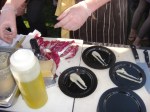

We attended with our friend Sara, who enjoys a tasty bite as much as we do. We arrived early, and set out with a really outstanding Bloody Mary served by Pasco kitchen and lounge. Their urban farm cuisine is totally amazing. We plan to go to brunch there this weekend for more. We tasted our way through the most innovative dishes and drinks put together in one place by the Slow Food people. The live band and the lively crowd of foodists made this a party to treasure in the tastebuds of the mind. I started out to be very precise and document all the flavors and happy moments, and then happiness took over. We ran into old friends and I abandoned the picture taking to just have fun. I am not, gentle reader, a real reporter. I am an enthusiastic and opinionated blogger who loves to taste. I had more wine than beer, but am still of the opinion that the beer is better in Arizona than the wine. The beverages were all worth trying and complimented the food nicely. I came away liking a beer from Dragoon Brewery as my fave new discovery. It is Stronghold Session Ale, with a dark and festive flavor.
The chefs all made amazing bites, and were willing to serve me the plate without meat when it was easy. Chef Ryan Clark, the host chef of the event, served green posole, vegetarian, with the option to add pork. I loved him for that, and think the posole should go on his menu because it is epic. Doug Levy from Feast made mesquite biscuit mini sandwiches that drove me and the whole crowd wild. Everyone was talking about those. He did not mind that we were all snatching more than one. The radishes with mozzarella foam butter from Zona 78 were incredible, as was the grilled radicchio. They brought their farmers with them which was very cute. Acacia served me a plate minus the meat which was fabulous. There was no bad food at all. From my own taste perspective I gave Nancy Taylor, a woman who wrote a book and supports Slow Food with it the best dish award. She served prickly pear. Nopales, prickly pear cactus pads, are delicious, lower the blood sugar of those who eat them, and are virtually free to anyone who wants to go pick cactus. I adore nopales, and have a never ending search for the best recipe featuring them on earth. At the moment Ms Taylor is in first place with her tepary been, chiltepin salad. I will knock this off in my kitchen very soon. The contest will continue, however. Don’t hesitate to contact me, gentle readers, if you have a recipe for nopal. I am open to learning them all.
We discussed our discoveries on the way home in the car. Bob, Sara and all have all discovered new restaurants we want to visit, and been reminded that we are surrounded by talented, caring, creative chefs. This is all very good news.

My 9th great-grandmother was a published poet. She was born in England and died in Massachusetts. Much is known about her because of her famous father and husband, but for a Pilgrim she was a feminist. Her poems were about cosmology and the elements. She was an intellectual in her own right. This is a good account from http://www.famouspoetsandpoems.com:
Anne Bradstreet
Anne Bradstreet was born in 1612 to a nonconformist former soldier of Queen Elizabeth, Thomas Dudley, who managed the affairs of the Earl of Lincoln. In 1630 he sailed with his family for America with the Massachusetts Bay Company. Also sailing was his associate and son-in-law, Simon Bradstreet. At 25, he had married Anne Dudley, 16, his childhood sweetheart. Anne had been well tutored in literature and history in Greek, Latin, French, Hebrew, as well as English.The voyage on the “Arbella” with John Winthrop took three months and was quite difficult, with several people dying from the experience. Life was rough and cold, quite a change from the beautiful estate with its well-stocked library where Anne spent many hours. As Anne tells her children in her memoirs, “I found a new world and new manners at which my heart rose [up in protest.]”a. However, she did decide to join the church at Boston. As White writes, “instead of looking outward and writing her observations on this unfamiliar scene with its rough and fearsome aspects, she let her homesick imagination turn inward, marshalled the images from her store of learning and dressed them in careful homespun garments.”Historically, Anne’s identity is primarily linked to her prominent father and husband, both governors of Massachusetts who left portraits and numerous records. Though she appreciated their love and protection, “any woman who sought to use her wit, charm, or intelligence in the community at large found herself ridiculed, banished, or executed by the Colony’s powerful group of male leaders.”Her domain was to be domestic, separated from the linked affairs of church and state, even “deriving her ideas of God from the contemplations of her husband’s excellencies,” according to one document.This situation was surely made painfully clear to her in the fate of her friend Anne Hutchinson, also intelligent, educated, of a prosperous family and deeply religious. The mother of 14 children and a dynamic speaker, Hutchinson held prayer meetings where women debated religious and ethical ideas. Her belief that the Holy Spirit dwells within a justified person and so is not based on the good works necessary for admission to the church was considered heretical; she was labelled a Jezebel and banished, eventually slain in an Indian attack in New York. No wonder Bradstreet was not anxious to publish her poetry and especially kept her more personal works private.Bradstreet wrote epitaphs for both her mother and father which not only show her love for them but shows them as models of male and female behavior in the Puritan culture.An Epitaph on my dear and ever honoured mother, Mrs. Dorothy Dudley, Who deceased December 27, 1643, and of her age, 61Here lies/ A worthy matron of unspotted life,/ A loving mother and obedient wife,/ A friendly neighbor, pitiful to poor,/ Whom oft she fed, and clothed with her store;/ To servants wisely aweful, but yet kind,/ And as they did, so they reward did find:/ A true instructor of her family,/ The which she ordered with dexterity,/ The public meetings ever did frequent,/ And in her closest constant hours she spent;/ Religious in all her words and ways,/ Preparing still for death, till end of days:/ Of all her children, children lived to see,/ Then dying, left a blessed memory.Compare this with the epitaph she wrote for her father:Within this tomb a patriot lies/ That was both pious, just and wise,/ To truth a shield, to right a wall,/ To sectaries a whip and maul,/ A magazine of history,/ A prizer of good company/ In manners pleasant and severe/ The good him loved, the bad did fear,/ And when his time with years was spent/ In some rejoiced, more did lament./ 1653, age 77There is little evidence about Anne’s life in Massachusetts beyond that given in her poetry–no portrait, no grave marker (though there is a house in Ipswich, MA). She and her family moved several times, always to more remote frontier areas where Simon could accumulate more property and political power. They would have been quite vulnerable to Indian attack there; families of powerful Puritans were often singled out for kidnapping and ransom. Her poems tell us that she loved her husband deeply and missed him greatly when he left frequently on colony business to England and other settlements (he was a competent administrator and eventually governor). However, her feelings about him, as well as about her Puritan faith and her position as a woman in the Puritan community, seem complex and perhaps mixed. They had 8 children within about 10 years, all of whom survived childhood. She was frequently ill and anticipated dying, especially in childbirth, but she lived to be 60 years old.Anne seems to have written poetry primarily for herself, her family, and her friends, many of whom were very well educated. Her early, more imitative poetry, taken to England by her brother-in-law (possibly without her permission), appeared as The Tenth Muse Lately Sprung Up in America in 1650 when she was 38 and sold well in England. Her later works, not published in her lifetime although shared with friends and family, were more private and personal–and far more original– than those published in The Tenth Muse. Her love poetry, of course, falls in this group which in style and subject matter was unique for her time, strikingly different from the poetry written by male contemporaries, even those in Massachusetts such as Edward Taylor and Michael Wigglesworth.Although she may have seemed to some a strange aberration of womanhood at the time, she evidently took herself very seriously as an intellectual and a poet. She read widely in history, science, and literature, especially the works of Guillame du Bartas, studying her craft and gradually developing a confident poetic voice. Her “apologies” were very likely more a ironic than sincere, responding to those Puritans who felt women should be silent, modest, living in the private rather than the public sphere. She could be humorous with her “feminist” views, as in a poem on Queen Elizabeth I:Now say, have women worth, or have they noneOr had they some, but with our Queen is’t gone?Nay, masculines, you have taxed us long;But she, though dead, will vindicate our wrong.Let such as say our sex is void of reason,Know ’tis a slander now, but once was treason.One must remember that she was a Puritan, although she often doubted, questioning the power of the male hierarchy, even questioning God (or the harsh Puritan concept of a judgmental God). Her love of nature and the physical world, as well as the spiritual, often caused creative conflict in her poetry. Though she finds great hope in the future promises of religion, she also finds great pleasures in the realities of the present, especially of her family, her home and nature (though she realized that perhaps she should not, according to the Puritan perspective).Although few other American women were to publish poetry for the next 200 years, her poetry was generally ignored until “rediscovered” by feminists in the 20th century. These critics have found many significant artistic qualities in her work.
Anne Dudley (1612 – 1672)
is my 9th great grandmother
John Bradstreet (1652 – 1718)
son of Anne Dudley
Mercy Bradstreet (1689 – 1725)
daughter of John Bradstreet
Caleb Hazen (1720 – 1777)
son of Mercy Bradstreet
Mercy Hazen (1747 – 1819)
daughter of Caleb Hazen
Martha Mead (1784 – 1860)
daughter of Mercy Hazen
Abner Morse (1808 – 1838)
son of Martha Mead
Daniel Rowland Morse (1838 – 1910)
son of Abner Morse
Jason A Morse (1862 – 1932)
son of Daniel Rowland Morse
Ernest Abner Morse (1890 – 1965)
son of Jason A Morse
Richard Arden Morse (1920 – 2004)
son of Ernest Abner Morse
Pamela Morse
I am the daughter of Richard Arden Morse
Here is an example her work:
Part of the poem “Contemplations” said to be the finest of Anne Dudley Bradstreet’s poems:
“Sometimes now past in the autumnal tide,
When Phoebus wanted but hour to bed,
The trees all richly clad, yet void of pride,
Were gilded O’er by his rich golden head.
Their leaves and fruits seemed painted, but was true
of green, of red, of yellow, mixed hue,
Rapt were my senses at this delectable view
I wist not what to wish, yet sure, thought I
If so much excellence abide below,
How excellent is He that dwells on high,
Whose power and beauty by His works we know,
Sure He is goodness, wisdom, glory, light,
That hath this underworld so rightly sight,
More Heaven than Earth was her, no winter & no night.”
Today (April 16) in 1881 In Dodge City, Kansas, Bat Masterson fights his last gun battle. He is fined $8:00.
Guns and power are the entire subject of the cowboy and Indian movie genre. In my youth the entertainment was all about John Wayne and his ilk being in WWII with explosives, guns, and drama, or being in the Wild Wild West with the same scenario. My dad grew up in rural Kansas and Oklahoma, where guns were used for hunting, but he did not hunt because he had poor eyesight. He developed a love for fishing, which did not require keen sight. I personally learned to shoot a rifle when I was about 4 and my parents left me for a stay in Arkansas at my grandparents’ farm. I remember being very fond of it and liking it when my grandpa called me Annie Oakley. I thought target pracice was romantic and cool.
There were no guns in my house, so after my early youth I rarely saw anyone use guns anywhere. The first night I slept in Caracas when I was 13 I saw a murder from my hotel room on about the 10th floor of the Tamanaco. I freaked out entirely because there was lots of blood on the white shirt of the victim. The following day we learned that two hotel guards had shot each other, and that was the whole thing. Armed guards patrolled the petroleum company compound where I lived in rural Venezuela, which kind of resembled a military base. I thought nothing of it. Although I lived in Texas during high school, I still knew nobody who owned or shot guns.
The gun violence debate in the country is alien to my thinking. I am not comforted by the presence of guns. I don’t care to own or shoot one. The citizens who feel so strongly one way or the other about guns are starting to go haywire. The debate itself is getting scary.







Taste with your eyes, smell with your feet.
Take in the story with all our might
While there is color, while there is light.
Dreamtime reorders sensuality
In living color.



My favorite flower essence is made from the honeysuckle flower. As children this flower may have been part of our regular enchantment with nature. Most of us were taught how to pull the stamen down and suck the nectar out of the flower for fun and some insect style nutrition. I have two large plants that supply fragrance like crazy. I make and drink fresh essence from the flowers in mass qualities. It tastes like it smells, and the emotional remedy it supplies is deep release from past experiences. It is both edible and drinkable. It has been used for centuries medicinally. You can’t go wrong with honeysuckle, even if you just sit next to it an breathe. It is a happiness plant. The flowers start white and turn yellow as they age.


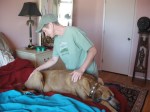
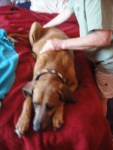





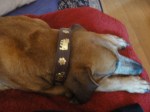





Meesie elected to take her treatment on the big parents’ bed, jumping right up. I left them alone for almost an hour before I checked in and took these pictures. This red bone coon hound was in heaven. She held on to a very snappy happy mood, although she did take an epic nap right after her massage. Her movement seems a little easier today. She is a loyal client, even if she does not get a big spa allowance. I am sure she will have a chance to do this again. It is healthy for her body, and she obviously loves the experience. Compared to a vet visit, which she does not enjoy at all, this is a very reasonable expense.

Coat of Arms
Although I love this family from Ireland, alas, Roger has helped me see that the last reliable information in this tree belongs to Mary Wright of Somerset, PA, so this is NOT my ancestor. I am leaving the post for those seeking John and what I have found about him..but I have to kiss him goodbye.
John McGalliard was a teacher who was trained as a minister in Ireland. He settled in New Jersey about 1750, and survived for 17 years in the new world. His son was a tailor who took off for Ohio and became a postmaster. Ohio was extreme wilderness at the time. These Irish came to America long before the potato famine to seek a new adventure in New Jersey. What inspired them we will never know.
John, Sr. McGalliard (1710 – 1767)
High finance is very easy to understand. The fact that everyone avoids understanding it makes it very easy to take advantage of the financial ignorance of the population. Bernie Maddoff you do not have to be, in order to screw your neighbor and your society out of maximum profit. Buy/borrow/die is all one has to do to benefit from the magic vanishing value of the currency everyone uses. Taxation avoidance, both legal and shady, is the province of those who already have their money in hand. Taxation without even a shabby lobbyist for representation is the fate of those who must claim earned income from jobs.
A carry trade is a calculated risk. The problem is that now the general public does not seem to know how to calculate risk, also known as random acts of unexpected circumstances. We hear the words risk-reward and carry trade, but think this is something that has nothing to do with us and our finances. This banker jargon is for people who wheel and deal, not for borrowers who pay interest on almost everything they buy during their lives. While occupying Wall Street may be symbolic, society would benefit by knowing how Wall Street profits while the population withers financially. If you carry credit card debt while your banker is free to gamble/borrow/invest in carry trades, you will come out as the big looser.
Do you ever wonder why carrying debt at a high interest rate all the time seems natural and unavoidable? Do you simply accept the idea that everything you buy is charged to the future, when presumably it will be so much easier to pay?
The Federal Reserve has become the banker of bankers. Now it is possible to predict with some certainty that interest rates will be kept at nothing for a long time. The certainty itself reduces risk for anyone who wants to gamble with money. Knowing how this will effect your own personal finances may be the single most valuable concept you have learned since you learned to count.
Zappos core value number six describes the goal of the communication systems. Any company has to be specific and mindful about communications within the company and with customers. Zappos takes this seriously. The open office design and the systems of training and benefits are conducive to better than average communication. Since the workers are encouraged to express their personalities in decor and office fashion, at least some nonverbal design language is included in the conversation.
If all companies bothered to find out if they really communicate what they think they are saying I believe huge leaps of employee satisfaction could result. Statistics show that most employees in the US are disengaged. What the disengagement does is psychically disconnect the employee from the mission of the company. Doing time in such an environment resembles jail more than it does a place of productive creativity. If the management has no clue about the reality of the workers, all possible loopholes will be used to avoid helping the company. For the purpose of oversight as well as for the purpose of clear discussion management today needs to interact rather than hand down dictums. Employees who feel at all unhappy with their work life will take it all out on your customer.






The fun starts at the front door at Zappquarters in Henderson, NV. Ties are cut and placed on the trophy board. The best communication device I noticed was the way they used your toilet time to make you look at the wellness information. Trapped in the stall you are educated about the opportunities to improve your overall health in the company wellness program. This is a fabulous message and delivery method. The Zappsters do not miss any opportunity to deliver that happy message honestly and clearly.
 mermaidcamp