mermaidcamp
Keeping current in wellness, in and out of the water
You can scroll the shelf using ← and → keys
You can scroll the shelf using ← and → keys
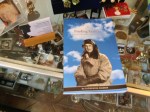
My neighbor, Cathy Harris, has written a fascinating book based on her uncle’s true experiences in as a pilot for the RAF in World War II. I interviewed her today in her shop about the new book, Finding Frances, Love Letters from a Flight Lieutenant. The way she has presented the book gives the reader a really good feel for his life and times. The letters are both historic and emotional because he tells what is happening in the war and pledges his love for Frances. The authentic snippets of his handwriting are a wonderful touch. I study family history so I am extra impressed with all the original documentation she has to show the reader. I was instantly in love with Eric as soon as I saw his pictures. I am sure with his accent and special British slang he must have been very exciting for a high school girl in Phoenix in the 1940s. I am glad she decided to put it all into book form to give us a glimpse into this dramatic part of our history in a personal, first hand account.


Netherlands
Mary Priest was born in the Netherlands. Her father Degory was a hatter who sailed to America on the Mayflower, and died in Plymouth Colony shortly after his arrival. His wife and children, including Mary, came later to Plymouth to inherit his allotment:
DEGORY PRIEST
ORIGIN: Leiden, Holland
MIGRATION: 1620 on Mayflower
FIRST RESIDENCE: Plymouth
OCCUPATION: Hatter (when admitted as a citizen of Leiden) [Leiden 216].
ESTATE: In the 1623 Plymouth land division “Cudbart Cudbartsone” received six acres as a passenger on the Anne in 1623 [ PCR 12:6]; four of these six shares would be for the deceased Degory Priest, his widow Sarah and his two daughters. In the 1627 Plymouth cattle division “Marra Priest” and “Sarah Priest” were the tenth and eleventh persons in the second company, just after their mother and stepfather [PCR 12:9].
BIRTH: About 1579 (aged about forty in 1619 [ Dexter 630]).
DEATH: Plymouth 1 January 1620/1 [ Prince 287].
MARRIAGE: Leiden 4 November 1611 [NS] “Sara Vincent, widow of Jan Vincent” [ MD 7:129-30; Leiden 216]; Priest is said to be of London. She was sister of ISAAC ALLERTON and married (3) Leiden November 1621 (betrothed 25 October 1621 [NS]) GODBERT GODBERTSON [Leiden 101].
CHILDREN:
i MARY, b. say 1612; m. by about 1630 PHINEAS PRATT.
ii SARAH, b. say 1614; m. by about 1632 JOHN COOMBS.
COMMENTS: Bradford includes “Digory Priest” in his list of those on the Mayflower, and in his accounting of 1651 says that Priest “died soon after … arrival in the general sickness,” but “had his wife and children sent hither afterwards, she being Mr. Allerton’s sister” [ Bradford 443, 447].
In 1957 John G. Hunt published the 1582 baptism for a “Digorius Prust” in Hartland, Devonshire [ NEHGR 111:320]; although there is nothing to connect this with Degory Priest of London, Leiden and Plymouth, it is a useful clue.
BIBLIOGRAPHIC NOTE: Degory Priest and his descendants have been given full and definitive treatment in the eighth volume of the Five Generations project of the General Society of Mayflower Descendants, compiled by Mrs. Charles Delmar Townsend, Robert S. Wakefield and Margaret Harris Stover, and edited by Robert S. Wakefield (Plymouth 1994). The Great Migration Begins
Sketches
PRESERVED PURITAN View Full Context

Mayflower increase
Mary Priest (1613 – 1689)
is my 12th great grandmother
Daniel Pratt (1640 – 1680)
son of Mary Priest
Henry Pratt (1658 – 1745)
son of Daniel Pratt
Esther Pratt (1680 – 1740)
daughter of Henry Pratt
Deborah Baynard (1720 – 1791)
daughter of Esther Pratt
Mary Horney (1741 – 1775)
daughter of Deborah Baynard
Esther Harris (1764 – 1838)
daughter of Mary Horney
John H Wright (1803 – 1850)
son of Esther Harris
Mary Wright (1816 – 1873)
daughter of John H Wright
Emiline P Nicholls (1837 – )
daughter of Mary Wright
Harriet Peterson (1856 – 1933)
daughter of Emiline P Nicholls
Sarah Helena Byrne (1878 – 1962)
daughter of Harriet Peterson
Olga Fern Scott (1897 – 1968)
daughter of Sarah Helena Byrne
Richard Arden Morse (1920 – 2004)
son of Olga Fern Scott
Pamela Morse
I am the daughter of Richard Arden Morse
She married Phineas Pratt, a joiner, who was part of a group that got into trouble with both Pilgrims and Natives:
Phineas Pratt was a member of a company of men sent from England by Thomas Weston. They arrived in New England in 1622 on three ships : the Sparrow, Charity and Swan (Pratt was a passenger on the Sparrow, the first to arrive). The approximately 67 men, many of them ailing, arrived with no provisions. The Pilgrims supported them throughout the summer of 1622.
In the fall of 1622, the Weston men left to colonize an area north of Plymouth called Wessagusset. They soon fell into difficulties through behaving, generally, in a very foolish and improvident fashion. They also severely angered the local Native Americans by stealing their corn.
Massasoit, sachem of the Wampanoags, informed the Plymouth colonists that there was a conspiracy among the Natives of the Wessagusset area to massacre the Weston men. Myles Standish prepared to head north with a small company of Plymouth men to rescue Weston’s men.
The same message was also delivered by one of Weston’s men, who came to Plymouth in March of 1623 “from the Massachusetts with a small pack at his back.”
Phineas Pratt was the man with the backpack. He had secretly snuck out of the Wessagusset settlement, traveling for several days without food through a snowy landscape on his 25-mile journey.
Myles Standish and a small contingent (minus Phineas, who was still recovering from his arduous journey) headed to Wessagusset to recognize Weston’s men. The Plymouth contingent killed several Native Americans in the process (for which, they were roundly scolded by their pastor, John Robinson). Soon afterwards, Weston’s group abandoned Wessagusset. Sometime in late 1623, Phineas joined the Plymouth settlement.
Sometime before May of 1648, when he purchased a house and garden in Charlestown (now a part of Boston), Pratt left Plymouth. In 1662, Pratt presented to the General Court of Massachusetts a narrative entitled “A declaration of the affairs of the English people that first inhabited New England” to support his request for financial assistance. The extraordinary document is Phineas Pratt’s own account of the Wessagusset settlement and its downfall.
Phineas Pratt was by profession a “joiner.” “Joining” was the principle method of furniture construction during the 17th century. “Joiners” were highly skilled craftsmen who specialized in this work; their skills were valued more highly than those of a carpenter.
Phineas Pratt married Mary Priest, daughter of Degory and Sarah Allerton Vincent Priest (the sister of Mayflower passenger Isaac Allerton, Sarah had been married to Jan Vincent and widowed before she married Degory Priest). Degory Priest journeyed to Plymouth on the Mayflower, his wife and two daughters intended to join him later. Priest died during the first winter. Before sailing for America, the widowed Sarah Allerton Vincent Priest married Godbert Godbertson, who became Mary Priest’s stepfather. The family (mother, stepfather and two daughters) were among the passengers of the Anne and Little James, arriving in Plymouth in 1623.
Phineas was probably born about 1593, Mary was probably born about 1612. It seems likely, given the probably age of their oldest child at the time of her death, that they married about 1631 or 1632. Phineas and Mary Pratt had 8 children.
According to his gravestone in the old Phipps Street Cemetery, in the Charlestown area of Boston, “Phinehas Pratt, agd about 90 yrs, decd April ye 19, 1680 & was one of ye first English inhabitants of ye Massachusetts Colony.” (Mayflower Descendant, Vol. 6, p. 1-2).

Priest and Pratt

Thomas French
My 11th great-grandfather came to America in 1632 with his sister. He was a taylor by trade. He lived in Ipswich, MA, where he served in the Pequod War.
Thomas French (1584 – 1639)
is my 11th great grandfather
Alice French (1610 – 1666)
daughter of Thomas French
Thomas Howlett (1638 – 1667)
son of Alice French
Mary HOWLETT (1664 – 1727)
daughter of Thomas Howlett
John Hazen (1687 – 1772)
son of Mary HOWLETT
Caleb Hazen (1720 – 1777)
son of John Hazen
Mercy Hazen (1747 – 1819)
daughter of Caleb Hazen
Martha Mead (1784 – 1860)
daughter of Mercy Hazen
Abner Morse (1808 – 1838)
son of Martha Mead
Daniel Rowland Morse (1838 – 1910)
son of Abner Morse
Jason A Morse (1862 – 1932)
son of Daniel Rowland Morse
Ernest Abner Morse (1890 – 1965)
son of Jason A Morse
Richard Arden Morse (1920 – 2004)
son of Ernest Abner Morse
Pamela Morse
I am the daughter of Richard Arden Morse
ORIGIN: Assington, Suffolk
MIGRATION: 1632
FIRST RESIDENCE: Boston
REMOVES: Ipswich 1635
OCCUPATION: Tailor. John Stratton writes from Boston under date of 17 March 1633/4: “I have put my sister a suit of mohair to making at Goodman French’s. She were best get the tailor to take her measure and send per Jno. Gallop” [WP 3:157]. Thomas French’s inventory included eleven yards of homemade cloth.
CHURCH MEMBERSHIP: Admitted to Boston church as member #128, which would be no later than mid-1632 [BChR 14]; on 27 January 1638/9 “our brother Thomas French was with the consent of the congregation dismissed to the church of Ipswich” [BChR 22].
FREEMAN: 6 November 1632 [MBCR 1:367].
EDUCATION: He signed his will.
OFFICES: Essex grand jury, 28 September 1652 [EQC 1:260]. Petit jury, 30 September 1651, 31 March 1657, 28 September 1658, 29 March 1659, 27 March 1660, 25 March 1662, 27 September 1664, 26 September 1665, 28 September 1669, 24 September 1672, 31 March 1674, 30 March 1675, 24 September 1678 [EQC 1:232, 2:11, 111, 138, 195, 347, 3:182, 270, 4:175, 5:79, 269, 6:1, 7:82]. Coroner’s jury on the body of Samuel Adams, Jr., 30 September 1676 [EQC 6:234].
Had service in the Pequod War. Proposed for Lieutenant, 25 March 1639 (but apparently not confirmed; in a letter of that date Daniel Dennison writes to John Winthrop “Our company wanting some officers, have according to their liberty, made choice of some, whom they desired me to propound to the Court or Council. They were willing to express their love and liking to Sergeant French and Sergeant Howlett proposing the former for Lieutenant, the other for Ensign” [WP 4:106]). On 18 May 1664 “Sergt. Thomas French deposed that being ordered by Major Genll. Denison to carry two soldiers who were stubborn off the field to prison, he went to them and persuaded them to submit themselves, promising to mediate for them” [EQC 3:140]. Appointed ensign at Ipswich 18 May 1664 [MBCR 4:2:106].
ESTATE: At a selectman’s meeting 31 January 1660[/1] eight men, including Thomas French, were granted liberty to “clear and break up a parcel of land at Scott’s hill to have two acres each for six years upon condition that they sow four bushels of good hay seed on every acre, to keep up the fence a year so that the English grass should get head, the hay seed to be sown with the last crop” [EQC 3:271].
In his will, dated 3 August 1680 and proved 28 September 1680, “Thomas French Senior of Ipswich … being weak of body” bequeathed to “Mary my beloved wife the bed whereon I used to lie, with all the appurtenances and furniture belonging thereto”; to “my son Thomas French” clothing; to “my son John French” one cow “to make up the full sum of £30 which I formerly promised him for his portion”; to “my daughter Mary Smith” one cow; to “my son Samuel French” a bed and bedding; “my sons Thomas and Samuel French” in consideration of £20 paid to “my son Ephraim French” as the remaining part of his portion, “my two sons Thomas and Samuel” shall receive the Pequod lands and division lot of marsh to be equally divided betwixt them; to “my son Thomas French” my dwelling house and homestead, also my lot in Labour-in-vain fields of twelve acres, also the rest of my cattle, stock, and moveable goods; to “my son Samuel” two acres of upland and two acres of meadow at Reedy marsh; “my son Thomas French” to give free liberty to “Mary my wife his mother” to dwell in the said house and to make use of any room or rooms thereof for her convenient accommodation … likewise … any such moveables as I do now leave in the hands of my son Thomas”; after her [Mary’s] decease, “my son Thomas” shall deliver to “my three children John, Samuel and Mary” three of the biggest pewter dishes; “my two sons Thomas and Samuel” to provide for “their mother’s” comfortable maintenance, and if she is not satisfied, they to allow her £9 paid by Thomas and 20s. paid by Samuel annually; and if she suffers sickness and the aforesaid £10 does not suffice, “my two sons Thomas and Samuel” shall supply her with necessaries and my lot in Labour-in-vain fields and two acres of meadow at Reedy Marsh shall stand bound respectively to my said wife during her natural life as security for the true performance of this my will as respecting her maintenance by my two sons; “my son Thomas French” sole executor [EPR 3:379-81].
The inventory of Ensign Thomas French was taken 25 August 1680 and totalled £217 15s. 6d. including £150 in real estate: “his dwelling house & barn & homestead with the privilege belonging,” £70; “twelve acres of land at Labor in vain,” £60; “two acres of land by Scotes Lane,” £10; and “two acres of marsh in the common field,” £10 [EPR 3:380-81].
BIRTH: Baptized Assington, Suffolk, 27 November 1608, son of Thomas and Susan (Riddlesdale) French [Dudley Wildes Anc 64].
DEATH: Ipswich 8 August 1680.
MARRIAGE: By 1632 Mary _____; she died at Ipswich 6 May 1681.
CHILDREN:
i MARY, bp. Boston 23 September 1632 [BChR 278 (corrected from 1631)]; d. soon.
ii MARY, bp. Boston 2 March 1633/4 [BChR 278]; m. by 1657 Robert Smith (called Mary Smith in father’s will) [Amos Towne Anc 25-27].
iii JOHN, b. about 1635 (deposed aged “about forty-eight” about March 1682 [EQC 8:329] unless this is someone else); m. by 1657 Phebe Keyes (son Thomas born Ipswich 25 May 1657), daughter of ROBERT KEYES.
iv THOMAS, b. about 1636 (deposed aged 22 in 1656 [EQC 2:140], deposed aged “about forty-seven” in March 1683 [EQC 9:16], deposed aged “about forty-eight” about March 1684 [EQC 9:191]); m. Ipswich 29 February 1659/60 Mary Adams.
v SARAH, b. say 1638; on 30 September 1656 “Hackaliah Bridges, accused by Sarah French of his getting her with child, and bound over, being brought by Sergeant French, was discharged” [EQC 2:2]; if she was a daughter of Thomas French, she had apparently died without issue prior to 1680, as she is not named in his will.
vi SAMUEL, b. say 1641; convicted for fornication, 26 March 1667 [EQC 3:398]; d. Ipswich in 1688 (day and month not stated in town vital records), apparently unmarried.
vii EPHRAIM, b. about 1643 (deposed in 1658 aged 15 [EQC 2:139]); d. Enfield, Massachusetts (now Connecticut), in September 1716, unmarried [Amos Towne Anc 50].
ASSOCIATIONS: Thomas French and his sister Alice had arrived in New England by 1632, and their two next younger sisters, Dorcas and Susan, came in 1633. Their parents and younger siblings sailed for New England after 1633, and are not included in this phase of the study. [See Parker-Ruggles 412-29, Dudley Wildes Anc 63-64 and NEHGR 142:250-52, 143:213-20, 363-64 for the ancestry of this group of French siblings.] Alice married THOMAS HOWLETT and Dorcas married first CHRISTOPHER PEAKE and then GRIFFIN CRAFTS (sketches for these families will be found elsewhere in this work). Susan may have been a servant in the household of John Winthrop Jr. for a time, but otherwise left no record in New England.
In a letter dated Groton 14 March 1632/3 John Bluett asked John Winthrop Jr. to remember him to “my schollers Thomas French and John Clarke” [WP 3:108].
COMMENTS: With most of the adult male population of Ipswich, Thomas French signed the petition to keep Mr. John Winthrop Jr. in town, 21 June 1637 [WP 3:433].
Ensign Thomas French and Thomas French Jr. were sureties on the bond of Samuel French when young Samuel was charged with a misdemeanor with Lydia Browne, at court 26 March 1667 [EQC 3:398].
The Great Migration Begins
Sketches
PRESERVED PURITAN

coat of arms
My 9th great grandfather was born in Barnstable in 1648, the son of English immigrants. He fought in King Philip’s was against my Wampanoag ancestors. His parents were Pilgrims who settled in Barnstable. His father left England alone to come to America because of religious problems. He sent for his family to join him after arrival.
Eleazer Hamblen (1648 – 1698)
is my 9th great grandfather
Isaac Hamblin (1676 – 1710)
son of Eleazer Hamblen
Eleazer Hamblin (1699 – 1771)
son of Isaac Hamblin
Sarah Hamblin (1721 – 1814)
daughter of Eleazer Hamblin
Mercy Hazen (1747 – 1819)
daughter of Sarah Hamblin
Martha Mead (1784 – 1860)
daughter of Mercy Hazen
Abner Morse (1808 – 1838)
son of Martha Mead
Daniel Rowland Morse (1838 – 1910)
son of Abner Morse
Jason A Morse (1862 – 1932)
son of Daniel Rowland Morse
Ernest Abner Morse (1890 – 1965)
son of Jason A Morse
Richard Arden Morse (1920 – 2004)
son of Ernest Abner Morse
Pamela Morse
I am the daughter of Richard Arden Morse
Page 526 – Eleazer Hamblin, son of James, was a soldier in Capt. John Gorham’s company in King Philip’s war, and an original proprietor of the town of Gorham, in Maine. I have not carefully examined his record, and know but little of his history. His wife was an early member of the church, and he joined in 1686. I think he resided at Hamblen’s Plain. The Eleazer Hamblins patronized the lawyers more than all others of the name ; but I may be
GENEALOGICAL NOTES OP BAKNSTABLE FAMILIES. 527
doing injustice in making the remark in connection with the elder
Eleazer.
He married 15 Oct. 1675, Mehitabel, daughter of John Jenkins,
and had six children born in Barnstable :
The two last probably died young aud therefore their names do
not appear on the town record.
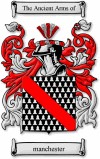
Manchester coat of arms
My 8th great grandfather was part of an unusual settlement in New Haven, Connecticut. He probably arrived in 1638 with a group of Puritans from England:
On April 24, 1638, a company of five-hundred English Puritans led by the Reverend John Davenport and Theophilus Eaton, a wealthy London merchant, sailed into the harbor. They soon discovered that the Quinnipiacks and other local tribes were much distressed by raiding bands of Pequots and Mohawks from surrounding areas. It was for this reason that Momauguin, the sachem of the Quinnipiacks, and other tribe members agreed to sell the tribe’s land to the Puritans. In return, the settlers pledged to protect the natives and to allow them the use of the lands on the east side of the harborNew Haven’s founders not only hoped to create a Christian utopia, they also saw in New Haven’s spacious harbor an opportunity to establish a commercial empire that would control Long Island Sound and possibly the coastline as far south as Delaware Bay. By 1640 a complete government had been established and the settlement, originally called Quinnipiac, was renamed Newhaven. The town plan was based on a grid of nine squares. In accordance with old English custom, the central square, now the Green, was designated a public common. By 1641 New Haven had grown into a community of approximately 800.
Over the next few years, however, the flow of newcomers began to weaken and trade with the outside world shifted more and more to Boston. In an attempt to establish direct trade with England, the settlers managed to assemble enough produce to fill a vessel which would become known as the “Great Shippe.” However, after setting sail in January, 1646, the ship and its crew were never heard from again. This disaster ended the dream of creating an economic empire and over the years New Haven became overshadowed by New Amsterdam and Boston.
from: http://www.cityofnewhaven.com/Mayor/History_New_Haven.asp
Thomas Manchester, the Manchester immigrant ancestor, was born in England, and was a resident of New Haven, Connecticut, in 1639, in the year following the planting of the colony. Afterward, however, he settled at Portsmouth, Rhode Island, where he is first mentioned in the land records, January 25, 1655, when he and his wife sold to Thomas Wood twelve acres of land. He married Margaret, daughter of John Wood.
In the settlement of her father’s estate, it was ordered March 17, 1655, that the son John pay his sister, Margaret Manchester, eight pounds. Eight acres of land were granted at Portsmouth to Thomas Manchester, December 10, 1657, and he sold to Richard Sisson one-three-hundredth right in Canonicut and Dutch Islands. In 1680 he was taxed four shillings. He and his wife testified, June 7, 1686, that they heard and saw Ichabod Sheffield married by William Paulstone. He deeded to his son John. July 9, 1691, his mansion house and lands at Portsmouth, except the place at the lower end of the ground, in possession of his son Thomas, one-half to be his at the death of grantor and the other after the death of grantor’s wife,mother of grantee, provided he pay to the sons Thomas, William and Stephen, ten shillings each, to Job twenty shillings and daughters Mary and Elizabeth ten shillings each. He also gave to John his personal property, including cattle, tools, etc.
Thomas Manchester died in 1691; his wife in 1693. Children: Thomas, born about 1650; William, 1654; John, died in 1708; George, admitted freeman in 1680; Stephen, mentioned in his own biography; Job, died 1713; Mary; Elizabeth.
Source:
New England families, genealogical and memorial
By William Richard Cutter (pgs. 853-854)
Thomas Manchester (1620 – 1691)
is my 8th great grandfather
Elizabeth Manchester (1667 – 1727)
daughter of Thomas Manchester
Dr. James Sweet (1686 – 1751)
son of Elizabeth Manchester
Thomas Sweet (1732 – 1813)
son of Dr. James Sweet
Thomas Sweet (1759 – 1844)
son of Thomas Sweet
Valentine Sweet (1791 – 1858)
son of Thomas Sweet
Sarah LaVina Sweet (1840 – 1923)
daughter of Valentine Sweet
Jason A Morse (1862 – 1932)
son of Sarah LaVina Sweet
Ernest Abner Morse (1890 – 1965)
son of Jason A Morse
Richard Arden Morse (1920 – 2004)
son of Ernest Abner Morse
Pamela Morse
I am the daughter of Richard Arden Morse
Thomas Manchester was born in England about 1620, and died at Portsmouth, R.I., about 1691. He was an early pioneer of Quinnipiac, called New Haven after 1640, in the Plantation of Connecticut: since he is found there in 1639, it would seem probable that he was of the company of Yorkshire settlers who in 1638 came to America with Ezekiel Rogers, the famous non-conformist minister, with the view of joining the Quinnipiac Plantation, although many of them eventually settled elsewhere.
The New Haven colony differed very much from other colonies. Many of the colonists put up large houses. As an explanation why this style of building was so general, it may be said that the founders of New Haven were mainly gentlemen and merchants, used to living in superior houses in London and other parts of England. For a period,Thomas continued at Quinnipiac, but removed to Portsmouth, R.I, before 1642.
On February 25/1642 he was appointed to serve on the next jury. From 1674 till his death, he was Town Sergeant. He became a considerable landed proprietor. Prior to 1655 he acquired land on the island of Aquidneck, and on January 25/1655, he made a deed of a tract of 12 acres there to Thomas Wood.
On December 10/1657, he shared in the land division and received eight acres at Portsmouth. He also had sharein Dutch Island and Quononoquet Island, and conveyed his interest in 1/300th right therein to Richard Sisson on July 6/1658. His mansion and homestead was built on his Portsmouth land.
On July 9/1691, Thomas deeded to his son John, his mansion house and all lands at Portsmouth, except the piece at the lower end, which had been theretofore deeded to his son Thomas. According to the deed, half was to be John’s on hisbrother Thomas’ death, and the remaining half upon the death of his Mother, conditioned always that pay to his brothers Thomas, William and Stephen, 10 shillings each, to Job 20/-, and to his sisters Mary and Elizabeth, ten shillings each. John also received from his father his personal property, cattle, chattels, implements, bonds, sums of money, and whatever belonged to him at the time of his death.
Thomas Manchester married, prior to 1650, Margaret Wood, who died about 1693, daughter of John Wood of Portsmouth, R.I., who bequeathed to his daughter Margaret the sum of œ8.
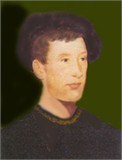
Thomas DeHoland
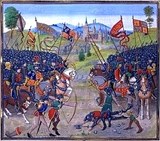
Battle of Najera
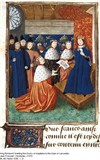
Richard II deeding Aquitaine to Lancaster
Thomas Deholand is my ancestor on both sides of my family. My maternal line looks like this:
Thomas DeHoland (1350 – 1397)
is my maternal 18th great grandfather
Edmund Holland (1383 – 1408)
son of Thomas DeHoland
Eleanor DeHoland (1405 – 1452)
daughter of Edmund Holland
Ann Touchet (1441 – 1503)
daughter of Eleanor DeHoland
Anna Dutton (1449 – 1520)
daughter of Ann Touchet
Lawrence Castellan of Liverpool Mollenaux (1490 – 1550)
son of Anna Dutton
John Mollenax (1542 – 1583)
son of Lawrence Castellan of Liverpool Mollenaux
Mary Mollenax (1559 – 1575)
daughter of John Mollenax
Francis Gabriell Holland (1596 – 1660)
son of Mary Mollenax
John Holland (1628 – 1710)
son of Francis Gabriell Holland
Mary Elizabeth Holland (1620 – 1681)
daughter of John Holland
Richard Dearden (1645 – 1747)
son of Mary Elizabeth Holland
George Dearden (1705 – 1749)
son of Richard Dearden
George Darden (1734 – 1807)
son of George Dearden
David Darden (1770 – 1820)
son of George Darden
Minerva Truly Darden (1806 – 1837)
daughter of David Darden
Sarah E Hughes (1829 – 1911)
daughter of Minerva Truly Darden
Lucinda Jane Armer (1847 – 1939)
daughter of Sarah E Hughes
George Harvey Taylor (1884 – 1941)
son of Lucinda Jane Armer
Ruby Lee Taylor (1922 – 2008)
daughter of George Harvey Taylor
Pamela Morse
I am the daughter of Ruby Lee Taylor
Thomas Holland, 2nd Earl of Kent (1350–April 25, 1397) was an English nobleman and a councillor of his half-brother Richard II.Thomas was the son of Thomas Holland, 1st Earl of Kent and Joan of Kent. His mother was a daughter of Edmund of Woodstock, 1st Earl of Kent and Margaret Wake. Edmund was in turn a son of Edward I of England and his second Queen consort Marguerite of France, and thus a younger half-brother of Edward II of England.
When his father died in 1360 Thomas became Baron Holand. His mother was still Countess of Kent in her own right. At sixteen, in 1366, Holland was appointed captain of the English forces in Aquitaine. He fought in various campaigns over the following years, and was made a Knight of the Garter in 1375.
Richard II became king in 1377, and soon Holland acquired great influence over his younger half-brother, which he used for his own enrichment. In 1381 he was created Earl of Kent.
Marriage and issue
Holland married Alice FitzAlan, daughter of Richard FitzAlan, 10th Earl of Arundel, and Eleanor of Lancaster. They had eight children:
Thomas Holland, 1st Duke of Surrey, who succeeded him
Edmund Holland, 4th Earl of Kent, married Constance of York
John Holland
Joan Holland, married Edmund of Langley, 1st Duke of York
Alianore Holland, married first Roger Mortimer, 4th Earl of March and second Edward Cherleton, 5th Baron Cherleton
Margaret Holland, married first John Beaufort, 1st Earl of Somerset and second Thomas of Lancaster, 1st Duke of Clarence
Elizabeth Holland, married Sir John Neville (eldest son of Ralph Neville, 1st Earl of Westmoreland)
Eleanor Holland, married Thomas Montacute, 4th Earl of Salisbury
Through the marriages of his daughters, he became the ancestor of many of the prominent figures in the Wars of the Roses, including Richard Plantagenet, 3rd Duke of York and Warwick the Kingmaker
Military career
At sixteen, in 1366, Holland was appointed captain of the English forces in Aquitaine. Over the next decade he fought in various campaigns, including the Battle of Nájera, under the command of his stepfather Edward, the Black Prince. He was made a Knight of the Garter in 1375.
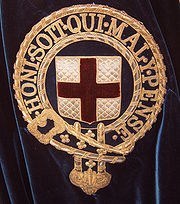
Order of the Garter
The Battle of Nájera, a k a the Battle of Navarrete, 3 April 1367
Fo ught between an Anglo-Gascon army and Franco- Castilian forces near Nájera, in the province of La Rioja, Castile. The English were led by Edward, the Black Prince, and John of Gaunt, Duke of Lancaster, allied with Peter of Castile (sometimes called “Peter the Cruel”) against his brother Henry of Trastámara (Spanish: Enrique II).
Peter and Henry had been in armed conflict, the Castilian Civil War, for some time before the intervention of foreign powers was sought. Peter begged assistance from the Black Prince in Bordeaux to restore him to his throne. James IV of Majorca also agreed to support Peter.
History
With 24,000 men, the Anglo-Gascon army marched south from Aquitaine and crossed the river Ebro at Logroño. They took control of the fortified village of Navarrete and continued towards Nájera to face Henry’s Franco-Castilian army, the latter’s strength being 60,000. Despite the large size of his army, Henry’s commander, Bertrand du Guesclin was later reported to have been reluctant to face the English in a pitched battle, but he was overruled.
The battle began with the English longbowmen gaining dominance over the French archers. Then, the English vanguard, led by Sir John Chandos and the Duke of Lancaster, attacked the French mercenaries commanded by Du Guesclin and Arnoul D’Audrehem. The chronicler Froissart gives detailed information about the participants in the battle.
Under the pennon of St. George, and attached to the banner of Sir John Chandos, were the free companies, who had in the whole twelve hundred streamers. Among them were good and hardy knights and squires, whose courage was proof; namely, Sir Robert Cheney, Sir Perducas d’Albret, Robert Briquet, Sir Garsis du Chastel, Sir Gaillard Viguier, Sir John Charnels, Nandon de Bagerant, Aymemon d’Ortige, Perrot de Savoye, le bourg Camus, le bourg de l’Esparre, le bourg de Breteuil, Espiote, and several others.
Th e Castilian cavalry, under heavy arrow fire from the English longbowmen, fled early, leaving Henry’s battle exposed to attack from the mounted English rearguard. The Franco-Castilian army disintegrated and retreated, pursued by the English, back to the bank of the river Najerilla. Du Guesclin was captured, but Henry escaped and fled.
Peter and the English completely routed Henry and the French, inflicting heavy losses. Unlike at other battles of the Hundred Years’ War, at Nájera it was the English who were attacking dismounted French troops. As with many other battles of the period, the English longbow proved a significant advantage, probably for the first time in the Iberian Peninsula. However, the battle was of dubious long-term significance as Peter and the Black Prince fell out over money, and Peter was not able to maintain his rule for long without foreign support.
References
Sir John Froissart; Translated from the French by Thomas Johnes. Chronicles of England, France and Spain and the Surrounding Countries. London 1808
My paternal connection to Sir Thomas looks like this:
Sir Thomas Holand Knight deHolland (1350 – 1397)
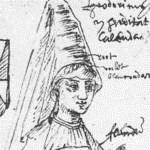
Sibilla Anjou
My 25th great grandmother was from the House of Anjou (like the pear) . Her father, Fulk, was a crusader who is buried at the Church of the Holy Sepulchre in Jerusalem, as King of Jerusalem, which is a very big deal, and pretty creepy. I have been there but did not think to look for my ancestors at the time. The Anjous are Plantagenets in that way that royal Euros had lots of different names and houses. The crusade thing is equally confusing. This is how the Anjous took over the English throne:
The Plantagenets are also called Angevins, because their immediate paternal progenitors were Counts of Anjou, an autonomous county in northern France. They descend in the male line from from the Counts of Gatinais, one of whom had married an heiress to the county, her Anjou ancestors deriving from an obscure 9th century nobleman named Ingelger. It is due to this lineage that the Plantagenets are sometimes referred to as the First House of Anjou. One of the more notable Counts was Fulk, a crusader who became King of Jerusalem. It was his son, Geoffrey, nicknamed Plantagenet, who gave his name to the dynasty, and Fulk’s grandson, Henry, was the first of the family to rule England.
Henry’ s claim to the English throne came through his mother, the Empress Matilda, who had claimed the crown as the daughter of Henry I of England. Empress Matilda’s brother William Adelin had died in the wreck of the White Ship, leaving Matilda her father’s only surviving legitimate child. However, on Henry’s death in 1135, Matilda’s cousin Stephen of Blois was supported by much of the Anglo-Norman nobility, and was able to have himself crowned instead. A tightly fought civil war known as The Anarchy ensued, with Matilda gaining support from her illegitimate half-brother, Robert, 1st Earl of Gloucester. The balance swayed both ways during the war, Matilda gained control at one point and carried the title “Lady of the English” before Stephen forced her out to Anjou. Unrest and instability continued throughout Stephen’s reign, while on the continent, Geoffrey managed to take control of the Duchy of Normandy for the Angevins in 1141 but seemingly showed no interest in campaigning across the Channel.
Sibilla went to Jerusalem where her father married the queen. Later she became a nun, like lots of my royal female ancestors:
Sibylla of Anjou (c. 1112-1165) was a daughter of Fulk V of Anjou and Ermengarde of Maine, and wife of William Clito and Thierry, Count of Flanders.
In 1123 Sibylla married to William Clito, son of the Norman Robert Curthose and future Count of Flanders. Sibylla brought the County of Maine to this marriage, which was annulled in 1124 on grounds of consanguinity. The annulment was made by Pope Honorius II upon request from Henry I of England, William’s uncle; Fulk opposed it and did not consent until Honorius excommunicated him and placed an interdict over Anjou. Sibylla then accompanied her widower father to the crusader Kingdom of Jerusalem, where he married Melisende, the heiress of the kingdom, and became king himself in 1131. In 1139 she married Thierry, Count of Flanders, who had arrived on his first pilgrimage to the Holy Land.
She returned to Flanders with her new husband, and during his absence on the Second Crusade the pregnant Sibylla acted as regent of the county. Baldwin IV, Count of Hainaut took the opportunity to attack Flanders, but Sibylla led a counter-attack and pillaged Hainaut. In response Baldwin ravaged Artois. The archbishop of Reims intervened and a truce was signed, but Thierry took vengeance on Baldwin when he returned in 1149.
In 1157 she travelled with Thierry on his third pilgrimage, but after arriving in Jerusalem she separated from her husband and refused to return home with him. She became a nun at the convent of St. Lazarus in Bethany, where her step-aunt, Ioveta of Bethany, was abbess. Ioveta and Sibylla supported Queen Melisende and held some influence over the church, and supported the election of Amalric of Nesle as Latin Patriarch of Jerusalem over a number of other candidates. Sibylla died in Bethany in 1165.
With Thierry she had six children:
Sibilla d’Anjou born about 1105 Anjou, France died 1165/67
father: *Foulques V “le Jeune” Count of Anjou & King of Jerusalemborn 1092 Anjou, France
died 10 November 1143 Jerusalem, Holy Landburied Church Of Holy Sepulchre, Jerusalem, Holy Land
mother: *Ermengarde (Ermentrude) du Maineborn about 1096 Maine, France
died 1126 Maine, Francemarried 11 July 1110 France
siblings:
*Geoffrey V “le Bon” Plantagenet born 24 August 1113 Anjou, France; died 7 September 1151 Chateau, France
Mathilde d’Anjou born about 1104 Angers, Maine-et-Loire, France; died 1154 Fontevrault Abbey, Fontevrault, Maine-et-Loire, France
Elias d’Anjou born about 1111 Anjou, France; died 15 January 1151 St Serge Abbey, Angers, Anjou, France buried L’Abbey des Sergela, Angers, France
spouse: *Dietrich (Thierry) d’ Alsaceborn about 1099 Alsace, France
died 17 January 1168married 1134
children:
*Marguerite de Lorraine born about 1135 Alsace, France died 15 November 1194
*Matthieu d’ Alsace born about 1137 Flanders, Belgium died 1214 buried St. Judoc, Ponthieu, France
The medicinal use of gin to prevent kidney problems in the tropics was made popular by the British. It was invented in the 17th century by Dutch medical professor Dr Franciscus Sylvius who called it Genever. It was pure alcohol flavored with juniper berries. The medicinal qualities of the berries treated the expatriate Dutch kidney complaints, since juniper is a diuretic. William of Orange made it popular in the UK. For almost the entirety of the eighteenth century half the population of England was guzzling gin. The cheapness and availability made it the curse of lower class London.
Gin and tonic also came about for medicinal treatment, for malaria. Quinine in tonic water was effective in prevention of malaria for the Brits in tropical parts of the Empire. One of the greatest fans of this medicinal drink was a medical doctor himself. Graham Chapman of Monty Python stayed drunk with Keith Moon of the Who for the decade of the 1970’s in an homage to the eighteenth century, I suppose. Dr. Chapman calculated how much gin and tonic would kill a person, and consumed just short of that amount each day. That is a scientific view of self destruction that is unusual. It took a toll. Now for Python lovers there will be a revival called One Down Five to Go in London.

Sabine VonSimmern
My 12th great-grandmother was born in Germany and died in Belgium. She had a very long royal name: Sabine von Pfalz-Simmern (Wittelsbach, Pfalz-Simmern) (Sabine von Pfalz-Simmern) durch Heirat Gräfin von Egmond und Fürstin von Gavere. This did not help her when she begged to spare her knight husband’s life. Such was the fickle finger of royal fate in those days.
Sabine was the daughter of the Count Palatine and Duke John II of simmern (1492-1557) from his marriage to Beatrix (1492-1535), daughter of Margrave Christoph I of Baden. She was a sister of the Elector Friedrich III of the Palatinate.
On April 8, 1544, she married Egmond Lamoral, Prince of Gavre (1522-1568). The wedding was in the Diet of Speyer in the presence of Emperor Charles V and numerous other German imperial princes. The marriage was of great political importance but was described as extremely happy. Due to his link with the German Empire princess (Sabine was called “Bavaria” in the Netherlands), Egmond ranked among the Knights of the Golden Fleece, in 1546.
Sabine begged on her knees to the Duke of Alba to spare the life of her husband but he was beheaded in 1568 in Brussels. After Egmond’s death, Sabine and her children lived in poverty. She was buried beside her husband in Sottegem. The place Oud-Beijerland in the Netherlands is named after Sabine.
I did not start studying genealogy with the expectation of spending years involved with my family tree. I did not expect to find much data, and thought I would be finished in a couple of weeks. In my sixth year of tracing my family back in time I could not imagine life without this research. I have now relearned history by tracing my own DNA through it. Believe me it becomes more interesting when you picture your own ancestors in events. The timeline is an important tool in life to assess progress and enlightenment. The same can be said of a much longer timeline, such as human history. I am starting to understand the mass migrations caused by religions that have shaped the political world. My people were motivated to take great risks and leave their known environments to follow religious convictions. They crossed the Atlantic in rickety boats with nothing but beer to drink. They froze and starved in the early American colonies. They adventured way out west to Ohio and beyond after the Revolutionary War. They fought on both sides of every British and American war, which is most revealing.
Ancestry.com is run by humans and therefore human error is part of it. The site has gathered and continues to gather public records to share as well as trees published by members who make them public. Often an unsubstantiated piece of data will be shared and repeated in the public tree arena. Fortunately there are also wizards who find some errors, and advise the owners of bogus trees to double check the data. I have twice needed to erase several generations of mistaken identity when I was given more information by a fellow family member. Bittersweet, erasing..I had become fond of the ancestors who were not really my own. It was a horrible blow to be wrong about them, but this study is about verification and facts, not just being up in your tree.
I have been asked which are my favorite ancestors, to which I generally reply I like them all for surviving so I could be here now. There are a few that I might love more than the others:
They are either well known or unknown, but all important to me and my existence. If you take the two week trial I bet you will find something remarkable in your own family history.
 mermaidcamp