mermaidcamp
Keeping current in wellness, in and out of the water
You can scroll the shelf using ← and → keys
You can scroll the shelf using ← and → keys


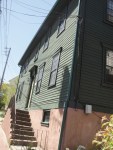


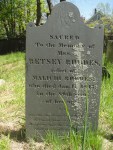

Since I study history through my ancestors’ perspective when I can, my dreams have become full of the characters from whom I descend. The way war and conflict are taught in school ,winners and the vanquished divide spoils and define conquest as history progressed. Places, however, record, digest, and reflect history on a different level. Environment and social structure result from human use of land and resources. If ownership and preservation of historical culture is valued and given high priority, the place is subject to less wasteful development. Pawtuxet, RI preserves history by keeping homes from the past in tact. Seeing places my ancestors have lived and died brings history to life for me, and fills my dreams with the struggles and joys they experienced.
The village of Pawtuxet is a place where local residents function as the tourist board. I was directed by local ladies at the cafe to drive up Post Road and start to look for Malachi Rhode’s home. I found it right away and saw the current resident in his back yard. I resisted the temptation to ask him if I could go into his back yard since my family had owned the home in the 1700’s. I had visited the larger new cemetery with graves that included Rhodes in great number. The small ancient graveyard on the Post Road was even more peaceful and special. I found Malachi there, within walking distance of his house. His life is honored and his place in history kept as a treasure that belongs to the place. Seeing and feeling the place put me in touch with the spirit of all my relations.
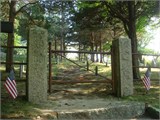
Anna Bursell at rest
Anna was born in Barnstable, Ma in 1640. She died a widow in Barnstable in 1724, living through some heavy times. She married Silas Sears:
Lieut. SILAS SEARS, son of Richard, died Yarmouth, Mass., 13 Jan, 1697/8; married ANNA ??(Bursell??) who died a widow in yarmouth, 4 Mar 1725/6. They had children:
SILAS, born Yarmouth c. 1661; RICHARD, born in Yarmouth; HANNAH, born Eastham(?) Dec 1672, m. 8 Feb 1692/3 Thomas SNOW(son of Mark and Jane(Prence)Snow) she died prior to 30 Sep 1706; JOSEPH, born Yarmouth, c. 1675; JOSIAH, born Yarmouth c. 1677; ELIZABETH, born Yarmouth, m. there 22 Nov 1705, John COOKE; DORRITY, born yarmouth c. 1687; m. there 8 Feb 1715/6 Joseph STAPLES she died 28 Feb 1753
Lt. Silas Sears lived in that part of Yarmouth known as the East precinct, now East Dennis; was “propounded to take up Freedom,” June 6, 1682; commissioned Ensign, 28 Oct 1681; Liet. 7 July 1682; chosen Representataive to the General Court at Plymouth, 1685-91; Selectman, 1680-94; Juryman, 1680-82.
25 Dec, 1689; “Silace Sears and other fined 20 shillings for not appearing and attending at Court, or disorderly departing therefrom;”–fines remitted latar, “it being first offense of the kind.”
1694; “Lt Silas Sears on Com. to seat men, women and others in the meetinghouse;” an onerous duty in those days.
1 Nov 1676, Emott Bursell and Silas Sears appointed administrators of the Estate of James Bursell of Yarmouth. It has been suggested that his wife may have been a daughter of James Bursell, based on the supposition of his being chosen one of the administrators.
Silas Sears left no will, and letters of administration were granted to his widow Anna, 1 May 1698. The “settlement” of his estate was made 5 May 1698 and mentions sons Silas, Richard, joseph and Josiah; and daughters, Hannah, Elizabeth and Dorrity
Anna Bursell (1640 – 1724)
is my 9th great grandmother
Silas Sears (1661 – 1732)
son of Anna Bursell
Sarah Sears (1697 – 1785)
daughter of Silas Sears
Sarah Hamblin (1721 – 1814)
daughter of Sarah Sears
Mercy Hazen (1747 – 1819)
daughter of Sarah Hamblin
Martha Mead (1784 – 1860)
daughter of Mercy Hazen
Abner Morse (1808 – 1838)
son of Martha Mead
Daniel Rowland Morse (1838 – 1910)
son of Abner Morse
Jason A Morse (1862 – 1932)
son of Daniel Rowland Morse
Ernest Abner Morse (1890 – 1965)
son of Jason A Morse
Richard Arden Morse (1920 – 2004)
son of Ernest Abner Morse
Pamela Morse
I am the daughter of Richard Arden Morse

William Kirkcaldy
My 13th great grandfather lived in Scotland when religion was making life very difficult for all involved. Mary Stuart reigned as a Catholic. Life was uneasy and brutal:
Biography from Wikipedia:
“Sir William Kirkcaldy of Grange (c. 1520 – 3 August 1573), Scottish politician and general, was the eldest son of Sir James Kirkcaldy of Grange (d. 1556), a member of an old Fife family. The house of the Grange lands was Halyards Palace.
Sir James was lord high treasurer of Scotland from 1537 to 1543 and was a determined opponent of Cardinal Beaton, for whose murder in 1546 he was partly responsible. William Kirkcaldy assisted to compass this murder, and when the castle of St Andrew’s surrendered to the French in July 1547 he was sent as a prisoner to Normandy, whence he escaped in 1550.
He was then employed in France as a secret agent by the advisers of Edward VI, being known in the cyphers as Corax; and later he served in the French army, where he gained a lasting reputation for skill and bravery. The sentence passed on Kirkcaldy for his share in Beaton’s murder was removed in 1556, and returning to Scotland in 1557 he came quickly to the front; as a Protestant he was one of the leaders of the lords of the congregation in their struggle with the regent, Mary of Guise, and he assisted to harass the French troops in Fife. He opposed Queen Mary’s marriage with Darnley, being associated at this time with Moray, and was forced for a short time to seek refuge in England.
Returning to Scotland, he was an accessory to the murder of Rizzio, but he had no share in that of Darnley, and he was one of the lords who banded themselves together to rescue Mary after her marriage with Bothwell. After the fight at Carberry Hill the queen surrendered herself to Kirkcaldy, and his generalship was mainly responsible for her defeat at the Battle of Langside. Kirkcaldy sailed to Orkney as Lord High Admiral of Scotland in pursuit of Bothwell, but his ship, the Lion, ran aground.[1] He seems, however, to have believed that an arrangement with Mary was possible, and coming under the influence of William Maitland of Lethington, whom in September 1569 he released by a stratagem from his confinement in Edinburgh, he was soon vehemently suspected by his fellows.
After the murder of Moray, Kirkcaldy ranged himself definitely among the friends of the imprisoned queen. About this time he forcibly released one of his supporters from imprisonment, a step which led to an altercation with his former friend John Knox, who called him a murderer and throat-cutter. Defying the regent Lennox, Kirkcaldy began to strengthen the fortifications of Edinburgh castle, of which he was governor, and which he held for Mary, and early in 1573 he refused to come to an agreement with the regent Morton because the terms of peace did not include a section of his friends.
After this some English troops arrived to help the Scots, and in May 1573 the castle surrendered. Strenuous efforts were made to save Kirkcaldy from the vengeance of his foes, but they were unavailing; Knox had prophesied that he would be hanged, and he was hanged on the 3rd of August 1573.”
William Kirkcaldy (1520 – 1573)
is my 13th great grandfather
Janet Kirkcaldy (1520 – 1572)
daughter of William Kirkcaldy
William Carr (1542 – 1655)
son of Janet Kirkcaldy
Benjamin Carr (1592 – 1635)
son of William Carr
Caleb Carr (1623 – 1695)
son of Benjamin Carr
Sarah Carr (1682 – 1765)
daughter of Caleb Carr
John Hammett (1705 – 1752)
son of Sarah Carr
MARGARET HAMMETT (1721 – 1753)
daughter of John Hammett
Benjamin Sweet (1722 – 1789)
son of MARGARET HAMMETT
Paul Sweet (1762 – 1836)
son of Benjamin Sweet
Valentine Sweet (1791 – 1858)
son of Paul Sweet
Sarah LaVina Sweet (1840 – 1923)
daughter of Valentine Sweet
Jason A Morse (1862 – 1932)
son of Sarah LaVina Sweet
Ernest Abner Morse (1890 – 1965)
son of Jason A Morse
Richard Arden Morse (1920 – 2004)
son of Ernest Abner Morse
Pamela Morse
I am the daughter of Richard Arden Morse

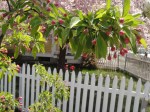




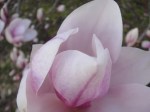


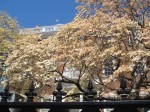

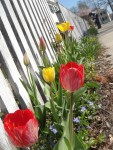
I had the super fine opportunity to extend the season of spring this year in the most pleasant way. By visiting New England I had the chance to study my ancestors in the places they lived and died. One of the strongest impressions I have of my visit is of the flowering trees. The botany of the ancestors reminded them of spring and hope in a way that was dramatic every year. To witness the return of color, warmth and spring fashion unfold before my eyes was a treat that stays in my memory. Hope is the motto of Rhode Island. I have a dreamy set of images that express hope through blossoms. I will not forget how happy all the flowers made me feel. I am comfortable and at home with all the people I met in Rhode Island. I love the way Jamestown, an island where my ancestors had dairy farming business in the 1600’s, is still a place for dairy and produce farming. They are completely rural and close to town at the same time. Hope springs eternal.

Ferniehirst castle
I will go grave hunting today on Jamestown Island, RI. Caleb Carr is buried there, and maybe it is possible to visit the ancestral home!!! He has a fancy Scottish background. His grandfather, William, was baron of a castle in Scotland:
About Ferniehirst Castle
Ferniehirst Castle consists of an extended and altered towerhouse, which incorporates the cellars from the 16th century castle, with larger wings and extentions. A large conical-roofed stairturret is corbelled out above the first floor level, and bartizans, with shot-holes crowning the top of the tower.The original entrance leads to a stair known as the ‘Left-Handed Staircase’, the story being that when Sir Andrew Kerr, who was himself left-handed, returned from Flodden in 1513 he had his followers trained to use their weapons with their left hands. This is said to be the origin of ‘Corrie-fisted’ or ‘Kerr handed’. The basement is vaulted, and the hall has a 16th-century fireplace.Ferniehirst was a property of the Kerrs and first built by Sir Thomas Kerr in 1476 on the remains of an earlier foundation, but was sacked by the English in 1523. It was recaptured with French help in 1549, and the leader of the English garrison was beheaded. Sir Thomas Kerr, protector of Mary, Queen of Scots invaded England in 1570, hoping to have her released, but all that resulted was an raid on Scotland, during which Ferniehirst was damaged. James VI destroyed the castle in 1593 because of help given by the family to the Earl of Bothwell. The castle was rebuilt about 1598. As late as 1767 the house was occupied and used by the Lord Lothian of that day but even then it was showing signs of delapidation. Between 1934 and 1984 it was leased by the Scottish Youth Hostel Association, except for during World War II when it served as a army billet.Purchased recently by Lord Lothian, Ferniehirst Castle has been restored. A bothy wing has been added and built on original foundation stones to serve as the private apartment of Lord Lothian and his Lady. When he is present his personal flag is flown from the flagpole atop the castle. His flag is blue with the resplendant sun in gold in the center.A ‘Green Lady’ is said to haunt the castle in some tales, and unusual occurrences were reported during its time as a youth hostel, although the story is refuted.
William Carr (1542 – 1655)
is my 11th great grandfather
son of William Carr
son of Benjamin Carr
daughter of Caleb Carr
son of Sarah Carr
MARGARET HAMMETT (1721 – 1753)
daughter of John Hammett
son of MARGARET HAMMETT
son of Benjamin Sweet
son of Paul Sweet
Sarah LaVina Sweet (1840 – 1923)
daughter of Valentine Sweet
son of Sarah LaVina Sweet
Ernest Abner Morse (1890 – 1965)
son of Jason A Morse
Richard Arden Morse (1920 – 2004)
son of Ernest Abner Morse
I am the daughter of Richard Arden Morse
Name: William CARRGiven Name: WilliamSurname: CarrNSFX: 10th Baron FennehurstTitle: 10th Baron FennehurstSex: MBirth: 16 MAY 1542 in Fernichrist,ScotlandDeath: in London,EnglandNote: 10th Baron of Fennefurst.Father: Thomas CARR b: ABT 1525 in Ferniehrist Castle,ScotlandMother: Janet KIRKCALDY b: in Grange,ScotlandMarriage 1 Mary Ann CLIFFORD b: ABT 1570 in EnglandMarried: ABT 1591 in London,EnglandChildrenBenjamin CARR b: 18 AUG 1592 in London,EnglandWilliam CARR b: 17 JUN 1597 in London,EnglandGeorge CARR b: 15 AUG 1599 in London,Middlesex,EnglandJames CARR b: 4 OCT 1602 in London,EnglandRichard CARR b: 1606 in London,EnglandOther children may have been born to this couple, but the given names are not known. William Carr became the 10th Baron of Fennehurst, but he lived in London,England. William took his mother’s maiden name to continue the Kirkcaldyline, but his children reverted to Carr when their father failed toinherit the Grange property. (David Carr notes)According to Billy Neil Carr, his uncle Charlie wrote a book on Amasa Carr (1830), showing his descendants and mentioning what he knew of Amasa’s ancestors. Quoting Charlie’s book, the first three generations were based on “the framed ‘Pedigree of Governor Caleb Carr’ that hangs on the wall of the living room in the old Carr Homestead in Jamestown, RI.”Sir William Carr was born in Scotland on 16 May 1542. He married Mary Ann Clifford Carr, sister of Lord Somerset. Sir William changed the name Kerr, first to Kelso then to Carr.Sir William’s father Thomas was the son of Sir John Kerr and Katherine, daughter of Sir Andrew Kerr of Cesford. Sir John reportedly rescued Mary Queen of Scots in the incursion against Scotland. Sir John was born 17 June 1500 and died 1562.Sir John was the son of Lord Andrew Kerr, born in Scotland in 1450. He married Janet, daughter of Lord Patrick Hume.10th Baron of Fennefurst.———According to notes by David Carr, William became the 10th Baron of Ferniehurst, Scotland. However, he lived in London, England, and took his mother’s maiden name to continue the Kirkcaldy line (Why? Possibly because she had no brothers, and with a view to receiving the family inheritance.) However, when William failed to inherit family property in Grange, Scotland, his children reverted to the Carr or Kerr surname.This information, as well as data on the preceding generations, is presented without verification. It may well be fact, but proving it may be difficult since England and Scotland are far away; furthermore, locating old records is often difficult. However, there is a lot of historical information on the internet about this family. [http://www.electricscotland.com/]William’s parents are given as Thomas Kerr (Carr), 9th Baron of Ferniehurst, and Janet Kirkaldy (b. ca.1530 in Grange, Scotland).Summary of online info:Thomas became the 9th Baron of Ferniehurst Castle. He was also noted for his patriotic involvement with Mary Stuart, Queen of Scots (see notes from David Carr). The name of Carr, Kerr, or Karre is as old as the Norman Conquest at the Battle of Hastings in 1066. One of the followers of William the Conqueror, of Normandy, is recorded in the Roll of the Gattle Abbey as having the name Karre. The early descendants of this Norman soldier and succeeding generations spread on both sides of the border between England and Scotland. Direct lines can be traced through various peerage books of England and Scotland (titles and whereabouts? see web site) to Andrew Kerr I, the 6th Baron of Ferniehurst, Scotland. He was born in 1450, created Baron in 1480, and knighted in 1483. He and his son Andrew II, 7th Baron of F., were remarkable men for talent and undaunted courage, conspicuous in the reigns of James IV and James V. Andrew Kerr II died in 1543. His son, Sir John Kerr, 8th Baron of F., did great service for Scotland by rescuing Mary, Queen of Scots from English raiders. Sir Thomas, 9th Baron and son of Sir John, was also a loyal and devoted subject of the Queen.See Watson’s “The House of Carr,” 1926. William’s youngest brother (or half-brother) was Robert “Robin” Carr, b. 1580 in Ferniehurst, Scotland. He is said to have been a favorite of King James VI of Scotland, who became King James I of England after the death of Elizabeth I. It was this king who authorized the King James translation of the Bible in 1611. Robin was: Groom of the Bed Chamber, 1607; Viscount Rochester, 1611; Knight of the Garter, 1613; Earl of Somerset; and Lord High Treasurer of Scotland, 1614. In 1609 he was granted the forfeited estate of Sir Walter Raleigh. As an influential member of the court, he was both feared and respected.
If I learned one thing on my ancestry quest in Massachusetts it is that the record keeper is the author of history. I have realized this by finding census and other documents that conflict with each other while studying my ancestors. Never has it been so clear. I believed that the tribe would have the information on the tribe in Mashpee, so I went straight to the museum to inquire. Because they rely on records kept by the Europeans the family trees are reconstructed using English last names. They use what they have. The records looked like they started in the 1800’s.




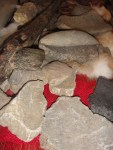
I was unhappy about the state of affairs. The tiny tribal museum has little funding, and can open only a few hours, a couple of days a week. I then traveled to the big well funded museum at Plimouth Plantation. Wow, what a difference!!!
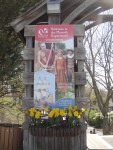
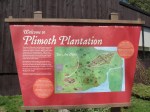

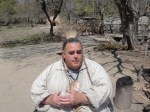

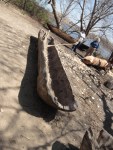
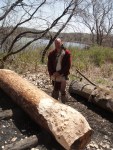

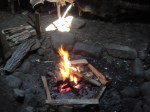

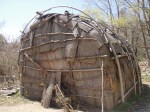

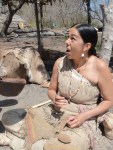


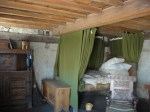


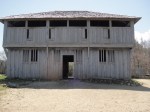

The museum at Plimouth Plantation is doing some revisionist history in order to correct many of the assumptions and erroneous stories that exist about the Mayflower and the native people. The Pilgrims play characters in period costume, expressing the beliefs of the time and place. The Pilgrims were religious prudes who considered themselves religiously superior to all other religions. They also felt entitled to take anything they wanted from the native people because they had permission from the King of England. Their church was fortified on top with cannons in all directions. I guess they felt that God and the King needed some back up. Although I had a few Pilgrims and only one ( I think) Wampanoag ancestor, I distinctly disliked the pretend Pilgrims when I met them. I am, however, glad they kept some records at the time.
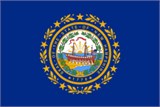
New Hampshire
My 10th great grandfather was baker in London who came to America with his very young future wife in 1635. He became wealthy in New Hampshire.
” John Browne 40″ as well as “William Walker, 15; James Walker 15 and Sarra Walker 17, servants to John Browne, baker, and William Brasey, linen draper in Cheapside” embarked upon the Eliz abeth, Mr. William Stagg, master, leaving London on 17 April 1635 and arriving in Boston, Suffolk County, MA in June, according to Peter Wilson Coldham’s The Complete Book Of Emigrants .
In London, Middlesex, England, John was a Baker and was listed as such on the manifest of The Elizabeth. His master, John Browne, was a Puritan who followed his preacher, Reverend Stephen Bachiler, to New England to escape the oppression of King Charles. He became a freeman two years after arriving in 1635, then moved to Hampton, New Hampshire.
First called the Plantation of Winnacunnet, Hampton was one of four original New Hampshire townships chartered by the General Court of Massachusetts , which then held authority over the colony. “ Winnacunnet” is an Algonquian Abenaki word meaning “pleasant pines”. The town was settled in 1638 by a group of parishioners led by Bachiler , who had formerly preached at the settlement’s namesake : Hampton, England .
He received a grant of 4 acres for a house lot on Brown’s River. He eventually became the third wealthiest man and the largest landowner in Hampton, owning four farms. John served as Selectman in 1651 and 1656
John sued Thomas Swetman for a debt due “for two fat oxen” in 1654. He also brought suit against the “prudential men” and the Town of Hampton for not building a road to his farm, which was near the Falls River toward the part of Salisbury, Essex County, MA that became Seabrook, Rockingham County, NH. The court decided in his favor and the road he wanted was built.
Once in New Hampshire, John built the first bark, a small ship, in Hampton, Rockingham County, NH at the river near Perkins Mill. This ship was mentioned in John Greenleaf Whittier’s poem “The Wreck of River Mouth.”
John Browne (1589 – 1687)
is my 10th great grandfather
Rebecca Browne (1669 – 1700)
daughter of John Browne
Dorothy Whipple (1669 – 1728)
daughter of Rebecca Browne
Dorothy Rhoades (1705 – 1705)
daughter of Dorothy Whipple
Margaret Hammett (1721 – 1753)
daughter of Dorothy Rhoades
Benjamin Sweet (1722 – 1789)
son of Margaret Hammett
Paul Sweet (1762 – 1836)
son of Benjamin Sweet
Valentine Sweet (1791 – 1858)
son of Paul Sweet
Sarah LaVina Sweet (1840 – 1923)
daughter of Valentine Sweet
Jason A Morse (1862 – 1932)
son of Sarah LaVina Sweet
Ernest Abner Morse (1890 – 1965)
son of Jason A Morse
Richard Arden Morse (1920 – 2004)
son of Ernest Abner Morse
Pamela Morse
I am the daughter of Richard Arden Morse
Travel is an adventure. I like to take just the right amount of stuff from home to give me extra room in my suitcase. I typically find something I want to buy and bring back home with me. Since I am on a long trip this time I am including an extra duffel bag inside the suitcase for large finds. I have arranged my accommodations, except for the last 3 nights, which I can decide when I get to that. I am meeting friends at the beach, planning a party, and going to a performance. What do I need? What do I want to purchase in New England?
I always take:
I enjoy shopping for or finding:
I know Cape Cod will have all manner of souvenirs, but I typically like things that are out of the ordinary. My friend who lives there makes wampum out of shells, so I look forward to purchasing a special commemorative set of jewels to go with the setting. I doubt that Plymouth Rock, Colony, etc. will have the kind of item I like to buy. I expect the Wampanoag tribe may have some crafts or books at the museum in Mashpee that will interest me. I love to collect stories and history. Since I am visiting many of my ancestors I expect to find some facts I do not know now. I am excited and open for a new culture, new cuisine, new (old) cities and towns, and friends I have not yet met. I have been gardening, supervising a construction project in my home, and working in the office to clear the desk and put all business in order. One thing I never take with me when I travel is my day-to-day concerns. My work is finished here for a couple of weeks. I will bring you along for the fun, gentle reader, as I to discover what is special about Rhode Island and Massachusetts.
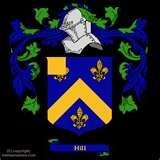
Hill coat of arms
My tenth great-grandfather arrived early in Massachusetts, and settled in Malden to be a miller and an inn keeper.
Abraham HILL arrived in Malden, MA in the 1630’s, among the first settlers there. He first received Lot #59, and then bought more land on the south side of Salem St. Later, when some 5 acre lots were divided up, he received 2 1/2 acres.
According to the History of Malden, Robert LONGE, the father of Abraham’s wife, Sarah, was also one of the first in Malden and received 5 acres. Daniel SHEPHERDSON, whose ggranddaughter,Sarah PARKER m. Moses’ grandson, Moses HILL, was also a pioneer in Malden.
Thomas CALL, the other grandfather of Joanna CALL, was a tenant of the SKINNERS. The house stood at the corner of Cross and Walnut Sts.
The only other mention of Abraham in the Malden book is that he was one of nine signers of a petition asking for a four mile square of land called Pennycooke to be an addition to the town.
Abraham Hill, the first American HILL ancestor of this branch of the family, was born in 1615, and was an inhabitant of Charlcstown, Massachusetts, in 1636. He kept a mill for John Coitmore, and was the owner of five lots of land in Charlestown and the neighborhood. He was admitted to the church in 1659, and his wife,’ Sarah Long, daughter of Robert Long, born in England in 1617, was admitted to the church in 1644. Abraham and Sarah (Long) Hill were married in 1639, and had eight children : Ruth, baptized in 1640, married William Augur; Isaac. 1641; Abraham. 164.1: Zachary, whose sketch follows; Sarah, 1647; Sarah, born and died in 1649; Mary, 1052 : Jacob, March, 1656-57. Abraham Hill died February 13, 1669-70, and the inventory of his estate amounted to six hundred and thirty-three pounds.
is my 10th great grandfather
daughter of Abraham Hill
son of Ruth Hill
daughter of Abraham Eager
daughter of Lydia Eager
Joseph Morse III (1752 – 1835)
son of Mary Thomas
John Henry Morse (1775 – 1864)
son of Joseph Morse III
son of John Henry Morse
Daniel Rowland Morse (1838 – 1910)
son of Abner Morse
son of Daniel Rowland Morse
Ernest Abner Morse (1890 – 1965)
son of Jason A Morse
Richard Arden Morse (1920 – 2004)
son of Ernest Abner Morse
I am the daughter of Richard Arden Morse
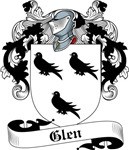
Glen Coat of Arms
My 20th great grandfather married the illegitimate daughter of Robert the Bruce, Margaret. His legitimate daughter Marjorie is also my ancestor. This is the kind of thing that gets the branches of your tree tangled. I wonder if he really accompanied the heart of Robert the Bruce to the holy land. What a totally bizarre mission. There is some confusion, but we know a lot, considering that he was born in 1303.
Robert, son of John de le Glen, married Margaret, illegitimate daughter of Robert Bruce Robert de Glen and ” Margaret Bruce the King’s sister,” his spouse, had a grant from David II., undated, of Nether Pitedye, Kinghorn, Fife (adjoining Balmuto) Robertson notes three other charters from David to this Robert de Glen, of the lands of Glasgow Forest, thanedom of Kintore, Aberdeen. Wood gives Margaret as legitimate, and says that she married, secondly, William, Earl of Sutherland. The latter did marry as his second wife, Margaret Bruce; but it is impossible that she was the widow of Glen, and an authority points out that the arms quartered by Glen, and attributed to the co-heiress of Abernethy, were not the Abernethy arms, but those of Scotland with the Scottish mark of illegitimacy, which agrees with a tradition preserved in several branches of the family, and is conclusive. Another tradition, traceable for four centuries, insists that Robert de Glen was one of those who accompanied the heart of Bruce to the Holy Land, and the Linlithgow line used two crests, one a martlet; the other an arm, the hand grasping a heart, in commemoration of that event. Moreover, the Glens of Bar possessed the sword of Bruce, which a descendant carried to Ireland, in 1606, where it was seen a few years since, the inscription on the blade leaving no doubt as to its original ownership.
Robert Glen (1303 – 1345)
is my 20th great grandfather
John Glen (1349 – 1419)
son of Robert Glen
Isabel Glen (1380 – 1421)
daughter of John Glen
Isabel Ogilvie (1406 – 1484)
daughter of Isabel Glen
Elizabeth Kennedy (1434 – 1475)
daughter of Isabel Ogilvie
Isabella Vaus (1451 – 1510)
daughter of Elizabeth Kennedy
Marion Accarson (1478 – 1538)
daughter of Isabella Vaus
Catherine Gordon (1497 – 1537)
daughter of Marion Accarson
Lady Elizabeth Ashton (1524 – 1588)
daughter of CATHERINE GORDON
Capt Roger Dudley (1535 – 1585)
son of Lady Elizabeth Ashton
Gov Thomas Dudley (1576 – 1653)
son of Capt Roger Dudley
Anne Dudley (1612 – 1672)
daughter of Gov Thomas Dudley
John Bradstreet (1652 – 1718)
son of Anne Dudley
Mercy Bradstreet (1689 – 1725)
daughter of John Bradstreet
Caleb Hazen (1720 – 1777)
son of Mercy Bradstreet
Mercy Hazen (1747 – 1819)
daughter of Caleb Hazen
Martha Mead (1784 – 1860)
daughter of Mercy Hazen
Abner Morse (1808 – 1838)
son of Martha Mead
Daniel Rowland Morse (1838 – 1910)
son of Abner Morse
Jason A Morse (1862 – 1932)
son of Daniel Rowland Morse
Ernest Abner Morse (1890 – 1965)
son of Jason A Morse
Richard Arden Morse (1920 – 2004)
son of Ernest Abner Morse
Pamela Morse
I am the daughter of Richard Arden Morse
 mermaidcamp