mermaidcamp
Keeping current in wellness, in and out of the water
You can scroll the shelf using ← and → keys
You can scroll the shelf using ← and → keys
The official political message this year of the Communist leaders of China is curb waste and conserve air quality this lunar new year. Banquets and fireworks are under fire for waste and pollution. The ancestors are featured heavily in celebrations of this holiday in China. The festival begins on the new moon, this year 10 Feb, 2013, and lasts for 15 days. Many Chinese people travel great distances to be at home for this time of year. Fireworks are central to the family party. I am a huge fan of pyrotechnics. I am not attracted to witness displays in China because frequent fires and accidents are the result of unregulated manufacture and distribution.
The practice of making noise to scare away evil spirits is ancient. China produces 90% of the fireworks in the world after inventing them. The original firecrackers were chunks of wet bamboo thrown into a fire. The invention of gunpowder in China around 600-900 AD changed everything. The public and private parties to welcome the Year of the Snake will last for a month. If you want to party with the Snake, clean your house, wrap even numbered dollar amounts in red paper and give them to your family, and do not wash your hair or sweep your house on the first day. You may be able follow up with Lion dancers in your community, and if you are lucky, some fireworks to scare away the evil forces in your life. Good to go.
The moon, the way we view it ,and the power it holds have been studied for all of history. The phases of the moon are significant in agriculture as well as business. Lunar calendars were used to measure time until the Catholics went Gregorian on the Euros. Since the Julian calendar , created by Julius Caesar in 46 BC was inaccurate in terms of the planets, the Pope became concerned that Easter was sliding into summer. Catholic calendar year is key to the liturgy practice and costuming. The whole system supporting the Easter Bonnet was slowly slipping away with each new year. Astronomers were hired to deal with the issue. The Greek Orthodox religion uses the Julian calendar now, as do the Berbers, the Ethiopians, and others concerned with historical continuity.
The Pope as a symbol was resisted by the Protestants. The idea that Pope Gregory would now change the way they counted time was not going to go over with the new religions that sprung up precisely to combat Popery. At his death the Vatican treasury was empty, but Gregory XIII had left his mark on time. For this reason the Gregorian style was not adopted at the same time. The Swiss used both calendars simultaneously for more than 100 years. The Catholic cantons adopted it when they got the bull from the Pope in 1582. The Protestants kept the Julian style rather than agree with a Catholic concept. The Protestant cantons gave in to the new calendar in 1700. The canton of St Gallen was the last hold out, continuing on the lunar side of life until 1724. The Chinese succumbed in 1949, but they still use their own lunar calendar.
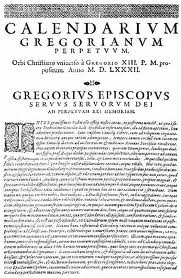
News from Pope Gregory XIII
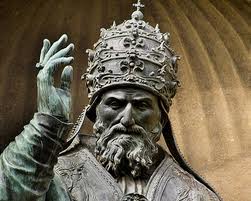
Gregory XIII in elaborate Easter Bonnet
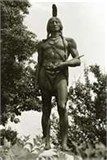
Ousameequin Massasoit
The First Thanksgiving, 1620, was a time of warm feelings and friendly relations between the Plymouth Colonists and the Indians of America. On March 22, 1621, Samoset, an Indian who spoke English appeared on the scene. He once had been kidnapped and taken to London where he learned pigeon English. He helped the Colonists to sow seed and manure the land with fish for a bountiful harvest. He then arranged a meeting between Massasoit, the revered chief of the Wampanoags, a tribe of the Algonoquin Indians, and the leaders of the Plymouth Colony and a Peace Treaty was signed. The Colonists, as hosts at the First Thanksgiving, could speak no Algonguian, the language of the Indians, and the Indians, except Samoset, could speak no English. There must have been much smiling, nodding of heads, pats on the shoulders, and hearty grunting. Of course a three day party where the English shared their new supply of beer certainly was expected to engage many friendships. It is particularly significant that the peace treaty drawn during the feast was never broken during the remaining forty years of Massasoit’s life! From the writings of two of the settlers, Govenor William Bradford and Edward Winslow, as compiled for “The Pilgrim Reader” by George F. Willison: “Our harvest being gotten in, our Governor sente four men out fowling that so we might, after a more special manner, rejoyce together after we had gathered the fruit of our labours. These four, in one day, killed as much fowl as, with a little help besides, served the company almost a week, at which time, amongst other recreations, we exercised out armes, many of the Indians coming amonst us. And amongst the rest, their greatest King, Massasoit, with some ninety men, whom, for three days, we entertained and feasted. And they went out and killed five deer, which they brought to the Plantation, and bestowed on our Governor and upon the Captaine and others. And although it be not always so plentiful as it was at this time with us, yet, by the goodness of God, we are so farr from wante that we often wish you partakers of our plentie.” 2. Various chroniclers at the time of the First Thanksgiving described Massasoit as being very tall and slender, typical of the Wampanoags, “a very lusty man in his best years, an able body, grave of countenance, and spare of speech”. His clothing, or lack thereof, did not differ from that of his followers, “only in a great chain of white bone beads about his neck” and “Behind his neck hangs a little bag of tobacco, which he drank and gave us to drink; his face was painted with a sad, red like mulberry, he was oiled both head and face and looked greasy, a long knife hanging on a lace at his breast was his only weapon”
After such a warm welcome, things went sour for the tribe. Today they want to build a casino, so the legal battles continue for the People of the First Light.
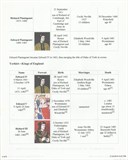
House of York
The British royals married as many people as possible, I think, and procreated with yet others. There were battles and schemes to take power from each other which I had never studied. I knew my maternal great grandmother from Selma Alabama was a descendant of these Plantagenet people. My brother once saw QE II in a convertible in Tobago in 1966 when he was less than 3 years old. The Queen and Price Philip stayed very near my parents at the Crown Point Hotel, right next to the airport. Little Ricky formed a highly unnatural interest the Queen. He had a little flag from that royal moment that he kept forever. None of them knew as they waved at Her Highness that both my parents are historically royally mixed up with the crown of Britain. Now that Richard III has been exhumed I looked into my relationship with him. On my mother’s side he is my uncle:
Richard III King of England Plantagenet (1452 – 1485)
is my 13th great grand uncle
Richard Plantagenet (1411 – 1460)
Father of Richard III King of England
Anne Plantagenet (1490 – )
Daughter of Richard
Henry Holland (1527 – 1561)
Son of Anne
John Holland (1556 – 1628)
Son of Henry
Francis Gabriell Holland (1596 – 1660)
Son of John
John Holland (1628 – 1710)
Son of Francis Gabriell
Elizabeth Holland (1652 – 1737)
Daughter of John
Richard Dearden (1645 – 1747)
Son of Elizabeth
George Dearden (1705 – 1749)
Son of Richard
George Darden (1734 – 1807)
Son of George
David Darden (1770 – 1820)
Son of George
Minerva Truly Darden (1806 – )
Daughter of David
Sarah E Hughes (1829 – 1911)
Daughter of Minerva Truly
Lucinda Jane Armer (1847 – 1939)
Daughter of Sarah E
George Harvey Taylor (1884 – 1941)
Son of Lucinda Jane
Ruby Lee Taylor (1922 – 2008)
Daughter of George Harvey
Pamela Morse
I am the daughter of Ruby Lee
Than again Richard III is my 14th great grandfather. I shudder to think how many different ways I may find to be his relative….I found another version in which he is my 1st cousin 17 x removed..He may well be all those things…
Mark Bittman is a foodist supreme and an omnivore. He and Anthony Bordain are my food persona idols. Although they both do eat all manner of animal products, they do it in awareness. In this TED talk Bittman details the history of eating and agriculture in America that has brought us to this point. I am about his age so I relate totally to the diet he describes on his childhood table. Like him, I was inspired my mother’s God awful cooking to learn to cook early in life. Unlike him, I became a vegetarian at the age of 19. In 1970 in North Carolina I can assure you that vegetarianism was completely foreign as a concept. My diet was not yet healthy, but it was mostly homemade. I was a baker of biscuits and bread. I was lucky that my roommate had mother who sent us really tasty canned produce from her garden in South Carolina. Over time I met vegetarians for health (from northern California, of course) and improved the ingredients I used. I garden and enjoy cooking and eating produce now, but my learning curve has taken place in a time when all agriculture has become progressively less healthy. I hope you will have time to listen to Bittman’s excellent talk, but if you need a summary here it is:
The celebration of Women’s History Month will take place in March, 2013 with a theme about innovation and imagination. A salute to women in engineering, math and science must include the women who broke into those and other fields after a struggle to be educated. By following a timeline we can see the contributions women have made. The Queen archetype, both in history and in mythology has power to rule with wisdom when she is at her best. Queens inherit the power and responsibility of ruling people wisely. The shadow queen is ruled by her own heart and lacks boundaries.
It is obvious that without women there could be no history, no men, and no archetypes. Our collective consciousness is full of both reality and projections. To create a better and more wholesome future it behooves us to sort out delusions in order to enlighten both men and women. When archetypes are understood well the need to perceive the world by using stereotypes can vanish. Stereotypes are cliche. Archetypes are infinitely instructive. When you look around the world do you notice examples of both? How do you avoid being a stereotype?
The Wampanoag tribe is known as the People of the First Light because they lived, hunted, fished and made wampum along the outer banks of New England before the Pilgrims landed. The dawn as viewed on this side of the Atlantic assures one that Europe is distant. New dawn in a new world is powerful natural medicine. As goes the story all across the nation, that medicine proved to be easily hackable by flim flam Euros. The First Light, and all the real estate with a fine view of same was desired by colonial imperialists as soon as they found it. Bare naked greed was employed to occupy the territory, form a government, and launch right into a big fat slave trade with big fat profits. Early in the disagreements King Philip, a native with a following, attempted to oust the invaders. This was used by the colonists as an excuse to starve and otherwise decimate the surviving native inhabitants in order to occupy all their real estate.
These same religious zealots who gave us the Salem witch trials used the Harvard Indian College as a political ploy to gain financial support in England for conversion of whatever was left of the heathen native people. This institution in Cambridge, like the Indian boarding schools in the western US, was designed to strip the natives of language and culture in order to make them good Christian citizens. Why colonize a place if you can’t decimate the population and make good fearful Christians of the survivors?
The Chinese New Year will arrive on Feb. 10, 2013, ushering in the year of the black water snake. The lady above and her snake, Precious, demonstrate snake power in action. Long associated with healing, the snake is a symbol of wisdom, contemplation, insight through meditation. In the Chinese zodiac the snake is a fortuitous influence that increases the flow of wealth around it. Snake year bodes well for profit through attention to detail. The significance of the color black is that of deep, unexpected change. It is important to be very mindful and attentive to detail in the coming year to avoid unexpected deeply tragic change. The flow of water inside the body deserves full attention, as the year will be all about kidney chi. Everything is always about kidney chi, but the importance of fluids in every sense, will be key in managing good health in the year of the black water snake.

Mayflower document
My family in history is LOADED with Pioneers, including my own parents. I find that almost all of my people left Europe in the early 1600’s to come to America. They had both the sense of adventure and the wherewithal to make it happen. Before that they were running around Europe doing daring stuff, but the whole idea of sailing in a ship across the Atlantic to live in the New World was extremely bold. As soon as they arrived in Plymouth there was quibbling about religion, which lead to some banishment and some abandonment of the first settlements. Here we have at work both the light and the shadow aspects of the Pioneer. A passion for innovation and creativity can have the shadow aspect of a compulsive need to keep moving with no anchor.
My 11th great-grandfather, John Tilley sailed on the Mayflower, signed the Mayflower Compact, then promptly dropped dead. He did his pioneer thing and died in Plymouth Colony. Lucky for me, his daughter Elizabeth survived.
John was a singer of the Mayflower compact which was done November 11, 1620. Therefore, if the day and month aqre correct he must have died in 1621.
John Tilley (1571 – 1620 or 1621) was one of the settlers who traveled from England to North America on the Mayflower and signed the Mayflower Compact. Tilley died shortly after arrival in New England.
Overview
Tilley was christened in Henlow, Bedfordshire, England on 19 December 1571. He was the eldest child of Robert and Elizabeth Tilley. He had four sisters (Rose, Agnes, Elizabeth, and Alice) and three brothers (George, William, and Edward or Edmund). Research done by Robert Ward Leigh, using probate records, show that Tilley’s paternal grandparents were William and Agnes Tylle, his great-grandparents were Thomas and Margaret Tylle, and great-great-grandparents were Henry and Johann[a]? Tilly, all of Henlow.
On 20 September 1596 in Henlow, John married Joan Hurst Rogers, the daughter of William and Rose Hurst and the widow of Thomas Rogers of Henlow. Joan had had one daughter from her previous marriage. John and Joan had five children between 1597 and 1607. At least one child died young. Research by George Ernest Bowman shows that John was not the Jan Tellij that married Prijntgen Van den Velde in Leyden.
In September 1620, John and Joan embarked on the Mayflower along with their teenage daughter Elizabeth and John’s brother Edward Tilley and his wife Ann or Agnes (Cooper) Tilley. Edward and Ann brought along Ann’s relatives Henry Sampson and Humility Cooper. They left behind their older children, who were married by this time. They arrived at what would become Plymouth in November. John and brother Edward were amongst the men who signed the Mayflower Compact.
Unfortunately, the first winter after their arrival was extremely difficult and a number of the settlers died. Amongst these were John, wife Joan, brother Edward, and sister-in-law Ann. William Bradford reported, “…Edward Tillie, and his wife both dyed soon after their arrivall; and the girle Humility their cousen, was sent for unto Ento England, and dyed ther But the youth Henery Sampson, is still liveing, and is married, & hath .7. children. John Tilley and his wife both dyed, a litle after they came ashore…” This left daughter Elizabeth the only surviving member of the Tilley family in America. The orphan was taken in by John Carver but he and his wife both died that spring. Elizabeth later married John Howland, Carver’s former servant, and left many descendants. I am one.
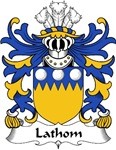
Latham Coat of Arms
Birth: Feb. 15, 1609KempstonBedfordshire, England
Death: Sep. 2, 1677NewportNewport CountyRhode Island, USA
Frances Latham (Dungan Clarke Vaughn) is known as the “Mother of Governors”. Her third husband was the Reverent William Vaughn. She had four children by her first husband; from the descendants of these children are many distinquished statesmen. There are seven children born of her second marriage, and these too have given many governors to the country. Each one of Frances Latham Clarke’s sons served his country, or church, with public service, and each daughter married men who did the same. “She was undoubtedly a very attractive woman, her three marriages would indicate. One can only imagine the gathering of distinquished men and women in the “Common Burial Ground” of Newport when Frances Vaughn, recently widowed for the third time was laid in her grave.There was her eldest Clarke son, then governor, her daughter Mary, with her husband, then Deputy-Governor John Cranston and later governor; and their son Samuel, who before the century closed would also be governor; her daughter Sarah, sometime the wife of Governor Caleb Carr; Barbara with her husband, James Baker, to be chosen the next year as deputy governor; Frances and her husband, Major Randall Holden, ancestors of several of Rhode Island’s governors and one of Washington: Weston Clarke, then attorney-general; James, Latham, and Jeremiah Clarke, with their sons and daughters, and Rev. Thomas Dungan, who perhaps was the one to say the last sacred words over his mother’s grave “Mother of Governors”Her father was Sargeant Falconer Lewis Latham to King Charles I.Children not listed below: John Dungan (died young), William Dungan, Frances Dungan Holden, Elizabeth Dungan (died young), Walter Clarke, Latham Clarke and Jeremiah Clarke Spouses: Married four times1st Lord Weston2nd William Dungan3rd Capt. Jerimah Clark4th Rev. William Vaughn Family links: Spouses: William Dungan (1606 – 1636) Jeremy Clarke (1605 – 1652) Children: Barbara Dungan Barker (1628 – 1677)* Thomas Dungan (1635 – 1688)* Mary Clarke Stanton (1640 – 1711)* Weston Clarke (1648 – 1730)* James Clarke (1649 – 1736)* Sarah Clarke Pinner Carr (1651 – 1706)* Inscription:Here Lyeth ye Body of Mrs. Frances Vaughn, Alias Clarke, ye mother of ye only children of Capt’n Jeremiah Clarke. She died ye 1 Week in Sept. 1677 in ye 67th year of her age.” Burial:Common Burying Ground NewportNewport CountyRhode Island, USA.
 mermaidcamp