mermaidcamp
Keeping current in wellness, in and out of the water
You can scroll the shelf using ← and → keys
You can scroll the shelf using ← and → keys
There is no crazy in the big overview. There is only true and false. To establish a mental health norm we need to establish a norm for the plain old truth. The truth will set us free, but the will to quibble about what is true is stronger than our will to be free. I attended the University of Texas at Austin in 1968 where our very famous tower had been featured a couple of years earlier in the first spectacular insane school shooting in America. The tower says, in giant letters, “You shall know the truth and the truth will set you free.” During the school year someone managed to steal Bevo ,the longhorn mascot, and take him to the top of the tower to hold for ransom. I believe this was part of the Send Bevo to Biafra movement, but that is not the important point. The point is that Bevo himself could be taken to the top of the tower two years after the mentally ill Nam Vet found the perfect spot to take aim at society…that tower. Let us not debate what is true and not true, what is safe and not safe. Let us take a rational overview to see what is happening to our social fabric. Let us be willing to be still and know the truth in order to be set free from our own self inflicted crazy.
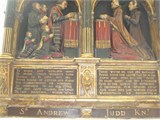
Sir Andrew Judde
My 14th great grandfather founded a famous school in Tonbridge in 1553. He was a trader, a risk taker, and an obvious negotiator. He was the Lord Mayor of London. He was a very wild thing. My father’s tree has many educators in the branches.
Andrew Judde** (1512 – 1586)
is my 14th great grandfather
In 1509 London apprenticed to John Buknell, “a Skinner and Merchant of the Staple of Calais” for 8 years. 23 Mar 1517 First evidence of him as Merchant of the Staple, so released at least a little early from his apprenticeship. On this date he paid the duty for a cargo of wool shipped to Calais. “Thereafter his name occurs frequently“.
In 1520 “took up his freedom as a member of the Skinners’ Company” London. 1520-1521 Fraternity of the Assumption of Our Lady, London; paid 4 shillings “entry money“; high on their list 1524. 1522-1523 Fraternity of Corpus Christi, London; “the account books of the Skinners show … that Andrew Judde paid 20 shillings on becoming one of the ‘Newe Brethern'”.
Mary Mirfyn was born circa 1521. Married Sir Andrew Judde in 1537, London. Died 14
Nov 1550. “Her funeral is entered both in Wriothesley’s Chronicle, and in Machyn’s Diary, both of which have been published by the Camden Society“.
In 1523 London co-executor of his father-in-law’s will with Mirfyn‘s own son. 1533 Master of the Skinners’ Co “and five times thereafter“. Merchant of the Staple of Calais. 12 Jul 1541 Alderman from this date ward of Farringdon without, London. Widowed before 1542? Had had five children with Mary; 2 not in his will. Married Agnes / Annys (—-) in 1542 London; 2nd wife, no children, nothing more known. In 1547 Treasurer of St Bartholomew’s Hospital, London, when it was remodelled. “Certainly one of the richest and most prominent of overseas merchants in early Tudor London“. 1550 Lord Mayor of London: “he had to deal with the problems caused by dearth and by the 1551 ‘calling down’ of the coinage“. One dau. survived from the 3rd marriage. In May 1553 Tonbridge School obtained letters patent for the erection of a free school with the Skinners’ Company as trustees. One of the Aldermen who signed the device of King Edward VI. In Sep 1555 Staple Inn, London, Felipe of Spain (consort of Queen Mary) passed the night at the Staple Inn, and “Sir Andrew presented the King with a purse containing a thousand marks in gold“. Circa 1556 Skinners Hall, London, Judde and Sir John Champneys donated money for the ceiling of the hall, and the Skinners had the arms of both carved as ornaments for the hall. Between 1556 and 1558 “At this time Sir Andrew was buying manors at Ashford and places adjoining from Sir Anthony Aucher, soon to lose his life at Calais. This estate passed to his daughter Alice and so to her son Sir Thomas Smyth, who in his turn was a benefactor of Tonbridge School“.
1557 and 1558 “Surveyor-general of all the London hospitals” London.
Before 1558 Resided at Eshetisford – Essetisford – Ashford, Kent. Will London; “Sir Andrew Jud, skinner, mayor 1551, erected one notable free school at Tunbridge in Kent, and alms houses nigh St. Helen’s church in London, and left to the Skinners lands to the value of 60 pounds 3 shillings and 8 pence the year; for the which they be bound to pay 20 pounds to the schoolmaster, 8 pounds to the usher, yearly, for ever, and four shollings the week to the six alms people, and 25 shillings and 4 pence the year in coals for ever“.
Buried Sep 1558, St Helen’s Bishopsgate, London. Probate Mar 1558 – 1605 Prerogative Court, Canterbury, Kent, Ref. 58 Noodes, 54 Welles (“De bonis non adm.”) grants, March 1558-9 & Aug 1605. Properties in St. Helene, London and Eshetisford, Kent, “etc.”
Sir Andrew, Six Times Master of the Skinner’s Company
Six times Master of the Skinners’ Company, Mayor of Calais and of London, Merchant Adventurer and Knight, Sir Andrew Judde was a man who took financial risks, grew wealthy and founded in Tonbridge one of the foremost public schools in England.
The Judde arms, with boars’ heads, and Skinners’ Company arms, with ermine, are displayed above the Porter’s Lodge entrance to Tonbridge School.
Judde (also often spelt Judd) was born about 1492, the youngest son of a significant Tonbridge landowner John Judde, whose lands were mainly to the south of the Medway, including Barden Park. His elder brothers inherited most of the estate, so Andrew went to London to seek his fortune. He was apprenticed between 1511 and 1517 to John Buknell, a man involved in both the fur trade, as a member of the Skinners’ Company, and the wool trade as a merchant of Calais – then a strategic port in English hands. Kentish wool was exported there and bought by foreign buyers, so that merchants of the ‘staple’, as Judde became in 1517, benefited from the profits in trade and in currency exchange.
Wool was not the only commodity traded through Calais. Sir Andrew’s name was also linked to trade in gold dust from Guinea, imports of oil and later also the fur trade with Russia. In 1533 he became Master of the Worshipful Company of Skinners, an annual post he was to hold six times. In 1550 he became Lord Mayor of London, when he was involved in a variety of problems ranging from the high price of larks to cases of treason. He was knighted by Edward VI at Westminster in the following year.
In his public life Sir Andrew attracted the favour of both Edward VI and Queen Mary despite the swing from Protestantism to Catholicism, through his overriding loyalty to the Crown. In spite of being nominally a Protestant, in Mary’s reign he was active in defending the city from Wyatt’s anti-Catholic rebellion.
The original building of Judde’s ‘Grammar School’ in Tonbridge, viewed from the High Street, as it was in 1836. (THS 12.003)
In 1553 there were two exciting developments in the life of Sir Andrew Judde. The first was that he received a charter from Edward VI to found a school in Tonbridge. Perhaps wishing to invest some of his wealth for the benefit of the town in which he grew up, he bought 30 acres of pasture land known as ‘sand hills’ just to the south of St. Pancras in London. The rents from this land were to provide funds for the new Tonbridge School, raising the sum of £13: 6s and 8d in 1558. Later, as this land was developed for housing the rents increased substantially, enabling the Skinners’ Company, who took over the management of the charity and governorship of the school on Sir Andrew’s death, to add to the Judde foundation a Workhouse (1720) and three more schools, including the Judd School in Tonbridge (1888) and Skinners’ School in Tunbridge Wells (1887).
The original foundation stone of Tonbridge School has been preserved and is now mounted above the Headmaster’s Entrance.
At its foundation, Tonbridge School was to be free, boarding and a grammar school. The last condition meant that the ‘three tongues’ of Latin, Greek and Hebrew should be taught. Another condition was that the school should be close to the Parish Church for regular worship and as Sir Andrew did not own land near enough, it is thought that he rented or bought land from his nephew Henry, who had just inherited land called ‘Houselands’ close to the centre of Tonbridge. The school opened there in 1553 with just 16 pupils, but now there are a total of about 3,200 children educated in Skinners’ Company schools.
The second important event in 1553 was the despatch of an expedition by the Merchant Adventurers Company of London, of which Sir Andrew was a prominent member. He and others financed the expedition to look for a north east passage through the Arctic to Asia, and to find new markets for English wool. Two of the three ships were lost near Lapland, but the third drifted by accident into the gulf of Archangel and its captain, Richard Chancellor, went on to make the difficult overland journey to Moscow to meet the tsar, Ivan the Terrible. He had with him a letter from the King and from that year the trade with Russia began and the Muscovy Company was created. Richard Judde, Sir Andrew’s son, was with Chancellor on his second expedition to Russia. On that occasion two of the four ships were lost which, with the first expedition, amounts to a less than fifty per cent rate of success. It was a risky enterprise but expeditions continued to be financed by the Company in which Sir Andrew played a leading role, and before long strict rules were drafted to improve safety and therefore the success of the expeditions. One expedition, to Guinea, brought back a rare trophy, the head of an elephant, which Sir Andrew kept in his house to show to visitors.
Sir Andrew Judde died in 1558 and was survived by his third wife, Mary, four sons and two daughters. He is buried in St. Helen’s Church on Bishopsgate in London, and a memorial there, thought to be commissioned by his heirs in about 1600, describes some aspects of his life. It is not thought to be very accurate since, because of his public duties, he never visited Russia and Guinea himself, though he was closely involved in the finance and organisation of expeditions there. The epitaph reads:
TO RVSSIA AND MVSCOVA / TO SPAYNE GYNNY WITHOVT FAYLE / TRAVELD HE BY LAND AND SEA / BOTHE MAYRE OF LONDON AND STAPLE / THE COMMONWELTHE HE NORISHED / SO WORTHELIE IN ALL HIS DAIES / THAT ECH STATE FULL WELL HIM LOVED / TO HIS PERPETVAL PRAYES
THREE WYVES HE HAD ONE WAS MARY / FOWER SUNES ONE MAYDE HAD HE BY HER / ANNYS HAD NONE BY HIM TRVLY / BY DAME MARY HAD ONE DOWGHTER / THVS IN THE MONTH OF SEPTEMBER / A THOWSANDE FYVE HVNDRED FYFTEY / AND EYGHT, DIED THIS WORTHIE STAPLAR / WORSHIPYNGE HIS POSTERYTYE
In addition to the Judd School, and Judd House at Tonbridge School, Sir Andrew’s name is commemorated by Judd Road in Tonbridge and Judd Street on what is now the Skinners’ Company Estate in St. Pancras.
Copies of An Essay on the Life of Sir Andrew Judde (1849) by George Maberley Smith and Sir Andrew Judde (1953) by H. S. Vere Hodge are in the Local Studies Collection at Tonbridge Reference Library.

Coopers Hawk Fledgling

I live in the middle of Tucson like Gabrielle Giffords. She lives somewhere just south of my neighborhood in a much fancier part of town. On the anniversary of her shooting two years ago, today there are ceremonies to ring bells, hang bells, pray, and commemorate. Tucson seems to me less peaceful, less educated, more reactionary, and more dangerous than it was two years ago. The city creates PR about how we have come together as more civil and less crazed, less armed, less scary…as IF!!!!!!
Where I live the cops do not respond for at least an hour and then they do not bother to even report the crimes you report to them. Nobody calls them because nobody wants to wait around for no reason. The gun store close to my house has had an overflowing parking lot for the last month. My next door neighbor who goes to the shooting range with a bunch of cops on Sundays told me their highly armed group is freaking out because there is no ammo in town to be purchased. They know that the government is a threat to their freedom, and want to buy all the ammo they may need to defend themselves against the government when they try to take their arms.
While commemoration is all well and good, there are plenty of mentally ill people roaming the streets where I live with instant access to weapons. Unfortunately, they have no access to or interest in mental health therapies. There are no cracks to slip through because there is virtually no safety net to treat mentally ill Tucsonans. There is a place where they can score prescription drugs, but no therapy. There is no evidence of effective law enforcement. If Gabby stayed in my neighborhood for a few days she would understand how futile law passing is. With all due respect to her point of view, nobody enforces the laws we have now. Why would adding more laws have a positive effect? I notice a frightening negative effect in the ammo buying population, all agitated and wanting more arms. Every action has an equal and opposite reaction. It bears repeating, gentle reader.

Sir THOMAS
My 13th great grandfather pissed off the Tudors several times. It appears that the customs office of the queen was privately held somehow, like outsourcing. Elizabeth I gave him the job of collecting customs fees, but he was taken to court for shortages more than once. His son, Sir Thomas Smith was instrumental in colonizing the world from the British Isles. Just like my mother’s Taylors, these Smiths marry some other Smiths down the line, just to keep everyone guessing.
Sir Thomas SMITH was born 1522 in Weston Hanger, Kent Co, England. He died 7 Jun 1597 in Kent, England. Sir married Alice JUDDE on 1554 in Weston Hanger, Kent Co, England
The Harris and Smith families were interested in the discovery and development of Virginia. He is referred to as “Customer” Smith and rose from obscurity in Queen Elizabeth’s time by marrying the daughter of Sir Andrew Judd, the Lord Mayor, of humble origins himself. THOMAS SMYTHE of Corsham, Wiltsbire, England was born in 1522 and died 7 June 1591 leaving a will. He married ALICE JUDDE, daughter of Sir ANDREW and MARY Mirfyn/Mervyn JUDDE. “Item. I give and bequeath to the children of my sonne in law, WILLIAM HARRIS, Esquire,BR> which he hath or shall beget uppon the bodie of my daughter ALICE, his wife, the like somme of five hundred and fiftie pounds to be equally divided between them. And if any of them shall fortune to decease, then the parts and portion of such as shall decease to remayne and be paid and divided indifferently between the Survivors of them.”
27. Alice JUDDE was born 1535 in Weston Hanger, Kent, England. She died 1593 in England.
ALICE (Judde) SMYTHE, widow of THOMAS, dau of ANDREW and MARY JUDDE, left a will dated 10 July 1592 London, proved 1598 in Prerogative Court of Canterbury. “Item. I bequeath to my daughter HARRIS my Jewell Ringe, an of Diamonds, A table cloth of Damask of the Story of Samyell conteyn inge five yeards in length, A doble Lowell and two dozen of napkins and two chayres of crymson silk taffeta. “Item. I give to her sonne THOMAS HARRIS twentie pounds, and to Arthur, her sonne, tenne pounds to be paid at theire ages of twentie and one yeres. “item. To her daughter Al ice, twentie pounds, And to her daughter Dorathie tenne pounds to be payde to the same daughters at their marriages or ages of twentie and one yeres, whichsoever of the same time shall first happen.”
John Steinbeck wrote American novels that richly described in detail the place and time. His final book was about greed and ethics. The title, Winter of our Discontent, was taken from a line in William Shakespeare’s Richard III. When I look back in history by studying my ancestors I see a constant struggle, sometimes ignorant, sometimes violent, about greed and ethics. Our current crossroads and choices are similar to the ones found in history. “There may be better times, but this one is ours.” J P Sartre. We have to go with what we’ve got.
Since nobody has free time for an epic Greek drama, or even Shakespeare, our morality play has to be formatted for a smart phone and be shorter than 2 minutes to have impact. I admire Alan Simpson as an artist and a scholar. The essence of his distinguished career as a statesman and public servant could not possibly be summed up better than his dance with the can. The medium is the message. He knows how to communicate. Get down on it, Alan.
Tradicionalmente en Tucson los negocios han servido el mercado de ambos lados de la frontera. Nogales, Sonora es la puerta de entrada por la mayoria de frutas y verduras que exporta el pais de Mexico. Hay bastante negocio y riqueza en Sta. Cruz County y en Sonora desde el tiempo de los Espanoles. Ranchos enormes y negocios viejos, acostumbrados de la cultura y los riesgos de la frontera sobreviven. Tucson, entre el diablo y la frontera, sufre poque los Maricopanos han parado comercio legitimo, pero no el crimen. Nos molesta, pero ellos tienen el poder político en el estado. Joe Arpayo no nos representa.
La gente de Sonora ya no tiene ganas visitar Arizona ya que SB1070 es la ley. Esto me parace muy natural. Tucson tiene una herida economica bien seria resultando de la clima politica. El nuevo alcalde de Tucson, Jonathan Rothschild, quiere renovar el comercio entre Sonora y Tucson. Si tiene éxito los Mexicanos, lindos y queridos, van a regresar con su efectivo a nuestra ciudad. Yo le brindo mucha suerte porque nos hacen mucha falta nuestros vecinos Mexicanos elegantes, distinguidos, y mas que todo, ricos, que antes nos visitaban. Aqui les esperamos, para servirles, sin pedo.
Disculpe el Espanol desnudo. No he encontrado el espellcheck en Espanol en mi WordPress.

Joe Bonnano
I live in central Tucson, where we are surrounded with gun dealing, dope dealing, human dealing, and we are not sure what else. Here everyone knows that these illegal businesses are perhaps the strongest part of our economy. Tucson works on that trickle down theory…if we let lots of crime money circulate in the city, somebody will buy something from the legal merchants. We are well aware that cops do not make extra money enforcing laws, but rather by strategically ignoring them.
People in other parts of the country might be shocked by what is called the neighborhood watch program in this city.. Our neighbors have had three visits from the neighborhood watch cop. We had a functional handful of neighbors who regularly e mailed and gave information to each other about crime, safety, and suspicious activity. We met with her to find out how to enhance our skills and coordinate with the TPD. She came but told us we did not meet the requirements she had to follow, so she could not work with us. We went ahead the same way, just using our e mail list to contact each other.
The second meeting set up to form an official watch was a few days before a sales tax election that was of great importance to the officer. Although we had far fewer attendees at the second meeting, she decided that this time we could make it official. So she stayed for an hour and promoted the sales tax and told us we already had no hope of law enforcement, but if the sales tax did not pass she might loose her job. I remember thinking, she really should loose her job since she is out here not doing it at all right now. After the official status was granted I contacted her to help eliminate the extreme flaming crime that we had to tolerate full time in the form of a charity scam operating in our public areas. She refused to help or respond. She told me to call the parking authority to try to remove the log jam of cars that blocked us into our houses while they made donations to the criminals. The parking authority did arrive six months later and ticket a neighbor who had been illegally parked for a decade, but all the neighborhhod had to live with full time fully public crime by three of the thirty houses in our condo village. Since they were in the scam business for years, our property value has been reduced to almost nothing. Nobody would come to look at a property where the residents were fully parked in to their homes with crime traffic.
The third meeting with the officer was even more poorly attended, with only three other homes represented, other than the full time criminals. So, with the threashhold of a minimum of 16 participants, she went ahead with a brief meeting to sanction the tiny, close knit, and full time criminal group who sat before her as our official neighborhood watch. The other homeowners would just be able to watch while their quality of life is trashed by this group. I raised the issue that there were not close to a majority there, which was met with hostility by both the charity scammers and the cop. What they have in common that aligns them is a desire to be hostile rather than aware. I watched a functioning group of neighbors turn into a crime enhancing group of punks under the guidance of the TPD. No exchange of information has been done since she sanctioned the criminal group. They refuse to respond, just like the TPD. I want to recognize the important work being done by this branch of law enforcement, and I want to stop paying for it. It seems to damage society when cops pretend that crime is not their problem. We don’t need to pay tax dollars to extend willful blindness to crime. We already have that.
There is a number to call in the ad above to tell congress if you want to stop living like Jessica Rabbit in a bad cartoon. Tweet them, write them, fax them, call them, and beg for mercy on this country. Each new installment of this congress show is less acceptable than the last. We have gone beyond throwing bums out, and must address the systemic way this all came about in the first place. I think it would be good to know what happened on K Street before lobbyists moved in and started running the Howdy Doody Show.

Hamlet and skull
that is the question…..wheather it is nobler in the mind to suffer the slings and arrows of 140 character communication, or ignore it. Peeps who do not tweet are not neccesarily out of touch, while tweeps who do may be wildly deranged or just killing time. Considering how much time is killed in real time, we must admit that this double edged sword cuts both ways. Our challenge is to use it for the benefit of mankind. I am sure there were many fatal errors while humans became familiar with the properties of fire, but eventually the power was harnessed for beneficial uses. The printing press, and, Oy Vey!, the printed Bible have drastically changed the course of history. The tool itself must not be maligned, but investigated to find the highest and best use.
We have a tool for democracy called congress which,in itself,is not a bad idea. It was created to govern our republic. There were corporations in early America, but there were no superpacs. Carolyn Myss uses an excellent example in the book Sacred Contracts to explain the use of tools on earth. She used the example of learning to use a knife. If you grab the knife by the blade it will be painful and destructive. When the paid becomes too great you may decide to use the handle of the knife which makes the knife useful for many purposes. Then the knife can cut food and perform a number of other useful tasks. We need to grab congress by the handle now. This is much too painful. This is our time in history, post Zombie Appocolypse global hot house. How shall we handle this?

Merry Praksters
There is one safeguard known generally to the wise, which is an advantage and security to all – suspicion. –Demosthenes
How can we cultivate a healthy sense of disrespect and suspicion that is mindful of and careful with the opinions of others? We see no mature examples set by politicians. Religious leaders all teach healthy disrespect for worldly authority. Some religions teach that all worldly authority is to be shunned because of the wicked nature of it. The nuns on the bus dissing the Pope showed healthy suspicion of politicians trashing the poor to be elected by the rich. There was a saying that resonated back in the hippie world. “You are either on the bus or off the bus.” The phrase came from the book The Electric Acid Kool-Aid Test by Tom Wolfe. We also talked constantly about revolution, and the end of the empire. Bob Dylan, The Dead, Angela Davis, Black Panthers, SDS….. it was all very meaningful….and then it faded like morning dew in a folk song. Perhaps these nuns were hippies who never lost the baby faith.

