mermaidcamp
Keeping current in wellness, in and out of the water
You can scroll the shelf using ← and → keys
You can scroll the shelf using ← and → keys
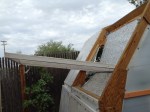
My visit with Michael Ray yesterday was fun and informative. Here he tells us about the benefits of the Nursetree Garden Arch:
I am impressed with his continual learning and improvement of his invention. I have been through the prototype process with Floatli and know it is both fun and frustrating. You can only learn through experiment. I believe Michael has created a wonderful tool desert gardeners will be needing more and more. A dozen years ago I bought 5 acres in Oracle, AZ with a gushing well, thinking I would grow food. When I sold the property last year the well was almost depleted for household use. In a way I was lucky I did not plant a big orchard and then loose the water for it. Today I garden in the city with an eye toward conservation of every kind. The garden arch is an innovative way to save water and grow food.
Michael Ray and I met at a small business group that meets at Tucson’s Ward 3 office once a month for a convo. When I saw the pictures of his invention I wanted one. After learning more in subsequent meetings, I asked to interview him about his gardening transformer, the Nursetree Arch. He developed this water catching temperature controlling environment for desert gardeners who have climate challenges. I love the way he can adapt his new prototype to the situation and economic needs of the particular client.
The fully decked out robotic arch in which Michael is growing papaya as well as brussels sprouts in Tucson on August fist is fancy indeed. He is recording data to help him refine his work. His outdoor garden benefits from his arch used as seedling starter in the winter.






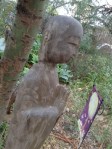
Leonardo, the maestro, was guided by core principals. Cultivation of grace ambidexterity, fitness, and poise were central to Da Vincian thought. He viewed healing as “restoration of discordant elements” in a person. His copious notes on personal responsibility for our own health and well being were left for history. Many think of the Mona Lisa smile as his signature work, but probably the best known of all his art work is the anatomical range of motion dude in a circle and square known as Vitruvian Man. His study of anatomy was accompanied by observation of his own body in relation to his wellness and fitness routine. His self portraits are studies in facial anatomy as well as in painting technique.
He advised people to dine, not eat. One of his many specialities was preparing vast feasts and party catering for wealthy Florentines. He collected knowledge about food and nutrition, recording recipes. He was known about town as having “more than infinite grace in every action”. His cultivation of effortless poise and ambidexterity in his own body made him famous in a rock star way. Florentines would come out on the street for the thrill of seeing Leonardo walking. His notebooks reflect a focus on balance, posture, and centering.
His favorite metaphor was the human body. It is also my own. If you consider any entity it will have a head, a heart, a circulatory system, consumption, and processing of waste. It will have dynamic balance and movement. It will present itself as open or closed, happy or sad. It will have chronic maladies and moods, a backbone, and sharp or weak senses. Often the right hand will not know what the left hand is doing. Next time you need to analyze an institution or business use this metaphor to create a picture in your mind. Ponder one of the maestro’s most famous observations, “every part is disposed to unite with the whole, that it may thereby escape from its own incompleteness.” At this moment, gentle reader, can you see how this applies to you?

Vitruvian Man
In Tucson our cops represent themselves very badly. A cop in training went to a gas station wearing a bullet proof vest waving his duty weapon at the clerk. He was looking intoxicated, which he has a right to be..in private…but not in public with the vest and weapon we supplied for this loose cannon. The TPD asks the public to excuse this little incident and forget another recent cop drunk driving to work event. Our tax dollars are being spent wisely we are assured. I don’t know anyone who trusts the TPD in my neighborhood. I do not like the way they spend my tax dollars.
If the general public has so much mental illness we need to assume that some of the cop population suffers from similar problems. If we look at evidence we notice that our police in Tucson behave badly. I am not at all pleased to have armed this punk who used his duty weapon to show his alignment with reality. Guns do not kill people…drunk punks dressed in vests certainly might.
Jamestown
My 10th great-grandfather sailed to America in 1610, settling in Virginia. He became the official interpreter for the colony, and served in many other public service capacities.
John Flood (1595 – 1658)
Notes- John Flood alias Fludd sailed from London aboard the ship “SS Swan(n)” in the summer of 1610 and landed at Jamestowne, Virginia, America in the same year. The passenger list describes him as “a gent” (gentleman). He took with him a considerable supply of provisions, including “corn, pease and beanes”, and also firearms and ammunition. He was the son of Nicholas Fludd, who was a younger son of Sir Thomas Fludd, a wealthy land owner living at Millgate, Bearsted, Kent. Nicholas married Elizabeth Davis at St. Andrews Church, Canterbury, Kent in February 1588/9.Initially John would have worked for various employers but he is known to have been employed in 1616 by The Reverend Alexander Whitaker, in Charles City, a settlement just to the west of Jamestowne, who is reputed to have converted Princess Pocahontas to Christianity in c1613. She is said to have been married to John Rolfe by Reverend Bucke at about this time. John was to marry Margaret Finche, widow, in c1624/5. She had arrived in Jamestowne in 1620 aboard the “SS Supply” with her husband William Finche and their daughter Frances. In September 1620 they are recorded as each holding fifty acres of land, but by 1624 William had passed away and John had married the widow Finche and they were living in Jordan’s Journey with their children Frances Finche and William Flood.By 1638 John had accumulated a considerable amount of land including that of his wife by right of marriage, and he was declared an Ancient Planter such that he was entitled to another 100 free acres of land. He was also granted a Patent of 2100 acres of land, where he established his plantation, located on the south side of the James River just opposite the town of Jamestowne. Here their other children were born, John c1627, Thomas c1629, and Mary c1635.His wife Margaret died c1644, leaving John with the young children. A year or so later he married Fortune Jordan, sister of Col. George Jordan, legislator, a member of a well known and influential family of Virginia. Their first daughter Jane, was born soon after and son Walter was born in 1656 when John was aged sixty-four.John served as a Representative in the Virginia House of Burgesses for twenty-two years, representing the areas of Flowerdieu Hundred, Westover and Weyanoke and served at least one term as their Speaker. By 1643 he was one of the representatives of James City County. In 1655 as Colonel John Flood, he was serving as a member of the local militia.At his death in 1658 he was Chairman of the Surry County Commission which held Court and administered the affairs of the County.John survived many hardships including the Indian uprising and massacre of 1644 which caused a break in the Colony’s fur trade. The Indian Treaty of 1646 gave the trade some protection with the erection of 4 forts along the frontier to which the Indians were permitted to come and trade. One of them, Fort Henry, was located on the south side of the James River, on the Appomattox. Across the river from the fort was the home of Captain John Flood, as he was then, who was appointed to the post of official interpreter for the colony.The Grand Assembly held at James City October 5, 1646, enacted the following: “that upon any occasion of a message to the Governor or trade, the said Necotowance and his people the Indians doe repair to fforte Henery, alias Appmattucke fforte, or to the house of Capt. John ffloud, and to no other place or places of the south side of the river, att which places the aforesayd badges of striped stuffe are to be and remaine. Indians found in ceded lands who were not wearing special striped coats picked up at the designated forts were to be killed on sight, and any white illegally entertaining Indians was to be punished severely. Be it also enacted that Capt. John ffloud be interpreter for the collony, and that for his service therin and transporting such Indians as shall be employed from time to tyme to the Gov=r in a message or otherwise, he is to be allowed from the publique the salary of four thousand pounds of tob’o yeerly.”. (The farming of tobacco was so widespread that it was used as a basis for money and trade).FLOOD(from page 301; “VIRGINIA HISTORICAL GENEALOGIES”, by Boddie)Col. John Flood (ca 1595-1658), of James City and Surry Counties, Va., arrived in 1610. In the “Muster Rolls, of Settlers in Virginia, 1624/5” is; “The MUSTER of John Fludd: John Fludd arrived in the ‘Swan’ 1610, Margaret, his wife, in the ‘Supply’ 1620. Frances Finch, her daughter, in the ‘Supply’ 1620, William Fludd, his son, aged 3 weeks”. John Flood was living in Charles City in 1616 and at “Jordan’s Journey” in 1625; in 1638 he patented land and settled in James City County just across the river from Jamestown in the section which in 1652 became Surry County.The above mentioned patent, dated May 12, 1638, was issued to “John Fludd, Gent,” and was for 2100 acres “E. upon land of Capt. Henry Browne, N. upon the maine river, S. into the maine woods & W. upon Benjamine Harrisons marked trees being upon the W. side of Sunken Marsh Cr.”, for transportation of 42 person. On June 7, 1650, “Capt. John Flood, Gent.” surrendered this patent and was given another of 1100 acres “on S. side the river, bounded S.E.S. upon land of Capt. Henry Browne, N.W. by N. upon land of Mr. Charles Foord and Richard Baven.” Among his headrights were listed: John Flood, an Ancient Planter, Margt., his wife, Frances Finch her daughter, John Flood, Junr., Eliza. Browne, John Lawrence, John Wright, Wm. Wood, and others. (“Cavaliers and Pioneers”, pages 86 and 194).On Jan 16, 1643/4, John Flood witnessed the will of Capt. Thomas Pawlett (owner of Westover) who left one silver spoon and one sow shote apiece to his godchildren, Wm. Harris, John Woodson, Tho. Aston, Thomas Fludd, Henry Richley, John Bishop, Tho. Woodward, Tho. Boyse, Tho. Poythers, and William Bayle. (“Title of Westover”, by Dr. Lyon G. Tyler, in Wm & Mary Qrtly, Vol 4, p 151).The Grand Assembly held at James City October 5, 1646, enacted – “That upon any occasion of message to the Gov’r. or trade, the said Necotowance and his people the Indians doe repair to fforte Henery alias Appmattucke fforte, or to the house of Capt. John ffloud, and to no other place or places of the south side of the river, att which places the aforesayd badges of striped stuffe are to be and remaine.” ***”Be it also inacted that Capt. John ffloud be interpreter for the collony, and that for his service therein and transporting such Indians as shall be employed from time to time to the Gov’r. In message or otherwise, he is to be allowed from the publique the salarey of four thousand pounds of tob’o yeerly.”The Grand Assembly held at James City July 5, 1653, ordered – “And the commissioners of York are required that such persons as are seated upon the land of Pamunkey or Chickahominy Indians be removed according to a late act of Assembly made to that purpose, and Coll. John Fludd to go to Tottopottomoy to exam the preceedings of business and to deliver it upon his oath.”John Flood was only a boy when he came to Virginia but he was active and energetic and rose to high honors. He was Burgess for Flowerdieu Hundred in 1630, for Westover, Flowerdewe in September 1632; he was one of the Burgesses for James City County in 1643, 1645, and 1654. He was Captain in 1643 (and probably earlier), Lieutenant-Colonel in 1652, and Colonel in 1653. At his death in 1658, he was Chairman of the Surry County Commission which held Court and administered the affairs of the county; the other commissioners at that time were Lt. Col. Thomas Swann, Capt. George Jordan, Capt. Benjamin Sidway, Mr. George Stephens, Mr. Thomas Warren and Mr. James Mason. He was also Speaker of the House of Burgesses in 1652. (5 V. 185) Spouses1 Margaret Unknown, F Death Date1644Death PlaceVAMarr Dateabt 1624Marr PlaceVAChildrenMary , F (~1635-~1678)2Fortune Jordan, F Birth Date abt 1623 Birth Place England Death Date14 Jul 1668 Age: 45Death Place VA Father Arthur Jordan , MMother? Unknown , F Marr Date 1645 Marr Place VA Children Walter , M (-1722)
Last night we attended our first farm to table dinner in Tucson. Zona 78 prepared a fresh and exotic menu featuring produce from Sleeping Frog Farms in the San Pedro valley. Four courses featuring produce were presented, along with a delicious berry cocktail or a glass of wine. All of our expectations were exceeded, from service, presentation, variety, to innovation. If you have not tired Zona 78 or Sleeping Frog Farms produce, I highly recommend that you do. We hope the farm to table dinners will become a regular feature because it is an extraordinary way to dine and expand horizons. We met cool people and discovered new cuisine, which is exactly our style.
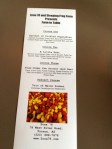
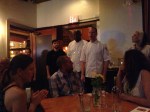







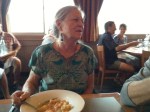

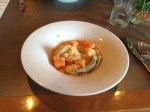



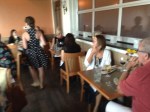

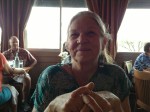


We were pleased and happy to taste and enjoy such creative innovative cuisine.
In my tree I have several ancestors who owned slaves in America. When your family has owned slaves, you are forever affected by that history. The slave archetype is a very interesting symbol. I had not considered the aspects that can both teach and menace. The ultimate slavery is full surrender to the divine. One’s own will is sacrificed to the divine will in order to be fully enlightened. Military discipline requires following orders without question. We don’t think of soldiers as slaves, but there is an aspect of it in the lack of choices. Some are slaves to substance abuse or systems of belief. This slavery may seem completely voluntary, but cultural pressure might be a strong factor. The positive slave archetype is the monk who devotes his life to divine providence. The shadow aspect of the slave today is the person who gives up choices, such as cult activity. Choice involves individuation. Following the script of the collective consciousness today without question is slavery.
My 6th great -grandmother, Sara Holt, was from a family that came to Virginia in 1620, so slavery probably was always part of their existence, like most colonials. She and her husband from Northern Ireland owned slaves and lived in a fancy style:
Sarah Truly, A Mississippi Tory By Madel Jacobs Morgan
The Journal of Mississippi History, Vol. XXXVII, No. 1, February, 1975
One of the most loyal advocates of the rule of King George III of England was Sarah Truly, a resident of the Old Natchez District when it was a province of Spain. She came to the Natchez District from Amelia County, Virginia, where she lived in comfortable circumstances with her husband Hector and their seven children: John, James, Bennet, Eleanor, Sarah, Judith and Martha (Patsey). It can be deduced from Hector’s will, which was probated in 1761, that the Trulys pursued life in the cavalier tradition. Daughter Eleanor rode sidesaddle on her own bay mare, Hector owned slaves, and he had a “complete distillery”. He had, as well, three hundred acres of land, two prayer books, four testaments, two hymnals and “one other book”.
As Revolutionary sentiment took root and spread, the position of Sarah Truly and the other Tidewater Virginia loyalists became less and less tenable. At the close of the decade following Hector’s death, Sarah and her brothers Dibdal and David Holt took positive action to improve their situation. Having learned of the rich lands along the Mississippi River which the British were making available for colonization, they began investigating the possibilities of a move. One of the Holts went to British West Florida in 1770 to consult with the governmental authorities about lands. He returned to Virginia; then, along with his brother and a neighbor, Robert Montford, he came back to West Florida the following year on another scouting trip.
Along with her brothers, the Widow Truly made preparations for the long journey southward. “Refusing to be a traitor to my king,” she said later, “and not wanting to live at enmity with my neighbors, I sought a home under the Spanish flag.”
Six of her children came south with Sarah Truly, John remained in Virginia. Her three brothers, David, John and Dibdal, accompanied her, as did a son-in-law, Francis Spain (Eleanor’s husband), the Spain children, and the slaves. If their caravan followed the route described by other migrants of that time, they traveled overland through the Cumberland Gap and across what is now Kentucky, where they paused to build a flatboat to embark on the Ohio River, floating on to the Mississippi and thence downstream to West Florida.
Seventeen hundred and seventy-three was the date of their arrival in West Florida. The first grant of land to Sarah Truly was most likely in one of the Feliciana Parishes of Louisiana, and it has been said that Bayou Sarah was named for her. She soon moved to a site north of Fort Panmure in the Natchez District.
The Widow was beset with difficulties from the start. The first year, she and her family were all sick and could not make a crop. She was obliged to sell a negro to buy provisions. In 1774, the younger son, Bennett, was hired by a neighbor, Mr. Lum, to row his boat up the river—his pay to be in corn for the use of the family. On arriving upriver, Bennett found the hunting good and instead of returning home, he remained four years.
In 1775, son James took his departure. He returned to Virginia to fight with his native colony against the crown. By this action James not only left the Widow Truly without the help of either of her sons, but placed her in the deplorable situation of acknowledging herself the mother of a Revolutionary soldier.
In 1778, both of the boys had reappeared on the scene. Bennett returned to find Sarah engaged in getting her corn crop planted. Instead of staying close by to lend assistance, he betook himself off to the bright lights of Natchez. There he stayed wntil the fall of 1778 when he went off on another hunt. But this hunt was of shorter duration. Bennett and those with him were captured by James Willing, the American officer–and a resident of the Natchez District–who was then raiding, pillaging, and recruiting on behalf of the American Army. Bennett was taken to New Orleans but soon came back home to his mother; and, Loyalist that he was, he enlisted in the local militia.
In the meantime, James Truly had returned from Virginia the the Natchez country in 1778, still a Revolutionary. He immediately made himself useful to the American cause by acting as a guide for Willing when he arrived at the Natchez landing in mid-Feburary with a company of American soldiers.
In 1779, the Widow had son Bennett at home. In her own words, Bennett “came to my house and worked with my lands and finished the crop with my three slaves.” Out of the proceeds of that crop, she paid off $300.00 in debts that Bennett had contracted in the neighborhood.
The following year Bennett seems to have been somewhat more dependable. She put him in charge of her crop, and with the help of four slaves he cleared 3,000 pounds of tobacco. It seemed as though things might be looking up for the Widow Truly. Bennett was at home and working, and the crop was good. Unfortunately for all concerned, Bennett came up with the idea of building a grist mill in partnership with one George Fourney. Sarah, who could see through such schemes, was expected to provide the capital for this venture–an idea of which she heartily disapproved. As later attested by Sarah’s daughter and granddaughter, Eleanor and Tabitha Spain, the Widow considered Fourney unreliable; and Bennett had not yet proved himself capable of carrying out such an ambitious project. In other words, Sarah had no desire to have a mill stone around her neck. Irrepressible Bennett went on with his plans, however, in spite of the objections and scoldings from his mother.
There was another complication! The sight of the English flag over Fort Panmure no longer gladdened Sarah’s heart. In its place waved the golden lions of Spain, for the Natchez district had been surrendered to Galvez when he captured Baton Rouge in1779.
No sooner had the English garrison evacuated Fort Panmure to the Spanish than Anthony Hutchins and John Blommart began plotting to recapture the Natchez District for the English. They were aided and abetted by the Widow Truly. She was a mere woman and has thus far received scant notice of historians, but the testimonials by her Natchez District neighbors vouch for the fact that she did all she could to assist the English cause and deal misery to the Spaniards.
When Galvez withdrew his heavy artillery to Pensacola, to bombard the British stronghold there, the Loyalist element in the Natchez District made plans for a revolt. Their plans came to fruition in 1781. While one group of the Loyalists took up their position at the house of John Rowe (Row, Rault) in plain view of Fort Panmure, another group was ensconced in a blockhouse especially built for the occasion by Madame Truly. The so-called rebels who took refuge in the blockhouse on the Truly holdings prepared themselves for a seige and even dug a well so that water would be plentiful. This well was later the subject of much controversy, for it seems that Bennett had contracted with Thomas Rule to dig a well on Sarah’s plantation, giving him a horse in payment. Before Rule could dig the well, the “rebels” encamped in the blockhouse dug it. A year later Sarah sued Rule for the price of the horse, charging that he did not fulfil his contract. The court ordered Rule to fulfil his contract by digging a well as originally specified. Thus, we can be reasonably sure that in spite of other vicissitudes she may have encountered, the Widow Truly spent the last days of her life well watered.
With the capture of Pensacola by Galvez and the arrival of a Spanish force at Natchez, the revolt collapsed (in May, 1781). The insurgents scattered in every direction. Some, led by Anthony Hutchins, went overland to Savannah and thence to England. Some struck into the wilderness where they joined a robber band. Another group became Spanish prisoners and were taken to Spanish headquarters at New Orleans. It is a matter of record that Sarah Truly made a quick trip to New Orleans in 1781. Whether she went there in the interest of her land holdings or was called up before the Spanish authorities for her part in the counter revolution against them is a matter for conjecture. She left at home two of her daughters, Eleanor Spain and Patsey Truly and a granddaughter, Tabitha Spain. Also at home was Bennett whose gristmill project had been interrupted by the revolt. But while Sarah journeyed down the river to New Orleans, Bennett rounded up George Fourney; and they slyly took advantage of the widow’s absence to complete the gristmill.
Upon leaving New Orleans, Sarah embarked for home by rowboat. She “encouraged the hands to row briskly” saying that they should have plenty of meat when they reached home. A trip to New Orleans by rowboat would be an ordeal at best, but in May with intense heat added to the humidity of the river swamps, not to mention the abundant insect life that thrives in such conditions, it must have been almost unbearable. Worn and exhausted and accompanied by the hungry crew, the Widow reached home expecting a feast. She found only two pieces of meat in the house. She went into a rage. Eleanor, Tabitha and Patsey wrung their hands. When the Widow inquired of the three girls what had become of the meat, one can imagine the violence of her reaction on being told that Bennett had given it to George Fourney, his partner in the gristmill.
Sarah Truly lived for ten years after this unfortunate episode, and it was her fortune to spend the entire time under Spanish rule. From the court records we learn that she spent much of her remaining time before the bar of justice—suing, being sued and testifying as wittness. The Spanish governors seemingly bore her no ill will for having taken arms against them, and she was always treated with the greatest consideration. Her name is mentioned in more than forty different places in Spanish court records, indicating that she was a woman of diverse interests. She loaned money, she bought and sold slaves, she dealt in lands. Various witnesses testified that she “cursed” and “scolded”. No one could deny that Sarah Truly was a woman of spirit.
Her children settled close around her, forming a sizeable clan of Trulys and their kin. James married Elizabeth Burch, a widow, and they brought up an interesting family at Truly’s Flat in what is now Jefferson County. Irrepressible Bennett married Mary Lum. Always on the lookout for a good investment, Bennett became interested in a cotton gin and in 1796 we note that he was hauled into court for turning out inferior cotton. Eleanor Spain and her family lived in Jefferson County. Judith married a Holstein and she was in England in 1796.
Two of the Truly girls, first Sarah and after her death, Patsey, were married to Captain Richard Harrison who was noted for his services in the American Revolution when he served as a courier for George Rogers Clark. The Harrison home, Auburn House, still stand in Jefferson County.
Age finally caught up with Sarah Truly, and she was “infirm and weak” on March 15, 1792, when she made her will. She left her “beloved son Bennett” a slave “Annico”, who had two children, and one large looking glass. To daughter Eleanor Spain went her prized feather bed and furniture. To daughter Martha Harrison went her scissors and thimble. The residue of her estate was to be divided among James, Bennett and Eleanor. Then passed from the scene a forceful character and gallant pioneer–a woman of loyalty and courage.
That many of her traits passed down to her children there is little doubt. As a fitting sequel to her tempestuous life, we note a paragrapg appended to her will which begins as follows: “7 May 1793. Whereas a controversy has arisen between the heirs of the late Sarah Truly, concerning the division of her estate…..”
Edict of Nantes
My 9th great-grandmother was born in France and died in Northern Ireland. As usual ,this exodus was inspired by an escape from religious persecution. Her family would later settle in South Carolina as Presbyterian religious and military leaders. She married into a family called Pickens, or Picon:
The Pickens Story. as told by Stuart Clark Pickens.
About 870 a.d. the Viking “Stirgud the Stout” and his men landed in the Orkneys and Northern Scotland. They came from Norway in an effort to expand. The Pickens name comes from this group of Vikings.
Later, under their Earl, Thorfinn Rollo, they invaded France about 910 AD. They held Paris under siege until the French King, Charles the Simple, conceded defeat and granted Northern France to Rollo, who became the first Duke of Normandy.
A descendant of Duke Rollo was Duke William who invaded England in 1066. William had a census taken in England in 1086 and compiled the Domesday Book. This Listing of names has Picken listed and many variations of the spelling as well. Most notably “Pinkeny” which in the 1200’s lived in Picquigny in the Somme in the arrondisement of Amiens in Normandy.
Ghilo Pinkeny was a Domesday book tenant in chief in the county of Northampton and others, and his son Ghilo, founded the Priory of Weedon in Northampton which was a branch of the original Priory at St. Lucien in Beauvais near Picquigny. They branched into Yorkshire and acquired Shrover Hall where they were landed gentry. They also established a seat in Oxfordshire where the name was Pinke.
The Pickens name emerged as a notable English family name in the county of Northampton where they were recorded as “a family of great antiquity seated as Lords of the Manor and Estates in that shire.”
In the late 1200’s many of the Norman families of England moved north to Scotland following Earl David of Huntingdon (who later became the second King of Scotland). They expanded into Scotland where the names were Pinkie, Pickie, and Picken. They settled in Inveresk in Midlothian, Scotland. Peter Pinkie was listed as a follower of Robert the Bruce in 1303. They flourished on these estates for several centuries spreading throughout Scotland.
There were Pickenses at the battle of Bannockburn in 1314 defeating the English who outnumbered them 5 to 1, gaining Scottish Independence. This battle was the first of many major victories giving the Scots a good reputation for winning battles.
In 1328 the Treaty of Northhampton was signed between the English King, Edward III and Robert I (Bruce) officially recognizing Scottish independence and Robert Bruce as it’s king. The following year, Earl David was crowned King upon the death of Robert the Bruce and Scotland was well on its way thanks in part to the efforts of the Pickens family.
In 1521 on May the 26th , Martin Luther was banned by the edict of Worms for his religious beliefs. Any deviation from Catholicism was considered blasphemous. There was a tremendous effort throughout Europe to spread Catholicism and keep these Protestant dissidents from converting the masses.
The Scottish would not be told how to think and so would not stand for any religious persecution. On the English border the Scotch Presbyterians were treated as low life and so the border was a hard place to live. They were forced into guerilla warfare just to survive. These “Border Reevers” became the best frontier fighters in the world. There were many of the Edinburgh Pickenses among this group of fighting farmers. The Border raids were finally quieted when the Scottish king James IV took the English throne as James I in 1603. These fighters were later used by the English to quiet the Irish.
The French huguenots in the mid 1500’s felt the same as the Scottish about religious persecution, and this common belief of religious freedom forged a friendship between the Scots and the French that lasted until 1685.
It was during this time, the late 1500’s, that one Robert Picken/Picon from Scotland went to France during the reign of King Henry IV (1589 – 1610). He held a diplomatic post in the Kings Court until 1610 when Louis XIII took the crown. He then returned to Scotland near the English border and lived there until his death. He had family in Edinburgh, Stewarton, Glasgow, and the Kintyre Peninsula. The border had become a friendly place at the time because a Scottish King sat on the English throne. (James I was also James VI of Scotland and the son of Mary, Queen of Scots). This made for what Robert thought would be an easy retirement.
When his son Andrew was born in 1624, the political climate was getting difficult. Charles I began his reign over England in 1625 and some of the attitudes changed toward the “Wily Border Reevers of Scotland”, so called because of the old hatred between the two countries under Elizabeth I (1558 – 1603). The Covenanters were also uprising against the English crown and England’s religious civil war was reaching into Scotland. The Scottish king James was no longer king and old hatreds built up again atop new hatreds. But it was still a tolerable life for Robert Picken/Picon because of his diplomatic status. Robert Senior died in 1644 and is buried in Lowland Scotland.
There were other Pickenses (Pickan) in Edinburgh who were believed to be Robert Picon’s (Pickens) brothers. A lot of their children moved to Ulster in the 1620’s and 1630’s. This was a colonization effort of the English to make Ireland “civilized”. (See Ulster History).
In 1644 Andrew had a son Robert named after Andrew’s father. Robert was born in Scotland according to LDS records. He went to France with his father at a young age. While in France, Robert met the young widow of a Frenchman named Jean Bonneau. Her name was Esther Jeane Benoit and she was from a Protestant huguenot family. They began a family there. Among Robert’s children were William Henry Pickens, who was born in 1669 (LDS) in France. His other sons were Andrew, John, Robert, Israel, and Thomas, and a daughter who married a Davis.
In 1651 Oliver Cromwell defeated Charles and began the commonwealth. The Irish Catholic rebellion was in full swing in Ireland and the English sent the Presbyterian/Covenanter Scottish armies (who called themselves God’s army) to stop them.
Catholicism was outlawed in Ireland and the Scots (fighting for the English) tried to convert the Irish Catholic Papists to the Presbyterian faith. That failed because the Scots didn’t want to tell people what to believe. So Cromwell’s army took over to enforce the English law.
Andrew Picken/Picon still believed, as most Scots did, in religious freedom and wanted to avoid that war because it seemed to him to be hypocritical. So he took his family to France to the town that his father had previously lived in.
The families enjoyed a peaceful existence in France until 1685 when they revoked the Edict of Nantes. There was no more religious freedom in France unless you were Catholic. This was a good reason for Andrew and his family to return to Scotland and find their relatives. So Robert and Esther, his parents and his children, and a host of French friends all went to Scotland to practice the Presbyterian faith. They became split on the subject of becoming Covenanters. Most believed that everyone should have the freedom to choose their religion. The Covenanters believed only in the right to be Presbyterian. The Catholics believed they were the one true religion.
This is what David Cody, Assistant Professor of English, Hartwick College had to say about the Covenanters.
“The Covenanters were supporters of the Scottish Covenant of 1638, which was a national protest against the ecclesiastical innovations in the Scottish Church imposed at Edinburgh and subscribed to by various nobles, ministers, and burgesses. Those who signed the Covenant, which was initially neither anti-royalist nor anti-Episcopalian, though it became both, declared that they would defend their religious beliefs against any changes not mandated by free assemblies and the Scottish Parliament. The term was also applied to their spiritual heirs who opposed the reintroduction of episcopacy in 1662.
“Some Covenanters were also signatories of the Apologetical Declaration which declared war on all established political officials, soldiers, judges, conformist ministers, and informers. This document, however, provoked a response upon the part of the authorities which became known as the Killing Times: during 1684-85, at least 78 persons were summarily executed for refusing to retract their allegiance to the declaration, and many others were executed after trial. Despite often brutal repression, especially during the period between 1678 and 1685, the excluded ministers, supported by the local aristocracy and independent peasantry, maintained an underground church in the south-western parts of Scotland.”
South Western Scotland is where our ancestors moved to at the time, Kintyre.
But in England the Covenanters were quelled and the Presbyterians were the lowest of second class citizens. Presbyterian marriages were considered not valid and they were labeled as fornicators. Anyone seen with a Presbyterian Covenanter was arrested with him and whole prisons were built to house them. It was a bad time near the border for humble Scottish cattle ranchers who were just trying to make a living.
Their land could no longer support them due to the ravages of war, and the English demanded outrageous taxes and rents. This caused so many people to leave Scotland that whole towns were left deserted. The massive emigration was compared to great swarms of bees rising out of the field.
A lot of the Pickenses went to the faraway tip of the Kintyre Peninsula to escape the strife and farm new land. It was 140 miles to the nearest city (Glasgow) along a thin strip of land, and it was only 14 miles across the water to Ireland (Ulster). Eventually Campbeltown became a busy port for refugees.
Then came the revolution of 1688 and Presbyterianism was restored as the state religion in Scotland.
In 1685, when the Pickenses arrived back in Scotland from France, they found that all their relatives had moved to Ulster, Northern Ireland. In the search for peace and religious freedom most of them followed the rest of their Clan to Ulster by way of Campbeltown, Argyll, Scotland. It seems that on their way through Scotland some members of the family stayed in the towns the went through.
CHILDREN OF ROBERT ANDREW PICKENS AND ESTHER JEAN BENOIT1. WILLIAM Henry born in France in 1669 went to Ireland with his father by way of Campbeltown, married Margaret Pike in 1693 in Ireland and had the following children all in Ireland: Israel born 1693; Margaret born 1695; Andrew born 1699; Robert Pike born 1697; William born 1705; John born 1710; Israel born 1712; Gabriel born 1715; and Lucy born 1718. All were born in Ireland and all moved to America in the spring of 1719. They appear in 1719 in Bensalem Church in Bucks County Pennsylvania as recent Immigrants from Ireland. 2. ANDREW moved to Fenwick and married Jane Mitchall; they had a daughter named Bessie who was christened May 13, 1705. 3. JOHN Stayed at Campbeltown and married Anne Colvine on June 2, 1691. They had at least 2 sons, James born March 20, 1692; and Alexander born July 9, 1693. 4. ROBERT moved to Glasgow and married Janet Corsby; they had at least 2 sons, Robert Christened June 5, 1707; and Alexander Christened August 27, 1721. 5. ISREAL born in France in 1676 went to Ireland with his father by way of Campbeltown, married and had at least 2 sons; William born in 1720, and Thomas born in 1730. 6. THOMAS stayed in Campbeltown and married a ? Clark; they had a daughter named Martha christened June 5 1692. 7. ?? A daughter who married a Davis. In Ulster in the 1690’s, the Irish papists, who were still mad at the Scots for Cromwell’s war 40 years earlier, banned Presbyterian services, and outlawed their ministers. So the Scotch/Irish Presbyterians had to have their services in the woods with guards posted at the corners to keep their ministers from being arrested. Hence the phrase, “They read their bibles with their guns cocked.”
The Irish cities of Derry and Coleraine were supposed to be English cities given to Lord Abercorn as a result of the Nine Years War. The Scots built a 20-foot wall around Derry to defend it from the English siege in the brutal winter of 1688-1689. The Scots lost the siege but were not displaced and so they took over Coleraine. Then came the Battle of the Boyne, on July 1, 1690.Click for a Map of the BattleAfter that the Protestants had no rights anymore. Ulster was so full of Scots that they outnumbered the English by 20 to 1. The Irish were happy that the English were being replaced by Scots, but still didn’t want so many Protestants in their country. Life was becoming just as hard for the Scots in Ireland as it was near the English border. This makes three generations that had to relocate because of religious persecution. They were tired of it.
They had heard of Pennsylvania.
There was a land where no one would tell you what to think or how to live. This land is not only rich farmland, but it is free for the taking! You could preach or worship any religion you want, Right next to someone preaching another religion. No tax, No Tithes, No rents, and No persecution. Imagine, Just walk into the frontier and claim a farm. Run it for only yourself and raise a family. Start a small village of just friends and family. If you’re a criminal – leave it behind. If you’re poor – leave it behind. If you’re afraid of being arrested for an “idea” – leave it behind. There is peace, prosperity and freedom on the frontier in the New World.
And all you have to do is get there.
There had been no harvest for 5 years due to the ravages of war and several severe winters. This recreated the need for emigration in the early days of the 1700’s. Many paid passage by agreeing to 4 years as indentured servants in order to take advantage of the fertile and free land in America.
Passage to America was not cheap, and to move your whole family (which was quite large back then) plus all your livestock, would cost a bundle. One could only go by ship and the voyage was tough enough without kids and livestock, if you could even get passage for livestock which wasn’t likely. If you could not afford passage, the only way was indentured servitude. There were rich American plantation owners who would pay for a man’s passage if he would work for a year. If he brought his family he would have to work four years. Unfortunately, some emigrants would literally jump from the ship to avoid the servitude altogether. They would disappear into the frontier and the plantation owner was out a considerable sum of money.
There were many references to bad ocean voyages, and even in the best of trips, which lasted 2 to 3 weeks; the ships were overloaded with people, the rations were short or just barely enough, the food was vermin ridden, and the water was stagnant and green with life. Many were blown off course northward. The weather would turn very cold and even icebergs were sighted. Hunger and thirst reduced them to shadows. Many killed themselves by drinking salt water or their own urine. Their journey lasted up to 13 weeks or 3 1/2 months. The disembarkation process at their destination was also harsh. First the ones who could pay full price were allowed to pay and get off the boat. Next the healthy ones were sold to their new masters for the full fee. Then unhealthy ones were sold at auction. This process often took several weeks. If one of the family died, the rest of the family members were held accountable for passage fees of the deceased. However, the Ulstermen thought they had found the Promised Land.
The Scots/Irish who had indentured themselves to reach the US, set out for the frontier immediately on fulfilling their Indenture. The “Frontier” was 40-50 miles west of Philadelphia. Across the Susquehanna River was the Alleghenies which marked the frontier. This is where the German Palatines settled. The Scots usually settled as far out as possible to be far enough from society so as to make their own kind of living. Just beyond the Ohio River lay the rich Cumberland Valley. Eventually, a ferry opened the Cumberland Valley to the Scots/Irish and it became their heartland. The French claimed to own the frontier beyond the Ohio River but there was no way to stem the flow of Scots/Irish to the area. Our ancestors settled in what was known as the “Seven Ranges” area, just beyond the Ohio River. They renamed the area “Scotch Ridge”. Scots were famous for being the furthest out on the frontier. They marked their property by cutting their initials in trees on their boundaries. Then cut circles in the bark to kill the tree. They refused to pay for the land, since God owned it. The wives spun flax, milled the corn, worked in the fields and bore 10-15 children. They also educated their own children. Homemade whiskey was important for trade and made a harsh frontier life more tolerable. The Whiskey also made the Indians more friendly to the Scots than the Germans or English. So the Scots made a good barrier between the Indians and the settled areas
Ester Jeanne Bonneau (1644 – 1699)
is my 9th great grandmother
William Pickens (1670 – 1735)
son of Ester Jeanne Bonneau
Anne Pickens (1680 – 1750)
daughter of William Pickens
Nancy Ann Davis (1705 – 1763)
daughter of Anne Pickens
Jean PICKENS (1738 – 1824)
daughter of Nancy Ann Davis
Margaret Miller (1771 – 1853)
daughter of Jean PICKENS
Philip Oscar Hughes (1798 – 1845)
son of Margaret Miller
Sarah E Hughes (1829 – 1911)
daughter of Philip Oscar Hughes
Lucinda Jane Armer (1847 – 1939)
daughter of Sarah E Hughes
George Harvey Taylor (1884 – 1941)
son of Lucinda Jane Armer
Ruby Lee Taylor (1922 – 2008)
daughter of George Harvey Taylor
Pamela Morse
I am the daughter of Ruby Lee Taylor
THE FRENCH TRADITION: General Andrew Pickens in his letter t General Lee in 1811 madethe following statement: “My father and mother came from Ireland. My father’s progenitors emigrated f rom France after the revocation of the Edict of Nantes. (Appendix No. I)” NOTE: Recently, I had someone check the listing of emigree from\ France after the Edict. There is not any listing for a Robert or Andre (Andrew) Pickin, Picken, Picon, Pican. Neither is there any listing for a Lady Ester J BONNEAU. It is my assumption that Robert married and moved to Ireland BEFORE the Edict, probably before 1667. I believe that the Robert showing in the Hearth Tax of 69 is in reality the same as William and Israel’s father. There seems to be some support for the claim that one Robert PICON, a Scotchman or Briton at the court of France was a Protestant who fled from Scotland in 1661 to avoid peresecution of Charles II. He may have gone to France in the days when there was a close alliance between Scotland and France. In France he is said to have married Madam Jean Bonneau, also a protestant. They fled France after the revocationof the Edict of Nantes by Louis XIV in 1685, annulling all privaledges granted to Prostestants by his grandfather Henry IV. Tradition continues that they went to Scotland, later to Northern Ireland, among their religious kinsmen, the Presbyterians
This was our first time to attend the Iron Chef Tucson competition that is held at Loews Ventana Canyon Resort. We took our dog and spent the night to make a little staycation out of the event. It was fun, surprisingly popular, and full of variety. The competition was won for the third year in a row by Ryan Clark. The trade show and competition brought out all kinds of people interested in cooking and dining. A good time was had by all, especially the dog, who enjoys hanging out in hotels.

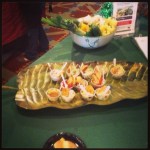






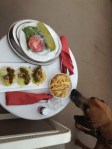




The trade show part of the even included samples, sips, and demos of many kinds of equipment, from knives to fancy stoves. There were vendors selling Nambe, candy, coffee, and even personal training. The most interesting thing I learned at the event is that our local food bank operates a culinary school that not only recycles food that would be wasted, but trains low income students to work in the food industry. This program has allowed the food bank to expand the prepared meals program in the community while training new students. I am so excited to hear about this. It has been in existence for 2 years, and this is the first time I have heard of it. I will follow up with a visit to the school, which is enrolling a new class next week.
One of my favorite vendors who installed a wood burning stove in my home is Val Romero. He owns Arizona Grill and Hearth. His company is an excellent source for all things grill, stove, and outdoor kitchen. My stove is the best upgrade I ever made to my living conditions, and the project was done with the utmost professionalism, and at a good price. He is a positive person with aloha in his attitude and fair dealing in his spirit. You will have a good time if you do business with Val.


In 1635 My 10th great-grandfather participated in a political act in the Virginia Colony that landed him in trouble:
A Principal in the Overthrow of a Capricious Ruler
York History Series #A-5, April 1997by (the late) Dick Ivy, Honorary NMDA Member
Hearing of secret and unlawful meetings since January by some of his councilors concerning decisions of his rulership of Virginia, Governor Sir John Harvey apprehended and committed their “chief actors” William English, Nicolas Martiau and Francis Pott. On Apr. 28, 1635, the Governor’s Councilors Samuel Matthews, John Utie, Thomas Harwood, William Perry, William Farrer, William Peirce, George Menefie and Dr. John Pott came to the governor-called council meeting at his house. John Utie of Yorke’s Chiskiak Parish hit the governor hard on his shoulder and declared he was under arrest for treason. The others held him secure and told him to go back to England to answer the complaints against him. They set Martiau and others free and called for their force of 50 musketmen waiting at a short distance. On May 7, 1635, the councilors met at James Town, opened the floor to complaints, and elected Capt. John West as governor. The complaint included the giveaway to please the King of the Isle of Kent to Maryland by a willing Harvey for persecuted Catholics from England, ignoring the ownership claim by William Claiborne who was trading with the Indians here. A war ensued between forces from Maryland and Claiborne when the latter refused to become a Catholic, it is said. Martiau was granted 1,600 acres of land that year. The King reinstated Harvey and the rebels were ordered to appear at the King’s Star Court, but were never tried for an unknown reason. Finally, Harvey was recalled over another incident of poor judgment.
Capt Nicolas Martiau (1591, France-1657) & Jane Page Berkeley
Capt. Martiau [also recorded as Marlier, Martue, Martin, Martian] was a French Huguenot (in church of Threadneedle St.) from the Island of Ré. He was in the service of Henry Hastings, Earl of Huntingdon and member of the Virginia Company, and educated as a military engineer. He was naturalized as an Englishman by royal decree. He came to Jamestown aboard the “Francis Bona Venture” in 1620, legally representing the Earl to plan fortifications. He led a foray against the Indians at Falling Creek after the 1622 massacre. He joined the liberal party committed to the Virginia outlook, pleading for continuance of the House of Burgesses in 1623/4. He, with Captain George Utie and Captain Samuel Mathews, was responsible for sending the tyrant governor Harvey back to England.
There is some question about his wives. His first wife was Elizabeth, last name and date of death unknown. She was most likely the mother of Elizabeth (born 1625). Jane was the widow of Lt. Edward Berkeley, who died in 1625; they had a child named Jane. . After her death, Nicholas married Isabella, widow of Robert Felgete & George Beech, in 1646.
Martiau’s defense of the French king in an argument with Capt. Thomas Mayhew forced him to take a loyalty oath in Jamestown in 1627. He was granted 600 acres as Chiskiack, which became Yorktown (in 1644, the Cheskiack Indians were moved to the Pianketank, where they would be forced out by Augustine Warner; the tribe seems to have vanished at that point.) He served as Burgess 1632-33, and Justice for York Co. 1633-57. “He, with George Utie and Captain Samuel Matthews, sent the tyrant governor, Harvey, close prisoner back to England.” Harvey returned, bringing George Reade–Martiau’s future son-in-law–with him, but he was forced back to England again, leaving Reade as Acting Governor. Martiau moved to the present Yorktown site in 1630 on 600 acres, plus 700 for headrights, where he grew tobacco. On this land Cornwallis surrendered his troops to Martiau’s great-great-great-grandson, General George Washington in 1781. Martiau later was granted 2000 acres on the south side of the Potomac River, which he gave to Col. George Reade in 1657. (See John Baer Stoudt, Nicolas Martiau, The Adventurous Huguenot, The Military Engineers, and the Earliest American Ancestor of George Washington.)
Nicholas French Huguenot Martiau (1591 – 1657)
Martin, Marten, Martens, Martyn (French, Spanish, English) Descendant of Martinus [belonging to the god Mars, the god of war]; one who came from Martin, the name of places in Spain and France. The popularity of the name in Western Europe is due to St. Martin of Tours, the fourth century French saint.
Source: New Dictionary of American Family Names by Elsdon C. Smith, Gramercy Publishing Company, New York, 1988.
Nicolas Martiau – The Immigrant
This portion of the Family Roots and Branches is dedicated to the study of Nicolas Martiau (pronounced Mar-ti-o) and his descendants.
“The Adventurous Huguenot” and the father of Yorktown, Virginia, was born in France 1591, came to Virginia in 1620 and died in 1657 at Yorktown, Virginia. He was a Captain in the Jamestown militia during the Indian uprisings, a member of the Colonial Virginia House of Burgesses, and Justice of the County of York. In 1635 he was a leader in the thrusting out of Governor Harvey which was the first opposition to British Colonial Policy. He is the original patentee for Yorktown. He is buried at the Grace Church in Yorktown, Virginia.
Descendants of Nicolas are through his daughters, Mary (married Lt. Colonel John Scarsbrook), Sarah (married Captain William Fuller, Puritian governor of Maryland), and Elizabeth (married Lt. Col. George Reade). Nicolas is the earliest American ancestor of our first President George Washington.
Among the descendants of Nicolas Martiau we find – in addition to Washington – one Vice President of the United States, two Justices of the Supreme Court, three ministers to foreign countries, three cabinet officers, six governors of states, eight senators, eleven generals involved in the War Between the States, fifteen congressman, forty commissioned officers who served in the American Revolution,
2 of 3
2/6/13 12:24 PM
and a veritable host of men and women prominent in national life. Such names as General Thomas Nelson, a signer of the Declaration of Independance; Meriwether Lewis, explorer of Lewis and Clark fame; Duff Green; Thomas Nelson Page and Amelia Rives are of special interest.
In the early 20th century the registrar of the Colonial Dames of America in the state of Virginia contains the names of more than four hundred women who could trace their lineage to Nicolas Martiau.
Nicolas Martiau is my 15th great grandfather and one of two of my earliest American ancestors. Here is my line of descendent from that adventurous Hugenout – Nicolas Martiau:
Larry Van Horn, NMDA Member #174 (Scar(s)brook-Condon-Wills)
1. Nicolas Martiau & Jane ? (Berkley)
2. John Scar(s)brook & Mary Martiau
3. David Condon & Elizabeth Scar(s)brook
4. Elias Wills & Mary Condon
5. John Wills & Susanna Robertson
6. James Cole & Mary Wills
7. James Cole & Fanny Chisman Wills
8. Ware Oglesby & Elizabeth Dancy Cole
9. Aaron Redus & Lucy Ann Oglesby
10. James Ware Redus Jr & Leah Magee
11. Alexander Hamilton David Hurt & Mary Susan Redus 12. James Ira Hurt & Johanna Himena Schneider
13. Witt Lange Van Horn and Jeanette Iris Hurt
Nicolas Martiau Descendants – The First Six Generations
The link below is to an Adobe Acrobat PDF Descendants Chart that shows six generations of Nicolas Martiau Descendants. If you are a descendant of any of the below listed in this chart you are eligible for membership in the Nicolas Martiau Descendant Association (see below). The lines represented on this chart are lines that are accepted for membership in the NMDA. As more information is entered into our genealogy database, new charts will be placed on this website and the NMDA website. Be sure to check for these pages for future updates.
Nicolas Martiau Six Generation Descendants Chart (Adobe Acrobat format) The NMDA Lineage SocietyNicolas Martiau Descendant Association
Genealogist who can prove descend from Nicolas Martiau are eligible for membership in the Nicolas Martiau Descendant Association (NMDA). The NMDA was started in 1991. Two first cousins from California went to Yorktown to meet Dick Ivy (recently deceased), the Towne Crier and Historian, for a tour of the Martiau Family sites. One cousin fell and injured a knee, was propped up by the wall of the Grace Church cemetery. A lone man was in the mist, reading inscriptions. He paused at theColonel George Reade/Elizabeth Martiau stone, not aware of the Martiau Family buried there without a marker. This one act prompted the chain of events culminating in the first Tribute to Martiau held in 1993 and the 1997 grave marker dedication. A second Tribute was held in the Spring of 2000 and the third was held Spring 2004 in Yorktown. The cousins were Lee Yandell and Marty Dale. (Reade- Reade-Wattington).
The NMDA had over 182 members nationwide. I have the honor of serving as the National Registrar for this proud and prestigous lineage based organization. You can get more information on the NMDA by contacting me, Larry Van Horn, via email (link at bottom of this webpage) or visiting the official NMDA website at:
Nicolas Martiau Descendant Association
At this website you can download lineage and application formsin pdf format to aid you in the application process. On the website you will find selected members lineages, news, events, history and much more.
 mermaidcamp