mermaidcamp
Keeping current in wellness, in and out of the water
You can scroll the shelf using ← and → keys
You can scroll the shelf using ← and → keys
In each tree there are challenging branches. My own difficult ancestor to whom I have dedicated untold number of hours in research is Thomas Peterson. He is special because he is mentioned in the handwritten notes I had to begin my whole search. His granddaughter, Sarah Helena Byrne, wrote facts and her own opinions about family members, said he is Pennsylvania Dutch. She also mentions that his nephew, James Peterson, married my grandmother Scott after her first husband died. This seems simple enough, but I am stumped because I can’t find a record of Thomas’ birth in Indiana in 1825. His parents are alleged to be born in Pennsylvania, but I know facts were sometimes recorded incorrectly in the census. What were his parents doing way out west before the Civil War? Who were they, and where in Pennsylvania were they born? This all remains unanswered. It makes me crazy…
Thomas Peterson (1825 – ?)

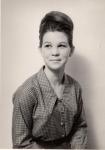
I spent my school career through the 8th grade in the small town of Oakmont, PA, a suburb of Pittsburgh. This tiny, close knit (nosey) community was about the Oakmont Country Club and Edgewater Steel, and some other stuff. For kids it was paradise with millionaire robber baron neighbors providing lavish recreational opportunities. My parents were Republicans who disliked JFK and did not play golf. On one hand they were non conformist, and on the other, very concerned with image. I had a running battle with my mother for my entire grade school career about bangs, permanent waves, and white socks. These symbols of culture and control were so important to my mother that my wishes were never considered. She stuck my hair in the sink and put stinky stuff and curlers in it against my will, and with loud protest. She always cut my bangs off, mullet style. The most important symbol to Ruby Morse was the little girl’s need to wear white anklet socks. This was truly the most hated of all conditions, the white sock purgatory. Ruby Morse believed that wearing stockings was a sign of loose morals. I believed she inflicted the white socks as a crazed statement of micro management. We had deep, basic irreconcilable fashion differences.
Management of any kind was about to fly out the window when the family moved to San Tomé, Venezuela in 1963. My father became the general manager for Mene Grande ( Gulf Oil) for eastern Venezuela. This meant that I lived in a big house with servants and my father was the boss of everyone in the town where I lived. My teachers in school worked for my father, as did all my friends’ parents. Strangers constantly gave me lovely gifts, and it was obviously too hot to wear white socks. I was the lucky imperialist 13-year-old with everything. I lived in a remote place so radio was a lot less available than it had been in Pittsburgh. The strongest reliable signal came from Radio Havana. Fidel would hold forth for hours and then they played some music. Live music was everywhere. I had a harp serenade at my window by a guy who wrote the song for me. This could not have happened in Pennsylvania. Although San Tomé had a golf course, there was no other commonality with Oakmont, PA. Nothing could have been more drastic, really. I loved it, but when given the chance to choose where I would go abroad for 10th grade, I chose PA because I still thought of it as my US home. I have not visited Oakmont since 1964.
I will return to Oakmont to see some of my school friends in a couple of months. We have all traveled different paths, but mine diverged drastically and forever. I am bringing back memories and enjoying the stories that my classmates remember. Some scenes are vivid as I think of them, and some are gone. I hardly remember any of the parents. Our personalities are in tact, from what I can detect on our Facebook page. We will go and physically be in the building where we went to elementary grades together. I think it will be amazing..our own versions of what we remember. I look forward to it with great anticipation.
My 11th great-grandfather, John Taylor was one of the ten chaplains present at the Field of the Cloth of Gold. As I look at history through the perspective of my ancestors I learn details that blow my mind. Henry VIII is known even to American history students for his wives, divorces, and church business. Henry was a music fan, and imported some of my ancestors from Italy to be musicians in his court. I had never heard of this Field of Cloth of Gold, sort of a party Henry had with lavish tents and chaplains. The king of France really tripped him in the fight Henry arranged. I love this story, and am highly amused that my ancestor can be placed at the crazy Anglo-Franco party. I say let’s invite Vlad over for a topless wrestling match in DC. What do you think? Has any of you ever heard of this Field party? Those royals were just so kinky.
In Tucson and around the country damage from mold is a serious issue. This health hazard can be dangerous to humans and pets. It is most devastating to real estate value because insurance companies rightly treat it like the plague. Mold that is rampant must be treated and removed to avoid spread and contamination of the entire area. Since the property with an adjoining wall has been used to collect donations for a decade, the water has been leaking profusely for months, and everything points to heavy duty mold damage I have repeatedly asked the HOA board that collects the donations from the public to hire Rocky the Mold Dog, who appears on TV. He is a beagle with a nose for mold. He sniffs the property and helps the humans identify problems so they can be treated. All health department code has been violated in this building for more than a decade. The unsupervised food collection, storage, and preparation in a leaky environment is a very likely contributor to the growth of mold. There is probable cause to believe the building is completely infested with mold which is damaging my home every day.
There is much more than a conflict of interest between the HOA board members who run the charity scam collecting donations, and the property owners in this neighborhood. I had some work done on my home recently and was informed by the contractor who did the work about the level of danger to my structural integrity posed by the neglect of my next door neighbor. He took some pictures of the rotting roof piled with debris, and explained that the load of all that garbage was a serious threat to my home. He taught me a lot that I did not know about the dangers and damage that mold represents. I read my insurance policy and spoke to my agent who explained the complex and very depressing details of mold, what it does, and what happens to your insurance policy once it is discovered. I am officially freaked out about the physical damage the charity scam has done to my home. The donation traffic has slowed to nothing, the water leak was repaired a couple of days ago after leaking for at least 6 months. I need the people who took advantage of all their neighbors to begin to acknowledge reality and the neighborhood by getting a mold test to confirm or deny the presence of a very hazardous material. Their behavior suggests that they do no believe in cause and effect. Believe it or not, every action will continue to have an equal and opposite reaction.

Passengers on the Bevis
Thomas Reeves is not the only one of my ancestors who arrived in America on the ship Bevis, nor is he the only one who came as an indentured servant. He landed after becoming a freeman in the colony, in Springfield, MA (a city I drove right past in May) where he was a blacksmith and the town drummer. How cute, the official drummer!! I wonder who the official town fife player was. His son Thomas, who moved to Long Island after his father’s death, seems to have continued the family trade of blacksmithing.
Thomas Sr (generation #1 in America) came from Southampton, England in 1638 on the “Bevis” and arrived in Boston. He was an indentured servant to Henry Byley, but became the servant of John Gore and lived in Roxbury, MA until 1644 when he became a freeman. He married Hannah Rowe on Apr 15, 1645 at Roxbury. They moved to Springfield, MA where he was a blacksmith and the town drummer. He died at Springfield on Nov 5, 1650 in his late twenties after fathering three children, two of which survived to adulthood (Thomas, Mary, John). His wife later remarried Richard Excell (or Exile) of Springfield on June 4, 1651, by whom she had four children (Mary, John, Lydia, Abigail). She died in 1660 in Spreingfield. He was still in the Springfield are in 1681. Mr. Excell presumably then moved to Southampton, LI with his step-son Thomas Jr and died there Feb 24, 1714, after suffering financial problems, according to his will. He also suffered from wounds received in King Phillip’s War.
There was another Thomas Reeves in MA who was born earlier and married a Mary Purrier.
Thomas Sr may have had an aunt Mary who immigrated with him and married William Webster, or the story about her is inaccurate in her age at death. Her husband was a the son of Gov. John Webster of Conn. She was accuased of being a witch in Hadley 1n 1673 by the county court in Northampton, but was acquitted at her trial in Boston in 1683. She died in 1696, her husband dying in 1688.

Sears family graveyard
My 10th great grandmother married a Mayflower Pilgrim, Richard Sears. Dorothy Jones was born about 1603, daughter of George and Agnes (_____) Jones of Dinder, Somerset. She married Richard Sears of Plymouth Colony by 1637. “Cady [i.e., Goody] Seares was buried the 19th of March [16]78[/9]” at Yarmouth.Their 3 children: i PAUL, b. about 1637 (d. Yarmouth 20 February 1707/8 in 70th year [gravestone]); m. by 1659 Deborah (eldest child aged thirteen on 3 July 1672, said to be daughter of George Willard. ii DEBORAH, b. about 1639 (d. Yarmouth 17 August 1732 “within about one month of 93 years of age;” m. by 1661 Zachariah Paddock (eldest child aged seventeen on 2 February 1678. iii SILAS, b. say 1641; m. by about 1665 Anna, probably daughter of James Bursell of Yarmouth
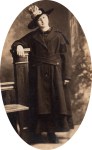
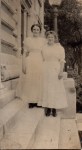

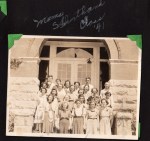


My grandmother, Olga Scott Morse, was a teacher of business skills. She graduated with her masters in education after she had four kids. She left them at home on the oil lease with their dad during the week to attend classes at Oklahoma State University. I believe that in the 1930s this was a bold feminist move. After graduation from OSU she taught typing and shorthand at a junior college near their home in Tonkawa,OK. Learning to type was a bold femenist move, believe it or not. Her students learned shorthand and typing and other current secretarial skills. The school to day is called Northern Oklahoma College. I stopped at the campus when I went to Oklahoma on an ancestry hunt a few years ago. I found her name in an old yearbook in the library, which was fun. I also looked through a lot of photos from the history of the school, where my dad and his brothers were students, but I did not find them. I walked around on campus, taking a break in my drive. Later, I found a picture of her with her students in the 1930’s in front of the central building at my uncle’s house in Wichita. I easily recognized the building since I had just been there.
Her mother, Sarah Helena Byrne, was a teacher and her great-grandfather , Amos Nichols,was also. My father was a university professor. The teacher archetype is all over my father’s family. I wonder if this is a DNA situation or all the reading and discipline that teachers represent. She was a farmer when I met her, having long since retired, but I remember her typewriter on the farm that had black keys..no letters. She could wail on that thing, but she had little reason to to so. I asked her to because I liked to watch her do it. She was a woman of many skills and talents, including flower and vegetable gardening. Most of the fruits and vegetables we ate in the winter in Pittsburgh were grown on my grandparents’ farm in Arkansas and frozen. I picture her in a sun bonnet, like all her friends wore, on the farm. Visiting the college where she taught before I was born was a really cool experience that showed me a part of her I never knew. For her day and place she was super highly educated and accomplished.
Olga Fern Scott (1897 – 1968)
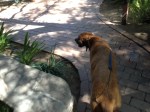


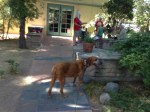
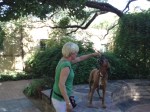

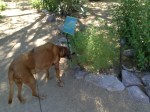

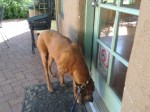



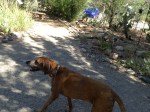
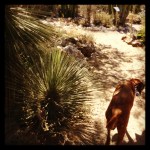
Artemisia, red bone coon hound, is a new canine member of the Tucson Botanical Gardens. On Tuesdays dog members and their families are welcome all day. This was a very special day because professional pet photographer, Vicky Stromee was set up to take pictures against a green backdrop. She and her assistant made the shoot quick and easy. We strolled through the shady paths for a few minutes, stopping for a drink at the cafe, which was closed. She smelled the door and wished it was open. Her shady and relatively cool experience today will be followed by her card and collar ring which will arrive in the mail. The dog membership is valid May through September. We have been family members for years, and now we are officially all part of the garden family. Artemisia recommends this reasonably priced membership to all Tucson dogs because of the shade. She liked it so much she sent an instagram.

British flag
My 8th great-grandfather came from England to Virginia in the 1600’s. We don’t know much about him except that he arrived early in America. He was a large landowner and his wife inherited land from her brother as well. These early settlers in Virginia had plenty of obstacles to overcome to just survive.
Capt John Gregory born: 1623 in Stockwith, England died: 1676 Rappahannock County, Virginia Officer in the Colonial Militia. Emigrated to Virginia prior to 1656; settled on the north side of the James River in Charles County. 20 February 1663 had a grant of 600 acres in Rappahannock County. Vestryman in 1665.
Capt John Gregory(1623 – 1676)
is my 8th great-grandfather
Mary Gregory (1665 – 1747)
daughter of Capt John Gregory
John Taylor (1685 – 1776)
son of Mary Gregory
John Taylor (1727 – 1787)
son of John Taylor
John Taylor (1747 – 1781)
son of John Taylor
John Nimrod Taylor (1770 – 1816)
son of John Taylor
John Samuel Taylor (1798 – 1873)
son of John Nimrod Taylor
William Ellison Taylor (1839 – 1918)
son of John Samuel Taylor
George Harvey Taylor (1884 – 1941)
son of William Ellison Taylor
Ruby Lee Taylor (1922 – 2008)
daughter of George Harvey Taylor
Pamela Morse
I am the daughter of Ruby Lee Taylor










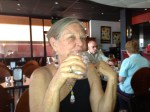

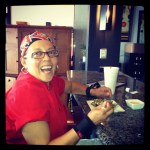









We are happy to have a tapas restaurant in our neighborhood. Tapas Fusion is our new favorite place to go for food and cocktail adventure. We had brunch there last Sunday with good results, so we returned yesterday for happy hour. Firey Friday features flambé drink specials. I tried one, and then had a pisco sour, both new to me.
It was a blast. The crew, including the friendly owner Mary Bellin, make you feel welcome. The happy hour pricing and the all you can eat tapas menu has something for everyone. I am vegetarian, and Bob is not, so we each ordered small dishes until we were full. The cuisine has many layers of flavor, with creative garnishes and fresh sauces making each dish pop. The flavorful variety gives your tastebuds a lot of intrigue for the size of the plates and the total of the bill. We are huge fans, and will return to try more of the menu. Mary has a generous frequent diner offer, and she doubles the points on Tuesdays or Wednesdays. For summer the restaurant will be closed on Mondays. She offers the all you can eat tapas menu every day, and it includes a lot of choices. Additional menu items are available a la carte. So far, we liked everything we ordered…a lot!!
 mermaidcamp