mermaidcamp
Keeping current in wellness, in and out of the water
You can scroll the shelf using ← and → keys
You can scroll the shelf using ← and → keys

Lanier coat of arms
My eighth great-grandfather came to Virginia with John Washington, and once owned Richmond:
John Thomas Lanier, son of Nicholas and grandson of Jerome was from
Bordeaux in 1603 to America with John Washington. He brought much of the
family furniture with him. He was given a grant of 10 miles or 1400 acres
of land on the South of James River and it included what is now Richmond,
located in what is now counties of Prince George, Brunswick, etc. He
subsequently moved to North Carolina (North border) and was very
prominent.
John Thomas Lanier (1631 – 1719)
is my 8th great grandfather
Sampson Lanier (1682 – 1743)
son of John Thomas Lanier
Elizabeth Lanier (1719 – 1795)
daughter of Sampson Lanier
Martha Burch (1743 – 1803)
daughter of Elizabeth Lanier
David Darden (1770 – 1820)
son of Martha Burch
Minerva Truly Darden (1806 – 1837)
daughter of David Darden
Sarah E Hughes (1829 – 1911)
daughter of Minerva Truly Darden
Lucinda Jane Armer (1847 – 1939)
daughter of Sarah E Hughes
George Harvey Taylor (1884 – 1941)
son of Lucinda Jane Armer
Ruby Lee Taylor (1922 – 2008)
daughter of George Harvey Taylor
Pamela Morse
I am the daughter of Ruby Lee Taylor
State-Wide, NC – Lanier Family Genealogical Tree
The following bible record is found on the LAGenWeb Archives at the
following http://files.usgwarchives.org/la/state/bible/lghsbible/
This record is “bible4-4.txt” in the list of records
Bible Records Published by Louisiana Genealogical and Historical Society.
Be it Known And Remembered: Vol. II, Bible Records 1961: Pages 1 – 60
Submitted to the USGenWeb Archives by LGHS, Jun. 1998
LANIER FAMILY GENEALOGICAL TREE
Taken from the Family Records of Mr. Lee Lanier of Amite, La. Submitted to
the Society by Mrs. Kathryne Watkins, Hammond, La., State Librarian of
Louisiana Daughters of the American Revolution.
Jerome Lanier of Brodeaux, France in 1558 emigrated with his family to
England, in the latter part of the reign of Queen Elizabeth. Jerome was a
Huguenot who fled from execution or persecution and finding himself
without means in a foreign land availed himself of his accomplishments and
secured a position in Queen Elizabeth’s household as Court musician. He
found great favor at the court and for about one hundred years – 1558 to
1666 – the Laniers flourished in England, distinguished themselves in
music, art and military genius. They were a family of means and culture in
France. Jerome Lanier had three sons: Nicholas, Clement and Jerome.
Nicholas Lanier was born in 1568, he was the most prominent of Jerome’s
sons. He enjoyed high favor under James the 7th reign and especially so
under Charles the 7th’s reign. English history says of him that he was one
of those artists whose various talents were so noticeable as to suit the
taste of Charles the 7th. He gathered Charles the 7th’s collection of
paintings. He was a skilled musician, artist and courier. Five of his
famous paintings are distributed as follows: one owned by Van Dyke, one in
the collection of Charles the 7th, one now in the music hall of Oxford.
Two owned by the Prince of Wales. He died in 1648 leaving two sons:
Nicholas, Jr. and John Thomas Lanier.
Nicholas Lanier, Jr., brother of John Thomas Lanier who migrated to
America in 1683; was also a noted musician and artist. He was frequently
seen at the court of England. He was made president of the English Society
of Musicians
Page 133
and Artists for life. He enjoyed many favors from the King. Other members
of the Society were Clement, Andreu, and Jerome. These appear to be of
another branch of Laniers.
(Comment of J. B. Lanier Plooard – 1947 – Apparently history closes out
all branches of the family who may have remained in England and the
Laniers in America seem to be descendants of John Thomas Lanier and
Elizabeth Washington, the aunt of George Washington.)
Jerome Lanier lives in a palatial house in Greenwich, was a great and
famous musician. Owned the greatest collection of paintings than in
existence. He had only one son.
Sir John Lanier in 1690 comes again in history of being knighted “Knight
of his valor, in the capture of Castle of Edinboro. He was Major General
of the “Horse & Dragon.” In the Irish war made himself prominent in Battle
of Boyne and fell at Battle of Steinkiek fighting gloriously along with
the brave Douglas. This closes his story as far as we know of Clement and
Jerome Lanier, so the family name was apparently perpetuated by the
descendants of the son Nicholas Lanier. They may have had daughters.
John Thomas Lanier, son of Nicholas and grandson of Jerome was from
Bordeaux in 1603 to America with John Washington. He brought much of the
family furniture with him. He was given a grant of 10 miles or 1400 acres
of land on the South of James River and it included what is now Richmond,
located in what is now counties of Prince George, Brunswick, etc. He
subsequently moved to North Carolina (North border) and was very
prominent. In 1688 he married Elizabeth Washington, daughter of John
Washington, aunt of George Washington. His will is on record in Prince
George County, Virginia. He was prosperous and left sons Sampson, Robert,
Nicholas, John Thomas and Buckner.
Nicholas Lanier, son of John Thomas Lanier, died 1779 and left two
daughters.
Sampson Lanier was the only surviving son of John Thomas Lanier and
Elizabeth Washington Lanier. He died in 1743 also rather young, but lived
a life of great usefulness as a plantation teacher and physician. His will
in Brunswick County, Va. left large estate to Thomas Dannell Lanier;
Sampson Lanier, Jr., James, Richard and Elizabeth.
Thomas Dannell Lanier died in 1745 and left two daughters.
Elizabeth married a Burch and second a Smith.
Richard Lanier had sons Lewis, Burwell, Buckner and daughter Winnifred.
Lewis, son of Richard Lanier, had a son Alexander Lanier that settled in
New York City. Alexander had a son James D. F. Lanier.
Burwell Lanier had one son David. David moved from Brunswick Co. to
Pittsylvania Co., Va. in 1772. The land is in what is now Henry Co., Va.
Va. records show that David Lanier was a Capt of a Co. in the revolution
distinguished himself as a brave military genius. He married Miss Mollie
Hicks.
Page 134
David Lanier, Jr. had son James Monroe Lanier, grandson Charles and
grandson James who named a son James Monroe Lanier, who was a Capt. in War
of 1812. Was of fine personal appearance and was a large land owner in
Virginia. Daughters of James Monroe Lanier, son of David, were Sally and
Judith.
John Hicks Lanier, Lucy and Nancy and Eliza were other children of David
Lanier.
John Hicks Lanier married a Miss Carter. She was the mother of his
children and when he married a second time the children could not get
along with the new wife and they moved to Missouri. Daughter Mary married
and moved to Lincoln Co., Mo. She married John Lovell__ Children: John,
Jr., Wilie and Allie. Son David had a daughter Mary. Mary first married
James Jones and then a Ferguson. John Hicks, Jr. married Sallie Robinson
and had children: David, Demarous, Mollie. Edward, son of John Hicks
Lanier, Sr. married Jane and had two sons. Robert, son of John H. Lanier,
Sr. married twice. His descendants live around St. Louis.
Sampson Lanier, Jr. – Sampson died 1757, Brunswick Co., Va. and it named
children:
Buckner Lanier, son of Sampson, Jr. was famous for ability to settle
disputes. Well educated – physician and planter. Had one son Sterling
Robert Lanier, son of Sterling, married Mary Anderson of Macon, Georgia.
Sterling Lanier had sons Sidney, the poet, who died of TB contracted
during the Civil War and son Clifford Lanier who went to Montgomery,
Alabama and settled. Sidney Lanier was born 1841.
These are old family records and are not documented; however, they are a
good finding list. There has recently been published a book regarding this
family that will bear out this information. Hillery and his brother
Benjamin were in the Florida Parishes section of Louisiana as early as
1873 but the court records do not show estate papers.
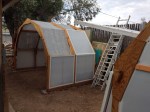
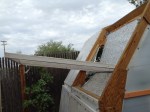
My visit with Michael Ray yesterday was fun and informative. Here he tells us about the benefits of the Nursetree Garden Arch:
I am impressed with his continual learning and improvement of his invention. I have been through the prototype process with Floatli and know it is both fun and frustrating. You can only learn through experiment. I believe Michael has created a wonderful tool desert gardeners will be needing more and more. A dozen years ago I bought 5 acres in Oracle, AZ with a gushing well, thinking I would grow food. When I sold the property last year the well was almost depleted for household use. In a way I was lucky I did not plant a big orchard and then loose the water for it. Today I garden in the city with an eye toward conservation of every kind. The garden arch is an innovative way to save water and grow food.
Michael Ray and I met at a small business group that meets at Tucson’s Ward 3 office once a month for a convo. When I saw the pictures of his invention I wanted one. After learning more in subsequent meetings, I asked to interview him about his gardening transformer, the Nursetree Arch. He developed this water catching temperature controlling environment for desert gardeners who have climate challenges. I love the way he can adapt his new prototype to the situation and economic needs of the particular client.
The fully decked out robotic arch in which Michael is growing papaya as well as brussels sprouts in Tucson on August fist is fancy indeed. He is recording data to help him refine his work. His outdoor garden benefits from his arch used as seedling starter in the winter.








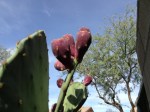




The desert when it rains is a magical place full of excitement and drama. All of a sudden the sky opens; great thunder and roaring winds announce monsoon season. Color explodes while plants express gratitude for the long cool drink. We enjoy the vibrant blooming while it lasts, and pray for more rain.









I am a member of a very special organization in Tucson. Native Seed S.E.A.R.C.H is a source for beans, garden seeds, education, and many local products. I support the mission and benefit from the close proximity of the store. We eat a wide variety of beans and chilies. The store carries the basic ingredients we use all the time in our diet. The seed preservation is the most important aspect of the mission. Today I planted 5 new plants I bought at the monsoon plant sale: 3 new watermelon varieties, a bell pepper and a special cucumber. They are all vigorous and healthy. I expect them to thrive in the rainy season, which was the point of the sale. We can grow many vegetables and fruits until frost, and if we protect them even longer. I have harvested giant crops of green tomatoes in December. These plant varieties are from Arizona and New Mexico, so they are adapted to our climate. I look forward to my Navaho red watermelon. You don’t need to live here to join. If you live in other parts of the country you can enjoy the benefits of membership which will keep your garden interesting.
Last night we attended our first farm to table dinner in Tucson. Zona 78 prepared a fresh and exotic menu featuring produce from Sleeping Frog Farms in the San Pedro valley. Four courses featuring produce were presented, along with a delicious berry cocktail or a glass of wine. All of our expectations were exceeded, from service, presentation, variety, to innovation. If you have not tired Zona 78 or Sleeping Frog Farms produce, I highly recommend that you do. We hope the farm to table dinners will become a regular feature because it is an extraordinary way to dine and expand horizons. We met cool people and discovered new cuisine, which is exactly our style.
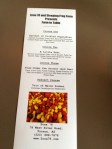

















We were pleased and happy to taste and enjoy such creative innovative cuisine.
In my tree I have several ancestors who owned slaves in America. When your family has owned slaves, you are forever affected by that history. The slave archetype is a very interesting symbol. I had not considered the aspects that can both teach and menace. The ultimate slavery is full surrender to the divine. One’s own will is sacrificed to the divine will in order to be fully enlightened. Military discipline requires following orders without question. We don’t think of soldiers as slaves, but there is an aspect of it in the lack of choices. Some are slaves to substance abuse or systems of belief. This slavery may seem completely voluntary, but cultural pressure might be a strong factor. The positive slave archetype is the monk who devotes his life to divine providence. The shadow aspect of the slave today is the person who gives up choices, such as cult activity. Choice involves individuation. Following the script of the collective consciousness today without question is slavery.
My 6th great -grandmother, Sara Holt, was from a family that came to Virginia in 1620, so slavery probably was always part of their existence, like most colonials. She and her husband from Northern Ireland owned slaves and lived in a fancy style:
Sarah Truly, A Mississippi Tory By Madel Jacobs Morgan
The Journal of Mississippi History, Vol. XXXVII, No. 1, February, 1975
One of the most loyal advocates of the rule of King George III of England was Sarah Truly, a resident of the Old Natchez District when it was a province of Spain. She came to the Natchez District from Amelia County, Virginia, where she lived in comfortable circumstances with her husband Hector and their seven children: John, James, Bennet, Eleanor, Sarah, Judith and Martha (Patsey). It can be deduced from Hector’s will, which was probated in 1761, that the Trulys pursued life in the cavalier tradition. Daughter Eleanor rode sidesaddle on her own bay mare, Hector owned slaves, and he had a “complete distillery”. He had, as well, three hundred acres of land, two prayer books, four testaments, two hymnals and “one other book”.
As Revolutionary sentiment took root and spread, the position of Sarah Truly and the other Tidewater Virginia loyalists became less and less tenable. At the close of the decade following Hector’s death, Sarah and her brothers Dibdal and David Holt took positive action to improve their situation. Having learned of the rich lands along the Mississippi River which the British were making available for colonization, they began investigating the possibilities of a move. One of the Holts went to British West Florida in 1770 to consult with the governmental authorities about lands. He returned to Virginia; then, along with his brother and a neighbor, Robert Montford, he came back to West Florida the following year on another scouting trip.
Along with her brothers, the Widow Truly made preparations for the long journey southward. “Refusing to be a traitor to my king,” she said later, “and not wanting to live at enmity with my neighbors, I sought a home under the Spanish flag.”
Six of her children came south with Sarah Truly, John remained in Virginia. Her three brothers, David, John and Dibdal, accompanied her, as did a son-in-law, Francis Spain (Eleanor’s husband), the Spain children, and the slaves. If their caravan followed the route described by other migrants of that time, they traveled overland through the Cumberland Gap and across what is now Kentucky, where they paused to build a flatboat to embark on the Ohio River, floating on to the Mississippi and thence downstream to West Florida.
Seventeen hundred and seventy-three was the date of their arrival in West Florida. The first grant of land to Sarah Truly was most likely in one of the Feliciana Parishes of Louisiana, and it has been said that Bayou Sarah was named for her. She soon moved to a site north of Fort Panmure in the Natchez District.
The Widow was beset with difficulties from the start. The first year, she and her family were all sick and could not make a crop. She was obliged to sell a negro to buy provisions. In 1774, the younger son, Bennett, was hired by a neighbor, Mr. Lum, to row his boat up the river—his pay to be in corn for the use of the family. On arriving upriver, Bennett found the hunting good and instead of returning home, he remained four years.
In 1775, son James took his departure. He returned to Virginia to fight with his native colony against the crown. By this action James not only left the Widow Truly without the help of either of her sons, but placed her in the deplorable situation of acknowledging herself the mother of a Revolutionary soldier.
In 1778, both of the boys had reappeared on the scene. Bennett returned to find Sarah engaged in getting her corn crop planted. Instead of staying close by to lend assistance, he betook himself off to the bright lights of Natchez. There he stayed wntil the fall of 1778 when he went off on another hunt. But this hunt was of shorter duration. Bennett and those with him were captured by James Willing, the American officer–and a resident of the Natchez District–who was then raiding, pillaging, and recruiting on behalf of the American Army. Bennett was taken to New Orleans but soon came back home to his mother; and, Loyalist that he was, he enlisted in the local militia.
In the meantime, James Truly had returned from Virginia the the Natchez country in 1778, still a Revolutionary. He immediately made himself useful to the American cause by acting as a guide for Willing when he arrived at the Natchez landing in mid-Feburary with a company of American soldiers.
In 1779, the Widow had son Bennett at home. In her own words, Bennett “came to my house and worked with my lands and finished the crop with my three slaves.” Out of the proceeds of that crop, she paid off $300.00 in debts that Bennett had contracted in the neighborhood.
The following year Bennett seems to have been somewhat more dependable. She put him in charge of her crop, and with the help of four slaves he cleared 3,000 pounds of tobacco. It seemed as though things might be looking up for the Widow Truly. Bennett was at home and working, and the crop was good. Unfortunately for all concerned, Bennett came up with the idea of building a grist mill in partnership with one George Fourney. Sarah, who could see through such schemes, was expected to provide the capital for this venture–an idea of which she heartily disapproved. As later attested by Sarah’s daughter and granddaughter, Eleanor and Tabitha Spain, the Widow considered Fourney unreliable; and Bennett had not yet proved himself capable of carrying out such an ambitious project. In other words, Sarah had no desire to have a mill stone around her neck. Irrepressible Bennett went on with his plans, however, in spite of the objections and scoldings from his mother.
There was another complication! The sight of the English flag over Fort Panmure no longer gladdened Sarah’s heart. In its place waved the golden lions of Spain, for the Natchez district had been surrendered to Galvez when he captured Baton Rouge in1779.
No sooner had the English garrison evacuated Fort Panmure to the Spanish than Anthony Hutchins and John Blommart began plotting to recapture the Natchez District for the English. They were aided and abetted by the Widow Truly. She was a mere woman and has thus far received scant notice of historians, but the testimonials by her Natchez District neighbors vouch for the fact that she did all she could to assist the English cause and deal misery to the Spaniards.
When Galvez withdrew his heavy artillery to Pensacola, to bombard the British stronghold there, the Loyalist element in the Natchez District made plans for a revolt. Their plans came to fruition in 1781. While one group of the Loyalists took up their position at the house of John Rowe (Row, Rault) in plain view of Fort Panmure, another group was ensconced in a blockhouse especially built for the occasion by Madame Truly. The so-called rebels who took refuge in the blockhouse on the Truly holdings prepared themselves for a seige and even dug a well so that water would be plentiful. This well was later the subject of much controversy, for it seems that Bennett had contracted with Thomas Rule to dig a well on Sarah’s plantation, giving him a horse in payment. Before Rule could dig the well, the “rebels” encamped in the blockhouse dug it. A year later Sarah sued Rule for the price of the horse, charging that he did not fulfil his contract. The court ordered Rule to fulfil his contract by digging a well as originally specified. Thus, we can be reasonably sure that in spite of other vicissitudes she may have encountered, the Widow Truly spent the last days of her life well watered.
With the capture of Pensacola by Galvez and the arrival of a Spanish force at Natchez, the revolt collapsed (in May, 1781). The insurgents scattered in every direction. Some, led by Anthony Hutchins, went overland to Savannah and thence to England. Some struck into the wilderness where they joined a robber band. Another group became Spanish prisoners and were taken to Spanish headquarters at New Orleans. It is a matter of record that Sarah Truly made a quick trip to New Orleans in 1781. Whether she went there in the interest of her land holdings or was called up before the Spanish authorities for her part in the counter revolution against them is a matter for conjecture. She left at home two of her daughters, Eleanor Spain and Patsey Truly and a granddaughter, Tabitha Spain. Also at home was Bennett whose gristmill project had been interrupted by the revolt. But while Sarah journeyed down the river to New Orleans, Bennett rounded up George Fourney; and they slyly took advantage of the widow’s absence to complete the gristmill.
Upon leaving New Orleans, Sarah embarked for home by rowboat. She “encouraged the hands to row briskly” saying that they should have plenty of meat when they reached home. A trip to New Orleans by rowboat would be an ordeal at best, but in May with intense heat added to the humidity of the river swamps, not to mention the abundant insect life that thrives in such conditions, it must have been almost unbearable. Worn and exhausted and accompanied by the hungry crew, the Widow reached home expecting a feast. She found only two pieces of meat in the house. She went into a rage. Eleanor, Tabitha and Patsey wrung their hands. When the Widow inquired of the three girls what had become of the meat, one can imagine the violence of her reaction on being told that Bennett had given it to George Fourney, his partner in the gristmill.
Sarah Truly lived for ten years after this unfortunate episode, and it was her fortune to spend the entire time under Spanish rule. From the court records we learn that she spent much of her remaining time before the bar of justice—suing, being sued and testifying as wittness. The Spanish governors seemingly bore her no ill will for having taken arms against them, and she was always treated with the greatest consideration. Her name is mentioned in more than forty different places in Spanish court records, indicating that she was a woman of diverse interests. She loaned money, she bought and sold slaves, she dealt in lands. Various witnesses testified that she “cursed” and “scolded”. No one could deny that Sarah Truly was a woman of spirit.
Her children settled close around her, forming a sizeable clan of Trulys and their kin. James married Elizabeth Burch, a widow, and they brought up an interesting family at Truly’s Flat in what is now Jefferson County. Irrepressible Bennett married Mary Lum. Always on the lookout for a good investment, Bennett became interested in a cotton gin and in 1796 we note that he was hauled into court for turning out inferior cotton. Eleanor Spain and her family lived in Jefferson County. Judith married a Holstein and she was in England in 1796.
Two of the Truly girls, first Sarah and after her death, Patsey, were married to Captain Richard Harrison who was noted for his services in the American Revolution when he served as a courier for George Rogers Clark. The Harrison home, Auburn House, still stand in Jefferson County.
Age finally caught up with Sarah Truly, and she was “infirm and weak” on March 15, 1792, when she made her will. She left her “beloved son Bennett” a slave “Annico”, who had two children, and one large looking glass. To daughter Eleanor Spain went her prized feather bed and furniture. To daughter Martha Harrison went her scissors and thimble. The residue of her estate was to be divided among James, Bennett and Eleanor. Then passed from the scene a forceful character and gallant pioneer–a woman of loyalty and courage.
That many of her traits passed down to her children there is little doubt. As a fitting sequel to her tempestuous life, we note a paragrapg appended to her will which begins as follows: “7 May 1793. Whereas a controversy has arisen between the heirs of the late Sarah Truly, concerning the division of her estate…..”



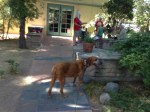
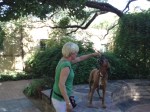

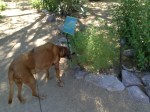





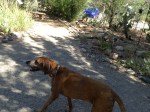
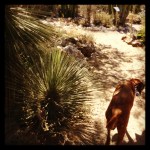
Artemisia, red bone coon hound, is a new canine member of the Tucson Botanical Gardens. On Tuesdays dog members and their families are welcome all day. This was a very special day because professional pet photographer, Vicky Stromee was set up to take pictures against a green backdrop. She and her assistant made the shoot quick and easy. We strolled through the shady paths for a few minutes, stopping for a drink at the cafe, which was closed. She smelled the door and wished it was open. Her shady and relatively cool experience today will be followed by her card and collar ring which will arrive in the mail. The dog membership is valid May through September. We have been family members for years, and now we are officially all part of the garden family. Artemisia recommends this reasonably priced membership to all Tucson dogs because of the shade. She liked it so much she sent an instagram.


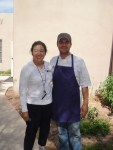

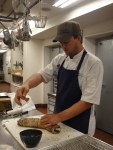

The Slow Food movement is a worldwide pushback to fast food. We all know, more or less, what is intended by the phrase fast food, but only after some examination does the core meaning of Slow Food emerge. As a food hippie from the 1960’s when health food and coops and gardening were a reaction to the available sources and quality of nutrition, I do not need coaching in this matter. In fact, I eat more convenience foods now than ever because I purchase a bit of fake meat from time to time. I am sometimes now a lazy food hippie at Trader Joe’s frozen food aisle. My core belief is that we need no packaged or processed foods in our lives unless we do that processing ourselves. Slow Food is out to change the conditions of farming, eating, and distributing food. I applaud the whole thing. They (we) are making strides.
This movement started in Turin, Italy and has fortunately spread as a philosophy and an organization. I joined this year and my first impression is really good. We attended tasting held by the Slow Food Southern AZ chapter at Lodge on the Desert. The event was inspirational and very reasonably priced. I, for one, loved having the posole deconstructed so I could have it without the pork. Ryan Clark was one of many chefs showing off their talents for a happy crowd.
Here in the Sonoran Desert the precious chile tepin grows wild. It has a distinctive flashy flavor that is desired by many on both sides of the border. It is said to be the mother of all cultivated chiles. I have recently replanted some in my garden after loosing some old ones in frosts. They can live for many years when protected in the winter. This promotional video from Sonora has chosen to use South American Inca pipe flute music, which has nothing to do with Sonora…but the chile is an emblem of life in desert conditions. Our natural chile forrest south of town in Tucson is still the largest in the US.

