mermaidcamp
Keeping current in wellness, in and out of the water
You can scroll the shelf using ← and → keys
You can scroll the shelf using ← and → keys

Globe
There is no way to separate the effect the body has on the mind or the mind on the body. This intricate interaction is centered around self image, accurate or not. We may not see ourselves as we are. In fact, the yoga sutras begin by addressing this subject:
1.1 Now, instruction in Union.
1.2. Union is restraining the thought-streams natural to the mind.
1.3. Then the seer dwells in his own nature.
1.4. Otherwise he is of the same form as the thought-streams.
1.5. The thought-streams are five-fold, painful and not painful.
1.6. Right knowledge, wrong knowledge, fancy, sleep and memory.
This was written in Sanskrit and has been translated in many ways since Patanjali wrote it. This translation is by BonGiovanni. We learn by reading this ancient text how the mind works. It is very specific and detailed. Meditation is offered as remedy for confusion and lack of clarity of purpose. Westerners have flocked to yoga as the perfect fitness activity, enjoying all kinds of variations on yogic teachings. Here in the western hemisphere we have trouble integrating mind and body, consciousness with soul and spirit. We want to have landmarks and rewards for success as we progress. Yoga as a strictly physical practice, even if you include pramayama, or breath control, does not align with the purpose, which is to control the mind. If we are successful yogis we will not only dwell in our own nature, but we will be free of identifying with thought streams. This requires constant and uninterrupted practice. Thought streams arise from ourselves, from the opinions of others, from cultural belief, and from circumstances. To acknowledge them and let them go is a powerful and uplifting act. You are not your thought streams!! This idea is the basis of meditative practice. Learning to execute the perfect tree pose takes full concentration. Presumably there is no attention left for thought streams while you balance on one leg and stay aligned. Asana is not the only way to bring the mind into focus by using the body:
The easiest (and therefore perhaps the most difficult) breathing practice I know is just a simple counting of breath. Count to ten, marking each inhale and each exhale with a mental number. This seems so simple that you will be surprised how often you can’t make it to ten without the mind drifting off onto some thought form. When you observe the interruption, simply start again with a silent number one on the next breath. Don’t struggle with the thought; just let it go. Resume counting and breathing. Do you have a practice to focus the mind and keep it focused? Do tell.

winter writing challenge
I just read in a fellow blogger’s post about the ROW80 challenge. I have just started a practice to improve my writing by creating poetry and art. I had not planed to commit to a daily routine, but I am finding that starting the creative day by drawing, editing photos, and making visual art I am more likely to be observant for the day. Observant includes in this case a full attention to detail as I go through my life, and easy flawless observance of boundaries I have set. Since the group is making personal goals a shared conversation, observant will also mean that I pay attention to my fellow writers and the way they express themselves. This idea arrived at a most propitious time, since 80 days of tracking my goal of a more poetic life will give me a good jump start to a full time practice. I look forward to learning how other people contribute to this exercise.
Observe and Grow are the key words for my goal. I hope to grow my vocabulary, my skills, and my creativity by publishing art and poetry. By observing the world, as well as my dreams, I will find richer, more vibrant subjects. I tend to be a scribe, writing just the facts, and supporting the facts with some photo documentation. I still enjoy that, but feel I could do some story telling, humor, and abstract sound pieces if I develop my poetic sense. I want to see where poetry leads me. I am not seeking approval for the work as much as I am wondering what will happen when I apply myself.
For the next 80 days I will observe what happens when I write a poem each day. This is an adventure I will share. It will include:
It is my desire to explore a different way of using the written word. I think it will open new doors for my self expression. I also believe my daily life will be enriched by looking for poetic subject matter. I publish my art and poetry on my Tumblr blog, The Flow.

winter writing challenge
I have cleared out my fridge and started a food preparation calendar for 2015. My first inquiry into this popular practice started on Pinterest, where there are many enthusiastic plans to use time and ingredients more wisely. I notice that most of the preppers favor a style of doing the work on Sunday to have planned healthy meals all through the work week. This is brilliant for anyone with a 9-5 job Monday through Friday. I am lucky enough not to have one, so my goals are slightly different. I still want to concentrate the effort into a compressed time slot, so I save time on clean up and on presentation later. I plan to keep the cooking and cleaning to a bare minimum 4 days a week. I can afford to have 3 active preparation days, and spread out the tasks as well as the freshness. I also am dedicating a day to drink preparation. I have been making shrubs, bitters and other infusions. I want to expand my repertoire in the beverage department. There are so many fun recipes to try, and a tasty beverage stands on its own for a pick me up any time of day.
For the first week I have planned (subject to revision in the future):
The rest of the week I am planning to enjoy the fruits of my labors and find out how well I have estimated the proper amount for the week. I already love the organized fridge and the new outlook I am adopting from the food preppers. It is a solid way to improve the way I shop, cook, and eat. I like restaurants, but honestly I prefer pretty and delicious meals concocted by my own hand. I can suit my own whims and moods. The advantage of the food prep practice is having something healthy and ready no matter what happens. I believe it will remove stress and extra money from the whole process of eating. If you have an interest in leaning more about my new found hobby, I can direct you to some highly educational pins:
There is a plethora of information on this subject. I think it offers me a way to structure a long time interest, making and eating food, into a more elevated and pleasurable experience. I think I will learn a lot. Do you use a meal planning and food preparation schedule? This is a first for me. I am sure I will tweek it, but it is a superior way to look at diet.
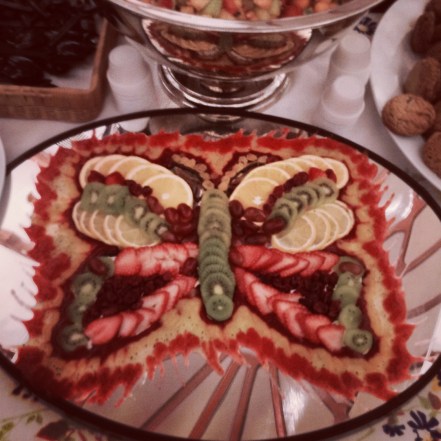
fruit salad
Chris Brogan has announced his 3 words for 2015. This annual challenge is an alternative to the classic resolution style. I have done it with success, and also done it when I forgot my words entirely. Like anything else, persistence is needed for results too occur. I am pleased with my own choices this year, patience, persistence, and poetry. They have meaning across the board to upgrades I aspire to make. I plan to use them liberally throughout the year. I also plan to use Brother Brogan’s words to apply to a specific change I am making in my household. There is no rule that says you can’t admire and swipe other people’s words if they suit you. His words work for my new world of menu planning. I have become convinced that improvisation is not the best way forward with nutrition. It has served me well, and I am healthy. I want to develop the skills and the results of managing our home kitchen like a chef with a restaurant. I know that planning and balance will bring lower costs and higher quality nutrition to our diet. We will waste less produce and use the freezer to make the most of what we buy. This new discipline fits perfectly with the words I am appropriating from Brother Brogan for this project.
His words are:
Thanks, as always, for your guidance, Chris. I am happily applying your words to my advantage this year. I have loved your teaching since Trust Agents. I hope your words will be fabulous for you as well. All the best in 2015.

psyche

psyche
Each night our psyche brings us images in dreams. We connect with them and live within the dream during our sleep. Upon awakening we sometimes lose the dream images as we file that dream somewhere within our unconscious and decide it is not part of our true reality. Notice that we are within the dream while asleep, and then the images are considered to be unreal when we are awake. We live within a gallery of art and image, dramas with set and costume, in our sleeping world. Our awakened ego is concerned with gathering information and meaning rather than absorbing art for art’s sake. We wake up and enter the world with an explanation for everything. By dismissing the power of the imagination we loose the opportunity to individuate. We diminish our own imagination by interpreting our dream images rather than interacting with them.
We run two systems in our awakened world, an economic system and a therapeutic system. All of our activities are divided into economic obligations and challenges or curing our ills. We are concerned with “growth” of our personal economy or “healing” our wounds. It is easy to see the connections that contribute to the cyclical nature of this limited spiral. What is not so simple is to break these cycles. If our addictions are fed by information, image is converted by the mind into interpretation. The ego prides itself on its ability to interpret everything. Since the ego determines that it alone is conscious, all the rest of reality can be fit into the unconscious basket. The ego explains the image and then its importance is belittled. We cease to interact with it once it has an explanation. Imagery has no explanation. Art and image are animate and inherently charged with insight.
I intend to respect the imagery inside of me by embracing a more poetic view of life. By bringing focus to imagination and imagery I want to contribute to my own creativity. I will investigate how I can interact with my psychic and artistic life through practice. This intention can only be controlled to a certain extent, and it is not my hope to contain my psyche, but to explore it. It has a lot to say.



April is Poetry month, with many activities and projects running around the country. I have taken the challenge to write a poem every day in April for the last two years. I push my way through the writing, with a fully punched card in participation, but have not really put my full attention into the whole process. We are lucky in Tucson to have a world-famous Poetry Center at the U of A, open to the public. Each time I visit the place I tell myself I will make a regular habit of spending time there. It is an inspiring place to read, write, meditate, or take part in one of the workshops or readings. The only resolution I need to make for 2015 is to honor the poet within me all year. There is a haunting feeling in my memory and in my dreams of a productive and expressive poet I believe is within my spirit. This artist/alchemist/poet has not been nurtured as well as it needs to be. I work with words daily but am not arching to new heights or even developing a larger vocabulary. When I do push myself to write poetry daily I can feel a response in my dream world toward more color and rich dramatic story lines. It is as if there are stories, poems, maybe even novels, deeply stored in my writing practice, but I do very little to develop my ability in these realms. The poetry is essentially trapped within my lazy writing practice. I plan to liberate this struggling poetic artist next year and allow her to explore and create in new ways.
As 2015 approaches I contemplate the 3 words I will use to ground my meditation, my health, and my creativity next year. This is a practice started and promoted by Chris Brogan. I have done it before and always find the quest for the right words to be very helpful. This year I want to make some kind of significant progress as a poet and creative writer. By using these key words all year I believe I can be a better poet in April and beyond. Moreover, I think these words fit perfectly with my goals to clear out excess clutter in my home and my life. I am working on this now, cleaning out my closet before the end of the year. I can honestly say that the results I see and feel in my closet after patiently and persistently ridding myself of extraneous clothing and accessories are nothing short of poetic. Poetry has more to do with what is edited than with what remains. The fewer words used to convey an idea, the more powerful each word becomes. Now my closet is more like a haiku than an epic drama. I am feeling much better when I walk into it now.
These words fit perfectly with my health and fitness goals. Movement and variety of enjoyable physical activities create strong healthy bodies. It does not matter if time is spent playing an active sport, hiking, swimming, or yoga, the key to success is always persistence. I like to cross train, in other words, do different physical activities, to keep things interesting. This is good for the body as well as the mind. I like doing some activities outdoors, but the gym makes me very happy too. In 2015 I plan to create a fitness regime that offers me a chance to improve my levels of grace, balance, and coordination. I plan to end 2015 as poetry in motion, retaining all my flexibility and enthusiasm for fitness and health. Too much of any one thing can cause burn out or injury, so there is no need to fixate on any one aspect of health or fitness. Balance is an important element of health.
My words have meaning for me in many aspects of living. They are good universal guiding principals that are easy to remember:
Do you do the 3 word challenge, Gentle Reader? Have you found it to be helpful?

Our new bed, Truth
Testing boundaries and applying discipline will lead to mastery of any skill we choose to practice. We generally rely on what we consider to be our strengths to solve most of our problems in life. Most of us hide our weaknesses, primarily from ourselves, since others can clearly see them. While I am on a big push to clean and clear out my home I notice similarities between my mental state and the state of all my various projects. While digging out all the clothing that is heading for new closets in other people’s houses I discover very cool things I had forgotten in the back of the closet. I have both stupid stuff I have barely worn and the most brilliant, well crafted wardrobe imaginable. The problem has been mixing them all together and overstuffing the space. Nothing is appealing when it is disheveled and jumbled. The same thing applies to my sewing supplies, my office desk, my kitchen cabinets, and, (dare I say it?), my mind. In each one of these cases I go looking for one thing and find 100s of useless items just hanging around for no reason, and a few real treasures I never see or use because they are in a sorry state of order. This clearing must continue until everything I own gives me joy. This must apply to all things, mental as well as physical, digital as well as analog. At the end of the month, which is the end of the year, our brand new bed will arrive. The mattress is named Truth. The truth is that I have a lot of cleaning to do before it arrives:
What needs to go?
What are the mental steps to take to assure I maintain my unobstructed new life?
I am looking forward to exposing this entire phenomena. Often it is said that our greatest strength is also our greatest weakness. I think we all keep a lot of junk out of sight. I maintain a clean and orderly home (to the naked eye), but stuffed into all available nooks and crannies are things I do not need or want. I believe my talents and spiritual life are similar to those overstuffed cabinets. Not only do I have way more than I can use, but I have some trouble distinguishing one thing from another because the agony is all wrapped around the ecstasy at this point. I don’t embrace resolutions. I do want to find myself at the end of 2015 owning fewer things and liking them more. How do you fight the clutter bug, Gentle Reader? Who will win in 2015? I am planning a victory!


My 7th great-grandfather had an inherited gift for bone setting. Both he and my 6th great-grandfather relieved suffering by using manipulative medicine. They had no degree in medicine but believed in their natural ability to pass this gift down to generations of Sweets.
“November 8th, 1724, Captain Benoni Sweet was baptised at St. Paul’s, in Narragasett, by the Rev. Mr. McSparran; and at the succeeding Easter, Captain Sweet was elected one of the Vestry.” [History of the Episcopal Church in Narragansett, Rhode Island, page 94.]
“James Sweet, the father of Benoni, emigrated from Wales [England] to this country, and purchased an estate at the foot of Ridge Hill, so called, in North Kingstown… Benoni had been a Captain in the British service–was well informed, and of polished manners. He was a natural bonesetter and the progenitor of the race in Rhode Island. He was styled Doctor Sweet, but he practised in restoring dislocations only. He was a regular communicant of the church, and officiated as a vestryman, until his death. ‘July 19th, 1751,’ says the record, ‘died Captain Benoni Sweet, of North Kingstown, in the ninetieth year of his age; Dr. McSparran preached his funeral sermon, and buried him in the cemetery of his ancestors.'” [History of the Episcopal Church in Narragansett, Rhode Island, page 94.]
“SWEET, Capt. Benoni, in 90th year, buried in his own family yard.” [Vital Record of Rhode Island, 1636-1850, v.10, page 384]
Benoni Sweet (1663 – 1751)
is my 7th great grandfather
Dr. James Sweet (1686 – 1751)
son of Benoni Sweet
Thomas Sweet (1732 – 1813)
son of Dr. James Sweet
Thomas Sweet (1759 – 1844)
son of Thomas Sweet
Valentine Sweet (1791 – 1858)
son of Thomas Sweet
Sarah LaVina Sweet (1840 – 1923)
daughter of Valentine Sweet
Jason A Morse (1862 – 1932)
son of Sarah LaVina Sweet
Ernest Abner Morse (1890 – 1965)
son of Jason A Morse
Richard Arden Morse (1920 – 2004)
son of Ernest Abner Morse
Pamela Morse
I am the daughter of Richard Arden Morse
The Bonesetter Sweets
Of South County, Rhode Island
By Martha R. McPartland
In colonial America, graduates of medical schools were few and far between. In Rhode Island there were only five medical school graduates practicing in 1800 and the first medical degree awarded in the state was a Brown University in 1814. Prior to that period, from its founding in 1636, Rhode Island had many men called “Doctor” with
little or no qualifications to back up their title. Some were the seventh son of a seventh son, and so believed to be endowed with special healing power; some were charlatans with a smattering of education and glib tongues, who took advantage of misfortune and ignorance; still others had a natural flair for caring for the sick and were able to relieve much suffering. In the last category was a remarkable family from the southern part of Rhode Island called, and still recalled, as the “Bonesetter Sweets.”
The Sweets were an old Rhode Island family whose progenitor, John Sweet, came to the state from Salem, Massachusetts in 1637. Of Welsh extraction, family tradition has it that their forbears in Wales had this innate facility for helping the sick. James Sweet , son of the immigrant, John, was the first of the American “Bonesetter Sweets.” He was born in 1622, came to Rhode Island with his parents, married Mary Greene and settled in what is commonly called South County, and more correctly named Washington County. Of the nine children of James and Mary Sweet, only Benoni , born in 1663, became a bonesetter. Traditionally, Benoni is said to have had a flowery and polished
manner—perhaps a forerunner of the bedside manner possessed by some of today’s medical men! He was called “Doctor” Sweet and his practice consisted of setting bones. He was a respected member of the community and a communicant of the historic Narragansett Church. When he died in 1751, Dr. James McSarren, rector of the
church, delivered a glowing eulogy. The inherited ability to set bones was not regarded by the Sweets as a vocation, but rather as an avocation. They were artisans by calling—stonemasons, blacksmiths, wheel-wrights, and carpenters. Bone setting was a sideline, as is demonstrated by an advertisement in the Providence Journal of February 16, 1830 and printed at the top or the first page of this article.
The remarkable part of this family was the fact that they never exploited their natural ability. Not one of them sought fame or fortune through this medium. The father usually selected one or two of his sons, probably those who showed a tendency in that direction, and instructed them in bonesetting. The Sweets did not deem this a magical thing, but more of an inherited knowledge acquired from their elders. They handled fractures, sprains, and dislocations with a skill to be envied by an orthopedic physician. Their skill was in the manipulation of bones but they were known to use herbs, ointments, and skunk grease in massaging too. Their knack was thought uncanny, as they so often succeeded where others, more learned and “better trained,” had failed. Instances naming local doctors who failed to relieve suffering that was later relieved by one of the Sweets have become a part of South County folklore.
Dr. Benoni Sweet selected his son, James , to carry on the family art. James was born in 1688 and not too much is known of his successes, but it was Job Sweet, son of James, who gained national recognition and established their bonesetting reputation. Job was born in 1724 and married Jemima Sherman in 1750. He lived all his life in the South County section of Rhode Island.

John Vowell Hooker
John Hooker, John Hoker or John Vowell (c. 1527–1601) was an English writer, solicitor, antiquary, civic administrator and advocate of republican government. He wrote an eye-witness account of the siege of Exeter that took place during the Prayer Book Rebellion in 1549. From 1555 to his death he was chamberlain of that city, though he spent several years in Ireland as legal adviser to Sir Peter Carew during his claim to lands there. He was, for short periods, a member of both the Irish and English parliaments and wrote an influential treatise on parliamentary procedure. He was one of the editors of the second edition of Raphael Holinshed’s Chronicles, published in 1587. His last, unpublished and probably uncompleted work was the first topographical description of the county of Devon.
John Vowell Hooker (1526 – 1601)
is my 11th great grandfather
Mary Hooker (1567 – 1617)
daughter of John Vowell Hooker
John (Dr) Greene (1597 – 1659)
son of Mary Hooker
Mary Greene (1633 – 1686)
daughter of John (Dr) Greene
Benoni Sweet (1663 – 1751)
son of Mary Greene
Dr. James Sweet (1686 – 1751)
son of Benoni Sweet
Thomas Sweet (1732 – 1813)
son of Dr. James Sweet
Thomas Sweet (1759 – 1844)
son of Thomas Sweet
Valentine Sweet (1791 – 1858)
son of Thomas Sweet
Sarah LaVina Sweet (1840 – 1923)
daughter of Valentine Sweet
Jason A Morse (1862 – 1932)
son of Sarah LaVina Sweet
Ernest Abner Morse (1890 – 1965)
son of Jason A Morse
Richard Arden Morse (1920 – 2004)
son of Ernest Abner Morse
Pamela Morse
I am the daughter of Richard Arden Morse
Hooker was born at Bourbridge Hall in Exeter, Devon, England. He was the second son of Robert Vowell or Hooker and Agnes Doble, his third wife. The Vowell family had acquired the name Hooker in the 15th century, but usually retained the earlier name; in fact John Hooker was known as John Vowell for much of his life. By the time he was born the family had been prominent in Exeter for several generations. Hooker received an excellent classical education, reading Roman law at Oxford followed by a period in Europe studying with leading Protestant divines, notably Pietro Martire Vermigli.
In the 1540s he married Martha, daughter of Robert Tucker of Exeter and they had three sons and two daughters. By 1586, Martha had died and he had married Anastryce (c. 1540–1599), daughter of Edward Bridgeman of Exeter. They had seven sons and five daughters. In later life his health failed and he died in Exeter some time between 26 January and 15 September in 1601 and was probably buried in the cathedral. He was the uncle of Richard Hooker, the influential Anglican theologian.
“
[I denounce those who chose] to supporte the authoritie of the Idoll of Rome whome they never sawe in contempte of their trewe & lawfull kinge, whom they knewe and oughte to obeye.
”
— Hooker, on the siege of Exeter, in The description of the citie of Excester, 1.67
During the Prayer Book Rebellion in 1549 he experienced at first hand the siege of Exeter, leaving a vivid account of its events in which he made no effort to conceal his religious sympathies. From 1551 to 1553 he was employed by Myles Coverdale during his short incumbency as Bishop of Exeter; and then in 1555 he became the first chamberlain of Exeter, a post that he held until his death.
As chamberlain he was responsible for the city’s finances, he dealt with disputes between guilds and merchants, oversaw the rebuilding of the high school, planted many trees in the city, and collected and put in order the city’s archives. He used these archives to compile his “Annals” of the City in which he details the characteristics of every Tudor mayor of Exeter, and in 1578 he also wrote and published The Lives of the Bishops of Exeter. In 1570/71 he was the MP for Exeter.
At a time when it was deemed essential for cities and nations to have ancient lineage, Hooker described the foundation of Exeter by Corinaeus, nephew of Brutus of Britain, son of Aeneas. He advocated emulating the governmental institutions of the Roman Republic which, in his opinion, brought Rome to greatness, and held the municipal government of Exeter up as a model republican commonwealth worthy of emulation.
Ireland
In 1568, possibly because he regarded himself as underpaid for the work he was doing for the city, Hooker was persuaded by Sir Peter Carew to go with him to Ireland to be his legal adviser. He also organised Carew’s papers in support of his claim for the barony of Idrone, a task to which he committed himself so deeply that in 1569 he was returned to the Irish parliament as member for Athenry. Hooker later wrote a biography of Carew, The dyscourse and dyscoverye of the lyffe of Sir Peter Carew, in which he almost certainly understated the deceit and aggression behind Carew’s Irish venture.
Until Carew’s death in 1575, Hooker spent much time in Ireland, but he had also been returned to the English parliament in 1571 as one of the burgessesof Exeter. The session had only lasted a few weeks, but he kept a journal in which he accurately recorded the proceedings. His experiences in the Irish and English parliaments led him to write a treatise on parliamentary practice, The Order and Usage how to Keepe a Parlement in England, which was published in two editions in 1572. One edition had a preface addressed to William FitzWilliam, the Lord Deputy of Ireland and was clearly intended to bring order to the Irish assembly; the other was addressed to the Exeter city authorities, presumably to aid his successor burgesses. In writing his treatise Hooker took much inspiration from the Modus Tenendi Parliamentum, a treatise from the early 14th century.
In 1586 Hooker again represented Exeter in parliament. At this time he was one of the editors of the second edition of Raphael Holinshed’s Chronicles, which was published in 1587. Hooker’s Order and Usage was included and he contributed an updated history of Ireland, including parts of his Life of Carew and a translation of Expugnatio Hibernica (“Conquest of Ireland”) by Gerald of Wales. In his Irish section he again made his religious and political sympathies very clear, repeatedly denouncing the Catholicism of the native Irish, seeing it as the cause both of their poverty and rebelliousness. Rome, he wrote, is “the pestilent hydra” and the pope “the sonne of sathan, and the manne of sinne, and the enimie unto the crosse of Christ, whose bloodthirstiness will never be quenched”.
Later life
“
a verye ancient towne … and maye be equall with some cities for it is the cheffe emporium of that countrie and most inhabited with merchantes whose cheffest trade in tyme of peace was with Spayne … it is a clene and sweete towne, very well paved…
”
— Hooker, on Barnstaple, in Synopsis Corographical, 261-262
Hooker continued to serve Exeter in his later years, becoming coroner in 1583 and recorder in 1590. He was also appointed as steward of Bradninch by Sir Walter Raleigh in 1587.[1] By this time he was involved in the long task of organising and writing his historically-based description of his home county that he called Synopsis Corographical of the county of Devon. He probably started work on this before his friend Richard Carew began writing his similar Survey of Cornwall.[2]In writing his Synopsis, Hooker was influenced by the style and structure of William Harrison’sDescription of England, which had been published in 1577 as part of the first edition of Holinshed’sChronicles.[1]
Although Hooker revised Synopsis many times, he probably never completed it to his satisfaction. The work exists today as two almost identical manuscripts which were used as source material for many later topographical descriptions of the county: Thomas Westcote’s Survey of Devon of 1630, and Tristram Risdon’s Chorographical Description or Survey of the County of Devon (c. 1632) are examples.
Works
Orders Enacted for Orphans and for their Portions within the Citie of Exeter, London, 1575
The Antique Description and Account of the City of Exeter: In Three Parts, All Written Purely by John Vowell, Alias Hoker
The order and usage of the keepingng of a parlement in England, 1572
A pamphlet of the offices and duties of everie particular sworned officer of the citie of Excester (sic) 1584
The Life and Times of Sir Peter Carew
We all have shadow elements in our personalities. The attributes that reside in our blind side are clear to others but never to ourselves. Nations have not only espionage in the dark, but also shadow aspects of culture, hidden from the national personality. This explains why nationalism often leads to irrational pride as well as prejudice against people we do not know. We learned about torture by the CIA and without examination of the facts most Americans decided it was okay under the circumstances. What is so odd about that is they knew nothing about the circumstances. When the news broke that Cuba and the US would begin to talk about resuming relations, many Americans recoiled in horror because they don’t understand what the status quo entails. Nobody else in the world has an embargo against Cuba, and the US dollar is the official currency of the island. They make lots of money from tourism, including from plenty of Americans who travel on flights through Mexico, or on their big fat yachts. There is nothing to loose by resuming a diplomatic relationship, and much to gain.
I went to Havana through Miami in about 1995. I bought my package through a tour agency but did not apply for a special visa. I went to the airport and was allowed to board the plane with the Cubans from Miami who had permission in those days to visit a couple of times a year. There was a grand inquisition at the Miami airport and the CIA busted some people in the holding room who had money..more cash than was permitted. Dogs were brought in and detected the extra currency. I had a ticket but no specific study agenda in Cuba. The immigration officer at Miami international asked me what I was going to do in Cuba. I responded that I planned to study dance. I produced a tiny slip of note paper with my teacher’s address in Havana. He asked where I had met her. I told him in a dance workshop in Tucson. He turned to the dozen or so CIA dudes there and said, “If you believe her, she can go”. I went!! The Cubans on the flight were quite amazed that I made it on the flight. I was the last one out of the Havana airport because I was not carrying a “gusano”, a giant duffle bag full of goods, which are taxed by Cuba. They were puzzled when I told them I did not know anyone in Cuba and would not give away my things. I flew back to Miami with nothing at all. I gave away all my clothes, toothpaste, pens, and the suitcase itself.
I spent 4 days, and visited both my dance teacher and the family of a Cuban friend of mine. She gave me cash and asked me to take them out to a fancy dinner. It was all arranged at the buffet in my hotel. Only foreign tourists are allowed in the hotels. Since I had invited them, they had the rare privilege to experience the tourist facilities in their own city. They dressed up heavily and came at all hours of the day to see me. Since we were sitting in the lobby or in the dining room I had no problems with the staff. When I asked about bringing my dance teacher to the pool for a swimming lesson, that was quite another matter. The pool staff and the housekeeper in my room told me I would NEVER get a Cuban into that pool. This housekeeper had been invited by her own aunt, who was a hotel guest visiting from Spain, but was not permitted to sit poolside. I took this as a challenge, and convinced the concierge that it would be too embarrassing for me to retract the swim invitation I had already made to my friend. I whipped out the Spanish word pena, and wallowed in it. The argument took a while, but eventually I wore her down and was given a special permission to borrow a kick board for the use of a Cuban in the hotel pool. We had our lesson with many hotel staff members looking on in both shock and admiration. I won my personal little social revolution in the pool, and felt very satisfied.
I learned a lot while I was there. Since that time much has changed, and is obviously soon will change more rapidly. What struck me about the Cuban people was their resourcefulness and affection for life. They are the kings cariño, and the soul musicians and dancers of the Caribbean. They cook, they laugh, they party, they dance, in seriously limited circumstances. They accept the fact that their revolution has resulted in repression and dictatorship, and yet they still have pride in that revolution. They suffer from economic problems we do not imagine, and respond with creativity. I thought when I went that the relations between our countries would be resolved soon. Then Elian Gonzalez came to Miami in 2003, and was deported back to Cuba. Laws changed, visiting rights were withdrawn, and we slipped into another decade of the same separatist policy. I am not sure I will go to Cuba again, but do recommend it for anyone interested in music, architecture or tropical culture. There is no need for us to remain clueless about Cuba. There is much to learn about the rise and fall of communism. While we were busy being excessive about capitalism, they were busy with their communist revolution. The results vary, gentle readers. Neither communism nor capitalism has yielded such fabulous peace on earth. Let’s get over our ancient political categories to examine the potential for good. This deal was brokered by the cutest Pope in the Vatican, my man Francis. I am pleased that higher logic is being used to resolve this issue.
 mermaidcamp