mermaidcamp
Keeping current in wellness, in and out of the water
You can scroll the shelf using ← and → keys
You can scroll the shelf using ← and → keys



My 22nd great grandmother was born in Syria while her parents were on a crusade.
Joan Plantagenet (1272 – 1307)
is my 22nd great grandmother
Lady Margaret De Clare Baroness Audley (1292 – 1342)
daughter of Joan Plantagenet
Lady Alice De Audley Baroness Neville (1315 – 1373)
daughter of Lady Margaret De Clare Baroness Audley
Sir John ‘3rd Baron de Raby’ Neville, Admiral of the Kings Fleet (1341 – 1388)
son of Lady Alice De Audley Baroness Neville
Thomas De Neville (1362 – 1406)
son of Sir John ‘3rd Baron de Raby’ Neville, Admiral of the Kings Fleet
Maude de Neville (1392 – 1421)
daughter of Thomas De Neville
John Talbot (1413 – 1460)
son of Maude de Neville
Isabel Talbot (1444 – 1531)
daughter of John Talbot
Sir Richard Ashton (1460 – 1549)
son of Isabel Talbot
Sir Christopher Ashton (1493 – 1519)
son of Sir Richard Ashton
Lady Elizabeth Ashton (1524 – 1588)
daughter of Sir Christopher Ashton
Capt Roger Dudley (1535 – 1585)
son of Lady Elizabeth Ashton
Gov Thomas Dudley (1576 – 1653)
son of Capt Roger Dudley
Anne Dudley (1612 – 1672)
daughter of Gov Thomas Dudley
John Bradstreet (1652 – 1718)
son of Anne Dudley
Mercy Bradstreet (1689 – 1725)
daughter of John Bradstreet
Caleb Hazen (1720 – 1777)
son of Mercy Bradstreet
Mercy Hazen (1747 – 1819)
daughter of Caleb Hazen
Martha Mead (1784 – 1860)
daughter of Mercy Hazen
Abner Morse (1808 – 1838)
son of Martha Mead
Daniel Rowland Morse (1838 – 1910)
son of Abner Morse
Jason A Morse (1862 – 1932)
son of Daniel Rowland Morse
Ernest Abner Morse (1890 – 1965)
son of Jason A Morse
Richard Arden Morse (1920 – 2004)
son of Ernest Abner Morse
Pamela Morse
I am the daughter of Richard Arden Morse
Joan of Acre (April 1272 – 23 April 1307) was an English princess, a daughter of King Edward I of England and Queen Eleanor of Castile. The name “Acre” derives from her birthplace in the Holy Land while her parents were on a crusade.
She was married twice; her first husband was Gilbert de Clare, 7th Earl of Gloucester, one of the most powerful nobles in her father’s kingdom; her second husband was Ralph de Monthermer, a squire in her household whom she married in secret.
Joan is most notable for the claim that miracles have allegedly taken place at her grave, and for the multiple references to her in literature.
Birth and childhood
Joan (or Joanna, as she is sometimes called) of Acre was born in the spring of 1272 in Syria, while her parents, Edward I and Eleanor of Castile, were on crusade. At the time of Joan’s birth, her grandfather, Henry III, was still alive and thus her father was not yet king of England. Her parents departed from Acre shortly after her birth, traveling to Sicily and Spain before leaving Joan with Eleanor’s mother, Joan, Countess of Ponthieu, in France. Joan lived for several years in France where she spent her time being educated by a bishop and “being thoroughly spoiled by an indulgent grandmother.” Joan was free to play among the “vine clad hills and sunny vales” surrounding her grandmother’s home, although she required “judicious surveillance.”
As Joan was growing up with her grandmother, her father was back in England, already arranging marriages for his daughter. He hoped to gain both political power and more wealth with his daughter’s marriage, so he conducted the arrangement in a very “business like style”. He finally found a man suitable to marry Joan (aged 5 at the time), Hartman, son of King Rudoph I, of Germany. Edward then brought her home from France for the first time to meet him. As she had spent her entire life away from Edward and Eleanor, when she returned she “stood in no awe of her parents” and had a fairly distanced relationship with them.
Unfortunately for King Edward, his daughter’s suitor died before he was able to meet or marry Joan. The news reported that Hartman had fallen through a patch of shallow ice while “amusing himself in skating” while a letter sent to the King himself stated that Hartman had set out on a boat to visit his father amidst a terrible fog and the boat had smashed into a rock, drowning him.
First marriage
Edward arranged a second marriage almost immediately after the death of Hartman.[12] Gilbert de Clare, Earl of Gloucester, who was almost thirty years older than Joan and newly divorced, was his first choice. The earl resigned his lands to Edward upon agreeing to get them back when he married Joan, as well as agreed on a dower of two thousand silver marks.[14] By the time all of these negotiations were finished, Joan was twelve years old. Gilbert de Clare became very enamored with Joan, and even though she had to marry him regardless of how she felt, he still tried to woo her. He bought her expensive gifts and clothing to try to win favor with her. The couple were married on 30 April 1290 at Westminster Abbey, and had four children together. They were:
Gilbert de Clare, 7th Earl of Hertford
Eleanor de Clare
Margaret de Clare
Elizabeth de Clare
Joan’s first husband, Gilbert de Clare died on 7 December 1295.[18]
Secret second marriage
Joan had been a widow for only a little over a year when she caught the eye of Ralph de Monthermer, a squire in Joan’s father’s household. Joan fell in love and convinced her father to have Monthermer knighted. It was unheard of in European royalty for a noble lady to even converse with a man who had not won or acquired importance in the household. However, in January 1297 Joan secretly married Ralph. Joan’s father was already planning another marriage for Joan to Amadeus V, Count of Savoy, to occur 16 March 1297. Joan was in a dangerous predicament, as she was already married, unbeknownst to her father.
Joan sent her four young children to their grandfather, in hopes that their sweetness would win Edward’s favor, but her plan did not work. The king soon discovered his daughter’s intentions, but not yet aware that she had already committed to them, he seized Joan’s lands and continued to arrange her marriage to Amadeus of Savoy. Soon after the seizure of her lands, Joan told her father of that she had married Ralph. The king was enraged and retaliated by immediately imprisoning Monthermer at Bristol Castle. The people of the land had differing opinions on the princess’ matter. It has been argued that the ones who were most upset were those who wanted Joan’s hand in marriage.
With regard to the matter, Joan famously said, “It is not considered ignominious, nor disgraceful for a great earl to take a poor and mean woman to wife; neither, on the other hand, is it worthy of blame, or too difficult a thing for a countess to promote to honor a gallant youth.” Joan’s statement in addition to a possibly obvious pregnancy seemed to soften Edward’s attitude towards the situation. Joan’s first child by Monthermer was born in October 1297; by the summer of 1297, when the marriage was revealed to Edward I, Joan’s condition would certainly have been apparent, and would have convinced Edward that he had no choice but to recognize his daughter’s marriage. Edward I eventually relented for the sake of his daughter and released Monthermer from prison in August 1297.[17] Monthermer paid homage 2 August, and being granted the titles of Earl of Gloucester and Earl of Hertford, he rose to favour with the King during Joan’s lifetime.
Monthermer and Joan had four children:
Mary de Monthermer, born October 1297. In 1306 her grandfather King Edward I arranged for her to wed Duncan Macduff, 8th Earl of Fife. (Ancestor of Harry S Truman, 33rd President of the USA).
Joan de Monthermer, born 1299, became a nun at Amesbury.
Thomas de Monthermer, 2nd Baron Monthermer, born 1301.
Edward de Monthermer, born 1304 and died 1339.
Relationship with family
Joan of Acre was the seventh of Edward I and Eleanor’s fourteen children. Most of her older siblings died before the age of seven, and many of her younger siblings died before adulthood. Those who survived to adulthood were Joan, her younger brother, Edward of Caernarfon (later Edward II), and four of her sisters: Eleanor, Margaret, Mary, and Elizabeth.
Joan, like her siblings, was raised outside her parents’ household. She lived with her grandmother in Ponthieu for four years, and was then entrusted to the same caregivers who looked after her siblings. Edward I did not have a close relationship with most of his children while they were growing up, yet “he seemed fonder of his daughters than his sons.”
However, Joan of Acre’s independent nature caused numerous conflicts with her father. Her father disapproved of her leaving court after her marriage to the Earl of Gloucester, and in turn “seized seven robes that had been made for her.” He also strongly disapproved of her second marriage to Ralph de Monthermer, a squire in her household, even to the point of attempting to force her to marry someone else. While Edward ultimately developed a cordial relationship with Monthermer, even giving him the title of Earl, there appears to have been a notable difference in the Edward’s treatment of Joan as compared to the treatment of the rest of her siblings. For instance, her father famously paid messengers substantially when they brought news of the birth of grandchildren, but did not do this upon birth of Joan’s daughter.
In terms of her siblings, Joan kept a fairly tight bond. She and Monthermer both maintained a close relationship with her brother, Edward II, which was maintained through letters. After Edward II became estranged from his parents and lost his royal seal, “Joan offered to lend him her seal” .
Death
Joan of Acre died on 23 April 1307, at the manor of Clare in Suffolk. The cause of her death remains unclear, though one popular theory is that she died during childbirth, a common cause of death at the time. While Joan’s age in 1307 (about 35) and the chronology of her earlier pregnancies with Ralph de Monthermer suggest that this could well be the case, historians have not confirmed the cause of her death.
Less than four months after her death, Joan’s father, Edward I died. Joan’s widower, Ralph de Monthermer, lost the title of Earl of Gloucester soon after the deaths of his wife and father-in-law. The earldom of Gloucester was given to Joan’s son from her first marriage, Gilbert, who was its rightful holder. Monthermer continued to hold a nominal earldom in Scotland, which had been conferred on him by Edward I, until his death.
Joan’s burial place has been the cause of some interest and debate. She is interred in the Augustinian priory at Clare, which had been founded by her first husband’s ancestors and where many of them were also buried. Allegedly, in 1357, Joan’s daughter, Elizabeth De Burgh, claimed to have “inspected her mother’s body and found the corpse to be intact which in the eyes of the Roman Catholic Church is an indication of sanctity. This claim was only recorded in a fifteenth-century chronicle, however, and its details are uncertain, especially the statement that her corpse was in such a state of preservation that “when her paps [breasts] were pressed with hands, they rose up again.” Some sources further claim that miracles took place at Joan’s tomb, but no cause for her beatification or canonization has ever been introduced.
Joan in fiction
Joan of Acre makes an appearance in Virginia Henley’s historical romance, entitled Infamous. In the book, Joan, known as Joanna, is described as a promiscuous young princess, vain, shallow and spoiled. In the novel she is only given one daughter, when she historically has eight children. There is no evidence that supports this picture of Joan.
In The Love Knot by Vanessa Alexander, Edward the II’s sister, Joan of Acre is an important heroine. The author portrays a completely different view of the princess than the one in Henley’s novel. The Love Knot tells the story of the love affair between Ralph de Monthermer and Joan of Acre through the discovery of a series of letters the two had written to each other.
Between historians and novelists, Joan has appeared in various texts as either an independent and spirited woman or a spoiled brat. In Lives of the Princesses of England by Mary Anne Everett Green, Joan is portrayed as a “giddy princess” and neglectful mother. Many have agreed to this characterization; however, some authors think there is little evidence to support the assumption that Joan of Acre was a neglectful or uncaring mother.
I have cleared out my fridge and started a food preparation calendar for 2015. My first inquiry into this popular practice started on Pinterest, where there are many enthusiastic plans to use time and ingredients more wisely. I notice that most of the preppers favor a style of doing the work on Sunday to have planned healthy meals all through the work week. This is brilliant for anyone with a 9-5 job Monday through Friday. I am lucky enough not to have one, so my goals are slightly different. I still want to concentrate the effort into a compressed time slot, so I save time on clean up and on presentation later. I plan to keep the cooking and cleaning to a bare minimum 4 days a week. I can afford to have 3 active preparation days, and spread out the tasks as well as the freshness. I also am dedicating a day to drink preparation. I have been making shrubs, bitters and other infusions. I want to expand my repertoire in the beverage department. There are so many fun recipes to try, and a tasty beverage stands on its own for a pick me up any time of day.
For the first week I have planned (subject to revision in the future):
The rest of the week I am planning to enjoy the fruits of my labors and find out how well I have estimated the proper amount for the week. I already love the organized fridge and the new outlook I am adopting from the food preppers. It is a solid way to improve the way I shop, cook, and eat. I like restaurants, but honestly I prefer pretty and delicious meals concocted by my own hand. I can suit my own whims and moods. The advantage of the food prep practice is having something healthy and ready no matter what happens. I believe it will remove stress and extra money from the whole process of eating. If you have an interest in leaning more about my new found hobby, I can direct you to some highly educational pins:
There is a plethora of information on this subject. I think it offers me a way to structure a long time interest, making and eating food, into a more elevated and pleasurable experience. I think I will learn a lot. Do you use a meal planning and food preparation schedule? This is a first for me. I am sure I will tweek it, but it is a superior way to look at diet.

Dorset Coat of Arms
Robert Sackville, 2nd Earl of Dorset, served in the House of Commons. Like the Downton Abbey family, the Sackvilles have two last names..Dorset is the name for the Earldom and Sackville is the family name. It is confusing, but the entire peer business is hard to understand. This family was heavily entwined with royalty at a dangerous time to be so. His wife was suspected of being crypto-Catholic, a very highly punishable offense in Tudor times. She survived by hiding her religion.
Robert Dorset (1525 – 1609)
is my 13th great grandfather
Lady Ann Dorset (1552 – 1680)
daughter of Robert Dorset
Robert Lewis (1574 – 1645)
son of Lady Ann Dorset
Robert Lewis (1607 – 1644)
son of Robert Lewis
Ann Lewis (1633 – 1686)
daughter of Robert Lewis
Joshua Morse (1669 – 1753)
son of Ann Lewis
Joseph Morse (1692 – 1759)
son of Joshua Morse
Joseph Morse (1721 – 1776)
son of Joseph Morse
Joseph Morse III (1752 – 1835)
son of Joseph Morse
John Henry Morse (1775 – 1864)
son of Joseph Morse III
Abner Morse (1808 – 1838)
son of John Henry Morse
Daniel Rowland Morse (1838 – 1910)
son of Abner Morse
Jason A Morse (1862 – 1932)
son of Daniel Rowland Morse
Ernest Abner Morse (1890 – 1965)
son of Jason A Morse
Richard Arden Morse (1920 – 2004)
son of Ernest Abner Morse
Pamela Morse
I am the daughter of Richard Arden Morse
Robert Sackville, 2nd Earl of Dorset (1561–1609) was an English aristocrat and politician, with humanist and commercial interests.
Life
He was the eldest son of Thomas Sackville, 1st Earl of Dorset, by Cecily, daughter of Sir John Baker. His grandfather, Sir Richard Sackville, invited Roger Ascham to educate Robert with his own son, an incident inn 1563 that Ascham introduced into his pedagogic work The Scholemaster (1570) as prompting the book. He matriculated from Hart Hall, Oxford, 17 December 1576, and graduated B.A. and M.A. on 3 June 1579; it appears from his father’s will that he was also at New College.
He was admitted to the Inner Temple in 1580 but not called to the bar, and was elected to the House of Commons in 1585 as member for Sussex, aged 23, by his father’s influence. In 1588 he sat for Lewes, but represented the county again in 1592–3, 1597–8, 1601, and 1604–8. He was a prominent member of the Commons, serving as a chairman of several committees. At the same time he engaged in trading ventures, and held a patent for the supply of ordnance.
He succeeded to the earldom of Dorset on the death of his father on 19 April 1608. He inherited from his father manors in Sussex, Essex, Kent, and Middlesex, the principal seats being Knole and Buckhurst. Dorset survived his father less than a year, dying on 27 February 1609 at Dorset House, Fleet Street, London. He was buried in the Sackville Chapel at Withyham, Sussex, and left money for the building and endowment of Sackville College.
Family
Dorset married first, in February 1580, Lady Margaret, only daughter of Thomas Howard, 4th Duke of Norfolk, then suspected as a crypto-Catholic. By her he had six children, including:
Richard who became third earl;
Edward, fourth earl;
Anne, married Sir Edward Seymour, eldest son of Edward Seymour, Viscount Beauchamp,
Cecily, married Sir Henry Compton, K.B.
Lady Margaret, in fact a devout Catholic, died on 19 August 1591; Robert Southwell, who never met her, published in her honour, in 1596, Triumphs over Death, with dedicatory verses to her surviving children.
Dorset married, secondly, on 4 December 1592, Anne (d. 22 September 1618), daughter of Sir John Spencer of Althorp, and widow of, first, William Stanley, 3rd Baron Monteagle, and, secondly, Henry Compton, 1st Baron Compton. In 1608–9 Dorset found reason to complain of his second wife’s misconduct, and was negotiating with Archbishop Richard Bancroft and Lord Ellesmere for a separation from her when he died.
Notes
^ Lawrence V. Ryan, Roger Ascham (1963), pp. 252–3.
^ J. E. Neale, The Elizabethan House of Commons (1963), p. 63 and p. 293.
^ Scott R. Pilarz, Robert Southwell and the Mission of Literature, 1561-1595 (2004), p. 204.
Attribution
This article incorporates text from the entry Sackville, Robert in the Dictionary of National Biography (1885–1900), a publication now in the public domain.
Political officesPreceded by
The Earl of NottinghamThe Earl of NorthumberlandLord Lieutenant of Sussex
1608–1609Vacant
Title next held by
The 3rd Earl of DorsetPeerage of EnglandPreceded by
Thomas Sackville Earl of Dorset
1608–1609Succeeded by
Richard Sackville
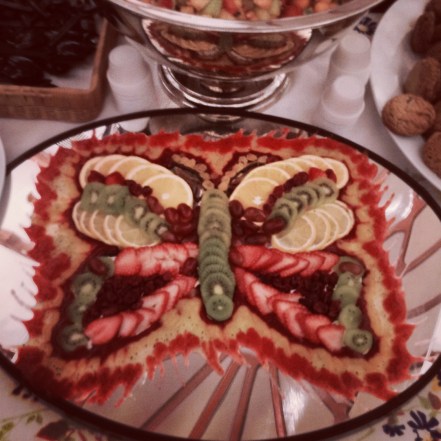
fruit salad
Chris Brogan has announced his 3 words for 2015. This annual challenge is an alternative to the classic resolution style. I have done it with success, and also done it when I forgot my words entirely. Like anything else, persistence is needed for results too occur. I am pleased with my own choices this year, patience, persistence, and poetry. They have meaning across the board to upgrades I aspire to make. I plan to use them liberally throughout the year. I also plan to use Brother Brogan’s words to apply to a specific change I am making in my household. There is no rule that says you can’t admire and swipe other people’s words if they suit you. His words work for my new world of menu planning. I have become convinced that improvisation is not the best way forward with nutrition. It has served me well, and I am healthy. I want to develop the skills and the results of managing our home kitchen like a chef with a restaurant. I know that planning and balance will bring lower costs and higher quality nutrition to our diet. We will waste less produce and use the freezer to make the most of what we buy. This new discipline fits perfectly with the words I am appropriating from Brother Brogan for this project.
His words are:
Thanks, as always, for your guidance, Chris. I am happily applying your words to my advantage this year. I have loved your teaching since Trust Agents. I hope your words will be fabulous for you as well. All the best in 2015.

psyche

psyche
Each night our psyche brings us images in dreams. We connect with them and live within the dream during our sleep. Upon awakening we sometimes lose the dream images as we file that dream somewhere within our unconscious and decide it is not part of our true reality. Notice that we are within the dream while asleep, and then the images are considered to be unreal when we are awake. We live within a gallery of art and image, dramas with set and costume, in our sleeping world. Our awakened ego is concerned with gathering information and meaning rather than absorbing art for art’s sake. We wake up and enter the world with an explanation for everything. By dismissing the power of the imagination we loose the opportunity to individuate. We diminish our own imagination by interpreting our dream images rather than interacting with them.
We run two systems in our awakened world, an economic system and a therapeutic system. All of our activities are divided into economic obligations and challenges or curing our ills. We are concerned with “growth” of our personal economy or “healing” our wounds. It is easy to see the connections that contribute to the cyclical nature of this limited spiral. What is not so simple is to break these cycles. If our addictions are fed by information, image is converted by the mind into interpretation. The ego prides itself on its ability to interpret everything. Since the ego determines that it alone is conscious, all the rest of reality can be fit into the unconscious basket. The ego explains the image and then its importance is belittled. We cease to interact with it once it has an explanation. Imagery has no explanation. Art and image are animate and inherently charged with insight.
I intend to respect the imagery inside of me by embracing a more poetic view of life. By bringing focus to imagination and imagery I want to contribute to my own creativity. I will investigate how I can interact with my psychic and artistic life through practice. This intention can only be controlled to a certain extent, and it is not my hope to contain my psyche, but to explore it. It has a lot to say.




April is Poetry month, with many activities and projects running around the country. I have taken the challenge to write a poem every day in April for the last two years. I push my way through the writing, with a fully punched card in participation, but have not really put my full attention into the whole process. We are lucky in Tucson to have a world-famous Poetry Center at the U of A, open to the public. Each time I visit the place I tell myself I will make a regular habit of spending time there. It is an inspiring place to read, write, meditate, or take part in one of the workshops or readings. The only resolution I need to make for 2015 is to honor the poet within me all year. There is a haunting feeling in my memory and in my dreams of a productive and expressive poet I believe is within my spirit. This artist/alchemist/poet has not been nurtured as well as it needs to be. I work with words daily but am not arching to new heights or even developing a larger vocabulary. When I do push myself to write poetry daily I can feel a response in my dream world toward more color and rich dramatic story lines. It is as if there are stories, poems, maybe even novels, deeply stored in my writing practice, but I do very little to develop my ability in these realms. The poetry is essentially trapped within my lazy writing practice. I plan to liberate this struggling poetic artist next year and allow her to explore and create in new ways.
As 2015 approaches I contemplate the 3 words I will use to ground my meditation, my health, and my creativity next year. This is a practice started and promoted by Chris Brogan. I have done it before and always find the quest for the right words to be very helpful. This year I want to make some kind of significant progress as a poet and creative writer. By using these key words all year I believe I can be a better poet in April and beyond. Moreover, I think these words fit perfectly with my goals to clear out excess clutter in my home and my life. I am working on this now, cleaning out my closet before the end of the year. I can honestly say that the results I see and feel in my closet after patiently and persistently ridding myself of extraneous clothing and accessories are nothing short of poetic. Poetry has more to do with what is edited than with what remains. The fewer words used to convey an idea, the more powerful each word becomes. Now my closet is more like a haiku than an epic drama. I am feeling much better when I walk into it now.
These words fit perfectly with my health and fitness goals. Movement and variety of enjoyable physical activities create strong healthy bodies. It does not matter if time is spent playing an active sport, hiking, swimming, or yoga, the key to success is always persistence. I like to cross train, in other words, do different physical activities, to keep things interesting. This is good for the body as well as the mind. I like doing some activities outdoors, but the gym makes me very happy too. In 2015 I plan to create a fitness regime that offers me a chance to improve my levels of grace, balance, and coordination. I plan to end 2015 as poetry in motion, retaining all my flexibility and enthusiasm for fitness and health. Too much of any one thing can cause burn out or injury, so there is no need to fixate on any one aspect of health or fitness. Balance is an important element of health.
My words have meaning for me in many aspects of living. They are good universal guiding principals that are easy to remember:
Do you do the 3 word challenge, Gentle Reader? Have you found it to be helpful?

Affeton Castle
My 12th great-grandfather was a very petty, criminal, mean man, eventually shunned by society. I am descended from both his son and his daughter.
SIR “JUDAS” STUKELEY
SIR LEWIS STUKELEY, or Stucley, who has been branded as the Judas of Devonshire, was the eldest son of John Stukeley, of Affeton, by Frances St. Leger. He had two brothers and several sisters. He was great-nephew to “Lusty” Stucley, and partook of that vein of meanness and treachery that characterized Thomas. He was married to Frances daughter of Anthony Monk, of Potheridge, a family which, if not more ancient, was free from the taint of baseness that savoured three of the Stukeleys. By her he had five sons; none were knighted, the shame of the father rested on them, and it was not till the next generation that knighthood was again granted to the representative of the Stukeleys, of Affeton.
Lewis himself was knighted, not for any worthiness that he had shown, but as the representative of a good family, when James I was on his way to London in 1603. In 1617 he was appointed guardian of Thomas Rolfe, the infant son of Pocahontas by J. Rolfe. Then he was created Vice-Admiral of Devon, and in that capacity he left London in June, 1618, with verbal orders from the King to arrest Sir Walter Raleigh, then arrived at Plymouth on his return from the Orinoco. Sir Walter had been released from his long captivity in the Tower, because he gave hopes to James of finding a gold-mine in Guiana. He had been there before, had brought away auriferous spar, and had heard tidings of deposits of gold. James was in debt and in need of money, and he clutched at the chance of getting out of his difficulties through the gold of Guiana. That there was gold there is certain; Raleigh’s mine has been identified; but since he had left the Orinoco, the Spaniards had pushed up the river and annexed land and built stations.
James did not want to break with the Spanish Government and gave Raleigh instructions not to come to blows with the Spaniards. Unhappily, Raleigh’s lieutenant, whom he had dispatched up the river, did come to blows with them, and blood was shed; it was however in self-defence, for the Spaniards had fallen upon the English party when unprepared and killed some of them. This unfortunate business, and the fact that Raleigh could not reach his gold-mine, the way to it being intercepted by the Spaniards, made him turn back with a heavy heart. On reaching Plymouth, he hasted towards London to state the case to the King, when he was met at Ashburton by his cousin, Sir Lewis Stukeley, with smiles and professions of love—but having war in his heart. His rancour against his kinsman was due to a quarrel in 1584, when, as Stukeley asserted, Sir Walter did “extreme injustice” to Stukeley’s father, then a volunteer in Sir Richard Grenville’s Virginia voyage, by deceiving him in a matter of a venture he had made. James was in a great fright lest he should be plunged in war with the King of Spain, and very angry because the gold-mine had not been found; and Stukeley was promised £500 to worm out of his cousin some damning admissions, as that there never had been any goldmine at all, and to betray these to James. Stukeley had received only verbal instructions from the King. He therefore reconducted Raleigh back to Plymouth, where he placed him in Radford, the house of Sir Christopher Harris, who was charged with his custody, till Stukeley received orders from James. Raleigh was ill—or feigned to be ill—the former is the more probable, and he being laxly guarded formed a plan of escape to France. He commissioned Captain King, the only one of his officers who remained faithful to the last, to make arrangements for flight with the master of a French vessel then lying in the Sound. At nightfall, the two stole from Radford and got into a boat lying at the little quay below the house. They had not rowed far, however, before qualms came over Raleigh; it seemed to him unworthy of his past and of his honour to fly his native land; and he perhaps counted too securely on the generosity of the despicable James. He changed his mind, and ordered King to return to Radford. Next day he sent money to the Frenchman, and begged him to wait for him another night. Night came, but Raleigh did not stir. This singular irresolution in a man so energetic, ready, and firm, points surely to the fact that he was ill at the time, suffering from the ague which so often prostrated him. Stukeley at length received orders to take his prisoner to London, and the opportunity to escape was gone for ever. As Raleigh passed through Sherborne, he pointed out the lands that had once been his, and related how wrongfully they had been taken from him.
At Salisbury Raleigh complained of illness, and begged to be allowed to halt there for a while. It was asserted by a French quack, Mannourie, set as a spy over him, that he got the doctor to anoint him so as to produce sores wherever the ointment was applied. This was one of the charges afterwards brought against him, at the special insistence of King James, who always kept his eye on trifles. Whilst Raleigh was at Salisbury, Sir Lewis Stukeley robbed him of all his jewels and money, leaving him only the emerald ring on his finger, engraved with the Raleigh arms. It has been asserted that Sir Walter endeavoured here to bribe his cousin to connive at his escape. Had this been the case, Stukeley would certainly have mentioned it in his “Humble Petition,” and justification of his conduct after the execution of Raleigh. He was not the man to fail to flaunt such a feather in his cap as that he had resisted a bribe, had such a bribe been offered him.
Whilst Raleigh lay ill at Salisbury, Captain King hurried up to London, by his master’s direction, to hire a vessel to wait at Gravesend till he should be able to go on board. The master of the vessel at once betrayed the matter. Sir William St. John, a captain of one of the King’s ships, immediately took horse and rode to meet Stukeley and his prisoner on their way to town, and encountered them before he reached Bagshot. Stukeley then confided to him certain charges against Raleigh which he was to lay before the King.
Next day Stukeley had fresh matter to dispatch to the Court. It was this: La Chesnee, the interpreter of the French Embassy, visited Sir Walter at Brentford. He had brought with him a message from Le Clerc, agent for the King of France, offering him a passage on board a French vessel, together with letters of introduction which would secure him an honourable reception in Paris. Raleigh thanked him for the offer, but replied that he had already provided for his escape. All this Stukeley learned by applying his ear to the keyhole or by worming the secret out of Raleigh by professions of kindness and desire to assist him to escape.
James at once took alarm. A plot with France was a serious matter at that time. He accordingly directed Stukeley to continue to counterfeit friendship with Raleigh, to assist him in his meditated escape, and only to arrest him at the last moment; and to bring this attempt as one more charge against Raleigh. So Stukeley continued to insinuate himself into the confidence of his cousin, and endeavoured by all means in his power to wheedle out of him such papers as might afford evidence of his designs and might serve to help to bring him to the scaffold.
On his arrival in town, Raleigh was conducted to his own house in Broad Street. There he was revisited by Le Clerc, who repeated his former offers.
The next morning Sir Walter got into a boat attended by Stukeley, all smiles, and the honest King; and, as prearranged, he was arrested at Woolwich and at once lodged in the Tower.
On 29 October, 1618, Raleigh’s head fell under the executioner’s axe. He was a victim to Spanish resentment and to James’s meanness in offering him as a sacrifice to curry favour with Spain. Gardiner says Raleigh was executed “nominally in accordance with the sentence delivered in 1603; ln reality because he had failed to secure the gold of which James was in need. The real crime was the King’s, who had sent him out without first defining the limits of Spanish sovereignty.”
The writer of the notice of Sir Lewis Stukeley in the Dictionary of National Biography takes a lenient view of Stukeley’s conduct. “Stukeley certainly gave hostile, not necessarily false evidence against Raleigh. He seems to have been a harsh, narrow-minded, and vulgar man, glad to have his cousin in his power, to revenge himself on him for the pecuniary loss his own father had entertained.” Gardiner says: “Stukeley seems to have thought it no shame to act as a spy upon the man who had called upon him to betray his trust;” but it is precisely this charge that cannot be established. We have no good evidence that Raleigh did attempt to bribe him. Popular opinion ran strongly against Stukeley, and he was nicknamed Sir Judas. He tried to hold up his head at Court, but no man would condescend to speak to him. He met on all sides with glances full of contempt and gestures of disgust. He hurried to James, and offered to take the Sacrament upon the truth of a story Raleigh had denied on the scaffold—that he had been offered a commission by the French King (the story came through Mannourie); but no one would have believed Stukeley a whit the readier had he done this.
Indeed, Mannourie subsequently admitted that it was false, when he was arrested for clipping the gold, the blood money, he had received for spying on Sir Walter. In a letter from the Rev. T. Lorkin to Sir T. Puckering on 16 February, 1618-19, he says: “Manourie, the French Apothecary, (who joigned with Stukely in the accusation of Syr Walter Raleigh) is at Plimouth for clippyng of gold … his examination was sent up hether to the King, wherein … (as I hear from Syr Rob. Winde, cupbearer I thincke to his Majesty, who saith he read the examination) that his accusation against Raleigh was false, and that he was wonne thereto by the practise and importunity of Stukely, and now acknowledges this his present miserable condition a judgment of God upon him for that.”
When Stukeley made this offer to King James, a bystander dryly observed that if the King would order him to be beheaded, and if he would then confirm the truth of his story with an oath while on the scaffold, then possibly he might be believed.
One day Sir Judas went to call on the old Earl of Nottingham, who was Lord High Admiral, and asked to be allowed to speak to him. The Earl turned on him instantly. “What,” he said, “thou base fellow! Thou who art reputed the scorn and contempt of men, how darest thou offer thyself into my presence? Were it not in my own house, I would cudgel thee with my staff for presuming to be so saucy.” Stukeley ran off to whine to the King, but even there he met with no redress. “What,” said James, “wouldst thou have me do? Wouldst thou have me hang him? On my soul, if I should hang all that speak ill of thee, all the trees in the country would not suffice.” It was even said, probably without truth, that James had said to Stukeley, “Sir Walter’s blood be on thy head.”
A few days after the scene with the King, it was discovered that Stukeley had been for many years engaged in the nefarious occupation of clipping coin. It was even said that he tampered in this way with the very gold pieces which had been paid to him as the price of his services for lodging Raleigh in the Tower and betraying him. When arrested he endeavoured to excuse himself by inculpating his son. Could meanness descend to a lower depth?
“1618-19. Jan. 12. … Upon Twelf night Stukely was committed close prisoner in the Gate house for clipping of gould. He had receyved of the Exchequer some weeks before £500 in recompense for the service he had performed in the business of Syr Walter Raleigh, and beganne (as is said) to exercise the trade upon that ill-gotten money (the price of blood). Upon examination he endeavoured to avoid it from himself, by casting the burden either upon his sonne or man. The former playes least in sight and can not be found. The servant is committed to the Marshalsay, who, understanding that his Master would shift over the business to him, is willing to sett the saddle upon the right horse, and accuses his Master.”[1]
But the accusation was not pressed. King James owed Stukeley too deep a debt to let him suffer, and he threw him a pardon, so that the evidence against him was not gone into. It may be remembered that “Lusty” Stukeley had also been implicated in clipping and coining, and had only escaped arrest by flying the country.
Stukeley, an outcast from society in London, went down to Affeton. But even there he was ill-received. The gentry would not speak to him, his own retainers viewed him with a cold, if not hostile, eye, and rendered him but bare obedience.
The brand of Cain was on him, and he fled from the society of his fellow men to the isle of Lundy, and shut himself up in the lonely, haunted tower of the De Mariscoes. There he went raving mad and perished (1620), a miserable lunatic on that rock, surrounded by the roaring of the waves and the shrieks of the wind. His body was conveyed to South Molton, so that he was denied even a grave beside his ancestors at Affeton.
For authorities, see Gardiner, Prince Charles and the Spanish Marriage, Vol. I, London, 1869; Dr. Brushfield’s Raleghana, Part VII; the Dictionary of National Biography, s.n.; and the various Lives of Raleigh.
↑ Letter from T. Lorkin to Sir T. Puckering.
Sir Lewis Stukely (1523 – 1620)
is my 12th great grandfather two times
Lewis Stukely (1544 – 1570)
son of Sir Lewis Stukely
Mary Stukely (1570 – 1591)
daughter of Lewis Stukely
Mary Periam Wescott (1581 – 1681)
daughter of Mary Stukely
James Sweet (1622 – 1695)
son of Mary Periam Wescott
Benoni Sweet (1663 – 1751)
son of James Sweet
Dr. James Sweet (1686 – 1751)
son of Benoni Sweet
Thomas Sweet (1732 – 1813)
son of Dr. James Sweet
Thomas Sweet (1759 – 1844)
son of Thomas Sweet
Valentine Sweet (1791 – 1858)
son of Thomas Sweet
Sarah LaVina Sweet (1840 – 1923)
daughter of Valentine Sweet
Jason A Morse (1862 – 1932)
son of Sarah LaVina Sweet
Ernest Abner Morse (1890 – 1965)
son of Jason A Morse
Richard Arden Morse (1920 – 2004)
son of Ernest Abner Morse
Pamela Morse
I am the daughter of Richard Arden Morse

Our new bed, Truth
Testing boundaries and applying discipline will lead to mastery of any skill we choose to practice. We generally rely on what we consider to be our strengths to solve most of our problems in life. Most of us hide our weaknesses, primarily from ourselves, since others can clearly see them. While I am on a big push to clean and clear out my home I notice similarities between my mental state and the state of all my various projects. While digging out all the clothing that is heading for new closets in other people’s houses I discover very cool things I had forgotten in the back of the closet. I have both stupid stuff I have barely worn and the most brilliant, well crafted wardrobe imaginable. The problem has been mixing them all together and overstuffing the space. Nothing is appealing when it is disheveled and jumbled. The same thing applies to my sewing supplies, my office desk, my kitchen cabinets, and, (dare I say it?), my mind. In each one of these cases I go looking for one thing and find 100s of useless items just hanging around for no reason, and a few real treasures I never see or use because they are in a sorry state of order. This clearing must continue until everything I own gives me joy. This must apply to all things, mental as well as physical, digital as well as analog. At the end of the month, which is the end of the year, our brand new bed will arrive. The mattress is named Truth. The truth is that I have a lot of cleaning to do before it arrives:
What needs to go?
What are the mental steps to take to assure I maintain my unobstructed new life?
I am looking forward to exposing this entire phenomena. Often it is said that our greatest strength is also our greatest weakness. I think we all keep a lot of junk out of sight. I maintain a clean and orderly home (to the naked eye), but stuffed into all available nooks and crannies are things I do not need or want. I believe my talents and spiritual life are similar to those overstuffed cabinets. Not only do I have way more than I can use, but I have some trouble distinguishing one thing from another because the agony is all wrapped around the ecstasy at this point. I don’t embrace resolutions. I do want to find myself at the end of 2015 owning fewer things and liking them more. How do you fight the clutter bug, Gentle Reader? Who will win in 2015? I am planning a victory!


My 7th great-grandfather had an inherited gift for bone setting. Both he and my 6th great-grandfather relieved suffering by using manipulative medicine. They had no degree in medicine but believed in their natural ability to pass this gift down to generations of Sweets.
“November 8th, 1724, Captain Benoni Sweet was baptised at St. Paul’s, in Narragasett, by the Rev. Mr. McSparran; and at the succeeding Easter, Captain Sweet was elected one of the Vestry.” [History of the Episcopal Church in Narragansett, Rhode Island, page 94.]
“James Sweet, the father of Benoni, emigrated from Wales [England] to this country, and purchased an estate at the foot of Ridge Hill, so called, in North Kingstown… Benoni had been a Captain in the British service–was well informed, and of polished manners. He was a natural bonesetter and the progenitor of the race in Rhode Island. He was styled Doctor Sweet, but he practised in restoring dislocations only. He was a regular communicant of the church, and officiated as a vestryman, until his death. ‘July 19th, 1751,’ says the record, ‘died Captain Benoni Sweet, of North Kingstown, in the ninetieth year of his age; Dr. McSparran preached his funeral sermon, and buried him in the cemetery of his ancestors.'” [History of the Episcopal Church in Narragansett, Rhode Island, page 94.]
“SWEET, Capt. Benoni, in 90th year, buried in his own family yard.” [Vital Record of Rhode Island, 1636-1850, v.10, page 384]
Benoni Sweet (1663 – 1751)
is my 7th great grandfather
Dr. James Sweet (1686 – 1751)
son of Benoni Sweet
Thomas Sweet (1732 – 1813)
son of Dr. James Sweet
Thomas Sweet (1759 – 1844)
son of Thomas Sweet
Valentine Sweet (1791 – 1858)
son of Thomas Sweet
Sarah LaVina Sweet (1840 – 1923)
daughter of Valentine Sweet
Jason A Morse (1862 – 1932)
son of Sarah LaVina Sweet
Ernest Abner Morse (1890 – 1965)
son of Jason A Morse
Richard Arden Morse (1920 – 2004)
son of Ernest Abner Morse
Pamela Morse
I am the daughter of Richard Arden Morse
The Bonesetter Sweets
Of South County, Rhode Island
By Martha R. McPartland
In colonial America, graduates of medical schools were few and far between. In Rhode Island there were only five medical school graduates practicing in 1800 and the first medical degree awarded in the state was a Brown University in 1814. Prior to that period, from its founding in 1636, Rhode Island had many men called “Doctor” with
little or no qualifications to back up their title. Some were the seventh son of a seventh son, and so believed to be endowed with special healing power; some were charlatans with a smattering of education and glib tongues, who took advantage of misfortune and ignorance; still others had a natural flair for caring for the sick and were able to relieve much suffering. In the last category was a remarkable family from the southern part of Rhode Island called, and still recalled, as the “Bonesetter Sweets.”
The Sweets were an old Rhode Island family whose progenitor, John Sweet, came to the state from Salem, Massachusetts in 1637. Of Welsh extraction, family tradition has it that their forbears in Wales had this innate facility for helping the sick. James Sweet , son of the immigrant, John, was the first of the American “Bonesetter Sweets.” He was born in 1622, came to Rhode Island with his parents, married Mary Greene and settled in what is commonly called South County, and more correctly named Washington County. Of the nine children of James and Mary Sweet, only Benoni , born in 1663, became a bonesetter. Traditionally, Benoni is said to have had a flowery and polished
manner—perhaps a forerunner of the bedside manner possessed by some of today’s medical men! He was called “Doctor” Sweet and his practice consisted of setting bones. He was a respected member of the community and a communicant of the historic Narragansett Church. When he died in 1751, Dr. James McSarren, rector of the
church, delivered a glowing eulogy. The inherited ability to set bones was not regarded by the Sweets as a vocation, but rather as an avocation. They were artisans by calling—stonemasons, blacksmiths, wheel-wrights, and carpenters. Bone setting was a sideline, as is demonstrated by an advertisement in the Providence Journal of February 16, 1830 and printed at the top or the first page of this article.
The remarkable part of this family was the fact that they never exploited their natural ability. Not one of them sought fame or fortune through this medium. The father usually selected one or two of his sons, probably those who showed a tendency in that direction, and instructed them in bonesetting. The Sweets did not deem this a magical thing, but more of an inherited knowledge acquired from their elders. They handled fractures, sprains, and dislocations with a skill to be envied by an orthopedic physician. Their skill was in the manipulation of bones but they were known to use herbs, ointments, and skunk grease in massaging too. Their knack was thought uncanny, as they so often succeeded where others, more learned and “better trained,” had failed. Instances naming local doctors who failed to relieve suffering that was later relieved by one of the Sweets have become a part of South County folklore.
Dr. Benoni Sweet selected his son, James , to carry on the family art. James was born in 1688 and not too much is known of his successes, but it was Job Sweet, son of James, who gained national recognition and established their bonesetting reputation. Job was born in 1724 and married Jemima Sherman in 1750. He lived all his life in the South County section of Rhode Island.

