mermaidcamp
Keeping current in wellness, in and out of the water
You can scroll the shelf using ← and → keys
You can scroll the shelf using ← and → keys
October brings ancient celebrations and rituals to life. Samhain, Halloween, Guy Fawkes Day,as well as Divali, fall at the end of October and beginning of November. They have in common ritual use of fire as part of the celebrations. As we enter the darkest part of the year in the northern hemisphere we honor the dead and invite them to partake in their former earthly pleasures. Day of the Dead is only one of the cultural holidays designed around remembering. The season is the right time to let go, to clean, clear, and remember. This is possible without any formal outward practice. You don’t have to dress up or build an altar to honor this change of season.
We all go through dark times in life. Lighting up the sky with fires and fireworks reminds us of energy shared, passed on, and finally no longer needed. You don’t need to be religious to understand the sacred nature of the inheritance of our human life. To be able to walk on the earth is not a small gift. Without the generations that survived before us we would not exist. We may notice a feeling of guidance from the ancestors, or simply a reverence for those who created our existence out of their own. I sometimes feel a deep sense of regret when I consider the lives of my ancestors. Who knows if that comes from me or from them. What can be known is that our connection to our ancestors is permanent. What we can learn from knowing about them and from imagining the way they lived gives us some insight into our own strengths and weaknesses. The ancestors know about those strengths and follies because they had them before we did, under different circumstances. I believe they would like for us to learn from their experiences.

Visconti Coat of Arms
Coat of Arms of the Visconti of Milan depicting the biscione, a serpent who appears to be swallowing a human.
The effectual founder of the Visconti of Milan, Ottone, wrested control of the city from the rival Della Torre family in 1277.
The family, once risen to power, loved to claim legendary versions about its origins. Fancy genealogies were en vogue at the time, while established facts reflect quite sober and almost humble beginnings in the lesser nobility. The branch of the Visconti family that came to rule Milan was originally entrusted with the lordship of Massino (nowadays Massino Visconti), a hamlet in lovely position over Lago Maggiore, where they were in charge since the twelfth century as archiepiscopal vassals.
It is thought that the Milanese Visconti had their origins in a family of capitanei (cfr. the modern surname Cattaneo) whom archbishop Landulf of Milan (978-998) had granted certain feudal holdings known as caput plebis (at the head, likely in geographical and not hierarchical sense, of the pieve, an ecclesiastical lesser subdivision). A document from the year 1157 says the Visconti were holders of the captaincy of Marliano (today Mariano Comense); late chronicler Galvano Fiamma confirms this version. Decades before that, surely before 1070, they had gained the public office of viscount, to be later inherited down the male line (Biscaro, ASL, “I maggiori dei Visconti di Milano”). Soon the family dispersed into several branches, some of which were entrusted fiefs far off from the Lombard metropolis; the one which gave the Medieval lords of Milan is said to be descended from Umberto (d. in the first half of the 12th century).
The Visconti ruled Milan until the early Renaissance, first as Lords, then, from 1395, with the mighty Gian Galeazzo who almost managed to unify Northern Italy and Tuscany, as Dukes. Visconti rule in Milan ended with the death of Filippo Maria Visconti in 1447. He was succeeded, after a short-lived republic, by his son-in-law Francesco I Sforza, who established the reign of the House of Sforza.
Visconti rulers of Milan
Ottone Visconti, Archbishop of Milan (1277 – 1294)
Matteo I Visconti (1294 – 1302; 1311 – 1322)
Galeazzo I Visconti (1322 – 1327)
Azzone Visconti (1329 – 1339)
Luchino I Visconti (1339 – 1349)
Bernabò Visconti (1349 – 1385)
Galeazzo II Visconti (1349 – 1378)
Matteo II Visconti (1349 – 1355)
Gian Galeazzo Visconti (1378 – 1402) {1st Duke of Milan & nephew of Bernabò Visconti}
Giovanni Maria Visconti (1402 – 1412)
Giacomo Visconti (1412 – 1447)

Obizzo Visconti
Obizzo Visconti (1198 – 1266)
is my 22nd great grandfather
Theobald Visconti (1220 – 1276)
son of Obizzo Visconti
Matteo I Visconti (1250 – 1322)
son of Theobald Visconti
Stefan Visconti (1289 – 1327)
son of Matteo I Visconti
Bernabo Lord Milan di Visconti (1319 – 1385)
son of Stefan Visconti
Veridis Duchess Austria Visconti (1352 – 1414)
daughter of Bernabo Lord Milan di Visconti
Ernst I “Ironside” Archduke of Austria Habsburg (1377 – 1424)
son of Veridis Duchess Austria Visconti
Katharina Archduchess Austria Von Habsburg (1420 – 1493)
daughter of Ernst I “Ironside” Archduke of Austria Habsburg
Christof I VanBaden (1453 – 1527)
son of Katharina Archduchess Austria Von Habsburg
Beatrix Zahringen (1492 – 1535)
daughter of Christof I VanBaden
Sabine Grafin VonSimmern (1528 – 1578)
daughter of Beatrix Zahringen
Marie L Egmond (1564 – 1584)
daughter of Sabine Grafin VonSimmern
Richard Sears (1590 – 1676)
son of Marie L Egmond
Silas Sears (1638 – 1697)
son of Richard Sears
Silas Sears (1661 – 1732)
son of Silas Sears
Sarah Sears (1697 – 1785)
daughter of Silas Sears
Sarah Hamblin (1721 – 1814)
daughter of Sarah Sears
Mercy Hazen (1747 – 1819)
daughter of Sarah Hamblin
Martha Mead (1784 – 1860)
daughter of Mercy Hazen
Abner Morse (1808 – 1838)
son of Martha Mead
Daniel Rowland Morse (1838 – 1910)
son of Abner Morse
Jason A Morse (1862 – 1932)
son of Daniel Rowland Morse
Ernest Abner Morse (1890 – 1965)
son of Jason A Morse
Richard Arden Morse (1920 – 2004)
son of Ernest Abner Morse
Pamela Morse
I am the daughter of Richard Arden Morse
OBIZZO Visconti (-after 1258). m FIORINA Mandelli, daughter of RUFFINO Mandelli & his wife Aldesia Pietrasanta. Obizzo & his wife had two children:
a) TIBALDO Visconti (-beheaded Gallarate 1276). The Annales Mediolanenses record that “Archiepiscopum Ottonem…Tibaldi nepotis sui” was beheaded “in Galerate” in 1276 . m ANASTASIA Pirovano, niece of Cardinal Uberto Pirovano Archbishop of Milan, daughter of — (-1276, bur [Milan San Eustorgio]). The primary source which confirms her parentage and marriage has not yet been identified. Tibaldo & his wife had [four] children:
i) MATTEO [I] Visconti (Invorio 15 Jul 1250-Crescenzago 28 Jun 1322). Giovanni di Musso´s Chronicon Placentinum records that “Dominus Mafæus Vicecomes nepos Domini Ottonis Vicecomitis Archiepiscopi Mediolani” was installed as “Populi Mediolani Capitaneus” in 1287 and shortly after as “Dominus Generalis civitatis Mediolani” . Lord of Milan.
– see below.
ii) UBERTO Visconti (-22 Apr 1315, bur Milan Dominican Church). The Annales Mediolanenses record the death in 1315 of “Nobilis Miles Ubertus Vicecomes frater magni Matthæi Vicecomitis” and his burial “in conventu Fratrum Prædicatorum”.
iii) [STEFANO Visconti (-1327, bur Milan San Eustorgio). The Annales Mediolanenses record the death in 1327 of “nobilis Miles Stephanus Vicecomes” and his burial “apud Sanctum Eustorgium cum matre sua” . The source does not specify Stefano´s parentage but it is possible that he was another otherwise unrecorded brother of Matteo [I] Visconti Lord of Milan.]
iv) [OTTORINO Visconti ([12/14] Oct 1336, bur Milan San Eustorgio). The Annales Mediolanenses record the death in 1336 of “nobilis Miles Ottorinus Vicecomes” and his burial “in ecclesia Sancti Eustorgii” 15 Oct. His place of burial suggests that Ottorino may have been the brother of Stefano Visconti.]
b) PIETRO Visconti (-after 1301). The Annales Mediolanenses record that “Petrus Vicecomes Dominus Seprii et frater patris Matthæi” rebelled against “Matthæum Vicecomitem Dominum civitatis Mediolani” in 1301 but was captured and held “in castro de Serezano” . m —. The name of Pietro´s wife is not known. Pietro & his wife had one child:
i) daughter . Her parentage and marriage are confirmed by the Annales Mediolanenses which record that “Petrus Vicecomes Dominus Seprii et frater patris Matthæi” incited “Ruscam Dominum civitatis Cumanæ generum suum” to rebel against Matteo [I] Visconti Lord of Milan in 1301, the succeeding passage recording “Conradus Rusca Dominus civitatis Cumanæ” among the rebels . m CORRADO “Rusca” Signore di Cuma, son of — (-after 1301).
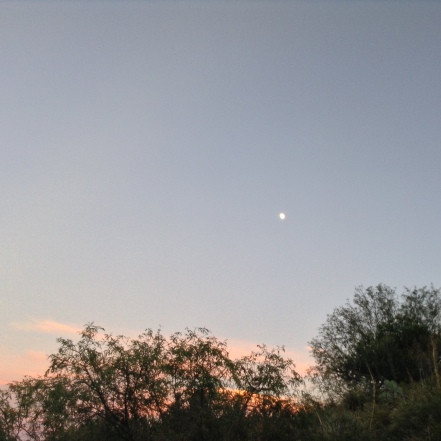
Clarkdale, AZ
I bought the audio book Falling Upward at the suggestion of a fellow student at a conference I attended last June. I encountered the contemplatives for the first time, and had a lot to learn from them. James Finley guided us for a meaningful and educational weekend. I owned an audio book by Dr Finley and Carolyn Myss covering the subject I have already heard at the conference, transcending trauma. This complex idea deserved a review, so on my recent car trip I listed to the trauma book to deepen my understanding. On my trip back home I decided to hear Richard Rohr read his own book, Falling Upward. I started from Clarkdale before dawn and arrived in Tucson about 10 in the morning. Most of the drive was really scenic, but even Phoenix traffic was bearable because I was enjoying the book so thoroughly. I have one disc still to hear, but I am fully ready to recommend this book to anyone, especially to those over 40. This is another way to look at retirement planning, from a spiritual perspective.
Falling Upward explains spirituality as it pertains to the two halves of life. In other words, humans are involved in the giant birth/death/recycle action of the universal field. There is a time for building up, and a very appropriate time for breaking down. All of nature does this constantly. Although Mr Rohr is a Franciscan and a Catholic priest, his point of view is not all presented from a theological stance. He knows history very well and uses his experience in the study of initiation rites of native people around the world to draw large conclusions. His conviction is that humans are capable of taking a grand excursion of the soul. He reminds us that all saints and holy figures leave home on a big crazy journey, only to return to home. The journey represents necessary suffering that teaches the mystery beyond the suffering. In the second half of life this death of the perceived self, or being in the world but not of it, can lead to enlightenment. In our culture many of us cling to the structures we built in our youth as if there is nothing greater or beyond our own creative control. Falling Upward involves letting go to the point that previous reality fades from view as we float to our intended home in eternal bliss. Sound kooky??? Well, it is. All the saints and prophets were considered to be out of their minds. Many were killed. Before the truth sets you free it generally makes you appear to be crazy.
I like to hear authors read their own books to me. I feel like it becomes more personal. This one is very special because I had never heard of Richard Rohr before his fan told me about him last June. Now I am a huge fan too. I invite you to listen, gentle reader. I could make a big difference in the end.

Falling Upward


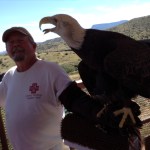

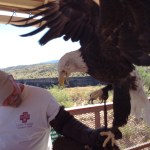

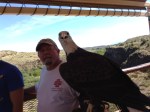

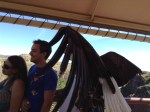


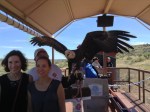
I drove to Clarkdale, AZ last weekend to ride the Verde Valley Railroad with Sonora the bald eagle. She was brought to wildlife rescue as a very young bird with her wing badly broken. Today she can fly in her enclosure, but her wing never healed well enough for her to return to the wild. I have to say for a captive eagle, this girl gets around and continues to enjoy nature while she rides the train through the canyons. Her enclosure in Scottsdale is at Liberty Wildlife Refuge, at the home of a former vet of the Phoenix zoo, and her two handlers that accompany her on field trips obviously love her dearly. She is a pampered (not that it was her choice) suburban eagle with a soccer mom schedule of school events, train appearances, and other symbolic and educational obligations. She seems happy, and everyone who gets to see her up close and personal is ecstatic while in her presence. I was completely out of my mind. She flapped me on the head with her wing while I was standing next to her, which I consider to have been a super magical gift. She didn’t hurt me at all, but I did get a sense of her power. I want to say I am her greatest fan, but I suspect we all adore her at the same very high level. She is just awesome. If you have a chance to meet Sonora, don’t miss it. She rides the train once a month for now. She began her programs on the train in 2010 when she was 3. Now she is a seasoned model and train enthusiast. I can’t tell you how fun it is to meet her.

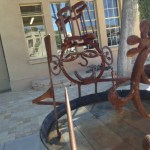

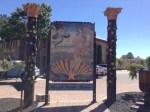


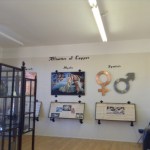

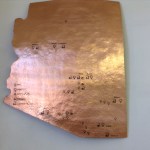


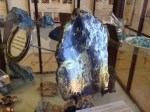
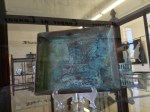


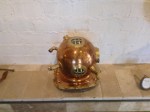
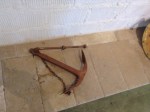

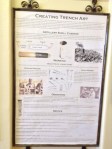


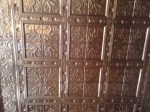

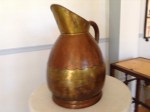


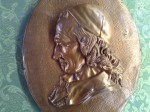


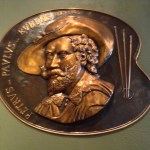


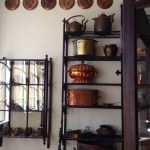
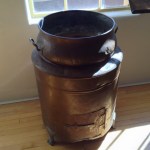

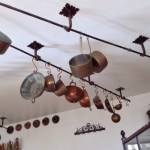


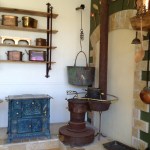

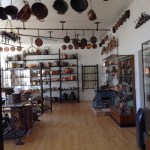


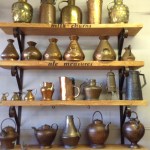

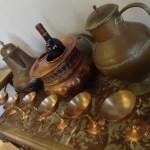

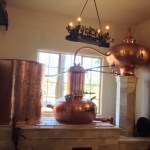
One highlight of my recent trip to the historic and supposedly spooky Historic 89A from Cottonwood to Jerome was the new museum housed in the old Clarkdale high school. This old building with giant windows lets in an abundance of natural light. This is really the perfect place to display copper. Jerome, the mining town up the hill, is a famous ghost destination and artist colony. There was a very large copper mine that brought wealth to the town. The family that has started the museum owns a copper shop in Jerome. They rent the ground floor of the high school building, and rent the upstairs to residential tenants who serve as security at night. I think it is a great gig to live upstairs because the view, the location, and the fact that the copper art is always downstairs make it uniquely attractive.
The very extensive military and kitchen collections are on permanent loan from private collectors. There is a temporary collection of antique tin cookie forms, mostly Santas, but bunnys and other holiday shapes as well. I learned a lot from the extensive charts and informative posters. The museum covers the history, the myth and meaning, the mining, and the art that resulted. I love the look of copper, but appreciate the other qualities it has, such as antibacterial. Everything is covered well and the staff (owner) checks in frequently to see if the patrons have questions about the exhibits. I saw him take great care and a lot of time when kids were visiting with parents. There is no formal tour, but the space is small and the guest is invited to ask for more guidance. I normally spend an extra long time in museums, and this was no exception. I was fascinated and needed to look at all the detail. I noticed other patrons were also sitting down and spending time looking deeply at the displays. One of my favorite rooms contains spent artillery shells from WWI that were turned into “trench art” by soldiers. I believe anyone would enjoy seeing this museum. It has artistic and historic value displayed in a place that makes it shine. If you are in the Clarkdale area to ride the train, don’t miss this awesome museum just around the corner from the train station.
The Verde Valley north of Phoenix has a very interesting history. I had not visited the area for years and had read about the popular wine trail as a destination. I decided to spend a night in the restored historic section of Cottonwood. It is charming and very laid back. Folks are friendly, and most of the merchandise I saw on offer was of high quality. There are several antique dealers with very large inventories of interesting items. There are excellent restaurants and plenty of wine bars for tasting or evening entertainment. The wineries are doing good business here selling mostly limited small batch varieties. I did a tasting at the Burning Tree Cellars that I enjoyed. I liked all of the reds I tried, to my surprise. The Arizona wine industry has vastly improved the quality of their products in recent years. Some of the Burning Tree wines are made from California grapes, but made and bottled in Camp Verde, AZ. Arizona can be proud of our wine now. It has come a long way, baby. The walkable downtown makes tasting here a breeze. There are four upscale wineries located in a two block area, all very popular.
I don’t drink much wine these days, but am always immersed in history. I like to learn everything I can about places I visit. Knowing what happened in the past brings the place to life for me. I was unaware that Cottonwood had such a famous and checkered past. This tiny town was the bootlegging capitol of the state in the 1920s. There were tunnel systems below the streets leading from one storage place to others. The typical establishment had a pool hall, a barber shop, or another small business in the front and liquor sales in the back of the building. The tunnels were connected to homes and shops, as well as to automotive garages. Cottonwood bootleggers were supercharging cars and filling them with liquor to transport out of the area. It is said the garages had two tanks on the street out front, one with gasoline and another with hootch. Al Capone was once held in the local jail and there is a carving of his name that still remains. A still blew up and caused a very large fire that destroyed many wooden buildings in 1925. I learned all this and more when I took a short walking tour with Karen Leff, Cottonwood businesswoman and enthusiast.
I entered the lobby of the Cottonwood Hotel and found Karen, who is the owner, at the reception desk. She has made a study of the town’s history by questioning old timers who remember, and looking up documents and newspapers from the past. Her knowledge is extensive. She shares it by leading tours for interested groups by organizing Custom Cultural Heritage Tours. It was my lucky day because she had a short window of time to give me a quick version of her walking tour. I had a wonderful time touring some of the rooms in her hotel before we walked around to see the places the bootleggers made famous. Mae West did stay at the hotel, and a charming suite dedicated to her memory is one of the choices for accommodation. The small former rooms have been updated and expanded for modern taste. The balcony is a treat because it gives a full view of Main Street below. The view came in handy for a group of bank robbers who checked in. I fully enjoyed my time learning about history and some present day ghost stories as well. If you are in the area I fully recommend one of the tours Karen offers. She is in love with her town and it shows. You will get in touch with the spirit of the past by looking around historic Cottonwood. Karen added greatly to my appreciation of the town.





My 18th great-grandfather was born and is burred in Vilnuis, Lithuania. His conquest of Slavic lands that had been held by the Kievan Rus was his claim to fame. He was successful in establishing a headquarters in the Crimea. My 18th great-grandmother, his wife, was an Orthodox Russian princess, but he still tried to take over Moscow by military force. He is buried at Cathedral of the Theotokos
in Vilnuis.
Algirdas (c. 1296 – May 1377) was a monarch of medieval Lithuania. He ruled the Grand Duchy of Lithuania from 1345 to 1377, which chiefly meant monarch of Lithuanians and Ruthenians.
With the help of his brother Kęstutis, who defended the western border of the duchy, he created a vast empire stretching from the Baltics to the Black Sea and reaching within 50 miles of Moscow.
Algirdas was one of the seven sons of the Grand Duke Gediminas. Before his death in 1341, Gediminas divided his domains, leaving the youngest son Jaunutis in possession of the capital of Vilnius, with a nominal priority. With the aid of his brother Kęstutis, Algirdas drove out the incapable Jaunutis and declared himself a Grand Prince in 1345. Thirty-two years of his reign (1345–1377) were devoted to the development and expansion of the Grand Duchy of Lithuania.
Two factors are supposed to have contributed to achieve this result: The extraordinary political sagacity of Algirdas, and, the lifelong devotion of his brother Kęstutis.
A neat division of their dominions is illustrated by the fact, that Algirdas appears almost only in East Slavic sources, whereas the Western chronicles are aware mostly of Kęstutis. The Teutonic Knights in the north and the Tatar hordes in the south were equally bent on the subjection of Lithuania, while Algirdas’ eastern and western neighbors Muscovy and Poland generally were hostile competitors.
Algirdas not only succeeded in holding his own, he acquired influence and territory at the expense of Muscovy and the Golden Horde, and extended the borders of the Grand Duchy of Lithuania to the northern shore of the Black Sea.
Principal efforts of Algirdas were directed to securing the Slavonic lands which had been a part of the former Kievan Rus. He procured the election of his son Andrew as the Prince of Pskov, and a powerful minority of the citizens of the Republic of Novgorod held the balance in his favor against the Muscovite influence. However, his ascendancy in both these commercial centers was, at best, precarious.
Algirdas occupied the important principalities of Smolensk and Bryansk in western Russia. Although his relations with the grand dukes of Muscovy were friendly on the whole — he married two Orthodox Russian princesses – that did not prevent him from besieging Moscow in 1368 and again in 1372, both times unsuccessfully.
An important feat of Algirdas was his victory over the Tartars in the Battle of Blue Waters at the Southern Bug in 1362. It resulted in breaking up of the powerful Kipchak horde and compelled the khan to migrate still farther south and establish his headquarters for the future in the Crimea.
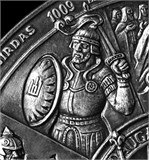
Algirdas Grand Duke of Lithuania

Pecans grow abundantly in Arizona, with large commercial groves to be found both north and south of the city of Tucson. Green Valley Pecan Company is the largest pecan farm in the world. I love the organic pecans from our neighbors just 20 minutes south of Tucson. They sponsor the Sahuarita Pecan Festival to celebrate the harvest and get festive with the local population. This year the festival will take place Nov. 8, 2014 from 9 am to 5 pm at the farm. Parking is free until 8:30 am, and $5 per car after that time. I adore food festivals. I am a bigger fan of nuts than I am of wine, so this local festival is particularly appealing to me. I am not waiting to start eating my organic Green Valley pecans. I have already polished off half of the first bag I purchased eating them straight up. That is honestly my favorite way to have them. I do cook with them, and when I was in Austin this summer I heard about a pecan syrup being used in bourbon cocktails that intrigued me. My friend made a wonderful concoction of bitters by using a whole pecan in the shell as one of the local ingredients she was testing. The flavor of the nut came out nicely in the final product, the shell lending some bitter notes. My mother used to shell loads of pecans each year and give them to me as a holiday gift. It was the best thing she gave me, and she kept doing it until she was very old. She would spend a month or so shelling pecans in the fall for her holiday gifting. She was from Texas, so I imagine this came from her childhood. She made a decent pecan pie, but my mother, Ruby, specialized in pralines. She made no other kind of candy, and it only happened once a year (for the holiday gifts). She put pecans in her fruitcakes too, but then she ruined them with fruitcake (I was never a fan of this extremely labor intensive preparation).
Here are some savory examples of pecans for fall festivities:
Most of the classic pecan recipes are for sweets:
If you have made the ice cream you can them have a:
What is your favorite way to enjoy pecans, Gentle Reader?

shrimp plant

fairy duster

desert rose
Science Friday is a show on PBS radio that I enjoy. This week I heard a story that has fascinated me. They are sponsoring a nationwide program to encourage people to enter into science experiments. The scientific methods are shared with anyone who cares to discover literally anything. Citizen science is a booming area of interest. Anyone can participate and if the results are shared on line with the hashtag #observeeverything there is a chance of encouragement and coaching from other scientists. The idea is to observe anything with a question in mind. Random observation can be the place to start. If you start today to closely watch what happens around you something may catch your fancy that can be the basis of your experiment. It should truly interest you and make you curious. There may be something you have been wondering about for a while, or you may stumble upon a phenomena you can’t explain or interpret. After you narrow down a question or theory to prove you need to take detailed notes and maybe some photos or videos to support your experiment.
I did a lot of science at home with my father when I was a child. I was struck by the way my dad was relatively careless with chemicals. He brought chemicals home from his job at Gulf Oil research. I like the dry ice the best. He liked to blow things up and make bombs. That was okay, but there were some fairly dangerous accidents as a result of my dad’s science lab in the garage, the backyard, and the front sidewalk. One time we spilled an explosive mix designed to be dropped in small quantities on the sidewalk to pop when it was touched. My father set of the toxic explosive spill with a broom and it flared up and looked like it might set the front porch on fire for a few minutes. I preferred to put dry ice in the bathtub and blow bubbles that would rest on the top of the CO2. I was also allowed to play with a large bottle of mercury..that’s right, mercury. My friends and I rolled it around in our hands…OY! I had access to a Teslacoil that we used to make our hair stand on end and to zap each other. I guess my childhood was a kind of mad experiment.
I have been making bitters lately and have been thinking maybe there is an experiment I could do that relates to different kinds of bitters and their effects on the body. Since it is subtle I don’t know how one might go about such a test, but I am considering that as a possible subject. I think the thing to do is go start that observation and see if something jumps up at me and wants to be studied. Is there a question you are itching to answer? Take a look at the twitter stream or the #observeeverything streams on any social media to follow the latest and see where the citizen science movement will lead us.

 mermaidcamp