mermaidcamp
Keeping current in wellness, in and out of the water
You can scroll the shelf using ← and → keys
You can scroll the shelf using ← and → keys
My single Wampanoag ancestor, Quadequina is the only true American in my tribe. My DNA tests out at 96% from the British Isles. My pedigree is what is known in the US as blue blooded. My ancestors almost all left Europe in the early 1600’s to colonize America. They had a religious problem with the locals who were freaking out all over Europe in different religious ways. Suffice it to say the move to Plymouth or Jamestown was done with more than a little religious arrogance. The locals here had a perfectly adequate religious practice, but the Pilgrims and Virginians were bound to convert and enslave them in an exciting new monotheistic way. The God who sailed over with the Pilgrims was that angry, vengeful ,all by himself God who just had no patience or tolerance for the beliefs of others. This God provided for the English on American soil by making sure the king back home had power to scare the beJesus out of any non-believer.
Imagine the dismay of the locals in Massachusetts when they learned that the colonists not only sucked down their erstwhile property and hunting rights, but planned to take more of the same. King Philip , AKA my great uncle, planned and executed a revolution against the colonists, which is when things got ugly quickly and forever. When I visited Mashpee, the land that was given by the English to the tribe, by arrangement with the King in 1655, I thought I would see the graves of the elders who started Thanksgiving. I was mighty upset with my Pilgrim ancestors, even though one of them married into the tribe, the group in general was highly rude and creepy. I saw the graves of the Mayflower passengers, and their church….but not a clue as to the location of Quadequina’s resting place. Bury my heart at Mashpee.
I learned much about the way American history has been reconstructed, but I also got to meet some young Wampanoag people who have great pride and are reviving the language. I became very angry again when I found out the wampum belts that document this history are in England…and the tribe asked them to return the property to Mashpee. Wampum is a shell currency used to create agreements and make purchases. The belt was a form of contract used to define, for instance, real estate deals made with Brits. The state of Rhode Island was purchased with wampum. I have no power to get the wampum artifacts returned, or change the facts of history. I just wear the wampum I got on Cape Cod as a reminder of by beloved American tribe. On behalf of 96% of my blood, I apologize.

Disbrow Coat of Arms
Peter Disbrow was instrumental in founding the town of Rye, New York. He and his brother ,Henry, operated a ferry to Oyster Bay.
Among these westward drifting settlers was a groupled by a Peter Disbrow who, after settling temporarily at Greenwich, led a small party still further west and settled on Manussing Island just off what was soon to be the site of the village of Rye. Just when he arrived on the island we do not know but in 1659 we find him associ-ated with his brother Henry operating a ferry between the island and Oyster Bay. And here, while it is Henry who founded our Disbrow line, let us spare a word for this Peter for he was an interesting lad. He was born in 1631 and died May 2nd, 1688 at Rye. “The successors of the Dutch West India Company in1660 were Peter Disbrow, John Coe, and Thomas Studwell.These were all residents of Greenwich at the time whenthe first Indian treaty was signed. Their leader wasPeter Disbrow, a young, intelligent, self-reliant youngman who seems to have enjoyed the thorough confidence ofhis associates; his name invariably heads the lists of the proprietors; and it is on all the treaties and declar-ations.” On January 3rd, 1660 he made a treaty with theIndians of Poningoe Neck for the purchase of that tractof land described as follows – “Lyeing on the Maine between a certain place called Rahonaness to the East and the Westchester Path to the 20 North and Southe to the Sea or Sound.” This includes the lower part of the present town of Rye on the east side of Blind Brook. On June 20th of that same year they concluded another treaty which gave them Manussing Island. With-in the next two and a half years they had acquired title to pieces of real estate that included, besides the area now covered by the towns of Rye and Harrison, much of the towns of North Castle and Bedford in New York, and Green-wich in Connecticut.
Peter Disbrow (1631 – 1688)
From The Rye Record
Rye’s Founders
– By Paul Rheingold –
Every history of Rye, including mine, starts with three Greenwich men, Thomas Studwell, John Coe and Peter Disbrow, buying Manursing Island from the Indians in 1660 and starting to farm. A fourth, John Budd, joined them a year later, buying other sections of what was to become Rye. Thanks to Bolton’s and Baird’s histories and genealogy on the Web, we know quite about the four founders.
They were not just farmers looking for new fields, but land buyers — proprietors or speculators, styling themselves “successors of the Dutch West India Company.” As their stories unfold, they emerge as three-dimensional people with families.Thomas Studwell (1600-1670), sometimes spelled Stedwell, was born in England at the family seat near Kent. Lord Say and Seal (one man, a British lord, who was sympathetic to the colonist) along with Lord Brook obtained a grant from the King to found a colony in the Connecticut area now named Saybrook. Lord Say and Seal sponsored Studwell for the grant in about 1635. In the 1650s, Studwell bought land in Greenwich and is in their town records.
He was about 60 when he bought the land on Manursing Island, signing with an “X” on the purchase from the Indians. Rye records show that he built a rude house on the island and later a more substantial home in the Mill Town area. With Coe and Disbrow, he acquired more land from the Indians on the mainland and west into what is now Harrison. By 1663, he and others began to sell land to later settlers. One deed shows the sale of a home on Mill Brook, as Blind Brook was then known.
Problems with the other Connecticut colonies arose soon after for Hastings (Rye’s original name), as reflected in documents signed by Studwell and the other two first settlers. In July 1662 they sent a declaration to the General Court in Hartford of their allegiance to that government (so long there were “holsom laws that are just and Righteous according to God and our capableness to receive”).
Baird in his usual comprehensive fashion traces the Studwell genealogy. His wife was Elizabeth, and there appear to have been three sons, one of whom, Joseph, was living in Rye in the early 1700s. In 1667, Studwell went with one son to Stamford and then to Greenwich, where he died. Much more information and the family line can be found in Marion J. Stedwell, “Steadwell, Stedwell, Studwell,” Heritage Books, 1996.
John Coe (1622-1702) was born in Suffolk, England. The family moved to America, first settling in Watertown, Mass., then Wethersfield, Conn., and finally Greenwich. In 1650, he married Hannah Jenner, and they had two children, Andrew in 1654 and Hannah in 1656.
Coe and his family lived in Stamford and sold property there in 1651, moving to Greenwich. Then, in 1659, he sold his home in Cos Cob in preparation for his new enterprise, as one genealogist put it. His name on the 1660 purchase from the Native American Shenowell and others is spelled Coo.
His original lot on Manursing Island was described as 2-3 acres on the north end of the island (now protected by a gate house). Later he is recorded as owning 14 salt meadow lots, a valuable commodity for feeding livestock. In 1663, the first three settlers, plus John Budd, now organized as a syndicate, sold the land on Manursing Island to a new syndicate, in which Coe remained as a member. Later, Coe sold land on the mainland to Hachaliah Brown, who became the progenitor of a significant Rye family. In 1672 Coe and Budd were listed as two of the 12 town proprietors.
In 1683 Coe, with others, is mentioned in an expired writ of error in the Court of Sessions, Kings County. This probably related to the litigation involving whether Rye was in New York or Connecticut. Around 1689 he is listed as living in Byram Neck. Baird reports he moved to Long Island, then under the jurisdiction of Connecticut.
Baird’s genealogy lists five sons. The eldest, also John, took over the homestead on North Manursing Island (which was then separated from the southern end by “Coe’s Ditch”). This he sold in 1668 to Stephen Sherwood and lived for a while on Grace Church Street where present-day Kirby Lane is. Baird traces the Coe family down seven generations to descendants living in and around Rye at the time of his writing, 1871.
You can learn more by reading “Robert Coe, Puritan”, John G. Bartlett, 1911.Peter Disbrow (1631-1688) (also spelled Disborough and Disbro) was born at the family seat in Essex. One ancestor was Major General Disborough. Peter came to America and in 1638 he married Sarah Knapp, who hailed from Watertown, Mass. They had six children, four of them daughters.
Although only about 30, he appears to be have been the leader of the families coming south to Rye, as his name is usually first in legal papers. Apparently he was in land negotiations with the Indians as early as January of 1660, six months before the purchase of Manursing Island. Several biographers describe Peter as an “intelligent, self-reliant young man who seems to have enjoyed the thorough confidence of his associates.”
Disbrow, along with the other three founders, sold some of the land holdings he had in Rye. In 1676 he divided up property south of the Byram River into 10-acre lots which he sold to planters. Further land sales were recorded in 1681. After the early years, Peter had a house in what was called “the Plains” area of Rye, which Baird describes as the area between Milton Road and Blind Brook, probably around Rectory Street.
It is recorded in Connecticut public records for 1681 that Peter had a disastrous fire and the General Court “doe remitt unto him his country rate for the year ensuing.”
A Disbrow genealogy is presented in Bolton, which showed many descendants, some living in Mamaroneck, as of 1848.
John Budd (1600 to 1669) has been credited with being a founder of New Haven and Southhold on Long Island as well as Rye. His house on Long Island, a National Historic Landmark and the oldest English-style building in New York State, was built in 1649 and moved 50 years ago to Cutchogue, where it is now a public museum.
Southold records for 1657 list his profession as judge. He may have moved across the Sound to Rye due to religious problems with his neighbors — Budd was a Quaker.
Born in England, Budd married Katherine Brown and came to America aboard the “Hector” in June 1637 with his wife and three children, the oldest about 20. The ship came to Boston, and then Budd and others in the party moved on to New Haven.
Budd appears in Rye in 1661 with a purchase of a large amount of land from the Indians, known thereafter as Budd’s Neck, running from the west side of Blind Brook to Mamaroneck. The deed of purchase from the Indians was later confirmed by a patent. In 1665 he became a seller of lands west of Blind Brook, which led to objections by the town proprietors. One of the later purchases was to the progenitor of the Jay family.
In Oct. 15, 1669, Budd wrote a document called a will but which today might better be described as a trust, in which he left all of his property in Rye to his son, John Budd Jr. This included the mill on the Blind Brook, where Oakland Beach Avenue crosses today. His son was obligated to pay 30 pounds a year to John and Katherine, or the survivor of the two. The payment was to be in wheat, pork and peas.
His two sons, John and Joseph, stayed in Rye. Joseph, known as Captain Budd, was prominent in town affairs, according to Baird. Their descendants were living in Rye when Baird wrote his book in 1871. For more, see Robert Bolton, Jr., “ A History of the County of Westchester,” 184 and Charles W. Baird, “History of Rye”, 1871.
Any descendants of these founders living in the Rye area are asked to come forward and participate in the programs being arranged to honor Rye’s 350th anniversary.

hot dog
Fast food has been known to the Euros for ages. They demand fast food everywhere all the time, but it is local and superb. They are all about the grilled wurst. It s everywhere, grilled outside and served with a piece of bread, but no hot dog bun. This snack/meal is the basic on the go food for German-speaking peeps, including the Swiss. Everywhere you go with Swiss people they end up with a wurst. It is not what I eat, but there are plenty of street foods that I adore. My favorite dish on earth is vegetarian tandooori schnitzel at Hiltl. The oldest vegetarian restaurant in Europe is in Zurich, in the heart of downtown Switzerland; the schnitzel calls to me in my dreams.
How we fell so far from the wurst grilling street vendors to the Wienerschnitzel chili dog is a sad story of linguistic and culinary decline. A schnizel is a filet of pork sirloin, and not a hot dog in any way. Wiener refers to Vienna, a culinary hub where I assure you nobody would consider eating the chili dog or our famous canned Vienna sausage. They just would not do that to their taste buds and bodies. Beanie Weenies would be scorned as well because food that rides around in a can is simply not fast. The first ingredient in these alleged fast foods is petroleum, since they are shipped great distances in freezing conditions or heavy packaging.
Ironically, on the most important weenie weekend of the year, 4th of July, I probably pay more for my vegetarian apple smoked sausage which I will eat with organic sauerkraut than most people pay for the meat hot dog, corn dog, or burger. It too has traveled far in the so called health food supply chain. I have bought these because I am lazy and have not made my own, which are always better than store bought. At least when I want a chili dog I make the chili. Truly taking care of body earth and soul means saying good bye, or at least see you later to processed foods that cost too much to produce. These well traveled weenies are not good for anyone. To heal the politics of the nation we need to pass on the used Weiners, and get back to basic whole civilization.


In 1635 My 10th great-grandfather participated in a political act in the Virginia Colony that landed him in trouble:
A Principal in the Overthrow of a Capricious Ruler
York History Series #A-5, April 1997by (the late) Dick Ivy, Honorary NMDA Member
Hearing of secret and unlawful meetings since January by some of his councilors concerning decisions of his rulership of Virginia, Governor Sir John Harvey apprehended and committed their “chief actors” William English, Nicolas Martiau and Francis Pott. On Apr. 28, 1635, the Governor’s Councilors Samuel Matthews, John Utie, Thomas Harwood, William Perry, William Farrer, William Peirce, George Menefie and Dr. John Pott came to the governor-called council meeting at his house. John Utie of Yorke’s Chiskiak Parish hit the governor hard on his shoulder and declared he was under arrest for treason. The others held him secure and told him to go back to England to answer the complaints against him. They set Martiau and others free and called for their force of 50 musketmen waiting at a short distance. On May 7, 1635, the councilors met at James Town, opened the floor to complaints, and elected Capt. John West as governor. The complaint included the giveaway to please the King of the Isle of Kent to Maryland by a willing Harvey for persecuted Catholics from England, ignoring the ownership claim by William Claiborne who was trading with the Indians here. A war ensued between forces from Maryland and Claiborne when the latter refused to become a Catholic, it is said. Martiau was granted 1,600 acres of land that year. The King reinstated Harvey and the rebels were ordered to appear at the King’s Star Court, but were never tried for an unknown reason. Finally, Harvey was recalled over another incident of poor judgment.
Capt Nicolas Martiau (1591, France-1657) & Jane Page Berkeley
Capt. Martiau [also recorded as Marlier, Martue, Martin, Martian] was a French Huguenot (in church of Threadneedle St.) from the Island of Ré. He was in the service of Henry Hastings, Earl of Huntingdon and member of the Virginia Company, and educated as a military engineer. He was naturalized as an Englishman by royal decree. He came to Jamestown aboard the “Francis Bona Venture” in 1620, legally representing the Earl to plan fortifications. He led a foray against the Indians at Falling Creek after the 1622 massacre. He joined the liberal party committed to the Virginia outlook, pleading for continuance of the House of Burgesses in 1623/4. He, with Captain George Utie and Captain Samuel Mathews, was responsible for sending the tyrant governor Harvey back to England.
There is some question about his wives. His first wife was Elizabeth, last name and date of death unknown. She was most likely the mother of Elizabeth (born 1625). Jane was the widow of Lt. Edward Berkeley, who died in 1625; they had a child named Jane. . After her death, Nicholas married Isabella, widow of Robert Felgete & George Beech, in 1646.
Martiau’s defense of the French king in an argument with Capt. Thomas Mayhew forced him to take a loyalty oath in Jamestown in 1627. He was granted 600 acres as Chiskiack, which became Yorktown (in 1644, the Cheskiack Indians were moved to the Pianketank, where they would be forced out by Augustine Warner; the tribe seems to have vanished at that point.) He served as Burgess 1632-33, and Justice for York Co. 1633-57. “He, with George Utie and Captain Samuel Matthews, sent the tyrant governor, Harvey, close prisoner back to England.” Harvey returned, bringing George Reade–Martiau’s future son-in-law–with him, but he was forced back to England again, leaving Reade as Acting Governor. Martiau moved to the present Yorktown site in 1630 on 600 acres, plus 700 for headrights, where he grew tobacco. On this land Cornwallis surrendered his troops to Martiau’s great-great-great-grandson, General George Washington in 1781. Martiau later was granted 2000 acres on the south side of the Potomac River, which he gave to Col. George Reade in 1657. (See John Baer Stoudt, Nicolas Martiau, The Adventurous Huguenot, The Military Engineers, and the Earliest American Ancestor of George Washington.)
Nicholas French Huguenot Martiau (1591 – 1657)
Martin, Marten, Martens, Martyn (French, Spanish, English) Descendant of Martinus [belonging to the god Mars, the god of war]; one who came from Martin, the name of places in Spain and France. The popularity of the name in Western Europe is due to St. Martin of Tours, the fourth century French saint.
Source: New Dictionary of American Family Names by Elsdon C. Smith, Gramercy Publishing Company, New York, 1988.
Nicolas Martiau – The Immigrant
This portion of the Family Roots and Branches is dedicated to the study of Nicolas Martiau (pronounced Mar-ti-o) and his descendants.
“The Adventurous Huguenot” and the father of Yorktown, Virginia, was born in France 1591, came to Virginia in 1620 and died in 1657 at Yorktown, Virginia. He was a Captain in the Jamestown militia during the Indian uprisings, a member of the Colonial Virginia House of Burgesses, and Justice of the County of York. In 1635 he was a leader in the thrusting out of Governor Harvey which was the first opposition to British Colonial Policy. He is the original patentee for Yorktown. He is buried at the Grace Church in Yorktown, Virginia.
Descendants of Nicolas are through his daughters, Mary (married Lt. Colonel John Scarsbrook), Sarah (married Captain William Fuller, Puritian governor of Maryland), and Elizabeth (married Lt. Col. George Reade). Nicolas is the earliest American ancestor of our first President George Washington.
Among the descendants of Nicolas Martiau we find – in addition to Washington – one Vice President of the United States, two Justices of the Supreme Court, three ministers to foreign countries, three cabinet officers, six governors of states, eight senators, eleven generals involved in the War Between the States, fifteen congressman, forty commissioned officers who served in the American Revolution,
2 of 3
2/6/13 12:24 PM
and a veritable host of men and women prominent in national life. Such names as General Thomas Nelson, a signer of the Declaration of Independance; Meriwether Lewis, explorer of Lewis and Clark fame; Duff Green; Thomas Nelson Page and Amelia Rives are of special interest.
In the early 20th century the registrar of the Colonial Dames of America in the state of Virginia contains the names of more than four hundred women who could trace their lineage to Nicolas Martiau.
Nicolas Martiau is my 15th great grandfather and one of two of my earliest American ancestors. Here is my line of descendent from that adventurous Hugenout – Nicolas Martiau:
Larry Van Horn, NMDA Member #174 (Scar(s)brook-Condon-Wills)
1. Nicolas Martiau & Jane ? (Berkley)
2. John Scar(s)brook & Mary Martiau
3. David Condon & Elizabeth Scar(s)brook
4. Elias Wills & Mary Condon
5. John Wills & Susanna Robertson
6. James Cole & Mary Wills
7. James Cole & Fanny Chisman Wills
8. Ware Oglesby & Elizabeth Dancy Cole
9. Aaron Redus & Lucy Ann Oglesby
10. James Ware Redus Jr & Leah Magee
11. Alexander Hamilton David Hurt & Mary Susan Redus 12. James Ira Hurt & Johanna Himena Schneider
13. Witt Lange Van Horn and Jeanette Iris Hurt
Nicolas Martiau Descendants – The First Six Generations
The link below is to an Adobe Acrobat PDF Descendants Chart that shows six generations of Nicolas Martiau Descendants. If you are a descendant of any of the below listed in this chart you are eligible for membership in the Nicolas Martiau Descendant Association (see below). The lines represented on this chart are lines that are accepted for membership in the NMDA. As more information is entered into our genealogy database, new charts will be placed on this website and the NMDA website. Be sure to check for these pages for future updates.
Nicolas Martiau Six Generation Descendants Chart (Adobe Acrobat format) The NMDA Lineage SocietyNicolas Martiau Descendant Association
Genealogist who can prove descend from Nicolas Martiau are eligible for membership in the Nicolas Martiau Descendant Association (NMDA). The NMDA was started in 1991. Two first cousins from California went to Yorktown to meet Dick Ivy (recently deceased), the Towne Crier and Historian, for a tour of the Martiau Family sites. One cousin fell and injured a knee, was propped up by the wall of the Grace Church cemetery. A lone man was in the mist, reading inscriptions. He paused at theColonel George Reade/Elizabeth Martiau stone, not aware of the Martiau Family buried there without a marker. This one act prompted the chain of events culminating in the first Tribute to Martiau held in 1993 and the 1997 grave marker dedication. A second Tribute was held in the Spring of 2000 and the third was held Spring 2004 in Yorktown. The cousins were Lee Yandell and Marty Dale. (Reade- Reade-Wattington).
The NMDA had over 182 members nationwide. I have the honor of serving as the National Registrar for this proud and prestigous lineage based organization. You can get more information on the NMDA by contacting me, Larry Van Horn, via email (link at bottom of this webpage) or visiting the official NMDA website at:
Nicolas Martiau Descendant Association
At this website you can download lineage and application formsin pdf format to aid you in the application process. On the website you will find selected members lineages, news, events, history and much more.
In each tree there are challenging branches. My own difficult ancestor to whom I have dedicated untold number of hours in research is Thomas Peterson. He is special because he is mentioned in the handwritten notes I had to begin my whole search. His granddaughter, Sarah Helena Byrne, wrote facts and her own opinions about family members, said he is Pennsylvania Dutch. She also mentions that his nephew, James Peterson, married my grandmother Scott after her first husband died. This seems simple enough, but I am stumped because I can’t find a record of Thomas’ birth in Indiana in 1825. His parents are alleged to be born in Pennsylvania, but I know facts were sometimes recorded incorrectly in the census. What were his parents doing way out west before the Civil War? Who were they, and where in Pennsylvania were they born? This all remains unanswered. It makes me crazy…
Thomas Peterson (1825 – ?)

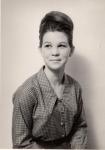
I spent my school career through the 8th grade in the small town of Oakmont, PA, a suburb of Pittsburgh. This tiny, close knit (nosey) community was about the Oakmont Country Club and Edgewater Steel, and some other stuff. For kids it was paradise with millionaire robber baron neighbors providing lavish recreational opportunities. My parents were Republicans who disliked JFK and did not play golf. On one hand they were non conformist, and on the other, very concerned with image. I had a running battle with my mother for my entire grade school career about bangs, permanent waves, and white socks. These symbols of culture and control were so important to my mother that my wishes were never considered. She stuck my hair in the sink and put stinky stuff and curlers in it against my will, and with loud protest. She always cut my bangs off, mullet style. The most important symbol to Ruby Morse was the little girl’s need to wear white anklet socks. This was truly the most hated of all conditions, the white sock purgatory. Ruby Morse believed that wearing stockings was a sign of loose morals. I believed she inflicted the white socks as a crazed statement of micro management. We had deep, basic irreconcilable fashion differences.
Management of any kind was about to fly out the window when the family moved to San Tomé, Venezuela in 1963. My father became the general manager for Mene Grande ( Gulf Oil) for eastern Venezuela. This meant that I lived in a big house with servants and my father was the boss of everyone in the town where I lived. My teachers in school worked for my father, as did all my friends’ parents. Strangers constantly gave me lovely gifts, and it was obviously too hot to wear white socks. I was the lucky imperialist 13-year-old with everything. I lived in a remote place so radio was a lot less available than it had been in Pittsburgh. The strongest reliable signal came from Radio Havana. Fidel would hold forth for hours and then they played some music. Live music was everywhere. I had a harp serenade at my window by a guy who wrote the song for me. This could not have happened in Pennsylvania. Although San Tomé had a golf course, there was no other commonality with Oakmont, PA. Nothing could have been more drastic, really. I loved it, but when given the chance to choose where I would go abroad for 10th grade, I chose PA because I still thought of it as my US home. I have not visited Oakmont since 1964.
I will return to Oakmont to see some of my school friends in a couple of months. We have all traveled different paths, but mine diverged drastically and forever. I am bringing back memories and enjoying the stories that my classmates remember. Some scenes are vivid as I think of them, and some are gone. I hardly remember any of the parents. Our personalities are in tact, from what I can detect on our Facebook page. We will go and physically be in the building where we went to elementary grades together. I think it will be amazing..our own versions of what we remember. I look forward to it with great anticipation.
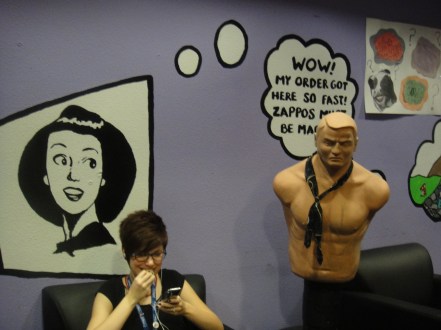
Zappos Headquarters
The 7th core value at Zappos is about team building. The social fabric of the Zappos team is strong and purposely flexible. Diversity is encouraged; self expression is made mandatory; teams tackle problems in groups. The jolly team spirit is evident in the work environment at Zappos headquarters. I think it is closer to being the happiest place on earth than Disneyland is..but that is not saying much. Family in the workplace means shared responsibility as well as camaraderie.
My specialty is teaching swimming. In order to teach the skill an environment of trust must exist. This week I had the pleasure of teaching two young ladies who are friends. They have a big age difference but get along well as friends. The right atmosphere brings out the best in everyone. The girls worked hard each day in lessons, and at the end of the week, they had their little doll family on the steps with them for a swimming lesson. They had become the teachers, inspiring the dolls with their confidence. This is how the positive team and family spirit works. It is contagious, and uplifting for everyone. Cooperation and inspiration are natural partners in business.
My 11th great-grandfather, John Taylor was one of the ten chaplains present at the Field of the Cloth of Gold. As I look at history through the perspective of my ancestors I learn details that blow my mind. Henry VIII is known even to American history students for his wives, divorces, and church business. Henry was a music fan, and imported some of my ancestors from Italy to be musicians in his court. I had never heard of this Field of Cloth of Gold, sort of a party Henry had with lavish tents and chaplains. The king of France really tripped him in the fight Henry arranged. I love this story, and am highly amused that my ancestor can be placed at the crazy Anglo-Franco party. I say let’s invite Vlad over for a topless wrestling match in DC. What do you think? Has any of you ever heard of this Field party? Those royals were just so kinky.
In Tucson and around the country damage from mold is a serious issue. This health hazard can be dangerous to humans and pets. It is most devastating to real estate value because insurance companies rightly treat it like the plague. Mold that is rampant must be treated and removed to avoid spread and contamination of the entire area. Since the property with an adjoining wall has been used to collect donations for a decade, the water has been leaking profusely for months, and everything points to heavy duty mold damage I have repeatedly asked the HOA board that collects the donations from the public to hire Rocky the Mold Dog, who appears on TV. He is a beagle with a nose for mold. He sniffs the property and helps the humans identify problems so they can be treated. All health department code has been violated in this building for more than a decade. The unsupervised food collection, storage, and preparation in a leaky environment is a very likely contributor to the growth of mold. There is probable cause to believe the building is completely infested with mold which is damaging my home every day.
There is much more than a conflict of interest between the HOA board members who run the charity scam collecting donations, and the property owners in this neighborhood. I had some work done on my home recently and was informed by the contractor who did the work about the level of danger to my structural integrity posed by the neglect of my next door neighbor. He took some pictures of the rotting roof piled with debris, and explained that the load of all that garbage was a serious threat to my home. He taught me a lot that I did not know about the dangers and damage that mold represents. I read my insurance policy and spoke to my agent who explained the complex and very depressing details of mold, what it does, and what happens to your insurance policy once it is discovered. I am officially freaked out about the physical damage the charity scam has done to my home. The donation traffic has slowed to nothing, the water leak was repaired a couple of days ago after leaking for at least 6 months. I need the people who took advantage of all their neighbors to begin to acknowledge reality and the neighborhood by getting a mold test to confirm or deny the presence of a very hazardous material. Their behavior suggests that they do no believe in cause and effect. Believe it or not, every action will continue to have an equal and opposite reaction.

Passengers on the Bevis
Thomas Reeves is not the only one of my ancestors who arrived in America on the ship Bevis, nor is he the only one who came as an indentured servant. He landed after becoming a freeman in the colony, in Springfield, MA (a city I drove right past in May) where he was a blacksmith and the town drummer. How cute, the official drummer!! I wonder who the official town fife player was. His son Thomas, who moved to Long Island after his father’s death, seems to have continued the family trade of blacksmithing.
Thomas Sr (generation #1 in America) came from Southampton, England in 1638 on the “Bevis” and arrived in Boston. He was an indentured servant to Henry Byley, but became the servant of John Gore and lived in Roxbury, MA until 1644 when he became a freeman. He married Hannah Rowe on Apr 15, 1645 at Roxbury. They moved to Springfield, MA where he was a blacksmith and the town drummer. He died at Springfield on Nov 5, 1650 in his late twenties after fathering three children, two of which survived to adulthood (Thomas, Mary, John). His wife later remarried Richard Excell (or Exile) of Springfield on June 4, 1651, by whom she had four children (Mary, John, Lydia, Abigail). She died in 1660 in Spreingfield. He was still in the Springfield are in 1681. Mr. Excell presumably then moved to Southampton, LI with his step-son Thomas Jr and died there Feb 24, 1714, after suffering financial problems, according to his will. He also suffered from wounds received in King Phillip’s War.
There was another Thomas Reeves in MA who was born earlier and married a Mary Purrier.
Thomas Sr may have had an aunt Mary who immigrated with him and married William Webster, or the story about her is inaccurate in her age at death. Her husband was a the son of Gov. John Webster of Conn. She was accuased of being a witch in Hadley 1n 1673 by the county court in Northampton, but was acquitted at her trial in Boston in 1683. She died in 1696, her husband dying in 1688.

