mermaidcamp
Keeping current in wellness, in and out of the water
You can scroll the shelf using ← and → keys
You can scroll the shelf using ← and → keys

Forster Coat of Arms
My 13 Great Grandfather was born in England and died in Long Island. He came to America at the age of about 35. He was a founder of the town of Lynn,MA before moving to New York.
Christopher Foster — He came from England in the “Abigail”, in 1635, age 32, with his wife Frances, age 25, and children Rebecca, Nathaniel, and John. The “Abigail” embarked from London, June 4, 1635 and arrived in Boston about Oct. 8, 1635 with small pox aboard. He was made Freeman in Boston, April 17, 1637. In the same year, he was a resident of Lynn, MA, where in 1638, sixty acres of land were alloted to him. He came to Southampton in 1651. He had a previous spouse name unknown who died in 1628. Sally’ s Family Place-Wheeler Christopher Foster was born in July 1603 (Ewell, Surrey, England); He married there 24 Dec 1628 Frances Stevens, born 1 July 1610 daughter of Alice Stevens (will 1645) of Ewell in Surrey, England. Chrostopher Foster styled himself a husbandman on his shipping, embarked in London, June 17, 1635 in the “Abigail.” “In the Abigail from the minister of their conformitie and from the Justices, that they are no susidy men. Christopher foster ae 32, Bxofr ffrancis ffoster ae 25, Rabecca ffoster ae 5, Nathaniel ffoster ae 2, Jo, ffoster ae1, Alice Steevens 11, Tho Steevens 12. New pp. C. E. Banks in the book Planter of the Commonwealth, “which traces 2,646 emigrants to America for whom there is a clear record says that Christoper Fostrer was a “husbandman (farmer) of Ewell, County Surrey,” and that Alice Stevens was “probably sister of Mrs. Foster.” He adds the following about the “Abigail” on which others of the passengers were John Winthrop Jr. age 27 and his wife Elizabeth and son Deane. “Abigail of London, Richard Hackwell, Master. She listed passengers fo New England from June 4 until July 24, and sailed from Plymouth as her last port of departure about Aug 1, with two hundred and twenty persons aboard, and many cattle. She arrived in Boston about Oct. 8, 1635, infected with smallpox. among those coming in this ship, but not listed, were Sir Henry Vane, son and heir to Sir Henry Vane, Comptroller of the King’s Household, traveling incognite, the Revernd Hugh Peter, pastor of the English Church at Rotterdam, and the Reverend John Wilson, who was returning to Boston, with his wife, hr first appearance in New England. They were part of the Puritan migration and Hugh Peters, later Cromwell’s chaplain, was on the same ship and helped form the church congregation to which Christopher belonged. Some of the passengers with Christopher Foster are also connected to Sir Thomas Foster. Sir Henry Vane’s son who is the Comptroller of the King’s Household is connected to Sir Thomas Foster household because of the Comtroller for King Henry VIII is entombed next to Sir Thomas Foster. This is amking a clear connection to the royal family especially with Governor Winthrop’s son aboard also and Christopher Foster with them. Further Info on Christopher: He was made a freeman at Boston (or Lynn) April 17 1637. In the same year he was a resident of Lynn where in 1638 sixty acres were allotted to him. At one time, the Fosters lived in Nahant St., Lynn. In 1647, he went to Hempstead, and then to Southampton in 1650, both in New York. In October of 1650, we find him as a townsman or selectman to manage the affairs of the town, being one of the 41 propietors. He mny have been part of the originlal Lynn group that setled Southampton LI; Christopher first appears in records of Southampton in 1651 and he was living there in 1670. His son Nathaniel removed to Hungington LI and their resided. Christopher Foster died 1687; he resided Lynn, MA. and Southamptoin LI (Long Island, NY).
Christopher Lynn Foster (1603 – 1687)
is my 13th great grandfather
John Christopher Foster (1634 – 1687)
son of Christopher Lynn Foster
Rachel Foster (1675 – 1751)
daughter of John Christopher Foster
Abraham Sr Reeves (1699 – 1761)
son of Rachel Foster
Hannah Reeves (1720 – 1769)
daughter of Abraham Sr Reeves
John McGilliard Jr (1759 – 1832)
son of Hannah Reeves
John McGilliard III (1788 – 1878)
son of John McGilliard Jr
Mary McGill (1804 – 1898)
daughter of John McGilliard III
John Wright (1800 – 1870)
son of Mary McGill
Mary Wright (1814 – 1873)
daughter of John Wright
Emiline P Nicholls (1837 – )
daughter of Mary Wright
Harriet Peterson (1856 – 1933)
daughter of Emiline P Nicholls
Sarah Helena Byrne (1878 – 1962)
daughter of Harriet Peterson
Olga Fern Scott (1897 – 1968)
daughter of Sarah Helena Byrne
Richard Arden Morse (1920 – 2004)
son of Olga Fern Scott
Pamela Morse
I am the daughter of Richard Arden Morse
He first came to Boston, where he was a Freemen on 17 April 1637. In 1638, he moved to Lynn, Massachusetts. In 1647, he went to Hempstead, and then to Southampton in 1650, both in New York. In October of 1650, we find him as a townsmen or selectmen to manage the affairs of the town, being one of the 41 proprietors.
HISTORY: Christopher Lynn Foster is the son of Sir Knight Thomas Foster (FORSTER). He (Thomas)changed his name because he married a close cousin named Susanna FORSTER. They had the same Great Great Great Grandfather. This family tree goes back to Sir Knight John Forster and Sir Knight Richard Foster. Sir John rode with King Richard I the Lion Heart to Palestine in the late 1100’s. This family was given the Bamburg Castle by Queen Elizabeth I. The family went bankrupt in the 1700 or 1800 hundreds and sold the castle the the Armstrong family of Adderstone, Northumberland, England which is where the castle is located. The FORSTER FAMILY came to England in the 1000 AD time frame to escape the Saxon invasion into Flanders. The Forster family changed from FORESTER (THE FAMILY were the Counts of Flanders) and evolved from the de FORRESTER of Belgium. The de FORRESTER FAMILY was by record the Prince of Dijon, Belgium in 740 AD. The Counts of Flanders (Anacher Great FORESTER, BALWIN I through the V, Arnulf Forester had marriages to Princess of England, Princess of France, Princess of Luxemboroug, etc. One of the Baldwin’s daughters married William the Conquer. Her name was Matilda. (Info received from Leroy Foster Nov 2002)











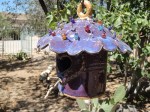




Have you ever thought about all the different ways birds design? What do birds look for in a piece of real estate? There must be a very wide variety of tastes. For an exhibit at the Tucson Botanical Garden artists have designed bird spaces from all kinds of materials. They are for sale. Birds have so many choices from rustic to modern. I love all of them, so it is good that I am not a bird.

Yorkshire flag
Jane Sotheron was born in England into a wealthy family. She died in Rowley, Massachusetts. Her husband, Thomas Crosby, was a wealthy man as well:
Tradition says that Thomas CROSBY came over in company with the Rev. Ezekiel ROGERS in 1638. That he was a man of wealth for those days is shown by his advancing a considerable sum of money for the first printing press brought and set up in America.
He spent his last years in the home of his grandson Dr. Anthony CROSBY, of Rowley, and d. there 6th May, 1661.
Jane Sotheron Born: 4 MAR 1581/82 in Holme-on-Spalding-Moor, York County, England Death: 2 MAY 1662 in Rowley, Middlesex, Massachusetts Married: 19 OCT 1600 in Holme-on-Spalding-Moor, York County, England
Their Children:Anthony b: 1602 in Holme-on-Spalding-Moor,York County, England Thomas b: 1604 in Holme-on-Spalding-Moor,York County, William b: 1606 in Holme-on-Spalding-Moor,York County, England Simon b: 1608 in Holme-on-Spalding-Moor, York Co. England
18 APR 1638 sailed to America on John Of London with a group of Reverend Ezekiel Rogers’ followers. They may have lived with the widow of their son Simon in Cambridge, Massachusetts until she remarried in 1645 — at about that time, Thomas purchased a house in Cambridge. After a few years, he sold his holdings in Cambridge and the couple relocated, for the last time, to Rowley, Massachusetts.Thomas lived to over 85 years of age and died in Rowley in 1661, buried on May 6.Jane died the following year and was buried in Rowley on May 2, 1662
1609 tax records indicate that William Sotheron (father of Jane) was the wealthiest resident of the parish.Thomas’ father died in 1599 and Thomas inherited a hundred-acre farm in Holme-on-Spalding-Moor.Tax records and other documents suggest that the family led a fairly well-to-do life.




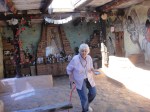




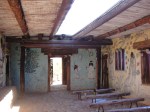





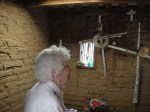


I met Gloria on the flight from Chicago to Tucson recently. I enjoyed her company and invited her to call me. She is visiting her son who works at the U of A during the week. She told me she was Catholic and that as a child she walked to mass by herself. She is now fed up with Vatican politics, and wants the Latin liturgy to return. I took her yesterday to see Ted DeGrazia’s chapel to the Virgin of Guadalupe. She had never seen milagros on altars before. Since I would not be caught dead or alive without some milagros on me, I gave her a tiny jet key from Venezuela to unlock her future. I have more at home, and she had no offering with her. I explained that our Virgin is pre Christian and that is all right. She is both Catholic and pre Christian, and we see no conflict with that. She had a good time with this altar and milagro business. She also enjoyed the art gallery. I always love to go up there, and am happy I had the chance to share it with someone who really found new meaning in an old practice through an ancient design left behind by a great artist.
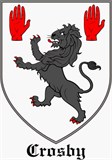
Crosby Coat of Arms
My 9th great-grandfather made it across the Atlantic Ocean to arrive in the new world at the age of 8 months, in 1635. He was born in England and his grave can be found today, located in Boston. He graduated from Harvard College and became a minister. There are conflicting reports about his formal ordination, but no doubt that he was employed to teach religion. He also got to trade ammo and alcohol. He made his money selling liquor, powder, and shot. This paints a funny picture if you ask me, but I am prejudiced against much of the founding fathers’ behavior. Thomas was well respected in his time as a preaching ammo and alcohol dealer. I appreciate that he survived so I can be here today. It would have been very easy to die on the voyage from England as an infant, but he had a different destiny.
Thomas Crosby (1635 – 1702)
He graduated from Harvard College in 1653. Although never ordained, he was hired in 1655 to preach in the church at Eastham, MA and continued as minister succeeding Reverend John Mayo there until 1670 at a salary of 50 pounds per annum. Reverend Crosby was also engaged in trade and in 1664 was among those who kept for sale “liquor, powder and shot”.
Later, he became a merchant at Harwich, Mass., and while on a business trip to Boston was found dead in bed there, 13 June 1702, aged sixty-seven years. His inventory totalled £1091-16-0 with debts of £717-16-0, leaving a net estate of £374-0-0. His heirs divided his property by agreement, 8 Aug. 1705.Marriage 2 Sarah FITCH b: in Mass.1662Children Thomas CROSBY, Jr. b: 7 APR 1663 Sarah CROSBY b: 24 MAR 1666/67 Joseph CROSBY b: 27 JAN 1668/69 John CROSBY b: 4 DEC 1670 in Eastham, Massachusetts William CROSBY b: 16 MAR 1672/73 Ebenezer CROSBY b: 28 MAR 1675 Anne CROSBY b: 14 APR 1678 Mercy CROSBY b: 14 APR 1678Increase CROSBY b: 14 APR 1678 Eleazer CROSBY b: 31 MAR 1680When Thomas was eleven years of age and his brother Joseph was seven, they removed with their Mother to Braintree, a Village on the south side of Boston, Mass. now Quincy, after her marriage to the Rev. William Tompson.After attending District School, with the assistance of Doctor Tompson, entered Harvard College, graduating in 1653, and was ordained a clergyman. He was minister at Eastham, Mass. from 1655 to 1670. He seems to have been engaged as a religious teacher to carry on the Sabbath Service at a salary of 50 pounds.While at Eastham, he was engaged in a trade. He resided near the burying ground, a place he bought of Jonathan Sparrow in 1665. He removed to Harwich, about 1670, here he was also engaged in a trade. His widow, Sarah, the mother of his 12 children, m. Apr. 28, 1703, John Miller, of Yarmouth. He died in 1702 and has many descendants living in the vicinity of Cape Cod, Mass. He had a half-sister Anna, born in 1648.
In about 1662 he married Sarah Fitch. Their children born in Eastham, MA were: 1. Thomas born April 7, 1663, died May 21, 1731. 2. Simon born July 5, 1665, died 1718 3. Sarah born March 24, 1666-7, married Silas Sears 4. Joseph born January 27,1668-9, died May 30, 1725. 5-6. JOHN (3) born December 4, 1670 and died May 25, 1717 and twin who died February 11, 1670/1 7. William born March 1672-3 8. Ebenezer born March 28, 1675 9-11. Anne, Mercy and Increase born April 14, 1678 (Anne married William (2) Luce, (Henry 1) on July 5,1704) 12. Eleazer born March 31, 1680Later he became a merchant at Harwich, MA and was one of the founders of the church in that town. On a business trip to Bostonhe was found dead in bed there on the 13th or 27th of June 1702, age 67 years. He is buried in the Old Granary Cemetery in Boston, MA. After his death, his widow Sarah married John (2) Miller of Yarmouth on April 8, 1703, son of Reverend John and Lydia Miller.

reflecting
Since returning home after ancestry quest I have tracked my dream life. I think am digesting centuries of action in my nightly dramatic interpretations. My homework assignment to record dreams and notice the archetypes I find in them has not been completed in a very rigorous fashion. During my weekend with Thomas Moore we talked about dreams and did a group discussion about one lady’s dream that she shared with us. My guilt about not doing homework as the rebel archetype dominates the teacher in my chart of origin, came into focus. I fell deeply to sleep that night and did start to notice and record dreams on a regular basis while I was still on the road. I visited homes and graves, museums and city streets where the specific ancestors lived and died. I started to have some strong emotions about history and groups of the dead.
Although Mayflower ancestry is highly valued by some, I am much more excited about those who rebeled against the Pilgrims. The sooner they dissed Plymouth, Salem, and the Pilgrim way of religious fascism the more I liked them. My special pride in my one Wampanoag ancestor makes me feel entitled to some explanations. They will not be forthcoming, and I need to understand that I am the sum total of many warring factions going back in time. While Mary Stuart was burning one ancestor at the stake, another ancestor was defending her in Scotland. This is how life works. We do not just have two crazy parents, we have all of karmic history in our collective inheritance.
I have had a dream now more than once that is symbolic and clear. I enter a big building, box, loft, kind of structure, where I am joined by all kinds of other beings from past and present..maybe future also. The place is intended to heal, but the multiple streams of energy mix and collide inside the space. The beings leave having exchanged symptoms with other people, leaving with new issues, side effects and thoughts. The desire to dump one’s own faults on others who are handy is at the root of this gift exchange gone so bad. Common practice is to blame the dead, or the absent for almost everything, trying to leave with only shining and laudable characteristics. This creates a mighty vortex that fills with neediness and greed once the door to the blame barn has been left ajar. A boomerang of dreadful feelings never fails to be returned to the sender. I am no dream interpretation expert, not even a very faithful recorder in the past. This series of dreams in the warehouse health space is about healing, boundaries, and inevitability. I haves used the flower essence Mexican Hat recently, which I find to be powerful and freaky. It is blooming in my garden in a few places. Under this hat’s influence the connections to others that we wish to ignore are highlighted. This flower essence refers to boundaries and healing, exactly like the dreams. Reflection is imperative to interpret both sides of symptoms, causes, and remedies.
Last at number ten, but not least, Zappos core value concerning humility is short and sweet. Be Humble. Humility is tightrope on which to stay centered. This trick is easier said than done, like all the core values of this company. There must be enough confidence to build self esteem and positive team spirit, and enough gravitas to accomplish intended goals. Restraint of ego mania in favor of pride in the entire workforce is a major element in delivering happiness. Hubris hoards potential joy in the corporate executive cafeteria. Zappos spreads it lavishly all over the company and customer base.
I had the idea 12 years ago when I invented Floatli that my teaching was such an important element of life that I naturally needed to create a teaching dynasty by certifying Floatli professionals. I was in a spa mentality and was influenced by my work experience. I became sidetracked by the demands of real life on this journey, and had to clarify my reasons several times for continued expenditure of time and effort on this business. Since I no longer live at spas I have a new perspective that is much more reasonable. I have reached the conclusion that Floatli is as obvious as a hula hoop or roller skates. No instruction is needed. No certification, no dynasty of teaching will enhance the fun. It is not a lifesaving device, but it is superior to other aquatic training equipment because it fits the anatomy of the user, no need to grip any thing with the hands to stay above water. It can be used in all bodies of water, but my experience says be super careful in surf or currents.
I want to work with Zappos as my marketing partner because their philosophy and values are dear to me, as is the quality of the merchandise they sell. I humbly request that the Zappsters share the joy in delivering floating happiness to zillions of customers who will have fun creating their own ways to use Floatli for training and fun. I sincerely believe we can deliver happiness in several different directions by empowering folks to find new ways to float.

Food handling

food charity scam in action

charity scam

donation drop off

food handling
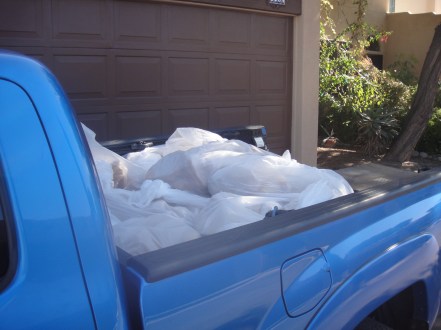
truck of used bread

food handling
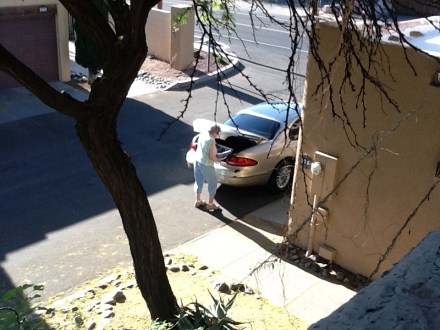
unload and load
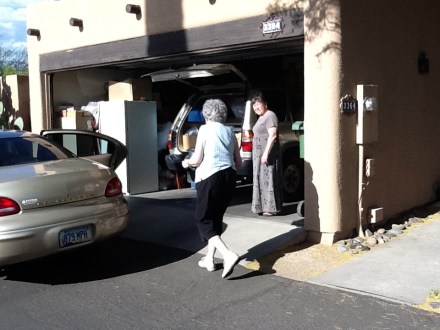

holiday traffic
The current uproar at the IRS highlights the much misunderstood function of granting tax exempt status and enforcing it. I have gone through the process of obtaining a 501C3 permit to run a non-profit corporation, and can tell you it is exhaustive and thorough. Like Medicare fraud, there must be pros who go about cheating and defrauding the system from within. Tax exempt status is given to legitimate corporations willing to go through strict accounting documentation to prove that they are satisfying the mission they stated in the original application. By submitting in good faith to this non-profit status scrutiny they are subject to a review of their activities constantly. Applying for the status is technical and rigorous, as it should be. Keeping it is equally serious in nature.
Going completely commando, soliciting donations from the public without any IRS permit or reporting of the donations whatsoever is the highly lucrative method that has been used in my neighborhood for many years. They have begged openly for donations of food, money, items, and labor. They ask for public support to store prepare food in a residential condo to be served randomly to presumably homeless people they find in parks. No laws are obeyed, from zoning, to health code, to revenue laws. They openly ask for donations on the internet, although multiple law enforcement agencies have been informed for many years of the crimes. This self-appointed charity does not feel the need to obey any laws because no laws are enforced. The lack of interest of the government agencies could be seen as negligence. You might believe, if you love conspiracy theory, that since these charity folks presumably vote liberal democratic tickets, they are allowed with the collusion of our local government, to break all these laws. That is too silly.
I don’t believe there is a conscious effort by government to allow crime to take over the neighborhood. My impression is that public servants feel resentful about serving the public. When opportunity arises to feel powerful through corruption, the loyalty of any public servant to act for the benefit of all concerned is questionable. This is where mental illness diagnosis is important. If only insane and or incompetent people are left to run the government, the government will continue to act against the citizens’ best interests. I do not think we have good or effective governance. I do not trust that the money collected by the IRS is well spent. I have always paid taxes, and benefit from no loopholes. I pay taxes knowing it must be done. Waste and corruption are not what I want to buy with my tax dollars, but they are all I see on the menu at the moment.
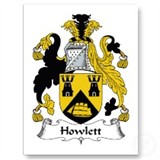
Howlett Coat of Arms
Thomas Howlett arrived in America on the ship Hopewell in 1630 to live in Boston. He was a carpenter, and had skills as a surveyor. He was active in church and military matters.
Thomas Howlett (1605 – 1678)
is my 10th great grandfather
Thomas Howlett (1638 – 1667)
son of Thomas Howlett
Mary HOWLETT (1664 – 1727)
daughter of Thomas Howlett
John Hazen (1687 – 1772)
son of Mary HOWLETT
Caleb Hazen (1720 – 1777)
son of John Hazen
Mercy Hazen (1747 – 1819)
daughter of Caleb Hazen
Martha Mead (1784 – 1860)
daughter of Mercy Hazen
Abner Morse (1808 – 1838)
son of Martha Mead
Daniel Rowland Morse (1838 – 1910)
son of Abner Morse
Jason A Morse (1862 – 1932)
son of Daniel Rowland Morse
Ernest Abner Morse (1890 – 1965)
son of Jason A Morse
Richard Arden Morse (1920 – 2004)
son of Ernest Abner Morse
Pamela Morse
I am the daughter of Richard Arden Morse
| Name | Thomas HOWLETT Sergeant, Ensign |
| Birth | 1605, Assington, Suffolk, England |
| Death | 24 Sep 1677, Topsfield, Essex, Massachusetts |
| Occupation | Carpenter |
| Father | William HOWLETT (1579-) |
Misc. NotesFrom co. Suffolk, England. Removed Ipswich 1633. Deposed 1658, aged 52. Church member 1630.29One of the first settlers in Agawam (Ipswich) 1632/33. Deputy from Ipswich 1635 and Topsfield 1665 and often employed in running lines and locating towns and farms.Ipswich, Massachusetts Deputy in 1635. Ensign of Ipswich Company under Captain Daniel Dennison, 3rd Regiment, Colonel John Endicott 1636.102Thomas Howlett was twenty-five years old when he came to New England in 1630 aboard the ship “Hopewell” as part of Governor Winthrop’s Fleet. He was a carpenter by trade, with origins in South Elmham Parish of Suffolk County, East Anglia in England. He first settled in Boston, as did a majority of Winthrop colonists, and became a member of the First Church on August 27, 1630. In the spring of 1633 he married Alice French, daughter of Thomas and Susan (Riddlesdale) French, who apparently had emigrated to New England prior to her parents. She was a member of the First Church and was eventually dismissed on September 10, 1643 to the church in Ipswich as “Our sister Alice French ye wife of Thomas Howlet of Ipswich.”Although Howlett later settled in Topsfield where he spent the latter years of his life, he was one of the nine originals of John Winthrop Jr’s 1633 party settling the Indian village Agawam, which the next year became the town of Ipswich. He was sworn a freeman at Ipswich on March 4, 1633.In 1634 Ipswich granted Howlett, in partnership with John Manning and others, on the neck of land on which the town stood, two acres of meadow and two and a half acres of marsh between the town riger and the lands of William Sergient (probably Sargent) and John Newman. Added to this in 1635 was a house lot in the town, thirty acres of upland and ten of meadow at the head of Chebacco Creek and ten acres north of the town toward the Reedy marsh. In 1637 he purchased forty acres from John Perkins, Sr. His later acquired Topsfield holdings are described in his will.Thomas Howlett’s highest political office came to him as a young man, when, in 1635, he represented Ipswich in the General Court. he served on the Essex County Jury of Trials in 1654, 1657, and 1665 and on the Grand Jury in 1650, 1659, 1666, and 1667 and served as Selectman of Topsfield in 1661.In 1640 he was sergeant of the Ipswich military defense company and later became its ensign. In 1643 he, as Sergeant, and ten other militiamen were voted compensation by the town for their three days acting in defense of the Agawam Indians against their tribal enemies. In 1672 he became a Deacon of the Topsfield Church and his contribution of five pounds to the salary of Rev. Jeremiah Hubbard was the largest of those made.There were eight children of Howlett’s marriage with Alice — Sarah (1633/34-1700), John (1633/34-1674/75), alice (1636-1696), Thomas, Jr. (1637/34-1667), Mary (1641/42-1718), Nathaniel (1646-1658), William (1649/50-1718), and Samuel (1654/55-1719/20). On June 6, 1666, after the death of Alice he married Rebecca Smith, widow of Thomas Smith if Ipswich and Newbury, with his step-son, Thomas Smith, in 1671, choosing him as his guardian.Thomas Howlett died in Topsfield, Essex County on September 24, 1677.Military Was in Pequot War32, No. 74, pg. 120, 1920Spouses
| 1 | Alice FRENCH |
| Birth | 9 Oct 1609 |
| Death | 26 Jun 1666, Topsfield, Essex, Massachusetts |
| Christen | 9 Apr 1610, Assington (St. Edmund’s), Suffolk, England |
| Father | Thomas FRENCH (<1584-<1639) |
| Mother | Susan RIDDLESDALE (<1584-1658) |
Misc. NotesProbably emigrated to America with her brother Thomas. Alice was dismissed from the Boston Church to Ipswich 16 Jun 1644.
| Marriage | 1 Jan 1633/34, Ipswich, Essex, Massachusetts |
| Children | Sarah (1633-1700) |
| Alice (ca1636-<1696) | |
| Thomas (1637-1667) | |
| Mary (1641-1718) | |
| John (1643-1675) | |
| Samuel (1645-1719) | |
| Nathaniel (ca1646-1658) | |
| William (1649-1718) |
| 2 | Rebecca SMITH |
| Death | before 1 Jan 1634/35 |
| Father | Thomas SMITH |
| Mother | Alice |
I was born in Tulsa in 1951, and although I moved to Pennsylvania when I was 4, I visited Oklahoma many times in my childhood. When the musical Oklahoma came out in 1955 I was thrilled and learned the words and music to sing ad infinitum. I was the soundtrack of some of my best years. I identified with my Oklahoma birthplace which was reinforced by frequent visits, and visiting Tulsans at our home in Pittsburgh. My parents hung out and had musical hootenannies with other petroleum engineer friends from Tulsa who had come to PA like my dad, to specialize in fracking for Gulf Oil. They brought much of their Okie lifestyle with them including Woody Guthrie, hickory chips and barbecue.
I went to Tulsa and drove all over the state a few years ago on my first ancestry discovery trip. I did feel very at home, although perhaps not in political alignment with the population. I particularly loved the grapes at the farmers market that reminded me of the grapes my grandpa grew when I was very young. While driving with my uncle to Bartlesville I asked as a joke what we do in case of a twister. He said we jump out of the car and hide in a drainage culvert. I started noticing how infrequently these culverts were there on the side of the road, and started having thoughts of vulnerability. I imagined hustling my fairly nimble but old uncle out of the car and into the ditch to save our lives and I just did not like that idea at all. I made it back and forth across Kansas and Oklahoma without incident, but did find graves and documents from my ancestors who lived through the dust bowl. I respect and admire those Boomer Sooners and pioneer petro peeps who formed the history of the Cherokee Strip and my family tree. I am sad that my fellow Okies are suffering so much natural disaster and destruction in their lives. Although I still feel the pride of being from Oklahoma, I know I could not handle living with the terror of tornadoes in my territory. I have adjusted to wildfires and floods here in Arizona as my natural disasters of choice. I wish the state of my birth a full and speedy recovery.

