mermaidcamp
Keeping current in wellness, in and out of the water
You can scroll the shelf using ← and → keys
You can scroll the shelf using ← and → keys

Cybele drives the lion chariot
At the Equinox everyone on earth has about the same amout of darkness and light. The sun is close to the equator as it shines for about 12 hours on all parts of the earth for a day. This seasonal shift is of significance to most native cultures. It signals either a lengthening or a shortening of daylight in the months ahead. It creates the conditions for spring planting or fall harvest, depending on the hemisphere in which you live. For a single day, however, we all have the same amount of light and dark in our experience. The literal meaning of the word equinox is equal night. Many calendars begin around the vernal equinox. Romans began the new year on the Ides of March, Astrology uses 21 March as the first of the year, as the Sun moves into Aires. A new year celebration makes sense at this time, as do celebrations to honor rebirth.
The Roman goddess Cybele was associated with rebirth in one of the first Spring break resurrection parties ever held. Romans were all about blood, so they used real bull blood…no chalice of red wine for them. Hilaria was a celebration of resurrection and eternal life held in Rome on the vernal equinox to honor Cybele. She ruled dangerous animals, fertility, and rebirth. She protects civilization. The fact that she is resurrecting her son, Attis, who is also her lover is not a big deal in Roman terms. These things happen in pantheons all the time. After all was ceremonially brought safely back to life Hilaria commenced in a frenzy of joy and mirth. We do not have any evidence of chocolate bunnies, but they were festive in their own Roman way, with orgies, and chariots drawn by lions, castration, and other stuff they liked. Violets are the flower of the day, since the blood of Attis when he died the first time became the violet we pick in the spring. Do not hesitate to decorate your eggs with violets if you want to get down Roman style this year. Unlike our own Virgin Mary, this mother drives a lion chariot, while holding a pineapple, and is on the violent side, so, caveat emptor.
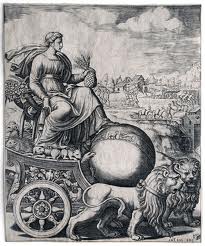
Roman goddess Cybele

Cybele with her lions
To move in synchronicity with others requires concentration and practice. The more a performing group practices the more it develops coordination and precision. From flying trapeze to marching band groups, timing and focus make all the difference. This Chinese troupe is hearing impaired, which makes the synchronization very impressive.
Synchronicity is not practiced, and may appear to be unrelated. The coordination of meaning is personal, but it depends on the oneness of the universe. The individual must notice and connect the dots to appreciate synchronicity. One must look from a new frame of reference to see the connections that fall into place every day.
Systems thinking was described by Leonardo da Vinci as “Everything is connected to everything else”. He called this connessione, or connection. Now that we study quantum physics, we can see that Leonardo’s concern with the connectedness of all things was ahead of his time. Ecology is the whole picture, with all the actions and reactions charted, considered and studied. Man has now reached the conclusion that the unenlightened connections to our environment are probably destroying the future of man.
Where and how do you connect with all of creation? We can think of many examples of disconnection….government, education, so called health care, all the failed and failing systems created without any thought of wholeness and balanced contribution. How do you effect the world around you and how does it effect you? Are you aware of any connections in your life? What is the most important intellectual connection you have made up to this point? I notice that resources abound for those who notice, respect, and care for them. I have connected human greed, depression and insatiable consumption of resources as a single downward spiral. I believe that mindless overconsumption of everything around us is our biggest threat.
Leonardo observed,” every part is disposed to unite with the whole, that it may thereby escape from its own incompleteness.” How do you apply this idea?
Americans are going deeper into process addictions daily. The repetition of compulsive behavior as a substitute for involvement and enjoyment in life is a growing national disaster. Our national diabetes and obesity problems are highly related to the indoctrination created by the food industry. If people are vulnerable and advertising is unquestionably absorbed by the public, where is the ethical line of common sense? I heard that one in every four health care dollars in the US is spent on diabetic patients. Our nation is not in control of our health or our advertising. Compulsion rather than appreciation is promoted at every level.
Professionals are being trained to recognize the symptoms and help patients who suffer. The behavior repeated may be socially acceptable, making it hard to distinguish from healthy behavior. Eating disorders are a common variety of process addiction. Eating itself, working itself, sex itself, and even gambling itself ,are not the real problems with the process addicted person. The overwhelming need to repeat and continue to seek reward in a behavior as the thrill diminishes is the hallmark of process addiction. Joy is drained away from the person who stays in a deep rut of compulsive habits. The remedy is similar to substance abuse treatment, since the same brain centers are involved. To evolve and escape the tyranny of habit is everyone’s job. To make better choices, the first step is to be present and aware. If most of your choices are made by default, this is a good time to begin to choose more deliberately.
Pope Francis has the twitter handle of the Vatican now, and this is his first tweet:
“Dear friends, I thank you from my heart and I ask you to continue to pray for me. Pope Francis.”
His style is matter of fact. He keeps asking for the people to pray for him. He breaks out and kisses babies. I think he is a very smart and astute cookie. The Jesuits are big into discernment as a key to practice. The order teaches ways to recognize the activities of the spirits in action in everyday life. They devote a good deal of time and effort into understanding the emotions and the spiritual meaning in the details. They listen for the voice of God. It is most tempting for the human ego to impersonate the Creator, rather than deeply search for divine guidance.
The Catholic church needs now to both listen to the membership and discern what is spiritually best for the world. A closed, authoritarian, dogmatic institution has the need for a live wire to bring it back to awareness. The first deliberate steps taken by Pope Francis (who I believe is named for both Francis of Assisi and Francis Xavier) signal a new direction. I am neither Catholic nor a fan of any church, but I do appreciate discernment. He seems ready willing and able to bring fresh discernment to a troubled institution. He has already changed the vibe.
Forrester coat of arms
My 20th great-grandfather, Adam Forrester, was the founder of a clan in Scotland. He became wealthy trading, and had permission to import grain into Scotland without paying duty. His castle no longer exists, but there are parts of the churches he erected in his time that can be seen today. He and his son John held important political offices. The both were Keepers of the Great Seal of Scotland. The clan is without a chief and has been waiting for one for centuries. I want to visit someday, but I do not think they will hand over any clan power to an American woman.
Adam Forrester (1360 – 1405)
is my 20th great-grandfather
John Forrester (1390 – 1448)
son of Adam Forrester
Janet Forrester (1410 – 1488)
daughter of John Forrester
John MAXWELL (1404 – 1484)
son of Janet Forrester
Mariota Maxwell (1430 – 1472)
daughter of John MAXWELL
Annabella Boyd (1449 – 1476)
daughter of Mariota Maxwell
Robert Lord Gordon (1475 – 1525)
son of Annabella Boyd
CATHERINE GORDON (1497 – 1537)
daughter of Robert Lord Gordon
Lady Elizabeth Ashton (1524 – 1588)
daughter of CATHERINE GORDON
Capt Roger Dudley (1535 – 1585)
son of Lady Elizabeth Ashton
Gov Thomas Dudley (1576 – 1653)
son of Capt Roger Dudley
Anne Dudley (1612 – 1672)
daughter of Gov Thomas Dudley
John Bradstreet (1652 – 1718)
son of Anne Dudley
Mercy Bradstreet (1689 – 1725)
daughter of John Bradstreet
Caleb Hazen (1720 – 1777)
son of Mercy Bradstreet
Mercy Hazen (1747 – 1819)
daughter of Caleb Hazen
Martha Mead (1784 – 1860)
daughter of Mercy Hazen
Abner Morse (1808 – 1838)
son of Martha Mead
Daniel Rowland Morse (1838 – 1910)
son of Abner Morse
Jason A Morse (1862 – 1932)
son of Daniel Rowland Morse
Ernest Abner Morse (1890 – 1965)
son of Jason A Morse
Richard Arden Morse (1920 – 2004)
son of Ernest Abner Morse
Pamela Morse
I am the daughter of Richard Arden Morse
This week I had the opportunity to take a workshop with Watershed Management Group. I am concerned about the use and abuse of our water resources in Tucson, so I was curious to learn what this group is teaching. I found the format to be very effective. Our 2 day workshop took place at the Ward 1 City of Tucson office near the Santa Cruz River. A grant has been secured to improve the environment around the office. The water harvesting techniques we learned to retrofit neighborhoods with green infrastructure are needed in all parts of the Tucson valley in order to preserve and repair our water table. The city of Tucson Water, and the Arizona Department of Environmental Quality sponsor and fund some of these storm water harvesting projects. Others are created by neighborhoods and cities. Lake Havasu City has been an active client, as is the city of Sierra Vista.
My fellow students came from as far away as Buffalo, New York. There were several New Mexicans. All were professionals in the fields of landscape design, civil engineering, architecture, permaculture, and real estate management. I attended out of my general interest in water quality and health. I have a specific interest in stopping the rape of the environment in my neighborhood by my own HOA board. There is an insistence on as much water waste and plant destruction as possible, which has left us with a more and more barren urban heat island. The value of our property as well as the quality of life around us has been destroyed, along with wildlife habitat, by simply following worst environmental practices for more than a decade. If no steps are taken to stop the destructive practices we can expect our value to continue to drop and our crime rate to continue to rise. Environment and greenery have a very direct effect on crime rates.
I learned more than enough to convince some of my neighbors to join me in turning the tide of waste and ghetto creation in our hood. I look forward to participating in more projects with Watershed Management Group.
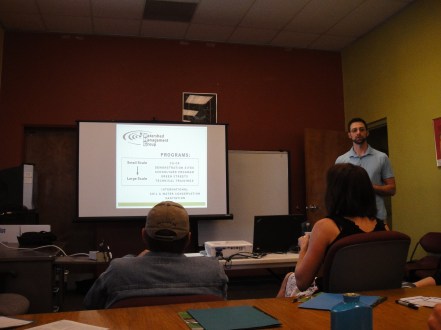
Benefits and techniques

Costs

Healthy snacks
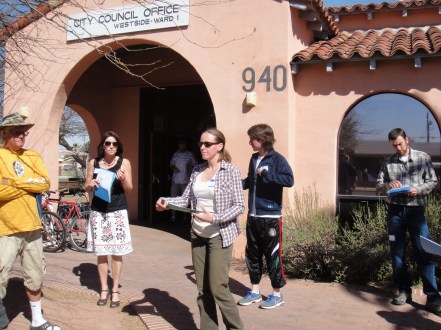
we assess the site
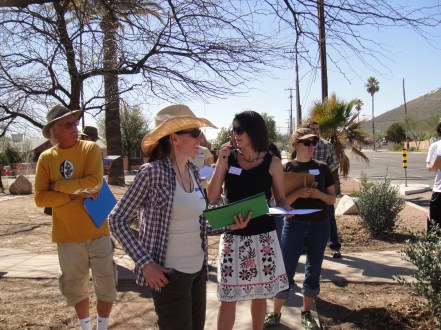
checking all deets
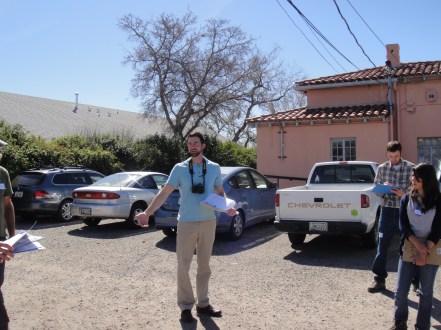
Parking lot project
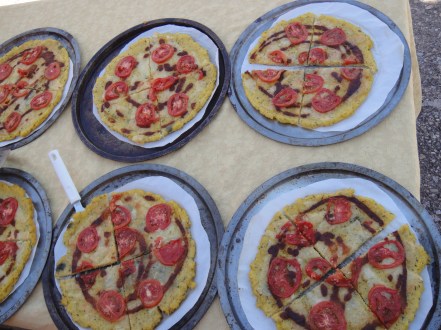
polenta pizza

beets, greens, salad

greens
I am a huge fan of the entire process, about which I will tell you much more, gentle reader. Let it suffice to say that taking courses in watershed management will get you into the best lunch you have ever tasted. Incredibly tasty local ingredients were catered for us picnic style. A good time was had by all. The learning was fine, but the camaraderie and gourmet enjoyment put this experience over the top in my book.

Zappquarters
The second core value of Zappos is simple, but not so easy. Change is never as easy as it seems. The investment in any status quo is heavier than it appears to the naked eye. To start something new is much easier than to destroy something old that does not work (think Congress). People feel that change involves admission of some kind of error, and that is why they will not enter the zone. Being right is important to the point that it can alter the mind of the thinker significantly. When driving change that involves others, be sure that you do not threaten their self images. Any indication that there is a better way, also indicates that the present path is the wrong one. Egos invest in this kind of righteous battle. Ego battles virtually always get out of control because the individuals cannot control the egos. It is best to show by example how change can work for the benefit of all participants.
We are joined at the core, Tony…..tweet me, maybe.
Zappos intentionally transformed the workplace of the telephone bank ordering system. Since this service of taking orders from customers and executing them will continue, serious thought was put into making the job more fun. The tour of the Zappos office will convince you that something very different is afoot. They are used to being observed on the job, and seem to enjoy flaunting costuming, toys, banners, and personal expression of every kind. It made me think of a friend of mine who worked in a cubicle for Quantas, doing reservations. The company issued a memo that no personal items could be displayed in the cubicle of any kind. My friend removed her personal decor and displayed instead the memo itself as her new decoration. The hostility she felt for her incredibly insensitive employer had to come through on every call.
Repression never works, and I am living proof. I have instinctive distrust of dogma, certifications and senseless regulations. Giving people the creative freedom to contribute to the group beats a hierarchy with power issues every time. Zappos does create titles, but they can be very non traditional. My tour guide had the title Culture Clown, which sounded to me like a very fine position. Her job was to tour and explain to the public how being fun and weird at work is good for the human race. This seems obvious, so her job is pretty easy, if not always a barrel of monkeys.
The reasons I think Floatli is the perfect official sport for Zappos:
You do not need to imagine. Say the word and I will fly up and Floatli with you. If it is not fun and weird enough for you I will be very surprised.

Astrological Man
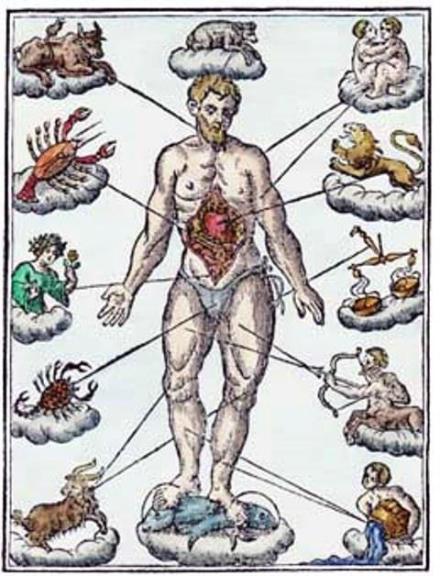
planetary rulers of organs
In the history of medicine the planets and cosmos were the guiding clues that were used to discover treatments and cures. All plants are ruled by planets as are parts of the body. Before YouTube people studied the heavens and did lots of praying. They reached a number of conclusions about cosmology of which most humans today are unaware. Pharmacists, medical doctors and healers used astrology in practice as a matter of course. Everything depended on seasons and the sun. Before we dug coal and oil from the ground civilizations rose and fell because of food supply. Knowing how to make, prepare, gather, and preserve food for the seasons was a matter of life and death. It stands to reason that knowledge of farming and nature was also the only means to improve diet, hygiene and health. Plants are the medicine from which drugs are synthesized now. Plants are the food from which processed foods are prepared today.
Plants were gathered and cultivated to be used as food and medicine. The phases of the moon were and still are important in plant cultivation. More detailed information about the meaning and use of plants was studied by the ancients. In fact, in Basel, Switzerland, arguably the big pharma capital of the world, the botanical garden is smack dab in the middle of the medical school campus. This was the same medical school from which my man Paracelsus was expelled for being a heretic. We like to think we are all that today with our science. I believe we have allowed a much narrower view of life to reign. I think we are made whole and healthy by the cosmos. Smaller, short term thinking is not all that healthy. Taking drugs of unknown origin is the new normal. You might look at these planet guys and think they are silly, but they would not pop pills without any rational reason. We cannot return soon enough to growing, knowing, and using plants as food and medicine. That is what nature intended, gentle readers.

