mermaidcamp
Keeping current in wellness, in and out of the water
You can scroll the shelf using ← and → keys
You can scroll the shelf using ← and → keys

Wampanoag dwelling
I am proud to be a descendant, even though there are 10 generations between my tribe and me. Massasoit, my 11th great uncle, was the Sachem who made a treaty with the Pilgrims in 1621. His father, Wasanequin, is the last link I have found, but I hope when I go to Cape Cod my tribe will know more.
The Wampanoag/Pilgrim Treaty
About an hour after noon on a fair, warm day on March 22/April 1, 1621, Samoset and Squanto appeared in the village of Plymouth with some skins and newly caught and dried herrings to trade. They told the colonists that the great Sachem Massasoit was nearby with his brother Quadequina and all their men. About an hour later Massasoit came to the top of the hill with some sixty of his men. However, the Pilgrims were not willing to send their governor to meet them, and the Indians were unwilling to come to them. Squanto went again to Massasoit and brought back word that Massasoit wished to have trade and peace with them, asking the Pilgrims to send someone to parley with him.
Edward Winslow agreed to serve as diplomatic ambassador and went to Massasoit. The scene was described by Winslow in his Journal as follows:
“We sent to the King a payre of Knives, and a Copper Chayne, with a jewell at it. To Quadequina we sent likewise a Knife and a Jewell to hang in his eare, and withall a Pot of strong water, a good quantity of Bisket, and some butter, which were all accepted: our Messenger [Winslow] made a speech unto him, that King James saluted him with words of love and Peace, and did accept him as his Friend and Alie, and that our Governour desired to see him and to trucke with him, and to confirme a Peace with him, and his next neighbour: he liked well of the speech and heard it attentively, though the Interpreters did not well expresse it; after he had eaten and drunke himselfe, and given the rest to his company, he looked upon his messengers sword and armour which he had on, with intimation of his desire to buy it, but on the other side, our messenger shewed his unwillingness to part with it: In the end he left him in the custodie of Quadequina his brother, and came over the brooke, and some twentie men following him, leaving all their Bowes and Arrowes behind them. We kept six or seaven as hostages for our messenger.”
Captain Standish and William Brewster met the king at the brook with half a dozen musketeers, where they saluted him and he them. With Standish on one side of Massasoit and Brewster on the other, they escorted Massasoit to a house which was just being built. On the floor, the Pilgrims had placed a green rug and three or four cushions.
Winslow described Massasoit and his men as “…a very lustie [strong] man, in his best yeares, an able body, grave of countenance, and spare of speech: In his Attyre little or nothing differing from the rest of his followers, only a great Chaine of white bone Beades about his neck, and at it behind his necke, hangs a little bagg of Tobacco, which he dranke and gave us to drinke; his face was paynted with a sad [dark] red like murray, and oyled both head and face, that he looked greasily: All his followers were likewise, were in their faces, in part or in whole painted, some blacke, some red, some yellow, and some white, some with crosses and other Antick [antique] workes, some had skins on them, and some naked, all strong, tall, all men in appearance…”
Immediately, Governor Carver came to the house with drum and trumpet after him and a few musketeers. Governor Carver kissed the hand of Massasoit and Massasoit kissed Carver before they sat down.
Governor Carver called for some strong water, and made a toast to Massasoit. Massasoit drank deeply of the liquor which made him sweat. Then, Carver called for fresh meat, which Massasoit ate and shared with his followers. Later in the text, Winslow remembered additional details:“…one thing I forgot, the King had in his bosome hanging in a string, a great long knife, hee marvelled much at out Trumpet, and some of his men would sound it as well as they could…”
TERMS OF THE TREATY
Following the introductory ceremonies, Carver and Massaoit agreed upon the terms of a peace treaty between the Pilgrims and the Wampanoags. The treaty of mutual support they negotiated said in part:
1. That he nor any of his should do hurt to any of their people.
2. That if any of his did hurt any of theirs, he should send the offender, that they might punish him.
3. That if anything were taken away from any of theirs, he should cause it to be restored; and they should do the like to his.
4. If any did unjustly war against him, they would aid him; if any did war against them, he should aid them.
5. He should send to his neighbors confederates to certify them of this, that they might not wrong them, but might be likewise compromised in the conditions of peace.
6. That when their men came to them, they should leave their bows and arrows behind them.
7. That King James would esteem Massasoit as his friend and ally.
Winslow concluded his account of the treaty signing as follow: “Wee cannot yet conceive, but that he is willing to have peace with us, for they have seene our people sometimes alone two or three in the woods at worke and fowling, when as they offered them no harme as they might easily have done, and especially because hee hath a potent Adversary the Narowhiganseis [Narragansetts], that are at warre with him, against whom hee thinkes wee may be some strength to him…”
Pokanoket is a tribe of Native Americans who trace their their lineage back thousands of years beyond the colonial days of the United States of America. We trace our ancestry through the bloodlines and the written and oral history of our people. We are the people of Massasoit Ousamequin, Massasoit Wamsutta, and Massasoit Metacom. We are Philip’s people, the people of Metacom. We are the people who celebrated the First Thanksgiving with the Pilgrims in 1621. We are the people who have endured much and who have returned, after a long journey through history to the present day and continue to look forward to the future.
Pokanoket is also a Nation. The Nation of Tribes you may have heard of referred to as Wampanoag ( pronounced wahm – peh – noe – ahg ) was known to our ancestors as the Pokanoket Nation. The Pokanoket Nation, also known as the Pokanoket Confederacy or Pokanoket Country, was comprised of a multitude of Tribes.
Each Tribe was comprised of Bands and Villages and the Pokanoket Tribe was the Headship of the Pokanoket Nation.
Pokanoket is also our home. Prior to the time of the pilgrim’s arrival in Plymouth, which used to be Patuxet, the realm of the Pokanoket included portions of Rhode Island and much of southeastern Massachusetts, including the surrounding islands around Cape Cod and Martha’s Vineyard.
The Pokanoket social organization developed in a manner that differed from neighboring Native American Tribes, since Pokanoket was more socially structured and layered, as well as more politically complex.
Unique to the Pokanoket Tribe were the spirtual and military elite, know as the Pineese (Pineese Warrior), who protected and served the Massasoit (Great Leader). They are the spiritual guardians of Pokanoket Nation.
Pokanoket believed seven to be the perfect number of completeness, for we still believe in the Seven Spirits of the Creator.
Everyman, also known as the regular guy, is one of the archetypes in Carl Jung’s core breakdown. The primary goal of this player in the personality is to be accepted. Blending in, not standing out, is the way the regular guy relates to society. Ad companies use this profiling to create messages that they hope will reach the market of choice. To be desirable to a regular guy a product needs to show that everyone uses it. The most common experience is the target.
This player has much in common with the orphan child archetype, having similar needs and fears. This personality will forfeit much in order to feel like a part of something. After finding the fold in which to fit, they often find it unrewarding and not what they had hoped it would be. The irony of seeking approval from others by being like them is that your own desires may never be made clear. If standing out in a crowd is your worst fear, your own dreams (and personality) may forever remain a mystery to you.
I do not respond well to messages aimed at Everyman. They have a negative effect by showing me that everyone is doing something. I recoil from that. A Eurofriend said this week she does not understand Oprah, the American phenomena. I tweeted her that Oprah is everywoman, as a joke. But, in truth, Oprah does market herself as everywoman (who can afford to buy $900 blouses). That is pretty ironic in itself, that her favorite things are out of range in price for most of her audience. She makes many feel like they are a part of her network, even if she is really the queen.
The eighth core value at Zappos is Do More with Less. This is an essential philosophy to make it in the world now. Using what we already have is a first step to achieve better results. Recent economic bubble popping has shown us how wasteful and risky spending can have dire consequences. As household and government debt grew so did people’s expectations that the prosperity could never end. Now that the economy is reorganized. People look for value and efficiency like never before. Many have embraced thrift over extravagance as a necessity.
Floatli does more with less by versatility. It uses the common floatation noodle, which is easy to replace. Since it works in all kinds of water, including a jacuzzi, it provides a new activity or sport to pools and natural bodies of water. From light to heavy work can be done, by everyone from elite athletes to those recovering from injury. That is another reason Floatli is the perfect official sport for Zappos. It works anywhere there is water, and will be really fun in Lake Mead in summer.
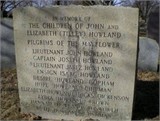
Howland Monument
While my first cousin 12x removed, King Philip, was waging war against the Pilgrims, Joseph Howland, my 9th great grandfather, was guarding Wampanoag prisoners. The fact that I am related to so many people in the colonies is not all that strange because they only had a limited pool of religiously correct folks to marry. The ones who went Baptist and went to Rhode Island, had even fewer. If my Pilgrim ancestor, Gabriel Wheldon, had not gone AWOL upon arrival in Plymouth and married a Wampanoag princess I would not be related to both sides of this bloody war. The conflict between the welfare of the Pilgrim people and the welfare of the native people is still in gear. Guess who is winning.
Joseph lived and died in Plymouth, where he was always closely identified with the welfare of the people. He was commissioned a lieutenant of militia in 1679 which position he held many years. He was a large real estate owner, and he and his son Thomas, his grandson, Consider, and his great grandson, Thomas, successively held the land on which Pilgrim Hall, in Plymouth, now stands. Joseph d. 1st mo. n1704.
JOHN HOWLAND: A MAYFLOWER PILGRIMJoseph Howland was the second son of the Pilgrim, born about 1635 to 1640. A pioneer farmer as his father was, he too held various offices, among them that of surveyor, church delegate, selectman which at that time included the office of justice of the peace,and deputy to the General Court. He served on many town committees, once with the Governor, and was foreman of the jury.
Joseph was also a soldier. In 1667 he agreed to serve the town as a standing trooper for a period of five years. He later became lieutenant of the Plymouth Military Company. During King Philip’s War, in 1675, when the Indians reached the outskirts of Plymouth and were burning houses, he and another soldier guarded Indian prisoners.
By 1690 he had become Captain of the Plymouth Company. This was a considerable honor as this company was the oldest in the Colony and its first Captain was Myles Standish. A special law had been passed which permitted its former officers who had resigned to keep their military titles. Military titles in those days of Indian attack were very highly thought of.
Starting out originally with two acres Joseph eventually became a large landowner. He ingerited land not only from his father, but also through his wife from her father. Captain Thomas Southworth. Much of the latter was of considerable value as it was situated in the center of Plymouth, where Pilgrim Hall now stands.
In 1664 Joseph married Elizabeth . Joseph’s mother-in-law. Elizabeth Reynor Southworth was a close relation of the Reverend John Reynor, for many years the Plymouth misister. He, as many of the early Colonial New England clergy was a graduate of Magdalen College Cambridge University. The Reverend John referred to Joseph as “beloved kind man”, and Joseph eventually became trustee of his estate.
As at the present time, there was servant problems in those days. One sued Joseph for unpaid wages. However, Joseph won the suit.
In Joseph’s inventory, a horse, saddle, and pillion are mentioned. He and his wife Elizabeth must have ridden often together from Rocky Nook to Plymouth and beyond.
The Pilgrim John Howland had bought the property at Rocky Nook in 1633. He left this in his will to his wife Elizabeth stating that it was to be hers for the rest of her life, then it was to go to Joseph. In 1675, during King Philip’s War Indians attacked Rocky Nook and burned the main “dwelling house”, Elizabeth eventually went to live with her daughter Lydia Brown, the wife of James Brown, Swansea. Joseph Howland took over and built his house in 1676. When he died in 1736, he left the property to his son James ? who finally sold it in 1735. All told Howlands lived at Rocky Nook for almost one hundred years.From and address at Dedication at Rocky Nook, Kingston, Mass. by McClure M. Howland September 7, 1963.
Joseph Howland (1640 – 1703)

King Philip
Is the essential nature of humans greedy or generous? There are two sides to every coin. If it were possible for you to reverse one trend, what would you change? I think I would make it obsolete to ship, process, and package food.
I have a sourdough start that has been living for about 5 years. I feed it potato water, sugar and potatoes to keep the yeast alive. The yeast lives in the air and will be different in each geographic location. Technically beer yeast and bread yeast are different strains, but they are both alive. The sourdough is a domesticated life form growing in my kitchen. Each time I make bread I take out half of the starter and add potatoes and sugar to the bowl. After it grows for a day or so I refrigerate it because I have no need to make bread every 24 hours. The ritual of making the bread and keeping the levain alive is important. Mine is unusual because I use no flour in the starter liquid.
Making and sharing food has deep significance. Not everyone has time or interest in bread baking or cooking as a sport, but everyone gets hungry. The way we deal with our appetites tells us something about our relationship to divine providence. To be too strict or picky results in loss of joy, whereas to be undiscriminating will have the exact same result. Culinary taste can and does vary greatly, but the full pleasure of dining is in the execution. The delightful MFK Fisher wrote before the advent of Food Network and the crush of celebrity chefs as entertainers. I have purchased tickets to see Anthony Bordain live on stage in Providence because he does the same schtick. His travel and dining adventures are metaphor fairy tale food stories. Once I saw that he and I will have traveled to the same city at the same time I knew I had to see his show Good and Evil, an obvious referral to food as life. He and I do not eat the same things, but we dine with the same attitude. I look forward to the evening with delight. It will be tasty.
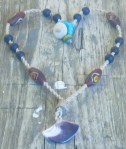
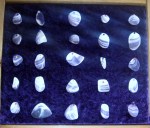
My friend Chico lives in Cape Cod and makes wampum, a currency and an art. He turns the shells of particular beauty into individual pieces of jewelry art. The town of Falmouth, where he lives, has a big tourism business in the summer. To complete the experience the town hosts an art market. Chico is there to offer shoppers a truly local art and perfect souvenir of Falmouth. Next month he will retire from his day to day work and be a man of his own currency. While many face retirement without a good relationship to nature and life, wondering how to handle the free time they anticipate, Chico has created art as currency, and currency as art. It is light weight, tucks into a suitcase, and has historical meaning. He calls his art business Chico’s Wampum Revealed. I predict much will be revealed.







Portsmouth Compact
The Puritans left England for religious freedom. As soon as they arrived in New England some of them needed to be religiously free of the Puritans in Plymouth. These ultra free people formed their own “Plantations” in Rhode Island. One such Bodie Politick was Portsmouth, which made it’s political agreement in 1638 with God Himself.
The Portsmouth Compact
The following is quoted from the book Story of Dr. John Clarke; The Founder of The First Free Commonwealth of the World; on the Basis of “Full Liberty in Religious Concernments” by Thomas W. Bickness, published by the Author, Providence, R. I., 1915; third edition. Note: In the book is a picture of the compact which has been scanned in color for these pages. The transciption has been corrected to spell Phillip Shearman’s name with two “L”s and to add the words “his mark” as they appear next to Henry Bull’s name and under his mark “+”.
Prior to leaving Boston, a compact was drawn up, under date of March 7, 1638, by which a number of the leading men of the proposed Colony incorporated themselves into “A Bodie Politik” to the end that they might go to their new Plantation in a formal organization, under a chosen leader or Governor.
The compact is as follows:
The 7th Day of the First Month, 1638
We whose names are underwritten do hereby solemnly in the presence of Jehovah incorporate ourselves into a Bodie Politick and as He shall help, will sub- mit our persons, lives and estates unto our Lord Jesus Christ, the King of Kings, and Lord of Lords, and to all those perfect and most absolute laws of His given in His Holy Word of truth, to be guided and judged thereby. William Coddington John Clarke William Hutchinson, Jr. John Coggeshall W illiam Aspinwall Sa muel Wilbore John Porter John Sanford Edwa rd Hutchinson, Jr. Esq. Thomas Savage Willi am Dyre William Freeborne Ph illip Shearman [ John Walker Richa rd Carder Willi am Baulston Edw ard Hutchinson, Sr. + H enry Bull [“his mark” written next to name] Randal l Holden
Exodus, 24c., 3:4.II Cron., 11c., 3. II Kings, 11:17.
This compact was signed originally by twenty-three persons. The original paper is in the keeping of the Secretary of State, at the State House, Providence, a photograph of which appears on the opposite page. Four names,– Thomas Clarke, brother of John, John Johnson, William Hall and John Bright-man, Esq.,– follow the nineteen that appear above. Erasure marks have been made over these names, the reason for which it is not easy to understand as the first three were among the first recorded settlers of Newport, and Mr. Brightman may have been.
Neither was a Constitution nor a Bill of Rights for a Colony. Boston called the compact an act of incorporation. Plymouth called theirs a covenant, Boston did the act in “the presence of Jehovah,” Plymouth wrote “in the presence of God.” Boston formed a “Bodie Politick,” Plymouth called theirs a “Civill Bodie Politick.” Boston submitted their “persons, lives and estates unto our Lord Jesus Christ.” * * * ** “And to all those perfect and most absolute lawes of His given us in His Holy word of truth, to be guided and judged thereby.” Plymouth promised submission and obedience to such “just and equal lawes, ordinances, acts, constitutions and offices” as might be enacted, constituted and framed. Each compact had for its purpose the formation of a civil state under an orderly government. The Boston paper was probably written by Dr. John Clarke, whose piety and purpose lent a strongly religious sentiment to the document, so much so that some historians have called it theocratic. But Dr. Clarke did not classify The Christ as a theocrat, for all his writings make the great Teacher the interpreter of a new Democracy in which soul-liberty is established and enforced.
Samuel G. Arnold, our Rhode Island historian, has given a very clear and just interpretation of the Portsmouth Compact. He says, “So prominent indeed is the religious character of this instrument, that it has by some been considered, although erroneously, as being itself ‘a church covenant, which also embodied a civil compact.’ Their plans were more matured than those of the Providence settlers. To establish a Colony independent of every other was their avowed intention, and the organization of a regular government was their initial step. That their object was to lay the foundation of a Christian state, where all who bore the name might worship God according to the dictates of conscience, untrammelled by written articles of faith, and unawed by the civil power, is proved by their declarations and by their subsequent conduct.” * * * *
My 10th great grandfather was on the list signing the document breaking up totally with England, church and state. They were disarmed and put in jail by the Puritans for praying in the home of Anne Hutchinson. They decided to leave.
Richard Carder (1604 – 1675)
is my 10th great grandfather

Portsmouth Compact
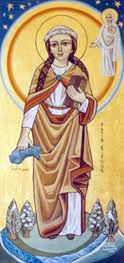
St Verena of Egypt
I first knew St. Verena because I stayed many times a year for many years at her hotel in Baden Switzerland. It is a fantastic Belle Epoque building with plaster elephants on the dining room ceiling and a direct access to the hot spring mineral baths. Verena served one of the best ever Swiss breakfast buffets, which is saying a lot. The Swiss hotel breakfast buffet is designed to wow you, fill you, and make you a loyal customer of the establishment. As a vegetarian I do not care about all the cold cut and caviar stuff, but am an expert in knowing a good muesli bar when I find one. Verenahof had everything, but the stairs were noisy and creaky, the elevators smelled highly of sulpher, and the surrounding hotels had closed. Now it looks like Baden, with a history of spa since Roman times is having a grand reopening. I am so pleased to know that Verena will once again be serving breakfast at the bad.
I did not think too much about her until I visited Bad Zurzach on the Rhine a few years ago. She is buried there in a church. The mineral spring there was not discovered until relatively recently, but Verena was a big deal there for centuries. I saw all kinds of statuary and art of Verena, and made an attempt to read about her in German (ha!). It looked like she was from Egypt and lived in a cave in Switzerland ( aka Rome) where she became a magical healing saint. Since that was way too weird, I decided I must be translating very badly. I went to her grave and lit some candles and hung out all by myself with her a few times at the church. She does have a heavy vibe, based on the people who have come here to see her for centuries. When I arrived in the states I looked up her story and read about Coptics in the Roman army in English. Her story is even wilder than I could have imagined.
Verena grew up in Luxor and traveled to Italy to receive a Christian education. When she learned of the fate of St Maurice she went to Switzerland to look for the Theban legion. They had been decimated by the Roman Emperor Maximian. Since her army was slaughtered, she found herself in a strange land with no language skills, so she went into a cave to pray and meditate. She came out of the cave healing like crazy, and was even imprisoned for it. She is typically depicted as holding a water vessel and a comb, symbols of her work with the sick and the poor. Today you can visit the cave where she had her big empowerment. Who would guess that a third century Coptic saint would end up at Swiss spas? Another great reason to visit Bad Zurzach, where the healing complex is extensive and elegant, is the hand organ festival which they hold each year.

Jung’s Kundalini
One of Carl Jung’s most controversial theories was his view of the God within. He was drastically disappointed in his first communion at the Swiss Reform Church. His father was the pastor and Carl was a faithful member of his church. He expected something more, or different, when he attended that communion. He basically never stopped pursuing that ecstasy he had wanted through religion for the rest of his life.
His later years were consumed with individuation, which he considered to be the meaning of existence. He used artistic expression, dream journaling, and isolation in a primitive tower built by his own hand to achieve his own individuation. He studied ancient alchemy and philosophy. His belief that symbols contain the most direct and deep meaning lead him to study ancient texts and charts. To Jung individuation was not a substitute for God, but a deep search for the divine nature of self.
His investigations were deep and lengthy. He stated that he only studied of God as a psychological archetype and not as religious doctrine. His idea of the collective unconscious is that images and symbols are primordial. We absorb symbolic messages but do not analyze their meaning. That is why Jungian therapy can include sand box drawing, word association, and art to discover archetypes. Dream work is a pivotal part of Jungian analysis. In his tower, reading about ancient alchemists, living without modern conveniences, Jung came close to living in a dream. Most cannot afford such an extravagant personal quest for the divine, but we can all do a little dream investigation. Does God enter your dreams?

dream spiral

