mermaidcamp
Keeping current in wellness, in and out of the water
You can scroll the shelf using ← and → keys
You can scroll the shelf using ← and → keys
There is a tendency to avoid truth and maintain status quo in an effort to stay in control. This habitual use of the lowest common denominator to define reality is detrimental to wellbeing. Bernie Seigal notes in the above video that to forget is to get something for yourself. To forgive is to give something to another. The gift that everyone has to give is responsibility. We have selective memories and stories that we tell about ourselves and our circumstances. The story about the wound is the one that keeps the wound alive, whatever it may be.
Woundology is the currency exchange that places value on damage. The currency of pain only has value if you accept it and give it. Carolyn Myss coined the phrase and noticed a growth of the epidemic. Her work as a medical intuitive has been to explain and teach Why People Don’t Heal. I believe that there is a codependent heath and fitness industry that feeds the insecurity and pain as a way to make a living. I have seen this in action, although I do not think the participants had awareness of their folly. If your health and fitness story is not a clean, clear and happy one, the good news is that you can change it. Change your story by refusing to allow the past to define your present. Trade in the wounds for a brand new set of possibilities.

Feet of Culture Clown
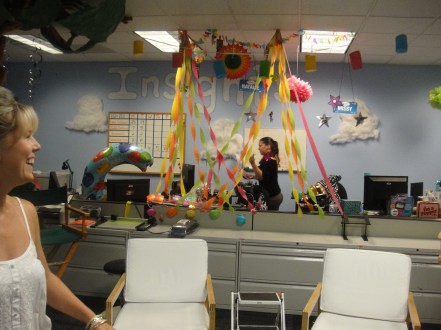
Zappos Insights
The number nine core value at Zappos is about passion and determination. This one may be the determining factor in my quest to make Floatli the official sport of Zappos. I am positive that many have, are currently, and will pursue a spot in Zappos future. In order to make my offer stand out in a giant crowd I accept the challenge of showing more passion, and ultimately more determination, than others who are vying to be the provider of the official sport of the company.
With any luck I will be the only one applying for this position. Zappos is full of healthy employees who enjoy working and playing. The presence of the company coach supports this balanced lifestyle. Employees can schedule coaching sessions for work or personal reasons. The popular program is much utilized, therefore a waiting list exists for appointments with her. I admire this kind of development program because a passionate determined employee is a content and personally fulfilled employee.
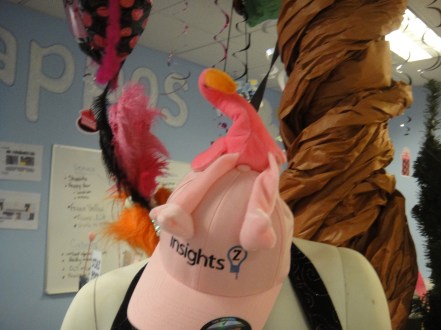
Zappos Education Dept
As the most insightful capitalist venture I have ever seen, Zappos screams sport. The minute you walk into the place the vibe is all about personal expression and fashion extravagance. The team spirit is overwhelming. My guide, Culture Clown, told us how she and her firefighter husband enjoy Lake Meade and participation in outdoor fitness events. She had completed a tough mudder with Marines that impressed me greatly. The reason Floatli is the perfect team sport for Zappos is that it is non competitive. What gravity does, Floatli remedies. The more you wear shoes and play tough games on land, the more you need to reverse that action. Floatli downshifts the joints and prehabilitates the body to do more sports without risk of injury. Summer is hot in Vegas, but they still have a big beautiful Lake Mead, as well as millions of pools.
I want the chance to to market Floatli with Zappos. More fun even than that would be to organize an exciting alternative fitness program that enhances staff levels of health and satisfaction within the company. The integrity of the company comes from taking care of the employees so they can deliver happiness to customers. I want to deliver some happiness to the discriminating employees to give them a new way to chill and stay fit. I am passionate and determined to get an audition.

Jessica Breton, L Ac
Last week I had a treatment from Jessica Breton at my hospital/spa. She does acupuncture at the Supportive Care for Healing at U of A Cancer Center. I recently overcame my fear of needles to try acupuncture and am now a huge fan. It has had a very salubrious effect on me. I expect when one is very ill it might be super curative. Jessica is like the other practitioners I have met at the hospital, extremely competent. She has additional skills that she uses in her private practice that are not employed at the hospital. As my treatment progressed I already felt good, but when she commenced to to cranial sacral work while I wore my needles I just loved it. It was noticeable to me that this was only my third acupuncture treatment and I was relaxed and looking forward to the boost of euphoria that I now associate with it. I had a big fear of needles that had existed since early childhood. I still do not want anyone to give me a shot or take my blood, but these needles are really super friendly.
Jessica has a low key style that made me feel very relaxed. In fact, at one point I asked if the needles were still in because I had no sensation of them. The resulting effects were not subtle. I noticed a freeing and balanced feeling that I am starting to know comes from acupuncture. In her private practice she does cupping and moxa as well as Tui Na. These modalities are similar in that they diagnose by reading pulses and your tongue. They address the balance of chi in the meridians. Tui Na works on the ligaments to restore balance and order. Each can be powerful alone, but combined they make an effective treatment more beneficial for the body.
To reach Jessica for an appointment at Zylla Acupuncture in Tucson you can call 520-221-6559 or reach her at zhenpoints@gmail.com. She is punctual, polite and professional.

Ship Bevis log

Old Rehoboth Cemetery
William Carpenter was a notable town clerk of Rehoboth, Massachusetts. He is from the Carpenter family that became large and influential in Rhode Island and southeastern Massachusetts by the 1700s.
Early Life
William Carpenter, Jr. was baptized on November 22, 1631. His parents were William Carpenter, III and Abigail Briant (sometimes erroneously reported as Bennett or Sale/Seals/Searles), both originally from Wiltshire. Since his family was able to bring a servant with them to Plymouth Colony, it is likely that they came from some affluence.
Carpenter’s place of baptism is variously recorded as Shalbourne, Berkshire, England or Southampton, Wiltshire, England. (Sources also differ on whether it was the Shalbourne in Berkshire, Wiltshire, or the non-existent “Whitshire.”) Professional genealogist Eugene Cole Zubrinsky, author of the Carpenters’ Encyclopedia, maintains that it was Shalbourne, Berkshire based on primary source records. The confusion could be blamed on Shalbourne having been split between Berkshire and Wiltshire around 1841, since it had straddled the line, with some records going to one county and some going to the other. Southampton, meanwhile, was the family’s departure port from England, explaining why some list Carpenter as having been born there.
Arrival in America
By May 2, 1638, Carpenter and his family set sail from Southampton, Hampshire, England on the Bevis, arriving at Boston in July or July. (The passenger list said that by May 2, “they had been some Dayes gone to sea,” so the exact date of departure is unknown.) The family’s full entry said:
William Carpenter 62 Carpenter of Horwell, William Carpenter Jr. 33 Carpenter of Horwell, Abigael Carpenter 32 and 4 children 10 and under, Tho: Banshott 14 Servant
A scan of the log can be seen in the “Photos” section of this profile; a more legible transcription is available throughOlive Tree Genealogy.
The family first settled in Weymouth, and then moved to Rehoboth in 1644.
Marriages & Children
Carpenter’s first marriage was to Priscilla Bennett on October 5, 1651 at Rehoboth. It is unclear whether she was the daughter or widow of Edward Bennett of Weymouth, Massachusetts Bay Colony. She died on October 20, 1663 in Rehoboth.
His second marriage was to Miriam Sale on February 10, 1663/4. (It is sometimes recorded as December since the original record, following the old calendar, called February the “12 month.”) She was born c. 1645 and died on May 1, 1722 at Rehoboth. She was the daughter of Edward sale of Weymouth and Rehoboth and was approximately 20 years old at the time of her marriage.
With his first wife, Carpenter had (all in Rehoboth):
John Carpenter, b. October 19, 1652, d. probably April 9, 1713 in Dedham, Massachusetts
William Carpenter, b. June 20, 1659, d. March 10, 1718/9 in Attleborough, Massachusetts
Priscilla Carpenter Sweet, b. July 24, 1661, d. 1745 in East Greenwich, Rhode Island
Benjamin Carpenter, b. October 20, 1663, d. April 18, 1738 in Coventry, Connecticut
With his second wife, Carpenter had (all in Rehoboth):
Josiah Carpenter, b. December 18, 1664, d. February 28 or 29, 1727/8 in Rehoboth
Nathaniel Carpenter, b. May 12, 1667, d. Rehoboth or Attleborough
Daniel Carpenter, b. October 8, 1669, d. September 14, 1721 in Rehoboth
Noah Carpenter, b. March 28, 1672, d. Attleborough
Miriam Carpenter Bliss, b. October 26, 1674, d. May 21, 1706 in Rehoboth
Obadiah Carpenter, b. March 12, 1677/8, d. October 25, 1749 in Rehoboth
Lt. Ephraim Carpenter, b. April 25, 1681, d. April 30, 1743 in Rehoboth
Hannah Carpenter Chaffee, b. April 10, 1684, d. after January 19, 1767 probably in Rehoboth
Abigail Carpenter Perrin, b. April 15, 1687, d. January 15, 1781 in Rehoboth
The Carpenter family house was on the left-hand side of the road from Rehoboth to the East Providence meetinghouse, “some 50 or 60 rods from the crossing of the Ten Mile river.”
Professional Life
Carpenter was propounded on June 6, 1660 in Weymouth but not admitted as a freeman until June 1, 1663.
Fitting with his surname, Carpenter was originally a carpenter. Records show him owning a “long Cross cutt saw” that he used at his home and which he later willed, along with assorted tools, to his son John, also a carpenter.
For nearly 35 years, Carpenter served as the town clerk of Rehoboth. His records are notable due to his exceptional handwriting and general literacy, which point to some formal education in his background. He also owned a small library of mostly theological books.
Records show that, while serving as clerk, he oversaw the highways, served as constable and juryman, was appointed to settle boundary disputes, helped hired the schoolmaster, served as magistrate, and was otherwise involved in all aspects of local governance.
Deacon or Deputy?
In his 1898 genealogy, Amos Carpenter said that William Carpenter was a deacon of the Rehoboth church and a deputy to the General Court of Plymouth Colony in 1668. Although these “facts” continue to be passed down through some branches of the family, Zubrinsky has conclusively shown that neither could have been true. Although Carpenter’s father served as deputy to the General Court in 1656, Carpenter himself never appears on any list of deputies. Furthermore, the original records of the Rehoboth church list a Deacon Cooper, not Carpenter. Even though he served as neither deacon nor deputy, he continues to be popularly known as “Deacon” simply due to the number of years for which the myth was propagated.
Death & Legacy
Carpenter’s will was dated November 10, 1702 and was proved April 20, 1703. His entire estate, including housing and lands, was worth £215 5s. 4d., or roughly £16,500/US$27,700 in 2011 figures.
Carpenter was buried at Newman Cemetery, one of the oldest (established in 1643) in present-day Rhode Island but which was, at the time of its founding, part of Rehoboth and Plymouth Colony. His parents are also buried in the same cemetery.
Additional Reading
Zubrinsky’s profile of William is perhaps the best available. It is uploaded in the “Documents” section of this profile.
The Wikipedia on the Rehoboth Carpenter family is a good starting point for learning about the family’s spread and influence over time.
Amos Carpenter’s A Genealogical History of the Rehoboth Branch of the Carpenter Family in America, often referred to as “The Carpenter Memorial,” was printed in 1898 and serves as the basis for most modern genealogies. Press of Carpenter & Morehouse, Amherst, Mass., 1898) However, due to the problems noted above with his biographical sketch of Carpenter, it must be read with caution.
Sources
Beers, J. H. Representative Men and Old Families of Southeastern Massachusetts. Chicago: J. H. Beers & Co., 1912.
Carpenter, Amos B. A Genealogical History of the Rehoboth Branch of the Carpenter Family in America. Amherst, Mass.: Carpenter & Morehouse Press, 1898.
Zubrinsky, Eugene Cole. “William Carpenter of Rehoboth, Massachusetts.” Carpenters’ Encyclopedia, updated January 18, 2011.
This biographical profile was written in May 2011 by J. Ashley Odell for Geni. It should not be reposted elsewhere without full attribution.

Grave of William Carpenter
Julia Sweeney of SNL fame performed the opening of her show “Letting Go of God” for this TED talk. She is witty and insightful as she talks about her childhood exposure to religion. We all had different parental models. My parents were not religious but they belonged to a church they rarely attended. They got the big idea that I needed to go to this Presbyterian church when I was about 11. They made no bones about the purpose of my Sunday school enrollment. It was punishment. I am not sure what the infraction was, but I was to atone by being a Sunday school student. It fully sucked. I successfully physically fought off my mother in the ladie’s room the first time she tried to leave me at Sunday school, but eventually I had to go for a couple of years. I even was baptized and confirmed at the same time, since in infancy I was not baptized. My overall impression is that it was a drag, but I do know some of the songs still today. I asked my father why I had to go and they did not. I always remember his answer. He said, “I believe in God, but not like that.” Why they thought I should be indoctrinated like that is still odd to me.

Pawtuxet, Rhode Island
My 9th grandfather was a founder of the town of East Greenwich, Rhode Island. I am excited to find that in Warwick, RI there is an historical village of Pawtuxet where I will be able to visit the Malachi Rhodes home. It will be a huge thrill. I love preserved history, and am so pleased that the Rhode Islanders decided to preserve entire villages of Rhode’s stuff. The village is the oldest in the US, and contains historic buildings that model the past. This will be my kind of village because the Rhodes are not the only family to whom I am related. Ghost tourism at the highest levels will be savored. These people still dress up and guard the village with a militia..can’t wait!!
Malachi Rhodes (1650 – 1682)
is my 9th great grandfather
Malachi Rhodes (1676 – 1714)
Son of Malachi
Dorothy Rhoades (1705 – 1705)
Daughter of Malachi
MARGARET HAMMETT (1721 – 1753)
Daughter of Dorothy
Benjamin Sweet (1722 – 1789)
Son of MARGARET
Paul Sweet (1762 – 1836)
Son of Benjamin
Valentine Sweet (1791 – 1858)
Son of Paul
Sarah LaVina Sweet (1840 – 1923)
Daughter of Valentine
Jason A Morse (1862 – 1932)
Son of Sarah LaVina
Ernest Abner Morse (1890 – 1965)
Son of Jason A
Richard Arden Morse (1920 – 2004)
Son of Ernest Abner
Pamela Morse
I am the daughter of Richard Arden
If you have attended an elementary school you have been involved in gossip. Private information spreading is power for the gossip. It can have two distinct patterns running at the same time. Damaging or false information may be spread as well as flattering or promotional stories. This is a member of the creative family and can be considered to be artful and expressive. Dr. Phil and his ilk fit into this category. Networking can be a positive form of gossip designed to help others. To make the best of your own gossip within notice the news you spread and why you do it. To a certain extent we all make our own PR as well as our own self image. We spotlight or eliminate part of the story for effect, even if we are unconscious of it, and even in our memories.
How can the gossip teach us to respect the feelings of others? If you observe your own communication carefully you can spot trends. The shadow gossip my bring you news of all kinds, but it is not your job to share it. I know plenty of people who do not watch cable TV but are still influenced to believe what they are told, read, or hear. Due diligence is your friend when it comes to discernment and discretion. Know what you mean to say and why.
The the P’s have served me well as a guide since I first saw them on a sign in a panyard in Port of Spain, Trinidad. I hung out at the Neal and Massey Trinidad All Stars yard in the early 1980’s. I took my video camera and shot the practice sessions. I adored the look as well as the sound of the steel drum. The panman was just leaving the shadows of Trini society in the 1980’s. The Despers, The All Stars, and some other very old steel bands were representing very hard neighborhoods in Port of Spain. The idea that you could build an instrument out of an oil barrel and make a professional orchestra of people who did not read music was not yet considered to be a fine art by everyone.
I had some of the best times of my life at that yard. I remember Dane Gulston for his artistry and also his super friendly attitude. He was very young, but was already indoctrinated with the discipline of the All Stars. Dedication and cooperation are the ingredients needed to win in Panorama and in life. Today Pantrinbago oversees educational programs and the nation is proud of their indigenous instrument. Brooklyn has a large contingent of the best musicians for at least part of the year. In the above solo Dane ably demonstrates the benefits of practicing the three P’s.
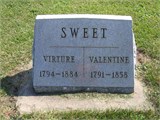
Virtue and Valentine Sweet
Valentine Sweet was born on 14 Feb, 1791 in New York. The Sweet family had come from Rhode Island. Virtue Kelly, an Irish woman no doubt, married Valentine in New York in 1811. They moved to Polo, Ogle, Illinois between 1850 and 1859. Polo had a tunnel for the underground railroad. Their daughter Sarah married her husband Daniel Morse in Illinois in 1858. Daniel and his young bride and first born son returned to New York in 1860 because he thought he might be drafted to fight in the Civil War. After the war Sarah and Daniel moved to Kansas to farm.
The limits to your love are set by you. Finding fault is the opposite of finding love.
 mermaidcamp