mermaidcamp
Keeping current in wellness, in and out of the water
You can scroll the shelf using ← and → keys
You can scroll the shelf using ← and → keys
I have been enjoying meeting and spreading the work of bloggers on the Triberr platform. I went to NYC in September to learn more about it, and have been pleased with all I have gained from my enjoyment of Triberr. Yesterday the stream of blogs started drying up and today we learn that a limit was imposed of a maximum of 6 posts a week for each member. I am not as prolific as many of my tribe mates. I do not advertise or promote anyone’s products on my blog. My thing is simple. I am just shocked that they are going all Netfix with no warning.
I predict there will be an exodus of some kind, and maybe a knock off site. In the meantime it will be the talk of the town, not in a good way. I do not mind paying a small fee, but there is something about changing the rules overnight that causes uproar. Triberr has some ‘splainin to do.
My Dead Peeps
I have traveled in person only once to visit my dead ancestors and look for local records of their lives. I went to Tulsa, where I was born, and my grandparents are buried, but I can not find their graves. After my cousin went back to Iowa I did more investigation in the town where my father was born, Independence, KS. I drove to the small rural town of Ladore, where many of my ancestors settled when they came from Ohio and New York. I found the grave of one of my 2nd great grandmother while looking for somebody else. It made the hair stand up on my neck even in sweltering humid July in Kansas. I have been all over the world on all kinds of journeys, but this is a whole new way to look at travel…visiting history by combining the ancestors and geography. Kinky, and very cool.
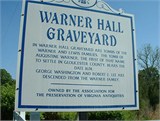
I have accumulated and am trying to geographically arrange data on ancestors around Plymouth Colony, MA and around Jamestown, VA. I will go to both destinations eventually, but have to choose one to be the first. The peeps are mostly very fancy in both places and we know how to find many of the graves, some homes, etc. I am not really into them for the royal blood and fame, I just like them because they survived. It is nothing like visiting living relatives. They are past judgement and are all very low maintenance. They are what you might call spooky. I just learned from a local that Virginia is a vortex for ticks, which makes graves in Massachusetts instantly sound so much more appealing. I am thinking now of flying to tick free, but cold Boston. Someday I will procure the right tick graveyard gear to safely visit my Virginians…like Mary, who is in the private and elite graveyard at Warner Hall with a lot of my other ancestors:
The walled family cemetery of the Warner and Lewis families is located on the Warner Hall property, southeast of Warner Hall. Access to the Graveyard is from the road North of Warner Hall and not from Warner Hall or the Driveway to Warner Hall located West of the Graveyard. The cemetery is the final resting place for many of the Warner and Lewis family members. The family cemetery, is also the resting place for such well known ancestors of George Washington, Robert E. Lee, The Queen Mother of England, and Queen Elizabeth II. Queen Elizabeth has visited Gloucester where she placed a wreath upon her ancestor’s grave. The cemetery has thirteen graves and plaques in memory of all the family. The cemetery is owned and maintained by the Association for Preservation of Virginia Antiquities (A.P.V.A.). The A.P.V.A. acquired the cemetery at Warner Hall in 1903, since which time the Association’s Gloucester Branch, now known as the Joseph Bryan Branch, has zealously maintained it.
There are thirteen graves in the Warner Hall Grave Yard. they are:1 Mary Warner (believed to be Mary Towneley Warner), 1614 – 16622 Augustine Warner I, 1611 – 16743 Augustine Warner II, 1642 – 16814 Mildred Reade Warner (wife of Augustine Warner II), 16945 Augustine Warner III, 1666 – 16866 Elizabeth Warner Lewis (d/o Augustine Warner II w/o Col John Lewis), 1672 – 17197 Col John Lewis (s/o John & Isabella Lewis h/o Elizabeth Warner), 1669 – 17258 Mary Chiswell Lewis (d/o John & Elizabeth Randolph Chiswell w/o Warner Lewis II, 1748 – 17769 Warner Lewis II (s/o Warner Lewis I & Eleanor Bowles Gooch Lewis & grandson of Col John Lewis & Elizabeth Warner Lewis), 1747 – 179110 Juliana Clayton (d/o Dr. Thomas & Isabella Lewis Clayton), 1731 – 173411 Isabella Lewis Clayton (d/o Col John Lewis & Elizabeth Warner w/o Dr. Thomas Clayton), 1706/7 – 1742 (the dates 1706/7 is exactly what is engraved on her stone)12 (Dr.) Thomas Clayton (h/o Isabella Lewis), 1701 – 173913 Caroline Lewis Barrett (d/o Warner Lewis II), 1783 – 1811

Private Graveyard at Warner Hall
The all around good time, right livelihood, and value vibe created by Zappos is a result of excellent design. The products we buy from Zappos are of high quality. What is perhaps more important is that they are steering capitalism in a healthy direction by upgrading the way business is designed. Feudalism, slavery, share cropping and all other adverse forms of employment feature happiness for shareholders only. This short-sighted vision produces more unhappy servants of the apparently happy owners of companies than it does loyal customers. With the contentment quotient working in reverse, quality, innovation, and value erode and vanish. I think this erosion is occurring in the public service sector. If Vets kill themselves there is a clear indication that something essential is missing in the overall design of our public business.
How can we make the business of government switch from a stagnant vessel of inefficient service to a lean mean contentment machine? Are there ways to practice the Zap happy values in public service and politics?
I do see a little weirdness, but far too little. The WOW Through Service is just not happening. Imagine the government being passionate to do more with less, or be humble. These core values are created for the benefit of all. Happiness compounds daily, as does negligence. My dream government applies these guiding principles to create a better world. Imagine, gentle reader, a government that makes us as happy as Zappos does, all while being creative and open minded. We can dream.
I was reminded of a meditation technique I used to practice, but have almost forgotten. The bubbling spring meditation is an active way to make contact with the earth element and move stagnant energy in the body. It is powerful and easy to learn. I need to brush up and use it, since it is vital to remember how energy flows (and becomes stagnant) in the body. Kidneys, as well as kidney chi, are the source of confidence and mental clarity. I think this is the big mental illness plague confusing and freaking out the United States. The kidney chi of the nation has been trashed with coffee and alcohol, drugs and junk food. The adrenal gland of the nation is shot from constant flight or flight paranoid delusional thinking. This is a people in need of contact with the earth, our supporting element. The water element of your body meets the earth at a specific point on the bottom of your foot known as the kidney one point. You can learn about this in more detail from a teacher of qigong, Tai Chi, or any Traditional Chinese Medicine practitioner, such as an acupuncturist. I encourage you to do so.
Kidney one, a point to be found on the sole of your foot, is the important gateway to health available with each step you take. All you need to do is to find kidney one and start to know how it makes your life either lovely or hellish. Once you know, you will respect the kidney meridian. I spent a lot of time in dementia wards for a few years when my mom needed care. We rescued her from that care because the standard of care was to dehydrate the helpless seniors to death. A few years later all the citizens of my country, including the congress, resemble the folks we met in the locked dementia wards. They are angry, and irrational like crazy fire. Kidney chi, gentle reader, kidney chi.
The water element is as unhealthy in our emotional society as the bodies of polluted water are around the globe. We polluted the water on earth the same way we emotionally pollute our society. We dis the flow. We fight the river. We ignore the Tao. Simple steps can be taken to restore balance and order. Awareness is the key.

Colonel Augustine Warner II (1642-1681)
Colonel Augustine Warner II succeeded his father and became political friends with Nathaniel Bacon, who was educated at Oxford and a Barrister in London. Bacon staged the first actual American Revolution in 1676, as he organized an army of three hundred to four hundred pioneers to cope with the Indians North of the York River. He was involved in a private fur deal spanning the entire Virginia frontier. By the end of the decade, Bacon’s troops had taken care of all the Indian tribes. They marched on Jamestown as Governor William Burkeley fled, and sailed to the Eastern Shore. Nathaniel Bacon and his troops soon set up their headquarters at Warner Hall after the burning of Jamestown in 1676. This Virginia Colony was in charge of matters North of the York to the Potomac River. Beyond the Potomac, lay the Maryland Colony. It was at Warner Hall, where he sent notices for the people to assemble to take the “Oath of Fidelity” of his fellow countrymen. Bacon contracted Malaria and died within a year his troops then fleeing the Colony.
Augustine Warner II inherited Warner Hall at the death of his father in 1674. He married Mildred Reade, the daughter of George Reade, founder of Yorktown, and after her death, Elizabeth Martian. Augustine II was speaker of the House of Burgesses during Bacon’s Rebellion in 1676, and also was a member of the Council.
When Augustine Warner II died, he left three daughters his son dying June 19, 1681. Mary became the wife of John Smith, of Purton, on the York, and their son Augustine Smith was said to have been one of the Knights of the Golden Horseshoe with Governor Spotswood, on his famous expedition across the Blue Ridge in 1716. Mildred, another daughter of Augustine Warner II, married Lawrence Washington, of Westmoreland, and her second husband was George Gale. Her three Washington children were John, who built Highgate, Augustine, father of George Washington (first President of the United States), and Mildred. Augustine Washington married Mary Ball, and named his son George for his great grandfather, George Reade, who founded Yorktown.
Elizabeth, the third daughter of Augustine Warner II, became the wife of John Lewis and inherited Warner Hall. Their son, John Lewis II was a member of His Majesty’s Council, and was prominent in the county. For generations the Lewises lived here, and members of the family emigrated to all parts of the United States. Their descendants built Belle Farm, Eagle Point, Abingdon, Severby, and Severn Hall, all in Virginia. Elizabeth and John Lewis I’s grandson, Colonel Fielding Lewis, of Belle Farm, married Catherine Washington, and after her death married Elizabeth Washington, also known as Betty, sister of George. He built beautiful Kenmore for her, in Fredericksburg.
Ideally situated at the head of the Severn River in Gloucester County, the manor house at Warner Hall stands on a neck of land that has been occupied and built upon continually from the mid-17th century. Referred to as “Austin’s Desire” in the 1642-land patent, the original six hundred-acre plantation site was established by Augustine Warner as a “land grant” from the British Crown. Augustine Warner received the acreage in exchange for bringing twelve settlers across the Atlantic Ocean to the Jamestown Settlement, a colony desperately in need of manpower to survive in the New World.
The two families associated with the property from this early period until well into the 19th century, the Warners and the Lewises, were among the most prominent families in Colonial Virginia. Over the years, Warner Hall Plantation thrived, as did the descendants of Augustine Warner. Some of the most recognized names in American history are direct descendents of Augustine Warner – George Washington, the first president of the United States, Robert E. Lee, the most famous Civil War General and Captain Meriwether Lewis, renowned American explorer of the Lewis & Clark expedition. George Washington was a frequent visitor to his grandparent’s plantation.
Queen Elizabeth II, the current monarch of England, is a direct descendent of Augustine Warner through the Bowes-Lyon family and the Earl of Strathmore. In England, Warner Hall is referred to as “The home of the Queen’s American ancestors”. In 1957, in conjunction with her trip to Jamestown, VA, for the 350th anniversary of the settlement, Queen Elizabeth II visited Warner Hall Plantation. The Queen was photographed placing a wreath on the grave of Augustine Warner.
Warner Hall is also significant for the part it played in the drama of Bacon’s rebellion, one of the most important events in early Virginia history. After leading a 1676 rebellion against the British governor and burning Jamestown, Bacon retreated to Warner Hall Plantation. At the time, Augustine Warner II, who was Speaker of the House of Burgesses and a member of the King’s Council, was in residence and very likely agitated that his plantation was taken over by opponents of the Crown.
Today, Warner Hall consists of a Colonial Revival manor house (circa 1900) which was rebuilt on the earlier 17th and 18th century foundation. Like the previous structures at Warner Hall, all of which indicated the prominence of their owners, the Colonial Revival core is a grand architectural gesture. The original 17th century west wing dependency (the plantation schoolroom and tutor’s quarters) has been completely restored and offers a rare glimpse into the past. Historic outbuildings include 18th century brick stables, a dairy barn and smokehouse. The Warner-Lewis family graveyard, maintained by the Association for the Preservation of Virginia Antiquities, offers a remarkable collection of 17th and 18th century tombstones.
There is no crazy in the big overview. There is only true and false. To establish a mental health norm we need to establish a norm for the plain old truth. The truth will set us free, but the will to quibble about what is true is stronger than our will to be free. I attended the University of Texas at Austin in 1968 where our very famous tower had been featured a couple of years earlier in the first spectacular insane school shooting in America. The tower says, in giant letters, “You shall know the truth and the truth will set you free.” During the school year someone managed to steal Bevo ,the longhorn mascot, and take him to the top of the tower to hold for ransom. I believe this was part of the Send Bevo to Biafra movement, but that is not the important point. The point is that Bevo himself could be taken to the top of the tower two years after the mentally ill Nam Vet found the perfect spot to take aim at society…that tower. Let us not debate what is true and not true, what is safe and not safe. Let us take a rational overview to see what is happening to our social fabric. Let us be willing to be still and know the truth in order to be set free from our own self inflicted crazy.
We have a new favorite restaurant in Tucson. It was recommended to us by a friend, so my neighbor Heidi and I went on reconnaissance. We enjoyed a lovely lunch with gourmet touches and warm service the week before Christmas. I decided to take advantage of a special offer on gift certificates, and purchased three for 2013. I received a 30% discount which always makes me feel smart and happy. Lodge on the Desert is creating a seasonal artisanal menu that suits me perfectly. I am a dedicated groupie of Ryan Clark who tickles my tastebuds exactly the way I like. Dining out is a rare special occasion, so I need to make it count.
Christmas brunch was pure delight. Now I can return for two more blow out gourmet dining experiences when the season changes. The chef is brilliant, the cuisine local and contemporary. This is my idea of ideal dining, right in the ‘hood. Chef Ryan Clark is a local treasure. I am looking forward to tasting our next meal in his restaurant.






Sir Andrew Judde
My 14th great grandfather founded a famous school in Tonbridge in 1553. He was a trader, a risk taker, and an obvious negotiator. He was the Lord Mayor of London. He was a very wild thing. My father’s tree has many educators in the branches.
Andrew Judde** (1512 – 1586)
is my 14th great grandfather
In 1509 London apprenticed to John Buknell, “a Skinner and Merchant of the Staple of Calais” for 8 years. 23 Mar 1517 First evidence of him as Merchant of the Staple, so released at least a little early from his apprenticeship. On this date he paid the duty for a cargo of wool shipped to Calais. “Thereafter his name occurs frequently“.
In 1520 “took up his freedom as a member of the Skinners’ Company” London. 1520-1521 Fraternity of the Assumption of Our Lady, London; paid 4 shillings “entry money“; high on their list 1524. 1522-1523 Fraternity of Corpus Christi, London; “the account books of the Skinners show … that Andrew Judde paid 20 shillings on becoming one of the ‘Newe Brethern'”.
Mary Mirfyn was born circa 1521. Married Sir Andrew Judde in 1537, London. Died 14
Nov 1550. “Her funeral is entered both in Wriothesley’s Chronicle, and in Machyn’s Diary, both of which have been published by the Camden Society“.
In 1523 London co-executor of his father-in-law’s will with Mirfyn‘s own son. 1533 Master of the Skinners’ Co “and five times thereafter“. Merchant of the Staple of Calais. 12 Jul 1541 Alderman from this date ward of Farringdon without, London. Widowed before 1542? Had had five children with Mary; 2 not in his will. Married Agnes / Annys (—-) in 1542 London; 2nd wife, no children, nothing more known. In 1547 Treasurer of St Bartholomew’s Hospital, London, when it was remodelled. “Certainly one of the richest and most prominent of overseas merchants in early Tudor London“. 1550 Lord Mayor of London: “he had to deal with the problems caused by dearth and by the 1551 ‘calling down’ of the coinage“. One dau. survived from the 3rd marriage. In May 1553 Tonbridge School obtained letters patent for the erection of a free school with the Skinners’ Company as trustees. One of the Aldermen who signed the device of King Edward VI. In Sep 1555 Staple Inn, London, Felipe of Spain (consort of Queen Mary) passed the night at the Staple Inn, and “Sir Andrew presented the King with a purse containing a thousand marks in gold“. Circa 1556 Skinners Hall, London, Judde and Sir John Champneys donated money for the ceiling of the hall, and the Skinners had the arms of both carved as ornaments for the hall. Between 1556 and 1558 “At this time Sir Andrew was buying manors at Ashford and places adjoining from Sir Anthony Aucher, soon to lose his life at Calais. This estate passed to his daughter Alice and so to her son Sir Thomas Smyth, who in his turn was a benefactor of Tonbridge School“.
1557 and 1558 “Surveyor-general of all the London hospitals” London.
Before 1558 Resided at Eshetisford – Essetisford – Ashford, Kent. Will London; “Sir Andrew Jud, skinner, mayor 1551, erected one notable free school at Tunbridge in Kent, and alms houses nigh St. Helen’s church in London, and left to the Skinners lands to the value of 60 pounds 3 shillings and 8 pence the year; for the which they be bound to pay 20 pounds to the schoolmaster, 8 pounds to the usher, yearly, for ever, and four shollings the week to the six alms people, and 25 shillings and 4 pence the year in coals for ever“.
Buried Sep 1558, St Helen’s Bishopsgate, London. Probate Mar 1558 – 1605 Prerogative Court, Canterbury, Kent, Ref. 58 Noodes, 54 Welles (“De bonis non adm.”) grants, March 1558-9 & Aug 1605. Properties in St. Helene, London and Eshetisford, Kent, “etc.”
Sir Andrew, Six Times Master of the Skinner’s Company
Six times Master of the Skinners’ Company, Mayor of Calais and of London, Merchant Adventurer and Knight, Sir Andrew Judde was a man who took financial risks, grew wealthy and founded in Tonbridge one of the foremost public schools in England.
The Judde arms, with boars’ heads, and Skinners’ Company arms, with ermine, are displayed above the Porter’s Lodge entrance to Tonbridge School.
Judde (also often spelt Judd) was born about 1492, the youngest son of a significant Tonbridge landowner John Judde, whose lands were mainly to the south of the Medway, including Barden Park. His elder brothers inherited most of the estate, so Andrew went to London to seek his fortune. He was apprenticed between 1511 and 1517 to John Buknell, a man involved in both the fur trade, as a member of the Skinners’ Company, and the wool trade as a merchant of Calais – then a strategic port in English hands. Kentish wool was exported there and bought by foreign buyers, so that merchants of the ‘staple’, as Judde became in 1517, benefited from the profits in trade and in currency exchange.
Wool was not the only commodity traded through Calais. Sir Andrew’s name was also linked to trade in gold dust from Guinea, imports of oil and later also the fur trade with Russia. In 1533 he became Master of the Worshipful Company of Skinners, an annual post he was to hold six times. In 1550 he became Lord Mayor of London, when he was involved in a variety of problems ranging from the high price of larks to cases of treason. He was knighted by Edward VI at Westminster in the following year.
In his public life Sir Andrew attracted the favour of both Edward VI and Queen Mary despite the swing from Protestantism to Catholicism, through his overriding loyalty to the Crown. In spite of being nominally a Protestant, in Mary’s reign he was active in defending the city from Wyatt’s anti-Catholic rebellion.
The original building of Judde’s ‘Grammar School’ in Tonbridge, viewed from the High Street, as it was in 1836. (THS 12.003)
In 1553 there were two exciting developments in the life of Sir Andrew Judde. The first was that he received a charter from Edward VI to found a school in Tonbridge. Perhaps wishing to invest some of his wealth for the benefit of the town in which he grew up, he bought 30 acres of pasture land known as ‘sand hills’ just to the south of St. Pancras in London. The rents from this land were to provide funds for the new Tonbridge School, raising the sum of £13: 6s and 8d in 1558. Later, as this land was developed for housing the rents increased substantially, enabling the Skinners’ Company, who took over the management of the charity and governorship of the school on Sir Andrew’s death, to add to the Judde foundation a Workhouse (1720) and three more schools, including the Judd School in Tonbridge (1888) and Skinners’ School in Tunbridge Wells (1887).
The original foundation stone of Tonbridge School has been preserved and is now mounted above the Headmaster’s Entrance.
At its foundation, Tonbridge School was to be free, boarding and a grammar school. The last condition meant that the ‘three tongues’ of Latin, Greek and Hebrew should be taught. Another condition was that the school should be close to the Parish Church for regular worship and as Sir Andrew did not own land near enough, it is thought that he rented or bought land from his nephew Henry, who had just inherited land called ‘Houselands’ close to the centre of Tonbridge. The school opened there in 1553 with just 16 pupils, but now there are a total of about 3,200 children educated in Skinners’ Company schools.
The second important event in 1553 was the despatch of an expedition by the Merchant Adventurers Company of London, of which Sir Andrew was a prominent member. He and others financed the expedition to look for a north east passage through the Arctic to Asia, and to find new markets for English wool. Two of the three ships were lost near Lapland, but the third drifted by accident into the gulf of Archangel and its captain, Richard Chancellor, went on to make the difficult overland journey to Moscow to meet the tsar, Ivan the Terrible. He had with him a letter from the King and from that year the trade with Russia began and the Muscovy Company was created. Richard Judde, Sir Andrew’s son, was with Chancellor on his second expedition to Russia. On that occasion two of the four ships were lost which, with the first expedition, amounts to a less than fifty per cent rate of success. It was a risky enterprise but expeditions continued to be financed by the Company in which Sir Andrew played a leading role, and before long strict rules were drafted to improve safety and therefore the success of the expeditions. One expedition, to Guinea, brought back a rare trophy, the head of an elephant, which Sir Andrew kept in his house to show to visitors.
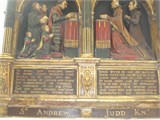
Sir Andrew Judde died in 1558 and was survived by his third wife, Mary, four sons and two daughters. He is buried in St. Helen’s Church on Bishopsgate in London, and a memorial there, thought to be commissioned by his heirs in about 1600, describes some aspects of his life. It is not thought to be very accurate since, because of his public duties, he never visited Russia and Guinea himself, though he was closely involved in the finance and organisation of expeditions there. The epitaph reads:
TO RVSSIA AND MVSCOVA / TO SPAYNE GYNNY WITHOVT FAYLE / TRAVELD HE BY LAND AND SEA / BOTHE MAYRE OF LONDON AND STAPLE / THE COMMONWELTHE HE NORISHED / SO WORTHELIE IN ALL HIS DAIES / THAT ECH STATE FULL WELL HIM LOVED / TO HIS PERPETVAL PRAYES
THREE WYVES HE HAD ONE WAS MARY / FOWER SUNES ONE MAYDE HAD HE BY HER / ANNYS HAD NONE BY HIM TRVLY / BY DAME MARY HAD ONE DOWGHTER / THVS IN THE MONTH OF SEPTEMBER / A THOWSANDE FYVE HVNDRED FYFTEY / AND EYGHT, DIED THIS WORTHIE STAPLAR / WORSHIPYNGE HIS POSTERYTYE
In addition to the Judd School, and Judd House at Tonbridge School, Sir Andrew’s name is commemorated by Judd Road in Tonbridge and Judd Street on what is now the Skinners’ Company Estate in St. Pancras.
Copies of An Essay on the Life of Sir Andrew Judde (1849) by George Maberley Smith and Sir Andrew Judde (1953) by H. S. Vere Hodge are in the Local Studies Collection at Tonbridge Reference Library.
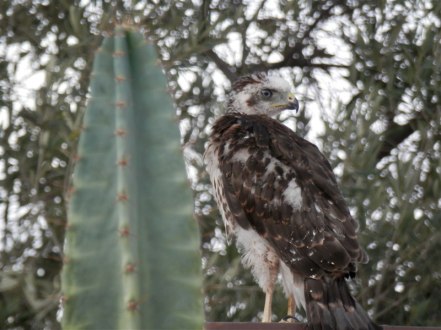
Coopers Hawk Fledgling
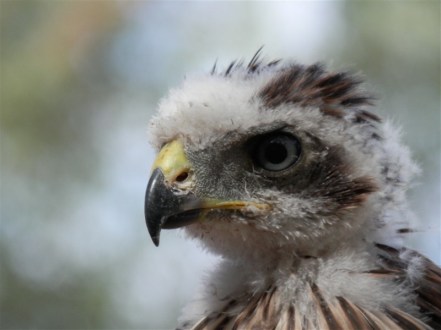
I live in the middle of Tucson like Gabrielle Giffords. She lives somewhere just south of my neighborhood in a much fancier part of town. On the anniversary of her shooting two years ago, today there are ceremonies to ring bells, hang bells, pray, and commemorate. Tucson seems to me less peaceful, less educated, more reactionary, and more dangerous than it was two years ago. The city creates PR about how we have come together as more civil and less crazed, less armed, less scary…as IF!!!!!!
Where I live the cops do not respond for at least an hour and then they do not bother to even report the crimes you report to them. Nobody calls them because nobody wants to wait around for no reason. The gun store close to my house has had an overflowing parking lot for the last month. My next door neighbor who goes to the shooting range with a bunch of cops on Sundays told me their highly armed group is freaking out because there is no ammo in town to be purchased. They know that the government is a threat to their freedom, and want to buy all the ammo they may need to defend themselves against the government when they try to take their arms.
While commemoration is all well and good, there are plenty of mentally ill people roaming the streets where I live with instant access to weapons. Unfortunately, they have no access to or interest in mental health therapies. There are no cracks to slip through because there is virtually no safety net to treat mentally ill Tucsonans. There is a place where they can score prescription drugs, but no therapy. There is no evidence of effective law enforcement. If Gabby stayed in my neighborhood for a few days she would understand how futile law passing is. With all due respect to her point of view, nobody enforces the laws we have now. Why would adding more laws have a positive effect? I notice a frightening negative effect in the ammo buying population, all agitated and wanting more arms. Every action has an equal and opposite reaction. It bears repeating, gentle reader.

New Year’s Eve

uplight
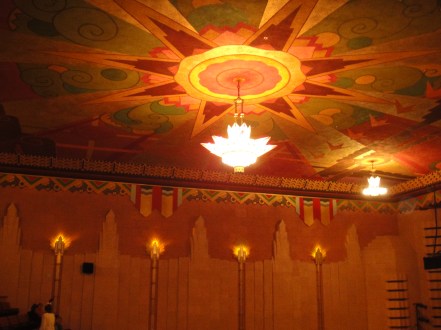
Fox Theater downtown Tucson
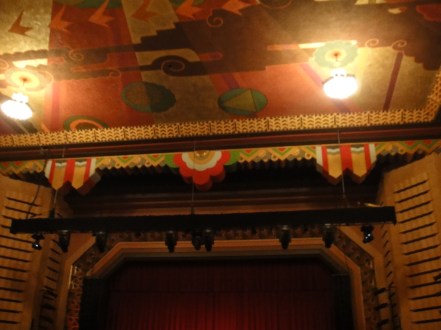
stage

Bob takes a call

before the show

lighting fixture at Fox
I had not been in the Fox Theater since the 1970’s when I used to pay $1 to stay all afternoon and watch Woody Allen movies in air conditioned comfort. Downtown Tucson has had a bit of a slow start and restart to our urban renewal concept known as Rio Nuevo. I seriously thought about moving downtown, but did not think it would ever come around to a desirable state. There are still issues, but I am very pleased with what is happening now. We went to a Paula Poundstone show on New Year’s Eve at the historic theater. It was a great comedy concert, but we really enjoyed the design and the atmosphere of the building. We were able to find a cab to take us home, which has been a problem on outings to downtown in the past. Eventually we will have a tram to take us to the restaurants and entertainment venues that are starting to appear. I have high hopes that ten years from now I will be able to hop on the bus in front of my home, connect to the tram to go enjoy the vibrant downtown Tucson deserves. I certainly hope so.
 mermaidcamp