mermaidcamp
Keeping current in wellness, in and out of the water
You can scroll the shelf using ← and → keys
You can scroll the shelf using ← and → keys

My Ethnicity Map
REGIONAPPROXIMATE AMOUNT
Europe 99%
Great Britain 85%
Europe West 6%
Trace Regions 8%
West Asia < 1%
Trace Regions < 1%
I have studied my ancestry since 2008, and have made much progress. There are several dead ends that seem kind of hopeless. My maternal grandmother was an orphan who was adopted right after the Civil War in Mississippi in a county where the courthouse burned to the ground with all the records. I know who her adopted parents were, and that she had a brother named Fidel who was adopted by the same family. My paternal 2nd great-grandfather was part of a Swiss/Pennsylvania Dutch family. I know who his nephew was because I have written notes form my own great-grandmother. I can trace his nephew back to Virginia, and then to Switzerland, but I can find no record of his birth. I have not found his parents out of all the Petersons scattered all over the Midwest. I hold a grudge against the state of Indiana for this oversight/problem, because that was the state of his birth. I desperately want to hook up the data, but can’t find the hard evidence to do so.
The big problem with records of all kinds is that they were created by human beings. There are errors for all kinds of reasons. Since all these cases are extremely cold I have no way to verify anything I might find in writing beyond a shadow of a doubt. I have made errors because of common names like Taylor, Smith and Morse in my tree that can easily be mistaken for another person with the same last name. Still, I do learn a lot about the history of the times even when I am proceeding along an erroneous lead. When I find errors sometimes I can rebuild with accurate data easily, but often I am back to square one without a clue.
I sent my DNA sample to Ancestry.com when the service was first available. With few folks in the study my DNA was described as 99.9% from the British Isles. Now the a few years have passed and more comparison DNA has been added I am only 85% from Britain. I have not paid too much attention to this data, only checking in infrequently. The impressive part of this data is that I now have 540 4th cousins or closer in the site’s database. I have started looking at this as a new way to trace the connections because I was recently contacted by an adopted man looking for his birth parents. His closest DNA match is a 2nd cousin of mine. He and I do not show any match, but male DNA, containing the y chromosome, has more detailed information, as I have recently discovered. I began to research more about how these tests work and what we can discern from them. My relative in search of his roots informed me that a match can go back for up to 12 generations. Finally all my research may be useful to solve this adopted man’s mystery. He has turned my attention to this fascinating element of genealogy research that I had not really used. I don’t think I will solve my brick walls (as we call the dead ends in family trees), but it does give me a new way to discover my connections to all my relations. I am grateful all these 540 people felt curious enough to send in DNA samples for our mutual benefit. Have you examined your DNA, gentle reader? Any surprises?

Ranching
I have a solid memory of the morning of September 11, 2001. My father called me on the phone and told me the Pentagon had just been hit. I said “It’s just a Pentagon.” Then I turned on the TV news, and to my horror, learned about the tragic events that had taken place while I was rocking and rolling around my house, blissfully unaware. Those of us who were alive when JFK was shot all had a spooky feeling that this terror was all connected. The axis of evil had landed on our shores, and nothing would ever be the same. We lost our innocence, and many of us also lost our minds.
The first responders, and their sacrifices, came into focus like never before in modern history. The risks and the losses they take every day started to hit home in the hearts and minds of American citizens. Many folks joined the military because they felt the need to do something to protect our country. We got a Department of Homeland Security and the borders started getting way tighter. I was well aware of the border phenomena because I was working as a wetback gringa in Mexico at the time. Suddenly the Tecate border crossing, which had always been almost a joke border, became very strict. This clogged up the traffic, which would back up for blocks in Tecate, BC, waiting to cross. There were people who would wait in the line for you for a fee, and those people had all the work they wanted. Since I was a guest instructor, spending only a couple of weeks at time down there, the border issue really put a wet blanket on my commute. I had to drive 6 hours from Tucson, which I had accepted. I just could not handle waiting an hour in bumper to bumper traffic while waiting to leave the country. I determined after a couple of years that Mexico, lindo y querido, was no longer fun for me. I have not crossed the border since 2003. I have not seen the border wall, and I may never see it.
Things changed for the worse in Mexico because all kinds of people who had walked to the border from Guatemala, Chiapas, or Nicaragua were stuck. They had few options. The criminal element suddenly had a huge influx of desperate people to employ, a boon to smuggling and anything else they cared to do. They probably started digging new tunnels all over the place with their new source of labor. Our tiny town of TKT (the local way to spell Tecate) went from safe to wildly violent overnight. One of my Mexican colleagues came in to work all freaked out because she had discovered her boyfriend, chopped up in the trunk of a car. We went from zero to chopped up in the trunk of a car in no time. It was no longer safe for me to ride the public bus to Tijuana, use the route taxis to go to to the beach , or generally live it up in borderlandia. The party was over, but it had been very good while it lasted.
Now we mark the date with remembrance of the solemn occasion. I am afraid that the meaning is being lost. People are using it to sell merchandise, which really offends me. We all lost something on that day. I lost a country and a culture that I loved dearly. I mean Mexico when I say that, but in many ways my own country endured a cultural change from which we will not recover. What did you personally lose, gentle reader?
Loss of dignity at the mattress store

Lower Surry Church
Lawnes Creek Parish Church was the first church erected on Hogg Island in 1628 for the citizens of James City County who lived on the south side of the James River. Surry formed from James City County and the first parish for the area now encompassed by Surry County was known as “Lawnes Creek.”
The parish church members would have been buried at their place of worship as was the custom in those days.
This site is now occupied by the Surry Nuclear Plant.
No access permitted.
LAWNES CREEK PLANTATION, Rts 650 & 628
The peninsula of land about 2 miles in width and 8 in length between Lower Chippoakes Creek and Lawnes Creek and south of Hog Island, was, together with the lands adjoining upper Chippoakes Creek and opposite Jamestown, the first to be settled in Surry away from the James River. Virtually all this land had been patented before 1635, mainly by William Spencer, Captain William Pierce, Roger Delke, and Captain Lawrence Baker.
My 8th great-grandfather, John Holt was born in 1664 in Surry County, Virginia, a British colony. He died in 1705 Surry County, Virginia, hung by his own hand. His 8th great-grandson, George Harvey Taylor, committed the same “Felonious homicide of a man’s self” by drinking carbolic acid in 1941. George Harvey was my maternal grandfather. It is said that suicide reoccurs in families.
He was listed in the 1687 Cavalry of Surrey County, Virginia. John M. Holt was born in 1664 in Lawnes Creek Parish, Hog Island, Surry County, VA. John died 1705 at the age of 41 in Surry County, VA. John Holt committed suicide.
On Feb 24, 1685 Mr. John Holt and his wife were fined for not going to church by the Surry County Court. (This may have been rather harsh as she most probably was pregnant.)
In 1703 he petitioned the Legislature to be Keeper of the Ferry settled on James River to Archer’s Hope Creek on the north side. Appears on the 1704 Rent Roll for Surry County, VA On November of 1706 the Surry County Court Records state that “John Holt upon his petition is admitted to keep a ferry in Hog Island pursuant to a Law made to that purpose and for his better compliance therewith ordered that he forthwith provide and maintain one substantial flat bottom boat of at least fifteen feet by the keel for carrying over of horses as also one other boat of at least twelve or thirteen feet by keel for passengers with three able men constantly to attend the said service ant that he enter into a bond with good and sufficient security duly to perform the same. In May of 1710 John Holt petitioned the Court and they “exempted him from payment from his bond for keeping a ferry at Hog Island. (Surry County, Virginia Court Records, 1707-1711, Book VI
By 1704 the Holt family would own 2,768 acres in Surry County. Of this, 1,450 acres were controlled by Elizabeth Holt, wife of Randall Holt, Jr.. The remainder was owned by the sons of Randall and Elizabeth..
John Holt (1664 – 1705)
8th great-grandfather
David Holt (1685 – 1749)
son of John Holt
Sarah Holt (1740 – 1792)
daughter of David Holt
James Truly (1755 – 1816)
son of Sarah Holt
Elizabeth Betsy Truly (1782 – 1851)
daughter of James Truly
Minerva Truly Darden (1806 – 1837)
daughter of Elizabeth Betsy Truly
Sarah E Hughes (1829 – 1911)
daughter of Minerva Truly Darden
Lucinda Jane Armer (1847 – 1939)
daughter of Sarah E Hughes
George Harvey Taylor (1884 – 1941)
son of Lucinda Jane Armer
Ruby Lee Taylor (1922 – 2008)
daughter of George Harvey Taylor
Pamela Morse
I am the daughter of Ruby Lee Taylor
By 22 September 1705 John Holt “laid violent hands upon himself”
Suicide was against the law. Without regard to the rights of the heirs, the estate and property of the perpetrator reverted back to the crown. Govenor of Virginia Colony was Edward Nott decribes John as a man “who being under some indisposition of mind lately hanged himself…troubled with lunacy and distraction of mind.”
John’s eldest son David, had already received a substantial land grant from his grandfather David Crafford prior to David’s twenty-first birthday. John’s sons John Jr., Charles, Benjamin, and Joseph attended the hearing. The deposition of the court read in part: “Having labor’ d long under a very great Indisposition of Mind, and at last layd violent hands upon himself”, a coroner’s jury found that his estate was forfeited as “Felo de Se.” {Latin for “Felonious homicide of a man’s self”}
Governor Edward Nott appealed to the Crown for the family. He inventoried the estate at: 159I, 16s, 6d, and “his Five Surviving Children are fit Objects of Our Mercy and Compassion.”.
Queen Anne commanded the restoration of his estate to them on 7 Jan. 1706. “the said estate consisting chiefly in cattle proper for plantations and other perishable good is hereby to be restored to his five children John, David, Charles, Joseph and Benjamin. ibid, p.512.”
Source: I want to Especially THANK Charles Lindley Holt for sending me his research on this Virginia Colony HOLT family. THANK YOU. I used his dates and many of his ” ” ‘s.
Also:: Familysearch had some of this “(taken from the book “Adventurers of Purse and Person”.}” .
On Labor Day in Brooklyn every year there is a street carnival to mimic the Carnival in Trinidad which held the week before Lent. It is a chance for the West Indians living in New York to celebrate together with traditional costumes and musical competitions. In Port of Spain the best steel drum bands bring it to Panorama in the Grand Savannah. In Brooklyn the steel bands are small, but many of the really popular pan virtuosos move to New York to further their careers in music. The performers who are paid to entertain at the Brooklyn Museum are the same ones who appear on the big stage in Trinidad.
I attended the Brooklyn Carnival in September of 1989 when Dinkins was running for mayor against Ed Koch. At that time New York City was a big, fat, violent mess. The racial tension was palpable. The murder of a teenager in Bensonhurst, Brooklyn turned New York into a symbol of racial hatred and violence. The Koch/Dinkins race was perceived to be mostly about race. All my friends who lived in Manhattan told me I would get killed if I went to the Carnival just for being white. I already had my tickets to see the Mighty Sparrow and Tambu in a small venue, and I was not at all to be dissuaded.
Two things happened to me that week that were spectacular. There was a show running on Broadway called Black and Blue playing at the sumptuously classy Minscoff Theater. It was sold out, but I decided to go down to the box office right before a matinee and try my luck for a standing room only spot. The box office had nothing to sell me. A lady from group of extremely well dressed black people approached me and asked if I wanted a free ticket because their friend had cancelled. I offered to pay but she refused. I then proceeded to watch the show in a very good seat, way down front, right smack in the center of my new best friends. I was underdressed to be with them, but they did not seem to mind. I thanked them profusely, but we all had this feeling we were doing something kind of symbolic (because we were). I accepted the rare generosity and they bestowed it on me as some kind of show of racial solidarity. It was very cool.
I then felt completely confident to ignore my wimpy Manhattan friends who thought it was dangerous to go to a show at the Brooklyn Museum. I saw great musicians, had a wonderful time with my fellow concert goers, and then the most magical thing happened. The Mighty Sparrow, the undisputed king of Trinidad Carnival off all time, stepped down from the stage into the crowd in his Congo Man costume. He had just performed the song, and since the crowd was so tiny compared to Port of Spain, where he would have been mauled by fans, he personally mingled with the audience. I was hugged by the Mighty Sparrow in his Congo Man costume. Very few people can say that. I treasure the experience forever.
This year shootings erupted at the J’Ouvert parade and celebration. This warm up event is a costumed street parade leading up to the more formal Fat Tuesday costume balls and floats. It happens before dawn on Carnival Monday in Port of Spain. The costumes are anything but fancy, because celebrates the dark, sinful side of life before Lent takes over the calendar. It is time to blow it all out before 6 weeks of some kind of penance. The mas players who want to do it all start on Monday, then sleep very little between that opening party and Tuesday at midnight when it ends abruptly. The political significance is huge because it was the time slaves and European masters exchanged places in a symbolic way. This is where the very sarcastic and political practice of calypso was started. Brooklyn is now one of the places on earth that still has this culture.

Beatrice de Savoy Countess de Provence (1205 – 1267)
23rd great-grandmother
She was born as the second child of Thomas I and Beatrice de Geneve. She married Raimond Berenger de Provence in 1219. After two miscarriages she bore him a son and four daughters. Her son died young. The two elder daughters were married to reigning kings while the husbands of the younger two later rose to that rank. She was buried at the chapel in the Chateau de Menuet near Les Échelles. Her mausoleum was desecrated during the revolution and only her skull could be saved. It was deposited in her brother Bonifaces grave.
Beatrice of Savoy was Countess of Provence from December 1220 – 19 August 1245
Her spouse was Ramon Berenguer IV, Count of Provence. Their children were:
Margaret, Queen of France
Eleanor, Queen of England
Sanchia, Queen of Germany
Beatrice, Queen of Sicily
Raymond of Provence
She was from the House of Savoy (by birth) and House of Aragon (by marriage)
Beatrice of Savoy was the daughter of Thomas I of Savoy and Margaret of Geneva. She was Countess consort of Provence by her marriage to Ramon Berenguer IV, Count of Provence.
Her paternal grandparents were Humbert III, Count of Savoy, and Beatrice of Viennois. Her maternal grandparents were William I, Count of Geneva and Beatrice de Faucigny. Beatrice of Savoy’s mother, Margaret was betrothed to Philip II of France. While Margaret was travelling to France for her wedding, she was captured by Beatrice’s father, Thomas. He took her back to Savoy and married her himself. Thomas’ excuse was that Philip II was already married, which was true.
Beatrice was the tenth of fourteen children born to her parents. Her siblings included: Amadeus IV, Count of Savoy; Thomas II of Piedmont; Peter II, Count of Savoy; Philip I, Count of Savoy; Boniface of Savoy, Archbishop of Canterbury; Avita the Countess of Devon; and Margherita of Savoy wife of Hartmann I of Kyburg.
Beatrice betrothed on 5 June 1219 to Ramon Berenguer IV, Count of Provence; they married in December 1220. She was a shrewd and politically astute woman, whose beauty was likened to that of a second Niobe by Matthew Paris. Ramon and Beatrice of Savoy had four daughters, who all lived to adulthood, and married kings. Their only son, Raymond died in early infancy.[2]
Margaret, Queen of France (1221–1295), wife of Louis IX of France
Eleanor, Queen of England (1223–1291), wife of Henry III of England
Sanchia, Queen of Germany (1228–1261), wife of Richard, Earl of Cornwall
Beatrice, Queen of Sicily (1231–1267), wife of Charles I of Sicily
Raymond of Provence, died young
At the English court[edit]
In 1242, Beatrice’s brother Peter was sent to Provence by Henry III to negotiate the marriage of Sanchia to Richard. Another brother, Philip, escorted Beatrice and Sanchia to the English court in Gascony, arriving in May 1243. There they joined Henry, Eleanor, and their baby, Beatrice of England. Henry was very happy at this occasion and gave many gifts to the various relatives.
In November 1243, Beatrice and Sanchia travelled to England for the wedding. This wedding did much to strengthen the bond between Richard and Henry III. She further strengthened the unity of the English royal family by convincing Henry III to help pay the debts of his sister Eleanor and her husband Simon de Montfort, who had often been at odds with Henry.[5] In January 1244, Beatrice negotiated a loan for her husband from Henry of four thousand marks, offering the king five Provençal castles as collateral.
When Ramon Berenguer died on 19 August 1245, he left Provence to his youngest daughter, and his widow was granted the usufruct of the county of Provence for her lifetime. Beatrice’s daughter and namesake then became one of the most attractive heiresses in medieval Europe. Frederick II, Holy Roman Emperor sent a fleet and James I of Aragonsent an army to seize her, so Beatrice placed herself and her daughter in a safe fortress in Aix, secured the trust of its people then sent to the Pope for his protection. The Pope was also a target for Frederick’s military incursions in France. In Cluny during December 1245, a secret discussion, between Pope Innocent IV, Louis IX of France, his mother Blanche of Castile, and his brother Charles of Anjou, took place. It was decided that in return for Louis IX supporting the Pope militarily, the Pope would allow Charles of Anjou, youngest brother to the French King, to marry Beatrice of Provence. Mother and daughter were satisfied with this selection.[7] But Provence was to never go to France outright through Charles. It was agreed that if Charles and Beatrice had children, the county would go to them; if there was no issue, then the county would go to Sanchia of Provence. If Sanchia died without an heir, Provence would go to the King of Aragon.
Henry protested the selection, arguing that he had not yet received the full dowry for Eleanor nor his brother for Sanchia. He also still had the castles in Provence against the loan he had made to the former count.
When Charles took over the administration of Provence in 1246, he did not respect Beatrice’s rights within the county. She sought the aid of Barral of Baux and the Pope in protecting her rights within the area. The citizens of Marseille,Avignon, and Arles joined this resistance to Capetian control. In 1248, Charles began to seek peace with her so that he could join his brother’s crusade. A temporary truce was reached to allow this.
In 1248, she travelled back to England with her brother Thomas, to see their family there.
In 1254, as Louis was returning from his crusade by way of Provence, Beatrice petitioned him for a more permanent resolution of the dispute with Charles. The French queen Margaret joined the petition, noting that Charles had not respected her dowry either. Beatrice travelled with them back to Paris. As the year progressed, Henry and his wife were invited to travel to Paris, and eventually all four daughters joined their mother there for Christmas.[11]
The generally good relationship among the four sisters did much to improve the relationship of the French and English kings. It brought about the Treaty of Paris in 1259, where differences were resolved.[12] Beatrice and all her four daughters participated in the talks.[13] While the family was still gathered, Louis IX finally persuaded Beatrice to surrender her claims and control in Provence in exchange for a sizable pension to be paid to her. Charles also paid back the loan henry had made to the previous count, clearing his claims in the county.[14]
In 1262, Beatrice was part of the family discussion to try again to bring peace between Henry and Simon de Montfort. When Henry was captured in 1264, Beatrice’s brother Peter II, Count of Savoy took his army to join the efforts to free the king. He left Beatrice in charge of Savoy while he was gone.
Beatrice outlived her third daughter Sanchia and came close to outliving her youngest daughter Beatrice, who died months after her mother (Beatrice the elder died in January, Beatrice the younger died in September). Beatrice of Savoy died on 4 January 1267.
Beatrice de Savoy Countess de Provence (1205 – 1267)
23rd great-grandmother
Eleanor Berenger (1223 – 1291)
daughter of Beatrice 1205 de SavoyCountess de Provence
Edward I “the Longshanks” Plantagenet (1239 – 1307)
son of Eleanor Berenger
Elizabeth of Rhuddlan Princess of England Plantagenet (1282 – 1316)
daughter of Edward I “the Longshanks” Plantagenet
William Earl of Northampton De Bohun (1312 – 1360)
son of Elizabeth of Rhuddlan Princess of England Plantagenet
Lady Elizabeth Countess Arundel Countess DeBohun (1350 – 1385)
daughter of William Earl of Northampton De Bohun
Elizabeth Duchess Norfolk Fitzalan (1366 – 1425)
daughter of Lady Elizabeth Countess Arundel Countess DeBohun
Lady Joan De Goushill Baroness Stanley (1402 – 1459)
daughter of Elizabeth Duchess Norfolk Fitzalan
Countess Elizabeth Sefton Stanley (1429 – 1459)
daughter of Lady Joan De Goushill Baroness Stanley
Thomas Sir 8th Earl of Sefton Molyneux (1445 – 1483)
son of Countess Elizabeth Sefton Stanley
Lawrence Castellan of Liverpool Mollenaux (1490 – 1550)
son of Thomas Sir 8th Earl of Sefton Molyneux
John Mollenax (1542 – 1583)
son of Lawrence Castellan of Liverpool Mollenaux
Mary Mollenax (1559 – 1598)
daughter of John Mollenax
Gabriell Francis Holland (1596 – 1660)
son of Mary Mollenax
John Holland (1628 – 1710)
son of Gabriell Francis Holland
Mary Elizabeth Holland (1620 – 1681)
daughter of John Holland
Richard Dearden (1645 – 1747)
son of Mary Elizabeth Holland
George Dearden (1705 – 1749)
son of Richard Dearden
George Darden (1734 – 1807)
son of George Dearden
David Darden (1770 – 1820)
son of George Darden
Minerva Truly Darden (1806 – 1837)
daughter of David Darden
Sarah E Hughes (1829 – 1911)
daughter of Minerva Truly Darden
Lucinda Jane Armer (1847 – 1939)
daughter of Sarah E Hughes
George Harvey Taylor (1884 – 1941)
son of Lucinda Jane Armer
Ruby Lee Taylor (1922 – 2008)
daughter of George Harvey Taylor
Pamela Morse
I am the daughter of Ruby Lee Taylor
Dangerous
I was born in the year of the tiger. I did not discover this until I was middle aged. I only knew what I had read on the Chinese restaurant place mats. The problem with those place mats is the use of western years to measure Chinese years. Chinese new year falls any time between January and February, so it does not coincide with our calendar. I thought I was a rabbit based on this misinformation. I never really felt like a rabbit, so when I discovered the error I was somewhat relieved. If your birthday falls in December, January, or February you might want to check your animal sign for accuracy.
The reason it is pertinent is that a very large number of people on earth use this system to make decisions. You might not personally put any stock into Feng Shui or Daoist anything, but since such a large part of the world’s population does, I find it interesting. Big bucks are invested in Feng Shui for commercial buildings in Hong Kong, one of our big financial centers. There is a grand tradition and belief in this system. I don’t really make decisions with it, but do like to study the details. I feel the same way about western astrology. It is more than superstition because it has a long history and a following. I like learning about the way the ancients thought. They thought a lot about the stars, the moon and the sun. Farmers’ Almanac confirms that there is still some thought devoted to the positions of the astral bodies. I take note of special events in the sky, like today’s eclipse, as a matter of curiosity.
Curiosity may have killed some cats, but I feel I still have a few lives left to devote to everything that sets off my curious streak. In western astrology I am an Aquarius, a sign known for being aloof. Tigers are naturally aloof except when we need to kill and eat. Both of these signs are known as free (perhaps rebellious) spirits. Both are territorial and will defend the group that surrounds them. Both can act very swiftly without warning in order to protect the homeland. Both are perfectly happy being solitary, and don’t really care what others think. Both appear calm and reserved while being perfectly capable of pouncing on dishonorable players. Neither is motivated by power or money. Bravery and unpredictability is our stock in trade.
I am a metal tiger, highly conductive and sharp. I am a walking razor. Don’t you watch my size. I am dangerous!!!!!!!!! Don’t pull my tail.
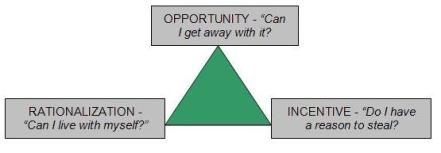
Fraud Triangle
There is an ethical ladder that ascends to the highest moral code. As children we should be taught how to climb that ladder by example. Unfortunately many children are witnesses to adult misbehavior that leads them to cling to a low rung on the ladder. As we go through life we respond to situations according to our ethical code. There is a sliding scale for moral fortitude, depending on the difficulty of the stand, or the popular opposition to the truth. It is obviously easier to go along with the crowd no matter what they do. People who stay down at that level just want to not make waves. They do not consider how they contribute to the morality of the entire world.
At the bottom of the ethical stairway is only one consideration:
If we mature we start to realize there could be more:
As educated adults participating in a community we may start to notice:
On which rung do you live most of your life, gentle reader? I encourage you to take the highest ground possible, not just for yourself, but for the entire world.

Compromise Triangle

Burial:
St Mary Churchyard
Warwick
Warwick District
Warwickshire, England

Sir Thomas in his grave

Sir Thomas and Lady Katherine
My 19th great-grandfather was born in Warwick Castle in Warwickshire, England Feb. 14, 1313. He was the 11th Earl of Warwick. He died of the plague on Nov. 13, 1369 in Calais, Departement du Pas-de-Calais, Nord-Pas-de-Calais, France
He was English nobility. He was one of the Founder Knights of the Order of the Garter in 1348. He was related to the Kings of England and held many offices under them including: Hereditary Chamberlain of the Exchequer, Hereditary Sheriff of Worcestershire, Warden of the Scottish Marches, Marshall of England, and Sheriff of Warwick and Leicester counties. He was known for his military prowess and fought in many battles: in Scotland, in France in command at Valenciennes, and with the King at Tournai, at the Battles of Crecy and seige of Calais, and in Lithuania as a crusader from 1362 to 1365. He married Katherine de Mortimer after a dispensation was granted for being related in the 3rd degree ,after February 22 1324. They had fifteen children, including Thomas, Knight, Knight of the Garter and his successor as Earl of Warwick. He died testate of the plague at Calais, France. (bio by: Michael Schwing) from Find a Grave
Thomas DeBeauchamp (1314 – 1369)
19th great-grandfather
WILLIAM BEAUCHAMP (1358 – 1411)
son of Thomas DeBeauchamp
Joan Elizabeth Beauchamp (1396 – 1430)
daughter of WILLIAM BEAUCHAMP
Elizabeth Butler (1420 – 1473)
daughter of Joan Elizabeth Beauchamp
Isabel Talbot (1444 – 1531)
daughter of Elizabeth Butler
Sir Richard Ashton (1460 – 1549)
son of Isabel Talbot
Sir Christopher Ashton (1493 – 1519)
son of Sir Richard Ashton
Lady Elizabeth Ashton (1524 – 1588)
daughter of Sir Christopher Ashton
Capt Roger Dudley (1535 – 1585)
son of Lady Elizabeth Ashton
Gov Thomas Dudley (1576 – 1653)
son of Capt Roger Dudley
Anne Dudley (1612 – 1672)
daughter of Gov Thomas Dudley
John Bradstreet (1652 – 1718)
son of Anne Dudley
Mercy Bradstreet (1689 – 1725)
daughter of John Bradstreet
Caleb Hazen (1720 – 1777)
son of Mercy Bradstreet
Mercy Hazen (1747 – 1819)
daughter of Caleb Hazen
Martha Mead (1784 – 1860)
daughter of Mercy Hazen
Abner Morse (1808 – 1838)
son of Martha Mead
Daniel Rowland Morse (1838 – 1910)
son of Abner Morse
Jason A Morse (1862 – 1932)
son of Daniel Rowland Morse
Ernest Abner Morse (1890 – 1965)
son of Jason A Morse
Richard Arden Morse (1920 – 2004)
son of Ernest Abner Morse
Pamela Morse
I am the daughter of Richard Arden Morse

Warwick Castle
Deal with the negative people you encounter
 “You cannot have a positive life and a negative mind.” ~Joyce Meyer
1. Recognize and accept their toxicity
First and foremost, it is important to identify and accept that someone we know is a negative person. This can be difficult, especially when the person is someone we care about. Either way, we must be careful not to allow their negativity to transfer onto us. We need to accept that negativity is toxic and will only breed more negativity. It is especially important to avoid complainers. People who complain have given up hope that their actions can make any difference. We must be careful not to enable complainers by always listening to their woes.
2. Stop playing savior and/or problem solver
As human beings, we are wired to connect. For most of us, it is in our nature to lend a compassionate ear to someone who is in need. We must be careful not to let ourselves fall into the…
View original post 319 more words

 mermaidcamp