mermaidcamp
Keeping current in wellness, in and out of the water
You can scroll the shelf using ← and → keys
You can scroll the shelf using ← and → keys

painting

fall flora in Tucson

fall flora in Tucson
Although I see some of you around the inter webs I have not taken the time to sit down and share coffee and life events with the group for a long time. I follow with interest your writing projects and day to day issues because although we are scattered around the globe, we have much in common. If you read and write as a primary source of pleasure and value, this coffee share is for you. The diversity of nationality and interests makes this the perfect place to just chat about this and that.
Fall is finally arriving at a snail’s pace in Baja Arizona. I have been writing about a serious crime problem we have had with the city government in Tucson for years. I think after almost a decade we will finally get a little rule of law in the neighborhood where I live. It has been a ridiculous struggle to communicate with all departments of this highly convoluted system. You never know how crazy it all is until you try to make it perform for the benefit of the community. I started writing blog posts about our predicament in 2013, never thinking I was creating an e book about government dysfunction. I thought that as soon as I presented the facts the problem would be solved by our paid public servants. This turned out to be a serious joke. Not only did all the departments refuse to perform in their respective jurisdictions, they refused to respond when citizens petitioned and pleaded for law enforcement services. I was dragged into the vortex of government dysfunction, to my horror. There was no bottom to this high speed waste of public funds and energy.
I wrote a post every few months and sent them all to the officials I hoped to make aware of our dire straights. This practice continues until today because every department has refused to address the crime problems we have reported to them. Without an hero I could never end the book or get any help to end obvious crime in my neighborhood. I searched high and wide for a hero for ages, finally finding one at the police department. This is very fitting since we have been plagued with crime and willful blindness to it courtesy of the inaction and or refusal to respond by the police department. We actually had a fake neighborhood watch to promote crime and willful blindness, funded by taxpayers. The damage done was, and continues to be, significant to property value as well as quality of life. It tuns out that once you set a precedent of non compliance and willful blindness it is very hard to change the direction. It continues to drag the community down until it is reformed.
There were two working titles before I settled on the current, and very apt one. The first few years the book was named after the neighborhood watch cop who supported charity scamming in the fire lane of our condo village. I called the work in progress “Dirty Becky”. Then Tucson elected a mayor who is a lawyer. Neighbors got all excited and petitioned this lawyer mayor to stop the 24 hour donation drop off inviting the general public to drive through our condo village to “donate” or volunteer to handle food for a charity scam. He never responded to us, even after we petitioned two years in a row. He told some cops to just stonewall us, and all the crime continued full speed ahead. Naturally with all this official help the scam stayed in business and completely trashed our hood as well as our respect for law enforcement. The working title changed to “The Emperor’s New Neighborhood Watch” to indicate that the lawyer mayor still had no idea the neighborhood watch was working hard to promote crime in the hood.
I have, after all these years, and all this inability to find a government agency that functions for our benefit, created a third and final title for my e book. It is “Clulusion, The Sinister Fusion of Cluelessness and Colusion in Government.” I do think the title perfectly evokes the spirit of the book I never wanted to write. Now all I need is a denouement. The hero will need to move mountains because changing the government is a gigantic task. When I am able to put this one in the can I think I can write an e book on purpose. Have you ever written an e book, gentle reader?
If you care to join the weekend coffee share party, share your link here.
For this weekend, reflect and carefully select the new habits and practices you wish to make permanent in your life.
Moon in Pisces, laboratory process of Projection – emotionally instinctive
If you find an affinity for any of these statements it’s good to know what’s ‘in the air’.
A good time to: scrutinize and reinforce your gut feelings about things you want to stick with.
Challenges: Feeling that your amount of determination is a bit troublesome.
Balance: Just be attentive to what you know is right and remember to breath.
Sidereal astrology, from an individual viewpoint.
Keywords:
Sun in Virgo – persistent, analyzing = conscientious
Moon in Pisces – changes, relaxative = emotionally instinctive
Mercury in Leo – mental, organizing = positive
Venus in Virgo – pleasant, analyzing = fastidious
Mars in Scorpio – impulsive, solidifying = explosive
Jupiter in Virgo – fortunate, analyzing = dutiful
Saturn in Scorpio – disruptive, solidifying = purposeful
#alchemyastrology
—–
The author’s ads:
Laboratory Alchemists – plan ahead, purchase…
View original post 41 more words
I subscribe to Hulu for a month at a time, then put the subscription on hold for the maximum time, 90 days. This means it is only in the home 4 months out of the year, which is perfect for us. I binge down on different new shows, and by the end of the month I have seen everything I care to watch. This month I have watched a lot of very well produced series. I have focused on comedy, seeing at least 10 stand up comedy specials. I also found many comedy tv series that make me very happy. My favorite, now that the month is coming to a close, is Selfie. This modern day version of Pygmalion is hysterically updated to show characters typical to our times. This social satire hits all the notes.
Eliza Dooley, the same archetype represented in My Fair Lady by Julie Andrews as Eliza Doolittle, has a modern twist as a self obsessed social media star. The romantic comedy takes a satirical look at workaholics, socialnetworkaholics , and corporate hierarchy. It is set in a children’s pharmaceutical company where Henry Higgins, the British snob, is thinly disguised as Henry Higgins, branding expert. The plot and characters are instantly recognizable, but the story unfolds in ways I could never have imagined. All the parts are extremely well played, but the writers and producers get major credit. This script makes me laugh for every reason, from physical comedy schtick to sophisticated satirical commentary woven into the whole story. Some of the smaller parts are the very best because they have such extreme personalities and dialogue. I will not give away more than that. Just watch it if you can.
The story of Pygmalion comes for the mythology of Greece. It is based on a god who fell in love with one of his own sculptures. In 1748 the story was presented at the prestigious Paris Opera House. This production, written by Jean-Philippe Rameau, was staged as a one act piece. Since that time this story has been told and retold, including the popular musical version with Rex Harrison playing the stuffy and rude Henry. The story has the same punch line every time.
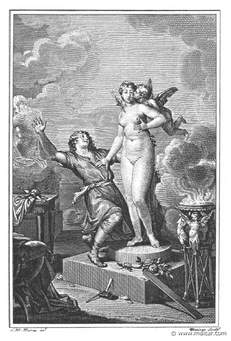
Greek god Pygmalion

Yelverton Family Tree
My 11th great-grandfather lived in England when religion was a dangerous thing. He and his wife were on a list of “popish Recusants” kept by Queen Elizabeth. He was imprisoned for getting caught with Jesuits in his home. He was a graduate of Peterhouse College. His grave lies beneath the pavement of Sandringham Church. Location: Grimstonmanor, Norfolk,England
Edward Yelverton (1559 – 1623)
11th great-grandfather
Elishua Miller Yelverton (1592 – 1688)
daughter of Edward Yelverton
Yelverton Crowell (1621 – 1683)
son of Elishua Miller Yelverton
Elishua Crowell (1643 – 1708)
daughter of Yelverton Crowell
Yelverton Gifford (1676 – 1772)
son of Elishua Crowell
Ann Gifford (1715 – 1795)
daughter of Yelverton Gifford
Frances Congdon (1738 – 1755)
daughter of Ann Gifford
Samuel Thomas Sweet (1765 – 1844)
son of Frances Congdon
Valentine Sweet (1791 – 1858)
son of Samuel Thomas Sweet
Sarah LaVina Sweet (1840 – 1923)
daughter of Valentine Sweet
Jason A Morse (1862 – 1932)
son of Sarah LaVina Sweet
Ernest Abner Morse (1890 – 1965)
son of Jason A Morse
Richard Arden Morse (1920 – 2004)
son of Ernest Abner Morse
Pamela Morse
I am the daughter of Richard Arden Morse
Nazareth was known as the “virtuous and loving wife’ of Edward Yelverton. But she was also known as “an obstinate Recusant” and was listed as a “popish Recusant” which is a yearly list since the beginning of Elizabeth’s reign, and is a list of Catholics who refused to attend the worship of the Established Church, and denied the spiritual supremacy of the cross and were subjected to cruel penalties and fees.
Edward Yelverton, her spouse, was also named on the list of “Popish Recusants in Norforld and Suffolk. He was the son of William Yelverton of Rougham. Edward was born in Rougham and moved to Grim stone Manor, then to Appleton. He also had a small house in Wolferton. His grave lies beneath the pavement of Sandringham Church.
Edward inherited Estates at Grimstone. He received Jesuits there and was imprisoned in 1598.
Edward went to Peterhouse College and received a B.A. 1579-80

His grave lies beneath the pavement of Sandringham Church.
“We could be heroes” today as Sun squares MARS and opposes Chiron in PISCES. this aspect is perfecting this week.
For those of you who do not know what mansplaining is, you may be inadvertently doing it. You may also be a victim of it. Not all mansplaining is done by men, unfortunately. This powerful force in society is spreading like wildfire. The comedy of it is hilarious, but the reality is disconcerting. It plays out in the political campaign, naturally. It also plays out when any woman has interactions with the government. Our government has completely embraced the custom of condescending to citizens who want functional systems. We pay for everything these public “servants” do, but they live in a highly insular world where it is perfectly acceptable to sit around and mansplain to each other. The #squadgoals seem to be ignorance and sexist bliss.
If mansplaining does not work it is usually followed by some gaslighting. This is a practice of indicating that a woman must be out of her mind to be the way she is. This is a more sinister form of mansplain, just more extreme. Here in Tucson I reported the same egregious crimes to the Tucson Police Department for a decade, always being told that the crimes were not crimes at all, but civil matters. I persisted because the crimes seriously effect everyone in my neighborhood. Groups of neighbors, both male and female, petitioned to stop the crimes for years to no avail. The situation had been totally mansplained internally, so we could get no law enforcement help. Finally this year a cop came out in person to mansplain to me why the fake neighborhood watch to promote crime and willful blindness in our neighborhood was serving and protecting us. He informed me that he is the law, as if a person could be the law. When I did not accept this concept he came back the next day to gaslight me with the mental health division of the TPD. After passing my mental exam they just decided to pretend that I did not exist, which after all, is the goal of both mansplaining and gaslighting.
This disastrous plague needs to be exposed as well as eradicated. Everyone’s justice is compromised by this common practice. Have you had experience with mansplaining or gas lighting, gentle reader? Do tell.
family history
My tenth great-grandfather was part of the Great Migration. He moved to Cape Cod in January of 1639. Many Pilgrims who moved out to Cape Cod got in trouble with the Plymouth church. In those days reaching villages on Cape Cod was a long hard journey from Plymouth. Some of my ancestors who lived on Cape Cod became (or already were) Quakers, and some moved to Rhode Island to escape the oppressive Pilgrim Fathers.
On January 7, 1639 the court record refers to the land grant to the first settlers John Crow, Thomas Howes, and Anthony Thacher as “the lands of Mattacheeset, now called Yarmouth”. This is considered the first usage of the name.
“Yarmouth” to represent the new township to the east of Barnstable.
Plymouth Colony: Its History and People 1620-1691 Part One: Chronological Histories Chapter 3: The Founding of Towns (1633-1643) Yarmouth On 7 January 1638/39, the Court of Assistants granted lands at “Mattacheeset, now called Yarmouth” to Mr. Anthony Thatcher, Mr. Thomas Howes, Mr. John Crow, and John Coite “to be enquired of.” Coite might have been the man of that name of Marblehead, but apparently he did not move to Plymouth Colony. Thatcher, Howes, and Crow were proposed [p.66] as freemen of Yarmouth, along with Mr. Marmaduke Mathews, Philip Tabor, William Palmer, Samuel Rider, William Lumpkin, and Thomas Hatch. It was also specifically noted that “Old Worden (dead),” Burnell, Wright, and Wat Deville were “Psons there excepted against,” probably meaning they were not eligible to be given freemen status, and showing that some form of settlement had already been in existence. In fact, on 4 September 1638 the General Court ordered the inhabitants of Sandwich and “Mattacheese or Yarmouth” to build a bridge over the Eel River (which was just a bit south of Plymouth town, and had to be crossed for travel between Plymouth and the Cape). On 5 March 1638/39 William Palmer was authorized by the General Court to be the one at Yarmouth who would exercise inhabitants in arms, and William Chase was elected constable there. It is apparent that earlier the Plymouth Court had granted land at Yarmouth to others also, for on 1 April 1639 it noted that lands at Mattacheese (another confusion of the names, for it should have been Mattacheeset) were granted to persons who should have inhabited there long ago, but did not, and the grantees “are not likely to come to inhabite there in their owne persons, and lest such as are there should receive in unto them unworthy persons, whereof the Court hath lamentable experience …, the Court doth order that onely such of them wch at present are there shall remayne & make use of some lands for their present necessity, but shall not divide any portions of lands there either to themselves or any others
American Genealogical-Biographical Index (AGBI)
John Sr Crowell (1590 – 1673)
10th great-grandfather
Yelverton Crowell (1621 – 1683)
son of John Sr Crowell
Elishua Crowell (1643 – 1708)
daughter of Yelverton Crowell
Yelverton Gifford (1676 – 1772)
son of Elishua Crowell
Ann Gifford (1715 – 1795)
daughter of Yelverton Gifford
Frances Congdon (1738 – 1755)
daughter of Ann Gifford
Samuel Thomas Sweet (1765 – 1844)
son of Frances Congdon
Valentine Sweet (1791 – 1858)
son of Samuel Thomas Sweet
Sarah LaVina Sweet (1840 – 1923)
daughter of Valentine Sweet
Jason A Morse (1862 – 1932)
son of Sarah LaVina Sweet
Ernest Abner Morse (1890 – 1965)
son of Jason A Morse
Richard Arden Morse (1920 – 2004)
son of Ernest Abner Morse
Pamela Morse
I am the daughter of Richard Arden Morse
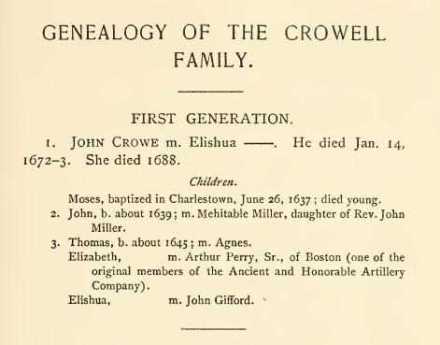
The Crowell family in North Dennis is descended from John Crow, who came, it is said, from Wales in 1635, to Charlestown, where he and his wife, Elishua, joined the church. It is probable that they sojourned there until 1639, when Mr. Crow came with Anthony Thacher and Thomas Howes to Yarmouth, with a grant from the court, having previously taken the oath of allegiance. All the first settlers
selected spots for their homes adjacent to good springs of water. The brook that flows through the village of North Dennis had numerous fine flowing springs to supply the need of the first comers. John Crow built his home north of the center of the present village, near the spot where the late Philip Vincent lived. His land, much of which is still owned by his descendants, was east of Indian Fields, and extended from the shore to the top of the hills back of the settlement. John Crow was a man of character and influence in the infant town of Yarmouth, filling many important offices. He died in 1673. His sons were: John, Samuel and Thomas. John married Mehitable. daughter of Rev. John Miller of Yarmouth. A grandson of John Crow, sr., whose name was John, was the first person buried in the North Dennis cemetery. He died in 1727. The name about that time had developed into Crowell. The offspring of John Crow are now to be found in all parts of the country, occupying important positions, with honor and credit to the name. Those who have remained upon the hereditary acres have produced in every generation men of ability and distinction. The late Hon. Seth Crowell and his cousin, Capt. Prince S. Crowell, and Mr. William Crowell, the well-known cranberry grower and seller, are illustrations of the character of the Crowells in the seventh generation. The family has never been large in North Dennis. Two pews in the old church sufficed to accommodate their needs for sitting room. Many of the family, before the old meeting house was torn down in 1838, had become desciples of John Wesley and left the church of their fathers.
Mr. Jeremiah Crowell, a descendant in the fourth generation from the grantee, John Crow, was for two generations a village celebrity. He lived in what was called “Crow Town,” just outside the western limits of Indian Field. The public highway went no farther east than his house in his day. The county road went through the woods south of Scargo hill. Mr. Crowell constructed a globe with the four quarters of the earth marked upon it. This was received by the Nobscusset children with open-eyed wonder. It was to be seen only, however, upon payment of one cent per head. He had besides a mammoth kite with a string a mile long, with a tail of wondrous length. He kept a daily journal of passing events, such as the capture of a whale, the arrival home of the Cod fishermen, the state of the weather, and the direction of the wind. But his great effort was the building of a pair of wings and attempting to fly. This was an achievement beyond his power to accomplish. The flying he regarded as practical and easy, but the alighting was difficult. He died at an advanced age, about the close of the last century.
I have been an enthusiastic fan of the local social network, Nextdoor, since it launched. I started one for our neighborhood right away, and have worked to increase participation because I believe it has potential to drastically improve communication between neighbors as well as between neighborhoods and law enforcement agencies. We have made a few gains, but I notice recently that many members do not understand how the system works. A neighbor recently asked me where to find instructions to use the site. This inspired me to find this tutorial and create this post with some simple suggestions.
One of the most common misunderstandings seems to be about who can see the posts. Some folks think that because our police department is a member, and does post useful information to the community using the system, they are monitoring Nextdoor full-time. The posts initiated by the police force are visible to the force. All other posts are private from any government agency. There is a private messaging system with which to privately contact any cop who is in the system. Some officers also publish their phone numbers or e-mail addresses. This is not an official channel to report crime. It is a way to dialog about community issues that may include crime. The goal of Nextdoor is to increase engagement, not enter the arena of law enforcement. We already have a police force working very hard on that. Increasing engagement may eventually improve our crime statistics just because more pertinent information is shared.
The calendar and the classified sections are excellent tools to promote events or let neighbors know about services offered. The classified section provides free advertising between local establishments and local residents. The reason to use these special designations is simple. The conversation that is known as a thread or stream will move on with time and be buried by newer posts and conversations. New members will not be likely to search the conversations held in the past. They might, however, check the classified section or the calendar, just as they might in a newspaper. These useful sections are underused where I live. If a member shows interest in an event on the calendar Nextdoor will send an e-mail reminder when the event is soon to occur. There is a new feature I have not used much myself that tags, and recommends businesses that are discussed in the thread.
If you do not have a Nextdoor site in your area, I urge you to start one. It is available as an app for the phone, which most people use now. If you have a site I encourage you to use it to get to know your neighbors. It is free. What is not to like?
 new recommendations feature
Leadership


View original post 542 more words

My Ethnicity Map
REGIONAPPROXIMATE AMOUNT
Europe 99%
Great Britain 85%
Europe West 6%
Trace Regions 8%
West Asia < 1%
Trace Regions < 1%
I have studied my ancestry since 2008, and have made much progress. There are several dead ends that seem kind of hopeless. My maternal grandmother was an orphan who was adopted right after the Civil War in Mississippi in a county where the courthouse burned to the ground with all the records. I know who her adopted parents were, and that she had a brother named Fidel who was adopted by the same family. My paternal 2nd great-grandfather was part of a Swiss/Pennsylvania Dutch family. I know who his nephew was because I have written notes form my own great-grandmother. I can trace his nephew back to Virginia, and then to Switzerland, but I can find no record of his birth. I have not found his parents out of all the Petersons scattered all over the Midwest. I hold a grudge against the state of Indiana for this oversight/problem, because that was the state of his birth. I desperately want to hook up the data, but can’t find the hard evidence to do so.
The big problem with records of all kinds is that they were created by human beings. There are errors for all kinds of reasons. Since all these cases are extremely cold I have no way to verify anything I might find in writing beyond a shadow of a doubt. I have made errors because of common names like Taylor, Smith and Morse in my tree that can easily be mistaken for another person with the same last name. Still, I do learn a lot about the history of the times even when I am proceeding along an erroneous lead. When I find errors sometimes I can rebuild with accurate data easily, but often I am back to square one without a clue.
I sent my DNA sample to Ancestry.com when the service was first available. With few folks in the study my DNA was described as 99.9% from the British Isles. Now the a few years have passed and more comparison DNA has been added I am only 85% from Britain. I have not paid too much attention to this data, only checking in infrequently. The impressive part of this data is that I now have 540 4th cousins or closer in the site’s database. I have started looking at this as a new way to trace the connections because I was recently contacted by an adopted man looking for his birth parents. His closest DNA match is a 2nd cousin of mine. He and I do not show any match, but male DNA, containing the y chromosome, has more detailed information, as I have recently discovered. I began to research more about how these tests work and what we can discern from them. My relative in search of his roots informed me that a match can go back for up to 12 generations. Finally all my research may be useful to solve this adopted man’s mystery. He has turned my attention to this fascinating element of genealogy research that I had not really used. I don’t think I will solve my brick walls (as we call the dead ends in family trees), but it does give me a new way to discover my connections to all my relations. I am grateful all these 540 people felt curious enough to send in DNA samples for our mutual benefit. Have you examined your DNA, gentle reader? Any surprises?


