mermaidcamp
Keeping current in wellness, in and out of the water
You can scroll the shelf using ← and → keys
You can scroll the shelf using ← and → keys

Perkins COA
My 10th great-grandmother was born in England and died in Massachusetts. She sailed to the new world with her parents and settled in Ipswich. She probably met her husband there. They moved to Newbury and then to Amesbury, MA, where they laid down some very litigious history in the records of the courts of that town. It seems her husband was the more litigious of the two, but I am grateful for the records, so we know something about them today.
Elizabeth came to America with her family aboard the Lyon, William Pierce, master on 1 December 1630 for its first trip to the New World. They embarked in Bristol, England and arrived in Nantasket, Suffolk co., MA on 5 February 1631.
The Sargent family were some of the original settlers of the Agawam section of Ipswich, Essex co., MA, with William receiving 12 acres in the 1634 Ipswich Land Grant. The family later moved to Newbury, Essex co., MA; Hampton, Rockingham co., NH; Salisbury, Essex co., MA and finally Amesbury, Essex co., MA. Remember that NH & ME were all part of MA at the time. The family moved from Newbury to Hampton because “…’Willli[am] Sergant’ was amongst the list of petitioners mostly Newbury men who were headed by Stephen Bachiler, who were on 6 September 1638 granted ‘liberty to begin a plantation at Winnacunnet [what is now Hampton, Rockingham co., NH]..” And “Will[iam] Sargent” is listed as one of the married men in the list of first comers to Hampton.
The Sargents found themselves in court over disputes with their neighbors on many occasions. Given the fact that this pattern of contentiousness continued after Eliabeth’s death, I contend that William was the fractious party in the area. On 26 December 1643, William “Sargeant” sued Mr. William Hook of Salisbury for 56s. in corn[67,68]. William acknowledged the court’s judgment in favor of Mr. Jonathan Wade on 26 September 1648. Michael Spencer sued him for detaining corn and other goods on 2 January 1650.
But the biggest battles were reserved for their near neighbors, the Martins. Either William or his namesake son was sued for slander on 13 April 1669, because the Sargent in question had called Martin’s wife “a witch”. The bad blood transcended generations, for Martin later sued William’s son Thomas Sargent “…for saying that his son George Martin was a bastard and that Richard Martin was Goodwife Martin’s imp…”
In 1672, William Sargent and Joanna his second wife sued Christopher Osgood for debt due part of the estate of Joanna’s late husband, Valentine Rowell. However, Joanna was curiously not mentioned in his will, although she had married him a few months earlier. To contemporary credible researchers, this strongly suggests that there was a pre-nuptial agreement between them which left Joanna nothing.
Elizabeth Judith Perkins (1611 – 1670)
is my 10th great-grandmother
Mary Sargent (1634 – 1716)
daughter of Elizabeth Judith Perkins
John Challis (1655 – 1741)
son of Mary Sargent
Mary Challis (1699 – 1739)
daughter of John Challis
Amos Nicholls (1740 – )
son of Mary Challis
Amos Nicholls (1780 – )
son of Amos Nicholls
Amos Nicholls (1808 – 1868)
son of Amos Nicholls
Emiline P Nicholls (1837 – )
daughter of Amos Nicholls
Harriet Peterson (1856 – 1933)
daughter of Emiline P Nicholls
Sarah Helena Byrne (1878 – 1962)
daughter of Harriet Peterson
Olga Fern Scott (1897 – 1968)
daughter of Sarah Helena Byrne
Richard Arden Morse (1920 – 2004)
son of Olga Fern Scott
Pamela Morse
I am the daughter of Richard Arden Morse
Elizabeth PERKINS was christened/baptized on 3 MAR 1611 in Hillmorton, Warwickshire, England. She immigrated on 1 DEC 1630 from England to America. She died on 18 SEP 1670 at Amesbury, Essex County, Massachusetts. She has Ancestral File Number 7TTF-7J. Elizabeth’s father came from England in the ship “Lyon” with Roger Williams, in 1631; lived in Boston two years; settled in Ipswich in 1633;
Sailed on the “LYON”, William Peirce, Master, from Bristol December 1, 1630, and arrived February 5, 1631, with about twenty passengers and two hundred tons of goods.
SOURCE: 1. Ancestral File (TM), data as of 2 January 1996, Family History Library, 35 North West Temple, Salt Lake City, Utah 84150
2. Perkins Family in Ye Olden Times. p 78-79 (B11C27)
3. Old Families of Salisbury & Amesbury, Mass by Hoyt, p 281 (Mass S&)
4. Dawes & Allied Families by Mary Walton Ferre, p 484-85 (B12F12)
5. Planters of the Commonwealth, Charles E. Banks 1930
6. Hoyt’s “Old Families of Salisbury and Amesbury” page 281/282 (John Perkins #12)

questions answered

paleo snacks

bone broth explained

kraut fans

kraut fans
My latest craze is making sauerkraut. I discovered Garden Goddess Ferments products at a farmer’s market in Scottsdale a couple of weeks ago. We returned to Phoenix the following weekend to buy more sauerkraut and attend a workshop about making fermented foods. Suzette Smith of Garden Goddess Ferments organized an expo with break out learning sessions at the Office Pile. The space was perfect for the event, and many interested patrons turned out to learn more about eating healthy food. Healthy snacks, bone broth, personal chef services, and health coaching tables greeted guests, and classes were held both upstairs and in a conference room.
The fermented food class Suzette taught was so basic, simple, and informative that anyone could leave and go make kraut after attending. She told us about the benefits of the natural probiotic cultures and how she created her own delicious line of small batch artisanal krauts which she sells to the public. She also has for sale hand made crocks and cabbage shredders for the home fermenter. She forgot to bring the tool with which she had planned to mash the cabbage, so while she gave her informative lecture she pounded the cabbage with her fist until it yielded enough liquid to submerge itself. It really drove home the primitive, and as Suzette stressed in the class, forgiving nature of this process. If you have a glass or stainless steel vessel, a cabbage, a small amount of salt and a fist you can preserve food like our ancient ancestors. The mixture was rubbing up immediately, demonstrating the basic chemistry involved. This is the most natural way to preserve food and keep it alive.
It is so simple I can’t believe we are not all doing it all the time. I am hooked. I had both succeeded and failed in the past with large batch kraut in a ceramic crock. After seeing the class I understood that I had used too much salt and left it in the crock too long. Other students reported the same thing. This is what we got for following directions. This is one of those hands on experiences, like bread baking, that can be best learned by personal observation. Suzette is enthusiastic about the healthy possibilities and has developed a range of zesty flavorful krauts containing very healthy ingredients such as ginger, garlic and turmeric. The difference between her products and commercial krauts is the living probiotic culture present in the home made version. Bubbbie’s is the only live sauerkraut I know on the market, but she does not have anything like the range of flavors Garden Goddess offers. Suzette also creates seasonal varietals. Right now at home I have Kowboy Kraut, finished with cumin, Kristmas Kraut with some apple and my favorite, Power Kraut, made with red cabbage, garlic, ginger, and turmeric. She is constantly creating new and exciting combinations. If you live in the Phoenix area I urge you to run right out and buy some Garden Goddess kraut. Your digestion will thank you for it.
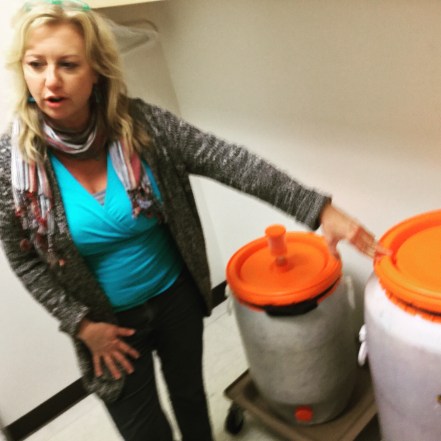
Suzette in her kitchen
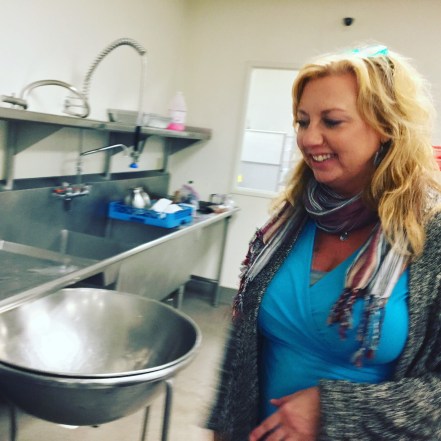
Suzette in her kitchen

The Garden Goddess
The “meaning of the holidays” is a phrase that has been diluted. Although this commercial venture of the company was done for public relations purposes, there could be no better public relations. I wish all the gentle readers comfort and joy for the season and beyond.

air bnb
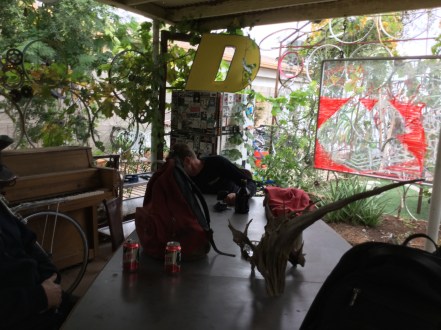
air bnb

air bnb

air bnb

air bnb

air bnb
We visited downtown Phoenix over the weekend, staying in the Garfield Historic District. The neighborhood is undergoing a major revitalization with very impressive results. It had been few years since I was in that part of town which now is near university campuses for medicine and law. U of A and ASU now have large downtown campuses and hospitals. The demand for real estate has taken off fast. Very cool local businesses have sprouted up to serve the community. We enjoyed eating at two of them, Jobot Coffee and Dining and Mother Bunch Brewery. They both have distinctive atmosphere, excellent service, and fantastic food. There are very few chain stores in the district. Most businesses are local and unique. The Roosevelt Growhouse is a wonderful non profit with a mission to promote healthy food and handmade art. Participants are welcome to work on and pick from the communal garden, and some people rent small individual garden spaces for $10 a month. The folks working in the garden together on Sunday were clearly enjoying each other and the beautiful sunny day.
Mother Bunch Brewery

Mother Bunch Brewery

Mother Bunch Brewery

Mother Bunch Brewery
There are murals everywhere. The back alleys and walls, utility boxes and entire buildings are decorated with brightly painted art. Naturally some are better than others, but the total effect is really stunning. The artsy feeling flows all through the area. Our home away from home was the best part. We rented a shipping container Air bnb apartment that came with bikes for us to ride around the area. We felt right at home. Our local hosts gave us advice and directions and off we went exploring. I look forward to returning to do some more exploration and watch the Phoenix as it rises up from the ashes of the real estate depression. It appears to be a very lively rebirth.
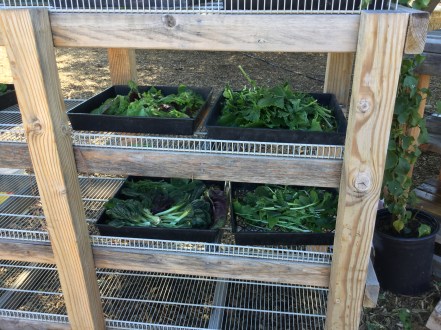
Roosevelt Growhouse
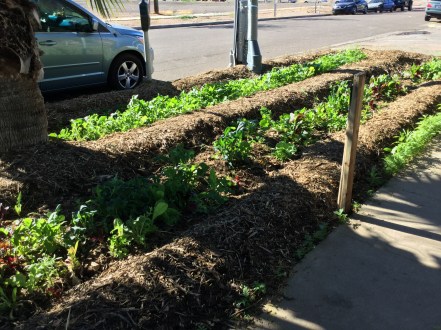
Roosevelt Growhouse

mural art

mural art
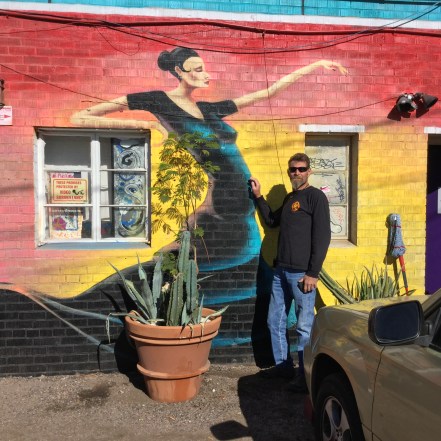
mural art
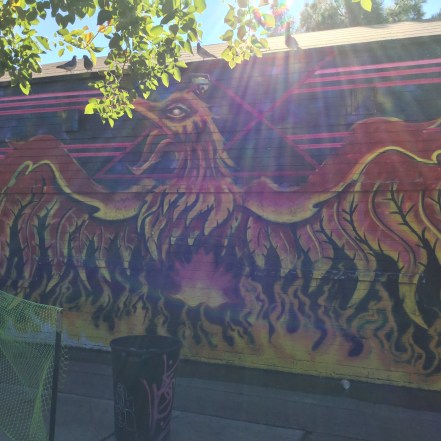
The Phoenix
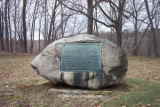
Memorial to the First Settlers Amesbury-1654 Golgotha
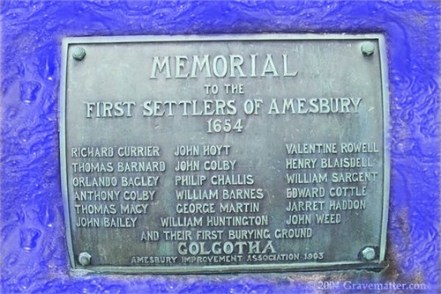
Memorial to the First Settlers Amesbury-1654 Golgotha
My 10th great-grandfather came to America from Bath, England in 1632 and founded many towns in New England. We know a lot about him because he went to court often, and the records remain in tact. If he had not been so contentious with his dealings we might know little about his life.
William Sargent was born 28 Mar 1609 in Bath, Somerset, England. His parents were Richard SARGENT and Katherine STEVENS. He migrated to America in 1632 and was often referred to as a “seaman”, “mariner” or sometimes “yeoman” in legal documents. He married Elizabeth PERKINS in 1633 in Amesbury, Essex, Mass. He was made Freeman on 22 May 1639. After Elizabeth died, he married Joanna Pinder Rowell. William died sometime between 24 Feb 1673/74, when his name appeared on a Norfolk Land Deed, and 8 April 1675, when inventory was taken on his estate in Amesbury, Essex, Mass.
William helped found more towns than any of our other ancestors: Agawam – now Ipswich Mass, Wessacucoh – now Newbury Mass, Winnacunnet – now Hampton NH, South Merrimac – now Salisbury – Mass, and Salisbury New Town -now Amesbury Mass.
Elizabeth Perkins was born 31 Mar 1611 in Hillmorton, Warwickshire, England. Her parents were John PERKINS and Judith GATER. Elizabeth died 18 Sep 1670 in Salisbury, Essex, Mass.
Joanna Pinder was born in 1621. She was the daughter of Henry and Mary Pinder. She married Valentine Rowell on 14 Nov1643 in Salisbury, Mass. She married as her second husband William Sargent on 18 Sep 1670 in Amesbury, Mass. Joanna Pinder married Richard Currier as her third husband on 26 Oct 1676 in Amesbury, Mass. She died in October 1690 in Amesbury.
Children of William and Elizabeth:
1.
Mary Sargent
27 Sep 1634 Amesbury, Essex, Mass
Phillip Challis
1652
Salisbury
27 Sep 1716
Amesbury, Mass
2.
Thomas Sargent
11 Jun 1643 Salisbury, Essex, Mass
Rachel Barnes (daughter of William BARNES)
2 Mar 1668 Salisbury
27 Feb 1706
Amesbury, Mass
3.
William Sargent
2 Jan 1645 Salisbury
Mary Colby (daughter of Anthony COLBY)
23 Sep 1668 Amesbury
31 May 1712
Amesbury
4.
Lydia Sargent
17 Jun 1647 Salisbury
1661
Salisbury
5.
Elizabeth Sargent
22 Nov 1648 Salisbury
Samuel Colby (Son of Anthony COLBY)
1667
Salisbury
5 Feb 1736
Amesbury
6.
Sarah SARGENT
29 Feb 1652 Salisbury
Orlando BAGLEY Jr.
22 Dec 1681 Amesbury
3 Oct 1701 Salisbury
The earliest record seeming to bear on the origin of this Sargent family appears in the Abbey church at Bath, England, under date of Nov 22, 1602, where the record of the marriage of Richard Sargent and Katherine Stevens is set out, and it states further “Ano Dom. 1630, Jenning Walters and Joane Sargent were married April 15,” and under “Baptism,” “Elizabeth, the daughter of Richard Sargent, 28 day, 1603, October; 1606, June, William the Sonne of Richard Sargent the 28th; March, 1609, Joane the daughter of Richard Sargent was baptised the 26th.” No further record of father or son is found there, and it is inferred that they may have gone to London and William shipped from there.
One historian of the Sargent family says: “At first I was not inclined to believe this William was our ancestor, or from this part of England. But since learning that the father of William’s first wife, ‘Quarter Master John Perkins,’ was at Agawam in August, 1631, a short time after arriving in America, and that he came from near Bath, England, it seems quite probable that if William was from there and with Captain Smith in 1614, when the latter landed at Agawam and wrote up its beauties and advantages, William may have returned and induced John Perkins and others to emigrate.”
The first record found of William is in the general court records of Masschusetts Colony in April, 1633, where a copy of an act appears to protect him and other grantees of land at Agawam, now Ipswich. Massachusetts, in their rights. The next record is that of his oath of allegiance and fidelity in 1639. It is shown by records and deeds that he was one of the first settlers at Wessacucoh, now Newbury, in 1635; at Winnacunnet, now Hampton, New Hampshire, in 1638.
Oct 1638 – The reverend Stephen BACHILER and his company, who had received permission from the general court when united together by church covenant, commenced a settlement at Winicowett. He was at this time residing in Newbury. On Mr. Rawson’s request, the place was called Hampton. The following persons, residents of Newbury, went with Mr. Bachiler. John Berry, Thomas COLEMAN, Thomas Cromwell [Giles CROMWELL‘s brother], James DAVIS, William Easton, William Fifield, Maurice Hobbs, Mr. Christopher Hussey [BACHILER’s son-in-law], Thomas Jones, Thomas Marston, William Marston, Robert Marston, John Moulton, Thomas Moulton, William Palmer, William SARGENT, and Thomas Smith. Smith, however, soon returned to Newbury. A few went to Salisbury.
Our ancestos’ lots are underlined in red. William Sargent’s lot was at the corner today’s Winnacunnet Road and Park Ave. — Map of the homes of the original settlers of Hampton, NH, recreated from published maps and ancient records in 1892
Lafayette Road, and Winnacunnet Road, Hampton, NH on Google Maps
The main road going horizontally across the top of the map then, at right, angling down to the right corner, is today’s Winnacunnet Road. At the bottom right corner it leads “To The Sea”.
Today’s Lafayette Road/Route One starts in the top left and goes vertically down (south) into the thicker road, then about 2/3 of the way down angles sharply off to the left corner in the small road reading “To Salisbury”. That road today is pretty much straight as an arrow north to south.
Midway down that same road a small road angles off to the left that reads “To Drake Side”. That is today’s Drakeside Road.
The fat road leading from the point where Route One angles off “To Salisbury” to the right and its meeting with Winnacunnet Road, is today’s Park Ave.
The two roads leading off the bottom of the map both say “To the Landing”, and at the time were both ends of a single road that went in a loop. Today they are still there, called Landing Road, but are cut off in the middle by a new highway.
Lastly the small road in the top right is Mill Road.
First called the Plantation of Winnacunnet, Hampton was one of four original New Hampshire townships chartered by the General Court of Massachusetts, which then held authority over the colony. “Winnacunnet” is an Algonquian Abenaki word meaning “pleasant pines” and is the name of the town’s high school.
In March 1635, Richard Dummer and John Spencer of the Byfield section in Newbury, came round in their shallop, came ashore at the landing and were much impressed by the location. Dummer, who was a member of the General Court, got that body to lay its claim to the section and plan a plantation here. The Massachusetts General Court of March 3, 1636 ordered that Dummer and Spencer be given power to “To presse men to build there a Bound house”.
The town was settled in 1638 by a group of parishioners led by Reverend Stephen Bachiler, who had formerly preached at the settlement’s namesake:Hampton, England. Incorporated in 1639, the township once included Seabrook, Kensington, Danville, Kingston, East Kingston, Sandown, North Hampton and Hampton Falls..
William was at South Merrimac. now Salisbury, Massachusetts, in 1639, and that “William Sargent, townsman and commissioner of Salisbury,” had a tax rate December 25, 1650, of 7s. 4d.
William Sargent – Ipswich Lot
He was next located at Salisbury New Town, now Amesbury and Merrimack, in 1655, where he resided until his death in 1675. He is believed to have married Elizabeth Perkins about 1633, as she came with her parents to America in the ship “Lion,” in the spring of 1631. She died before September 18, 1670, for William married at that time Joanna Rowell, who survived him and married Richard Currier, of Amesbury. The children of William Sargent seem to have been as follows, but owing to lack and contradiction of records there is uncertainty about them: Mary, Elizabeth, died young: Thomas, William, Lydia, Elizabeth, died young; Sarah, died young; Sarah and Elizabeth.
Over half the first settlers names on this memorial are our ancestors. They are: Richard Currier, Orlando BAGLEY Sr., John Bailey, William BARNES, Thomas Barnard, Henry Blaisdell, Philip Challis, Anthony COLBY, John COLBY, Edward Cottle, Jarret Haddon, John HOYT, William Huntington, Thomas Macy, George MARTIN, Valentine Rowell, William SARGENT and John Weed.
OFFICES: Essex grand jury, 13 April 1652 Petit jury, 8 April 1662, 24 June 1662, 13 April 1669, 12 April 1670 . Sworn clerk of the train band of Salisbury on 8 April 1651
ESTATE: “It is ordered that no person whatsoever shall go to plant or inhabit at Aggawam, without leave from the court, except those that are already gone, viz. …
1634 – ” Willm Srjeant” In a grant at Ipswich,, William Sargent received twelve acres of land
6 Sep 1638 – ” Willi[am] Sergant” was in the list of petitioners, mostly Newbury men, headed by [our ancestor] Stephen BACHILER, were granted “liberty to begin a plantation at Winnacunnet [Hampton]”1:236].
The Grantees and Settlement of Hampton, N. H. By Victor Channing Sanborn — Kenelworth, Ill.Essex Institute Historical Collections, 53 – (1917), Pgs. 228-249
That little band, the first settlers of Winnicunnet (afterwards called Hampton) was composed of at least two diverging groups. Search must be made in Southern England (Hampshire and Wiltshire) and in Eastern England (Norfolk and Suffolk) to find the homes of these men. They came from Newbury, Ipswich and Watertown, under the leadership of Stephen Bachiler.
The first authentic record is found in the list of those who presented their petition to the General Court of Massachusetts at that session which began on 6 September, 1638.
“The Court grants that the petitioners, Mr. Steven BACHILER , Christopher Hussey, Mary Hussey vidua, Tho: Crumwell, Samuel Skullard, John Osgood, John Crosse, Samu: Greenfeild, John Molton, Tho: Molton, Willi: Estow, Willi: Palmer, Willi: SERGANT, Richrd Swayne, Willi: Sanders, Robrt Tucke, wthdivers others, shall have liberty to begin a plantation at Winnacunnet”.&c.
The first six grantees were all from the south or west of England. The last ten were probably from Norfolk or Suffolk. The “divers other”, being unnamed, we may not assign, but they probably included others of Bachiler’s neighbors or kinsmen, among them being his three Samborne grandchildren.
“Will[iam] Sargent” was in the section of married men in the list of first comers to Hampton
7 Nov 1644 – John Severans of Salisbury, planter, sold to William SARGENT of Salisbury, planter, twenty acres of upland in Salisbury on the west side of Powwos river
25 Mar 1647 – Anthony “Colebie” [our ancestor Anthony COLBY] of Salisbury, planter, deeded to William SARGENT of Salisbury, seaman, a dwelling house and house lot in Salisbury between Jarred Haddon and Henry Browne
16 Dec 1652 – William SARGENT of Salisbury sold to [our ancestor] John BROWNE of Hampton, the meadow and upland adjacent to Aquilla Chase and widow “Bristos”.
15 April 1659 – William SARGENT of Salisbury sold to John Woodin of Salisbury upland in Salisbury near the “Pawwaus River above the falls”
In his will of 20 June 1663 Theophilus SHATSWELL of Haverhill named “my brother Wilyam Sargent & my kinsman Lieutenant Philip Challis” his overseers; Philip Watson-Challis had married Mary, the eldest child of William Sargent. Recent research has shown that no sibling of Theophilus Shatswell married William SARGENT, and the two wives of William Sargent have been identified. The most likely remaining solution is that Theophilus Shatswell married a sister of William Sargent. Perhaps Theophilus married William’s sister Susanna SARGENT in 1639 in Ipswich, Mass. Susanna Sargent was born in 1618 in England. Susanna died in Oct 1672 in Ipswich, Mass
1 Nov 1666 – William Sargent of Salisbury, seaman, gave for “natural affection” to his son Thomas Sargent thirty acres of upland in Salisbury abutting the Merrimack River
22 Oct 1669 – William Sargent of Amesbury gave for “natural affection and other considerations” to his “beloved son Thomas Sargent” six acres of marsh granted to him by Salisbury, and a sweepage lot of salt marsh in Salisbury at a place called “ye beache” being lot number 8 containing three acres and four rods, being half the lot of marsh between two islands called “Barnss Iland” and “Ware Iland” ].
9 Oct 1669 – William Sargent of Amesbury, planter, gave for “natural affection and other considerations” to his “beloved son William Sargent” a great lot of upland containing two hundred acres in Amesbury, a lot of upland in ox common containing eight acres, a lot of upland west of the great pond containing forty acres, a lot of upland in “burchin meadow hill” containing forty-five acres “which I bought of Edward Goe”; the last division of three acres in the pond meadow (all the foregoing in Amesbury); and half his first division of the higledee pigledee lots of salt marsh in Salisbury.
4 Mar 1670/71 – William Sargent of Amesbury, seaman, sold for £2 10s. to William Sargent Jr. of Amesbury, planter, two acres of upland at the Indian ground in Amesbury; wife Johana Sargent made her mark to this deed
23 Apr 1672 – William Sargent of Amesbury, yeoman, sold to Isaac Green of Hampton 2 acres of salt marsh called Hall’s farm
1 Jul 1673 – William Sargent Sr. of Amesbury, with the consent of his wife, “Janna,” sold to Thomas Wells of Amesbury ninety-five rods of land in Amesbury, part of his houselot.
1 Oct 1673 – “William Sergent … of Almsberry in Norfolke senior and mariner” mortgaged to Nathaniel Williams of Suffolk County eight acres of upland in Amesbury that Sergeant had by exchange with Richard Currier .
24 Feb 1673/74] – William Sargent Sr. of Amesbury, seaman, sold to Caleb Moody of Newbury, maltster, for £5 1s. “my second division higledee pigledee” lot of salt marsh containing three acres in Salisbury .
18 Oct 1696 – Among parcels sold by William Sargent Jr. on to Henry Deering, was a great lot of upland given by his grandfather [unnamed] to his father William Sergeant, “containing by estimation 200 acres in Amesbury amongst the great lots”
WILL: In his will, dated 24 March 1670/1 and proved 13 April 1675, “
William Sargent of the town of Emsbery,” seaman, “being in pritty good health of body…” bequeathed to “my grandchild William Challis” £5; to “my grandchildren: Elizabeth, Lidia, Mary and Phillip Watson Challis” each of them 20s.; to “my grandchildren Dorethie, & Elizabeth Colby” each 20s; to “my grandchild William Sargent” 30s.; to “my daughter Elizabeth the wife of Samuel Colby” £5; residue to “my daughter Sarah” and if she die without children, the housing and lands to be equally divided to “my four children hereafter named i.e.: my sons Thomas & William: & my daughters: Mary and Elizabeth”; “my son Thomas Sargent and my daughter Sarah Sargent” executors; loving “brother-in-law Mr. Tho: Bradbury” and esteemed friend Major Robert Pike (son-in-law of Joseph MOYCE) , overseers .
The inventory of the estate of “Willi. Sargent, Senr.,” taken 8 April 1675 by Thomas Sergeant and John Weed, totalled £196, of which the real estate totalled £137 10s., including “housing & lands about the house & orchard on both sides [of] the country way,” £85; “half the lot in the tide meadows, £16; “a Higledee Pigledee lot in the salt marsh” £25; “a lot lying in … Lyons Mouth,” £5 10s.; “a lot in the great swamp,” £2; “a lot in … Bugmore,” £4 .
Unmarried daughter Sarah chose to have her “loving brother” Thomas act in her behalf as executor, 14 April 1675 .
Although William had married his last wife, Joanna, just a few months before he wrote his will, and she survived him, she was not mentioned, strongly implying that there was a pre-nuptial agreement (of which no record can now be found).
The Sargent family were some of the original settlers of the Agawam section of Ipswich, Essex co., MA, with William receiving 12 acres in the 1634 Ipswich Land Grant. The family later moved to Newbury, Essex co., MA; Hampton, Rockingham co., NH; Salisbury, Essex co., MA and finally Amesbury, Essex co., MA. Remember that NH & ME were all part of MA at the time. The family moved from Newbury to Hampton because “…’Willli[am] Sergant’ was amongst the list of petitioners mostly Newbury men who were headed by Stephen Bachiler, who were on 6 September 1638 granted ‘liberty to begin a plantation at Winnacunnet [what is now Hampton, Rockingham co., NH]…” And “Will[iam] Sargent” is listed as one of the married men in the list of first comers to Hampton..
The Sargents found themselves in court over disputes with their neighbors on many occasions. Given the fact that this pattern of contentiousness continued after Eliabeth’s death, I contend that William was the fractious party in the area. On 26 December 1643, William “Sargeant” sued Mr. William Hook of Salisbury for 56s. in corn. William acknowledged the court’s judgment in favor of Mr. Jonathan Wade on 26 September 1648. Michael Spencer sued him for detaining corn and other goods on 2 Jan 1650.
In 1672, William Sargent and Joanna his second wife sued Christopher Osgood for debt due part of the estate of Joanna’s late husband, Valentine Rowell . However, Joanna was curiously not mentioned in his will, although she had married him a few months earlier. To contemporary credible researchers, this strongly suggests that there was a pre-nuptial agreement between them which left Joanna nothing.
William Richard Sargent (1606 – 1675)
is my 10th great grandfather
Mary Sargent (1634 – 1716)
daughter of William Richard Sargent
John Challis (1655 – 1741)
son of Mary Sargent
Mary Challis (1699 – 1739)
daughter of John Challis
Amos Nicholls (1740 – )
son of Mary Challis
Amos Nicholls (1780 – )
son of Amos Nicholls
Amos Nicholls (1808 – 1868)
son of Amos Nicholls
Emiline P Nicholls (1837 – )
daughter of Amos Nicholls
Harriet Peterson (1856 – 1933)
daughter of Emiline P Nicholls
Sarah Helena Byrne (1878 – 1962)
daughter of Harriet Peterson
Olga Fern Scott (1897 – 1968)
daughter of Sarah Helena Byrne
Richard Arden Morse (1920 – 2004)
son of Olga Fern Scott
Pamela Morse
I am the daughter of Richard Arden Morse

Beer flights on the balcony
A quick weekend trip to Tempe to take in the sights and sounds of the Festival of the Arts was a perfect get away (but not very far away) for us last weekend. I found a great Air bnb apartment in the perfect location for walking to the action. We discovered new places to drink and dine, and purchased a few pieces of original jewelry at an artist’s booth. My parter Bob is a big beer fan, so we sat for a while overlooking the fair on the balcony of the famous landmark Gordon Biersch Brewery. The beer is okay. The view is fabulous.
Our favorite new spot for food drinks and a lively crowd is Culinary Dropout. We enjoyed wonderful service in a very jovial atmosphere there before we went to the fair. The menu was innovative bistro style food. It was tempting to eat all our meals there, but we wanted to do some investigating into other places. Tempe is full of bars and food offering of all kinds. If there is nothing you like to eat or drink there, you are just too picky.

Culinary Dropouts

Culinary Dropouts
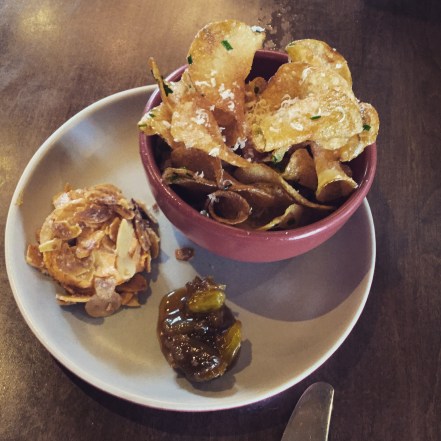
appetizer Culinary Dropout

cocktail menu

Culinary Dropout
The Arts Festival turned the town into a large outdoor party with plenty of opportunity to people watch. We had such a good time we may just make a habit of visiting Tempe. There is much to discover.

art

art vendor

art
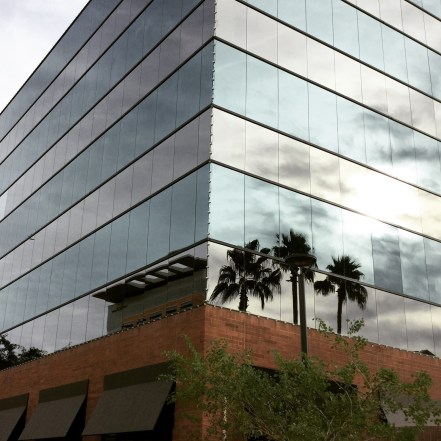
reflection

Retro Toy Theme

family fun on the street
As part of the Tempe Festival of the Arts everyone was invited to draw on the street downtown. Participants in the professional art show covered large spaces and stuck to the theme “Retro Toys”. The creativity as well as the stunning artistry was very impressive. Watching the work evolve each day is a major part of the fun for us. The artists don’t mind a little visiting while they work. We left before the end to drive back to Tucson, but think I will stay until the end next year. All of the work is amazing considering the medium and the way they have to work. Many of the artists we met were from Tempe, but they came from all over to compete and make the street look extra special for the holiday.



The community participation was the best part. I purchased my chalk and joined the youngsters on the street. I had a very good time meeting my fellow artists on kneepads. I paid $5 to support the festival, and got to keep my chalk to take home and practice on my own driveway. I was pleased with the way my piece turned out, but after I packed up and left it occurred to me that I could have done more than one square..nobody would have stopped me. The way the community mosaic mural looked on Sunday morning was superb. All the styles went together very well to show a patchwork of visitor talent right next to the sidewalk. I am proud to leave my mark on Tempe, and thank that very artsy city for the opportunity to do so.


chalk mural artists


chalk mural artists

retro toy

chalk mural artists

artist on kneepad
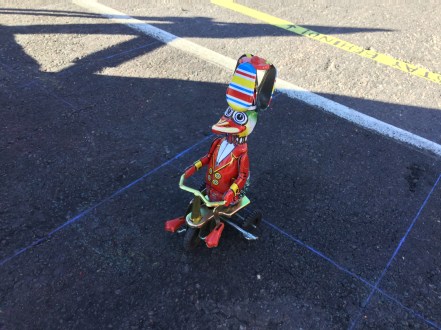
retro toy

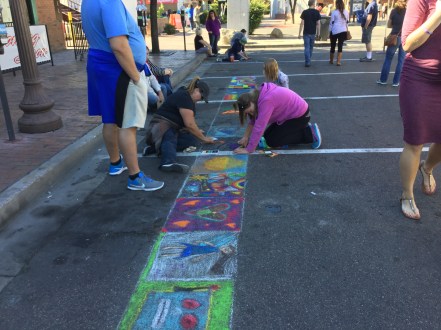
family fun on the street
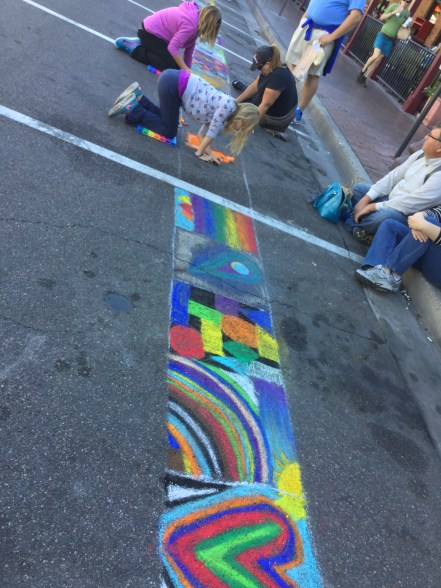
artists on kneepads
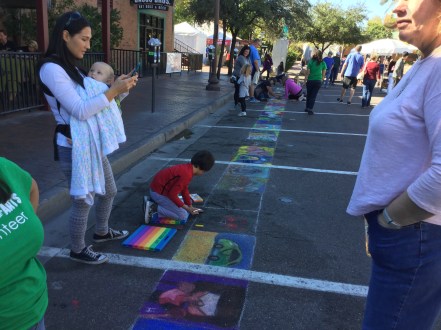
family fun on the street

Doc, Me, Wyatt
I recently gave thought to the question “What is the opposite of gratitude?” I decided it is entitlement. This exercise works well for all kinds of grand concepts and world events. Our violent world is punctuated with opinions and some bravery, but the violence itself looks more powerful all the time. I am a believer in Chinese medicine and the power of understanding opposite forces. I go to acupuncture every week for my health to balance the chi in my body. There are macro and microcosms of chi as well, like the environment, social order, etc. Energy balances energy and life continuously flows. Balance depends on constant movement and exchange, like inhale and exhale.
With the bigger picture in mind I wonder what is the opposite energy to contradict and balance violence. I don’t own weapons or use them. My life is easy, comfortable, and fun. I don’t think about encountering violence even though there is plenty of it right in my neighborhood as well as across the globe. I agree with the sentiment of the Parisians who believe that fear to go out and live it up is what terrorists want to see in their victims. Caving in to fear may be the worst reaction, but what is the best one? I live in Tucson where we were shaken by mass shooting early in the game. Our city is plenty violent all the time with the full time smuggling at work here. Most people go about our business without any thought of the crime and violence we know happens. I have started to wonder if this is unrealistic or healthy.
As long as I stay aware of the shadow of violence I think it is healthy to be happy and free of fear. The only thing that has worked in my life as a cure for big and little violence is patience. Patience must be the opposite of violence. Patience develops into empathy if practiced for a long enough time. When you restrain your emotions long enough to see the bigger overview you always find ignorance was the cause of all problems. Ignorance continues to cause trouble, but if I sincerely practice patience I can stop myself from adding my own portion of violence to the boiling pot of trouble. What do you think, gentle reader? Have you found any new truths by observing all the horror lately?
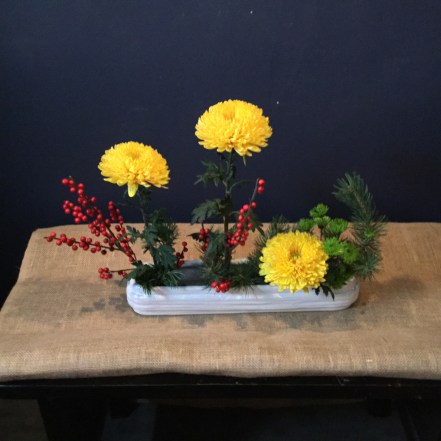
Ohara School

outdoor exhibit

outdoor exhibit

outdoor exhibit
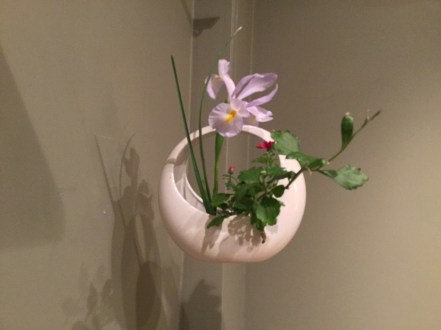
indoor exhibit
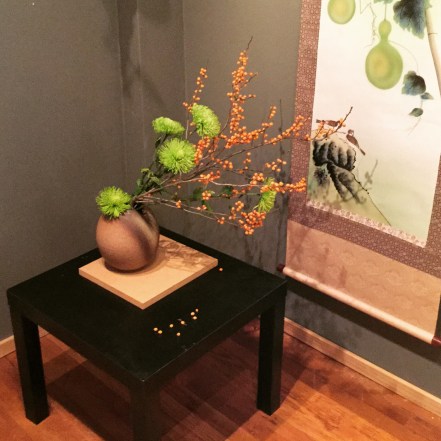
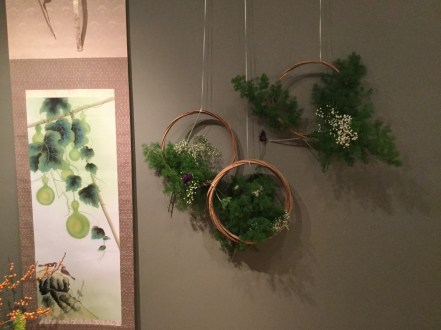
Tomorrow is the last day of the annual Ikebana event at Yume Japanese Gardens of Tucson. This delightful addition to the garden’s peaceful atmosphere is wonderfully worth a visit. The works are displayed in all parts of the gardens as well as in two interior galleries. There are well defined spaces that allow contemplation or mindfulness practice at Yume any time you visit. To see these adorned with Ikebana is a real invitation to deep meditation. The work itself is done as a meditative practice, finding the best way to use the plant materials to express art. The relatively short life of the materials is an element of the contemplative experience for me. Like sand mandala they will be discarded in the future, with less ceremony.
I was very lucky to be invited to the arranging pre party where I met artists and teachers working on the show. The universe of Ikebana was unknown to me, but it took a very enjoyable guided tour. It was clear to me that in the group situation some found it more difficult than others to be immersed in the creative process. I asked questions but did not want to get carried away and become a big distraction. Once I tuned in to what was happening it reminded me of yoga. The teacher comes around and gives assistance and guidance to to student while the work is in progress. There is a reverent attitude toward the plant materials, and quiet concentration. When I saw all the finished pieces in the show I was impressed with the work in all of them. They caught a seasonal natural harvest in whimsical harmony with the moment in which it was created. The curation of the show is done so that every piece looks natural and harmonious with the surroundings. For this Thanksgiving weekend Yume, which means dream, is one big flower arrangement containing many arrangements. It is the perfect place to be one with nature right in the center of the city of Tucson.
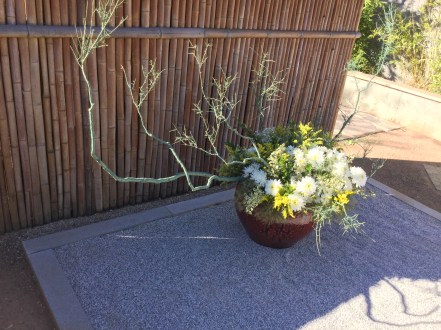
Ikebana in the garden
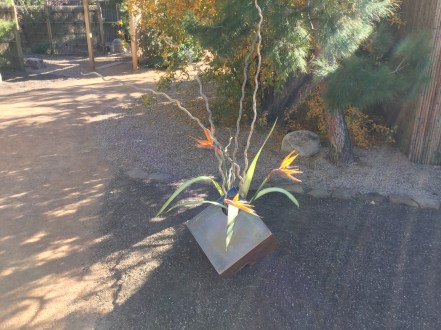

Ikebana in the garden
Make sure you take a look around all the corners because there are arrangements tucked into the gardens like a treasure hunt. The indoor galleries are also very well curated to show a range of styles. I am a happy newcomer to this exciting form of art and meditation.
indoor gallery
indoor gallery

indoor gallery
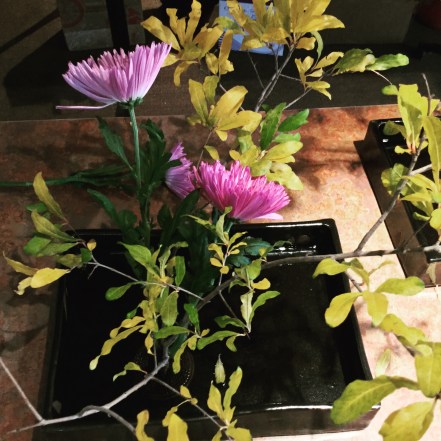
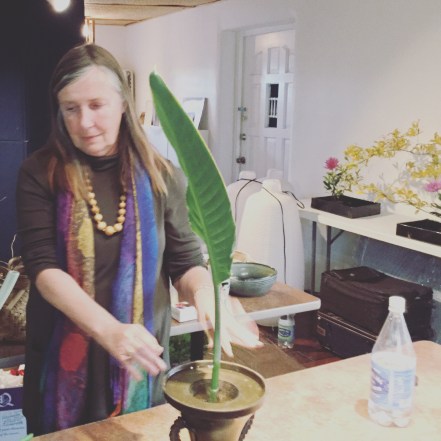
I was lucky to catch up with Patricia Deridder at the Yume Japanese Gardens of Tucson as she prepares for this weekend’s big Ikebana exhibit. She is the founder of the gardens, a teacher, and still a student, of Ikebana. She has organized a group of masters who will show their work over the weekend in the gardens. This very special treat will give the public an idea of the different schools of Ikebana and the individuals who live here and practice these special arts. There are monks in Japan who do this practice as meditation. Anyone involved in this way of looking at flower arranging will discover elements of mediation or merging with nature.
I am thrilled to have this artful peaceful alternative to Black Friday shopping offered in my neighborhood. If you happen to be in Tucson this event is offered with the regular entry fee, or to members as part of our membership. This is a wonderful opportunity to be immersed in nature carefully and beautifully crafted by artists. I am excited to learn more and enjoy the show. The three pieces I watched in progress all came out beautifully.
flower show in progress

freestyle
formal arrangement
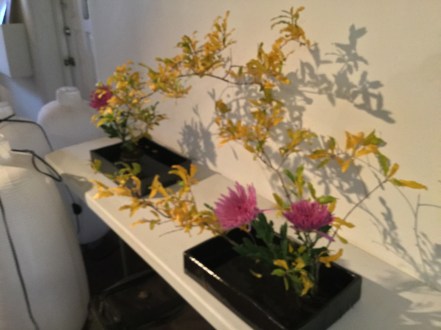
flower show in progress
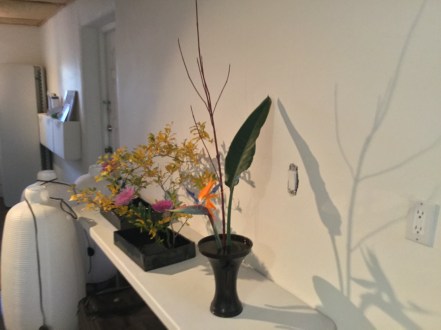
flower show in progress
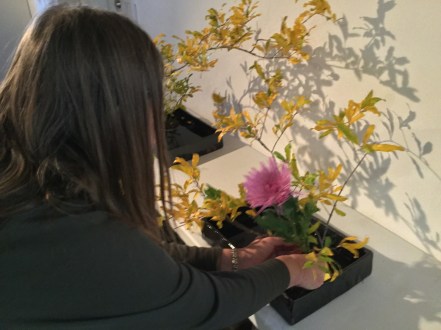
Patricia does a final edit
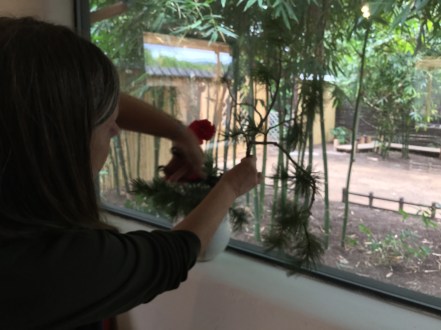
freestyle
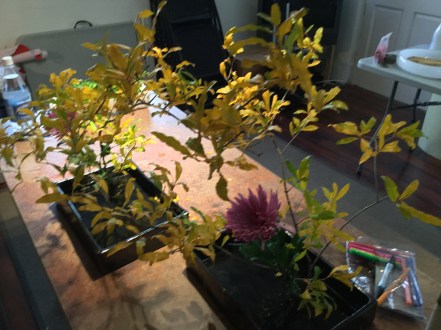
flower show in progress
 mermaidcamp