mermaidcamp
Keeping current in wellness, in and out of the water
You can scroll the shelf using ← and → keys
You can scroll the shelf using ← and → keys
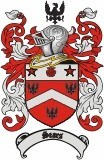
Sears COA
My 11th Great grandfather was so totally kicked out of England:
JOHN BOURCHIER, so named after his father, “he married MARIE L. daughter of PHlLIP VAN EGMONDE, of that city, and acquired with her a large fortune, principally in money. With this he was enabled to purchase property in Essex, adjoining the lands which he hoped soon to recover as his lawful patrimony. Amongst the estates thus bought were Bourchier and Little Fordham Manors, both of which had in former times belonged to his ancestors. But his return to England was resisted by those who were deeply interested in keeping at a distance so formidable a claimant to many of their broad acres. Strenuous and energetic were the efforts JOHN BOURCHIER SEARS made to remove the obstacles which intervened to keep him in exile; but all to no purpose. His opponents were inexorably hostile, and even threatened him with a prosecution, as a participator in the gunpowder plot, if he ventured to set foot in England. The attainder, it must be remembered, which hung over his grandfather, had never been removed, and still impended over the family at the time of his death in 1629.”
He left two sons and two daughter, RICHARD, JOHN, MARIE, and JANE, the three latter settled in Kent; the eldest son
“worn out by his parents’ want of success to recover their English possessions, determined at his father’s death to quit England for ever. He accordingly took passage, with a party of Puritans, for New England in America, and landed at Plymouth in Massachusetts on the 8th of May, 1630. Here he became the founder of a family which has attained wealth and honours in the New World, and died in 1676, leaving behind him three sons, KNYVET, PAUL, and SYLAS. “In the year 1851, a descendant of this family, the Honourable DAVID SEARS, of Boston, visited Colchester in company with a friend, Mr. H. G. SOMERBY, of London, and inspected with much interest the monuments in St. Peter’s Church. With a view to perpetuate the recollection of the ties that attached his family to the town of Colchester, Mr. SEARS caused a brass tablet to be engraved, and obtained the permission of the late Vicar (the Rev. S. CARR), for its erection on the North wall of the Church.”
This brass is divided into three columns, with the copies of the memorials on either side. The central column is headed by a coat of arms bearing the mottoes “EXALTAT HUMILES” and “HONOR ET FIDES”. Beneath is repeated the motto “Exaltat humiles” and the following:
Worth is better than wealth, Goodness better than nobility, Excellence better than distinction. To their Pilgrim Fathers, a grateful posterity. The outer columns transcribe the following memorials: Sacred to the Memory of Richard Sears, son of John Bouchier Sears and Marie L. Van Egmont in lineal descent from Richard Sears of Colchester and Ann Bouchier Knyvet, England. he landed at Plymouth in 1630, Married Dorothy Thacher and died in Yarmouth in 1676. Sacred to the Memory of Knyvet Sears eldest son of Richard Sears of Yarmouth, born in 1635, married Elizabeth Dymoke and died in England in 1686. Sacred to the Memory of Paul Sears, second son of Richard Sears born in 1637, married Deborah Willard and died in Yarmouth in 1707. Sacred to the Memory of Sylas Sears, third son of Richard Sears, born in 1639, married and died in Yarmouth in 1697. Sacred to the Memory of Daniel Sears, son of Knyvet Sears of Yarmouth born in 1682, married Sarah Hawes and died in Chatham in 1756. Sacred to the Memory of Daniel Sears II son of Daniel Sears of Chatham born in 1712, married Fear Freeman and died at Chatham in 1761. Sacred to the Memory of David Sears I son of Daniel Sears II of Chatham born in 1752, married Ann Winthrop and died in Boston in 1816. An explanation for this plate is given along the bottom edge: ON GRANITE MONUMENTS IN THE GRAVEYARDS OF YARMOUTH, AND CHATHAM, IN MASSACHUSETTS, NEW ENGLAND, IN NORTH AMERICA, ARE THE ABOVE INSCRIPTIONS TO THE MEMORY OF THE DESCENDANTS OF THE SAYERS OF ALDHAM, AND COLCHESTER. 1830.
I was a born farmer, entitled to play with everything on my grandparent’s farm. While my parents pitched in to help, I was given free reign of the place. My grandparents, Olga and Ernest Morse lived and farmed in Lincoln, Arkansas at the end of their lives after careers in teaching (my grandmother had a masters in education) and oil well drilling ( my grandfather drilled for oil before the rotary bit was invented). I did not know them before they had the farm, so I always think of them as farmers.

Pam and flowers 1953

Pam and the Fam on the farm
Here is my look in 1960, on Christmas at my grandparents’ farm in Arkansas…very American Gothic in my opinion:

A girl and her farm

Christmas 1960 Pam & Father
I met my cousin Mary in Tulsa a couple of years ago to trace the heritage of our mutual great grandmother. We did not remember that we had met in 1964 at her grandfather’s house in Iowa. Our grandfathers were brothers who followed different paths. They both did migrant labor as very young boys, traveling to work picking corn in Iowa and beyond.

Cousins in Iowa 1964
Uncle Ed sent this postcard to his brother Ernie telling him about Emma.

Uncle Ed goes to harvest
Ed sealed the deal when he married the farmer’s daughter in Council Bluffs, Iowa
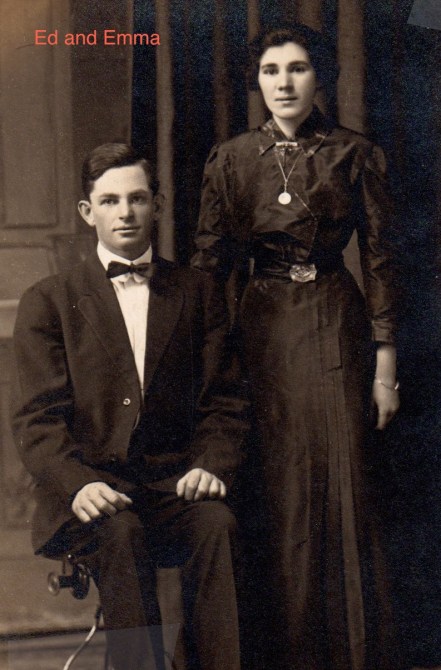
Married the farmer’s daughter
My grandfather returned to the Cherokee Strip to marry Olga Scott and drill oil wells, creating two different paths for the future.

Ernest Morse
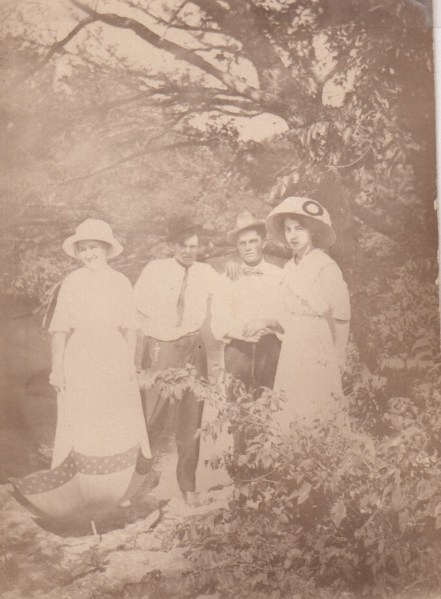
My grandparents on a double date
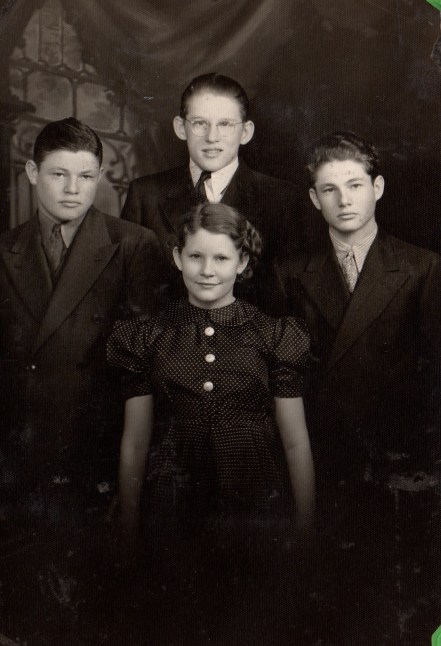
My dad and siblings 1933

London COA
We see that my 8th great grandfather was in the tobacco business, owning land in Virginia starting in 1635. Sadly I have found no portraits of him. From the following data we can make a sketch of his life. He was born in London.
RECORDS AND LAND TRANSACTIONS FOR CHRISTOPHER LEWIS
1635 Christopher Lewis is a headright for a patent of John Upton for 1650 acres on Pagan Point Creek, Isle of Wight County and mentioned again in same land in another patent for 1500 acres adj. Ambrose Bennett (Isle of Wight Deed Book, P. 25, 69, 99)
4 July 1649 400 acres in James City County (Later Surry County) at Blackwater on eastern-most branch pointing up to Chippoakes Creek. (Nugent, p. 183) (Laond Office Patent Book 2, 1643-1651; p. 176)
5 Dec 1651 Christopher Lewis to John Guttridge (Virginia Magazine of History, Vol 5, p. 405)
26 July 1652 750 acres in Isle of Wight one mile to the southwest of Henry White’s Plantation (Cavaliers and Pioneers, Nell Nugent, Vol 1, p. 261)
30 Sept 1652 200 acres to John Burgess (Virginia Magazine of History and Biography Vol 5, p. 404)
2 Apr 1660 On a jury to investigate the death of a man (Surry County Book !, 1652-1672, p. 150)
1 Mar 1661/62 Between Christopher Lewis and Bartholomew Owen, 200 acres on the west side of Gray’s Creek named Great Level (Surry County Records 1652-84, p. 39)
25 Mar 1662 Christopher Lewis and wife Jane to William Foreman for 60 acres of land part of a dividend bought of Christopher Lawson (Lewis, p. 54) (Surry County Book 1, 1652-72, p. 186)
2 June 1662 John Hux to Christopher Lewis, a mare (Lewis, p. 54)
6 May 1662 Bartholomew Owen of Gray’s Creek, Southwarke Parish to Christopher Lewis, certain livestock. (Lewis p. 53) (Surry County Book 1, 1652-72, p. 187)
3 Jan 1665/6 Gyles Linscott of Warrencock, Surry sells to Christopher Lewis, winecooper, certain livestock (Lewis, p. 54)
31 June 1667 Christopher Lewis makes bond with Christopher Lawson for a debt that Thomas Andrews shall have of Anthony Rossey (Lewis, p. 54)
1668 Roger Williams to pay Christopher Lewis £1730 tobacco by court order (Lewis, p. 54)
1674 Bequeathes to the church warden of Southwark Parish “a silver flagon of two quarts measure” to William Thompson minister “1500 lbs of tobacco” and “desires to be buried in ye chancel of ye church and to have a tombstone over me and a funeral sermon” preached for which his executors are to pay. (Surry County Book 2, 1671-1678; pp. 34, and 36)

Virginia Colony
10 Aug 1676 Mr. Edward, Clerk, is to record a gift from Christopher Lewis, ded’d to Katherine Owen, daughter of Bartholomew Owen (Surry County Record Book II, (March 1671-July 6, 1684, p. 119)
Sources: Lewis Patriarchs of Early Virginia and Maryland; Robert J.C.K. Lewis, 3rd volume, Heritage Books; Westminster Maryland, 1998.
Christopher Lewis died in Virginia in Sept, 1673. His will mentions paying the minister for the funeral services 1500 lbs of tobacco, not to be paid until 1675. He made clear where he wished to be buried, and that he wanted tombstone and sermon in the exchange. They used British Pound Sterling but It sounds like tobacco was the currency most used.
 mermaidcamp