mermaidcamp
Keeping current in wellness, in and out of the water
You can scroll the shelf using ← and → keys
You can scroll the shelf using ← and → keys

Thomas Kerr
Thomas Kerr was devoted to the interests of Mary, Queen of Scots, who was in turn, devoted to the martyrdom of my maternal 10th great-grandfather, Rowland Taylor. My family has been opposed to itself in history more than once. As a child in suburban Pittsburgh I lived very near a family named Kerr of fabulous, robber baron wealth of some kind. I now wonder if I was a distant relative of the Kerrs in my childhood neighborhood. They had a castle and loads of fine stuff they shared generously with all the kids in the area. I suppose I will never know. We do know quite a bit about Thomas, including his ruffled fashion statement:
Thomas Kerr (Carr) became the 9th Baron of Ferrniehirst Castle. He was also noted for his involvement with Mary Stuart, Queen of Scots. (From notes of David W Carr)The name of Carr, Kerr or Karre is as old as the Norman Conquest by William of Normandy in 1066. One of the followers of William I is recorded in the Roll Of The Gattle Abbey as the name of Karre.The early descendants of this Norman soldier and succeeding generations spread on both sides of the border of England and Scotland.Direct lines can be traced through various peerage books of England and Scotland to Andrew Kerr I, the 6th Baron of Fennehurst, Scotland. He was born in 1450 , created Baron in 1480 and knighted in 1483. He and his son Andrew II, 7th Baron of Fennehurst, were remarkable men for talent and undaunted courage, conspicious in reigns of James IV and James V. Andrew Kerr II, died in 1543. His son Sir John Kerr, 8th Baron of Fennehurst, did great service against the English and rescued Queen Mary from incursions by the English against the Scots. Sir Thomas, 9th Baron and son of Sir John, was also devoted to Queen Mary’s interests. (Quoted from Watson’s “The House of Carr”1926)
Thomas Kerr (1529 – 1586)
is my12th great grandfather
William Carr (1542 – 1655)
son of Thomas Kerr
Benjamin Carr (1592 – 1635)
son of William Carr
Caleb Carr (1623 – 1695)
son of Benjamin Carr
Sarah Carr (1682 – 1765)
daughter of Caleb Carr
John Hammett (1705 – 1752)
son of Sarah Carr
MARGARET HAMMETT (1721 – 1753)
daughter of John Hammett
Benjamin Sweet (1722 – 1789)
son of MARGARET HAMMETT
Paul Sweet (1762 – 1836)
son of Benjamin Sweet
Valentine Sweet (1791 – 1858)
son of Paul Sweet
Sarah LaVina Sweet (1840 – 1923)
daughter of Valentine Sweet
Jason A Morse (1862 – 1932)
son of Sarah LaVina Sweet
Ernest Abner Morse (1890 – 1965)
son of Jason A Morse
Richard Arden Morse (1920 – 2004)
son of Ernest Abner Morse
Pamela Morse
I am the daughter of Richard Arden Morse
Sir John’s son, Sir Thomas Kerr of Ferniehirst, was noted for his loyalty to Mary Queen of Scots, for whom he built a fortified house in the centre of Jedburgh. He raised the Royal Standard for her in Dumfries, helping her and her husband Darnley to put down an insurrection by a group of her nobles (she won at the time but was forced into exile a few years later). Subsequently he sheltered her English supporters after the rising of the Northern Earls (1568) and rescued Lady Northumberland, stranded by illness in a Liddesdale outlaw’s hide-out. He helped his father-in-law, Kirkcaldy of Grange, to defend Edinburgh Castle in the Queen’s name; when it was taken he lost precious family documents which were never seen again, but at least he escaped with his life (Kirkcaldy was beheaded) and fled abroad for some years. He was re-instated in his lands by James VI when the young King came of age and took power into his own hands. The townsmen of Jedburgh supported the Regent Morton (later also beheaded) against Mary; they “debagged” and publicly caned a herald sent out by Ferniehirst to read out a proclamation of loyalty to the Queen, also compelling him to eat his document.
From her English prison, Mary wrote to Sir Thomas, thanking him for his past services and encouraging him to keep up his loyalty. She seems to have taken a particular liking to his young son Andrew, the first Lord Jedburgh, and may have knighted him while still a child, for she asks in particular to be remembered to “Sir Andrew”.
Briefly imprisoned after the fall of Edinburgh Castle, Sir Thomas was in exile and unable to perform his duties as Warden at the time of the last major clash on the Border, the Raid of Redeswire. This incident developed on one of the “days of truce” when the Wardens or their deputes met to resolve various local problems and to exchange or hang wanted criminals. On this occasion the English Warden complained that the Scots had failed to hand over a thief known as “Farnstein” (not a German refugee or mercenary, as one might think, but an Englishman whose real name was Robson). This led to mutual insults, no doubt aggravated by the fact that both sides had been liquidating a great deal of liquid. The argument grew into a scuffle and the scuffle grew into a fight. Eventually the Jedburgh men arrived in strength and dispersed the English, killing a few and capturing others, who were later released without ransom.
Though he missed this particular incident, Sir Thomas was involved in a similar but smaller affray, on almost the same spot, ten years later. By then he was back in office as Warden of the Middle March; Forster, now 84, was still in charge on the other side, and Forster’s son-in-law, who was also a son of the Earl of Bedford, was killed. Elizabeth Tudor was not amused, and insisted on Ferniehirst’s punishment, though the rights and wrongs of the whole affair were by no means clear. Being anxious to succeed to the English throne, James VI sought to ingratiate himself with her, and exiled Sir Thomas to Aberdeen, where he died within a year. The inscription on his memorial in Jedburgh Abbey reads “Sir THOMAS KERR of Fernyherst, Warden of the Marches, Provost of Edinburgh and Jedburgh, Father of Andrew Lord Jedburgh, Sir James Kerr of Creylin (Crailing) and Robert Earl of Somerset. He died at Aberdeen on March 31, 1586 and lies buried before the Communion Table. He was a man of action and perfit loyaltie and constancie to Queen Marie in all her troubles. He suffered 14 years’ banishment besides forfaulter (forfeiture) of his lands. He was restored to his estates and honours by King James the Sext.”
Sir Thomas married twice. His children by his first wife, Janet Kirkcaldy, included Sir Andrew of Ferniehirst, first Lord Jedburgh (see below) and William, who took the name of Kirkcaldy to continue his mother’s line; his children, however, reverted to Kerr, having failed to inherit the Grange property. By his second marriage, to Janet Scott, Sir Thomas was the father of Sir James Kerr of Crailing (father of the second Lord Jedburgh) and of Robert Can, Earl of Somerset (see below). He had several other children by both his wives.
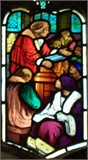
Rev John Taylor
John Taylor (c. 1480 – 1534) was Master of the Rolls of the Court of Chancery from 1527 to 1534, following a successful career as a priest and civil servant. Taylor would have been notable just for the circumstances of his birth: he was the firstborn of healthy triplets who all survived to adulthood, which was virtually unheard of in the 15th century.
King Henry VII met John and his brothers Rowland and Nathaniel in their childhood, and undertook responsibility to educate the three boys if they came to manhood; this informal act, and others like it, later inspired Queen Victoria’s Royal Bounty for Triplets which continued until the reign of Elizabeth II. There is note in the Royal Privy Purse expenses of 1498 “for the wages of the King’s Scoler John Taillor at Oxenford.”[1]
During his lifetime, Taylor donated money towards the building of St. James Church in Barton-under-Needwood, Staffordshire, the village where he grew up. Construction began in 1517 and was completed in 1533. The John Taylor High School, a specialty science school founded in Barton-under-Needwood in 1957, was named in his honor.[2]
In 1503, Taylor was ordained Rector at Bishop’s Hatfield, and then became Rector of Sutton Coldfield in 1504. He served as one of the Royal Chaplains at Henry VII’s funeral, 21 April 1509, and was afterwards appointed by King Henry VIII as the King’s Clerk and Chaplain-he was later one of the commissioners to decide if Henry VIII’s marriage to Catherine of Aragon was valid. In 1511, he was made Clerk to the Parliament.
Taylor was appointed as Archdeacon of Derby in 1515, then as Royal Ambassador to Burgundy and France and Prolocutor of Convocation. In 1516, he was appointed Archdeacon of Buckingham, and was conferred the degrees of Doctor of Civil Law and Doctor of Canon Law at Cambridge in 1520. He was one of ten chaplains present at the Field of the Cloth of Gold in 1520. In 1528 he became Archdeacon of Halifax.
From 1527 to 1534 he was Master of the Rolls of the Court of Chancery — the presiding officer of the Civil Division of the Court of Appeal. This position was the third most senior judicial position in England (after Lord Chancellor and Lord Chief Justice).
References· “Taylor, John (d.1534)”. Dictionary of National Biography. London: Smith, Elder & Co. 1885-1900.1. Notable Bartonians: John Taylor (circa 1480 to 1534)2. John Taylor High School
Source: John Taylor (Master of the Rolls). (2011, September 20). In Wikipedia, The Free Encyclopedia. Retrieved 15:03, October 27, 2011, from http://en.wikipedia.org/w/index.php?title=John_Taylor_(Master_of_the_Rolls)&oldid=451553336
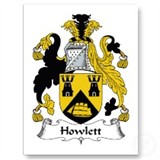
Howlett Coat of Arms
Thomas Howlett arrived in America on the ship Hopewell in 1630 to live in Boston. He was a carpenter, and had skills as a surveyor. He was active in church and military matters.
Thomas Howlett (1605 – 1678)
is my 10th great grandfather
Thomas Howlett (1638 – 1667)
son of Thomas Howlett
Mary HOWLETT (1664 – 1727)
daughter of Thomas Howlett
John Hazen (1687 – 1772)
son of Mary HOWLETT
Caleb Hazen (1720 – 1777)
son of John Hazen
Mercy Hazen (1747 – 1819)
daughter of Caleb Hazen
Martha Mead (1784 – 1860)
daughter of Mercy Hazen
Abner Morse (1808 – 1838)
son of Martha Mead
Daniel Rowland Morse (1838 – 1910)
son of Abner Morse
Jason A Morse (1862 – 1932)
son of Daniel Rowland Morse
Ernest Abner Morse (1890 – 1965)
son of Jason A Morse
Richard Arden Morse (1920 – 2004)
son of Ernest Abner Morse
Pamela Morse
I am the daughter of Richard Arden Morse
| Name | Thomas HOWLETT Sergeant, Ensign |
| Birth | 1605, Assington, Suffolk, England |
| Death | 24 Sep 1677, Topsfield, Essex, Massachusetts |
| Occupation | Carpenter |
| Father | William HOWLETT (1579-) |
Misc. NotesFrom co. Suffolk, England. Removed Ipswich 1633. Deposed 1658, aged 52. Church member 1630.29One of the first settlers in Agawam (Ipswich) 1632/33. Deputy from Ipswich 1635 and Topsfield 1665 and often employed in running lines and locating towns and farms.Ipswich, Massachusetts Deputy in 1635. Ensign of Ipswich Company under Captain Daniel Dennison, 3rd Regiment, Colonel John Endicott 1636.102Thomas Howlett was twenty-five years old when he came to New England in 1630 aboard the ship “Hopewell” as part of Governor Winthrop’s Fleet. He was a carpenter by trade, with origins in South Elmham Parish of Suffolk County, East Anglia in England. He first settled in Boston, as did a majority of Winthrop colonists, and became a member of the First Church on August 27, 1630. In the spring of 1633 he married Alice French, daughter of Thomas and Susan (Riddlesdale) French, who apparently had emigrated to New England prior to her parents. She was a member of the First Church and was eventually dismissed on September 10, 1643 to the church in Ipswich as “Our sister Alice French ye wife of Thomas Howlet of Ipswich.”Although Howlett later settled in Topsfield where he spent the latter years of his life, he was one of the nine originals of John Winthrop Jr’s 1633 party settling the Indian village Agawam, which the next year became the town of Ipswich. He was sworn a freeman at Ipswich on March 4, 1633.In 1634 Ipswich granted Howlett, in partnership with John Manning and others, on the neck of land on which the town stood, two acres of meadow and two and a half acres of marsh between the town riger and the lands of William Sergient (probably Sargent) and John Newman. Added to this in 1635 was a house lot in the town, thirty acres of upland and ten of meadow at the head of Chebacco Creek and ten acres north of the town toward the Reedy marsh. In 1637 he purchased forty acres from John Perkins, Sr. His later acquired Topsfield holdings are described in his will.Thomas Howlett’s highest political office came to him as a young man, when, in 1635, he represented Ipswich in the General Court. he served on the Essex County Jury of Trials in 1654, 1657, and 1665 and on the Grand Jury in 1650, 1659, 1666, and 1667 and served as Selectman of Topsfield in 1661.In 1640 he was sergeant of the Ipswich military defense company and later became its ensign. In 1643 he, as Sergeant, and ten other militiamen were voted compensation by the town for their three days acting in defense of the Agawam Indians against their tribal enemies. In 1672 he became a Deacon of the Topsfield Church and his contribution of five pounds to the salary of Rev. Jeremiah Hubbard was the largest of those made.There were eight children of Howlett’s marriage with Alice — Sarah (1633/34-1700), John (1633/34-1674/75), alice (1636-1696), Thomas, Jr. (1637/34-1667), Mary (1641/42-1718), Nathaniel (1646-1658), William (1649/50-1718), and Samuel (1654/55-1719/20). On June 6, 1666, after the death of Alice he married Rebecca Smith, widow of Thomas Smith if Ipswich and Newbury, with his step-son, Thomas Smith, in 1671, choosing him as his guardian.Thomas Howlett died in Topsfield, Essex County on September 24, 1677.Military Was in Pequot War32, No. 74, pg. 120, 1920Spouses
| 1 | Alice FRENCH |
| Birth | 9 Oct 1609 |
| Death | 26 Jun 1666, Topsfield, Essex, Massachusetts |
| Christen | 9 Apr 1610, Assington (St. Edmund’s), Suffolk, England |
| Father | Thomas FRENCH (<1584-<1639) |
| Mother | Susan RIDDLESDALE (<1584-1658) |
Misc. NotesProbably emigrated to America with her brother Thomas. Alice was dismissed from the Boston Church to Ipswich 16 Jun 1644.
| Marriage | 1 Jan 1633/34, Ipswich, Essex, Massachusetts |
| Children | Sarah (1633-1700) |
| Alice (ca1636-<1696) | |
| Thomas (1637-1667) | |
| Mary (1641-1718) | |
| John (1643-1675) | |
| Samuel (1645-1719) | |
| Nathaniel (ca1646-1658) | |
| William (1649-1718) |
| 2 | Rebecca SMITH |
| Death | before 1 Jan 1634/35 |
| Father | Thomas SMITH |
| Mother | Alice |



The 40th anniversary of the Watergate investigation is a national watershed moment. Credibility has been destroyed in all American political and religious institutions during those 40 years. The population forced to pay for the corrupt system has lost the belief that government works in their best interests. Religious institutions have been exposed and now have lower status and less respect. When I voted to end the war in Viet Nam the situation was known as “The Generation Gap”, as if this was the first, last ,and only generation so violently opposed to the politics and lifestyle of the previous. I suspect that each generation has a gap of various depth and breadth to be digested by the course of history. After my parents were dead I became interested in my ancestry. This study has shown me the drastic, religious and political beliefs of their ancestors. My father’s side is full of teachers, and my mother’s is full of preachers.
Tracing a spiritual and political timeline of my ancestors has shown me that rebellion was frequent and sometimes drastic. My ancestors rebelled against religious and political institutions by moving to America in the 1600’s. The entire protestant reformation was an act of rejecting an overly powerful Catholic church to become more pure. After crossing the Atlantic for religious freedom my ancestors founded and preserved institutions in the colonies. Other members of my family firmly rejected the Puritan way of life, setting out to live free in new territories rather than submit to the religious fascism of the Pilgrim fathers. The Wampanoag branch of my family tried hard to wipe out the British presence for good during King Philip’s War. I had family members in the military on both sides of the Civil War, when that happened. There may have been a few settled, stationary generations, but when I look at the ethical will of my ancestors they were generally busy rebelling and rejecting institutions as much as they were preserving them. A dynamic historical tension can be found in the cultural traditions of my ancestors. This explains why my parents were so crazy. It was imperative to reject the beliefs they embodied. It probably also explains why my own generation’s traditions and habits need a vigorous review. Generation gaps are forever. Barry Goldwater is fully dead, and only a faint glimmer of the military industrial complex as our worst internal nightmare has been superseded by the much freakier medical pharmaceutical complex. We have a new fall of civilization to manage now.
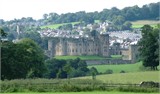
Alnwick Castle
My 16th great grandfather was born into a fancy Scottish family. Politics, diplomacy and treason were part of life in Scotland under King James III:
Robert Boyd (d.c.1470) Lord Boyd, was a Scottish Statesman.
A son of Sir Thomas Boyd (d. 1439), Robert Boyd belonged to an old distinguished family, of which one earlier Sir Robert Boyd, had fought with Sir William Wallace and Robert the Bruce.
Created Lord Boyd in 1454, he was one of the Regents during the minority of King James III, in 1460. He conspired with his brother, Sir Alexander Boyd, and obtained possession of the King’s person in 1466 and was made by Act of Parliament sole Governor of the Realm.
He negotiated the marraige between James and Margaret of Norway in 1469 and secured with it the cession of the Orkney Islands by Norway. He was appointed Great Chamberlain for life, and Lord Justice General in 1467.
Conflict broke out between the King and Boyd family. Robert, and his son Thomas Boyd, 1st Earl of Arran (who was married to Princess Mary), were out of the country involved in diplomatic activities when their regime was overthrown. Robert, 1st Lord Boyd was pronounced guilty of treason and fled firstly to Alnwick, Northumberland. His brother and assistant, Sir Alexander Boyd, was captured and beheaded on November 22, 1469.
Robert 1st Lord Boyd fought in the English service in the French wars, and died in exile.
He married Mariotta, daughter of Sir John Maxwell of Calderwood, and had numerous issue. One of his daughters, Elizabeth, married Archibald Douglas, 5th Earl of Angus.
Robert Boyd (1425 – 1470)
Lord Boyd conspired with his brother, Sir Alexander Boyd, and obtained possession of the young King’s person in 1466 and was made by Act of Parliament sole Governor of the Realm; and Great Chamberlain for life, and Lord Justice General in 1467.[4] Early in that year he procured the marriage of his eldest son, Thomas, (created Earl of Arran for that occasion) with Mary, elder sister of James III, which aroused the jealousy of the other nobles[1] and made his eventual downfall inevitable since the King regarded the marriage as an unforgivable insult.
Lord Boyd obtained the cession of the Orkney Islands to Scotland, 8 September 1468, from Christian I, King of Norway, for whose daughter Margaret, he negotiated a marriage with James III. While absent for that purpose he and his son Thomas (the Earl of Arran) and his brother (and coadjutor) Sir Alexander Boyd, were attainted for high treason, whereby his peerage became forfeited. He was living Easter 1480/1, and died before October 1482, it is said, at Alnwick in Northumberland where he had fled in 1469.[1]
James III’s biographer sums Boyd up as an unscrupulous political gambler and an inveterate optimist. To forcibly assume guardianship of an underage King was, indeed, a familiar path to power in mediaeval Scotland, but it was also a dangerous path. Boyd underestimated the dangers, overestimated his support, and made the fatal mistake of marrying his son to the King’s sister, an insult the King would not forgive.[5]
FamilyRobert Boyd belonged to an old and distinguished family, of which one earlier Sir Robert Boyd, had fought with Sir William Wallace and Robert The Bruce.[4] He was the son and heir of Sir Thomas Boyd of Kilmarnock (died 9 July 1439).[1] Robert married Mariot (or Janet), daughter of Sir Robert Maxwell of Calderwood. She died after 25 June 1472, apparently early in 1473.[1] They had three sons:[6]
[ edit] References
Attribution
 This article incorporates text from a publication now in the public domain: Chisholm, Hugh, ed. (1911). “Boyd, Robert Boyd”. Encyclopædia Britannica. 4 (11th ed.). Cambridge University Press. pp. 353,354. http://www.archive.org/stream/encyclopaediabri04chisrich#page/353/mode/1up. This article incorporates text from a publication now in the public domain: Cokayne, George Edward, ed. (1912). Complete peerage of England, Scotland, Ireland, Great Britain and the United Kingdom, extant, extinct or dormant (Bass to Canning). 2. London: The St. Catherine Press, ltd.. pp. 260,261. http://www.archive.org/details/completepeerageo02coka. This article incorporates text from a publication now in the public domain: Balfour, Paul, James (1904). The Scots peerage; founded on Wood’s edition of Sir Robert Douglas’s peerage of Scotland; containing an historical and genealogical account of the nobility of that kingdom. 5. Edinburgh: D. Douglas. pp. 145,146.
Peerage of ScotlandPre ceded byNew Creation Lord Boyd1454–1482Succeeded byJames Boyd
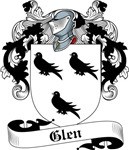
Glen Coat of Arms
My 20th great grandfather married the illegitimate daughter of Robert the Bruce, Margaret. His legitimate daughter Marjorie is also my ancestor. This is the kind of thing that gets the branches of your tree tangled. I wonder if he really accompanied the heart of Robert the Bruce to the holy land. What a totally bizarre mission. There is some confusion, but we know a lot, considering that he was born in 1303.
Robert, son of John de le Glen, married Margaret, illegitimate daughter of Robert Bruce Robert de Glen and ” Margaret Bruce the King’s sister,” his spouse, had a grant from David II., undated, of Nether Pitedye, Kinghorn, Fife (adjoining Balmuto) Robertson notes three other charters from David to this Robert de Glen, of the lands of Glasgow Forest, thanedom of Kintore, Aberdeen. Wood gives Margaret as legitimate, and says that she married, secondly, William, Earl of Sutherland. The latter did marry as his second wife, Margaret Bruce; but it is impossible that she was the widow of Glen, and an authority points out that the arms quartered by Glen, and attributed to the co-heiress of Abernethy, were not the Abernethy arms, but those of Scotland with the Scottish mark of illegitimacy, which agrees with a tradition preserved in several branches of the family, and is conclusive. Another tradition, traceable for four centuries, insists that Robert de Glen was one of those who accompanied the heart of Bruce to the Holy Land, and the Linlithgow line used two crests, one a martlet; the other an arm, the hand grasping a heart, in commemoration of that event. Moreover, the Glens of Bar possessed the sword of Bruce, which a descendant carried to Ireland, in 1606, where it was seen a few years since, the inscription on the blade leaving no doubt as to its original ownership.
Robert Glen (1303 – 1345)
is my 20th great grandfather
John Glen (1349 – 1419)
son of Robert Glen
Isabel Glen (1380 – 1421)
daughter of John Glen
Isabel Ogilvie (1406 – 1484)
daughter of Isabel Glen
Elizabeth Kennedy (1434 – 1475)
daughter of Isabel Ogilvie
Isabella Vaus (1451 – 1510)
daughter of Elizabeth Kennedy
Marion Accarson (1478 – 1538)
daughter of Isabella Vaus
Catherine Gordon (1497 – 1537)
daughter of Marion Accarson
Lady Elizabeth Ashton (1524 – 1588)
daughter of CATHERINE GORDON
Capt Roger Dudley (1535 – 1585)
son of Lady Elizabeth Ashton
Gov Thomas Dudley (1576 – 1653)
son of Capt Roger Dudley
Anne Dudley (1612 – 1672)
daughter of Gov Thomas Dudley
John Bradstreet (1652 – 1718)
son of Anne Dudley
Mercy Bradstreet (1689 – 1725)
daughter of John Bradstreet
Caleb Hazen (1720 – 1777)
son of Mercy Bradstreet
Mercy Hazen (1747 – 1819)
daughter of Caleb Hazen
Martha Mead (1784 – 1860)
daughter of Mercy Hazen
Abner Morse (1808 – 1838)
son of Martha Mead
Daniel Rowland Morse (1838 – 1910)
son of Abner Morse
Jason A Morse (1862 – 1932)
son of Daniel Rowland Morse
Ernest Abner Morse (1890 – 1965)
son of Jason A Morse
Richard Arden Morse (1920 – 2004)
son of Ernest Abner Morse
Pamela Morse
I am the daughter of Richard Arden Morse

Anne Devereux
Anne’s father Walter was a big Yorkist knight in the War of the Roses. She married a knight who was mixed up in this royal Lancaster/York mess as well. Her husband, William Herbert, was lord of a giant castle, Raglan. She had nice digs in Wales at this castle while the Brits were embroiled in their Rose thing. I am still having trouble sorting out the royal roses and why the people of Wales would care, but they got into it too.
Anne Devereux is the daughter of Sir Walter Devereux and Elizabeth Merbury. 2 She married William Herbert, 1st Earl of Pembroke, son of Sir William ap Thomas. Her married name became Herbert.
Children of Anne Devereux and William Herbert , 1st Earl of Pembroke
Lady Catherine Herbert + 3 d. b 8 May 1504
Lady Maud Herbert + 1 b. 1448, d. a 1485
Citations
[1] Richard Glanville-Brown, online , Richard Glanville-Brown (RR 2, Milton, Ontario, Canada), downloaded 17 August 2005.
[2] Tim Boyle, “re: Boyle Family,” e-mail message to Darryl Roger Lundy, 16 September 2006. Hereinafter cited as “re: Boyle Family.”
[3] G.E. Cokayne; with Vicary Gibbs, H.A. Doubleday, Geoffrey H. White, Duncan Warrand and Lord Howard de Walden, editors, The Complete Peerage of England, Scotland, Ireland, Great Britain and the United Kingdom, Extant, Extinct or Dormant, new ed., 13 volumes in 14 (1910-1959; reprint in 6 volumes, Gloucester, U.K.: Alan Sutton Publishing, 2000), volume VII, page 167. Hereinafter cited as The Complete Peerage.
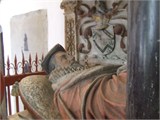
Thomas Forster monument
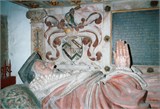
The Monument to Sir Thomas Forster A.D. 161 shows him in his judge’s robes, is a perfect example of the period with fine contemporary wrought-iron railings. He was born in 1548 and joined the Inner Temple in 1571 and was made Sergeant before Elizabeth’s death in 1603. He was knighted ii 1604 and appointed Judge of Common Pleas in 1607. Sir Thomas was one of the first Governors of Charterhouse and was counsel to Queen Ann and Prince Henry. He died on May 18th, 1612 at Clerkenwell and was buried in Hunsdon on May 20th, 1612.
Sir Thomas Forster (1548 – 1612)
Judge in grave
F orsters continued to serve the Kings of England. Sir Richard Forster fought in the Hundred Years’War against France with King Edward III at Bordeaux and Crecy. Richard participated in the Battle ofPoictiers in 1356 and was knighted for his part in the battle.Sir Richard’s son, William, was born about 1355 and married Elizabeth De Orde about 1400 inBuckton, Northumberland, England. William was knighted for service to King Henry V and served asa General in the battle against France.Their son Thomas Forster married Joan De Elmerdon about 1430. Thomas and Joan’s son, alsonamed Thomas Forster, married Elizabeth Featherstone of Stanhope Hall, Durham, England. Theyhad Roger Forster, although records show that he spelled the name Foster rather than Forster.Roger Foster married Joan Hussey in 1540.
A Genealogy of the Descendants of Roger Foster of Edreston, Northumberlandwas compiled by Alkman Henryson Foster-Barham and published in London in 1897. Roger was 17 when he fled from Northumberland, as explained in a letter from Sir John Forster of Bamburgh, dated 17 April 1590. The letter below was written by Sir John to Roger Foster’s grandson, Thomas Foster of Hunsdon.
” Dear Cousin, After right hearty commendations unto you, ye shall understand I have received yourletter wherein you desire to know of your pedigree. Your grandfather, as ye havelearned, was descended out of the house of Etherstone – whether he was the elder,second, or third, or fourth brother – and fled the country of Northumberland. I assure you I can truly satisfy you therein. Your grandfather, called Roger Foster,was my great uncle. His father was called Thomas Forster and his mother’s namewas Featherstonehaugh. His eldest son was called Thomas Forster, my greatgrandfather. It happened that four of the said brethren had been at a-hunting and were ridinghomeward through a town called Newham. They and a company of Scottish Kerrs fellout and there began bloodshed and feuds which continued until there was but oneKerr living. During this time my grandfather and yours and another brother of theirs calledNicholas Forster (mine being twenty years old, yours 17 years, and Nicholas, a childof 14) being a-hunting – were waited upon by one of the Kerrs and two of theiralliance called Too and King. They set upon the three brothers and were thought tohave slain them at a place near Branton where a cross still stands.Two were slain there and Kerr fled. After the slaughter my grandfather fled toRidsdale in the county because he was safe there and yours fled to southern parts.” At my house near Alnwick, 17th April 1590, your loving cousin,John Forster.”
Roger Foster’s son was Thomas Foster (1515-1599) of Hunsdon, Hertfordshire, England, whomarried Margaret Browning (1520-1599). Thomas and Margaret had a son who was also named Thomas Foster (1548-1612), who married Susannah Forster(1555-1625).

Gov Simon Bradstreet
Bradstreet was chosen to fill several important positions in colonial affairs, and he served as an assistant in the lower house of the General Court for most of his life. During his first twenty years in the colony, he was heavily involved in business pursuits, as well as the founding of new towns. In 1661, he was chosen as an envoy to the court of Charles II, that monarch having recently been restored to power. In 1679 Bradstreet was chosen governor of the colony. He would turn out to be the last governor under the original charter. In 1686, the colony was denied its right to self-rule, and Sir Edmund Andros was installed as governor. Bradstreet served briefly as governor again after Andros was overthrown, but England replaced him with Sir William Phips in 1692. Bradstreet continued to serve in government until his death in 1697, in Salem, Massachusetts.
Simon Bradstreet built his first home in America at the present location of Harvard Square at Brattle Street and John F. Kennedy Street, Cambridge Massachusetts
Governor Simon Bradstreet (1604 – 1697)
is my 9th great grandfather
John Bradstreet (1652 – 1718)
son of Governor Simon Bradstreet
Mercy Bradstreet (1689 – 1725)
daughter of John Bradstreet
Caleb Hazen (1720 – 1777)
son of Mercy Bradstreet
Mercy Hazen (1747 – 1819)
daughter of Caleb Hazen
Martha Mead (1784 – 1860)
daughter of Mercy Hazen
Abner Morse (1808 – 1838)
son of Martha Mead
Daniel Rowland Morse (1838 – 1910)
son of Abner Morse
Jason A Morse (1862 – 1932)
son of Daniel Rowland Morse
Ernest Abner Morse (1890 – 1965)
son of Jason A Morse
Richard Arden Morse (1920 – 2004)
son of Ernest Abner Morse
Pamela Morse
I am the daughter of Richard Arden Morse
ORIGIN: Horbling, Lincolnshire MIGRATION: 1630 FIRS T RESIDENCE: Boston RE MOVES: Cambridge 1634, Ipswich 1636, Salem 1646, Andover 1652, Salem 1676, Boston by 1689, Salem 1692 RETU RN TRIPS: To England and return in 1662 on colony business OCCUPATION: Magistrate. CHURCH MEMBERSHIP: “Simon Brandstreete” admitted to Boston church as member #7, which would be in the fall of 1630 [BChR 13]. FREE MAN: 25 May 1636 [MBCR 1:372]. (He was one of seven men admitted on that day who had been involved with the Massachusetts Bay Company for many years, and had held high offices; their admission to freemanship on this date was merely a formality that recognized a status that had existed for some time.) ED UCATION: Morison argues that the Simon Bradstreet who received degrees at Emmanuel College, Cambridge, was not the immigrant, although the immigrant did reside at that college about 1628-9 and was a very well-educated man [Morison 367-68; see Venn 1:203 for the record of the “other” Simon Bradstreet]. OFFICES: Assistant, Massachusetts Bay Colony, 1630 to 1678; Secretary, 1630 to 1636; Governor, 1679 to 1686 and 1689 to 1692; Commissioner of the United Colonies, 1644, 1663 to 1667 [MA Civil List 17-18, 21-26, 28]. (Savage credits Bradstreet with service as Deputy Governor from 1673 to 1678, but Samuel Symonds held this office in those years, as Savage also notes.) Bradstreet held many other offices at the county and local level, such as Cambridge selectman and Essex magistrate. ESTATE: With other leading men of Essex county, “Mr. Symon Bradstreete” petitioned to be allowed a “free company of adventurers” to pursue trade in Massachusetts Bay, 1 October 1645 [MBCR2:138]. The General Court granted “Mr. Symon Bradstreete” eight hundred acres to be located near the farms of Capt. Keane and others, 23 May 1650 [MBCR 3:193, 413]. Bradstreet and Thomas Wiggen, gent., were granted one thousand acres near Dover, with the privilege of timber for their sawmill, 14 October 1651 [MBCR 3:247, 306, 364]. Mr. Bradstreet and Mr. Symonds were granted five hundred acres “in reference to service done at York and Kittery,” 14 September 1653 [MBCR 3:339] to be laid out eight miles from the Haverhill meeting house [MBCR 4:2:327]. He was granted another five hundred acres, August 1653, near the Connecticut River next to his two hundred acres, 6 May 1657 [MBCR 3:430], but was encouraged to locate it elsewhere, 28 May 1659 [MBCR 4:1:380]. As a result, he was granted an additional three hundred acres, to be six miles or more from the Northampton meeting house, 31 May 1660 [MBCR 4:1:420]. His five hundred acres near Hadley was in controversy 18 May 1664 [MBCR 4:2:106]. In his will, dated 23 December 1689 (with codicil of 27 January 1692/3) and proved 2 April 1697, “Simon Bradstreet of Boston … being at present in competent health and strength” set his house in order and “for my outward estate which God in his rich mercy hath blessed me withal in this Wilderness (having given all my eight children such portions as I thought meet and equal & divided my plate and household stuff amongst them)” the remainder was bequeathed to “my dear and loving wife Mrs. Ann Bradstreet all that estate real and personal whatsoever that I had of hers or with her in marriage … (according to agreement made with her before marriage) in lieu of her thirds,” also £10 per year during her life out of my farm at Lynn “whereon Cornet John Lewis now liveth,” also £10 more during her widowhood, one half from my house and land at Andover and the other half from my farm at Topsfield, also “my negro woman Hannah and her daughter Bilhah now living with me, not to be sold to any except in way of marriage, but if she finds meet to dispose of them or either of them before or at her death, then to some of my children whom she pleaseth,” also “use of that little household stuff I bought since I came to Boston during her pleasure and then to some of my children as she shall see meet,” also provisions at the house in Boston with one quarter rent of the house wherein I lived at my death “entreating her to accept of these small bequests as a testimony of my unfeigned love … in regard of that love, care and tenderness she hath always showed to me and mine”; whereas “by a former will I had given to my eldest son Samuel Bradstreet my farm at Lynn” but at his death by his will given to Mary Bradstreet “his eldest daughter by his first wife whom I have been forced to educate and maintain … since September 1670 … and have now three of my said son’s children sent me from Jamaica” make some alteration to this gift by granting my wife £10 a year from the farm and “to the said Mercy Bradstreet the daughter of my son Samuel” the farm in Lynn occupied by Cornet John Lewis, to her and her heirs or in want of such heirs of her body, to the children of her father Samuel Bradstreet equally she paying the aforementioned £10 to “her grandmother Ann Bradstreet”; to “the said Mercy her father’s picture and household goods”; to “John and Simon Bradstreet two of my son Samuel’s children now with me my house and land in Lynn” purchased of Major Samuel Appleton and his son Samuel, said land and house equally divided betwixt them, also to the said John Bradstreet my twenty acres of meadow and part of a little island in Topsfield; to “Anne Bradstreet another child of my son Samuel Bradstreet” a house and land in Lynn of forty-three acres lately purchased of Mr. Ezekiel Needham; “my dear and loving wife Mrs. Ann Bradstreet” executrix as regards the three children of my son Samuel viz. John Simon and Anne; to the three children of my son Simon Bradstreet viz. Simon John and Lucy, a half of all my houses and lands in Andover, also £10; to Simon Bradstreet the eldest of the three children before mentioned ten acres in Lynn near my farm; to “my son Dudley Bradstreet” the other half of my houses and lands in Andover, also to each of his children living at my decease £10 each; to “my son John Bradstreet and to the heirs of his body lawfully begotten my house and farm at Topsfield wherein he now liveth,” also the lots of wood belonging to the farm, also the parcel of meadow purchased of Robert Muzzey together with all the swamp and ten or twelve acres of upland, also £60 and to each of his children living at my decease £10 apiece, his heirs to receive the farm as follows, one half to his eldest son and the other half equally divided amongst the rest of his sons and daughters; to “my grandchild Mr. John Cotton of Hampton” £20 and to his sisters “the daughters of my daughter Dorothy” or so many of them living at my decease £10 each “only as to Ann’s legacy I leave it to my executor and overseers to do therein as they shall see cause and as she may deserve” by her carriage and behavior; to “my son-in-law Mr. Andrew Wiggin” all that debt which he owes me £50″ and to every of his children by “my daughter Hannah” living at my decease £10 each; to “my daughter Mrs. Sarah Ward and to her husband Capt. Samuel Ward” all that debt which her former husband Mr. Richard Hubbard owed me being more than £100, and to every of her children living at my decease £10; to “my daughter Mrs. Mercy Wade and to her husband Mr. Nathaniel Wade” my farm at Topsfield whereon John Hunkins now lives, with twenty six acres of upland, part of an island, also the lot of upland of forty acres, she or her husband paying yearly the sum of £5 to “my wife Mrs. Ann Bradstreet during her widowhood,” also to every one of her children living at my death £10 each; to “the three children of my son Simon” one farm of five hundred acres granted me for service to the colony and not laid out yet; to “my son Dudley Bradstreet” the other farm of five hundred acres granted me; to “the three children of my son Samuel (viz) John Simon and Anna now with me” £100 each for their education and make void a former bequest to them of my two houses and lands in Lynn mentioned in the former part of my will, “having already disposed of one of them”; to Mr. Samuel Willard “the Reverend Pastor of the South Church in Boston” £5; residue distributed by my executors to some of my grandchildren, especially to those of “my son Simon and Daughter Cotton whose parents had the least portions”; son Dudley Bradstreet sole executor except in duties committed to “my dear wife”; “my much honored friends Capt. Wait Winthrop Esqr. and Mr. Peter Sedgwick” overseers to accept 40s. each to buy a ring. In a codicil dated 27 January 1692/3 Bradstreet altered the bequest of his two negros Hannah and Bilhah so they were completely at the dispose of wife Ann Bradstreet and she to pay to said negros 20s. each; to my wife my spectacles set in gold; again entrusted the education of his son Simon’s three children to wife Ann Bradstreet; to my grandson John [Bradstreet] my set of gold shirt buttons; to Simon a silver trencher salt; to Anna a silver porringer; to “my granddaughter Mrs. Mary Oliver her father’s picture”; to “my three grandchildren John, Simon and Anne, all the arrears of what is due to me for salary as late Governor of the Colony of the Massachusetts Bay”; to “my grandson Simon the son of my late son Mr. Simon Bradstreet” ten acres of land in Lynn “he standing in great need of my help”; authorized his executor to sell the farm at Topsfield if the price of £250 can be gotten, £100 to his three grandchildren, John, Simon and Anne the children of my son Samuel, and the rest to my daughter Wade; Mr. Isaac Addington overseer [SPR 11:276-82]. BIRTH: Baptized Horbling, Lincolnshire, 18 March 1603/4, son of Rev. Simon Bradstreet [NEHGR 48:168-71]. DEATH: Salem 27 March 1697 [Sewall 371]. MAR RIAGE: (1) Before 1630 Anne Dudley, daughter of THOMAS DUDLEY. (At the birth of her first child she wrote “It pleased God to keep me a long time without child …” [EIHC 64:303]. She was admitted to Boston church as member #13, shortly after her husband [BChR 13]. She died at Andover 16 September 1672. (Simon Bradstreet’s first wife, Anne (Dudley) Bradstreet, was, of course, the renowned poetess. Two recent studies of Anne Bradstreet and her poetry are Elizabeth Wade White, Anne Bradstreet: The Tenth Muse [New York 1971], and Ann Stanford, Anne Bradstreet: The Worldly Poet [New York 1974].) Of her children she wrote
(2) 6 June 1676 Ann (Downing) Gardner, baptized St. Brides Fleet Street, London, 12 April 1633, daughter of Emanuel Downing (by his second wife, Lucy Winthrop), and widow of Captain Joseph Gardner of Salem (son of THOMAS GARDNER) [Hale, House 518]; she d. 19 April 1713 [Sewall 710]. CHILDREN:
ASSOCIATIONS: As argued under JOHN BOSWORTH, Simon Bradstreet may have brought with him as servants ANTHONY COLBY, JOHN BOSWORTH, GARRETT HADDON and JOSEPH REDDING. While still in England Bradstreet had married the daughter of THOMAS DUDLEY.COMMENTS:Bradstreet was partners with George Carr and Richard Saltonstall in a vessel captained by Elias Parkman, who plied up and down the coast from the Bay to Connecticut. Parkman’s debt was the subject of a letter by Saltonstall to Winthrop in October, 1638 [WP 4:64]. Stephen Bachiler invited the help of “our Christian Friend Mr. Brodstreet” the first working day when he began the settlement of Hampton [WP 4:70]. On 23 April 1646 Emmanuel Downing reported to John Winthrop that “Mr. Broadstreet is about to settle his habitation with us, at Salem; and to imploy his stock in trading here” [WP 5:78]. At the General Court on 27 November 1661, “the honored Mr. Bradstreete is called, on the service of the country, to leave his family’s occasions, & go for England…” [MBCR 4:2:36]. “1661 February 10th Mr. Bradstreet & Mr. Norton with Mr. Davis & Mr. Hull took ship & set sail the next morning” [RChR 199]. Eliot welcomes him home 3 September 1662: “Mr. Bradstreet & Mr. Norton returned from England, bringing with them a gracious letter from his Majesty confirming our Charter & liberties” [RChR 200]. In parallel with other New England colonies, Massachusetts Bay saw the need to send representatives to England at the time of the Restoration to see to their “liberties.” John Eliot recorded on 10 July 1666 that There happened a dreadful burning at Andover. Mr. Bradstreet’s house & the greatest part of his goods were burnt. The occasion of which burning was the carelessness of the maid, who put hot ashes into an hogshead over the porch: the tub fired about 2 o’clock in the morning & set the chamber & house on fire [RChR 204]. Unlike several of his contemporaries, Simon Bradstreet managed his estate with a firm hand and dealt with reliable people. There was no necessity for him to clog the courts with debt cases, and aside from the occasional dead cow [EQC 1:116], “worried hog” [EQC 1:248] or missing beaver skins [EQC 1:90], Bradstreet generally tended to stay on the bench and not before it. Certainly in comparison to others of similar broad trading interests, Bradstreet’s business career was quite peaceful. His choice of servants was generally good as well, although he did have a little trouble with Thomas “Shareman” [EQC 1:205]. BIBLIOGRAPHIC NOTE: Unlike many of his equally illustrious contemporaries, Bradstreet has not been the subject of a lengthy biography (having been eclipsed by his more famous wife in this regard). William Andrews Pew did summarize his life in 1928 [EIHC 64:301-28]. |
The Great Migration BeginsSketchesPRESERVED PURITAN

tatted doilie
My grandmother did tatting, a lace work done with a tiny plastic shuttle which produced doilies. I have a large variegated doilie that she made but it is in the closet. In my house it would be a big dust collector. When I was young I did crochet, embroidery and some knitting. I taught myself to sew at boarding school when I was 14. When I was 17 I learned to weave on a loom. I like the art and enjoyment of crafting things for my own fashion purposes. My mother was an advanced self styler creating matching hats, shoes and belts to go with her dresses. All of these activities are so satisfying until…..you make a mistake. Then you find there is only one way out of your predicament..rip it out and start again. The entire time you are ripping it out you must take care not to damage the materials, which requires that you not enter rip out rage too deeply. This was agony to me, so I became a potter. If you blow your creation before firing you simply quickly turn it back into mud. If my pots were ugly and I did not want them to live I put them in a bush in the desert and shot them with a 22 pistol. There was no ripping and remorse. A different kind of patience is required to make pots. You just accept that a certain percentage will fail and that is fine.
Last week I opened a message on Ancestry.com from a common descendant of Swain Smith. I am always happy to hear from my fam on Ancestry because they bring extra data and sometimes have documents and pictures to share. This cousin pointed out to me that I had an obvious error in my tree. Swain’s father married twice, and I had listed his mother as the second wife. Since he had been born before the second marriage my mistake was easy to spot. I have revised my tree, and now have no clue about the pedigree of Swain’s real mother. I can only rip out the branches of the tree that I built on a specious assumption and start again. I am so totally back in crochet world. I have to go back to the place where I skipped the loop of my 4th great-grandmother, Sarah Archer, born in New Jersey in 1787. She is my new mystery woman.
 mermaidcamp