mermaidcamp
Keeping current in wellness, in and out of the water
You can scroll the shelf using ← and → keys
You can scroll the shelf using ← and → keys

Byzantine Empire
John Komnenos (Greek: Ἰωάννης Κομνηνός; ca. 1015 – 12 July 1067) was a Byzantine aristocrat and military leader. The younger brother of Emperor Isaac I Komnenos, he served as Domestic of the Schools during Isaac’s brief reign (1057–59). When Isaac I abdicated, Constantine X Doukas became emperor and John withdrew from public life until his death in 1067. Through his son Alexios I Komnenos, who became emperor in 1081, he was the progenitor of the Komnenian dynasty that ruled the Byzantine Empire from 1081 until 1185, and the Empire of Trebizond from 1204 until 1461.
Life.
John Komnenos was born ca. 1015 as the younger son of the patrikios Manuel Erotikos Komnenos, a senior military commander in the late reign of Basil II (ruled 976–1025). He is first mentioned in 1057, the year his elder brother Isaac I Komnenos, at the head of a group of generals, rebelled against Michael VI and forced him off the throne. At the time of the revolt, John held the post of doux, but after his brother’s victory, he was raised to the rank of kouropalates and appointed as Domestic of the Schools of the West.
Nothing is known of John’s activities during his brother’s reign, although Nikephoros Bryennios the Younger, who married John’s granddaughter Anna Komnene, says that in his capacity as Domestic of the West he left his (unspecified) acts as an “immortal monument” to the people of the Balkan provinces.
Isaac’s reign was cut short by his clash with the powerful Patriarch of Constantinople,Michael Keroularios, who had been instrumental in securing Michael VI’s abdication, and the powerful civil aristocracy of the capital. Keroularios and his supporters led the opposition against Isaac’s stringent economizing policies, forcing him to resign on 22 November 1059, after which he withdrew to the Stoudios Monastery.
The crown then passed to Constantine X Doukas (r. 1059–67), although Bryennios asserts that it was first offered to John, who refused it, despite the pressure of his wife, Anna Dalassene, to accept. According to the historian Konstantinos Varzos, however, this version is suspect, and may well be a post-fact attempt at legitimizing the eventual usurpation of the throne by John’s son, Alexios I Komnenos (r. 1081–1118).
John is not mentioned in the sources during the reign of Constantine X, perhaps indicating, according to Konstantinos Varzos, that he was in imperial disfavour, despite Bryennios’ assertion that both he and his brother remained much honoured by the new emperor.The late 12th-century typikon of the Monastery of Christ Philanthropos, founded by Alexios I’s wife Irene Doukaina, is the only source to record that John Komnenos retired to a monastery, probably at the same time as his wife, Anna Dalassene. He died as a monk on 12 July 1067.
Family..John Komnenos married Anna Dalassene, the daughter of Alexios Charon, most likely in 1044. Anna, born ca. 1028, long outlived her husband and after his death ran the family as its undisputed matriarch. Anna became involved in conspiracies against the Doukas family, whom she never forgave for taking the throne in 1059. Later she also played a major role in the successful overthrow of Nikephoros III Botaneiates (r. 1078–81) and the rise of her son Alexios to the throne. After that, and for about fifteen years, she served as the virtual co-ruler of the empire along her son. She then retired to a monastery, where she died in 1100 or 1102.
With Anna, John had eight children, five boys and three girls:
IOANNES Komnenos, son of MANUEL Erotikos Komnenos & his wife — ([1015]-12 Jul 1067). Nikephoros Bryennios names “maiori natu Isaacio…iunior Ioannes” as the two sons of “Comneni Manuelis” . His parentage is confirmed by the Alexeiad which describes Emperor Isaakios Komnenos as brother-in-law of Anna Dalassena, an earlier passage naming him Ioannes [43]. Patrikios. Skylitzes records that Emperor Isaakios created “Joannem fratrem et Catacalon Combustum curopalatas” and “fratrem suum magnum domesticum” after his accession, in 1057 . His brother abdicated in his favour 25 Dec 1059, but Ioannes refused the throne. He became a monk as IOANNES. The list of obituaries of Empress Eirene Doukas’s family records the death “12 Jul, monk John father of Emperor”.
m ([1042]) ANNA Dalassena, daughter of ALEXIOS Kharon Prefect of Italy & his wife — Dalassena (-1 Nov/27 Apr 1100/01). Nikephoros Bryennios records the marriage of “Ioanni” and “filia Charonis Alexii…Anna”, recording that her mother was “genus a Dalassenis”. The Alexeiad names “Anna Dalassena, the mother of the Komneni” when recording that she arranged the marriage of “the grandson of Botaneiates and the daughter of Manuel her eldest son”. Despoina 1048/57. Regent of Byzantium 1081 and 1094-1095. She became a nun at Pantopopte convent which she founded. The list of obituaries of Empress Eirene Doukas’s family records the death “1 Nov, Anna, mother of the Emperor”.
Ioannes Komnenos & his wife had eight children:

Empress Irini Augusta Dukaina Dukas
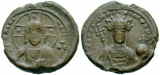
Empress Irini Augusta Dukaina Dukas’ seal
My 29th great-grandmother was married when she was 11 years old. By this marriage she became Empress Mother of the Byzantine Empire. Her daughter Anna recorded history, perhaps revisionist. Empress Irini is an ancestor of Ann Dudley Bradstreet, another woman who recorded history and wrote poetry. I have noticed that Mistress Bradstreet has the most impressive pedigree of important powerful women. This one, like many other royals who are embroiled in political intrigue, landed in a convent under mild house arrest at the end of her life.
Irene Doukaina or Ducaena (Greek: Ειρήνη Δούκαινα, Eirēnē Doukaina) (c. 1066 – February 19, 1123 or 1133) was the wife of the Byzantine emperor Alexios I Komnenos, and the mother of the emperor John II Komnenos and of the historian Anna Komnene.
Empress Irini Augusta Dukaina Dukas (1066 – 1133)
is my 29th great grandmother
Theodora Comnena (1096 – 1116)
daughter of Empress Irini Augusta Dukaina Dukas
Andronikos Dukas Angelos (1122 – 1185)
son of Theodora Comnena
Alexios Emperor Byzantine Empire (1153 – 1204)
son of Andronikos Dukas Angelos
Empress Anna Komnene Angelina Nicaea (1176 – 1212)
daughter of Alexios Emperor Byzantine Empire
MARIA Laskarina (1206 – 1270)
daughter of Empress Anna Komnene Angelina Nicaea
King of Hungary Stephen V (1240 – 1277)
son of MARIA Laskarina
Marie DeHungary (1257 – 1323)
daughter of King of Hungary Stephen V
Marguerite Sicily Naples (1273 – 1299)
daughter of Marie DeHungary
Jeanne DeVALOIS (1294 – 1342)
daughter of Marguerite Sicily Naples
Philippa deHainault (1311 – 1369)
daughter of Jeanne DeVALOIS
John of Gaunt – Duke of Lancaster – Plantagenet (1340 – 1399)
son of Philippa deHainault
Philippa Plantagenet (1370 – 1415)
daughter of John of Gaunt – Duke of Lancaster – Plantagenet
Beatrix DePinto (1403 – 1447)
daughter of Philippa Plantagenet
John Fettiplace (1427 – 1464)
son of Beatrix DePinto
Richard Fettiplace (1460 – 1511)
son of John Fettiplace
Anne Fettiplace (1496 – 1567)
daughter of Richard Fettiplace
Mary Purefoy (1533 – 1579)
daughter of Anne Fettiplace
Susanna Thorne (1559 – 1586)
daughter of Mary Purefoy
Gov Thomas Dudley (1576 – 1653)
son of Susanna Thorne
Anne Dudley (1612 – 1672)
daughter of Gov Thomas Dudley
John Bradstreet (1652 – 1718)
son of Anne Dudley
Mercy Bradstreet (1689 – 1725)
daughter of John Bradstreet
Caleb Hazen (1720 – 1777)
son of Mercy Bradstreet
Mercy Hazen (1747 – 1819)
daughter of Caleb Hazen
Martha Mead (1784 – 1860)
daughter of Mercy Hazen
Abner Morse (1808 – 1838)
son of Martha Mead
Daniel Rowland Morse (1838 – 1910)
son of Abner Morse
Jason A Morse (1862 – 1932)
son of Daniel Rowland Morse
Ernest Abner Morse (1890 – 1965)
son of Jason A Morse
Richard Arden Morse (1920 – 2004)
son of Ernest Abner Morse
Pamela Morse
I am the daughter of Richard Arden Morse
Succession of Alexios and Irene
Irene was born in 1066 to Andronikos Doukas and Maria of Bulgaria, granddaughter of Ivan Vladislav of Bulgaria. Andronikos was a nephew of Emperor Constantine X and a cousin of Michael VII.
Irene married Alexios in 1078, when she was still eleven years old. For this reason the Doukas family supported Alexios in 1081, when a struggle for the throne erupted after the abdication of Nikephoros III Botaneiates. Alexios’ mother, Anna Dalassene, a lifelong enemy of the Doukas family, pressured her son to divorce the young Irene and marry Maria of Alania, the former wife of both Michael VII and Nikephoros III. Irene was in fact barred from the coronation ceremony, but the Doukas family convinced the Patriarch of Constantinople, Kosmas I, to crown her as well, which he did one week later. Anna Dalassene consented to this but forced Kosmas to resign immediately afterwards; he was succeeded by Eustratios Garidas.
Alexios’ mother Anna continued to live in the imperial palace and to meddle in in her son’s affairs until her death 20 years later; Maria of Alania may have also lived in the palace, and there were rumours that Alexios carried on an affair with her. Anna Komnene vociferously denied this, although she herself was not born until December 1, 1083, two years later.
Character
Anna may have been whitewashing her family history; she has nothing but praise for both of her parents. She describes her mother in great detail:
“She stood upright like some young sapling, erect and evergreen, all her limbs and the other parts of her body absolutely symmetrical and in harmony one with another. With her lovely appearance and charming voice she never ceased to fascinate all who saw and heard her. Her face shone with the soft light of the moon; it was not the completely round face of an Assyrian woman, nor long, like the face of a Scyth, but just slightly oval in shape. There were rose blossoms on her cheeks, visible a long way off. Her light-blue eyes were both gay and stern: their charm and beauty attracted, but the fear they caused so dazzled the bystander that he could neither look nor turn away…Generally she accompanied her words with graceful gestures, her hands bare to the wrists, and you would say it was ivory turned by some craftsman into the form of fingers and hand. The pupils of her eyes, with the brilliant blue of deep waves, recalled a calm, still sea, while the white surrounding them shone by contrast, so that the whole eye acquired a peculiar lustre and a charm which was inexpressible.”
It “would not have been so very inappropriate,” Anna writes, to say that Irene was “Athena made manifest to the human race, or that she had descended suddenly from the sky in some heavenly glory and unapproachable splendour.”
Irene was shy and preferred not to appear in public, although she was forceful and severe when acting officially as empress (basileia). She preferred to perform her household duties, and enjoyed reading hagiographic literature and making charitable donations to monks and beggars. Although Alexios may have had Maria as a mistress early in his reign, during the later part of his reign he and Irene were genuinely in love (at least according to their daughter Anna). Irene often accompanied him on his expeditions, including the expedition against Prince Bohemund I of Antioch in 1107 and to the Chersonese in 1112. On these campaigns she acted as a nurse for her husband when he was afflicted with gout in his feet. According to Anna she also acted as a sort of guard, as there were constant conspiracies against Alexios. Alexios’ insistence that Irene accompany him on campaigns may suggest that he did not fully trust her enough to leave her in the capital. When she did remain behind in Constantinople, she acted as regent, together with Nikephoros Bryennios, Anna’s husband, as a counselor.
Death of Alexios
Irene frequently suggested that Alexios name Nikephoros and Anna as his heirs, over their own younger son John. According to Niketas Choniates, who depicts her more as a nagging shrew than a loving wife, she “…threw her full influence on the side of her daughter Anna and lost no opportunity to calumniate their son John… mocking him as rash, pleasure-loving, and weak in character.” Alexios, preferring to create a stable dynasty through his own son, either ignored her, pretended to be busy with other matters, or, at last, lost his temper and chastized her for suggesting such things.
Irene nursed Alexios on his deathbed on 1118, while at the same time still scheming to have Nikephoros and Anna succeed him. Alexios had already promised the throne to John, and when John took his father’s signet ring Irene accused him of treachery and theft. When Alexios finally died, she felt genuine grief, and wore the mourning clothes of her daughter Eudokia, whose own husband had died previously. However, she soon conspired with Anna against John, but their plots were unsuccessful and both Irene and Anna were then forced into exile at the monastery of Kecharitomene, which Irene had founded a few years previously. It was not a harsh exile, and Irene lived there in peace, distributing food to the poor and educating young orphan girls. Irene may have inspired the history written by her son-in-law Nikephoros Bryennios and corresponded with or patronized several important literary figures, including Theophylact of Ohrid and Michael Italikos.
In Literature
The great modern Greek poet Constantine Cavafy includes a reference to Irene Doukaina in his poem “A Byzantine Nobleman in Exile Composing Verses”, which refers to Doukaina “that viper Irini Doukaina” and that as the cause of the titular nobleman’s exile, “may she be cursed”. It is a clear reference to her reputation as a plotter.
Children
Irene died on February 19, in either 1123 or 1133, most likely the latter. With Alexios I Komnenos she had nine children:
Anna Komnene (1083–1153)
Maria Komnene
John II Komnenos (1087–1143)
Andronikos Komnenos
Isaac Komnenos
Eudokia Komnene
Theodora Komnene, who married Constantine Angelos. Among their children were John Doukas (who took his grandmother’s surname) and Andronikos Angelos, father of the emperors Alexios III Angelos and Isaac II Angelos.
Manuel Komnenos
Zoe Komnene
Sources
The Oxford Dictionary of Byzantium, Oxford University Press, 1991.
Anna Comnena, The Alexiad, trans. E.R.A. Sewter. Penguin Books, 1969.
Nicetas Choniates, O City of Byzantium: Annals of Niketas Choniates, trans. Harry J. Magoulias. Wayne State University Press, 1984.
Georgina Buckler, Anna Comnena: A Study. Oxford University Press, 1929.
Thalia Goumia-Peterson, “Gender and Power: Passages to the Maternal in Anna Komnene’s Alexiad “, in Anna Komnene and Her Times, ed. Thalia Goumia-Peterson. Garland Publishing, 2000.
Warren Treadgold, A History of the Byzantine State and Society. Stanford University Press, 1997.
Royal titles
Preceded by
Maria of Alania
Byzantine Empress consort
1081–1118
Succeed ed by
Piroska of Hungary
Empress-Mother of the Byzantine Empire
1118–February 19, 1133
Shared title with Piroska of Hungary from 1122 until 1133.
 mermaidcamp