mermaidcamp
Keeping current in wellness, in and out of the water
You can scroll the shelf using ← and → keys
You can scroll the shelf using ← and → keys
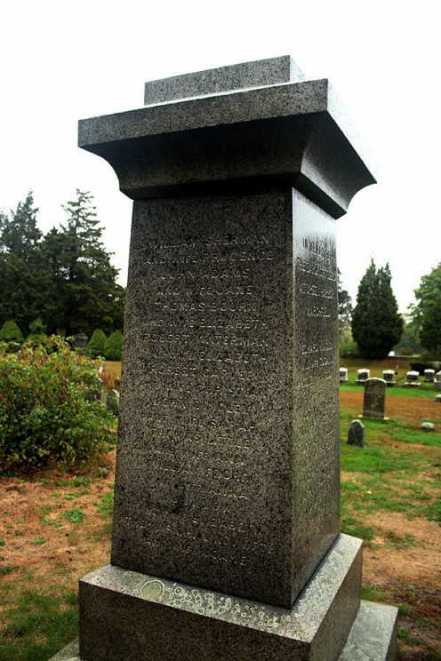
His name is on the monument dedicated to the early settlers of Green Harbor at the Winslow Cenetery in Marshfield, Mass.
The first record of Thomas Little in the new world was on the tax list of March 25, 1633. It is not known on which ship he had arrived. He moved to Marshfield, which is 14 miles from Plymouth. In the 1600’s 14 miles was a very long distance to travel. He was the constable in Marshfield, MA, in June of 1662.
Thomas married Anna Warren on April 19, 1633, in Plymouth Colony. They were the parents of about nine children.

Thomas Little, lawyer
Thomas Little was born in England before 1608 based on his marriage (Anderson, Great Migration). The Ancestral file, without documentation, lists his origin as Devon which is also known as Devonshire with Exeter as the county seat. According to many writers, he arrived at Plymouth, Massachusetts in 1630, but it is not positively known when, or on what ship he came. The earliest date in the Plymouth records is January 2nd, 1632/3, when he was taxed. He married, April 19th, 1633, Ann, born in England about 1612, daughter of Richard and Elizabeth Warren, who were Mayflower passengers (Avery 127, 129; NEHGR XIII, 279). Avery writes that Thomas Little came from England to Plymouth in 1630. He was a lawyer, and his coat of arms is still preserved at the old homestead in the house of Luther Little at Sea View, Massachusetts known as Littletown (Avery 126-127).
Thomas Little and Ann Warren had nine children as listed by Avery, Anderson in the “Great Migration,” and various others. Abigail married Josiah Keene; Patience married Joseph Jones; Ruth apparently unmarried; Hannah married Stephen Tilden; Mercy married John Sawyer; Isaac married Bethia Thomas; Ephraim married at Scituate Mary Sturtevant; Thomas died in King Phillips War; and Samuel married Sarah Gray (Anderson, Great Migration).
Thomas Little bought a shallop in 1633, and was enrolled for military service in August, 1643, at Plymouth, as was every other male in the Colony between 16 and 60 on that date (Avery 129-130).
His first residence was at Plymouth where he was a “Keeper of the Colony of New Plymouth books.” He was assessed 18 shillings in Plymouth tax lists of 1633 and 1634. In 1647, he had five acres of upland meadow on “Indian Brook,” listed as within the limits of the township of Plymouth, retaining that land in 1655. But in 1664, Jonathan Morey expressed an interest in the land that was “sometimes Thomas Little’s. Prior to that, in 1652, Thomas Little and his wife Ann sold a house and land on the Eel river in the township of Plymouth (a former residence). On 3 June 1662, Thomas Little had rights confirmed to a farm at Marshfield, and on 3 October 1665 was granted a hundred acres on which he settled title by 1 May 1666. Back in June 1662, he was a Marshfield Constable (Anderson, Great Migration, quoting Plymouth Records).
In his will, dated 17 May 1671, Thomas Little, Sr. bequeathed to “my loving wife all my housing and all of my land, upland and meadow on that side of the brook I now dwell, except only the meadow I purchased of Thomas Tildin and Morris Trewant.” He left land to sons Isacke and Ephraim land on the other side of the brook; all his land at Namassakett upland and meadow to his younger sons Thomas and Samuel, excepting an identified upland to grandson John Jones; a featherbed and furniture to Ephraim; the whole stock of cattle to be equally divided amongst all his children; and other dispositions. Administration of the estate was granted to Anna Little, his wife, on 14 August, 1662.(Anderson, Great Migration listing sources).
Thomas Little was buried at Marshfield, March 12, 1671. His widow died after February 19, 1675 (Avery 129-130).
There is some confusion from 28 October 1633 when a grant of land to Richard Warren was returned to court for failure to erect a building; the land was to be regranted to a Mr. Ralph Fogg upon his satisfactory payment to Widow Warren for her fence remaining there (PCR 1:18). But on 7 March 1636, “it is agreed upon, by the consent of the whole court, that Elizabeth Warren, widow, the relict of Mr. Richard Warren, deceased, shall be entered, and stand, and be purchaser instead of her said husband, as well because that (he dying before he had performed the said bargain) the said Elizabeth performed the same after his decease, and also for the establishing of the lots of lands givern formerly by her unto her sons-in-law Richard Church, Robert Bartlett, and Thomas Little, in marriage with their wives, her daughters” [PCR 1:54; 2:177]. On 5 May 1640, “Richard Church, Rob(er)te Bartlett, Thomas Little, and Mrs. Elizabeth Warren are granted enlargements at the heads of their lots to the foot of the Pyne Hills, leaving a way betwixt them and the Pyne Hills, for cattle and carts to pass” (PCR: 1:52). Ann Warren born est 1613, m. Thomas Little at Plymouth 19 April 1633 (PCR 1:13)
Thomas Little (1609 – 1675)
10th great-grandfather
William Little (1640 – 1731)
son of Thomas Little
William Little (1660 – 1740)
son of William Little
William Little Jr (1685 – 1756)
son of William Little
Jeanette Little (1713 – 1764)
daughter of William Little Jr
Andrew Armour (1740 – 1801)
son of Jeanette Little
William Armor (1775 – 1852)
son of Andrew Armour
William Armer (1790 – 1837)
son of William Armor
Thomas Armer (1825 – 1900)
son of William Armer
Lucinda Jane Armer (1847 – 1939)
daughter of Thomas Armer
George Harvey Taylor (1884 – 1941)
son of Lucinda Jane Armer
Ruby Lee Taylor (1922 – 2008)
daughter of George Harvey Taylor
Pamela Morse
I am the daughter of Ruby Lee Taylor

Lower Surry Church
Lawnes Creek Parish Church was the first church erected on Hogg Island in 1628 for the citizens of James City County who lived on the south side of the James River. Surry formed from James City County and the first parish for the area now encompassed by Surry County was known as “Lawnes Creek.”
The parish church members would have been buried at their place of worship as was the custom in those days.
This site is now occupied by the Surry Nuclear Plant.
No access permitted.
LAWNES CREEK PLANTATION, Rts 650 & 628
The peninsula of land about 2 miles in width and 8 in length between Lower Chippoakes Creek and Lawnes Creek and south of Hog Island, was, together with the lands adjoining upper Chippoakes Creek and opposite Jamestown, the first to be settled in Surry away from the James River. Virtually all this land had been patented before 1635, mainly by William Spencer, Captain William Pierce, Roger Delke, and Captain Lawrence Baker.
My 8th great-grandfather, John Holt was born in 1664 in Surry County, Virginia, a British colony. He died in 1705 Surry County, Virginia, hung by his own hand. His 8th great-grandson, George Harvey Taylor, committed the same “Felonious homicide of a man’s self” by drinking carbolic acid in 1941. George Harvey was my maternal grandfather. It is said that suicide reoccurs in families.
He was listed in the 1687 Cavalry of Surrey County, Virginia. John M. Holt was born in 1664 in Lawnes Creek Parish, Hog Island, Surry County, VA. John died 1705 at the age of 41 in Surry County, VA. John Holt committed suicide.
On Feb 24, 1685 Mr. John Holt and his wife were fined for not going to church by the Surry County Court. (This may have been rather harsh as she most probably was pregnant.)
In 1703 he petitioned the Legislature to be Keeper of the Ferry settled on James River to Archer’s Hope Creek on the north side. Appears on the 1704 Rent Roll for Surry County, VA On November of 1706 the Surry County Court Records state that “John Holt upon his petition is admitted to keep a ferry in Hog Island pursuant to a Law made to that purpose and for his better compliance therewith ordered that he forthwith provide and maintain one substantial flat bottom boat of at least fifteen feet by the keel for carrying over of horses as also one other boat of at least twelve or thirteen feet by keel for passengers with three able men constantly to attend the said service ant that he enter into a bond with good and sufficient security duly to perform the same. In May of 1710 John Holt petitioned the Court and they “exempted him from payment from his bond for keeping a ferry at Hog Island. (Surry County, Virginia Court Records, 1707-1711, Book VI
By 1704 the Holt family would own 2,768 acres in Surry County. Of this, 1,450 acres were controlled by Elizabeth Holt, wife of Randall Holt, Jr.. The remainder was owned by the sons of Randall and Elizabeth..
John Holt (1664 – 1705)
8th great-grandfather
David Holt (1685 – 1749)
son of John Holt
Sarah Holt (1740 – 1792)
daughter of David Holt
James Truly (1755 – 1816)
son of Sarah Holt
Elizabeth Betsy Truly (1782 – 1851)
daughter of James Truly
Minerva Truly Darden (1806 – 1837)
daughter of Elizabeth Betsy Truly
Sarah E Hughes (1829 – 1911)
daughter of Minerva Truly Darden
Lucinda Jane Armer (1847 – 1939)
daughter of Sarah E Hughes
George Harvey Taylor (1884 – 1941)
son of Lucinda Jane Armer
Ruby Lee Taylor (1922 – 2008)
daughter of George Harvey Taylor
Pamela Morse
I am the daughter of Ruby Lee Taylor
By 22 September 1705 John Holt “laid violent hands upon himself”
Suicide was against the law. Without regard to the rights of the heirs, the estate and property of the perpetrator reverted back to the crown. Govenor of Virginia Colony was Edward Nott decribes John as a man “who being under some indisposition of mind lately hanged himself…troubled with lunacy and distraction of mind.”
John’s eldest son David, had already received a substantial land grant from his grandfather David Crafford prior to David’s twenty-first birthday. John’s sons John Jr., Charles, Benjamin, and Joseph attended the hearing. The deposition of the court read in part: “Having labor’ d long under a very great Indisposition of Mind, and at last layd violent hands upon himself”, a coroner’s jury found that his estate was forfeited as “Felo de Se.” {Latin for “Felonious homicide of a man’s self”}
Governor Edward Nott appealed to the Crown for the family. He inventoried the estate at: 159I, 16s, 6d, and “his Five Surviving Children are fit Objects of Our Mercy and Compassion.”.
Queen Anne commanded the restoration of his estate to them on 7 Jan. 1706. “the said estate consisting chiefly in cattle proper for plantations and other perishable good is hereby to be restored to his five children John, David, Charles, Joseph and Benjamin. ibid, p.512.”
Source: I want to Especially THANK Charles Lindley Holt for sending me his research on this Virginia Colony HOLT family. THANK YOU. I used his dates and many of his ” ” ‘s.
Also:: Familysearch had some of this “(taken from the book “Adventurers of Purse and Person”.}” .
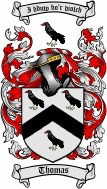
Thomas Coat of Arms
David Thomas is thought to have been born in Wales about 1620, David probably arrived in America about 1640-1 on the ship “Sampson”. It certainly is a fact that a session of the Quarterly Courts at Salem on 8th July 1645 “David Thomas” is a witness in a suit for defamation of character brought by John Bartoll against Alice, wife of John Peach, Jr, for having said that the plaintiffs wife, Parnell Bartoll, had “committed adultery with the Boatswain of the ship “Sampson” in the cabin of Parnell about four years ago.” This is the first record that we know of for David Thomas in America.
David lived in that part of Salem which is about to become the town of Marblehead. David left Marblehead probably early 1661, and removed to the part of Salem which later became Beverly. Two known maps showed the location of the Salem property of David Thomas agree that David owns Lot 16, which seems to have had no dwellings on it while David owned it.
It is significant that his wife Joanna executed her consent to the sale of the Beverly property by an instrument dated at Plymouth 14th July 1669. (Essex County Deeds book 3, pages 57 and 189). It seems this must have been the year David and Joanna Thomas moved to Middleborough. The birth of his son Edward Thomas on 6th February 1669 is the first entry in the Town Records of Middleborough, even though that entry may have been made at a later date, since the Town Records are said to have been destroyed by the Indians during King Philip’s War of 1675.
David is a Farmer at “Middlebury” and his family is one of the 16 families that constituted this Town in 1675. During this year when Indians attacked “Middlebury’s” new white inhabitants, forcing these settlers back into the Old Plymouth Colony Village. After this war ended these early settlers returned and 28th June 1677 those who had owned lands there, numbering 68 persons, met and agreed to re-settle “Middlebury” presently what is now called Middleborough.
David Thomas’s house at Middleborough (not standing anymore) is a little distance southeast of the town proper at the end of what is now Thomas Street at the area that became well known as “Thomastown”.
David Thomas (1620 – 1689)
9th great-grandfather
Mary Thomas (1664 – 1754)
daughter of David Thomas
Ann Northup (1696 – 1772)
daughter of Mary Thomas
Ann Gifford (1715 – 1795)
daughter of Ann Northup
Frances Congdon (1738 – 1755)
daughter of Ann Gifford
Samuel Thomas Sweet (1765 – 1844)
son of Frances Congdon
Valentine Sweet (1791 – 1858)
son of Samuel Thomas Sweet
Sarah LaVina Sweet (1840 – 1923)
daughter of Valentine Sweet
Jason A Morse (1862 – 1932)
son of Sarah LaVina Sweet
Ernest Abner Morse (1890 – 1965)
son of Jason A Morse
Richard Arden Morse (1920 – 2004)
son of Ernest Abner Morse
Pamela Morse
I am the daughter of Richard Arden Morse
David Thomas and his wife came from Salem to Middleboro soon after 1668, the of he selling his land in Salem. They settled in Thomastown, where their descedants are still living. He bought into the Twenty-six Men’s purchase.
He had sveral children, David, Joanna, William, Jeremiah, and Edward, the last born February 6 1669, the first birth in the early records of the town.
Source: History of the Town of Middleboro.

headstone
My 8th great-grandfather came to America as young boy with his parents and became a founder of Hartford, Connecticut.
John was born about 1628 in England and came to Connecticut with his parents as a young child. He married Hannah Potter, daughter (or possibly stepdaughter) of William Potter of Stamford. John and his brother Joseph moved from Stamford to Hempstead, Long Island, and returned to Connecticut by 1664. John died 5 Feb 1699, probably in Connecticut. John was one of seven original proprietors of Greenwich, CT, as described at http://www.rootsweb.com/~ctfairfi/pages/greenwich/greenwich_index.htm
“On February 5, 1664, the Seven Proprietors made a formal request to the General Assembly in Hartford to be allowed to separate from Stamford and to support its own minister and lay out its own lands. The Seven Proprietors were John MEAD, Jonathan RENALDS, John HOBBY, Joseph FERRIS, Joshua KNAPP, Angell HUSTED, and Jeffrey FERRIS.
On May 11, 1665, the General Assembly in Hartford declared Greenwich a separate township, and authorized funds for the hiring and support of an orthodox minister. In 1672, the so-called “27 Proprietors” bought land from the few remaining Indians to the west of the “Myanos River.” This land became known as “Horseneck” because of the neck of land now known as Field Point was the common HORSE PASTURE. ”
John signed all documents with a mark, but had several books in his estate inventory, so he could probably read but not write.
John and Hannah had eleven children:
John, b. abt 1658, married Ruth Hardey in 1681.
Joseph, b. 2 May 1660, married Mary.
Hannah, b. abt 1661, married John Scofield 12 Jul 1677.
Ebenezer, b. 1663, married Sarah Knapp in 1691.
JONATHAN, b. abt 1665, married Martha Finch.
David, b. abt 1665, married Abigail Leane 16 Dec 1707.
Benjamin, b. May 1666, married first Sarah Waterbury, second Rachel Brown.
Nathaniel, b. abt 1669, married Rachel.
Samuel, b. abt 1673, married Hannah.
Abigail, b. abt 1675. Fairfield Probate Records cited in The Ancestry of Elizabeth Barret Gillespie, “reveal that she was incompetent to manage her own affairs: ‘Whereas John Mead Sen’r, deceased, of Greenwich, haveing not made Satisfieing provision in his will for his daughter Abegaile Mead, She being not Capable of doing for her Self as may be desired by Reason, whearof Ebeneaz Mead of Greenwich dos hereby, in the presence of ye Prerogative Court, Engage to pay unto ye s’d Abegaile Mead, his sister, ye Sum of therty and five pounds, to be paid unto her According as he Shall Apprehend She Shall stand in Need of it for her Comfortable subsistence.”

Tomac Burying Ground
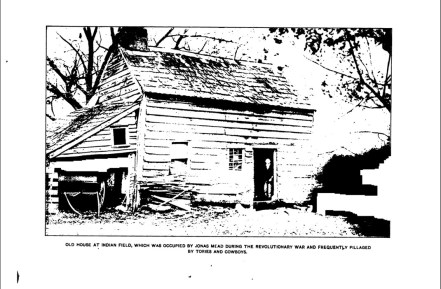
John Mead’s House
John Mead (1634 – 1699)
8th great-grandfather
Benjamin Daniel Mead (1667 – 1746)
son of John Mead
Mary Mead (1724 – 1787)
daughter of Benjamin Daniel Mead
Abner Mead (1749 – 1810)
son of Mary Mead
Martha Mead (1784 – 1860)
daughter of Abner Mead
Abner Morse (1808 – 1838)
son of Martha Mead
Daniel Rowland Morse (1838 – 1910)
son of Abner Morse
Jason A Morse (1862 – 1932)
son of Daniel Rowland Morse
Ernest Abner Morse (1890 – 1965)
son of Jason A Morse
Richard Arden Morse (1920 – 2004)
son of Ernest Abner Morse
Pamela Morse
I am the daughter of Richard Arden Morse
The following anecdote, which has been preserved by tradition, shows his character: One day when he was quite an old man, as he was going for his grist on horseback to the mill at Dumpling Pond, before he reached the Mianus River he overtook and old Quaker jogging slowly along, loaded with a heavy budget. In a real spirit of kindness he offered to take the Quaker’s load upon his horse, and thus give him a lift on his journey. No,replied the Quaker, thee don’t get my bundle, for I can read men’s thoughts. Thee wants to get my bundle, and then thee’ll run off. Thee don’t get my bundle. Very well, was the simple reply, and so they went slowly on together. At last they came to the brink of the Mianus River. Here the Quaker was really in trouble. How to cross a river, two or three feet deep, dry shod, was quite a puzzle. But he gladly accepted a second offer of assistance from the horseman. The bundle was mounted in front, John in the middle, and the Quaker behind. Arriving at the centre of the river, in pretending to adjust his stirrup John caught the Quaker by the heel and gave him a gratuitous bath. Such treatment was too much, even for Quaker forbearance, and the victim, with his hands full of pebbles, would have taken summary vengeance, had not the other party threatened to put the bundle under a similar course of treatment. This threat, and the lecture following it, gradually cooled off the Quaker’s anger. John informed him that all had been done for his good, to teach him a lesson. And the lecturer said he hoped the stranger would never again profess to read men’s thoughts. For, said he, I asked you to ride, kindly in the first place, when you refused; but at the second time of asking, I really intended to do as I have just done. So saying, and tossing the bundle back, he rose on, leaving his companion to apply the moral as he thought best.

Central Burial Grounds Boston
My 10th great-grandfather was banished from the colony of Massachusetts, and signed the Portsmouth Compact. He did not stay in Rhode Island for very long, but returned to live in Boston, where he was one of the citizens who purchased the Boston Common and donated it to the town. I am not sure how he became un-banished, but his case is not the only un-banishment in our family. He kept his property in Rhode Island and had extensive holdings in Boston as well. He was in the wool business.

Portsmith Compact
Samuel Wilbore and wife Ann, came to America before 1 December, 1633 and lived in Boston. May have come 4 September, 1633 on ship “Griffin” He was a merchant, had a ship, probably sold cloth and lumber and was in the wool business.
He and 6 men under him guarded the gate at Roxbury. He sold his home on what is now Washington St. to Samuel Sherman. In 1634, he and William Blackstene bought “Boston Commons” and gave it to the town. Made “Freeman” 4 March 1633/4 and with John Porter and Philly Sherman bought Aquidneck Island, (Rhode Island). He was banished from Boston 30 August 1637, and disarmed 20 November 1637 and went to Portsmouth, R.I. because of his association with a religious group lead by Anne Hutchinson, Mr. Wheelwright and possibly Roger Williams. Anne Hutchinson was the unauthorized Puritan preacher of a dissident church discussion group.
Rhode Island had become a haven for persecuted religious sects. These people, called Antinomians, believed that the moral laws as taught by the Church of England were of no value and that the only law that should be followed was that of the Gospel. Quakers, who eventually merged with the Antinomians, established a meeting house on Aquidneck in 1657.
11 January 1638/9 he was constable at Portsmouth. He owned land at Nt. Wolliston (now Quincy). With Ralph Earle he built a planing mill at Portsmouth,1640. By 1645 was back in Boston, though he kept his Portsmouth and Taunton land, and lived on Mill Street. He was wealthy and gave to the 1st free school in America. The early spelling was “Welleboro”, a Norman name. In 1626 he was a “juror” in Sible Hedington, Essex, England.
Samuel Wilbore (1595 – 1656)
10th great-grandfather
Dorothy Wilbore (1617 – 1696)
daughter of Samuel Wilbore
Elizabeth Albro (1646 – 1720)
daughter of Dorothy Wilbore
Benjamin Congdon (1676 – 1756)
son of Elizabeth Albro
William Congdon (1711 – 1755)
son of Benjamin Congdon
Frances Congdon (1738 – 1755)
daughter of William Congdon
Thomas Sweet (1765 – 1844)
son of Frances Congdon
Valentine Sweet (1791 – 1858)
son of Thomas Sweet
Sarah LaVina Sweet (1840 – 1923)
daughter of Valentine Sweet
Jason A Morse (1862 – 1932)
son of Sarah LaVina Sweet
Ernest Abner Morse (1890 – 1965)
son of Jason A Morse
Richard Arden Morse (1920 – 2004)
son of Ernest Abner Morse
Pamela Morse
Samuel Wilbore was born in Jan 1595 in Sible Hedingham, Essex, England. He died on 29 Sep 1656 in Boston, Suffolk, Massachusetts. Samuel married Ann Smith on 13 Jan 1619/1620 in Sible, Hedingham, Essex, England.
Samuel Wildbore, said to have been born in 1585, came to Boston not later than 1633, and was admitted to the First Church of Boston on December 1/1633. His house was on the neck of land between the island and the mainland, now called Washington St. and later Milk Street. In 1634 Samuel and others bought the Boston Common for the town, from William Blackstone whose ownership was acknowledged by an entry in the Town Records as early as 1633 by which it was agreed that William Blackstone shall have 50 acres set off to him near his house in Boston. The Town Records have the following statement in reference to Samuel Wildbore’s share in the purchase of the Common. “The 10th day of the 9th month 1654: Item, Edmund Quinsey, Samuel Wildbore, William Baulston, Edward Hutchinson the elder, and William heesborough, constable, shall make and assess all the rates, viz, a rate of œ30 to William Blackstone”. Blackstone sold the whole parcel of land except 6 acres immediately adjoining his house. On August 6/1635, Samuel gave œ10 towards a free school, the first in America. Governor Winthrop gave a like amount, and none other gifts exceeded this amount. Samuel also had a piece of land on Essex St., near where the Touraine Hotel now stands. Samuel married in 1620, at Sibley Hedringham, England, Ann Smith. Most genealogies wrongly give her name as Ann Bradford. Samuel was made freeman on March 4/1634. He bought much property in Taunton and likewise possessed considerable holdings in Boston, evidently dividing his place of residence between the two places. While in Taunton, he with others, embraced the “dangerous doctrines” as they were then called, of Cotton and Wheelwright, for which in 1637 he was banished from the Massachusetts Colony. Acting upon the advice of Roger Williams, he and seventeen others fled to Providence, R.I., where they purchased the island of Aquidnec, (now Rhode Island) from the Naragansett Indians, and early in 1638 moved his family there and formed a colony on March 7/1638. Full details of the purchase and history of this action is contained in the Genealogies quoted, but too long to insert here. He did not remain in Rhode Island for long, and returned to Boston in 1645 and built the first iron furnace in New England at Taunton, now Raynham, on the main road from Tilicut to Taunton. He was clerk of the town board in 1638, Constable in 1639, Sergeant in 1644. He married, 2nd, before November 29/1645, Elizabeth Lechford, widow of Thomas Lechford. Date of his second marriage and date of death of his first wife Ann are not known. Samuel died July 24/1656. After his death Elizabeth married, 2nd, on December 20/1656, Henry Bishop who died in 1664: Elizabeth died in 1665. Samuel was a man of wealth and he was of very respectable standing in society, exerting a wide influence in each of the places he dwelt. His will was dated April 30/1656.
Ann SMITH-8832 was born on 13 Jan 1598 in Sible, Hedingham, Essex, England. She died on 24 Sep 1636 in Taunton, Bristol, Massachusetts. Ann married Samuel WILDBORE-8833 on 13 Jan 1619/1620 in Sible, Hedingham, Essex, England.
They had the following children.
MiSamuel WILBORE-8830 was born on 10 Apr 1622. He died in 1697. MiiWilliam WILBORE-8838 was born on 21 May 1630. He died on 15 Apr 1710.

Malvern Hill
My 6th great-grandmother was born in Virginia in 1720 in the home where her father had been born. The Cocke family came to Virginia in the 1600’s and played a significant part in the colony’s affairs. She married into the Holt family, another prominent family in Williamsburg. When I was a child my parents took me several times to vacation in Williamsburg. I always looked forward to being there to be immersed in the history of the place. We stayed at the Inn and walked around town to see the blacksmith, the candlestick maker, and many historical reenactments. I have vivid memories of buying sealing wax, which I used on all my correspondence until I was about 18. I had a real thing for fancy stationery and sealing wax that began when I saw it in use at Williamsburg. Now that I know my ancestors lived there I am even more thrilled that my parents (who had no idea about the ancestry connection) gave me the gift of an early interest in history.
Elizabeth Cocke, probably b. 1720’s; m. Dibdale or Dibdall HOLT, son of David HOLT & Margaret DIBDALL of New Kent, Hanover, and Williamsburg, VA (b. 1720’s; d. aft. 1792). Dibdall probably met Brazure COCKE’s family in Williamsburg where the HOLTS were a prominent family. Dibdall’s brother John HOLT served as mayor of Williamsburg and later published newspapers in New York City and Norfolk VA. Dibdall is named in John HOLT’s will, dated Oct. 1, 1749, proved Oct. 30, 1784, in New York. Dibdall’s sister Jane HOLT was married to a famous Presbyterian minister, Rev. Samuel DAVIES (1724-1761), of Hanover Co., VA. Dibdall probably married Elizabeth COCKE roughly 1745 and moved to Amelia Co., VA, soon thereafter. He can be found in Amelia Co. as early as 1748 when he witnessed the will of William STONE (Amelia WB 1, p.55) and was still there in 1762 when he appeared on a tax list. He lived in Nottoway Parish, which later become Nottoway County. A deed dated Dec. 14, 1751, from Phillip STONE of Johnston Co., VA, to Charles CONNALLY & Robert TAYLOR of Nottoway Parish, describes 100 acres in Nottoway Parish adj. where Dibdall HOLT now lives, Charles CONNALLY, Joseph HARPER, Robert TAYLOR’s line by the county line, and William STONE’s line now Dibdall HOLT’s. (Amelia Co., VA, DB 4, p.338.) Robert CHEEK worked as Dibdall Holt’s overseer and lived with him in 1754 and 1755, according to the Amelia Co. tax lists & court records. Dibdall’s daughter may be the Elizabeth HOLT who m. Samuel BIRCH (or BURCH) on May 1, 1764, in Granville Co., NC, with Robert CHEEK as bondsman. Dibdall moved to the Natchez District of the Louisiana territory sometime in the 1770’s & settled in an area that later became Jefferson Co., MS. Dibdall’s name appears on a petition dated Oct. 4, 1779, “from the citizens of Natchez to Lieut. Col. Dickson, 16th Reg. commanding his Britannick Majesty’s Forces in the River Mississippi. . . .” He is also mentioned in his sister Sarah TRULY’s will dated Mar. 15, 1792 (Natchez Dist.) and in other Natchez records. Children may have included David HOLT (m. Rebecca BELK), John HOLT, and William HOLT (d. 1836 in Hinds Co., MS).
Elizabeth Cocke (1720 – 1773)
6th great-grandmother
Elizabeth Holt (1747 – 1811)
daughter of Elizabeth Cocke
Elizabeth Betsy Truly (1782 – 1851)
daughter of Elizabeth Holt
Minerva Truly Darden (1806 – 1837)
daughter of Elizabeth Betsy Truly
Sarah E Hughes (1829 – 1911)
daughter of Minerva Truly Darden
Lucinda Jane Armer (1847 – 1939)
daughter of Sarah E Hughes
George Harvey Taylor (1884 – 1941)
son of Lucinda Jane Armer
Ruby Lee Taylor (1922 – 2008)
daughter of George Harvey Taylor
Pamela Morse
I am the daughter of Ruby Lee Taylor

ruins of Malvern Hill House
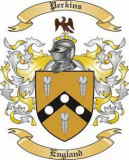
Perkins COA
My 10th great-grandmother was born in England and died in Massachusetts. She sailed to the new world with her parents and settled in Ipswich. She probably met her husband there. They moved to Newbury and then to Amesbury, MA, where they laid down some very litigious history in the records of the courts of that town. It seems her husband was the more litigious of the two, but I am grateful for the records, so we know something about them today.
Elizabeth came to America with her family aboard the Lyon, William Pierce, master on 1 December 1630 for its first trip to the New World. They embarked in Bristol, England and arrived in Nantasket, Suffolk co., MA on 5 February 1631.
The Sargent family were some of the original settlers of the Agawam section of Ipswich, Essex co., MA, with William receiving 12 acres in the 1634 Ipswich Land Grant. The family later moved to Newbury, Essex co., MA; Hampton, Rockingham co., NH; Salisbury, Essex co., MA and finally Amesbury, Essex co., MA. Remember that NH & ME were all part of MA at the time. The family moved from Newbury to Hampton because “…’Willli[am] Sergant’ was amongst the list of petitioners mostly Newbury men who were headed by Stephen Bachiler, who were on 6 September 1638 granted ‘liberty to begin a plantation at Winnacunnet [what is now Hampton, Rockingham co., NH]..” And “Will[iam] Sargent” is listed as one of the married men in the list of first comers to Hampton.
The Sargents found themselves in court over disputes with their neighbors on many occasions. Given the fact that this pattern of contentiousness continued after Eliabeth’s death, I contend that William was the fractious party in the area. On 26 December 1643, William “Sargeant” sued Mr. William Hook of Salisbury for 56s. in corn[67,68]. William acknowledged the court’s judgment in favor of Mr. Jonathan Wade on 26 September 1648. Michael Spencer sued him for detaining corn and other goods on 2 January 1650.
But the biggest battles were reserved for their near neighbors, the Martins. Either William or his namesake son was sued for slander on 13 April 1669, because the Sargent in question had called Martin’s wife “a witch”. The bad blood transcended generations, for Martin later sued William’s son Thomas Sargent “…for saying that his son George Martin was a bastard and that Richard Martin was Goodwife Martin’s imp…”
In 1672, William Sargent and Joanna his second wife sued Christopher Osgood for debt due part of the estate of Joanna’s late husband, Valentine Rowell. However, Joanna was curiously not mentioned in his will, although she had married him a few months earlier. To contemporary credible researchers, this strongly suggests that there was a pre-nuptial agreement between them which left Joanna nothing.
Elizabeth Judith Perkins (1611 – 1670)
is my 10th great-grandmother
Mary Sargent (1634 – 1716)
daughter of Elizabeth Judith Perkins
John Challis (1655 – 1741)
son of Mary Sargent
Mary Challis (1699 – 1739)
daughter of John Challis
Amos Nicholls (1740 – )
son of Mary Challis
Amos Nicholls (1780 – )
son of Amos Nicholls
Amos Nicholls (1808 – 1868)
son of Amos Nicholls
Emiline P Nicholls (1837 – )
daughter of Amos Nicholls
Harriet Peterson (1856 – 1933)
daughter of Emiline P Nicholls
Sarah Helena Byrne (1878 – 1962)
daughter of Harriet Peterson
Olga Fern Scott (1897 – 1968)
daughter of Sarah Helena Byrne
Richard Arden Morse (1920 – 2004)
son of Olga Fern Scott
Pamela Morse
I am the daughter of Richard Arden Morse
Elizabeth PERKINS was christened/baptized on 3 MAR 1611 in Hillmorton, Warwickshire, England. She immigrated on 1 DEC 1630 from England to America. She died on 18 SEP 1670 at Amesbury, Essex County, Massachusetts. She has Ancestral File Number 7TTF-7J. Elizabeth’s father came from England in the ship “Lyon” with Roger Williams, in 1631; lived in Boston two years; settled in Ipswich in 1633;
Sailed on the “LYON”, William Peirce, Master, from Bristol December 1, 1630, and arrived February 5, 1631, with about twenty passengers and two hundred tons of goods.
SOURCE: 1. Ancestral File (TM), data as of 2 January 1996, Family History Library, 35 North West Temple, Salt Lake City, Utah 84150
2. Perkins Family in Ye Olden Times. p 78-79 (B11C27)
3. Old Families of Salisbury & Amesbury, Mass by Hoyt, p 281 (Mass S&)
4. Dawes & Allied Families by Mary Walton Ferre, p 484-85 (B12F12)
5. Planters of the Commonwealth, Charles E. Banks 1930
6. Hoyt’s “Old Families of Salisbury and Amesbury” page 281/282 (John Perkins #12)

St. David’s Church, Radnor, Pa.
My 8th great grandfather was born in Wales and died in Maryland. He came to Pennsylvania on a mission for the Anglican church. He wrote his own epitaph in Latin which is telling about his beliefs. He was harsh on himself.
Rev. Henry Nicholls, B.A., 1703 & M.A., 1715, Jesus College, Oxford, Wales. He was sent to Pennsylvania, 1702-1708, during the reign of King James II. He ministered at Chester, Pennsylvania. The Chester Church is described as of good brick fabric, one of the neatest on the continent, furnished with handsome furniture and pews. He also served St. David’s Church, Radnor, Pa. and at Concord and Montgomery, Pa. Later, he was transferred to St. Michael’s Parish, Talbot Co., Maryland where he served, 1708-1749, (41 years).
From William King and Virginia Watkins – Their Ancestors and Descendents compiled by Maellen King Ford
Henry Nichols was the first residential missionary to Pennsylvania for the “Society for Propagation of the Gospel in Foreign Parts“, arriving in 1703. His churches were located in Chester, Concord, Radnor, and Montgomery. The members were regular and constant in divine worship, and they contributed 60 pounds a year toward their pastor’s support. The Radnor Church is still in excellent preservation, known as St. David’s Church and has been in use since 1708. Rev Nichols requested a transfer in 1708 and became rector at St. Michael’s Parish Church. Talbot Co., MD – a post he occupied until his death. For years, all records of his life were lost. The early church books had disappeared! Until June 1878 when workmen, employed to demolish the old church building, found his tomb under the Chancel in good preservation.
The following is a translation of the Latin inscription found on the slab over his tomb: “Here lies the remains of Henry Nicols, M. A., formerly a Fellow of Jesus College, Oxford, England, and a pastor of this church for 41 years – most unworthy. Born April 1st, 1678; died Feb. 12, 1748. Save his soul, O Christ for Thy own merits. Tread upon salt without savor.” (Henry has ordered these works to be inscribed before his death.) A number of his descendents still worship at St. Michael’s Church. They placed a tablet there to his memory where he ministered for so long. (From the Historical Magazine of the Protestant Episcopal Church, 1943, by Mary Clement, M. A., Principal of the Girls County School Board, Bridgend, Glamorganshire, Wales.)
Rev. Henry Nichols (1678 – 1748)
is my 8th great grandfather
William Nicholls (1709 – 1776)
son of Rev. Henry Nichols
Amos Nicholls (1740 – )
son of William Nicholls
Amos Nicholls (1780 – )
son of Amos Nicholls
Amos Nicholls (1808 – 1868)
son of Amos Nicholls
Emiline P Nicholls (1837 – )
daughter of Amos Nicholls
Harriet Peterson (1856 – 1933)
daughter of Emiline P Nicholls
Sarah Helena Byrne (1878 – 1962)
daughter of Harriet Peterson
Olga Fern Scott (1897 – 1968)
daughter of Sarah Helena Byrne
Richard Arden Morse (1920 – 2004)
son of Olga Fern Scott
Pamela Morse
I am the daughter of Richard Arden Morse
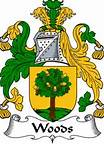
Woods Coat of Arms
My tenth great-grandfather was born Feb. 6, 1610, in England. He died July 10, 1678, Marlborough, MA.
John WOODS, a pin-maker by trade, arrived in America at age 26 in 1635 aboard the ‘Hopewell,’ and first settled at Salem, MA, but removed to Sudbury, MA by 1638, becoming a proprietor there in 1639. He was admitted freeman on May 10, 1642, and received several Sudbury land grants through 1655. After Marlborough was formed in 1660, John sold his property at Sudbury and relocated to Marlborough, where he had been granted land and served in various town offices. On Apr. 4, 1664, he deposed that he was about age 54. His will, dated Nov. 26, 1677 and proved Oct. 1, 1678, names his wife Mary, his three sons, daughter Katherine, son-in-law John BELLOWS, and grandchild Hannah LEVINS. The inventory of his estate, on Jul. 19, 1678 at £303.03.07, mentions son-in-law Joseph NEWTON. Married about 1633.
John Woods (1610 – 1678)
is my 10th great grandfather
John Woods (1641 – 1716)
son of John Woods
Lydia Woods (1672 – 1738)
daughter of John Woods
Lydia Eager (1696 – 1735)
daughter of Lydia Woods
Mary Thomas (1729 – 1801)
daughter of Lydia Eager
Joseph Morse III (1756 – 1835)
son of Mary Thomas
John Henry Morse (1775 – 1864)
son of Joseph Morse III
Abner Morse (1808 – 1838)
son of John Henry Morse
Daniel Rowland Morse (1838 – 1910)
son of Abner Morse
Jason A Morse (1862 – 1932)
son of Daniel Rowland Morse
Ernest Abner Morse (1890 – 1965)
son of Jason A Morse
Richard Arden Morse (1920 – 2004)
son of Ernest Abner Morse
Pamela Morse
I am the daughter of Richard Arden Morse
My 7th great-grandfather was born on May 7, 1667 in Greenwich, Fairfield County,Connecticut and died Feb. 22, 1746 in Greenwich. He is buried in the Old Burying Ground there.

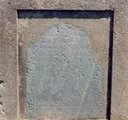
Benjamin Mead was an officer in the local militia and served a term as Surveyor for Fairfield County. Reports of his action in the French and Indian War are misleading, as he died before the Seven Years’ War war started. That said, that global war was only part of an ongoing conflict in Europe from 1689-1763 that had combat ramifications in North America on at least 4 occasions when wars were officially declared. In addition to having names these wars also had numbers under the rubrique of “Intercolonial Wars,” much as we have numbered “World Wars”– since the individual wars had different names in Britain than on the Continent, the numbering system helped keep things (somewhat) straight. Finally, the Intercolonial Wars, as they were called in Europe, were called the French And Indian Wars in North America.
Benjamin Mead was old enough to have fought in any of the first three of these, King William’s War or War of the League of Augsburg (1st Intercolonial) and Queen Anne’s War or War of the Spanish Succession (2nd Intercontinental) being the most likely. So in this sense, any action he saw during those wars makes him a veteran of the French and Indian Wars.
Spouses:
Sarah Waterbury Mead (1677 – 1745)*
Rachel Brown Mead (1680 – ____)*
Children:
Benjamin Mead (1701 – 1783)*
Eliphelet Mead (1704 – 1796)*
Elizabeth Mead Peck (1705 – 1783)*
Keziah Mead Howe (1707 – 1808)*
Obadiah Mead (1719 – 1759)*
Nehemiah Mead (1721 – 1791)*
Hannah Mead Mead (1726 – 1815)*
Siblings:
Ebenezer Mead (1663 – 1728)*
Hannah Mead Scofield (1664 – 1728)*
Jonathan Mead (1665 – 1712)*
Benjamin Daniel Mead (1667 – 1746)
Benjamin Daniel Mead (1667 – 1746)
is my 7th great grandfather
Mary Mead (1724 – 1787)
daughter of Benjamin Daniel Mead
Abner Mead (1749 – 1810)
son of Mary Mead
Martha Mead (1784 – 1860)
daughter of Abner Mead
Abner Morse (1808 – 1838)
son of Martha Mead
Daniel Rowland Morse (1838 – 1910)
son of Abner Morse
Jason A Morse (1862 – 1932)
son of Daniel Rowland Morse
Ernest Abner Morse (1890 – 1965)
son of Jason A Morse
Richard Arden Morse (1920 – 2004)
son of Ernest Abner Morse
Pamela Morse
I am the daughter of Richard Arden Morse
We know what has happened to his house in Greenwich:
Benjamin Mead, the son of John Mead, one of the 15 proprietors, inherited from his father 15 acres of property in Cos Cob in 1696. The will describes the inheritance as “five acres of land at Stickling brock (Strickland Brook) as it is lyd out to mee, and all my lands & meadow lying & and being at that place commonly cauled Coscob, as it is Layd out to mee & ten acres of upland above ye road aded now to ye five”.
In 1697, Benjamin built a house on the land, a two room saltbox with center chimney. A rear lean-to, including a kitchen ell was added in 1732 according to an architectural field study by the Greenwich Historical Society.
Obadiah Mead bought the Bible Street land and house from his father Benjamin Mead in 1746 (1756) for 200 pounds New York money. In that same year Obadiah married Lois Todd daughter of the Reverend Abraham Todd minister of the Second Congregational Society in Greenwich. The couple had 2 daughters, Mary Mead b.Aug 10 1757, d.2/14/1815 and Phoebe. Obadiah died in 1759 while the girls were young.
When the girls came of age the land was divided between them with a Dower lot for their mother. Mary eventually married Michael Cox Timpany b. abt 1755, d. 10/25/1811. Mary eventually inherited her sister and mothers shares to the land.
John Timpany, son of Mary and Michael, bought the house from his mother in 1813. In 1841 he sold the house to 3 of his daughters; Elvira, Hannah and Adelice (Delia) with the provision that they care for him the rest of his life. John died 11/15/1855.
Elvira Moshier never married and held the house until she died in 1880 willing her land to Sarah Ann Moshier Olmstead, wife of Henry Olmstead and the daughter of her sister Lois and James Moshier who were farmers on Cognewaug Road.
Sarahann held on to the house until she died and it was the purchased by her younger brothers Samuel Augustus Moshier, who ran a grocery on Greenwich Avenue, and Franklin Pierce Moshier who ran a livery / stable / early car dealership on Lewis Street.
Sam and Frank held onto the house until the early 1930’s, renting it out to family member (such as John Timpany Moshier who was waked in the Parlor November 1927).
I believe the house left the family due to losses incurred by Franklin and Augustus Moshier with the stock crash of 1929.
Since then the hous has turned over many, many times.
Very recently, a new owner, claiming the house was leaning, renovated the house. It now looks like a “new” old house….
 mermaidcamp