mermaidcamp
Keeping current in wellness, in and out of the water
You can scroll the shelf using ← and → keys
You can scroll the shelf using ← and → keys

Thomas French
My 11th great-grandfather came to America in 1632 with his sister. He was a taylor by trade. He lived in Ipswich, MA, where he served in the Pequod War.
Thomas French (1584 – 1639)
is my 11th great grandfather
Alice French (1610 – 1666)
daughter of Thomas French
Thomas Howlett (1638 – 1667)
son of Alice French
Mary HOWLETT (1664 – 1727)
daughter of Thomas Howlett
John Hazen (1687 – 1772)
son of Mary HOWLETT
Caleb Hazen (1720 – 1777)
son of John Hazen
Mercy Hazen (1747 – 1819)
daughter of Caleb Hazen
Martha Mead (1784 – 1860)
daughter of Mercy Hazen
Abner Morse (1808 – 1838)
son of Martha Mead
Daniel Rowland Morse (1838 – 1910)
son of Abner Morse
Jason A Morse (1862 – 1932)
son of Daniel Rowland Morse
Ernest Abner Morse (1890 – 1965)
son of Jason A Morse
Richard Arden Morse (1920 – 2004)
son of Ernest Abner Morse
Pamela Morse
I am the daughter of Richard Arden Morse
ORIGIN: Assington, Suffolk
MIGRATION: 1632
FIRST RESIDENCE: Boston
REMOVES: Ipswich 1635
OCCUPATION: Tailor. John Stratton writes from Boston under date of 17 March 1633/4: “I have put my sister a suit of mohair to making at Goodman French’s. She were best get the tailor to take her measure and send per Jno. Gallop” [WP 3:157]. Thomas French’s inventory included eleven yards of homemade cloth.
CHURCH MEMBERSHIP: Admitted to Boston church as member #128, which would be no later than mid-1632 [BChR 14]; on 27 January 1638/9 “our brother Thomas French was with the consent of the congregation dismissed to the church of Ipswich” [BChR 22].
FREEMAN: 6 November 1632 [MBCR 1:367].
EDUCATION: He signed his will.
OFFICES: Essex grand jury, 28 September 1652 [EQC 1:260]. Petit jury, 30 September 1651, 31 March 1657, 28 September 1658, 29 March 1659, 27 March 1660, 25 March 1662, 27 September 1664, 26 September 1665, 28 September 1669, 24 September 1672, 31 March 1674, 30 March 1675, 24 September 1678 [EQC 1:232, 2:11, 111, 138, 195, 347, 3:182, 270, 4:175, 5:79, 269, 6:1, 7:82]. Coroner’s jury on the body of Samuel Adams, Jr., 30 September 1676 [EQC 6:234].
Had service in the Pequod War. Proposed for Lieutenant, 25 March 1639 (but apparently not confirmed; in a letter of that date Daniel Dennison writes to John Winthrop “Our company wanting some officers, have according to their liberty, made choice of some, whom they desired me to propound to the Court or Council. They were willing to express their love and liking to Sergeant French and Sergeant Howlett proposing the former for Lieutenant, the other for Ensign” [WP 4:106]). On 18 May 1664 “Sergt. Thomas French deposed that being ordered by Major Genll. Denison to carry two soldiers who were stubborn off the field to prison, he went to them and persuaded them to submit themselves, promising to mediate for them” [EQC 3:140]. Appointed ensign at Ipswich 18 May 1664 [MBCR 4:2:106].
ESTATE: At a selectman’s meeting 31 January 1660[/1] eight men, including Thomas French, were granted liberty to “clear and break up a parcel of land at Scott’s hill to have two acres each for six years upon condition that they sow four bushels of good hay seed on every acre, to keep up the fence a year so that the English grass should get head, the hay seed to be sown with the last crop” [EQC 3:271].
In his will, dated 3 August 1680 and proved 28 September 1680, “Thomas French Senior of Ipswich … being weak of body” bequeathed to “Mary my beloved wife the bed whereon I used to lie, with all the appurtenances and furniture belonging thereto”; to “my son Thomas French” clothing; to “my son John French” one cow “to make up the full sum of £30 which I formerly promised him for his portion”; to “my daughter Mary Smith” one cow; to “my son Samuel French” a bed and bedding; “my sons Thomas and Samuel French” in consideration of £20 paid to “my son Ephraim French” as the remaining part of his portion, “my two sons Thomas and Samuel” shall receive the Pequod lands and division lot of marsh to be equally divided betwixt them; to “my son Thomas French” my dwelling house and homestead, also my lot in Labour-in-vain fields of twelve acres, also the rest of my cattle, stock, and moveable goods; to “my son Samuel” two acres of upland and two acres of meadow at Reedy marsh; “my son Thomas French” to give free liberty to “Mary my wife his mother” to dwell in the said house and to make use of any room or rooms thereof for her convenient accommodation … likewise … any such moveables as I do now leave in the hands of my son Thomas”; after her [Mary’s] decease, “my son Thomas” shall deliver to “my three children John, Samuel and Mary” three of the biggest pewter dishes; “my two sons Thomas and Samuel” to provide for “their mother’s” comfortable maintenance, and if she is not satisfied, they to allow her £9 paid by Thomas and 20s. paid by Samuel annually; and if she suffers sickness and the aforesaid £10 does not suffice, “my two sons Thomas and Samuel” shall supply her with necessaries and my lot in Labour-in-vain fields and two acres of meadow at Reedy Marsh shall stand bound respectively to my said wife during her natural life as security for the true performance of this my will as respecting her maintenance by my two sons; “my son Thomas French” sole executor [EPR 3:379-81].
The inventory of Ensign Thomas French was taken 25 August 1680 and totalled £217 15s. 6d. including £150 in real estate: “his dwelling house & barn & homestead with the privilege belonging,” £70; “twelve acres of land at Labor in vain,” £60; “two acres of land by Scotes Lane,” £10; and “two acres of marsh in the common field,” £10 [EPR 3:380-81].
BIRTH: Baptized Assington, Suffolk, 27 November 1608, son of Thomas and Susan (Riddlesdale) French [Dudley Wildes Anc 64].
DEATH: Ipswich 8 August 1680.
MARRIAGE: By 1632 Mary _____; she died at Ipswich 6 May 1681.
CHILDREN:
i MARY, bp. Boston 23 September 1632 [BChR 278 (corrected from 1631)]; d. soon.
ii MARY, bp. Boston 2 March 1633/4 [BChR 278]; m. by 1657 Robert Smith (called Mary Smith in father’s will) [Amos Towne Anc 25-27].
iii JOHN, b. about 1635 (deposed aged “about forty-eight” about March 1682 [EQC 8:329] unless this is someone else); m. by 1657 Phebe Keyes (son Thomas born Ipswich 25 May 1657), daughter of ROBERT KEYES.
iv THOMAS, b. about 1636 (deposed aged 22 in 1656 [EQC 2:140], deposed aged “about forty-seven” in March 1683 [EQC 9:16], deposed aged “about forty-eight” about March 1684 [EQC 9:191]); m. Ipswich 29 February 1659/60 Mary Adams.
v SARAH, b. say 1638; on 30 September 1656 “Hackaliah Bridges, accused by Sarah French of his getting her with child, and bound over, being brought by Sergeant French, was discharged” [EQC 2:2]; if she was a daughter of Thomas French, she had apparently died without issue prior to 1680, as she is not named in his will.
vi SAMUEL, b. say 1641; convicted for fornication, 26 March 1667 [EQC 3:398]; d. Ipswich in 1688 (day and month not stated in town vital records), apparently unmarried.
vii EPHRAIM, b. about 1643 (deposed in 1658 aged 15 [EQC 2:139]); d. Enfield, Massachusetts (now Connecticut), in September 1716, unmarried [Amos Towne Anc 50].
ASSOCIATIONS: Thomas French and his sister Alice had arrived in New England by 1632, and their two next younger sisters, Dorcas and Susan, came in 1633. Their parents and younger siblings sailed for New England after 1633, and are not included in this phase of the study. [See Parker-Ruggles 412-29, Dudley Wildes Anc 63-64 and NEHGR 142:250-52, 143:213-20, 363-64 for the ancestry of this group of French siblings.] Alice married THOMAS HOWLETT and Dorcas married first CHRISTOPHER PEAKE and then GRIFFIN CRAFTS (sketches for these families will be found elsewhere in this work). Susan may have been a servant in the household of John Winthrop Jr. for a time, but otherwise left no record in New England.
In a letter dated Groton 14 March 1632/3 John Bluett asked John Winthrop Jr. to remember him to “my schollers Thomas French and John Clarke” [WP 3:108].
COMMENTS: With most of the adult male population of Ipswich, Thomas French signed the petition to keep Mr. John Winthrop Jr. in town, 21 June 1637 [WP 3:433].
Ensign Thomas French and Thomas French Jr. were sureties on the bond of Samuel French when young Samuel was charged with a misdemeanor with Lydia Browne, at court 26 March 1667 [EQC 3:398].
The Great Migration Begins
Sketches
PRESERVED PURITAN


In 1635 My 10th great-grandfather participated in a political act in the Virginia Colony that landed him in trouble:
A Principal in the Overthrow of a Capricious Ruler
York History Series #A-5, April 1997by (the late) Dick Ivy, Honorary NMDA Member
Hearing of secret and unlawful meetings since January by some of his councilors concerning decisions of his rulership of Virginia, Governor Sir John Harvey apprehended and committed their “chief actors” William English, Nicolas Martiau and Francis Pott. On Apr. 28, 1635, the Governor’s Councilors Samuel Matthews, John Utie, Thomas Harwood, William Perry, William Farrer, William Peirce, George Menefie and Dr. John Pott came to the governor-called council meeting at his house. John Utie of Yorke’s Chiskiak Parish hit the governor hard on his shoulder and declared he was under arrest for treason. The others held him secure and told him to go back to England to answer the complaints against him. They set Martiau and others free and called for their force of 50 musketmen waiting at a short distance. On May 7, 1635, the councilors met at James Town, opened the floor to complaints, and elected Capt. John West as governor. The complaint included the giveaway to please the King of the Isle of Kent to Maryland by a willing Harvey for persecuted Catholics from England, ignoring the ownership claim by William Claiborne who was trading with the Indians here. A war ensued between forces from Maryland and Claiborne when the latter refused to become a Catholic, it is said. Martiau was granted 1,600 acres of land that year. The King reinstated Harvey and the rebels were ordered to appear at the King’s Star Court, but were never tried for an unknown reason. Finally, Harvey was recalled over another incident of poor judgment.
Capt Nicolas Martiau (1591, France-1657) & Jane Page Berkeley
Capt. Martiau [also recorded as Marlier, Martue, Martin, Martian] was a French Huguenot (in church of Threadneedle St.) from the Island of Ré. He was in the service of Henry Hastings, Earl of Huntingdon and member of the Virginia Company, and educated as a military engineer. He was naturalized as an Englishman by royal decree. He came to Jamestown aboard the “Francis Bona Venture” in 1620, legally representing the Earl to plan fortifications. He led a foray against the Indians at Falling Creek after the 1622 massacre. He joined the liberal party committed to the Virginia outlook, pleading for continuance of the House of Burgesses in 1623/4. He, with Captain George Utie and Captain Samuel Mathews, was responsible for sending the tyrant governor Harvey back to England.
There is some question about his wives. His first wife was Elizabeth, last name and date of death unknown. She was most likely the mother of Elizabeth (born 1625). Jane was the widow of Lt. Edward Berkeley, who died in 1625; they had a child named Jane. . After her death, Nicholas married Isabella, widow of Robert Felgete & George Beech, in 1646.
Martiau’s defense of the French king in an argument with Capt. Thomas Mayhew forced him to take a loyalty oath in Jamestown in 1627. He was granted 600 acres as Chiskiack, which became Yorktown (in 1644, the Cheskiack Indians were moved to the Pianketank, where they would be forced out by Augustine Warner; the tribe seems to have vanished at that point.) He served as Burgess 1632-33, and Justice for York Co. 1633-57. “He, with George Utie and Captain Samuel Matthews, sent the tyrant governor, Harvey, close prisoner back to England.” Harvey returned, bringing George Reade–Martiau’s future son-in-law–with him, but he was forced back to England again, leaving Reade as Acting Governor. Martiau moved to the present Yorktown site in 1630 on 600 acres, plus 700 for headrights, where he grew tobacco. On this land Cornwallis surrendered his troops to Martiau’s great-great-great-grandson, General George Washington in 1781. Martiau later was granted 2000 acres on the south side of the Potomac River, which he gave to Col. George Reade in 1657. (See John Baer Stoudt, Nicolas Martiau, The Adventurous Huguenot, The Military Engineers, and the Earliest American Ancestor of George Washington.)
Nicholas French Huguenot Martiau (1591 – 1657)
Martin, Marten, Martens, Martyn (French, Spanish, English) Descendant of Martinus [belonging to the god Mars, the god of war]; one who came from Martin, the name of places in Spain and France. The popularity of the name in Western Europe is due to St. Martin of Tours, the fourth century French saint.
Source: New Dictionary of American Family Names by Elsdon C. Smith, Gramercy Publishing Company, New York, 1988.
Nicolas Martiau – The Immigrant
This portion of the Family Roots and Branches is dedicated to the study of Nicolas Martiau (pronounced Mar-ti-o) and his descendants.
“The Adventurous Huguenot” and the father of Yorktown, Virginia, was born in France 1591, came to Virginia in 1620 and died in 1657 at Yorktown, Virginia. He was a Captain in the Jamestown militia during the Indian uprisings, a member of the Colonial Virginia House of Burgesses, and Justice of the County of York. In 1635 he was a leader in the thrusting out of Governor Harvey which was the first opposition to British Colonial Policy. He is the original patentee for Yorktown. He is buried at the Grace Church in Yorktown, Virginia.
Descendants of Nicolas are through his daughters, Mary (married Lt. Colonel John Scarsbrook), Sarah (married Captain William Fuller, Puritian governor of Maryland), and Elizabeth (married Lt. Col. George Reade). Nicolas is the earliest American ancestor of our first President George Washington.
Among the descendants of Nicolas Martiau we find – in addition to Washington – one Vice President of the United States, two Justices of the Supreme Court, three ministers to foreign countries, three cabinet officers, six governors of states, eight senators, eleven generals involved in the War Between the States, fifteen congressman, forty commissioned officers who served in the American Revolution,
2 of 3
2/6/13 12:24 PM
and a veritable host of men and women prominent in national life. Such names as General Thomas Nelson, a signer of the Declaration of Independance; Meriwether Lewis, explorer of Lewis and Clark fame; Duff Green; Thomas Nelson Page and Amelia Rives are of special interest.
In the early 20th century the registrar of the Colonial Dames of America in the state of Virginia contains the names of more than four hundred women who could trace their lineage to Nicolas Martiau.
Nicolas Martiau is my 15th great grandfather and one of two of my earliest American ancestors. Here is my line of descendent from that adventurous Hugenout – Nicolas Martiau:
Larry Van Horn, NMDA Member #174 (Scar(s)brook-Condon-Wills)
1. Nicolas Martiau & Jane ? (Berkley)
2. John Scar(s)brook & Mary Martiau
3. David Condon & Elizabeth Scar(s)brook
4. Elias Wills & Mary Condon
5. John Wills & Susanna Robertson
6. James Cole & Mary Wills
7. James Cole & Fanny Chisman Wills
8. Ware Oglesby & Elizabeth Dancy Cole
9. Aaron Redus & Lucy Ann Oglesby
10. James Ware Redus Jr & Leah Magee
11. Alexander Hamilton David Hurt & Mary Susan Redus 12. James Ira Hurt & Johanna Himena Schneider
13. Witt Lange Van Horn and Jeanette Iris Hurt
Nicolas Martiau Descendants – The First Six Generations
The link below is to an Adobe Acrobat PDF Descendants Chart that shows six generations of Nicolas Martiau Descendants. If you are a descendant of any of the below listed in this chart you are eligible for membership in the Nicolas Martiau Descendant Association (see below). The lines represented on this chart are lines that are accepted for membership in the NMDA. As more information is entered into our genealogy database, new charts will be placed on this website and the NMDA website. Be sure to check for these pages for future updates.
Nicolas Martiau Six Generation Descendants Chart (Adobe Acrobat format) The NMDA Lineage SocietyNicolas Martiau Descendant Association
Genealogist who can prove descend from Nicolas Martiau are eligible for membership in the Nicolas Martiau Descendant Association (NMDA). The NMDA was started in 1991. Two first cousins from California went to Yorktown to meet Dick Ivy (recently deceased), the Towne Crier and Historian, for a tour of the Martiau Family sites. One cousin fell and injured a knee, was propped up by the wall of the Grace Church cemetery. A lone man was in the mist, reading inscriptions. He paused at theColonel George Reade/Elizabeth Martiau stone, not aware of the Martiau Family buried there without a marker. This one act prompted the chain of events culminating in the first Tribute to Martiau held in 1993 and the 1997 grave marker dedication. A second Tribute was held in the Spring of 2000 and the third was held Spring 2004 in Yorktown. The cousins were Lee Yandell and Marty Dale. (Reade- Reade-Wattington).
The NMDA had over 182 members nationwide. I have the honor of serving as the National Registrar for this proud and prestigous lineage based organization. You can get more information on the NMDA by contacting me, Larry Van Horn, via email (link at bottom of this webpage) or visiting the official NMDA website at:
Nicolas Martiau Descendant Association
At this website you can download lineage and application formsin pdf format to aid you in the application process. On the website you will find selected members lineages, news, events, history and much more.

Passengers on the Bevis
Thomas Reeves is not the only one of my ancestors who arrived in America on the ship Bevis, nor is he the only one who came as an indentured servant. He landed after becoming a freeman in the colony, in Springfield, MA (a city I drove right past in May) where he was a blacksmith and the town drummer. How cute, the official drummer!! I wonder who the official town fife player was. His son Thomas, who moved to Long Island after his father’s death, seems to have continued the family trade of blacksmithing.
Thomas Sr (generation #1 in America) came from Southampton, England in 1638 on the “Bevis” and arrived in Boston. He was an indentured servant to Henry Byley, but became the servant of John Gore and lived in Roxbury, MA until 1644 when he became a freeman. He married Hannah Rowe on Apr 15, 1645 at Roxbury. They moved to Springfield, MA where he was a blacksmith and the town drummer. He died at Springfield on Nov 5, 1650 in his late twenties after fathering three children, two of which survived to adulthood (Thomas, Mary, John). His wife later remarried Richard Excell (or Exile) of Springfield on June 4, 1651, by whom she had four children (Mary, John, Lydia, Abigail). She died in 1660 in Spreingfield. He was still in the Springfield are in 1681. Mr. Excell presumably then moved to Southampton, LI with his step-son Thomas Jr and died there Feb 24, 1714, after suffering financial problems, according to his will. He also suffered from wounds received in King Phillip’s War.
There was another Thomas Reeves in MA who was born earlier and married a Mary Purrier.
Thomas Sr may have had an aunt Mary who immigrated with him and married William Webster, or the story about her is inaccurate in her age at death. Her husband was a the son of Gov. John Webster of Conn. She was accuased of being a witch in Hadley 1n 1673 by the county court in Northampton, but was acquitted at her trial in Boston in 1683. She died in 1696, her husband dying in 1688.
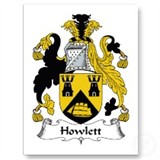
Howlett Coat of Arms
Thomas Howlett arrived in America on the ship Hopewell in 1630 to live in Boston. He was a carpenter, and had skills as a surveyor. He was active in church and military matters.
Thomas Howlett (1605 – 1678)
is my 10th great grandfather
Thomas Howlett (1638 – 1667)
son of Thomas Howlett
Mary HOWLETT (1664 – 1727)
daughter of Thomas Howlett
John Hazen (1687 – 1772)
son of Mary HOWLETT
Caleb Hazen (1720 – 1777)
son of John Hazen
Mercy Hazen (1747 – 1819)
daughter of Caleb Hazen
Martha Mead (1784 – 1860)
daughter of Mercy Hazen
Abner Morse (1808 – 1838)
son of Martha Mead
Daniel Rowland Morse (1838 – 1910)
son of Abner Morse
Jason A Morse (1862 – 1932)
son of Daniel Rowland Morse
Ernest Abner Morse (1890 – 1965)
son of Jason A Morse
Richard Arden Morse (1920 – 2004)
son of Ernest Abner Morse
Pamela Morse
I am the daughter of Richard Arden Morse
| Name | Thomas HOWLETT Sergeant, Ensign |
| Birth | 1605, Assington, Suffolk, England |
| Death | 24 Sep 1677, Topsfield, Essex, Massachusetts |
| Occupation | Carpenter |
| Father | William HOWLETT (1579-) |
Misc. NotesFrom co. Suffolk, England. Removed Ipswich 1633. Deposed 1658, aged 52. Church member 1630.29One of the first settlers in Agawam (Ipswich) 1632/33. Deputy from Ipswich 1635 and Topsfield 1665 and often employed in running lines and locating towns and farms.Ipswich, Massachusetts Deputy in 1635. Ensign of Ipswich Company under Captain Daniel Dennison, 3rd Regiment, Colonel John Endicott 1636.102Thomas Howlett was twenty-five years old when he came to New England in 1630 aboard the ship “Hopewell” as part of Governor Winthrop’s Fleet. He was a carpenter by trade, with origins in South Elmham Parish of Suffolk County, East Anglia in England. He first settled in Boston, as did a majority of Winthrop colonists, and became a member of the First Church on August 27, 1630. In the spring of 1633 he married Alice French, daughter of Thomas and Susan (Riddlesdale) French, who apparently had emigrated to New England prior to her parents. She was a member of the First Church and was eventually dismissed on September 10, 1643 to the church in Ipswich as “Our sister Alice French ye wife of Thomas Howlet of Ipswich.”Although Howlett later settled in Topsfield where he spent the latter years of his life, he was one of the nine originals of John Winthrop Jr’s 1633 party settling the Indian village Agawam, which the next year became the town of Ipswich. He was sworn a freeman at Ipswich on March 4, 1633.In 1634 Ipswich granted Howlett, in partnership with John Manning and others, on the neck of land on which the town stood, two acres of meadow and two and a half acres of marsh between the town riger and the lands of William Sergient (probably Sargent) and John Newman. Added to this in 1635 was a house lot in the town, thirty acres of upland and ten of meadow at the head of Chebacco Creek and ten acres north of the town toward the Reedy marsh. In 1637 he purchased forty acres from John Perkins, Sr. His later acquired Topsfield holdings are described in his will.Thomas Howlett’s highest political office came to him as a young man, when, in 1635, he represented Ipswich in the General Court. he served on the Essex County Jury of Trials in 1654, 1657, and 1665 and on the Grand Jury in 1650, 1659, 1666, and 1667 and served as Selectman of Topsfield in 1661.In 1640 he was sergeant of the Ipswich military defense company and later became its ensign. In 1643 he, as Sergeant, and ten other militiamen were voted compensation by the town for their three days acting in defense of the Agawam Indians against their tribal enemies. In 1672 he became a Deacon of the Topsfield Church and his contribution of five pounds to the salary of Rev. Jeremiah Hubbard was the largest of those made.There were eight children of Howlett’s marriage with Alice — Sarah (1633/34-1700), John (1633/34-1674/75), alice (1636-1696), Thomas, Jr. (1637/34-1667), Mary (1641/42-1718), Nathaniel (1646-1658), William (1649/50-1718), and Samuel (1654/55-1719/20). On June 6, 1666, after the death of Alice he married Rebecca Smith, widow of Thomas Smith if Ipswich and Newbury, with his step-son, Thomas Smith, in 1671, choosing him as his guardian.Thomas Howlett died in Topsfield, Essex County on September 24, 1677.Military Was in Pequot War32, No. 74, pg. 120, 1920Spouses
| 1 | Alice FRENCH |
| Birth | 9 Oct 1609 |
| Death | 26 Jun 1666, Topsfield, Essex, Massachusetts |
| Christen | 9 Apr 1610, Assington (St. Edmund’s), Suffolk, England |
| Father | Thomas FRENCH (<1584-<1639) |
| Mother | Susan RIDDLESDALE (<1584-1658) |
Misc. NotesProbably emigrated to America with her brother Thomas. Alice was dismissed from the Boston Church to Ipswich 16 Jun 1644.
| Marriage | 1 Jan 1633/34, Ipswich, Essex, Massachusetts |
| Children | Sarah (1633-1700) |
| Alice (ca1636-<1696) | |
| Thomas (1637-1667) | |
| Mary (1641-1718) | |
| John (1643-1675) | |
| Samuel (1645-1719) | |
| Nathaniel (ca1646-1658) | |
| William (1649-1718) |
| 2 | Rebecca SMITH |
| Death | before 1 Jan 1634/35 |
| Father | Thomas SMITH |
| Mother | Alice |

Perkins coat of arms
William Perkins was born in England, educated at Cambridge, and moved to New England in 1632. He served in the military and taught school after arrival. He was a very well educated man.
1. Rev.-Capt. William Perkins, son of William Perkins Merchant Taylor and Catharine Unknown, was
born on 25 Aug 1607, was christened in All Hallows, Bread Street, London, Eng., and died on 21 May 1682 in
Topsfield, MA at age 74.
General Notes: Robert Charles Anderson, The Great Migration Begins: immigrants to New England
1620-1633, New England Historic Genealogical Society, Boston, 1995, Three volumes.
From George Walter Chamberlain, History of Weymouth, Boston, 1923.
“Capt. William Perkins, the first schoolmaster of which there is any record, was voted ?10 for six months
schoohng, 10 Mar. 1651 (Weymouth Town Records.) He entered Emmanuel College, Cambridge, as a
pensioner at Michaelmas Term, 1625; afterwards immigrated to Christ’s College from which he
graduated, A.B., at lent term, 1627-28.
“He was son of William Perkins, a merchant tailor, of London, and was born 25 Aug. 1607, and came
in the ship William and Francis, leaving London, 7 Mar. 1631-32. This ship arrived at Boston, 5 June,
1632. (Drake’s, The Foumders of New England, 11.) He was made a freeman of the Massachusetts Bay
Colony, 3 Sept. 1634. He married at Roxbury, 30 Aug. 1636, Elizabeth Wootton, and removed to
Weymouth in 1643, where he resided till 1652, when he removed to Gloucester, and in 1655 to
Topsfield. He became the first munister of the latter place. He was deputy from Weymout in 1644 and
Captain there in 1645. He died at Topsfield, 21 May, 1682, aged 75 years.
“The General Court entered the following record on 7 Oct. 1641: ‘Mr. Willi Perkins, for his fathers
50, is granted 400 acres of land.’ (Massachusetts Bay Colony Records, 1:338.) He was to ‘have power to
end small causes at Waymoth,’ 29 May, 1644, and again, 14 May, 1645. (Ibid. 2: 73, 97.) He was a
deputy at the General Court, 29 May, 1644, and was called ‘Lieut. Wm. Perkms’ (Ibid. 66) and ‘Capt.,’ 4
Nov. 1746 (Ibid. 184.).”
——————–
William Perkins, 1607-82, A Study, The Essex Genealogist, vol 3, pp 65-76, May 1983, iss.2
We know from the Cambridge Alumni association that he was a preacher and a teacher:
Adm. at EMMANUEL, 1624. S. of William, merchant tailor, of London. B. there, Aug. 25, 1607. Schools, London and Colchester (Mr Danes). Matric. Michs. 1625. Migrated to Christ’s, Nov. 15, 1626. B.A. 1627-8. Went to New England, 1632. Resided at Roxbury, Mass., adm. a freeman of the Massachusetts Colony, 1634. Moved to Weymouth, Mass., 1643. Sent as deputy to the General Court, 1644; lieutenant, 1644, and captain, 1645, of the local military company; served as schoolmaster and preached occasionally. Removed to Gloucester, Mass., and taught school there, 1651-5. Retired to Topsfield, Mass., 1655. Died there, May 21, 1682. (Peile, I. 378; J. G. Bartlett.)
 mermaidcamp