mermaidcamp
Keeping current in wellness, in and out of the water
You can scroll the shelf using ← and → keys
You can scroll the shelf using ← and → keys
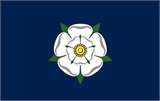
Yorkshire flag
Jane Sotheron was born in England into a wealthy family. She died in Rowley, Massachusetts. Her husband, Thomas Crosby, was a wealthy man as well:
Tradition says that Thomas CROSBY came over in company with the Rev. Ezekiel ROGERS in 1638. That he was a man of wealth for those days is shown by his advancing a considerable sum of money for the first printing press brought and set up in America.
He spent his last years in the home of his grandson Dr. Anthony CROSBY, of Rowley, and d. there 6th May, 1661.
Jane Sotheron Born: 4 MAR 1581/82 in Holme-on-Spalding-Moor, York County, England Death: 2 MAY 1662 in Rowley, Middlesex, Massachusetts Married: 19 OCT 1600 in Holme-on-Spalding-Moor, York County, England
Their Children:Anthony b: 1602 in Holme-on-Spalding-Moor,York County, England Thomas b: 1604 in Holme-on-Spalding-Moor,York County, William b: 1606 in Holme-on-Spalding-Moor,York County, England Simon b: 1608 in Holme-on-Spalding-Moor, York Co. England
18 APR 1638 sailed to America on John Of London with a group of Reverend Ezekiel Rogers’ followers. They may have lived with the widow of their son Simon in Cambridge, Massachusetts until she remarried in 1645 — at about that time, Thomas purchased a house in Cambridge. After a few years, he sold his holdings in Cambridge and the couple relocated, for the last time, to Rowley, Massachusetts.Thomas lived to over 85 years of age and died in Rowley in 1661, buried on May 6.Jane died the following year and was buried in Rowley on May 2, 1662
1609 tax records indicate that William Sotheron (father of Jane) was the wealthiest resident of the parish.Thomas’ father died in 1599 and Thomas inherited a hundred-acre farm in Holme-on-Spalding-Moor.Tax records and other documents suggest that the family led a fairly well-to-do life.
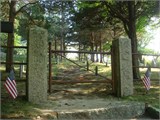
Anna Bursell at rest
Anna was born in Barnstable, Ma in 1640. She died a widow in Barnstable in 1724, living through some heavy times. She married Silas Sears:
Lieut. SILAS SEARS, son of Richard, died Yarmouth, Mass., 13 Jan, 1697/8; married ANNA ??(Bursell??) who died a widow in yarmouth, 4 Mar 1725/6. They had children:
SILAS, born Yarmouth c. 1661; RICHARD, born in Yarmouth; HANNAH, born Eastham(?) Dec 1672, m. 8 Feb 1692/3 Thomas SNOW(son of Mark and Jane(Prence)Snow) she died prior to 30 Sep 1706; JOSEPH, born Yarmouth, c. 1675; JOSIAH, born Yarmouth c. 1677; ELIZABETH, born Yarmouth, m. there 22 Nov 1705, John COOKE; DORRITY, born yarmouth c. 1687; m. there 8 Feb 1715/6 Joseph STAPLES she died 28 Feb 1753
Lt. Silas Sears lived in that part of Yarmouth known as the East precinct, now East Dennis; was “propounded to take up Freedom,” June 6, 1682; commissioned Ensign, 28 Oct 1681; Liet. 7 July 1682; chosen Representataive to the General Court at Plymouth, 1685-91; Selectman, 1680-94; Juryman, 1680-82.
25 Dec, 1689; “Silace Sears and other fined 20 shillings for not appearing and attending at Court, or disorderly departing therefrom;”–fines remitted latar, “it being first offense of the kind.”
1694; “Lt Silas Sears on Com. to seat men, women and others in the meetinghouse;” an onerous duty in those days.
1 Nov 1676, Emott Bursell and Silas Sears appointed administrators of the Estate of James Bursell of Yarmouth. It has been suggested that his wife may have been a daughter of James Bursell, based on the supposition of his being chosen one of the administrators.
Silas Sears left no will, and letters of administration were granted to his widow Anna, 1 May 1698. The “settlement” of his estate was made 5 May 1698 and mentions sons Silas, Richard, joseph and Josiah; and daughters, Hannah, Elizabeth and Dorrity
Anna Bursell (1640 – 1724)
is my 9th great grandmother
Silas Sears (1661 – 1732)
son of Anna Bursell
Sarah Sears (1697 – 1785)
daughter of Silas Sears
Sarah Hamblin (1721 – 1814)
daughter of Sarah Sears
Mercy Hazen (1747 – 1819)
daughter of Sarah Hamblin
Martha Mead (1784 – 1860)
daughter of Mercy Hazen
Abner Morse (1808 – 1838)
son of Martha Mead
Daniel Rowland Morse (1838 – 1910)
son of Abner Morse
Jason A Morse (1862 – 1932)
son of Daniel Rowland Morse
Ernest Abner Morse (1890 – 1965)
son of Jason A Morse
Richard Arden Morse (1920 – 2004)
son of Ernest Abner Morse
Pamela Morse
I am the daughter of Richard Arden Morse
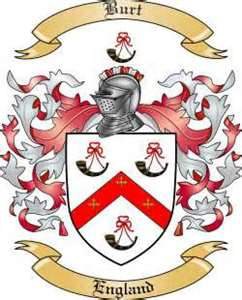
Burt Coat of Arms
Henry Burt (1595 – 1662)
Henry Burt was born about 1595 at Harberton, Devon Co, probably the second son of Henry. He married Ulalia March at Dean Prior, Devon County on December 28, 1619. He came to New England in the Spring or Summer of 1639, and with his wife and seven children settled at Roxbury, MA. Shortly after he settled there, his house was burned, for whatever reason, and, in November of 1639, the General Court made a grant to the town in the amount of 8 Pounds because of the loss . He moved to Springfield in 1640 and was Clerk of the writs (aparently the town recorder). But it is strange that his own childrens’ births are not recorded in the town. He died in Springfield, April 30, 1662.
Henry Burt, Jr
Born: About 1595 in: Harberton, Devon, England Married: December 28, 1619 in: Dean Prior, Devon, England Died: April 30, 1662 in: Springfield, MA
Ulalia March Born: About 1598 in: England Died: August 29, 1690 in: Springfield, MA
We know a lot about his life:
Documented events in his life were:
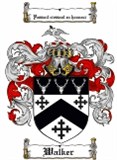
Walker Coat of Arms
My 10th great grandmother was 17 years old when she sailed from London to Salem, MA. She married John Brown soon after arrival in America and moved to New Hampshire. Her husband, who had been a baker, became a ship builder and a very wealthy man. Her sons were all farmers who fought against the Native people in King Philip’s War.
John Brown was born about 1589 in London, England. He emigrated on APR 17 1635 from London, England. *Genealogy of John Brown : “He sailed out of London on the ‘Elizabeth’, 17 April, 1635.” He immigrated in JUN 1635 to Boston, MA. (2646) *Genealogy of John Brown : They arrived in Boston in June 1635 and he remained, as tradition says, in Salem, Massachusetts, until 1638. He died on FEB 28 1687 in Hampton, NH. He is my 9th great grandfather. 9th great grandfather
*Genealogy of John Brown : “John Brown was born in London, England, in 1589 of Scottish parents. For several years he ran a bakery in London and at age fourty-six years decided to go to American Plantations. He sailed out of London on the ‘Elizabeth’, 17 April, 1635. Among his fellow passengers were Sarah Walker, age 17, (later to become his wife) and her brother, James Walker, age 15, who was formerly employed by John in the bakery. John registered at customs as a baker and they registered as servants. Sarah had been in the employ of William Brazey, a linen Draper in Cheapside.
They arrived in Boston in June 1635 and he remained, as tradition says, in Salem, Massachusetts, until 1638. Then John went to Hampton, New Hampshire, where he was one of the first settlers to receive a grant, a tract of four acres, for a house lot, lying near a branch of the river afterwards called Brown’s River. [ Note: This referrs to Browns River, along the Seabrook / Hampton Falls border.]
In 1640 he married Sarah Walker. She was born in 1618, and presumably, left London as a servant to John.” “…the fact that John Brown signed his own name, instead of a mark, shows that his education was not limited, and since he was a single man of fourty-six years when he came to this country, it is presumed that he did not leave London entirely destitute of property but was a man of considerable wealth. This may be one reason why Sarah married a man so much older than herself…”
”John built the first ‘barque’ (small boat) ever built in Hampton in 1641 or 1642 at the river near Perkins Mill.” “… it would seem that this barque was the one that John Green Wittier mentions in his poem, ‘The Wreck of River Mouth’.”
”John was a sober, industrious, hard-working and enterprising man, having made purchases of large additions to his four acres of land in various transactions in the different parts of town. He became one of the largest land owners and the third man of wealth in Hampton, being owner of four farms. He bought of John Sanders in March 1645 house and houselot with 12 acres of upland in the north field next to Morris Hobbs, six acrea of fresh meadow lying by the Great Boar’s Head next to William Fifield’s meadow.
Even though John was a selectman in 1651 and 1656, he never seemed to have taken an active part in town or church affairs. From the records of the court, it appears that John and his sons were engaged considerably in stock, and in 1654 they sued Thomas Swetman for a debt due for two fat oxen, for the want of which money they claimed to have been much damaged.
In 1673 and 1674 he and his eldest son, John, brought suit against the’prudential men’ and also against the Town of Hampton for not causing a road to be built to his farm near the Falls River toward Salisbury, Mass. (now Seabrook, NH). The courts decided in his favor and Landing Raod was built.
All five of John’s sons were farmers and were all engaged in conflict with the Indians in King Philip’s War.”…
*History of Hampton : “John Brown, born in England in 1588 or ’89, emigrated in 1635, and is said to have settled in Hampton as early as 1639. A tract of four acres, for a house-lot, lying near a branch of the river, afterward bearing his own name, was granted to him, though he seems not to have settled there. His residence was on a ten-acre lot bought of John Sanders, on which Zacceus Brown, a lineal descendant of the seventh generation, now resides. He afterward, by purchase, made large additions to this lot, and obtained various other tracts in different parts of the town.”
Note: This refers to Browns River, along the Seabrook/Hampton Falls border.
*E-Mail : “John Browne of Hampton, said to be the son of Sir Angus Browne of Scotland, came to the American colonies from London, England, where he was a baker of considerable means. Embarked on the ship “Elizabeth de London” in April 1635. While on board, he met Sarah Walker, age 17, with her brother, James, age 15, also of London. Reached Salem, Mass. in June 1635. After a few weeks residence there married Sarah and went with the first company of settlers to Hampton, N.H. Was one of richest men in the community. Was a ship builder and made several voyages to England to induce colonists to come to New England.” He was married to * Sarah Walker in 1640.
“In 1669, her brother, John, became violently ill and she cared for him in her home for several years. Sarah died 28 December, 1678 at the age of thirty-five years, being one of the fourty victims of smallpox in Charlestown.”

Caleb Carr at Rest
I must amend this post because I made an error in my tree. After I had the good luck to visit Caleb, I learned that I had the wrong Sweet in the 1600s. I have corrected the error, but will am leaving this here for his fans. He is not my 9th great grandfather, but is my relative.
Gov. Caleb Carr , born in London, Eng., Dec. 9, 1616, came to America with his brother Robert, on the ship Elizabeth Ann, which sailed from London May 9, 1635. He settled in Newport, R.I., with his brother Robert about 1640. He held many offices of public trust and honor during his lifetime, and accumlated considerable property. He was general treasurer from May 21, 1661 to May 22, 1662. In 1687-8, he was justice of the General Quarterly Session and Inferior Court of Common Pleas. He was governor of the colony in 1695, which last office he held till his death, which occured on the 17th day of December, of the same year. He was drowned. In religious belief he was a Friend or Quaker.
He had seven children by his first wife Mercy, (probably Mercy Vaughan) who died Sept. 21, 1675, and was buried in the family burying ground. The inscription on her gravestone reads as follows: “Here lieth interred ye body of Mercy Carr, first wife of Caleb Carr, who departed this life ye 21st day of September, in ye 45th year of her age, and in the year of our Lord, 1675.” His second wife was Sarah Clarke, (Widow Pinner) daughter of Jeremiah Clarke, and sister of Gov. Walter Clarke, and by whom he had four children. She was born in 1651 and died in 1706.
He died Dec.17, 1695, and was buried in the family burying ground on Mill street, beside his first wife. The inscription on his tombstone reads: “Here lieth interred the body of Caleb Carr, governor of this colony, who departed this life ye 17th day of December, 1695, in ye 73rd (79) year of his age.”
Caleb Carr (1623 – 1695)
is my 9th great grandfather
Sarah Carr (1682 – 1765)
Daughter of Caleb
John Hammett (1705 – 1752)
Son of Sarah
MARGARET HAMMETT (1721 – 1753)
Daughter of John
Benjamin Sweet (1722 – 1789)
Son of MARGARET
Paul Sweet (1762 – 1836)
Son of Benjamin
Valentine Sweet (1791 – 1858)
Son of Paul
Sarah LaVina Sweet (1840 – 1923)
Daughter of Valentine
Jason A Morse (1862 – 1932)
Son of Sarah LaVina
Ernest Abner Morse (1890 – 1965)
Son of Jason A
Richard Arden Morse (1920 – 2004)
Son of Ernest Abner
Pamela Morse
I am the daughter of Richard Arden
On May 9, 1635 the ship Elizabeth and Ann slipped her moorings and put out from London, England under the command of Roger Cooper, Master. Her destination was New England. On board were on hundred and two passengers bearing permission to emmigrate to the new world that lay on the western shore of their ocean.
Among these passengers two should command our attention. These are listed in the old records as Robert and Caleb Carr. The notation of “Taylor” is appended to the name of Robert designating his trade. A later writer, Dr. Turner of Newport, refers to them as from Scotland. As yet we do not know exactly from whence they came.
Sometime in the following June (early midsummer, one account says) the ship arrived in Boston harbor and our ancestors were in America.
For the next two years we have to guess as to the residence of the two passengers on the Elizabeth and Ann. For the remainder of their lives Robert and Caleb Carr were close associates of William Coddington who came from Boston, Lincolnshire, England as of of the original members of the Mass. Bay Company in 1629 and was a leading merchant in Boston, Mass. during this period. Robert and Caleb landed at Boston and two years later left Boston. Adding all these facts together are w not permitted to assume that our ancestors were for these first two years of the living on this side the Atlantic in the rapidly growing town of Boston.
Early in 1637 a group of Boston people led by William Coddington left Boston because of religious differences. They went to Providence and conferred with Roger Williams as to settling in those parts. With the active aid of Mr. Williams the group purchased from the Indians the large town of Quidnick and immediately proceeded to the business of founding the town of Pocassit (later called Portsmouth). It is thought that the Carrs left Boston with this group. Certainly they were early at the Pocassit settlement for on Feb. 21, 1638 Robert Carr was listed as an inhabitant. It is my thought that Caleb who was still but a child of fourteen accompanied Robert.
Many seem to have come to the new settlement at Pocassit that summer of 1638 and the following winter for in the spring of the next year William Coddington and a small group of the leading men removed to the south end of the island to lay out a new settlement leaving at Pocassit a goodly company to carry on.
Again the Carrs followed William Coddington and like him remained at the new settlement the rest of their days. the name which they gave this new home was remained unchanged all these years. It is still Newport.
Lying in the mouth of Narragansett Bay off shore from Newport is the sizable island of Conanicut (known now as Jamestown). In contrast with the forested shores of Aquidnick, Conanicut had some cleared land where the Indians had for generations summered and grown their corn and vegetables. This area of hay, pasturage and vegetable land appealed to the forest bound inhabitants of Newport. Thus in 1659 we find William Coddington, Benedict Arnold, William Brenton, Caleb Carr and Richard Smith leading a company of Newport citizens in arranging the transfer of Conanicut and the small adjoining islands of Gould and Dutch to themselves. Chief Quisaquam made the transfer on the part of the Indians.
Both Robert and Caleb were among the ninety-eight original purchasers of the island. It is thought that neither of the brothers resided on the island. This move was left to their children.

signatures on marriage contract
We know a lot about the life of my 12th great grandfather who arrived in Boston harbor to begin his new Puritan life in 1630. He was censured by the Puritans for defending a woman who held Bible studies in her home for both men and women. He had to retract his support for Anne Hutchinson under threat of having his gun taken from him. His brief touch with feminist sentiments and freewheeling seditious non conformity and Antinomianism were censured by his Puritan piers. The crazy religious infighting that created Rhode Island and Maine is not a well known part of the story of our founding fathers. Here is the story of one of my ancestors who arrived very early on the shores of North America:
BIRTH William was born circa 1581 in Bermondsey, Surrey, England[1], as based upon his date of marriage. DEATH & BURIAL He died in Woburn, Middlesex co., MA on 1 March 1645/6; he was 64[2,3]. MIGRATION & RESIDENCE William and his family migrated to New England by 1630[1], where he was admitted as an inhabitant of Charlestown, Suffolk co., MA that year[3,6,7]. “William Learned and Goodith his wife” were admitted to the church at Charlestown, Suffolk co., MA on 6d:10m(December):1632[1,6]. He made Freeman there on 14 May 1634[1,4]. William and his family remained in Charlestown for roughly a decade — he is on the lists of Charlestown residents of 9 January 1633/4 and January 1635/6[3,8]. Then, they removed to Woburn, Middlesex co., MA in 1640[1]. In Charlestown, William acquired and divested a great deal of real estate. In 1635, he was allotted two shares of hayground, which was subsequently increased to three[1,12], and he surrendered 5 acres on the Mystic Side[1,11]. On 13 January 1636/7 the Charlestown selectmen “agreed to allow Goodman Learned a portion of marsh by his house agreed upon by Goodman Richeson & Goodman W[illia]m Baker for his haylot by Mr. Gibbon’s which he yieldeth up to the town”[1,17]. In 1637, he had a 10-acre lot (number 7 on the Mystic Side)[6], and another 5 acres of land on the Mystic Side[1,13]. In addition, “W[illia]m Lernett” had 3.75 cow commons that year[1,14]. In the Mystic Side allotments of 23 April 1638 he received portions of 15, 40 and 5 acres[1,15]. Thus, in the 1638 Charlestown Book Of Possessions, “William Lernett” had 7 parcels of land: three acres of arable land and meadow, along with a dwelling house next to the “Olde Meeting House”; four acres arable land in the East Field; 3.75 cow commons; two acres of meadow in the Mystic Marshes; five acres of woods in the Mystic Field; fifteen acres of woods in the Mystic Field next to the Common; and forty acres of land in the Rock Field[6,9,10]. The 3.75 cow commons were further noted in an inventory of 20 December 1638[1,16]. TOWN SERVICE & EDUCATION William signed the petition on 10 February 1634/5 which established the office of the Selectman in Charlestown, Suffolk co., MA[3,20]. He himself served as Selectman in 1636[1,19]. On 26 April 1638, William was named to the Charlestown committee “to consider of some things tending towards a body of laws &c”. Anderson uses this as evidence of his higher education level[1,18]. LEGAL MENTION On 16 November 1637 “Will[iam] Larnet acknowledged his fault in subscribing the seditious writing [in favor of Rev. John Wheelwright], & desiring his name to [be] crossed out, it was yielded his, & crossed”[3,5]. The case of the Reverend John Wheelwright involved the Antinomian movement of the 1630s in the Boston Area. Bucking church authority was a part of Wheelwright’s nature, it would seem. Whilst a preacher in England, he was censured for non-conformity for his embrasure of Puritan sentiments. After arriving in Boston, Suffolk co., MA in 1636, he was soon suspected of following the Antinomian tenets proposed by his sister-in-law, Mrs. Anne Hutchinson. Thus, he was censured again, this time by the Puritan government under Governor John Winthrop after delivering a sermon at Mount Wollaston (now Quincy), Norfolk co., MA, disfranchised and banished. Unlike most Antinomian banishees, he went north to Maine instead of south to Rhode Island. Ever the contrarian… Wheelwright was forgiven in the 1650s when the hysteria over Antinomianism wore off. MARRIAGE #1 On 22 April 1606 when William was 25, he first married Goodith GILMAN, in St. Olave, Southwark, Surrey, England[2,3,21,22,23,24,25,26,27,28,29,30,31,32,33,34,35,36]. Goodith died sometime after 1632 in Charlestown, Suffolk co., MA[3]. It is worth noting that “Goodith” is neither a corruption of “Goodwife” nor “Judith”, as has been proposed in several books, but her given name in its own right[3]. MARRIAGE #2 After 1632 when William was 51, he second married Jane [surname not known], in Charlestown, Suffolk co., MA[2,22,37,38]. This marriage is also in the Malden, Middlesex co., MA vital records (they lived in the section of that town which later became Woburn, Middlesex co., MA) with the bride’s name given as “Sarah”. This name change stayed with her, either as a chronic mistake or as a preferred name of hers, for when Jane died on 24 January 1660/1 in Woburn, Middlesex co., MA[3,39,40] she was listed as “Sarah [sic] Learned widow”. In March of 1660/1, the “inventory of the estate of the widow Jane Learned deceased in Malden” was taken. Administration was granted to Ralph Shepard on 2 April 1661[3,39,40].
This is how I am related to him:
William Learned (1590 – 1645)
is my 12th great grandfather
Sarah Learned (1604 – 1652)
Daughter of William
Mary Ewer (1637 – 1693)
Daughter of Sarah
Mehitable Jenkins (1655 – 1684)
Daughter of Mary
Isaac Hamblin (1676 – 1710)
Son of Mehitable
Eleazer Hamblin (1699 – 1771)
Son of Isaac
Sarah Hamblin (1721 – 1814)
Daughter of Eleazer
Mercy Hazen (1747 – 1819)
Daughter of Sarah
Martha Mead (1784 – 1860)
Daughter of Mercy
Abner Morse (1808 – 1838)
Son of Martha
Daniel Rowland Morse (1838 – 1910)
Son of Abner
Jason A Morse (1862 – 1932)
Son of Daniel Rowland
Ernest Abner Morse (1890 – 1965)
Son of Jason A
Richard Arden Morse (1920 – 2004)
Son of Ernest Abner
Pamela Morse
I am the daughter of Richard Arden
 mermaidcamp