mermaidcamp
Keeping current in wellness, in and out of the water
You can scroll the shelf using ← and → keys
You can scroll the shelf using ← and → keys
What is your relationship to God? Your archetypes will define and expose your spirit. While we may all want to be a visionary or some very special rare spiritually gifted being, our story may be stronger than our experience. If you know the spiritual archetype, you will also have some experience with the shadow of it. Spirit does not bring along only happy good time feelings. It brings lessons required for our own wisdom and advancement. If you really are a martyr you have used your own suffering to manipulate others. The depth of the reality depends on how truthful and open you are. None of us worships like our parents before us…well, very few. Do you give your spirit a rich practice or a platitude?

Jung’s Kundalini
One of Carl Jung’s most controversial theories was his view of the God within. He was drastically disappointed in his first communion at the Swiss Reform Church. His father was the pastor and Carl was a faithful member of his church. He expected something more, or different, when he attended that communion. He basically never stopped pursuing that ecstasy he had wanted through religion for the rest of his life.
His later years were consumed with individuation, which he considered to be the meaning of existence. He used artistic expression, dream journaling, and isolation in a primitive tower built by his own hand to achieve his own individuation. He studied ancient alchemy and philosophy. His belief that symbols contain the most direct and deep meaning lead him to study ancient texts and charts. To Jung individuation was not a substitute for God, but a deep search for the divine nature of self.
His investigations were deep and lengthy. He stated that he only studied of God as a psychological archetype and not as religious doctrine. His idea of the collective unconscious is that images and symbols are primordial. We absorb symbolic messages but do not analyze their meaning. That is why Jungian therapy can include sand box drawing, word association, and art to discover archetypes. Dream work is a pivotal part of Jungian analysis. In his tower, reading about ancient alchemists, living without modern conveniences, Jung came close to living in a dream. Most cannot afford such an extravagant personal quest for the divine, but we can all do a little dream investigation. Does God enter your dreams?

dream spiral
Julia Sweeney of SNL fame performed the opening of her show “Letting Go of God” for this TED talk. She is witty and insightful as she talks about her childhood exposure to religion. We all had different parental models. My parents were not religious but they belonged to a church they rarely attended. They got the big idea that I needed to go to this Presbyterian church when I was about 11. They made no bones about the purpose of my Sunday school enrollment. It was punishment. I am not sure what the infraction was, but I was to atone by being a Sunday school student. It fully sucked. I successfully physically fought off my mother in the ladie’s room the first time she tried to leave me at Sunday school, but eventually I had to go for a couple of years. I even was baptized and confirmed at the same time, since in infancy I was not baptized. My overall impression is that it was a drag, but I do know some of the songs still today. I asked my father why I had to go and they did not. I always remember his answer. He said, “I believe in God, but not like that.” Why they thought I should be indoctrinated like that is still odd to me.
i have been reflecting a lot about the way the monotheists enjoy and spread their beliefs. There is such a giant conflict of interest inherent in pledging aligiance to one god then using that God as a marketing device. It appears that these worshipers do many diverse things to indicate how much they are into religion and their own sect. Sinning, confessing, decorating, blessing, baptizing, and tithing are slightly rediculous if they are performed to honor false gods.
Charleton Heston dressed in his Moses gear should be sent to the mall with the tablets and a buring bush. All the parents need to sit on his lap, very close to the bush, while the kids go to Santa’s workshop. Moses asks each parent if they have other gods before the one they take the kids to worship. Charleton will quiz them on their understanding and execution of the first commandment. The bush will then have some private time with each parent during which they will be still and know.
Would you be afraid to sit on Charleton’s lap? Did you have to look up the first commandment?
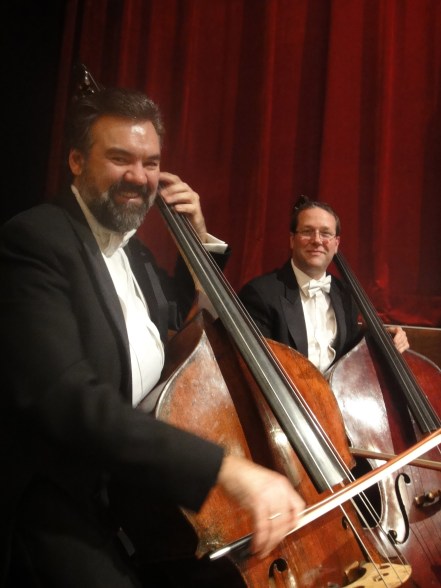
PSO at Heinz Hall
Last year I was very lucky to see the Pittsburgh Symphony Orchestra perform Handel’s Messiah as a fully staged opera. Everything about it was remarkable, even the serendipity of finding an excellent seat the day of the performance by just noticing the box office while I was on a walk. I grew up in Pittsburgh, but the Heinz Hall was new to me. Syria Mosque where I saw them in the 1960’s was gone like Forbes Field. In the lobby there was a great display about the life of Handel and the composition of the Messiah. He signed it SDG, in other words, he gave full credit to God for the music. I had seen this phrase before. It was written in German (those incredibly fancy letters you can’t read) on the outside of the school in Langweis, Switzerland, a small alpine village where my friend Steffi Burger lives. I love all that writing on the outside of old Swiss buildings, including hex signs to protect the contents of the buildings. They declare their faith and ask for protection in bold ( but hard to read) statements. I had some trouble with the reading, but was sure God was involved (most of them are about God and work) so I asked my friend, who also could not read it. We asked Walter Engle, whose family had crossed the Davos pass with their cows to settle the area centuries ago. He informed us that it said all glory to God (SDG).

School in Langweis
The protestant reformation was very into this idea and that is why it landed on the wall of the school. I relate it to the Niyama, or internal practice, of surrender to God as it is written in Sanskrit, Ishvara-Pranidhana. Apparently Handel went into a kind of trance and did speed composition under the heavy influence of spirit when he wrote the Messiah, signed it SDG and everyone knew what he meant. Bach was into this also. In yoga practice Ishvara is about trusting the divine flow, not so different from thy will be done. I wonder if by being a big student of linguistics I have stumbled upon the lowest common denominator of all religions. Surrender to God.
 mermaidcamp