mermaidcamp

mermaidcamp

Keeping current in wellness, in and out of the water

You can scroll the shelf using and keys

The Gilded Age, by Mark Twain

September 22, 2025

First edition cover

The phrase gilded age came from the title of a humorous novel written by America’s undisputed king of wit. It was written with fellow author Charles Dudley Warner to satirize the state of affairs after the Civil War.

We are listening to the audio book, produced as a radio play, using different voices for the characters. The book comes alive as the actors portray well defined parts in a well told tale of high comedy in a historic setting. The descriptions of daily lives are vivid enough to make the listener part of the action. The dialog defines each player to the T.

I’m writing this before finishing the book (Twain and Warner wrote in the forward that they expected to have the book reviewed without being read). It is a perfect book for our times. The writing reminds us that history repeats itself with regularly. I highly recommend reading it now, for insight and lots of laughs.
Kimpton Vintage Portland

September 17, 2025

Rooftop jacuzzi

The oldest hotel in Portland, Oregon is known now as Kimpton Vintage. When it opened in 1894 it was called the Imperial Hotel. Its history includes expansion and contraction through changes in ownership. I particularly enjoy the architecture of that period, which was built when the city was riding high. I have stayed in other Kimpton properties, which I admire for the reform and restoration of historic structures. Kimpton Vintage Portland is a shining example of artful design that creates an atmosphere of elegance and hospitality.

Lobby
Skylight

We had a wonderful visit in an elegant corner room before a long train journey. The front desk agent, Ben, convinced us to return at the end of our trip. We asked him what was happening on the 9th floor on the balconies. He told us about the jacuzzi suites available, then booked one for us.
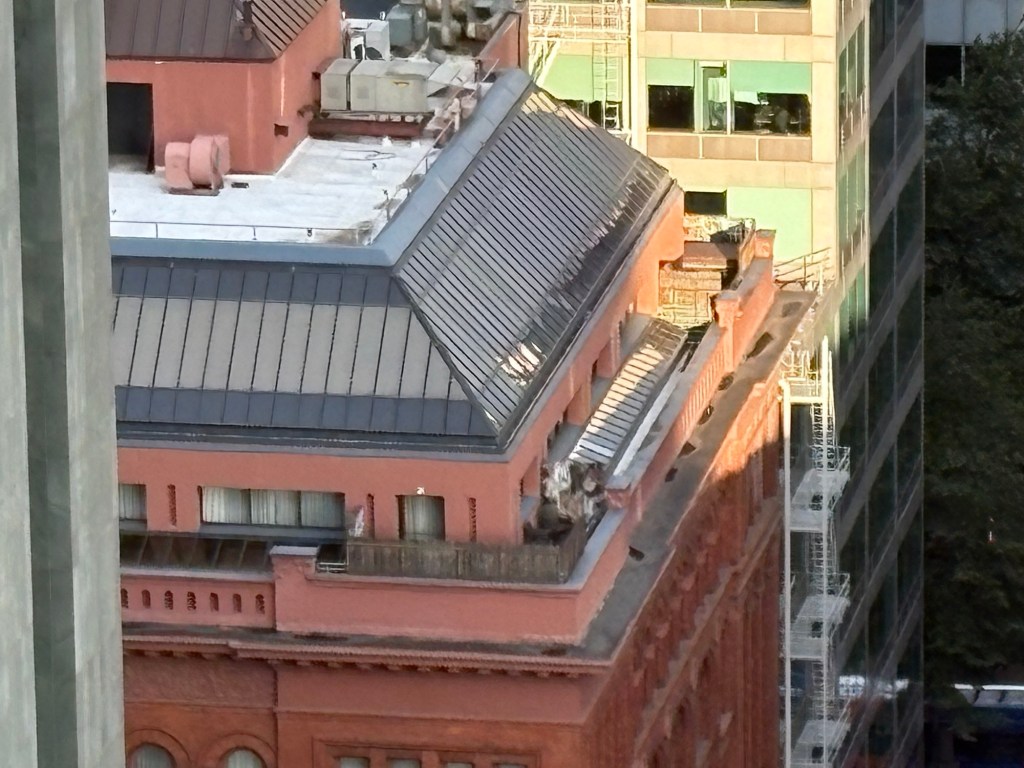
Rooftop balcony
Rooftop

This was a perfect grand finale to our trip. The hotel has a daily complimentary wine happy hour with excellent local wines. The convivial lobby event gives guests a cozy way to meet each other. We met a fellow guest who had borrowed the free bike the hotel offers to ride across the bridge to survey the city.

Too many superb options exist for dining within walking distance of the hotel. We only had time to visit a couple old favorites on our stay.
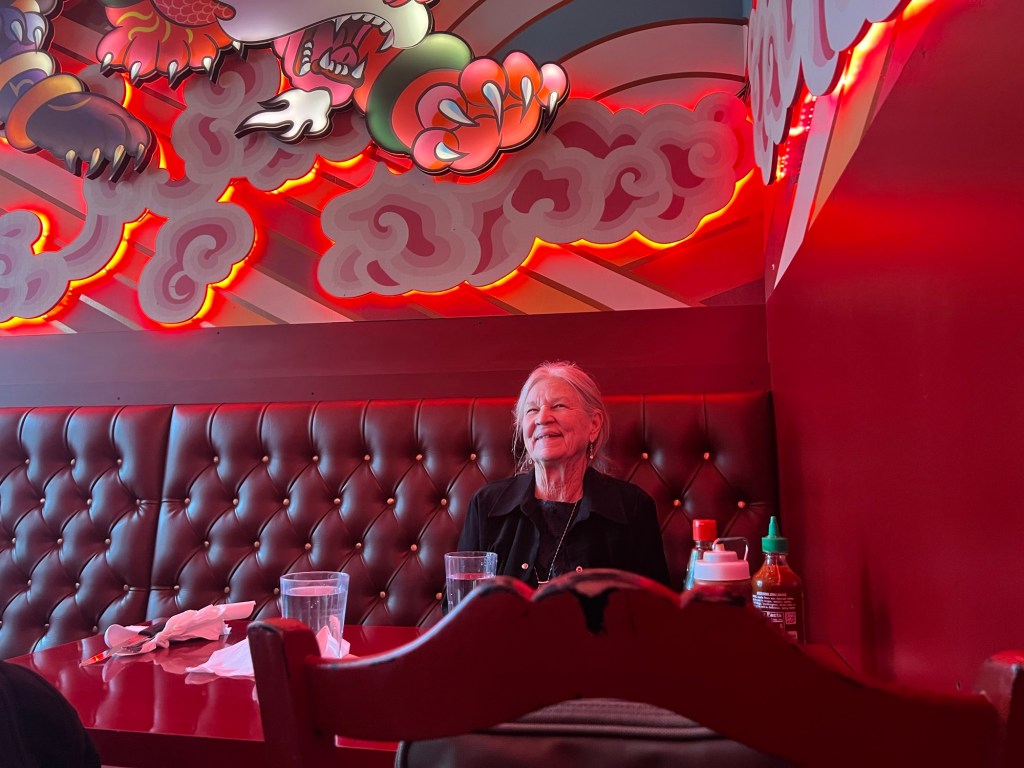
Luc Lac
Breakfast at Cheryl’s
Bon voyage

I love staying downtown Portland to experience history in a modern context. I have now found the perfect place to enjoy that. It’s a short walk to the waterfront, my fave place to stroll. Public transportation is super convenient and efficient. Cosmopolitan living at its finest is available for visitors to the Rose City. Dogs are welcome.

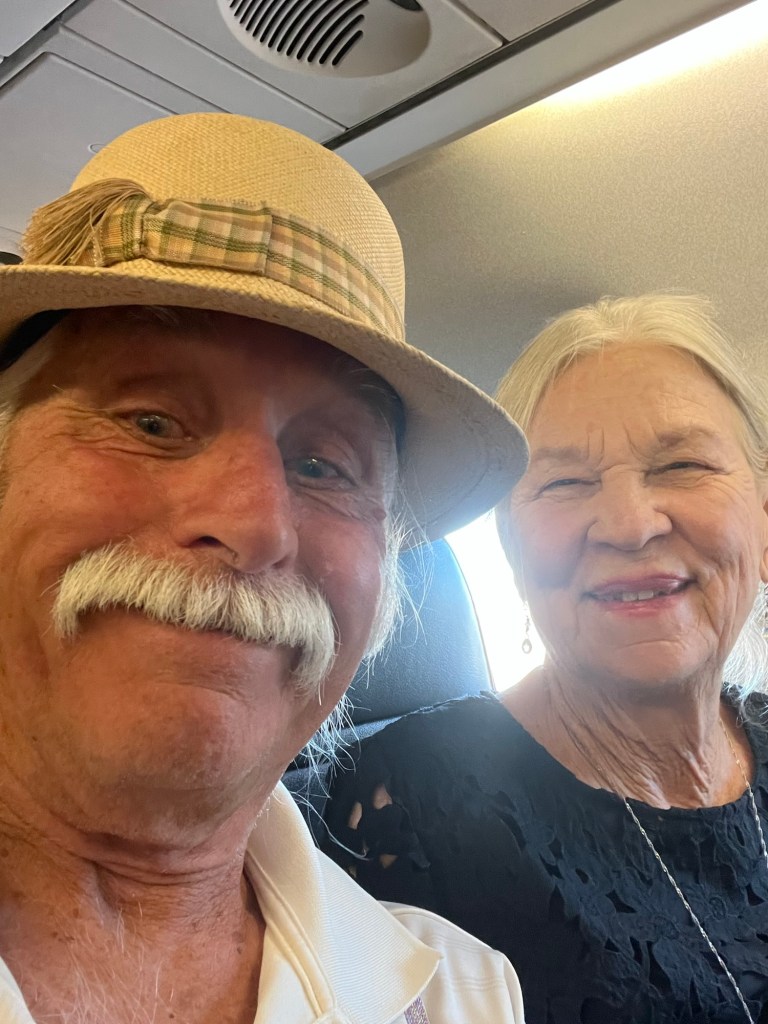
On MAX

Poets Against Random Tomfoolery

August 31, 2025

Recently public discourse has been a great concern of mine. Some on line acquaintances have chosen to leave platforms or go dark. When one of my friends of many years announced his departure he published an excellent essay about living presence as opposed to on line activity. His words moved me but I was unhappy to lose a view of his daily life.

After consideration of his well written thoughts on privacy and awareness I decided to stay but make new use of the platform I have now. The poet who writes here is a part of my archetypal make up. It’s an artistic skill I want to develop as a tribute to my famous poet ancestor, Anne Dudley Bradstreet. I decided to channel myself into this practice in order to extract myself from the current political debate. I have not found participation in on line politics to be fruitful use of my time or energy. It seems to be a catalyst for social collapse.

I’m sticking with the idea that writing poetry is the most effective method of self care I know. It’s my current way to communicate on the internet without generating vexation. I certainly hope I become better at it, but for now it’s what I do. When I take care of dogs I sing improvisation dog songs in which my current client is the star. They often begin with so and so is a good dog, a funky good dog. They always get it and have no criticism of my work.

Such a good dog

Elizabeth Cheney, Seventeenth Great-Grandmother

August 14, 2018 3 Comments

 Elizabeth Cheney
Elizabeth Cheney

My 17th great-grandmother was married twice.  She was the great-grandmother of Anne Boleyn, Jane Seymour, and Catherine Howard, who all met an unfortunate end as wives of Henry VIII.  That is really a coincidence, I think. She was buried with her second husband St. Augustine church at Broxbourne.

 Sir John and Lady Elizabeth Say are buried together at Broxbourne, Hertfordshire.
Sir John and Lady Elizabeth Say are buried together at Broxbourne, Hertfordshire.

Elizabeth Cheney (1420 – 1473)
17th great-grandmother
Elizabeth Tilney (1450 – 1497)
Daughter of Elizabeth Cheney
Lord Thomas Howard (1473 – 1554)
Son of Elizabeth Tilney
Lady Katherine Howard Duchess Bridgewater (1495 – 1554)
Daughter of Lord Thomas Howard
William ApRhys (1522 – 1588)
Son of Lady Katherine Howard Duchess Bridgewater
Henry Rice (1555 – 1621)
Son of William ApRhys
Edmund Rice (1594 – 1663)
Son of Henry Rice
Edward Rice (1622 – 1712)
Son of Edmund Rice
Lydia Rice (1649 – 1723)
Daughter of Edward Rice
Lydia Woods (1672 – 1738)
Daughter of Lydia Rice
Lydia Eager (1696 – 1735)
Daughter of Lydia Woods
Mary Thomas (1729 – 1801)
Daughter of Lydia Eager
Joseph Morse III (1756 – 1835)
Son of Mary Thomas
John Henry Morse (1775 – 1864)
Son of Joseph Morse III
Abner Morse (1808 – 1838)
Son of John Henry Morse
Daniel Rowland Morse (1838 – 1910)
Son of Abner Morse
Jason A Morse (1862 – 1932)
Son of Daniel Rowland Morse
Ernest Abner Morse (1890 – 1965)
Son of Jason A Morse
Richard Arden Morse (1920 – 2004)
Son of Ernest Abner Morse
Pamela Morse
I am the daughter of Richard Arden Morse

Elizabeth Cheney (April 1422 – 25 September 1473), later known as Elizabeth, Lady Tilney and Elizabeth, Lady Say, was an English aristocrat, who, by dint of her two marriages, was the great-grandmother of Anne Boleyn, Jane Seymour, and Catherine Howard, three of the wives of King Henry VIII of England, thus making her great-great-grandmother to King Edward VI, the son of Henry VIII and Jane Seymour, and Elizabeth I, the daughter of Henry VIII and Anne Boleyn. Her first husband was Sir Frederick Tilney, and her second husband was Sir John Say, Speaker of the House of Commons. She produced a total of nine children from both marriages.

Born in Fen Ditton, Cambridgeshire in April 1422, she was the eldest child of Laurence or Lawrence Cheney or Cheyne, Esq. (c. 1396 – 1461), High Sheriff of Cambridgeshire and Elizabeth Cokayn or Cokayne  Her paternal grandparents were Sir William Cheney and Katherine Pabenham, and her maternal grandparents were Sir John Cockayne, Chief Baron of the Exchequer and Ida de Grey, the daughter of Reginald Grey, 2nd Baron Grey de Ruthyn and Eleanor Le Strange of Blackmere.

On an unknown date, Elizabeth married her first husband Sir Frederick Tilney, of Ashwellthorpe, Norfolk, and Boston, Lincolnshire. He was the son of Sir Philip Tilney and Isabel Thorpe. They made their principal residence at Ashwellthorpe Manor. The couple had one daughter:
Elizabeth Tilney (before 1445 – 4 April 1497), married firstly in about 1466, Sir Humphrey Bourchier, by whom she had three children; and secondly on 30 April 1472, Thomas Howard, Earl of Surrey, who later became the 2nd Duke of Norfolk, by whom she had nine children. These children included Thomas Howard, 3rd Duke of Norfolk, Elizabeth Howard, mother of Anne Boleyn, and Lord Edmund Howard, father of Catherine Howard.

Sir Frederick Tilney died in 1445, leaving their young daughter Elizabeth as heiress to his estates. Shortly before 1 December 1446, Elizabeth Cheney married secondly Sir John Say, of Broxbourne, Hertfordshire, Speaker of the House of Commons, and a member of the household of King Henry VI. He was a member of the embassy, led by William de la Pole, which was sent to France in 1444 to negotiate with King Charles VII for the marriage between King Henry and Margaret of Anjou.  Her father settled land worth fifty marks clear per annum upon the couple and their issue before Candlemas, 1453. They made their home at Broxbourne, Hertfordshire.

Sir John Say and Elizabeth had three sons and four daughters:
Sir William Say (1452- 1529), of Baas (in Broxbourne), Bedwell (in Essendon), Bennington, Little Berkhampstead, and Sawbridgeworth, Hertfordshire, Lawford, Essex, Market Overton, Rutland, etc., Burgess (M.P.) for Plympton, Knight of the Shire for Hertfordshire, Sheriff of Somerset and Dorset, 1478–9, Sheriff of Essex and Hertfordshire, 1482–3, Justice of the Peace for Hertfordshire, 1486–1506, and, in right of his 1st wife, of East Lydford, Radstock, Spaxton, Wellesleigh, and Wheathill, Somerset, and, in right of his 2nd wife, of Wormingford Hall (in Wormingford), Essex, Great Munden, Hertfordshire, etc. He married (1st) before 18 November 1472 (date of letters of attorney) Genevieve Hill, daughter/heiress of John Hill, of Spaxton, Somerset. She was still alive in 1478. He married (2nd) shortly after 18 April 1480 Elizabeth Fray, widow of Sir Thomas Waldegrave, by whom he had two daughters, Mary Say and Elizabeth Say.
Mary, the eldest daughter married Henry Bourchier, 1st Earl of Essex and 6th Baron Bourchier, by whom she had one daughter, Anne Bourchier, 7th Baroness Bourchier
Thomas Say, of Liston Hall, Essex.
Leonard Say, clerk, Rector of Spaxton, Somerset. See Testamenta Eboracensia, 4 (Surtees Soc. 53) (1869): 86–88 (will of Leonard Say, clerk).
Anne Say (died 1478/1494), married Henry Wentworth, K.B., of Nettlestead, Suffolk, Goxhill, Lincolnshire, Parlington and Pontefract, Yorkshire, and of London, Esquire of the Household, Knight of the Body, Sheriff of Norfolk and Suffolk, 1481–82, Sheriff of Yorkshire, 1489–90, 1492, Knight of the Shire for Yorkshire, 1491–92, by whom she had issue, including Margery Wentworth, mother of Jane Seymour.
Mary Say, married Sir Philip Calthorpe, Knt., by whom she had issue.
Margaret Say, married Thomas Sampson, Esq.
Katherine Say, married Thomas Bassingbourne.

On 25 September 1473, aged 51, Elizabeth Cheney died. She was buried in the church at Broxbourne. Following her death, John Say remarried to Agnes Danvers. He died five years later on 12 April 1478. Sometime after 1478, Elizabeth’s eldest son, Sir William Say, married his second wife, Elizabeth Fray, a daughter of his stepmother Agnes, by her first husband, Sir John Fray (1419- 1461), Chief Baron of the Exchequer.

Sources
John Smith Roskell, Parliament and Politics in Late Medieval England, Vol. 2, Google Books, accessed 9 September 2009
References
Lundy, Darryl. “p.335.htm#3342”. The Peerage.
Ida Ashworth Taylor, Lady Jane Grey and Her Times, page 8, Google Books, accessed 3 September 2009
John Smith Roskell, Parliament and Politics in Late

Sir John Say, 1478, and wife Elizabeth, 1473, Broxbourne, Hertfordshire. Sir John Say, 1478, and wife Elizabeth, 1473, Broxbourne, Hertfordshire.

William Herbert, Earl Of Pembroke, Knight Of The Garter

August 7, 2018

William Pembroke Herbert

William Pembroke Herbert

My 18th great-grandfather was mixed up in that War of the Roses business that obsessed the British for so long.  He was beheaded, as several of my other ancestors were, during those tricky Tudor years. HIs castle, Raglan, can still be visited today.

Raglan Castle

Raglan Castle


How does one begin to describe the handsome majesty that is Raglan Castle? Raglan, with its great multi-angular towers and Tudor-styling, is unlike any other castle in Wales. There were only three times during our vacation, when visiting a site, I said to myself, “this is why we came to Wales.” The first time was while viewing Conwy Castle from the spur wall near the Quay. The second was upon seeing the cathedral and Bishop’s Palace at St. Davids, and the last was while standing in front of the double-towered gatehouse at Raglan.
The main stone used in construction of the castle is sandstone, but of two different types. The 15th century castle is characterized by pale, almost yellowish sandstone from Redbrook on the Wye river, three miles away. The other sandstone is local Old Red Sandstone, red, brown or purplish in color, used in the Tudor work. A paler stone was also used in the fireplaces. From a distance, Raglan seemed to have a reddish cast, although on approaching the gatehouse, the castle’s yellow sandstone becomes obvious.
The castle is probably most closely associated with William ap Thomas, who fought with King Henry V at the Battle of Agincourt in 1415. In 1426, ap Thomas was knighted by Henry VI, becoming known to his compatriots as “the blue knight of Gwent.” Sir William Herbert, Earl of Pembroke, was the next owner of the castle, and it is Herbert who is responsible for Raglan’s distinctive Tudor-styling. The castle was also the boyhood home of Henry Tudor, later King Henry VII. As a boy he bided his time at Raglan, while his uncle Jasper agitated a Lancastrian return to the throne in the person of young Henry.
Both William ap Thomas and William Herbert fought in France, and undoubtedly, the castles that they saw in that country influenced their work at Raglan. The elaborately decorated polygonal keep, as well as the double-drawbridge arrangement of the keep, unique in Britain, demonstrate French influence. In 1492, Elizabeth Herbert married Sir Charles Somerset, a natural son of Henry Beaufort, third duke of Somerset, and it is to the Somerset family as earls of Worcester that we owe the final architectural touches of the castle.
On approaching the gatehouse, we passed Raglan’s Great Tower, surrounded by its apron wall and beautiful moat. Pink wildflowers spring from the apron wall, creating an unforgettable image. The wall has six corner turrets, one of which has a postern door to the moat. The Great Tower, known as “The Yellow Tower of Gwent,” is the most striking feature at Raglan. It was begun by Sir William ap Thomas and was designed very much in contemporary French style. Unfortunately, the tower was largely destroyed by Parliamentary forces during the English Civil War. The tower and moat are outside the main body of the castle. The Great Gate leading to the Pitched Stone Court lies next to The Great Tower. It was raised by Sir William Herbert, and served as the main entrance to the castle after 1460, however, we chose to continue surveying The Great Tower from the outside, via the park surrounding the moat, finally entering the castle from the South Gate.
Through the South Gate, we entered the main Apartments. The porch and Grand Stair lead to the apartments in the Fountain Court. The Grand Stair reminded us of a similar structure at Carew Castle. The two most impressive rooms at Raglan are The Hall and Long Gallery. The hall is the finest and most complete of the castle’s surviving apartments. A plaque over the dais in the hall bears the distinctive arms of the third earl of Worcester, as Knight of the Garter. Viewing the Great Tower from the apartments, we saw a finely carved shield and badge over the first floor chamber, a good example of the castle’s surviving detail. The Long Gallery has been called one of the finest rooms of Tudor rebuilding in Britain. Once a showcase of Tudor elegance, the gallery contained handsome paintings, tapestries and sculptures. During this time, Raglan was one of Britain’s social centers. Important guests were entertained until the early hours of the morning. The gallery had a series of windows overlooking the Fountain Court, and an ornate Renaissance fireplace. The remains of the fireplace, clearly showing two carved human figures, are a major highlight of the castle.
Re-entering the castle through the Great Gate, we entered the Pitched Stone Court, a large cobblestone area. Standing at the end of the court gives a magnificent view of the rear of the gatehouse and the Attic. The Attic, with its stunning Tudor-style windows, housed another gallery running along the rear of the gatehouse range. The building once held the castle’s extensive library, which was also destroyed by Cromwell’s soldiers. The wonderful thing about Raglan is that there are so many parts of the castle retaining detail and beauty, that you could spend an hour or so just admiring the beauty of any one area. A green park with benches surrounds most of the castle, giving visitors the chance to sit and contemplate the magnificence before them. There are several on-site exhibits explaining the history of the castle, and an extensive giftshop is planned for the future.
We could have easily spent a half day at Raglan, to properly survey the castle. By the time we finished looking at the exhibit rooms, it was late afternoon and time to find lodging for the night. Still, I had to take just one more walk around the moat and Great Tower. I used the excuse that I had not yet seen the back of the castle to prolong our stay. As I took my final walk around the moat, my eyes were fixed on the castle, not on the ground before me. I knew it would be quite some time before I’d experience a site such as this, and I wanted to burn this view of the castle into my memory forever. I was probably lucky I didn’t fall into the moat! Raglan was like a fairy tale castle I was afraid would disappear if I looked away. Carew had its aspects of beauty, but stately Raglan is a handsome, unique structure in every detail. I knew that our trip to Raglan would be a highlight of the trip, but if I had known just how magnificent the site was, I would have certainly set aside more time than the two hours we were there. If you ever travel to south Wales, make seeing Raglan Castle your number one priority. If necessary, drop all other plans, just don’t miss seeing Raglan! Once you visit this wonder of medieval architecture, you’ll understand why.
Cadw 1990
Raglan, stately and handsome, is perhaps deceptive. The might of its angular towers bears comparison with the great castles of Edward I, and suggests its origins lay in the bitter conflicts of the later 13th century. In face it belongs mainly to the 15th century, and was as much a product of social aspiration as it was of military necessity.
It was begun by Sir William ap Thomas, a veteran of the French wars, who grew wealthy through exploiting his position as a local agent of the duke of York in south-east Wales. About 1435 he began building the Great Tower, subsequently known as the Yellow Tower of Gwent, probably on the site of a much earlier Norman motte-and-bailey castle. Surrounded by a water-filled moat, the unusual hexagonal plan of the tower, together with its elaborate drawbridge arrangements, are more easily paralleled in France than in Britain. Within, there was a single large room to each floor, and the entire structure echoed the power and influence of its builder.
Following ap Thomas’s death he was succeeded by his son William Herbert who continued to develop Raglan. As a prominent Yorkist, he played a major role in securing the throne for Edward IV in 1461, and was raised to the peerage as Lord Herbert of Raglan. Eventually rising to earl of Pembroke, his political career is reflected in his sumptuous building. Under Herbert, Raglan became a veritable palace, unmatched in the 15th century southern March. He added the great gatehouse, the Pitched Stone Court and also rebuilt the Fountain Court with a series of formal state apartments for himself and his household. All of these repay careful examination. Notice, for example, the circular gun ports in the lower part of the gatehouse. The great kitchen lay in the tower at the corner of the Pitched Stone Court, and its huge ovens and fireplaces remain.
Herbert was beheaded following his defeat at the battle of Edgecote in 1469, and there were no further major alterations to Raglan until the ownership of William Somerset, earl of Worcester (1548-89). In the main, he was responsible for extensive changes to the hall, which remains the finest and most complete of all apartments in the castle. The huge fireplace survives, as does the tracery of the beautiful windows. These were once filled with heraldic glass, and the roof was built of Irish oak. Earl William also added the long gallery, without which no great Elizabethan house was complete.
At the outbreak of the Civil War, Raglan was garrisoned for the king. Henry, the new earl, and later marquess of Worcester, poured his fortune into the royal cause. By 1646 the castle was under siege, one of the longest of the Civil War. It was pounded by heavy artillery under the command of Sir Thomas Fairfax, and finally the elderly marquess was forced to surrender.
The fall of Raglan virtually marked the end of the Civil War, and Cromwell’s demolition engineers were soon at work reducing the great walls. However, the strength of the Great Tower was almost great enough to defy them. Only after ‘tedious battering the top thereof with pickaxes’, did they eventually undermine the walls and two of its six sides were brought crashing down in a mass of falling masonry.

written by Jeff Thomas, 1994

William Pembroke Herbert (1423 – 1469)
18th great-grandfather
Maud Countess of Northumberland Herbert (1453 – 1485)
Daughter of William Pembroke Herbert
Eleanor Dutchess Buckingham Percy (1474 – 1530)
Daughter of Maud Countess of Northumberland Herbert
Elizabeth Dutchess Norfolk Stafford Howard (1497 – 1558)
Daughter of Eleanor Dutchess Buckingham Percy
Lady Katherine Howard Duchess Bridgewater (1495 – 1554)
Daughter of Elizabeth Dutchess Norfolk Stafford Howard
William ApRhys (1522 – 1588)
Son of Lady Katherine Howard Duchess Bridgewater
Henry Rice (1555 – 1621)
Son of William ApRhys
Edmund Rice (1594 – 1663)
Son of Henry Rice
Edward Rice (1622 – 1712)
Son of Edmund Rice
Lydia Rice (1649 – 1723)
Daughter of Edward Rice
Lydia Woods (1672 – 1738)
Daughter of Lydia Rice
Lydia Eager (1696 – 1735)
Daughter of Lydia Woods
Mary Thomas (1729 – 1801)
Daughter of Lydia Eager
Joseph Morse III (1756 – 1835)
Son of Mary Thomas
John Henry Morse (1775 – 1864)
Son of Joseph Morse III
Abner Morse (1808 – 1838)
Son of John Henry Morse
Daniel Rowland Morse (1838 – 1910)
Son of Abner Morse
Jason A Morse (1862 – 1932)
Son of Daniel Rowland Morse
Ernest Abner Morse (1890 – 1965)
Son of Jason A Morse
Richard Arden Morse (1920 – 2004)
Son of Ernest Abner Morse
Pamela Morse
I am the daughter of Richard Arden Morse

William Pembroke Herbert

William Pembroke Herbert


SIR WILLIAM HERBERT, EARL OF PEMBROKE, was elder son of William Herbert of Raglan Castle, called also William ap Thomas, and in Welsh Margoah Glas, or Gumrhi, who fought in France under Henry V, and was made a knight-banneret in 1415. Herbert’s mother was Gladys, daughter and heiress of David Gam, and widow of Sir Robert Vaughan. Sir Richard Herbert of Colebrook was a younger brother. Sir William’s grandfather, Thomas ap Gwillim ap Jenkin (d.1438), secured Raglan Castle on his marriage with Maud, daughter and heiress of Sir John Morley.

The Herbert family claimed descent from ‘Herbertus Camerarius,’ a companion of William I, and his son ‘Henry Thesaurarius,’ both of whom were tenants in capite in Hampshire.1 The descendants of Henry Thesaurarius in the fifteenth-century claimed that he was ‘son natural of King Henry the First,’ and that they were thus connected with ‘the Royal Blood of the Crown of England,’2 but the pretension contradicts established fact. Peter, the great-grandson of Henry Thesaurarius, seems to have been the first of the family to settle in Wales. He received from John in 1210 many grants of land there forfeited by William of Braose, Peter’s descendants by intermarriages with Welsh heiresses acquired very large estates in South-east Wales, and practically became Welshmen.

Herbert was a warrior from his youth. He was knighted by Henry VI in 1449, and in 1450 was on active service in France under the Duke of Somerset. He was taken prisoner at the battle of Formigny in 1450, but was apparently soon released. He played a prominent part on the side of the Yorkists in the Wars of the Roses. In Wales he did very notable service against Jasper Tudor, Earl of Pembroke, Henry, Duke of Exeter, and James, Earl of Wiltshire.

On 1 May 1457 it was reported that the Lancastrians had offered him his life and goods if he would come to Leicester and ask pardon of Henry VI; but the Yorkists were still strong, and he remained faithful to them.3 On Edward IV’s accession Herbert was made a privy councillor (10 March 1461). On 8 May following he was granted the offices of chief justice and chamberlain of South Wales, and some sub-ordinate posts; on 7 Sept. he was made steward of those castles, including that of Brecknock in South Wales, which had belonged to Humphrey, Duke of Buckingham. On 4 Nov. he was created Baron Herbert, and received in consideration of his services the castle, town, and lordship of Pembroke, with numerous manors and castles on the Welsh marches.

On 29 April 1462 he appeared in the House of Lords, and was made a knight of the Garter. Shortly afterwards he joined Edward IV in an expedition to the north of England, where Lancastrians still held out. In 1463 he was appointed justice in Merionetshire, and received new grants of land, including Dunster, and those manors in Devonshire and Suffolk which had been forfeited by Sir James Luttrell. On 3 June 1466 he was in London, and accompanied Edward IV on a visit to the Archbishop of York. In 1467 he was nominated chief justice of North Wales for life, and made constable of Carmarthen and Cardigan castles.

In August 1468 Pembroke and his brother, Sir Richard, advanced against the castle of Harlech, the last Lancastrian stronghold in Wales, where Jasper Tudor, with his young nephew Henry (afterwards Henry VII), still resisted the power of Edward IV. After a siege the castle, although strongly fortified, surrendered, but Sir Richard promised the governor to do what he could to save his life. Sir Richard petitioned Edward IV to that effect, and the request was unwillingly granted. Herbert seems to have taken Prince Henry prisoner, and he was appointed his guardian; but a plan to marry Henry to his daughter Maud failed.

He was advanced to the dignity of Earl of Pembroke (8 Sept. 1468), after the attainder of Jasper Tudor, and received the manor of Haverfordwest and the offices of chief forester of Snowdon and constable of Conway Castle. Soon afterwards the two brothers proceeded to Anglesey to apprehend seven brothers who had been guilty of ‘many mischiefs and murders.’ The mother pleaded strongly with Pembroke to spare the lives of two of her sons. Richard seconded her prayer, but Pembroke refused to yield, and executed all. Whereupon the mother cursed him on her knees, ‘praying God’s mischief might fall to him in the first battle he should make.’4

Meanwhile Pembroke and the Earl of Warwick had quarrelled. Pembroke, it is said, desired to marry his infant son to the daughter of Lord Bonvile, and Warwick opposed the arrangement. Pembroke thenceforth sought to widen the breach which was threatening the king’s relations with Warwick, and as early as 1466 he had captured in Wales a messenger of Queen Margaret of Anjou, with whom he showed that Warwick was intriguing. In January 1467 the disagreement seemed subsiding, and Pembroke and Warwick both attended a meeting of the king’s council.

But in July 1469 a rebellion, which was largely fomented by Warwick, broke out in the north. The rebels declared for Henry VI, and rapidly marched south. Pembroke readily prepared an army of Welshmen to resist their progress. He and his brother were ordered with their army to join at Banbury a strong detachment of archers under the command of Humphrey Stafford, Earl of Devonshire, and to intercept the enemy there. The first part of the manoeuvre was successfully accomplished. But a skirmish between a detachment of Pembroke’s army under Sir Richard and some rebel troops ended in the total rout of the former.

Immediately afterwards Pembroke and Devonshire encamped at Hedgecote, near Banbury. A quarrel between the commanders, however, caused Devonshire to lead his archers away, almost in presence of the enemy. On 26 July Pembroke, with his strength thus seriously impaired, was forced to give battle [Battle of Edgecote]. Panic seized his Welsh followers. He and his brother fought desperately. Sir Richard is said to have twice passed through the ‘battail of his adversaries,’ armed with a poleaxe, and ‘without any mortal wound returned.’But the defeat was decisive, and both brothers were taken prisoners.

Pembroke pleaded for his brother’s life in vain, on the ground of his youth; he declared that he was willing to die. On 27 July he made his will, giving directions for his funeral, making many pious bequests to Tintern Abbey and other religious foundations, and providing almshouses for the relief of six poor men. On 28 July Pembroke and Sir Richard were brought to Northampton and beheaded there. Pembroke was buried in Tintern Abbey, and Sir Richard in Abergavenny Church, where his wife Margaret was also buried.5

Pembroke married Anne, daughter of Sir Walter Devereux, Lord Ferrers of Chartley, and had by her four sons, William, Walter, George, and Philip, and six daughters. By a mistress, Maud, daughter of Adam ap Howell Graunt, he had some illegitimate issue, including Sir Richard Herbert, father of Sir William, first Earl of Pembroke of the second creation (1501?-1570).

Eleanor Percy, Duchess of Buckingham, 16th Great-Grandmother

August 3, 2018 2 Comments

Eleanor Dutchess Buckingham Percy

Eleanor Dutchess Buckingham Percy

Eleanor Percy, Duchess of Buckingham (ca. 1474 – 13 February 1530), also known as Alianore, was a daughter of Henry Percy, 4th Earl of Northumberland by his wife Lady Maud Herbert, herself a daughter of the first Earl of Pembroke. She married Edward Stafford, 3rd Duke of Buckingham, who was beheaded in 1521 on false charges of plotting to overthrow the king, Henry VIII. As a result, the Buckingham title and estates were forfeited, and her children lost their inheritance.
She was born about 1474 in Leconfield, Yorkshire. On 14 December 1490, at about sixteen years of age, Eleanor married Edward Stafford, 3rd Duke of Buckingham, who was five years old when his father, the rebellious 2nd Duke of Buckingham, was attainted and executed for high treason. Edward Stafford’s mother, Catherine Woodville, went on to marry the first Duke of Bedford and thirdly, Richard Wingfield. Two years after his father’s execution, when Henry VII ascended the throne, the attainder was reversed, and the title and estates of Edward’s father were restored to him. At seven, Edward became the third Duke of Buckingham and also the ward of King Henry VII’s mother, Lady Margaret Beaufort.
After Edward’s death, Eleanor remarried to John Audley. Her second marriage was childless.
Eleanor bore her husband, Edward Stafford, four children:
Mary (born abt. 1495), married George Nevill, 5th Baron Bergavenny, parents of Mary Nevill, Baroness Dacre
Elizabeth (1497 – 30 November 1558), married Thomas Howard, 3rd Duke of Norfolk.
Catherine (born abt. 1499 – 14 May 1555), married Ralph Neville, 4th Earl of Westmorland.
Henry (18 September 1501 – 30 April 1563), 1st Baron Stafford, married Ursula Pole, daughter of Margaret Pole, 8th Countess of Salisbury.

Eleanor Dutchess Buckingham Percy (1474 – 1530)
16th great-grandmother
Elizabeth Dutchess Norfolk Stafford Howard (1497 – 1558)
Daughter of Eleanor Dutchess Buckingham Percy
Lady Katherine Howard Duchess Bridgewater (1495 – 1554)
Daughter of Elizabeth Dutchess Norfolk Stafford Howard
William ApRhys (1522 – 1588)
Son of Lady Katherine Howard Duchess Bridgewater
Henry Rice (1555 – 1621)
Son of William ApRhys
Edmund Rice (1594 – 1663)
Son of Henry Rice
Edward Rice (1622 – 1712)
Son of Edmund Rice
Lydia Rice (1649 – 1723)
Daughter of Edward Rice
Lydia Woods (1672 – 1738)
Daughter of Lydia Rice
Lydia Eager (1696 – 1735)
Daughter of Lydia Woods
Mary Thomas (1729 – 1801)
Daughter of Lydia Eager
Joseph Morse III (1756 – 1835)
Son of Mary Thomas
John Henry Morse (1775 – 1864)
Son of Joseph Morse III
Abner Morse (1808 – 1838)
Son of John Henry Morse
Daniel Rowland Morse (1838 – 1910)
Son of Abner Morse
Jason A Morse (1862 – 1932)
Son of Daniel Rowland Morse
Ernest Abner Morse (1890 – 1965)
Son of Jason A Morse
Richard Arden Morse (1920 – 2004)
Son of Ernest Abner Morse
Pamela Morse
I am the daughter of Richard Arden Morse