mermaidcamp
Keeping current in wellness, in and out of the water
You can scroll the shelf using ← and → keys
You can scroll the shelf using ← and → keys

Beatrice de Savoy Countess de Provence (1205 – 1267)
23rd great-grandmother
She was born as the second child of Thomas I and Beatrice de Geneve. She married Raimond Berenger de Provence in 1219. After two miscarriages she bore him a son and four daughters. Her son died young. The two elder daughters were married to reigning kings while the husbands of the younger two later rose to that rank. She was buried at the chapel in the Chateau de Menuet near Les Échelles. Her mausoleum was desecrated during the revolution and only her skull could be saved. It was deposited in her brother Bonifaces grave.
Beatrice of Savoy was Countess of Provence from December 1220 – 19 August 1245
Her spouse was Ramon Berenguer IV, Count of Provence. Their children were:
Margaret, Queen of France
Eleanor, Queen of England
Sanchia, Queen of Germany
Beatrice, Queen of Sicily
Raymond of Provence
She was from the House of Savoy (by birth) and House of Aragon (by marriage)
Beatrice of Savoy was the daughter of Thomas I of Savoy and Margaret of Geneva. She was Countess consort of Provence by her marriage to Ramon Berenguer IV, Count of Provence.
Her paternal grandparents were Humbert III, Count of Savoy, and Beatrice of Viennois. Her maternal grandparents were William I, Count of Geneva and Beatrice de Faucigny. Beatrice of Savoy’s mother, Margaret was betrothed to Philip II of France. While Margaret was travelling to France for her wedding, she was captured by Beatrice’s father, Thomas. He took her back to Savoy and married her himself. Thomas’ excuse was that Philip II was already married, which was true.
Beatrice was the tenth of fourteen children born to her parents. Her siblings included: Amadeus IV, Count of Savoy; Thomas II of Piedmont; Peter II, Count of Savoy; Philip I, Count of Savoy; Boniface of Savoy, Archbishop of Canterbury; Avita the Countess of Devon; and Margherita of Savoy wife of Hartmann I of Kyburg.
Beatrice betrothed on 5 June 1219 to Ramon Berenguer IV, Count of Provence; they married in December 1220. She was a shrewd and politically astute woman, whose beauty was likened to that of a second Niobe by Matthew Paris. Ramon and Beatrice of Savoy had four daughters, who all lived to adulthood, and married kings. Their only son, Raymond died in early infancy.[2]
Margaret, Queen of France (1221–1295), wife of Louis IX of France
Eleanor, Queen of England (1223–1291), wife of Henry III of England
Sanchia, Queen of Germany (1228–1261), wife of Richard, Earl of Cornwall
Beatrice, Queen of Sicily (1231–1267), wife of Charles I of Sicily
Raymond of Provence, died young
At the English court[edit]
In 1242, Beatrice’s brother Peter was sent to Provence by Henry III to negotiate the marriage of Sanchia to Richard. Another brother, Philip, escorted Beatrice and Sanchia to the English court in Gascony, arriving in May 1243. There they joined Henry, Eleanor, and their baby, Beatrice of England. Henry was very happy at this occasion and gave many gifts to the various relatives.
In November 1243, Beatrice and Sanchia travelled to England for the wedding. This wedding did much to strengthen the bond between Richard and Henry III. She further strengthened the unity of the English royal family by convincing Henry III to help pay the debts of his sister Eleanor and her husband Simon de Montfort, who had often been at odds with Henry.[5] In January 1244, Beatrice negotiated a loan for her husband from Henry of four thousand marks, offering the king five Provençal castles as collateral.
When Ramon Berenguer died on 19 August 1245, he left Provence to his youngest daughter, and his widow was granted the usufruct of the county of Provence for her lifetime. Beatrice’s daughter and namesake then became one of the most attractive heiresses in medieval Europe. Frederick II, Holy Roman Emperor sent a fleet and James I of Aragonsent an army to seize her, so Beatrice placed herself and her daughter in a safe fortress in Aix, secured the trust of its people then sent to the Pope for his protection. The Pope was also a target for Frederick’s military incursions in France. In Cluny during December 1245, a secret discussion, between Pope Innocent IV, Louis IX of France, his mother Blanche of Castile, and his brother Charles of Anjou, took place. It was decided that in return for Louis IX supporting the Pope militarily, the Pope would allow Charles of Anjou, youngest brother to the French King, to marry Beatrice of Provence. Mother and daughter were satisfied with this selection.[7] But Provence was to never go to France outright through Charles. It was agreed that if Charles and Beatrice had children, the county would go to them; if there was no issue, then the county would go to Sanchia of Provence. If Sanchia died without an heir, Provence would go to the King of Aragon.
Henry protested the selection, arguing that he had not yet received the full dowry for Eleanor nor his brother for Sanchia. He also still had the castles in Provence against the loan he had made to the former count.
When Charles took over the administration of Provence in 1246, he did not respect Beatrice’s rights within the county. She sought the aid of Barral of Baux and the Pope in protecting her rights within the area. The citizens of Marseille,Avignon, and Arles joined this resistance to Capetian control. In 1248, Charles began to seek peace with her so that he could join his brother’s crusade. A temporary truce was reached to allow this.
In 1248, she travelled back to England with her brother Thomas, to see their family there.
In 1254, as Louis was returning from his crusade by way of Provence, Beatrice petitioned him for a more permanent resolution of the dispute with Charles. The French queen Margaret joined the petition, noting that Charles had not respected her dowry either. Beatrice travelled with them back to Paris. As the year progressed, Henry and his wife were invited to travel to Paris, and eventually all four daughters joined their mother there for Christmas.[11]
The generally good relationship among the four sisters did much to improve the relationship of the French and English kings. It brought about the Treaty of Paris in 1259, where differences were resolved.[12] Beatrice and all her four daughters participated in the talks.[13] While the family was still gathered, Louis IX finally persuaded Beatrice to surrender her claims and control in Provence in exchange for a sizable pension to be paid to her. Charles also paid back the loan henry had made to the previous count, clearing his claims in the county.[14]
In 1262, Beatrice was part of the family discussion to try again to bring peace between Henry and Simon de Montfort. When Henry was captured in 1264, Beatrice’s brother Peter II, Count of Savoy took his army to join the efforts to free the king. He left Beatrice in charge of Savoy while he was gone.
Beatrice outlived her third daughter Sanchia and came close to outliving her youngest daughter Beatrice, who died months after her mother (Beatrice the elder died in January, Beatrice the younger died in September). Beatrice of Savoy died on 4 January 1267.
Beatrice de Savoy Countess de Provence (1205 – 1267)
23rd great-grandmother
Eleanor Berenger (1223 – 1291)
daughter of Beatrice 1205 de SavoyCountess de Provence
Edward I “the Longshanks” Plantagenet (1239 – 1307)
son of Eleanor Berenger
Elizabeth of Rhuddlan Princess of England Plantagenet (1282 – 1316)
daughter of Edward I “the Longshanks” Plantagenet
William Earl of Northampton De Bohun (1312 – 1360)
son of Elizabeth of Rhuddlan Princess of England Plantagenet
Lady Elizabeth Countess Arundel Countess DeBohun (1350 – 1385)
daughter of William Earl of Northampton De Bohun
Elizabeth Duchess Norfolk Fitzalan (1366 – 1425)
daughter of Lady Elizabeth Countess Arundel Countess DeBohun
Lady Joan De Goushill Baroness Stanley (1402 – 1459)
daughter of Elizabeth Duchess Norfolk Fitzalan
Countess Elizabeth Sefton Stanley (1429 – 1459)
daughter of Lady Joan De Goushill Baroness Stanley
Thomas Sir 8th Earl of Sefton Molyneux (1445 – 1483)
son of Countess Elizabeth Sefton Stanley
Lawrence Castellan of Liverpool Mollenaux (1490 – 1550)
son of Thomas Sir 8th Earl of Sefton Molyneux
John Mollenax (1542 – 1583)
son of Lawrence Castellan of Liverpool Mollenaux
Mary Mollenax (1559 – 1598)
daughter of John Mollenax
Gabriell Francis Holland (1596 – 1660)
son of Mary Mollenax
John Holland (1628 – 1710)
son of Gabriell Francis Holland
Mary Elizabeth Holland (1620 – 1681)
daughter of John Holland
Richard Dearden (1645 – 1747)
son of Mary Elizabeth Holland
George Dearden (1705 – 1749)
son of Richard Dearden
George Darden (1734 – 1807)
son of George Dearden
David Darden (1770 – 1820)
son of George Darden
Minerva Truly Darden (1806 – 1837)
daughter of David Darden
Sarah E Hughes (1829 – 1911)
daughter of Minerva Truly Darden
Lucinda Jane Armer (1847 – 1939)
daughter of Sarah E Hughes
George Harvey Taylor (1884 – 1941)
son of Lucinda Jane Armer
Ruby Lee Taylor (1922 – 2008)
daughter of George Harvey Taylor
Pamela Morse
I am the daughter of Ruby Lee Taylor

Burial:
St Mary Churchyard
Warwick
Warwick District
Warwickshire, England

Sir Thomas in his grave

Sir Thomas and Lady Katherine
My 19th great-grandfather was born in Warwick Castle in Warwickshire, England Feb. 14, 1313. He was the 11th Earl of Warwick. He died of the plague on Nov. 13, 1369 in Calais, Departement du Pas-de-Calais, Nord-Pas-de-Calais, France
He was English nobility. He was one of the Founder Knights of the Order of the Garter in 1348. He was related to the Kings of England and held many offices under them including: Hereditary Chamberlain of the Exchequer, Hereditary Sheriff of Worcestershire, Warden of the Scottish Marches, Marshall of England, and Sheriff of Warwick and Leicester counties. He was known for his military prowess and fought in many battles: in Scotland, in France in command at Valenciennes, and with the King at Tournai, at the Battles of Crecy and seige of Calais, and in Lithuania as a crusader from 1362 to 1365. He married Katherine de Mortimer after a dispensation was granted for being related in the 3rd degree ,after February 22 1324. They had fifteen children, including Thomas, Knight, Knight of the Garter and his successor as Earl of Warwick. He died testate of the plague at Calais, France. (bio by: Michael Schwing) from Find a Grave
Thomas DeBeauchamp (1314 – 1369)
19th great-grandfather
WILLIAM BEAUCHAMP (1358 – 1411)
son of Thomas DeBeauchamp
Joan Elizabeth Beauchamp (1396 – 1430)
daughter of WILLIAM BEAUCHAMP
Elizabeth Butler (1420 – 1473)
daughter of Joan Elizabeth Beauchamp
Isabel Talbot (1444 – 1531)
daughter of Elizabeth Butler
Sir Richard Ashton (1460 – 1549)
son of Isabel Talbot
Sir Christopher Ashton (1493 – 1519)
son of Sir Richard Ashton
Lady Elizabeth Ashton (1524 – 1588)
daughter of Sir Christopher Ashton
Capt Roger Dudley (1535 – 1585)
son of Lady Elizabeth Ashton
Gov Thomas Dudley (1576 – 1653)
son of Capt Roger Dudley
Anne Dudley (1612 – 1672)
daughter of Gov Thomas Dudley
John Bradstreet (1652 – 1718)
son of Anne Dudley
Mercy Bradstreet (1689 – 1725)
daughter of John Bradstreet
Caleb Hazen (1720 – 1777)
son of Mercy Bradstreet
Mercy Hazen (1747 – 1819)
daughter of Caleb Hazen
Martha Mead (1784 – 1860)
daughter of Mercy Hazen
Abner Morse (1808 – 1838)
son of Martha Mead
Daniel Rowland Morse (1838 – 1910)
son of Abner Morse
Jason A Morse (1862 – 1932)
son of Daniel Rowland Morse
Ernest Abner Morse (1890 – 1965)
son of Jason A Morse
Richard Arden Morse (1920 – 2004)
son of Ernest Abner Morse
Pamela Morse
I am the daughter of Richard Arden Morse

Warwick Castle

Tattershall Coat of Arms
My tenth great-grandfather was born 1572 in Wininick, Lancashire, England, and died 1597 in Wininick, Lancashire, England. He married Ann Hyde on 11 Sep 1593 in Winewick, England, daughter of Robert Hyde and Beatrice Cleverly. His father was in the muster of soldiers in the County of Lancaster August 16, 1574, required to serve the Queen.
Richard Tattershall (1572 – 1597)
10th great-grandfather
Joanne Tattershall (1598 – 1635)
daughter of Richard Tattershall
Mary Greene (1633 – 1686)
daughter of Joanne Tattershall
Benoni Sweet (1663 – 1751)
son of Mary Greene
Dr. James Sweet (1686 – 1751)
son of Benoni Sweet
Thomas Sweet (1732 – 1813)
son of Dr. James Sweet
Samuel Thomas Sweet (1765 – 1844)
son of Thomas Sweet
Valentine Sweet (1791 – 1858)
son of Samuel Thomas Sweet
Sarah LaVina Sweet (1840 – 1923)
daughter of Valentine Sweet
Jason A Morse (1862 – 1932)
son of Sarah LaVina Sweet
Ernest Abner Morse (1890 – 1965)
son of Jason A Morse
Richard Arden Morse (1920 – 2004)
son of Ernest Abner Morse
Pamela Morse
I am the daughter of Richard Arden Morse
This family resided in Lancashire for several centuries before Richard was born. His daughter Joanne sailed to America with her husband and family but died either at sea or shortly after arrival in Boston.
The Lancashire Tattershalls
According to ‘Memories of Hurstwood’ the earliest records of Tattersalls in Lancashire begin with in the year 1380. In the year 1402 that is about 22 years after the death of Robert Tattersall of the Holme Extwistle, and Briercliff, we find the names of Richard and Edmund Tattersall as signatories to the costumale which is called the magna carta of Blackburnshire. Richard and John Tattersall who we find from this charter held an important position in the district in the year 1402 held their lands according to the custom and manner and honour of Lincoln. This fact links the Lincolnshire and Lancashire Tattersalls.
A list of all persons assessed to the Royal Subsidy in the township of Burnley in 1522, included Richard Tattersall 20s 12d. Richard Tattersall died in 1524 on 20th December. When he died he had 4 messuages, 80 acres of land, 16 acres of meadow, 40 acres of pasture, 10 acres of wood, 20 acres of moor and turbary, with their appurtenances in the towns of Brereclif and Burnley in the County of Lancaster. His son Christopher aged 36 inherited. His son Richard Tattersall died a very old man in 1587. He married a Barcroft of Barcroft Hall. He had three sons, Edmund, Richard and John and several daughters.
In the muster of soldiers in the County of Lancaster August 16, 1574 (Harl.MSS.1926) Richard Tattersall along with other local yeoman had each to furnish 1 longbowe, one sheffe of arrowes, one skull (or steel cap) and one bill for the use of Her Majesty. His youngest son John was a poor scholar at Oxford.
A copy of Richard Tattersall’s Will is preserved in the Probate Court of Chester dated 6th December, 1587 in which he is described as Richard Tattersall of Brearcliffe.
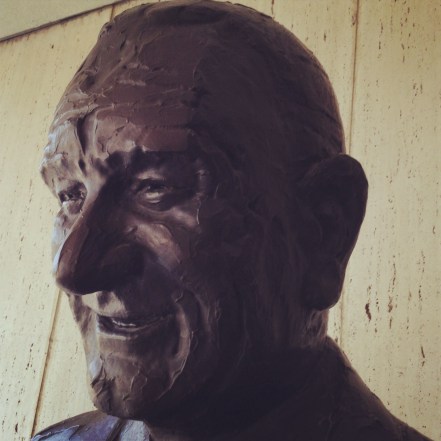
LBJ
I have been watching the HBO John Adams series about the American Revolution and the first American continental congress in Philly. It helps me see that our politicians are not in the worst situation in our history. Neither are they less favorably aligned than in the nation’s past. This congress we have today is about the same as all ruling bodies have always been, since the Roman Senate. The use of power by humans on earth has been punctuated with misery and cruelty. Conquest, political or military, has been imposed on nations, colonies, and entire continents. War and Peace have hung in the balance more times than we know, but always for the same reasons. War is an archetypal situation that repeats itself.
When we say history repeats itself we mean that archetypal events continue to occur. In the arch of recorded history we have seen the pendulum of power swing from feudalism to anarchy. Leaders have been both born and created in the struggle to survive. We think of those leaders as the representatives of the entire culture, but they may merely be the most famous. We know less about how the common person lived than we do about the fancy and well born. I know this very well from my study of my own ancestry. I learn more all the time about America by studying my ancestors’ lives. None of my forefathers was famous during the American Revolution, but many did fight in it. Power does flow through the events of man, but my religious ancestors would all say that fate is sealed by divine providence. Man is just a player on the eternal stage.
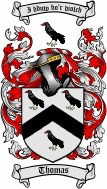
Thomas Coat of Arms
David Thomas is thought to have been born in Wales about 1620, David probably arrived in America about 1640-1 on the ship “Sampson”. It certainly is a fact that a session of the Quarterly Courts at Salem on 8th July 1645 “David Thomas” is a witness in a suit for defamation of character brought by John Bartoll against Alice, wife of John Peach, Jr, for having said that the plaintiffs wife, Parnell Bartoll, had “committed adultery with the Boatswain of the ship “Sampson” in the cabin of Parnell about four years ago.” This is the first record that we know of for David Thomas in America.
David lived in that part of Salem which is about to become the town of Marblehead. David left Marblehead probably early 1661, and removed to the part of Salem which later became Beverly. Two known maps showed the location of the Salem property of David Thomas agree that David owns Lot 16, which seems to have had no dwellings on it while David owned it.
It is significant that his wife Joanna executed her consent to the sale of the Beverly property by an instrument dated at Plymouth 14th July 1669. (Essex County Deeds book 3, pages 57 and 189). It seems this must have been the year David and Joanna Thomas moved to Middleborough. The birth of his son Edward Thomas on 6th February 1669 is the first entry in the Town Records of Middleborough, even though that entry may have been made at a later date, since the Town Records are said to have been destroyed by the Indians during King Philip’s War of 1675.
David is a Farmer at “Middlebury” and his family is one of the 16 families that constituted this Town in 1675. During this year when Indians attacked “Middlebury’s” new white inhabitants, forcing these settlers back into the Old Plymouth Colony Village. After this war ended these early settlers returned and 28th June 1677 those who had owned lands there, numbering 68 persons, met and agreed to re-settle “Middlebury” presently what is now called Middleborough.
David Thomas’s house at Middleborough (not standing anymore) is a little distance southeast of the town proper at the end of what is now Thomas Street at the area that became well known as “Thomastown”.
David Thomas (1620 – 1689)
9th great-grandfather
Mary Thomas (1664 – 1754)
daughter of David Thomas
Ann Northup (1696 – 1772)
daughter of Mary Thomas
Ann Gifford (1715 – 1795)
daughter of Ann Northup
Frances Congdon (1738 – 1755)
daughter of Ann Gifford
Samuel Thomas Sweet (1765 – 1844)
son of Frances Congdon
Valentine Sweet (1791 – 1858)
son of Samuel Thomas Sweet
Sarah LaVina Sweet (1840 – 1923)
daughter of Valentine Sweet
Jason A Morse (1862 – 1932)
son of Sarah LaVina Sweet
Ernest Abner Morse (1890 – 1965)
son of Jason A Morse
Richard Arden Morse (1920 – 2004)
son of Ernest Abner Morse
Pamela Morse
I am the daughter of Richard Arden Morse
David Thomas and his wife came from Salem to Middleboro soon after 1668, the of he selling his land in Salem. They settled in Thomastown, where their descedants are still living. He bought into the Twenty-six Men’s purchase.
He had sveral children, David, Joanna, William, Jeremiah, and Edward, the last born February 6 1669, the first birth in the early records of the town.
Source: History of the Town of Middleboro.

(MUNICH) — The teenager behind Friday’s deadly shooting rampage at a Munich mall had planned his attack for a year and chose his victims at random, investigators said Sunday. Bavarian investigator Robert Heimberger said the shooter, an 18-year-old German-Iranian identified only as David S., visited the site of a previous school shooting in the German…
via Munich Shooter Planned Attack for a Year, Officials Say — TIME

headstone
My 8th great-grandfather came to America as young boy with his parents and became a founder of Hartford, Connecticut.
John was born about 1628 in England and came to Connecticut with his parents as a young child. He married Hannah Potter, daughter (or possibly stepdaughter) of William Potter of Stamford. John and his brother Joseph moved from Stamford to Hempstead, Long Island, and returned to Connecticut by 1664. John died 5 Feb 1699, probably in Connecticut. John was one of seven original proprietors of Greenwich, CT, as described at http://www.rootsweb.com/~ctfairfi/pages/greenwich/greenwich_index.htm
“On February 5, 1664, the Seven Proprietors made a formal request to the General Assembly in Hartford to be allowed to separate from Stamford and to support its own minister and lay out its own lands. The Seven Proprietors were John MEAD, Jonathan RENALDS, John HOBBY, Joseph FERRIS, Joshua KNAPP, Angell HUSTED, and Jeffrey FERRIS.
On May 11, 1665, the General Assembly in Hartford declared Greenwich a separate township, and authorized funds for the hiring and support of an orthodox minister. In 1672, the so-called “27 Proprietors” bought land from the few remaining Indians to the west of the “Myanos River.” This land became known as “Horseneck” because of the neck of land now known as Field Point was the common HORSE PASTURE. ”
John signed all documents with a mark, but had several books in his estate inventory, so he could probably read but not write.
John and Hannah had eleven children:
John, b. abt 1658, married Ruth Hardey in 1681.
Joseph, b. 2 May 1660, married Mary.
Hannah, b. abt 1661, married John Scofield 12 Jul 1677.
Ebenezer, b. 1663, married Sarah Knapp in 1691.
JONATHAN, b. abt 1665, married Martha Finch.
David, b. abt 1665, married Abigail Leane 16 Dec 1707.
Benjamin, b. May 1666, married first Sarah Waterbury, second Rachel Brown.
Nathaniel, b. abt 1669, married Rachel.
Samuel, b. abt 1673, married Hannah.
Abigail, b. abt 1675. Fairfield Probate Records cited in The Ancestry of Elizabeth Barret Gillespie, “reveal that she was incompetent to manage her own affairs: ‘Whereas John Mead Sen’r, deceased, of Greenwich, haveing not made Satisfieing provision in his will for his daughter Abegaile Mead, She being not Capable of doing for her Self as may be desired by Reason, whearof Ebeneaz Mead of Greenwich dos hereby, in the presence of ye Prerogative Court, Engage to pay unto ye s’d Abegaile Mead, his sister, ye Sum of therty and five pounds, to be paid unto her According as he Shall Apprehend She Shall stand in Need of it for her Comfortable subsistence.”

Tomac Burying Ground
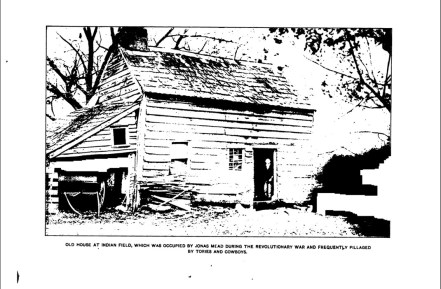
John Mead’s House
John Mead (1634 – 1699)
8th great-grandfather
Benjamin Daniel Mead (1667 – 1746)
son of John Mead
Mary Mead (1724 – 1787)
daughter of Benjamin Daniel Mead
Abner Mead (1749 – 1810)
son of Mary Mead
Martha Mead (1784 – 1860)
daughter of Abner Mead
Abner Morse (1808 – 1838)
son of Martha Mead
Daniel Rowland Morse (1838 – 1910)
son of Abner Morse
Jason A Morse (1862 – 1932)
son of Daniel Rowland Morse
Ernest Abner Morse (1890 – 1965)
son of Jason A Morse
Richard Arden Morse (1920 – 2004)
son of Ernest Abner Morse
Pamela Morse
I am the daughter of Richard Arden Morse
The following anecdote, which has been preserved by tradition, shows his character: One day when he was quite an old man, as he was going for his grist on horseback to the mill at Dumpling Pond, before he reached the Mianus River he overtook and old Quaker jogging slowly along, loaded with a heavy budget. In a real spirit of kindness he offered to take the Quaker’s load upon his horse, and thus give him a lift on his journey. No,replied the Quaker, thee don’t get my bundle, for I can read men’s thoughts. Thee wants to get my bundle, and then thee’ll run off. Thee don’t get my bundle. Very well, was the simple reply, and so they went slowly on together. At last they came to the brink of the Mianus River. Here the Quaker was really in trouble. How to cross a river, two or three feet deep, dry shod, was quite a puzzle. But he gladly accepted a second offer of assistance from the horseman. The bundle was mounted in front, John in the middle, and the Quaker behind. Arriving at the centre of the river, in pretending to adjust his stirrup John caught the Quaker by the heel and gave him a gratuitous bath. Such treatment was too much, even for Quaker forbearance, and the victim, with his hands full of pebbles, would have taken summary vengeance, had not the other party threatened to put the bundle under a similar course of treatment. This threat, and the lecture following it, gradually cooled off the Quaker’s anger. John informed him that all had been done for his good, to teach him a lesson. And the lecturer said he hoped the stranger would never again profess to read men’s thoughts. For, said he, I asked you to ride, kindly in the first place, when you refused; but at the second time of asking, I really intended to do as I have just done. So saying, and tossing the bundle back, he rose on, leaving his companion to apply the moral as he thought best.

Margaret Howard
Margaret Howard was the daughter of Thomas Howard, 4th duke of Norfolk (March 10, 1538-June 2, 1572) and his second wife, Margaret Audley (1539-January 10, 1564). Her father’s execution for treason when she was ten limited her choice of husbands but in February 1569 she married Robert Sackville of Bolbrooke and Buckhurst, Sussex and Knole, Kent (1561-February 27, 1609), later Lord Buckhurst and earl of Dorset. They had three sons and three daughters, including Richard (1590-1624), Edward (1591-1652), Anne, and Cecily. After her death, Robert Southwell published a small volume in her honor and Sackville described his late wife as “a lady . . . of as great virtue . . . as is possible for any man to wish to be matched withal.” He asked to be buried at Withyham “as near to my first dearly beloved wife . . . as can be” and ordered that £200 to £300 be spent on their tomb, with effigies of them both. A devout Catholic, she influenced his religious beliefs.

Robert Sackville and Margaret Howard
Margaret Howard (1561 – 1591)
13th great-grandmother
Lady Ann Dorset (1552 – 1680)
daughter of Margaret Howard
Robert Lewis (1574 – 1656)
son of Lady Ann Dorset
Robert Lewis (1607 – 1644)
son of Robert Lewis
Ann Lewis (1631 – 1686)
daughter of Robert Lewis
Joshua Morse (1669 – 1753)
son of Ann Lewis
Joseph Morse (1692 – 1759)
son of Joshua Morse
Joseph Morse (1721 – 1776)
son of Joseph Morse
Joseph Morse III (1756 – 1835)
son of Joseph Morse
John Henry Morse (1775 – 1864)
son of Joseph Morse III
Abner Morse (1808 – 1838)
son of John Henry Morse
Daniel Rowland Morse (1838 – 1910)
son of Abner Morse
Jason A Morse (1862 – 1932)
son of Daniel Rowland Morse
Ernest Abner Morse (1890 – 1965)
son of Jason A Morse
Richard Arden Morse (1920 – 2004)
son of Ernest Abner Morse
Pamela Morse
I am the daughter of Richard Arden Morse
Robert Sackville, 2nd Earl of Dorset, married first, in February 1580, Lady Margaret, by then only surviving daughter of Thomas Howard, 4th Duke of Norfolk, then suspected as a crypto-Catholic. By her he had six children, including:
Richard Sackville, 3rd Earl of Dorset (18 March 1589 – 28 March 1624)
Edward Sackville, 4th Earl of Dorset (1591 – 17 July 1652)
Anne, married Sir Edward Seymour, eldest son of Edward Seymour, Viscount Beauchamp, and, secondly, Sir Edward Lewis (d.1630) by whom she had issue
Cecily, married Sir Henry Compton, K.B.
Lady Margaret died on 19 August 1591; Robert Southwell, who never met her, published in her honour, in 1596, Triumphs over Death, with dedicatory verses to her surviving children
My 15th great-uncle, Thomas Sackville, inherited a calendar house, Knole House, in Kent, where they, no doubt, all visited. The house became famous:
Knole is an English country house in the town of Sevenoaks in west Kent, surrounded by a 1,000-acre (4.0 km2) deer park. One of England’s largest houses, it is reputed to be a calendar house, having 365 rooms, 52 staircases, 12 entrances and 7 courtyards. It is known for the degree to which its early 17th-century appearance is preserved, particularly in the case of the state rooms: the exteriors and interiors of many houses of this period, such as Clandon Park in Surrey, were dramatically altered later on. The surrounding deer park has also survived with little having changed over the past 400 years except for the loss of over 70% of its trees in the Great Storm of 1987.
In 1566, during the reign of Queen Elizabeth I, it came into the possession of her cousin Thomas Sackville whose descendants the Earls and Dukes of Dorset and Barons Sackville have lived there since 1603 (the intervening years saw the house let to the Lennard family). Most notably, these include writer Vita Sackville-West (her Knole and the Sackvilles, published 1922, is regarded as a classic in the literature of English country houses); her friend and lover Virginia Woolf wrote the novel Orlando drawing on the history of the house and Sackville-West’s ancestors. The Sackville family custom of following the Salic rules of primogeniture prevented Sackville-West herself from inheriting Knole upon the death of her father Lionel (1867–1930), the 3rd Lord Sackville, and her father bequeathed the estate to his brother Charles (1870–1962).
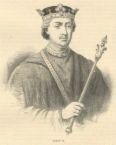
Henry II “Curtmantle” Plantagenet

Henry II “Curtmantle” Plantagenet

Henry II “Curtmantle” Plantagenet
My 25th great-grandfather reigned 1154-1189. He ruled an empire that stretched from the Tweed to the Pyrenees. In spite of frequent hostitilties with the French King his own family and rebellious Barons (culminating in the great revolt of 1173-74) and his quarrel with Thomas Becket, Henry maintained control over his possessions until shortly before his death. His judicial and administrative reforms which increased Royal control and influence at the expense of the Barons were of great constitutional importance. He introduced trial by Jury. He was Duke of Normandy. Henry II married Queen Eleanor, Duchess of Aquitaine, divorced wife of the Louis VII, king of France.
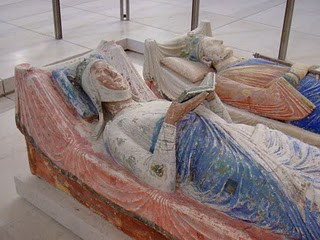
Henry II “Curtmantle” Plantagenet and Eleanor of Aquitaine
King Henry II was born March 5, 1133 at Le Mans, France HIs parents were Geoffrey, Count of Anjou, and Empress Matilda. He is Elizabeth II’s 22nd great-grandfather, and my 25th . He is from the House of Angevin. He ascended to the throne: October 25, 1154 aged 21 years. He was crowned December 19, 1154 at Westminster Abbey. He married Eleanor of Aquitaine, Daughter of William X, Duke of Aquitaine. He fathered five sons including Richard I and John, three daughters and several illegitimate children He died July 6, 1189 at Chinon Castle, Anjou, aged 56 years, 4 months, and 1 day. He is buried at Fontevraud, France. He reigned for: 34 years, 8 months, and 11 days and was succeeded by his son Richard.
King of England 1154–89. The son of Matilda and Geoffrey V, Count of Anjou, he succeeded King Stephen (c. 1097–1154). He curbed the power of the barons, but his attempt to bring the church courts under control was abandoned after the murder of Thomas à Becket, Archbishop of Canterbury, in 1170. The English conquest of Ireland began during Henry’s reign. On several occasions his sons rebelled, notably 1173–74. Henry was succeeded by his son Richard (I) the Lionheart.
Henry was lord of Scotland, Ireland, and Wales, and Count of Anjou, Brittany, Poitou, Normandy, Maine, and Gascony. He claimed Aquitaine through marriage to the heiress Eleanor in 1152. Henry’s many French possessions caused him to live for more than half his reign outside England. This made it essential for him to establish a judicial and administrative system which would work during his absence. His chancellor and friend, Becket, was persuaded to become archbishop of Canterbury in 1162 in the hope that he would help the king curb the power of the ecclesiastical courts. However, once consecrated, Becket felt bound to defend church privileges, and he was murdered in Canterbury Cathedral 1170 by four knights of the king’s household.
In 1171 Henry invaded Ireland and received homage from the King of Leinster. In 1174 his three sons Henry, Richard and Geoffrey led an unsuccessful rebellion against their father.
Henry II “Curtmantel” Plantagenet, “King of England” (1133 – 1189)
25th great-grandfather
Eleanor Spain Plantagenet (1162 – 1214)
daughter of Henry II “Curtmantel” Plantagenet, “King of England”
Berenguela CASTILE LEON (1181 – 1244)
daughter of Eleanor Spain Plantagenet
Saint Ferdinand Castile amp Leon (1199 – 1252)
son of Berenguela CASTILE LEON
Alfonso X Wise Castile Leon amp Galicia (1221 – 1284)
son of Saint Ferdinand Castile amp Leon
Sancho Brave Castile Leon (1258 – 1295)
son of Alfonso X Wise Castile Leon amp Galicia
Beatrice Sanchez Infanta Castile (1293 – 1359)
daughter of Sancho Brave Castile Leon
Peter I Portugal Cruel Algarve (1320 – 1367)
son of Beatrice Sanchez Infanta Castile
John I DePinto (1358 – 1433)
son of Peter I Portugal Cruel Algarve
Beatrix DePinto (1403 – 1447)
daughter of John I DePinto
John Fettiplace (1427 – 1464)
son of Beatrix DePinto
Richard Fettiplace (1460 – 1511)
son of John Fettiplace
Anne Fettiplace (1496 – 1567)
daughter of Richard Fettiplace
Mary Purefoy (1533 – 1579)
daughter of Anne Fettiplace
Susanna Thorne (1559 – 1586)
daughter of Mary Purefoy
Gov Thomas Dudley (1576 – 1653)
son of Susanna Thorne
Anne Dudley (1612 – 1672)
daughter of Gov Thomas Dudley
John Bradstreet (1652 – 1718)
son of Anne Dudley
Mercy Bradstreet (1689 – 1725)
daughter of John Bradstreet
Caleb Hazen (1720 – 1777)
son of Mercy Bradstreet
Mercy Hazen (1747 – 1819)
daughter of Caleb Hazen
Martha Mead (1784 – 1860)
daughter of Mercy Hazen
Abner Morse (1808 – 1838)
son of Martha Mead
Daniel Rowland Morse (1838 – 1910)
son of Abner Morse
Jason A Morse (1862 – 1932)
son of Daniel Rowland Morse
Ernest Abner Morse (1890 – 1965)
son of Jason A Morse
Richard Arden Morse (1920 – 2004)
son of Ernest Abner Morse
Pamela Morse
I am the daughter of Richard Arden Morse
HENRY II (1133–1189), king of England, was the eldest child of Matilda, daughter of Henry I, and Geoffrey Plantagenet (1113–1150), count of Anjou. Geoffrey represented a family which in two centuries grew from the defenders of the Angevin march against Bretons and northmen into the lords of three important counties, Anjou, Touraine, and Maine, and from dependence on the ducal house of France into rivalry with the ducal house of Normandy, and thus at last with the royal house of England, and it was for the purpose of extinguishing this rivalry, and providing England and Normandy, after Henry I’s death, with a sovereign in whom the blood of the hitherto hostile races should be united, that Matilda (whose first husband, the Emperor Henry V, had left her a childless widow) was married to the Angevin count in 1128. Geoffrey was then scarce fifteen—ten years younger than his wife—and it was not till 1133 that their first child was born, at Le Mans on Mid-Lent Sunday, 5 March (‘Acta Pontif. Cenomann.’ c. 36, in Mabillon, Vet. Analecta, p. 322). From his very birth, says a writer of the time, ‘many peoples looked to him as their future master;’ and the most important part of his destiny was indicated in the name by which he was baptised, and the surname by which he was commonly described, ‘Henry FitzEmpress.’ He was before all things King Henry’s grandson and chosen successor, destined by Henry to continue his work of building up a strong government in England. The English witan were at once made to swear him fealty as his grandfather’s heir; and the first two years of his life were chiefly spent with his mother at her father’s court in Normandy. The king’s death (December 1135), however, set the Norman and English barons free to repudiate an engagement made under compulsion to a child not yet three years old, the child too of a woman whom they scarcely knew, and of a man whom they hated with all the accumulated force of the hate that parted Anjou from Normandy; and Matilda found her son’s heritage, on both sides of the sea, wrested from her by her cousin Stephen. Through the ten years of war that followed, the boy’s education went on where and how it could. His earliest tutor was one Master Peter of Saintes, ‘learned above all his contemporaries in the science of verse,’ who took charge of him by his father’s desire (Anon. Chron., Rer. Gall. Scriptt. xii. 120), probably after his mother went to England in 1139. In 1142 his uncle Earl Robert of Gloucester brought him over to join her, and for the next four years he was ‘imbued with letters and instructed in good manners beseeming a youth of his rank,’ by a certain Matthew in Robert’s house at Bristol. In 1147 he rejoined his father, who had now conquered Normandy. Shortly after Matilda’s return next year both she and Geoffrey seem to have made over to their son the claims which they had been holding in trust for him on both sides of the sea (Chron. S. Albin. a. 1149; Hist. Pontif., in Pertz, Mon. Germ. Hist. xx. 532, 533). In 1149 he ventured upon an expedition to England, and was knighted at Carlisle on Whitsunday by his great-uncle, David king of Scots; in the summer of 1151 he received from King Louis of France the investiture both of Normandy and of his father’s hereditary dominions; and in September Geoffrey’s death left him sole master of them all. To these territories, stretching from the Somme to the Loire and covering the whole western side of the royal domain of France, Henry in May 1152 added the great duchy of Aquitaine by his marriage with its duchess Eleanor, the divorced wife of the French king. The young duke found himself strong enough to disregard a citation before the royal court (‘Gesta Ludov. Reg.,’ in {[sc|Duchesne}}, Hist. Franc. Scriptt. iv. 411; ‘Hist. Ludov. Reg.,’ ib. p. 414), to repel an attack made by Louis upon Normandy, to crush a rebellion of his own brother Geoffrey in Anjou, and to risk another visit to England at Epiphany 1153. Nine months of fighting and negotiation ended in the treaty of Wallingford (November), whereby Stephen and Henry adopted each other as father and son, Henry leaving the crown to Stephen for his life, on a promise of its reversion at his death, and Stephen undertaking to govern meanwhile according to Henry’s advice; as Roger of Howden expresses it, ‘the king made the duke justiciar of England under him, and by him all the affairs of the kingdom were settled.’ The discovery of a plot among the king’s Flemish troops to assassinate Henry drove him back to France early in 1154. On 24 Oct. Stephen died. Contrary winds detained Henry in Normandy till 7 Dec.; but the ‘mickle awe’ with which he was already regarded in England sufficed to keep the land in peace during the interregnum; and on Sunday, 19 Dec., he was crowned at Westminster.
There was little of regal dignity in the young king’s look and ways, in his square-built, thick-set frame, his sturdy limbs, his bullet-shaped head with its mass of close-cropped tawny hair, his ‘lion-like’ face with its freckled skin, and its prominent eyes that, for all their soft grey colour, could glow like balls of fire when the demon-spirit of Anjou was roused; in his absorbing passion for the chase; in the disregard of conventionalities shown by his coarse gloveless hands, his careless dress, his rough-and-ready speech; in the restlessness which kept him on his feet from morning till night, scorning every seat but the saddle, grudging every minute withdrawn from active occupation, beguiling with scribbling or with whispered talk the enforced tranquillity even of the hour of mass, dragging his weary courtiers about the country in ceaseless journeys, often to the most unlikely and inconvenient places, with equal indifference to their comfort and to his own; or in the outbreaks of a temper which mounted to sheer momentary madness, when he would utter the most unaccountable blasphemies, or gnaw the rushes from the floor and lie rolling among them like one possessed. Yet already England had discerned in this uncouth lad of twenty-one the quiet strength of a born ruler of men. ‘All folk loved him,’ says the English chronicler, summing up the impression left by the five months which had elapsed between Henry’s treaty with Stephen and his return to Normandy, ‘for he did good justice and made peace.’ And ‘justice’ and ‘peace,’ in the sense which those words conveyed to the men of his day, were to be the main characteristics of his reign in England.
Henry’s first kingly act was the issuing of a charter declaring, as the basis of his scheme of government, the restitution and confirmation of all liberties in church and state as settled by his grandfather. He next put in force certain hitherto unfulfilled provisions of the treaty of 1153, for the expulsion of Stephen’s Flemish mercenaries, the demolition of castles built by individual barons without royal license and held by them independently of royal control, and the restoration of royal fortresses and other crown property which had passed into private hands during the anarchy. William of Aumale in Yorkshire, Hugh of Mortimer and Roger of Hereford in the west, openly resisted this last decree; but in January 1155 Henry’s mere approach brought William to restore Scarborough; Roger submitted in April; and a siege of Hugh’s castle of Bridgnorth by the king in person ended in its surrender, 7 July. By the close of the year order was fairly re-established throughout the realm. The old machinery of justice, of finance, of general administration, was at work again; judges went on circuit through the country; capable ministers were set over the various departments of state business; even the succession to the crown had been thought of and carefully provided for in a council at Wallingford, 10 April 1155. The part of Henry’s life-work bequeathed to him by his English grandfather was so well in train that he could safely turn his attention to that other, and probably in his eyes more important work, which he had inherited from his paternal ancestors: the building up of an empire which, as had been foretold to one of them, was to spread from the rock of Angers to the ends of the earth. It spread now from the Flemish border to the Pyrenees, commanding the whole western coast of France, and covering more than half the soil whose nominal lord paramount was King Louis VII of France. But it was made up of five distinct fiefs, with claims of suzerainty over some half-dozen others; all held on different tenures, all jealous of one another, and most of them in a state of chronic disaffection, which Louis, jealous as he naturally was of his formidable vassal and rival, might easily turn to his own advantage; Henry’s brother Geoffrey, too, claimed the Angevin patrimony, which his father’s will had destined for him on Henry’s accession to the English throne. Early in 1156, therefore, Henry returned to France; he renewed his homage to Louis, fought Geoffrey into accepting a money-compensation for his claims, and secured his hold over Aquitaine; then he came back (1157) to enforce the surrender of a few royal castles still held by the Earls of Warren and Norfolk; to demand and win from his cousin Malcolm of Scotland the homage due from a Scottish to an English king, and the restoration of the three English counties—Northumberland, Cumberland, and Westmoreland—granted to Malcolm’s father by Stephen; and to claim at the sword’s point the homage of the princes of Wales. Another visit to Normandy in 1158 resulted in Henry’s acquisition of the county of Nantes on the death of its ruler, his brother Geoffrey, and a successful assertion of his right to the overlordship of Brittany, with the sanction of the French king, whose daughter Margaret was now betrothed to Henry’s eldest son. Next year Henry ventured to assert his wife’s claim to the overlordship of Toulouse, and when the claim was denied prepared to enforce it with an army consisting of the great barons of his realm with the Scottish king at their head, and a crowd of mercenaries hired with the proceeds of a ‘great scutage,’ a tax levied upon every knight’s fee throughout his dominions instead of the personal service due from the knights. The Quercy was conquered and the war carried to the gates of Toulouse, but when Louis threw himself into the city Henry withdrew, out of reverence for the feudal etiquette which forbade a vassal to fight against his overlord in person. In May 1160 a truce was made; in November Henry secured his Norman frontier by marrying his son to Margaret, and thus gaining possession of her dowry, the Vexin; a triple alliance between France, Blois, and Champagne failed to wrest from him the advantage which he had won; and he was seen as virtual arbiter of western Europe in 1162, when his adhesion to Pope Alexander III in his struggle with the emperor turned the scale in Alexander’s favour, and compelled Louis, with whom the pope had taken refuge, to make a formal alliance with the English king in Alexander’s presence at Chouzy.
In the intervals of his continental warfare Henry had been feeling his way towards a scheme of administrative reform in England. He had come to his throne just when the social, industrial, intellectual, and religious movements which had been stirring throughout Europe since the beginning of the century were all at their most critical stage. All of them, save the last, seemed to have been checked in England by the troubles of the anarchy, but no sooner was outward order restored than the forces which hitherto had been working in the dark confronted Henry in the light of day. He saw that the mere re-establishment of the old administrative routine of his grandfather’s time could no longer suffice for a country where the very confusion of the past nineteen years, the loosening of accustomed restraints, the abeyance of accustomed authority, had fostered a new spirit of self-assertion and independent activity in burgher and yeoman and clerk, as well as in earl and baron and knight. The breakdown of the higher judicature, and the consequently unchecked corruption of the lower courts, had given an enormous advantage to the revived canon law, of which the clergy were the representatives and interpreters. The new relations, too, with the continent into which men were brought by the accession of their Angevin king were opening wider fields for commercial enterprise, which in its turn stimulated the growth of industrial activity at home, and the intercourse with foreign churchmen and foreign scholars was quickened, whence the English clergy, and through them the English people, were learning to scrutinise more closely and criticise more sharply the relations of king and people, church and state. Henry saw the opportunity which such a transitional state of society afforded for the building up of a system of financial, judicial, and military organisation in direct dependence upon the king, wherein men should find their surest safeguard amid the dangers that beset them on every side in the rapidly changing conditions of the national life. Only a few incidental notices enable us to mark some of his early steps in the path of administrative and legal reform. At the outset of his reign he had re-established in working order the old financial machinery of the exchequer and the judicial machinery of the curia regis. In 1158 he caused the debased coinage of his predecessor and that which had been illegally issued from private mints during the anarchy to be all alike superseded by a new and uniform currency. He facilitated the removal of suits from the local courts to the curia regis; he facilitated the administration of justice in the curia regis itself and in the provincial visitations of its judges, by introducing new methods of procedure; he gave a new development to the system of inquest by sworn recognitors, by applying it to an important branch of civil litigation in a ‘great assize,’ which sanctioned the settlement of disputes concerning land by the sworn verdict of twelve chosen knights of the district, instead of by ordeal of battle between the claimants as heretofore. He broke through the dependence of the crown upon its feudal tenants for the supply of a military force by a series of skilfully planned innovations, culminating in the scutage of 1159, which, while it conferred a benefit upon the tenants-in-chivalry by exempting them from service beyond sea, swept away their old exemption from money-taxation, and enabled the king henceforth to replace them whenever he chose by a paid force under his own immediate control.
But the scutage touched other privileges besides those of the tenants-in-chivalry; it was levied not only upon the knight’s fees of the lay lords, but also, and more stringently, upon those held under the churches. It was thus Henry’s first step towards the execution of a plan for breaking down the barriers which, under the name of clerical immunities, kept a large part of the population free of all legal restraint save that of the canon law, and altogether beyond the reach of his kingly authority and justice. The chief agent of Henry’s reforms hitherto had been his chancellor, Thomas Becket, and it was to secure for his plans the co-operation of Thomas on a wider scale, and in a capacity which would add enormously to its value and usefulness, that he set constitutional tradition, ecclesiastical propriety, and public opinion all alike at defiance by raising his brilliant, worldly chancellor to the primacy of all England (June 1162). Instead of co-operation, he met from his new archbishop an uncompromising opposition. His proposal of a change in the mode of levying the land-tax, which would have transferred its profits from the sheriffs to the exchequer, was defeated by Thomas’s resistance (July 1163); his attempts to bring criminal clerks to justice broke against the shield of the canon law with which Thomas sheltered the delinquents; his demand, made in a great council at Westminster (October 1163), for a public acknowledgment of what he called the ‘customs of his grandfather,’ in other words, of his royal supremacy over all persons and all causes throughout his realm, was answered by the bishops, under their primate’s guidance, with a declaration that they would only agree to the customs ‘saving the rights of their order;’ and a vague verbal promise of assent which he at last wrung from them was revoked as soon as the customs were set forth in the form of written constitutions at the council of Clarendon (January 1164). Henry saw that in making Thomas archbishop he had but laid a stumbling-block across his own path, and he thrust it roughly aside. In October 1164 he summoned Thomas before a council at Northampton to answer a string of charges concerning his conduct as chancellor and as archbishop. From the outset it was plain that the primate’s condemnation was a foregone conclusion. Insults of every kind were heaped upon him; every offer of compromise was scornfully rejected or made vain by the introduction of some new and unexpected charge; the bishops were compelled to join with the lay barons in sitting in judgment on their primate, till a prohibition from Thomas himself, enforced by an appeal to Rome, scared them into a protest to which Henry found it necessary to yield; the lay lords, with ‘certain sheriffs and lesser barons ancient in days’ whom the king had summoned to join them, were ready to depose the archbishop as a traitor, but he checked the delivery of their sentence by another appeal to the pope, fought his way out of the council, and finally escaped over sea.
Thomas’s flight left Henry master of the field, and the constitutions of Clarendon were put in force at once. By these constitutions disputes about presentations and advowsons were transferred from the ecclesiastical to the royal courts; appeals to Rome without leave from the king, and ordination of villeins without leave from their lords, were forbidden; the right of sanctuary was annulled as regards chattels forfeited to the crown; clerks were made amenable to lay tribunals; the provisions of the ‘great assize’ were applied to disputes about church lands; and an appeal to the witness of twelve local jurors summoned by the sheriff was introduced to protect laymen from injustice in the bishops’ courts. With these provisions those ‘customs’ of the Norman kings which forbade bishops and beneficed clerks to quit the realm or excommunicate the king’s tenants-in-chief without his license, and regulated the election and the temporal liabilities of bishops, were now for the first time coupled together in a written code, which Henry probably meant as the first instalment of a much wider code, whereby he hoped to remodel the entire legal and administrative system of the country. Two years later, in fact, he boldly undertook to deal single-handed, on his own sole responsibility, with the whole question of the administration of justice in all criminal cases whatsoever. In his assize of Clarendon (February 1166) he applied the principle of jury-inquest to criminal cases by ordaining that in every shire criminals should be arrested and brought before the sheriffs and the itinerant justices, to be by them dealt with according to rules laid down in the same assize, on the presentment of twelve freemen of every hundred, and four of every township, bound by oath in full shire-court, to denounce all known malefactors in their districts; and he summarily set aside all claims to exemption, either from service on the juries or from liability to the interference of sheriffs and justices, founded on private jurisdictions or special franchises of any kind. In four ways especially Henry’s assize is a landmark in English history. It was the first attempt made by an English king to put forth a code of laws, as distinct from a mere reassertion of traditional ‘custom.’ It was the first attempt to break down the feudal system of government by bringing its countless independent jurisdictions and irresponsible tribunals into subjection to one uniform judicial administration. It re-established once for all, so far as England was concerned, the old Teutonic principle of the right and the duty of a people to govern itself, in its own courts and by its own customary procedure, as against the Roman law which was fast taking its place in continental Europe; and it opened an almost boundless field for the training of the English people in self-government, by bringing home to every man his share in the administration of justice and police. About the same time Henry seems to have issued the assize of novel disseisin, which enabled any man disseised of his freehold without legal sentence to claim within a given period reinstatement by a writ from the king. The act whereby Henry thus ‘cast his protection over possession made the disturbance of seisin a cause of complaint to the king himself,’ though apparently little noticed at the time, was in fact ‘perhaps the greatest event in the history of English law’ (Maitland, Introd. to Select Pleas in Manorial Courts, Selden Soc., i. liv).
At the moment when Henry thus opened a new era in the history of English government, he was in the hottest of his fight with the church. In vain had he sought to prevent the pope and the French king from espousing the cause of Thomas; still more vainly had he driven into exile every man, woman, and child who could be charged with any sort of connection with the primate; Pope Alexander, ill as he could afford it at the moment, risked a breach with England by receiving Thomas honourably. Louis offered a shelter in France to him and his fellow-sufferers, and Henry found himself held up to the general scorn and indignation of orthodox Christendom. He turned to the eagerly-offered alliance of the emperor and the antipope, promised his daughter’s hand to the emperor’s cousin, Henry the Lion, duke of Saxony, and threatened to withdraw from Alexander the spiritual obedience of the whole Angevin dominions. A Welsh war furnished him with a means of evading the consequences of these pledges, and of gaining a breathing space, which was turned to good account for England by the issuing of the assize of Clarendon. In Lent 1166 he recrossed the Channel to take up again the threads, complicated as they were by his embroilment with the church, of his continental policy; to reopen diplomatic relations with all parties at once: with the Marquis of Montferrat, whose influence at Rome was secured for the royal cause by the offer of a daughter of England as wife for his son; with the duke and the nobles of Brittany, whose heiress Henry was bent upon wedding to his third son, Geoffrey; with Louis of France, whose assent was needed for this arrangement, and also for the recognition of little Henry as heir of Normandy and Anjou, and for that of the second son, Richard, as heir of Aquitaine; with the emperor on one hand and with his Lombard foes on the other; with the kings of Castile and Sicily, who proposed to become Henry’s sons-in-law; with the discontented barons of Aquitaine, who were profiting by the troubles of their Angevin duke to break loose from his hated control; as well as with Thomas and Alexander, who were perpetually threatening to lay the English kingdom under interdict and excommunicate the king himself. In four years the work seemed all but done; Henry had secured the alliance of Germany and of Castile by the marriages of his two elder daughters, Matilda and Eleanor (1168–9); he had betrothed his youngest daughter, Joanna, to King William of Sicily (1169); he had broken the opposition of the Bretons in three successive campaigns (1166–9), and gained the French king’s formal sanction to his plans for his three sons in the treaty of Montmirail (January 1169). In an unlucky hour he resolved to complete the new settlement of his dominions by the coronation of his eldest son, a scheme which he had planned seven years before, but which had been set aside owing to his quarrel with Thomas, who as metropolitan of all England was alone qualified to crown an English king. Now, seeing no hope of agreement with Thomas, Henry was rash enough to fall back upon a license for the boy’s coronation by Archbishop Roger of York, granted by the pope three years ago, but since withdrawn; and at his command Roger, though forbidden by both Thomas and Alexander under pain of suspension, crowned the young king at Westminster, 14 June 1170.
This action was the greatest blunder of Henry’s life. The crowning of the heir during his father’s lifetime was an innovation wholly at variance with all English constitutional theory and practice, and the moment was singularly ill-chosen for such an unprecedented step. For fifteen years Henry had been developing a scheme of government whereby all separate jurisdictions, all local and personal privileges, were to be brought into direct subjection to the authority of the crown. For six years he had been literally, throughout his English realm at least, over all persons and all causes supreme, and there had been no outward obstacles to hinder the working of his administrative system. It worked, indeed, regularly and in the main successfully, but not without a great deal of very severe friction; and the adherents of Thomas were far from being the only section of the community who saw in Henry’s reforms nothing but engines of regal tyranny and extortion. The first visitation of the judges after the assize of Clarendon carried terror and desolation into every shire, while it brought to the treasury an enormous increase of wealth from the fines of justice and the goods and chattels of the criminals condemned under the assize. Scarcely was it concluded when a visitation of the forests was held in 1167, and this again was followed next year by the levy of an aid for the marriage of the king’s eldest daughter. The people writhed helplessly under these manifold burdens; the barons watched in sullen silence for an opportunity to break the yoke which Henry was rivetting more tightly upon them year by year. Henry’s own sense of an impending crisis in England, on his return thither in March 1170, was shown in the sweeping measure by which he sought to anticipate it. He suspended from their functions all the sheriffs of the counties and all the bailiffs of his own demesnes, and appointed a body of special commissioners to institute during the next two months an inquiry into every detail of the administration, judicial, financial, political, of every royal officer throughout the country and of every local tribunal, no matter to whom appertaining, during the last four years. When the two months expired, out of twenty-seven sheriffs only seven were reinstated in their office; to the places thus left vacant Henry appointed officers of the exchequer whom he knew and trusted. Three days later the feudal nobles, whose claims of hereditary jurisdiction and independence he had thus afresh trampled underfoot, were called upon to do homage and fealty to a new king, chosen by Henry himself to share with him in the sacred dignity which till now had been exclusively his own. The oath was taken readily enough; its possible results were perhaps better foreseen by some of those who took it than by him who demanded it. Meanwhile the wrath of primate and pope at the insult to Canterbury, and the wrath of the French king at the insult to his daughter, who had not been allowed to share in her husband’s coronation, rose to such a pitch that in July Henry was driven to a formal reconciliation with both Louis and Thomas. But there was no real peace with either. The king was keeping Christmas at Bures, near Bayeux, when the Archbishop of York and the bishops of London and Salisbury came to tell him that Thomas on his return to England had refused to absolve them from the papal sentence under which they lay for their share in the coronation, and was setting his royal will at defiance. ‘What a parcel of fools and dastards have I nourished in my house,’ he burst out, ‘that not one of them will avenge me of this one upstart clerk!’ Four knights took him at his word, and on 29 Dec. 1170 he was ‘avenged,’ far otherwise than he desired, by the martyrdom of St. Thomas of Canterbury.
For the moment all seemed lost. Alexander threatened to interdict the whole Angevin dominions and excommunicate the king unless he would do penance for the murder and submit unconditionally to the demands of the church, and at once despatched two legates to execute the threat. But the hour of extreme danger was always the hour which Henry turned to account for some specially daring piece of work; and it was at this most perilous crisis of his life that he added a new realm to his dominions. As early as 1155 he had planned the conquest of Ireland, and it was afterwards said that he had obtained from Pope Adrian IV a bull to sanction the enterprise; this bull, however, has never been found among the papal archives, and its genuineness is disputed (cf. Analecta Juris Pontifici, Mai–Juin 1882, Paris; F. A. Gasquet in Dublin Review, 3rd ser. x. 83). The scheme, opposed by his mother, was left in abeyance till at the close of 1166 Diarmait Mac Murchadha, king of Leinster, having been driven from his throne, besought Henry’s aid in regaining it, and offered him his homage in return. Henry accepted the homage, and proclaimed that any of his subjects who chose might enlist in the service of the Irish king. A band of knights from the South Welsh border availed themselves of the permission; by the end of 1170 they were masters of the Irish coast from Waterford to Dublin; their leader, Richard de Clare (d. 1176) [q. v.], was married to Diarmait’s daughter; on Diarmait’s death (May 1171) he set himself up as Earl of Leinster, and was in a fair way to become the head of an independent feudal state whose growth might soon have threatened England with a new peril, if Henry had not summarily taken the matter into his own hands. The papal legates were on the point of entering Normandy when he announced to his barons that he was going to Ireland. Early in August he landed at Portsmouth; a month later he received the submission of Earl Richard, whom he had summoned to a meeting on the Welsh border; by the end of September he was at Pembroke, and a fleet of four hundred ships was gathering in Milford Haven; and on 17 Oct. he landed at Waterford with some four thousand men. He had left strict orders both in Normandy and in England that the ports should be closed to all clerks, and that no man should follow him unless specially summoned; but more effectual than these precautions was the stormy wind of the western sea, which for nearly six months severed all communication between Ireland and the rest of the world. Those six months were fateful alike for Ireland and for England; in them was laid the foundation of Ireland’s subjection to the English crown. The hostile parties, whether of natives or invaders, all alike saw their only hope in submission to the new comer, and all alike laid themselves at his feet. Before Christmas 1171—which he kept at Dublin, in a palace built of wattles after the Irish fashion—Waterford, Wexford, Limerick, and Cork were in his hands, and all the Irish princes, except the king of Connaught, had given him hostages and promised tribute. The bishops and clergy made their formal submission to him at Cashel. With the promise of their spiritual obedience their conqueror might hope to strike a bargain with Rome; and the tidings which at last (March 1172) reached him from England made him feel that the bargain must be struck without delay. What little he could do for Ireland at the moment he did before he left her. He compelled Earl Richard and his fellow-adventurers to resign their conquests to him, and parcelled them out afresh as fiefs to be held in obedience to himself as sovereign; he appointed Hugh de Lacy to act as his representative and vicegerent; he fortified and garrisoned the coast towns; and he started Dublin, ruined as it was by three sieges in two years, on a new career of prosperity by granting it to the burghers of Bristol to colonise and raise into a trading centre as free and flourishing as their own native city. He sailed from Wexford on Easter night; by the middle of May he was in Normandy; on Sunday 21 May he met the legates at Avranches, purged himself of complicity in the primate’s death, promised expiation, and abjured his ‘customs;’ four months later he repeated his submission, and was publicly absolved.
It was no light matter that had moved the king thus to break off the work which he had but just begun in Ireland and to surrender the constitutions which he had so stubbornly maintained for eight years in the teeth of primate and pope; it was the discovery that in leaving his eldest son as king in his stead he had placed within reach of his foes a weapon which they were quick to use against him, and which was only too ready to lend itself to their use. Father and son no sooner met again than the young king asserted his claim to be acknowledged as actual ruler of England, or, if not of England, then of Normandy and the Angevin lands. Henry, busy now with a scheme for the marriage of his youngest son John to the heiress of Maurienne, which would have given him command over all the passes of the Alps, not only refused the claim but proposed to settle upon John three of the most important castles in Anjou and Touraine. The young king hereupon fled to the court of France, and on his appearance there a vast conspiracy came to light. The French king, the counts of Blois, Flanders, and Boulogne, the king of Scots, a crowd of barons in England, Normandy, Aquitaine, and the Angevin lands, his brothers Richard and Geoffrey, his mother Queen Eleanor, ranged themselves at once upon his side; and Henry had scarcely time to fortify the Norman frontier, recall some of his troops from Ireland, and gather a force of Brabantine mercenaries at the cost of every penny he possessed, before a general war broke out (June 1173). Normandy, attacked on two sides at once, was saved by the death of the Count of Boulogne and by a rapid march of Henry which drove Louis from Verneuil; and another equally rapid march upon Dol crushed the revolt in Brittany. In a flying visit to England (Eyton, Itin. Hen. II, p. 173) Henry, it seems, had already concerted measures for its security with the justiciar, Richard de Lucy; here the actual outbreak had been delayed by the absence of the chief rebel, Earl Robert of Leicester; and Leicester no sooner landed in Suffolk than he was defeated and made prisoner by the royal forces (17 Oct.) Next spring, while Henry was crushing out rebellion in Anjou and Aquitaine, a Scottish invasion stirred up a rising in the north; scarcely were the northern rebels defeated by the king’s illegitimate son Geoffrey, bishop-elect of Lincoln, when East Anglia was overrun by a host of Flemings brought in by the traitor Earl of Norfolk, Hugh Bigod; the London citizens broke into anarchy; the young king threatened invasion from Flanders; and the justiciars in despair called Henry to the rescue. He crossed the sea in a terrific storm on 7 July, and made straight for Canterbury. Fasting, barefoot, in pilgrim’s weeds, he entered the cathedral church, and there publicly did penance for the martyr’s death, submitting to be scourged by all the seventy monks of the chapter, spending the night in vigil before the shrine, and loading it with costly gifts ere he set out next morning for London. Four days later a courier burst at midnight into the king’s bedchamber, and woke him with tidings that on the very day, almost at the very hour, of his departure from Canterbury the Scottish king had been made prisoner at Alnwick (13 July 1174). Henry marched at once upon the English rebels, and in three weeks they were all at his feet. Then he recrossed the sea, forced Louis to raise the siege of Rouen, and by Michaelmas was in a position to dictate terms all round. The terms which he imposed on his sons, on the French king, and on the rebel barons amounted to little more than a return to the status quo ante bellum, with a pledge of general amnesty and reconciliation. The king of Scots, however, regained his freedom only by doing liege homage to the English king for his crown and all his lands, and giving up five of his strongest fortresses in pledge for his fidelity; and there was one captive whom Henry would not release at all. At the opening of the rebellion he had caught his wife, disguised in man’s attire, attempting to follow her sons to the French court; he had put her in prison at once, and there, with one brief interval, he kept her for the rest of his own life.
In England his triumph was complete and final. He took up again at once his work of administrative reform, and carried it on thenceforth without check and without break. In January 1176 he issued the assize of Northampton; this was in effect a re-enactment of the assize of Clarendon, with important modifications and amendments of detail, and with the addition of several entirely new clauses, one of which originated the proceeding known as the ‘assize of mort d’ancester,’ while others defined the pleas, criminal and civil, which were to be reserved for the hearing of the royal justices, and another directed that every man in the realm, from earl to ‘rustic,’ should take an oath of fealty to the king. In the same year he wrung from a papal legate a partial assent to the constitutions of Clarendon, which enabled him to bring clergy as well as laity within the scope of a great visitation of the forests, held in punishment for the damage done in the rebellion. Next year he ordered a return of all tenements held in chief of the crown, with the names of the existing tenants and the services due from each. An inquiry into the several liabilities of the king’s tenants-in-chivalry had been instituted ten years before, apparently for the assessment of the aide pour fille marier, and on that occasion the returns had been made by each baron for himself; the inquest of 1177, however, was seemingly designed to be of wider scope and more searching character, and was entrusted to the sheriffs and bailiffs of the different counties. In 1178 Henry reorganised the curia regis by restricting its highest functions to a small inner tribunal of selected counsellors, which afterwards grew into the court of king’s bench. From 1176 to 1180 he was busy with a series of experiments which ended in the virtual establishment of the system of judges’ circuits familiar to us now. By his assize of arms, 1181, he imposed on every free man the duty of bearing arms for the defence of the country; and by enacting that each man’s liability should be determined by the amount, not of his land, but of his annual revenue and movable goods, he introduced into English finance the principle of direct taxation on personal property.
The English king’s supremacy over the neighbour states and his importance in Europe at large grew with the growth of his power at home. Three Welsh campaigns (1157, 1163, 1165), and a series of negotiations conducted by Henry in person on his way to and from Ireland, had broken the independence of the Welsh princes; in the revolt of 1173, Rhys of South Wales appeared as the king’s ally, and at its close David of North Wales was bound to him by a marriage with his sister. The loyalty of the Scottish king was secured in 1175, and in the same year the homage of the king of Connaught completed Henry’s overlordship of Ireland. Next year his youngest daughter Joanna (1165–1199) [q. v.] was married to the king of Sicily, and welcomed in her new country with honours which showed how great was the reverence felt by its Norman rulers for the distant sovereign whom they were proud to acknowledge as the head of their race. The kings of Castile and Navarre chose him as arbiter in a family quarrel between themselves in 1177; the king of Arragon and the Count of Toulouse had done the like as early as 1173, when the latter had submitted to do homage to Henry for his county. In France itself the factions that raged around the deathbed of Louis VII and the ill-secured throne of his young successor, Philip Augustus, were driven to accept, nay to solicit, the mediation of the English king (1180–2); and the crowning-point of his glory seemed to be reached in 1185, when, as head of the Angevin house, he was implored by the patriarch of Jerusalem in person to undertake the deliverance of the Holy Land, where the Angevin dynasty and the Christian realm which they had been defending for half a century against the Moslems were both alike at their last gasp. The ‘faithful men’ of the land, however, assembled in council at Clerkenwell, refused to sanction such an undertaking (R. Diceto, ii. 33, 34); and Henry had ample reasons for yielding to their decision.
The peace-maker of Europe could not keep peace among his own sons. He had freely forgiven their rebellion, and fully reinstated all three in the positions which they had respectively occupied before it: Richard as duke of Aquitaine, Geoffrey as duke of Brittany, Henry as acknowledged heir to the overlordship of both, and to direct sovereignty over England, Normandy, and Anjou. But the brothers were jealous one of another, and their jealousy broke out at last in open war. In 1183 young Henry and Geoffrey joined the nobles of Aquitaine in a rising against their father and Richard, and twice, while besieging the rebels in their headquarters at Limoges, Henry himself narrowly escaped with his life. The young king’s death (11 June) ended the strife for a while, but it opened the way to other quarrels. Henry proposed to transfer Aquitaine from Richard, now heir to the crown, to John, whose betrothal with Alice of Maurienne had come to nothing, but for whom he had in 1176 secured the rich heritage of Earl William of Gloucester, and whom in 1177 he had nominated king of Ireland. It was to Ireland, not to Aquitaine, that John was at last despatched by his father (1185); but his misconduct there forced Henry to recall him within a few months. Geoffrey meanwhile was plotting treason with Philip of France; in August 1186 he died, and Philip claimed the guardianship of his infant heir Arthur (1187–1203) [q. v.] The relations of Philip and Henry were already strained almost to breaking point; there was a standing dispute between them about the dower-lands of the young king’s widow; there were other disputes about the overlordship of Auvergne, about the ownership of Berry, about the French king’s right of intervention in a quarrel between Richard and the Count of Toulouse, and about Philip’s sister Adela, who, as Richard’s plighted bride, had been for fourteen years, or more, in the custody of Henry, and whom he would give up neither to her brother nor to her betrothed. The motives and the aim of Henry’s policy at this juncture are as obscure to us now as they were to Richard then; but its outward aspect gave some colour of reason to the suspicion, adopted by Richard at Philip’s instigation, that he was planning to oust Richard from his position as heir, and perhaps to rob him of his intended wife, in favour of John. Conference after conference failed to restore the good understanding of father and son, to satisfy Philip, or to force from Henry a definite avowal of his intentions. For a moment all differences were hushed by tidings of the capture of Jerusalem; the two kings took the cross together (October 1187), and Henry went to England to arrange for the collection of the ‘Saladin tithe,’ a tax of one-tenth of all the movable goods of clergy and laity, which was to defray the expenses of his crusade. In his absence an attack made by Richard on Toulouse gave Philip a pretext for invading Berry; Henry hastened to its defence; Philip fought and negotiated by turns with the father and the son; at last all three met in conference at Bonmoulins (18 Nov. 1188); Richard demanded an explicit recognition as heir to all his father’s dominions, and on the refusal of his demand openly transferred his homage to the French king.
Henry was left alone, without troops, without money, without resources of any kind. His enemies saw their advantage and used it ruthlessly. They turned a deaf ear to his overtures of reconciliation, and to the remonstrances of the legates whom the pope, in terror for the peace of Europe and the success of the crusade, at once despatched to his support; they would be satisfied with nothing short of unconditional submission to their demands. Rather than stoop to this, Henry with a handful of followers shut himself up to await the end in his native city, Le Mans. The end came with startling rapidity. In a week Philip and Richard were masters of Maine; on 12 June 1189 they prepared to assault Le Mans; its defenders fired the suburbs; the city itself caught fire, and Henry with his little band fled for their lives towards Normandy. The wild words of blasphemy which Gerald de Barri (De Instr. Princ. dist. iii. c. 24) puts into the mouth of the fugitive king, if uttered at all, can only have been uttered in the irresponsible frenzy of despair; and as he lay that night at La Frênaye Henry recovered his self-control and planned the last adventure which was to be the fitting close of his adventurous life. Sending on his followers to Normandy with instructions for the gathering of fresh forces and the disposal of the Norman castles, he turned back almost alone and made his way through the heart of the conquered land to Chinon. Fever-stricken, death-stricken, he lay there or at Saumur while Philip and Richard stormed Tours; on 4 July he dragged himself, by a supreme effort, to meet them at Colombières. He was forced to put himself at their mercy, to pardon and release from their allegiance all those who had conspired against him, to renew his homage to Philip, to acknowledge Richard heir to all his lands, and to give him the kiss of peace. The kiss was given with a muttered curse; but it was not Richard’s treason that broke his father’s heart. That night Henry bade his vice-chancellor read him the list of the traitors whose names Philip had given up. The first name was that of John. ‘Enough,’ murmured the king as he turned his face to the wall; ‘now let things go as they may; I care no more for myself or for the world.’ For two days he lay tossing in anguish and delirium, cursing his sons and himself, muttering ‘Shame, shame on a conquered king!’ till the approach of death, and the tender care of the one child who had remained with him to the last, his illegitimate son Geoffrey, brought him back to reason, penitence, and peace, and on 6 July he passed quietly away. Two days later he was buried in the abbey church of Fontevraud, where the characteristic outlines of the face so vividly described by his courtiers may still be seen in the effigy sculptured on his tomb.
Henry’s children by his queen are enumerated in the biography of their mother [see Eleanor of Aquitaine]. He is known to have had three illegitimate sons: Geoffrey, born probably before his accession to teh crown, possibly even before his marriage [see Geoffrey, archbishop of York [q. v.]; Morgan, whose mother is said to have been the wife of a knight called Ralf Bloeth (Hist. Dunelm. Scriptt. Tres, Surtees Soc., p. 35); and William Longespée [q. v.], afterwards Earl of Salisbury, who may have been a child of Fair Rosamond. The romantic adjuncts of the Rosamond legend [see Clifford, Rosamond] have been swept away, but its central fact remains. Of the darker tale about Adela of France (Gesta Ric., ed. Stubbs, p. 160; {[sc|Gir. Cambr.}} De Instr. Princ. dist. iii. c. 2; cf. Ric Devizes, in Howlett, Chron. of Stephen and Henry II, iii. 403) it can only be said, on the one hand, that it seems to have rested on evidence strong enough to convince her betrothed husband Richard and her brother Philip Augustus; and, on the other, that Richard was only too ready to believe any evil of his father, while Philip was equally ready to feign belief of anything, if it suited his policy at the moment. Still, though the pictures of Henry’s private character given by lampooners such as Gerald de Barri and Ralph the Black may well be painted in needlessly glaring colours, we can hardly venture to say more in its defence than was said by another contemporary, that ‘he left the palm of vice to his grandfather.’ His nature was full of passion; but the passion was far from being all evil, though it was lavished too often upon unworthy objects, among the most unworthy being, unhappily, his own spoiled, ill-trained, mismanaged, but tenderly loved sons. Except in the case of his children, however, Henry’s bestowal of honour and power was never dictated by blind partiality to a personal favourite. Despot as he was, his ministers were no mere tools of the royal caprice, but responsible statesmen such as the elder Earl Robert of Leicester, Richard de Lucy ‘the loyal,’ and Richard’s successor, the great lawyer Ranulf de Glanville [q. v.], men who were not afraid to speak their minds and act upon their convictions, and to whom Henry, on his part, was not afraid to entrust the whole administration of affairs in his own absence from the country. His personal friends again, from Thomas Becket up to St. Hugh of Lincoln [q. v.], were far better men than himself; they were in fact among the purest and noblest characters of their time; and the more unlike they were to him, the holier and more unworldly were their lives, the more loyally and devotedly he clung to them, the more readily he accepted their counsel and their rebukes, and the more, too, he seems to have inspired in them a corresponding warmth of affection. The half droll, half pathetic stories of his relations with St. Hugh told in the ‘Magna Vita S. Hugonis’ reveal glimpses of a side of his character which is otherwise hardly perceptible in his career as an English king, but which has left traces to this day in the home-lands of his race, in the great hospitals which he built at Angers and at Le Mans, and in the remains or the records of the lazar-houses which he endowed in the chief towns of Normandy, that at Quévilly, near Rouen, indeed, being formed out of a hunting-seat which he had originally built for his own enjoyment.
Henry was a great builder, though not like his predecessors, of churches and abbeys. He founded but seven religious houses in the course of his life; the erection of three of these was part of the penance imposed on him for the death of St. Thomas; and though the commandery of Knights Templars at Vaubourg was founded in 1173, and the Charterhouse of Witham in the following year, while that of Le Liget in Touraine is said to date from 1175, they remained so insignificant that many years later Gerald de Barri could affect to ignore the very existence of two of them, and sneered at the niggardliness with which Henry was supposed to have fulfilled his vow at his predecessors’ expense, by putting regular instead of secular canons into Harold’s old foundation at Waltham, and foreign nuns from Fontevraud instead of English Benedictine sisters into the ancient abbey of Amesbury. His other religious foundations attained no greater fame; they were an Austin priory at Beauvoir in Normandy, established before his accession to the crown; a second near La Flèche in Maine, founded about 1180; a third at Newstead in Sherwood, dating possibly from 1170, more probably from 1166 or earlier; and a Gilbertine house at Newstead in Ancholm, which came into existence before 1175. Henry built much for himself, and, as he hoped, for his successors; Caen, Rouen, Angers, Tours were all adorned with royal palaces in his reign. He built yet more for his subjects, and while of his palaces scarcely a fragment remains, save the ruined pile at Chinon where he died, the waters of the Loire are kept in to this day by a great embankment or levée, thirty miles long, which he constructed as a safeguard against its frequent and disastrous floods. The ‘Grand Pont’ at Angers seems to have been built by him, in place of an earlier bridge destroyed by fire in 1177. The popular astonishment at the greatness of his architectural undertakings, and the rapidity with which they were accomplished, is expressed in the legend of the ‘Pont de l’Annonain,’ a viaduct over a swamp near Chinon, built by Henry, but locally said to have been reared by the devil in a single night at the bidding of his ancestor Fulk Nerra, the one other Angevin count who lived, side by side with Henry FitzEmpress, in the memory of the Angevin people. The English people, on the other hand, seem to have quickly cooled in their enthusiasm for the king whom before his accession they had ‘all loved;’ it was only by slow degrees, and after he was gone, that they learned to appreciate his real merits as a ruler. Henry never courted popularity. He by no means shunned personal contact with the multitude, and when he did go forth into their midst, he and they alike flung etiquette to the winds. But he did not lay himself out to please them, as his grandfather had done, by a routine, at once familiar and splendid, of daily life lived of set purpose before their very eyes. When counsellors, courtiers, and spectators had flocked together from far and near at his summons for a great judicial and political assembly, he would disappear at dawn and keep them all vainly awaiting his return till nightfall put an end to his day’s hunting. His household was a by-word for confusion and discomfort, to which he himself was utterly indifferent, and which went on unchecked while he withdrew to his chamber and there buried himself in his own pursuits. Chief among these was the discussion of literary questions with the scholars who thronged his court, and whom he delighted to honour. He had inherited both from his father and from his maternal grandfather a great love of learning; he was probably the most highly educated sovereign of his day, and amid all his busy, active life he never lost his interest in literature and intellectual discussion; he loved reading only less than hunting, and it was said by one of his courtiers that his hands were never empty, they always held either a bow or a book. He could speak, and speak well, in at least two languages, French and Latin, and is said to have known something of every tongue ‘between the Bay of Biscay and the Jordan,’ a definition which seems to exclude the English tongue. Of the varied elements, Angevin, Norman, and English, united in Henry FitzEmpress, the last indeed can hardly be traced at all in his strangely complex character. Yet the work that he did for England was the only part of his work that outlasted his own life, and it has lasted for seven centuries. It was under his rule that ‘ the races of conquerors and conquered in England first learnt to feel that they were one. It was by his power that England, Scotland, and Ireland were brought to some vague acknowledgment of a common suzerain lord, and the foundations laid of the United Kingdom of Great Britain and Ireland. It was he who abolished feudalism as a system of government, and left it little more than a system of land tenure. It was he who defined the relations established between church and state, and decreed that in England churchman as well as baron was to be held under the common law. It was he who preserved the traditions of self-government which had been handed down in borough and shire-moot from the earliest times of English history. His reforms established the judicial system whose main outlines have been preserved to our own day. It was through his “constitutions” and his “assizes” that it came to pass that all over the world the English-speaking races are governed by English and not by Roman law. It was by his genius for government that the servants of the royal household became transformed into ministers of state. It was he who gave England a foreign policy which decided our continental relations for seven hundred years.’ ‘Indirectly and unconsciously, his policy did more than that of all his predecessors to prepare England for the unity and freedom which the fall of his house was to reveal.’
[Notices of events in Henry’s life before his accession to the crown can only be picked out here and there from Robert of Torigni (Chronicle, ed. Delisle, Soc. de l’Hist. de Normandie; Contin. Will. Jumièges, in Duchesne, Hist. Norm. Scriptt.), Hen. Huntingdon, l. viii (ed. Arnold, Rolls Ser.), the Gesta Stephani (ed. Howlett, in Chronicles of Stephen, &c., vol. iii.), and the last pages of the English Chronicle (ed. Thorpe). From his coronation to the close of his struggle with the church information has to be extracted from the letters of Gilbert Foliot and John of Salisbury (ed. Giles, Patres Ecclesiæ Anglicanæ) and the vast store of Materials for Hist. of Archbishop Becket (ed. Robertson and Sheppard), supplemented by Ralph de Diceto and Gervase of Canterbury (ed. Stubbs). From 1169 onwards our primary authorities are the Gesta Henrici (wrongly ascribed to Benedict of Peterborough) and Roger of Howden (ed. Stubbs), while R. Diceto is of increased importance. Henry’s dealings with Ireland are recorded in Gerald de Barri’s Expugnatio Hiberniæ (Gir. Cambr. Opera, vol. v. ed. Dimock), and in an Anglo-Norman poem (ed. F. Michel); his dealings with Wales, in Gerald’s Itin. Kambriæ (Opera, vol. vi. ed. Dimock), and in the Annales Cambriæ and Brut y Tywysogion (ed. Williams ab Ithel). The Scottish war of 1173–4 has its special chronicler in Jordan Fantosme (ed. Michel, Surtees Soc., and Howlett, Chron. of Stephen, &c., vol. iii.). William of Newburgh (ed. Hamilton, Engl. Hist. Soc., and Howlett, as above, vol. i.) is a valuable contributor to the history of the whole reign. The Draco Normannicus (ed. Howlett, as above, vol. ii.) is more curious than really useful. For Henry’s continental policy and wars we have, besides Robert of Torigni’s Chronicle, the assistance of an Aquitanian writer, Geoffrey of Vigeois (Labbe, Nova Bibliotheca MSS. Libr., vol. ii.), and two French ones, Rigord and William of Armorica (Duchesne, Hist. Franc. Scriptt., vol. v.). From these two last, and Gerald’s De Instructione Principum (Anglia Christiana Soc.), the story of the king’s last days has been worked out in detail by Bishop Stubbs in his preface to Rog. Howden, vol. ii. Henry’s person and character are described by Gerald (De Instr. Princ.), W. Map (De Nugis Curialium, ed. Wright, Camden Soc.), Ralph Niger (ed. Anstruther, Caxton Soc.), and Peter of Blois (Epistolæ, ed. Giles). His buildings &c. may be traced in Dugdale’s Monasticon, Sainte-Marthe’s Gallia Christiana, Stapleton’s introduction to the Norman Exchequer Rolls (Soc. Antiqu.), the Chroniques d’Anjou, edited by Marchegay and Salmon (Société de l’Histoire de France), the Cartulaire de l’Hôpital St. Jean d’Angers (ed. C. Port), the Revue de l’Anjou, vol. xii. (1874), and the essay on the Home of our Angevin Kings in Green’s Stray Studies. The Tractatus de Legibus Angliæ, which passes under R. Glanville’s name, throws light on the king’s legal reforms; the Pipe Rolls 1–4 Hen. II (ed. Hunter) have been published by the Record Commission, those of 5–12 Hen. II by the Pipe Roll Soc.; other documents for the history of his government are to be found in Bishop Stubbs’s Select Charters, as well as in Gesta Hen., Rog. Howden, Rymer’s Fœdera, vol. i., the Liber Niger Scaccarii (ed. Hearne), and the appendices to Lord Lyttelton’s Hist. of Hen. II. Lyttelton’s own work is, in the words of a more modern authority, ‘a full and sober account of the time.’ An elaborate Itinerary of Henry II has been compiled by the Rev. R. W. Eyton. Dr. Stubbs has dealt with the constitutional side of the reign in Constit. Hist., chapters xii. xiii., and preface to Gesta Hen., vol. ii.; and with its more general aspects in Early Plantagenets, cc. ii–v., and preface to Rog. Howden, vol. ii. J. R. Green’s Hist. of the English People, bk. ii. ch. iii., Short History, ch. ii. secs. 7, 8, and Stray Studies, pp. 361–381, are studies of Henry’s character and career designed to form part of the groundwork for a history of the Angevin kings. Henry’s claims to a place among English statesmen have also been vindicated in a monograph by Mrs. Green. A general account of the reign appears in England under the Angevin Kings, by the writer of this article.]
K. N.
http://en.wikisource.org/wiki/Henry_II_(DNB00)
Canterbury Cathedral
Henry 2 and Eleanor holding court
BecketHenryII
Family of Plantagenet–DNB
Posted 31 May 2014 by rtcampbell87
Plantagenet, Family of (DNB00)
From Wikisource
Jump to: navigation, search
←Planta, Joseph (1787-1847)Dictionary of National Biography, 1885-1900, Volume 45
Plantagenet, Family of
by James TaitPlantagenet, Arthur→
sister projects: Wikipedia article.
PLANTAGENET, Family of. Inveterate usage has attached the surname Plantagenet to the great house which occupied the English throne from 1154 to 1485, but the family did not assume the surname until the middle of the fifteenth century. It was originally—under the form Plante-geneste—a personal nickname of Geoffrey, count of Anjou, father of Henry II (cf. Wace, Roman de Rou, ed. Andresen, ii. 437; Historia Comitum Andegavensium in Chroniques d’Anjou, pp. 229, 334), and it is traditionally derived from Geoffrey’s habit of adorning his cap with a sprig of broom or planta genista. This explanation cannot be traced to any mediaeval source (cf. Bouquet’s Recueil, xii. 581 n.) According to Miss Norgate, ‘the broom in early summer makes the open country of Anjou and Maine a blaze of living gold;’ but tradition hardly justifies an association of the name with Geoffrey’s love of hunting over heath and broom (Mrs. Green, Henry II, p. 6). Another version ascribes it to his ‘having applied some twigs of the plant to his person by way of penance’ (Vestigia Anglicana, i. 266). There is, it should be noted, a village of Le Genest close to Laval in Maine (cf. Du Cange, s.vv. genesteium, geneta, and planta).
Geoffrey transmitted no surname, anc Henry II, his son, the founder of the ‘Plantagenet’ dynasty, took from his mother the name Henry Fitz Empress, by which he was commonly known when his titles were not used. His descendants remained without a common family name for three centuries, long after surnames had become universal outside the blood royal. They were described by their Christian name in conjunction either with a title or a personal epithet, as John ‘Lackland,’ or Edmund ‘Crouchback;’ or with a territorial appellation derived from their place of birth or some country or district with which they had connections, as John ‘of Ghent,’ Richard ‘of Bordeaux,’ Edmund ‘of Almaine,’ Thomas ‘of Lancaster.’ If the younger branches had been longer-lived, these latter would no doubt have passed into surnames, as that ‘of Lancaster’ actually did for three generations (Complete Peerage, v. 5). In the early part of the fifteenth century the king’s sons were often referred to simply as ‘Monsieur John’ or ‘Monsieur Thomas.’
Matters stood thus when Richard, duke of York, desiring to express the superiority of his descent in the blood royal over the Lancastrian line, adopted Plantagenet as a surname. It makes its first appearance in formal records in the rolls of parliament for 1460,
when Richard laid claim to the throne, under the style of ‘Richard Plantaginet, commonly called Duke of York.’ He is described in the ‘Concordia,’ which recognised him as heir-apparent, as ‘the right high and myghty Prynce Richard Plantaginet, duke of York’ (Rot. Parl. v. 375, 378). A passage in Gregory the chronicler (p. 189) implies that York assumed the name as early as 1448, when he did not venture to emphasise his dynastic claims more openly (Ramsay, Lancaster and York, ii. 83). The pedigrees given by the Yorkist chroniclers, and evidently those which York laid before parliament, are all carried back to Geoffrey ‘Plantagenet’ and the counts of Anjou. None of them applies the name Plantagenet to any member of the family between Geoffrey and Richard (Hardyng, pp. 16, 258, 260; Worcester, ed. Hearne, p. 527; Chron. ed. Davies, p. 101; Three Fifteenth-Century Chronicles, p. 170). The distinction is preserved by the Tudor historians and in the dramatis personæ of Shakespeare’s historical plays. But Shakespeare in ‘King John,’ and one passage of the first part of ‘Henry VI’ (act iii. sc. 1,1. 172), uses the word as a family name of the whole dynasty (cf. Ramsay). The last legitimate male bearer of the name was Edward Plantagenet, earl of Warwick, grandson of York, executed in 1499. The last illegitimate bearer of the name is usually supposed to have been Arthur Plantagenet, viscount Lisle [q. v.], a natural son of Edward IV (Complete Peerage, v. 117; Fœdera, xiv. 452). But an entry (not original) in the parish register of Eastwell, Kent, states that a ‘Richard Plantagenet died here on 22 Dec. 1550,’ and according to a circumstantial story related by Peck in his ‘Desiderata Curiosa’ (1732), on the authority of Heneage Finch, earl of Nottingham, this Richard was an illegitimate son of Richard III, who was born in 1469, and, after the accession of Henry VII, worked as a bricklayer at Eastwell until about 1547. The story cannot be regarded as established (Gent. Mag. 1767, xxxvii. 408; Notes and Queries, 6th ser. viii. 103, 192, ix. 12; Walford, Tales of Great Families, 2nd ser. vol. i.; William Heseltine, Last of the Plantagenets).
J. T-t.
The sovereigns of the Angevin dynasty appear in this dictionary under their Christian names. Other members of the family are noticed under the following headings : Arthur, Viscount Lisle (1480?-1542), see Plantagenet, Arthur ; Edmund, surnamed Crouchback, Earl of Lancaster (1245-1296), see Lancaster; Edmund, Earl of Cornwall (d. 1300), see under Richard, Earl of Cornwall (1209-1272) ; Edmund of Woodstock, Earl of Kent (1301-1329), see Edmund; Edmund de Langley, first duke of York (1341-1402), see Langley; Edward, ‘The Black Prince’ (1330-1376), see Edward; Edward, second duke of York (1373 ?-1415), see ‘Plantagenet,’ Edward ; Edward, Earl of Warwick (1475-1499), see Edward ; {{sc|Geoffrey, Archbishop of York (d. 1212), see Geoffrey; George, Duke of Clarence (1449-1478), see Plantagenet, George ; Henry of Cornwall (1235-1271), see Henry; Henry, Earl of Lancaster (1281?-1345), see Henry; Henry, first Duke of Lancaster (1299?-1361), see Henry ; Humphrey, Duke of Gloucester (1391-1447), see Humphrey ; John of Eltham, Earl of Cornwall (1316-1336), see John ; John of Gaunt, Duke of Lancaster (1340-1399), see John; John of Lancaster, Duke of Bedford (1389-1435), see John; Lionel of Antwerp, Duke of Clarence (1338-1368), see Lionel ; Margaret, Countess of Salisbury (1473-1541), see Pole; Richard, Earl of Cornwall (1209-1272), see Richard ; Richard, Earl of Cambridge (d. 1415), see Richard ; Richard, Duke of York (1412-1460), see Richard ; Richard, Duke of York (1472-1483), see Richard; Thomas, Earl of Lancaster (1278-1322), see Thomas; Thomas of Brotherton, Earl of Norfolk (1300-1348), see Thomas; Thomas of Woodstock, Duke of Gloucester (1356-1397), see Thomas; Thomas, Duke of Clarence (1387-1421), see Thomas.
<img src=”//en.wikisource.org/wiki/Special:CentralAutoLogin/start?type=1×1″ alt=”” title=”” width=”1″ height=”1″ style=”border: none; position: absolute;” />
Volume 45, pages 398-399
http://en.wikisource.org/wiki/Plantagenet,Family_of(DNB00) Accessed 31 May 2014
Henry II Plantagenet, King of England–Brittania.com 02
Posted 13 Sep 2014 by rtcampbell87
Narrative History of England
Part 5: Medieval Britain (cont’d.) by Peter N. Williams, Ph. D.
Henry II (1154-1189)
Henry had become Duke of Normandy in 1150 and Count of Anjou after his father’s death in 1151. When he married Eleanor of Aquitaine in 1152, he ruled her duchy as well, thus becoming more powerful than his lord, King Louis of France. Eleanor had been divorced from Louis VII after her spell of adultery with her Uncle Raymond of Antioch, notwithstanding the efforts of the Pope to keep the marriage whole. She was several years older than Henry, but she was determined on the union and made all the initial overtures. The turbulent marriage of the able, headstrong, ambitious Henry to an older woman, equally ambitious and proud, was famous for its political results.
King Louis, fearful of his loss of influence in France, made war on the couple, joined by Henry’s younger brother Geoffrey who claimed the inheritance of Anjou. Their feeble opposition, however, was easily overcome and Henry acquired a vast swathe of territory in France from Normandy through Anjou to Aquitaine. The stage was set for the greatest period in Plantagenet history.
In England, Stephen was unable to garner the support he needed from his Barons, fearful that a victory for either side would be followed by a massive confiscation of lands. He had quarreled with his Archbishop of Canterbury in 1147, and the Church had consequently refused to recognize his son Eustace as his heir. After Eustace’s premature death in 1154, when Stephen was forced to meet Henry at Wallingford, the great Barons decided to shift any allegiance away from the King of England to the one he was more or less forced to acknowledge as his successor. Henry was duly crowned with general English acclaim. The problems of succession did not go away, however, for the union of Henry and Eleanor produced four sons, all thirsty for power and not averse to any means whatsoever to get it, even if it meant allying with Louis VII and Philip ll of France against their father.
In the meantime, however, Henry ll was making his mark as one of the most powerful rulers in Europe. His boundless energy was the wonder of his chroniclers; his court had to rush like mad to keep up with his constant travels and hunting expeditions. But he was also a scholar and Churchman, founding and endowing many religious houses, though he was castigated for keeping many bishoprics vacant to enjoy their revenues for himself. To posterity, he left a legacy of shrewd decisions in the effective legal, administrative and financial developments of his thirty-five year reign.
Leaving a greater impress upon the institutions of England than any other king, perhaps Henry’s greatest accomplishment was to take the English system of law, much of it rooted in Anglo-Saxon custom, a cumbersome, complex and slow accumulation of procedures, and turn it into an efficient legal system closely presided over by the royal court and the king’s justices. Making much use of the itinerant justices to bring criminals to trial, Henry replaced feudal law by a body of royal or common law. A major innovation was the replacement of the older system of a sworn oath or an ordeal to establish truth by the jury of 12 sworn men.
Upon his succession, Henry immediately took steps to reduce the power of the barons, who had built up their estates and consolidated their positions during the anarchy under Stephen. He refused to recognize any land grants made by his predecessor and ruled as if Stephen had not even existed. Any attempts at opposition were suppressed so that by 1158, four years into his reign, he ruled supreme in England.
Henry then turned his attention to the Church, shrewdly relying on his close ally Archbishop Theobald of Canterbury to carry out his religious policies. England began to prosper under its able administrators closely watched and guided by their king. Particularly noticeable were the growth of boroughs, the new towns that were to transform the landscape of the nation during the century and that were ultimately to play such a strong part in its political and economic life.
The growth of towns, the new trading centers, was greatly aided by the stimulation of the First Crusade that revived the commerce of Europe by increased contact with the Mediterranean and especially through the growth of Venice. Improvements in agriculture included the introduction of the wheeled plough and the horse collar, both of which were to have enormous influence on farming methods and transportation. For one thing, the horse collar made it possible to efficiently transport the heavy blocks of stone for the building of the great cathedrals. The drift into towns meant a weakening of serfdom and the Lord’s hold upon his demesne; serfs left the land to become traders, peddlers and artisans.
Great changes in Europe also had their effects on the English political system. Motivated by hatred and fear of the Moslems, and stimulated by the Crusades, the Italian city-states grew in influence and prosperity. Sicily had been conquered by the Normans by 1090, opening up the Western Mediterranean to trade. This in turn stimulated the growth of the towns, which soon led to demands for more say in their own government and the inevitable clash with the Church, ever anxious to protect its own areas of interest and those of the merchant classes and rapidly forming guilds. The continuing clash between Church and King was another matter altogether.
There seem to have been three main factors in the quarrel between Archbishop Becket and King Henry: their differing personalities, political implications and the intolerance of the age. As chancellor for eight years from 1154, Becket was a firm friend of the king with whom he had been a boyhood companion. He was energetic, methodical and trustworthy, supporting his king in relations with the Church. There was hardly any indication that the relationship of Church and State would be completely changed upon Becket’s appointment as Archbishop of Canterbury upon Theodore’s death in 1161, a position in which he now displayed the same enthusiasm and energy as before, but now sworn to uphold ecclesiastical prestige against any royal encroachments. Resigning the chancellorship, he began in earnest to work solely in the interests of the Church, opposing the king even on insignificant, trivial matters, but especially over Henry’s proposal that people in holy orders found guilty of criminal offences should be handed over to the secular authorities for punishment.
The king was determined to turn unwritten custom into written, thus making Becket liable for punishment, but Henry’s insistence that it was illegal for Churchmen to appeal to Rome gave the quarrel a much wider significance. After Henry had presented his proposals at Clarendon in January 1164, Becket refused to submit and his angry confrontation with the king was only defused with his escape to exile in France to wage a war of words. He found very little support from the English bishops who owed their appointments to royal favor and who were heavily involved on the Crown’s behalf in legal and administrative matters. They were not willing to give up their powers by supporting the Archbishop, whose intransigence made him, in their eyes, a fool. After six years in exile, however, a compromise was reached and Becket returned to England.
Showing not a sign of his willingness to honor the compromise, Becket immediately excommunicated the Archbishop of York and the other bishops who had assisted at the coronation of Henry’s oldest son. When the news reached Henry in Normandy, his anger was uncontrollable and the four knights who sped to Canterbury to murder Becket in his own cathedral thought that this was an act desired by the King. Instead, the whole of Europe was outraged.
The dead archbishop was immensely more powerful than the live one, and more than Henry’s abject penance made the murdered Becket the most influential martyr in the history of the English Church. The triangle of Pope, King and Archbishop was broken. Canon law was introduced fully into England, and an important phase in the struggle between Church and State had been won. Henry was forced to give way all along the line; as a way out, he busied himself in Ireland, sending his son John as “Lord of Ireland” to conduct a campaign that was a complete fiasco.
Taking advantage of their father’s weakness, his sons now broke out in open rebellion, aided by the Queen, though their lack of cooperation and trust in each other led to Henry eventually being able to defeat them one at a time. For her part, Eleanor was imprisoned for the remainder of the king’s life. During her husband’s many absences, she had acted as regent of England. Her particular ally against Henry was Richard, heir to the duchy of Aquitaine. During the last three years of Henry’s life, his imprisoned queen once more began to plot against him, and upon his death in 1189, she assumed far greater powers than she had enjoyed as his queen.
Under pressure from resistance in Britanny and Aquitaine, and possible rebellion from his sons, aided by their ambitious, scheming mother, Henry had worked out a scheme for the future division of his kingdoms. Henry was to inherit England, Normandy and Anjou; Richard was to gain Poitou and Britanny was to go to Geoffrey. John was to get nothing, but later was promised Chinon, Loudon and Mirebeau as part of a proposed marriage settlement. This decision was strongly contested by Prince Henry and was a leading factor in the warfare that ensued between the King and his sons. It was in Normandy that Henry fell ill; he died after being forced to accept humiliating terms from Philip of France and his son Richard, who succeeded him as King of England in 1189.
http://www.britannia.com/history/narmedhist3.html Accessed 13 September 2014
BACK
Henry II King of England Dictionary of National Biography
rtcampbell87 originally shared this on 17 Aug 2013
LINKED TO
HENRY II PLANTAGENET, KING OF ENGLAND
SAVED BY
SAVE TO MY TREE
COMMENTS
CANCEL SAVE
Title Required
Details
 mermaidcamp