mermaidcamp
Keeping current in wellness, in and out of the water
You can scroll the shelf using ← and → keys
You can scroll the shelf using ← and → keys
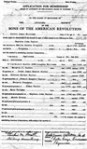

My 4th great-grandfather was born in Virginia and died in the Revolutionary War in South Carolina.
His father, John TAYLOR, b. ca. 1723, migrated from Virginia in 1754 to the east bank of the Congaree River, 10 miles south of Columbia, South Carolina.
Captain John TAYLOR (b. 1746 m. Sarah HIRONS d. 1 Feb 1781) was wounded twice, at Fort Moultrie and Sullivan’s Island, and captured with Colonel Thomas TAYLOR (b. 10 Sept 1743 & John’s brother) at Fishing Creek, but escaped while being carried to Camden, South Carolina. He was one of three brothers who fought in the American Revolution for the SC Militia.The 3rd brother, James TAYLOR, married both Sarah’s sister, Mary HIRONS, & Sarah DANIELL. (Taylor info: http://www.geocities.com/bcvsmith/ 19 April 2002)
Captain John Taylor died of smallpox during the war.
John Taylor (1747 – 1781)
is my 4th great grandfather
John Nimrod Taylor (1770 – 1816)
son of John Taylor
John Samuel Taylor (1798 – 1873)
son of John Nimrod Taylor
William Ellison Taylor (1839 – 1918)
son of John Samuel Taylor
George Harvey Taylor (1884 – 1941)
son of William Ellison Taylor
Ruby Lee Taylor (1922 – 2008)
daughter of George Harvey Taylor
Pamela Morse
I am the daughter of Ruby Lee Taylor
Rev John Taylor
John Taylor (c. 1480 – 1534) was Master of the Rolls of the Court of Chancery from 1527 to 1534, following a successful career as a priest and civil servant. Taylor would have been notable just for the circumstances of his birth: he was the firstborn of healthy triplets who all survived to adulthood, which was virtually unheard of in the 15th century.
King Henry VII met John and his brothers Rowland and Nathaniel in their childhood, and undertook responsibility to educate the three boys if they came to manhood; this informal act, and others like it, later inspired Queen Victoria’s Royal Bounty for Triplets which continued until the reign of Elizabeth II. There is note in the Royal Privy Purse expenses of 1498 “for the wages of the King’s Scoler John Taillor at Oxenford.”[1]
During his lifetime, Taylor donated money towards the building of St. James Church in Barton-under-Needwood, Staffordshire, the village where he grew up. Construction began in 1517 and was completed in 1533. The John Taylor High School, a specialty science school founded in Barton-under-Needwood in 1957, was named in his honor.[2]
In 1503, Taylor was ordained Rector at Bishop’s Hatfield, and then became Rector of Sutton Coldfield in 1504. He served as one of the Royal Chaplains at Henry VII’s funeral, 21 April 1509, and was afterwards appointed by King Henry VIII as the King’s Clerk and Chaplain-he was later one of the commissioners to decide if Henry VIII’s marriage to Catherine of Aragon was valid. In 1511, he was made Clerk to the Parliament.
Taylor was appointed as Archdeacon of Derby in 1515, then as Royal Ambassador to Burgundy and France and Prolocutor of Convocation. In 1516, he was appointed Archdeacon of Buckingham, and was conferred the degrees of Doctor of Civil Law and Doctor of Canon Law at Cambridge in 1520. He was one of ten chaplains present at the Field of the Cloth of Gold in 1520. In 1528 he became Archdeacon of Halifax.
From 1527 to 1534 he was Master of the Rolls of the Court of Chancery — the presiding officer of the Civil Division of the Court of Appeal. This position was the third most senior judicial position in England (after Lord Chancellor and Lord Chief Justice).
References· “Taylor, John (d.1534)”. Dictionary of National Biography. London: Smith, Elder & Co. 1885-1900.1. Notable Bartonians: John Taylor (circa 1480 to 1534)2. John Taylor High School
Source: John Taylor (Master of the Rolls). (2011, September 20). In Wikipedia, The Free Encyclopedia. Retrieved 15:03, October 27, 2011, from http://en.wikipedia.org/w/index.php?title=John_Taylor_(Master_of_the_Rolls)&oldid=451553336
 mermaidcamp