mermaidcamp
Keeping current in wellness, in and out of the water
You can scroll the shelf using ← and → keys
You can scroll the shelf using ← and → keys
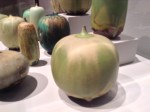


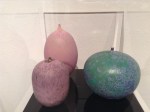


Athena is often mentioned as a war goddess because she was never defeated. She is also the goddess of wisdom and crafts. Her protection is important in firing the kiln. The ceramic demons that destroy a firing can take over without her blessing:
Homer’s Epigrams Fragment 14 (trans. Evelyn-White) (Greek epic C8th or C7th B.C.) :
“Potters, if you give me a reward, I will sing for you. Come, then, Athena [goddess of pottery], with hand upraised over the kiln. Let the pots and all the dishes turn out well and be well fired: let them fetch good prices and be sold in plenty in the market. Grant that the potters may get great gain and grant me so to sing to them. But if you turn shameless and make false promises, then I call together the destroyers of kilns, Suntribos (Shatter) and Smaragon (Smash) and Asbetos (Charr) and Sabaktes (Crash) and Omodamos (Crudebake) who can work this craft much mischief. Come all of you and sack the kiln-yard and the buildings: let the whole kiln be shaken up to the potter’s loud lament. As a horse’s jaw grinds, so let the kiln grind to powder all the pots inside.”
It is obvious to me that Rose Cabat made friends with Athena long ago in order to achieve such masterful results in the kiln. Her work is unique because her special glazes create a silky feel that is her secret weapon. The pots are vivid and beautifully shaped, inviting touch. The soft surface she creates is like no other. She calls the pots feelies, and has become famous for these special touchable forms. Her many collectors are happy to pay $400 and up for a tiny feelie because they only go up in value over time. Rose is still making pots from her wheel chair at age 100, and continues to be in very good standing with Athena. She has a show now at the Tucson Museum of Art featuring her work over her long career. It is incredible to see in person. I have seen her work over the years, but there are so many in one place that it delights the eye..and makes us wish we could feel them. There are some for sale in the Museum shop if you want your own to have and to hold.







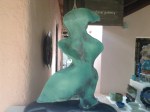

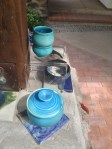


I recently reread the book Centering by Mary C Richards, a potter. In it she waxes very poetic about the subject of pottery. When I was covered with mud I considered Ms Richards to be fluffy and woo woo. About 35 years later I see how centering clay on a wheel is sheer poetry. I also notice my own approach to centering, which has never left me. I now like to center my body from the core in deep water, using tubular units for balance. This month as I attempt to write a poem a day I searched my memory for inspiration. Janet Burner, queen of all alchemists and artist of great skill and talent, popped into my mind. She has awesome technical skills and an alliance with fire like nobody I have ever seen. I like fire myself and enjoyed my time as a kiln queen. Janet has perfected various styles of firing to add variety and excitement to her work. She has always been famous for her raku. Now she has evolved other techniques, both modern and ancient, to bring her work to life.
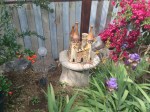
In the kiln the pot is actually born. Just like an animal at birth, it also has a chance of dying. Potters must accept that some work will crack or be ruined in the firing. They must also accept that pottery is breakable, and glazes can only be controlled to a certain extent. Intimate knowledge and wisdom of the firing process results from practice and experimentation. I think of Janet Burner as the ultimate goddess of the fire. We talked about how ironic it is that her last name is Burner, both because of fire and because one of the oldest techniques used in finished ceramics is called burnishing. Her work today is created in a wonderful studio full of light, love, and art that she built herself. The artful courtyard garden serves as a gallery to display her work. She continues to teach at the Tucson Museum of Art School and grace our community with her participation in the Pima Arts Council Open Studio Tours. Next weekend you can visit artists and see their studios all over Tucson. This is an excellent way to find art and artists.
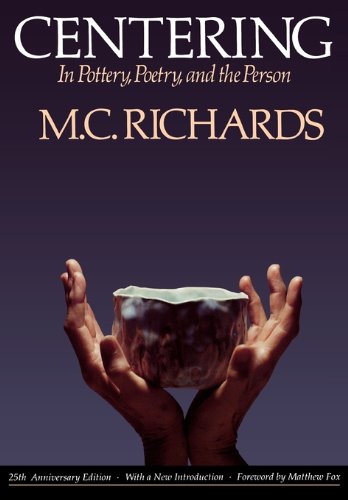
Centering by Mary Richards
I made pottery on the wheel when I was young. Two books were read by almost all the potters I knew in those days, Clay and Glazes for the Potter by Daniel Rhodes, and Centering by MC Richards. The first technical manual often called simply Rhodes gave formulas and facts needed to produce pottery. The centering book was all about zen and becoming one with the clay in the middle of the wheel. I used to think the centering book was too silly, but now I think it is brilliant. I have not thrown pots for at least 30 years, but the practice did make a difference in my philosophy. To center the clay one must be centered. All work is exactly like that. If you are not centered, balanced, able to focus, your clay will be hard to manage. Your vision will not quite be achieved because of distraction. With clay it is possible to endlessly recycle it if it has not been fired. However, if one works for too long on a thrown piece it is very likely to collapse. Brevity and self assurance are the essence of throwing pots.
Centering was taken from an inspirational speech given to fellow craftsmen. Mary Richards was asked to elaborate on that talk in a book. The 25th anniversary edition is out so I have zapped it into my Kindle. In her introduction Ms Richards states, “The imagery of centering is archetypal. To feel the whole in every part.” Chapter one begins, “CENTERING: that act which precedes all others on the potter’s wheel.” This seems obvious, but the metaphors are many. Whatever raw materials we have must be treated as a whole to make the most of them. Many mediums are not as forgiving as clay. Once wood or fabric has been cut it can’t be thrown into a slip barrel and become new. An unfired pot that does not meet standards can begin as a new lump of clay. Sensitivity and refined touch are the main skills needed to center and throw pots. Porcelain has different feel and qualities to stoneware. Each clay body has potential and personality. Each will take glazes differently. The chemical process of fusing glaze to pot happens at high heat and must be cooled slowly to avoid cracking and crazing. There is technical accuracy, just as in distillation. One follows a recipe and keeps a firing log in order to attain exact desired results on a regular basis. There will sometimes be pots that are ruined in the kiln, and this is a fact that must be accepted. Not every pot will survive.
Mary Richards quotes Emerson who said the law is: “Do the thing, and you shall have the power. But they who do not the thing, have not the powers.” When I read this book about centering today I know that being a potter early in my life gave me an appreciation for practice and balanced design in all things. I enjoy making my own clothes, growing my own food, and designing my own life. The concept of centering means connecting from my center to the center of others, touching the core. That is the essence of life. Stay centered, my friend.
 mermaidcamp