mermaidcamp
Keeping current in wellness, in and out of the water
You can scroll the shelf using ← and → keys
You can scroll the shelf using ← and → keys


My 8th great-grandmother was born in Salisbury, Witlshire in 1633. She was baptized in St Thomas church in Salisbury. She was sailing on the ship James through a hurricane when she landed in America in 1635, as an infant traveling with her parents:
1635 voyage
The ship James of London sailed from Southhampton on April 5, 1635 and arrived in Massachusetts Bay on June 3,[5] 1635 with master William Cooper[disambiguation needed] at the helm.
The ship James left King’s Road in Bristol on May 23, 1635 with master John Taylor[disambiguation needed] at the helm. From England to Massachusetts in a fleet of five ships, the Angel Gabriel, the Elizabeth (Bess), the Mary and the Diligence.
On June 3, 1635, the James joined four other ships, and set sail for the New World with just over 100 passengers as part of a fleet of five ships, including the families of Richard Mather, Captain John Evered and John Ayer. As they approached New England, a hurricane struck and they were forced to ride it out just off the coast of modern-day Hampton, New Hampshire. According to the ship’s log and the journal of Increase Mather, whose father Richard Mather and family were passengers, the following was recorded;
“At this moment,… their lives were given up for lost; but then, in an instant of time, God turned the wind about, which carried them from the rocks of death before their eyes. …her sails rent in sunder, and split in pieces, as if they had been rotten ragges…”
They tried to stand down during the storm just outside the Isles of Shoals, but lost all three anchors, as no canvas or rope would hold, but on Aug 13, 1635, torn to pieces, and not one death, all one hundred plus passengers the James manages to make it to Boston Harbor two days later.
The Angel Gabriel was wrecked off the coast of Maine, but the smaller, faster ships, the Mary, the Bess, and the Diligence outran the storm, and landed in Newfoundland on August 15, 1635.
Mary Greene (1633 – 1686)
is my 8th great grandmother
Benoni Sweet (1663 – 1751)
son of Mary Greene
Dr. James Sweet (1686 – 1751)
son of Benoni Sweet
Thomas Sweet (1732 – 1813)
son of Dr. James Sweet
Thomas Sweet (1759 – 1844)
son of Thomas Sweet
Valentine Sweet (1791 – 1858)
son of Thomas Sweet
Sarah LaVina Sweet (1840 – 1923)
daughter of Valentine Sweet
Jason A Morse (1862 – 1932)
son of Sarah LaVina Sweet
Ernest Abner Morse (1890 – 1965)
son of Jason A Morse
Richard Arden Morse (1920 – 2004)
son of Ernest Abner Morse
Pamela Morse
I am the daughter of Richard Arden Morse
Her father was a physician and surgeon in Rhode Island. She married James Sweet when she was 17 and began a healing practice:
“This Sweet family is known as the Bone-Setting Sweets. This gift is said to be inherited from Mary Greene, wife of James Sweet 1622-1698, who was the daughter of Surgeon John Greene. They also had another gift, the faculty of compounding linaments and washes from the roots and barks found in almost every neighborhood, and are very efficacious in reducing inflammation and swellings and in preventing mortification.”
Her husband James had also arrived as a child with his parents, and was an early settler of Rhode Island.
Birth: 1622 Death: Jun. 18, 1698South Kingstown
Washington County
Rhode Island, USA
The second son of JOHN & MARY SWEET, James Sweet came with his parents to America in 1632. He worked at a grist mill with his step-father, Ezekiel Holliman. He was an inhabitant of Warwick in 1648, Commissioner in 1653/1658/1659, freeman in 1655, juryman in 1656 and lived at the estate of the late William Congdon at the foot of Ridge Hill. He married MARY GREENE, daughter of JOHN GREENE & JOANE (TATTERSOL) GREENE, about 1654 in Providence, RI. On Sept. 30, 1660, he sold to Thomas Greene, the lot he had received from the town of Warwick along with meadow land. Later, the family moved to Prudence Island in Portsmouth Twp. about four miles soutwest of Bristol in 1664 being one of the first families to live on the island from 1664 to about 1685. Several family members are buried in the old family burying ground in the center of the island.
On November 8, 1686, he deeded his land in Providence that he had inherited from his father to eldlest son, Philip of Prudence Island. On the same date, he deeded to son, Benoni, certain land in Mashiantatack, and to son, James of Prudence Island, Valentine of Kingstown, and Samuel & Mary Sweet living with their parents, land in Mashiantatack. In 1695, James deposed and gave his age as 73. He died at age 93 years.
All the “bone-setter” family lines originate with James Sweet and his wife, Mary, who learned the art of bone-setting from her surgeon father, JOHN GREENE. James Sweet & his brother, John Sweet were interpreters to the Indians for first settlers and their names can be found on early Indian deeds. James Sweet signed with his mark.
Family links:
Parents:
John Sweet (1603 – 1637)
Mary Periam Sweet (1600 – 1681)
Spouse:
Mary Greene Sweet (1633 – 1686)
Children:
Benoni Sweet (1663 – 1751)*
Valentine Sweet (1664 – 1725)*
Samuel Sweet (1667 – 1728)*
Burial:
Sweet – Austin Lot
North Kingstown
Washington CountyRhode Island, USA
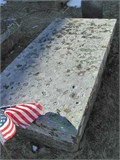
grave

Dr John
My 9th great-grandfather bought Shawomet, Warwick, RI for 144 fathoms of wampum:
Dr. John Greene was the fourth and youngest son of Sir Richard Greene, of Bowridge Hall. He was born in 9 Feb 1597 at Salisbury, Wiltshire, England. He came to Warwick, Rhode Island, sailing on the ship “James” 5 April 1635, arriving in Boston, Massachusetts, 3 June 1635. He moved his family to Providence, Rhode Island in 1637 all four of his sons being born in England. John born 15 Aug 1620, Peter born 10 Mar 1622, James born 21 Jun 1626, Thomas born 4 Jun 1628. His wife and sons all lived out their lives and are buried in Warwick, Rhode Island. He was one of the original 12 members of the Baptist Church. In January 1643, he and 10 others bought from Miantonimoh, Chief of the Narrowgansets (Native American Tribe), for 144 fathoms of Wampun, the tract of land called Shawomet (Warwick, Rhode Island). — A fathom (six feet of strung beads) of white wampum was worth ten shillings and double that for purple beads. A coat andBuskins “set thick with these Beads in pleasant wild works and a broad Belt of the same (Josselyn 1988: 101)” belonging to King Philip (Wampanoag) was valued at Twenty pounds. Even in the 1600s there was noted distinctiveness of Native-made wampum and the inability of others to counterfeit it, although attempts at imitations included beads of stone and other materials. — In 1644 Dr. John Greene went to England with Samuel Gorton and Randall Holden, returning in 1646, their mission successful. John Greene was Commissioner from 1654-57, Deputy Governer 1654. He married his first wife, Joan Tattersall, at Salisbury, England in St. Thomas Church, 4 Nov. 1619. Dr. John Greene died 11 Mar 1658. He is buried next to his wife Joan.
He married often and well:
JOHN GREENE, Surgeon, the progenitor of the Warwick Greenes, was the son of Richard and Mary (Hooker) Greene, and was born on his father’s estate at Bowridge Hill in the parish of Gillingham, County Dorset, England, about 1590. Though not so recorded, dates before and after him would seem to determine this as the year of his birth. His father, Richard, grandfather Richard, and great-grandfather, Robert, had for nearly one hundred years before him resided at Bowridge Hill, and were undoubtedly a branch of the Northamptonshire family of Greene through a younger son.
The mother of John Greene, surgeon, Mary Hooker, was the daughter of John Hooker (alias Vowell), who was born at Exeter, England, about 1524, his father, Robert Hooker, having been mayor of that city in 1520.
John Greene removed early to Sarum (Salisbury), the county town of Wiltshire, and was there married at St. Thomas’s Church,’ November 4, 1619, to Joanne Tattershall (or, as it was written on the church register, “Tatarsole”). Nothing is definitely known of her English connections. The name is frequently found in early records among post-mortem examinations, parliamentary writs, and charters, and is variously written Tatersall, Tateshall, Tatashall, Tatershal, and Tattershall. The first of the family of whom we have mention came in with William the Conqueror and obtained the lordship of Tattershall in Lincolnshire, where he seated himself and from which he took his surname. His descendants were seated in Berkshire and Norfolkshire, and were held in high repute. It is probable that other branches located in other counties, and it is not improbable to suppose that Joanne the wife of John Greene, who emigrated to America from Salisbury, County Wilts, was a connection of the family of George Tattershall, who was seated at Stapleford, County Wilts, which is about five miles distant from his Salisbury home ; but as yet this relationship has not been proved. The following note, recently received by the compiler in answer to an inquiry about records at Stapleford, may be of interest in this connection
“Stapleford Vicarage, Salisbury,” October 18, 1900.
“Madam: I have received your letter of the 25th September, but regret to say that I cannot help you in your research, as the Stapleford Register begins only with the year 1637. “J. F. D. HOERNLE, “Vicar of Stapleford.” [Joanne Tattershall ‘s marriage date was 1619, eighteen years earlier.]
The marriage of John Greene and the baptisms of all his seven children, recorded in the Parish Register of St. Thomas’s Church at Salisbury, England, are still extant. He is therein styled “Mr.” and “Gent,” a mark of some distinction at that date.” He resided at Salisbury with his family, following his profession, for about sixteen years. On April 6, 1635, he was registered for embarkation at Hampton, England with his wife and six children (one having probably died in England before this date),” in the ship James, of 200 tons, William Cooper, Master, for New England.” After a voyage of fifty-eight days he arrived at Boston, Mass., June 3, 1635. He first settled at Salem, Mass., where he was associated with Roger Williams, purchasing or building a house there, but soon after Mr. Williams’s flight from Salem (1636) he sold it and, joining Williams at Providence, secured his home lot, No.15, on the main street. He was one of eleven men baptized by Roger Williams, and one of the twelve original members of the first Baptist church on this continent, organized at Providence, R. I. He was the first professional medical man in Providence Plantations. He is alluded to in Goodwin’s Pilgrim Republic (p. 407) as “one of the two local surgeons” at Providence in 1638, though we are told “the people of Providence relied solely upon him for surgical aid long after his removal to Warwick in 1643.”
His first wife, Joanne Tattershall , the mother of all his children, died soon after his removal to Rhode Island and it is supposed was buried at Conimicut, Old Warwick (?). He married (2) ” Ailsce (Alice) Daniels, a widow” (recorded as proprietor of a home lot in Providence, 1637). They removed to Warwick, 1642-3. At the time of the persecution of the Shawomet pioneers (October, 1643), when “forty mounted and armed men,” sent from Boston to arrest them, fired over their houses, the women and children fled to the woods. Fright and exposure caused the death of the (second) wife of John Greene. (It seems more probable that this was the wife who was buried at Conimicut.) Samuel Gorton wrote of this attack of the Massachusetts troops: ” Afflicting our wives and children, forcing them to betake themselves some into the woods among the Indians, suffering such hardships as occasioned the death of divers of them, as the wife of John Greene, as also the wife of Robert Potter.” Judge Staples, in his Annals of Providence, mentions the fact that the second marriage of John Greene was not recorded, but he found evidence in Probate Records, where mention is made of the son of Alice Daniels as “John Greene’s stepson.”
Evidence of this marriage is also given in the following item:
“In the division of 52 House lots John Greene senior had lot between Thomas James on the North and John Smith on the South, and he inherited the lot of Alice Daniels his second wife between Wm. Harris on the North and John Sweet on the South” {Rhode Island Colonial Records [Printed], vol. i., p. 24).
In files. City Clerk’s office. Providence, is a book containing “A revised List of Lands and Meadows as they were originally lotted for the beginning of the Plantations of Providence in the Narragansett Bay in New England unto the [then] inhabitants of the said Plantations until anno i6—-.”
First in order are the “home lots,” beginning at the Mile-end Cove, south end of town, between Fox Point and Wickenden Streets, lots all bounded by Town (Main) Street on the west and by what is now Hope Street on the east. The name of Alice Daniels is found on this list.
Mr. Greene was married (3) in London, England, about 1644, to Phillippa (always written Phillip), who returned with him to Warwick, R. I., 1646. Her family name is not known. She died at Warwick, March 11, 1687, aged about eighty-seven years, having survived her husband for nearly thirty years.’ In further support that his third wife was from London we quote the words of Samuel Gorton, who, in a letter from Warwick addressed ” to Edward Calverly at his house by the east end of Christ Church in Newgate Market, London,” and dated November 20, 1649, wrote of this last wife of John Greene: ” Your auld neighbour, our loving friend, Mrs. Greene, hath writ a letter of advise to you [which] made me laugh not a little, which I heartily wish may come to your hands. She laies out the benefights of these parts better than I could have advised to have done. She takes well with the country and cheerfully performs her place [part], hath the love of all, non can open their mouth against her, which is a rare thing in these parts.”
Excerpt from the Book Title: The Greenes of Rhode Island, with historical records of English ancestry, 1534-1902 Author: General George Sears Greene (1801-1899) Publisher: Knickerbocker press Published in: New York Date of Publication: 1903 The Excerpt is Pages 54 – 56 The Document was retrieved from http://www.archive.org/details/greenesofrhodeis00gree

oldest Veteran’s memorial in the US
My 9th great grandfather was killed by my 11th great uncle. King Philip’s War was fought between the Wampanoag people and the colonists of Plymouth. This is the first, but not the last, war on American soil in which I had ancestors on both sides of the conflict. The memorial that commemorates this event is in preset day Providence, RI. It is the oldest Veterans memorial in the US. The vanquished native people were sent to the West Indies and sold into slavery. Nobody knows where the graves of my Wampanoag ancestors are.
Captain Michael Pierce was born in 1615 and died in1676. He and his descendants form the first American generation of Pierces in our family tree. Michael Pierce immigrated to the New World in the early 1640s from Higham, Kent, England to Scituate, in what later became Massachusetts. The ten year period from 1630 to 1640 is know as The Great Migration. During this period, 16,000 people, immigrated to the East Coast of North America.
Brother of famous Colonial Sea Captain, William Pierce. Captain Michael Pierce was the brother of the famous Colonial sea captain, William Pierce, who helped settle Plymouth Colony. Captain Michael Pierce played a significant role in the Great Migration. Historical records show that this one sea captain crossed the Atlantic, bringing settlers and provisions to the New World more frequently than any other. He had homes in London, the Bahamas and Rhode Island. He played a central role in the government of the early colonies. He was killed at Providence, one of the Bahama Islands, in 1641.
There were actually four Pierce brothers who made their mark on the New World: John Pierce (the Patentee), Robert Pierce, Captain William Pierce, and Captain Michael Pierce. All were grandsons of Anteress Pierce, and sons of Azrika Pierce and his wife Martha.
Marries Persis Eames. In 1643, Michael Pierce married Persis Eames of Charleston Massachusetts. His wife was born in Fordington, Dorsetshire England 28 October 1621. She was the daughter of Anthony Eames and Margery Pierce.
Pierce Family Moves to Scituate. Michael and Persis Pierce’s first child, a daughter, was born in 1645 and named Persis in honor of her mother. Unfortunately, their first child died in 1646 at one year of age. The new family settled first in Higham, but moved in 1676 to Scituate, where the Pierce family continued to reside for most of the next century. Scituate is located some 10 miles north of the original Plymouth colony. It was settled as early as 1628 by a group of men from Kent, England.
In 1646, Benjamin Pierce, their second child, a son and heir, was born. This son, Benjamin Pierce, fathered the second Pierce generation in this family tree. Twelve other children were born over the coming years: Ephraim, Elizabeth, Deborah, Sarah, Mary, Abigail, Anna, Abiah, John, Ruth and Peirsis.
Erected First Saw-Mill. Michael Pierce resided on a beautiful plain near the north river and not far form Herring brook. He assisted in erecting the first saw-mill. The mill was the first one erected in the colony. It is believed that Samuel Woodworth (1784-1842) wrote the song, “The Old Oaken Bucket,” concerning this river and mill in Scituate. Samuel Woodworth’s grandfather, Benjamine Woodworth, witnessed the signing of Captain Michael Pierce’s will, on January 1675. The lyrics to this classic American folk tune are given below:
How dear to this heart are the scenes of my childhood, When fond recollection presents them to view, The orchard, the meadow, the deep tangled wildwood, And ev’ry lov’d spot which my infancy knew. The wide spreading stream, the mill that stood near it, The bridge and the rock where the cataract fell. The cot of my father, the dairy house by it, And e’en the rude bucket that hung in the well. The old oaken bucket, the ironbound bucket, The moss-covered bucket that hung in the well. The moss-covered bucket I hail as a treasure, For often at noon when returned from the field, I found it the source of an exquisite pleasure, The purest and sweetest that nature can yield. How ardent I seized it with hands that were glowing, And quick to the white pebbled bottom it fell. Then soon with the emblem of truth overflowing, And dripping with coolness it rose from the well. The old oaken bucket, the ironbound bucket, The moss-covered bucket that hung in the well. How soon from the green mossy rim to receive it, As poised on the curb it reclined to my lips, Not a full flowing goblet could tempt me to leave it, Tho’ filled with the nectar that Jupiter sips. And now far removed from the loved situation, The tear of regret will intrusively swell. As fancy reverts to my father’s plantation, And sighs for the bucket that hung in the well. The old oaken bucket, the ironbound bucket, The moss-covered bucket that hung in the well.
Captain in the Local Militia Fighting the Indians. Unlike his famous brother, Captain William Pierce, Michael Pierce was not a sea captain. He attained the title, Captain, from the Colony court in 1669. Historical records show that he was first given the rank of Ensign under Captain Miles Standish, then later, in 1669, he was made Captain. These titles reflects his role as a leader in the local militia formed to protect the colony from the Indians.
Honored for Heroism in King Phillip’s War. Captain Michael Pierce’s memory is well-documented in American history. He is honored for the brave manner in which he died in defense of his country. The exact manner in which he died is repeated in more than 20 books and letters detailing the military history of the King Phillip’s War. This war took place between 1675 and 1676, and remains one of the bloodiest conflicts in American history. It was also a pivotal point in early American history. Although the English colonists were ultimately victorious over the Indians, it took the colonies over 100 years to recover from the economic and political catastrophy brought about by this conflict.
The battle in which Captain Michael Pierce lost his life is detailed in Drakes Indian Chronicles (pp. 220-222) as follows:
“Sunday the 26th of March, 1676, was sadly remarkable to us for the tidings of a very deplorable disaster brought into Boston about five o’clock that afternoon, by a post from Dedham, viz., that Captain Pierce of Scituate in Plymouth Colony, having intelligence in his garrison at Seaconicke, that a party of the enemy lay near Mr. Blackstorne’s, went forth with sixty-three English and twenty of the Cape Indians (who had all along continued faithful, and joyned with them), and upon their march discovered rambling in an obscure woody place, four or five Indians, who, in getting away from us halted as if they had been lame or wounded. But our men had pursued them but a little way into the woods before they found them to be only decoys to draw them into their ambuscade; for on a sudden, they discovered about five hundred Indians, who in very good order, furiously attacked them, being as readily received by ours; so that the fight began to be very fierce and dubious, and our men had made the enemy begin to retreat, but so slowly that it scarce deserved the name, when a fresh company of about four hundred Indians came in; so that the English and their few Indian friends were quite surrounded and beset on every side. Yet they made a brave resistance for about two hours; during which time they did great execution upon their enemy, who they kept at a distance and themselves in order. For Captain Pierce cast his sixty-three English and twenty Indians into a ring, and six fought back to back, and were double – double distance all in one ring, whilst the Indians were as thick as they could stand, thirty deep. Overpowered with whose numbers, the said Captain and fifty-five of his English and ten of their Indian friends were slain upon the place, which in such a cause and upon such disadvantages may certainly be titled “The Bed of Honor.” However, they sold their worthy lives at a gallant rate, it being affirmed by those few that not without wonderful difficulty and many wounds made their escape, that the Indians lost as many fighting men in this engagement as were killed in the battle in the swamp near Narragansett, mentioned in our last letter, which were generally computed to be above three hundred.”
Today, in Scituate, there is a Captain Pierce Road.
In Cumberland, Rhode Island, there is a monument called Nine Men’s Misery. A tablet near the monument reads:
NINE MEN’S MISERYON THIS SPOT WHERE
THEY WERE SLAIN
BY THE INDIANS
WERE BURIED
THE NINE SOLDIERS
CAPTURED IN
PIERCE’S FIGHT
MARCH 26, 1676
The monument is located in a dark, place in the woods, near a former monastery. The monastery is now a public library. The monument consists of little more than a pile of stones cemented together by a monk and marked with a plaque. However, this site is of major historical significance because it is concidered to be the oldest monument to veterans in the United States.
1. Captain Michael Pierce born 1615; died 3/26/1676.
married Persis Eames, 1643 (born. Oct. 28, 1621; died Dec. 31,1662). Micheal Pierce and Persis Eames had these 13 children:
2. Persis Pierce, born 1645. Persis died 1646 at 1 year of age. 3. >>>Benjamin Pierce, born 1646. 4. Ephraim Pierce, born 1647. Ephraim died 1719 at 72 years of age. 5. Elizabeth Pierce, born 1649. She married a Holbrook and gave birth to Captain Michael Pierce’s only two grandchildren at the time of his death who are mentioned in his will: Elizabeth Holbrook and Abigail Holbrook. 6. Deborah Pierce, born 1650. 7. Sarah Pierce, born 1652. 8. Mary Pierce, born 1654. She married Samuel Holbrook, 23 June 1675. Samuel was born in Weymouth, Mass 1650. Samuel was the son of William Holbrook and Elizabeth Pitts. Samuel died 29 October 1712 at 62 years of age. Mary Pierce and Samuel Holbrook had the following six children: Persis, Elizabeth, Bethiah, Samuel, Elizabeth, and Mary. 9.Abigail Pierce, born 1656. Abigail died 1723 at 67 years of age. 10. Anna Pierce, born 1657. 11. Abiah Pierce, born 1659. She married Andrew Ford. 12. John Pierce, born 1660. John died 28 June 1738 at 77 years of age. He married Patience Dodson 12 December 1683. 13. Ruth Pierce, born 1661. 14. Peirsis Pierce, born 1662. Persis 3 December 1695. She married Richard Garrett, 3rd, who was born in 1659. They lived in Scituate, Mass. and had three children: John (born 1706), Anna, and Deborah.
married Mrs. Annah James sometime soon after 1662. They had no children. Captain Michael Pierce remained married to Annah Pierce until his death. Annah Pierce is well provided for in his will.
Michael Pierce (1615 – 1676)
is my 9th great grandfather
Ann Pierce (1640 – 1655)
daughter of Michael Captain Pierce
Sarah Kinchen (1655 – 1724)
daughter of Ann Pierce
Philip Raiford (1689 – 1752)
son of Sarah Kinchen
Grace Raiford (1725 – 1778)
daughter of Philip Raiford
Sarah Hirons (1751 – 1817)
daughter of Grace Raiford
John Nimrod Taylor (1770 – 1816)
son of Sarah Hirons
John Samuel Taylor (1798 – 1873)
son of John Nimrod Taylor
William Ellison Taylor (1839 – 1918)
son of John Samuel Taylor
George Harvey Taylor (1884 – 1941)
son of William Ellison Taylor
Ruby Lee Taylor (1922 – 2008)
daughter of George Harvey Taylor
Pamela Morse
I am the daughter of Ruby Lee Taylor
When I read that he’d died during the Great Swamp Fight, it peaked my interest so I bought a book called King Philip’s War The History and Legacy of America’s Forgotten Conflict, by Eric B. Schultz and Michael J. Tougias. The following is an excerpt from the book describing Michael Pierce’s involvement in the conflict.
KING PHILIP’S WAR
PIERCE’S FIGHT, CENTRAL FALLS, RHODE ISLAND
The ambush of Captain Michael Pierce and his Plymouth Colony soldiers
occurred on Sunday, March 26, 1676, in the present-day city of Central
Falls, Rhode Island. Sometimes attributed to the Narragansett sachem
Canonchet, this ambush was in many respects a textbook military operation.
Several friendly natives escaped the engagement, but only nine English
survived, and these nine men were later discovered dead several miles
north of Central Falls in present-day Cumbedand, Rhode Island, a site now
known as Nine Men’s Misery. Not only was the ambush deadly for Pierce
and his men, but it was devastating to the morale of the colonies which, on
the very same day, witnessed the murder of settlers in Longmeadow, Massachusetts,
the burning of Marlboro, Massachusetts, and the destruction of
Simsbury, Connecticut.
Pierce, a resident of Scituate, Massachusetts, had gathered in Plymouth
a force of Englishmen from Scituate, Marshfield, Duxbury, Eastham, and
Yarmouth, supported by twenty friendly natives from Cape Cod. Together,
this band marched to Taunton, then along the Old Seacuncke Road
(Tremont Street) to Rehoboth (now East Providence, Rhode Island).
There, they were joined by several men from Rehoboth, expanding their total
number to sixty-three English and twenty friendly natives.
Reports indicated that a large group of the enemy had gathered in the
area of Pawtucket Falls, an ideal location from which to catch alewives,
salmon, and shad, and a natural fording spot in the river.149Pierce and his
men set out in pursuit. On Saturday, March 25, they skirmished with the
Narragansett, perhaps north of the falls, where, historian Leonard Bliss
concludes, Pierce “met with no loss, but judged he had occasioned considerable
to the enemy.”
It is not unreasonable to think that Pierce had skirmished with a small
patrol sent intentionally to meet and test the English-an exercise broken
off by the natives once they had gathered information on the size and”
strength of their opponent. In any event, Pierce met no other natives and returned
for the night to the garrison at Old Rehoboth. Meanwhile, armed
with information from the skirmish, native leaders undoubtedly set to work
devising a trap for the English troops.
On Sunday, March 26, Pierce and his troops returned to the field, probably
marching from present-day East Providence, north along the Seekonk
River (which becomes the Blackstone River), back toward Pawtucket Falls.
It is said that as they marched, they were watched by Narragansett from
Dexter’s Ledge, now the site of Cogswell Tower in Jenks Park, Central Falls
(rough distance and heavily wooded terrain made this questionable).
Somewhere close to the Blackstone, perhaps near a fording spot where
Roosevelt Avenue now crosses the river, in what Bliss describes as an
“obscure woody place,” they spotted four or five Narragansett fleeing as
if wounded or hurt. Had a more experienced commander witnessed this
show, he might have immediately fallen back. However, Pierce and his
troops charged after the bait, suddenly finding themselves surrounded by
“about 500 Indians, who, in very good order, furiously attacked them.”
Pierce apparently met the ambush on the eastern side of the Blackstone,
but crossed to the western side, where the natives were engaged in force. A
contemporary account of the battle by an anonymous Boston merchant,
paraphrased by Bliss, made the English out to be as heroic as possible, but
the devastation was complete:
Our men had made the enemy retreat, but so slowly, that it scarce deserved
the name; when a fresh company of about 400 Indians came in,
so that the English and their few Indian friends, were quite surrounded
and beset on every side. Yet they made a brave resistance for above two
hours, during all which time they did great execution upon the enemy,
whom they kept at a distance, and themselves in order. For Captain
Pierce cast his 63 English and 20 Indians into a ring and fought back to
back, and were double-double distance all in one ring, whilst the Indians
were as thick as they could stand thirty deep: overpowered with
whose numbers, the said captain, and 55 of his English, and 10 of their
Indian friends were slain upon the place; which, in such cause, and
upon such disadvantages, may certainly be styled the bed of honour.
It is unlikely, of course, that nine hundred natives participated in the ambush.
Nor does it seem logical that eighty-three men, disadvantaged by surprise,
terrain, and numbers, would have much chance of forcing even four
hundred warriors to retreat. (Contemporary writers reported that Pierce
and his men killed 140 of their enemy, a figure undoubtedly inflated.)
However, if Pierce and his troops crossed the Blackstone near present-day
Roosevelt Avenue, the battle may have moved northward along the river to
a spot near present-day Macomber Field on High Street, where a commemorative
marker was placed in 1907. The marker reads:
PIERCE’S FIGHT
NEAR THIS SPOT
CAPTAIN MICHAEL PIERCE
AND HIS COMPANY OF
PLYMOUTH COLONISTS
AMBUSHED AND OUTNUMBERED WERE
ALMOST ANNIHILATED
By THE INDIANS
MARCH 26 1676
ERECTED By THE STATE OF RHODE ISLAND
IN 1907
A visit to this site today places the traveler in a heavily industrialized area
surrounded by factories and baseball fields. It is worth remembering, however,
that Central Falls was once the “North Woods” of Providence and
remained only sparsely settled throughout the eighteenth century.
Marching along, Pierce would have seen a wooded land of oak, walnut,
chestnut, and birch trees with three falls (Pawtucket to the south, Valley to
the north, and Central near the crossing at Roosevelt Avenue) supplying the
Narragansett with rich fishing grounds. ’59Bycontrast, present-day Central
Falls is so densely built that the Blackstone River is all but invisible from
nearby Cogswell Tower.
Not all of Pierce’s troops died in the ambush. Several of the friendly natives
devised ingenious means of escape. One blackened his face with powder
like the enemy and passed through their lines without incident.16oAnother
pretended to chase his comrade with a tomahawk, the two running past
their enemies and on to safety.161It appears also that nine English soldiers
escaped death during the ambush, though the details of their story are conjecture
only. One tradition holds that they had gone ahead of the main body
of troops and were chased into present-day Cumberland, where they made
their stand against a large rock and all perished.161
A more plausible explanation is that these nine survived the ambush,
were taken prisoner, and were marched northward about three miles to a
piece of upland surrounded by swamp known as Camp Swamp. Here, upon
a large rock, they were executed. It was several weeks before their bodies
were found, scalped and uncovered, on this rock. The men were buried
some seventy yards northeast of the rock in a common grave. Above this
grave a heap of small stones was used to construct a fourteen-foot-Iong
stone wall, some three feet high and one foot wide at the base. To this
day, residents know this place as Nine Men’s Misery.
In the early twentieth century a cairn of stones (since damaged) was
placed over the spot, and in 1928 a granite marker was set by the Rhode Island
Historical Society. The marker reads:
NINE MEN’S MISERY
ON THIS SPOT
WHERE THEY WERE SLAIN BY
THE INDIANS
WERE BURIED THE NINE SOLDIERS
CAPTURED IN PIERCE’S FIGHT
MARCH 26, 1676
The cairn and marker can be found near the former Cistercian Monastery
on Diamond Hill Road, about six-tenths of a mile south of Route 295 in
Cumberland. (These grounds are now home to the Hayden Library, the
Northern Rhode Island Collaborative School, the Cumberland Senior Citizens
Department, and other city services.) A dirt road, heading northnortheast
from the northeast corner of the grounds, leads directly to the
site, which requires about a quarter-mile walk. (Many residents walk and
jog in this area and are able to point a visitor in the right direction.)
Around the time of the American Revolution a physician dug up remains
from the grave, identifying one skeleton as that of Benjamin Buckland
of Rehoboth by its large frame and double set of teeth.r65 When the
Catholic Order of Monks purchased the land, remains of the men killed at
Nine Men’s Misery were dug up and given to the Rhode Island Historical
Society. During the 1976 bicentennial celebration, after the land had been
turned over to the town of Cumberland for its use, the bones were reburied
at their original site.


While studying my tree I noticed that one of the branches had some discrepancies. The Sweet family of Rhode Island is a favorite of mine now that I have visited the state. Consulting family written documents, my suspicions were confirmed that I had the wrong Sweet in the wrong spot. I was sad because I had become attached to these people who would no longer be related to me, which itself is a ridiculous thought. Now I have spent time to repair the error, and with a bit of luck I did get back to the correct ancestor in just 3 generations. I had listed his brother John in this generation, an erroneous idea I found in other profiles on ancestry.com. Lucky for me, I do have family written references on this part of my fam. My new, revised 8th great grandfather is from a Sweet family of famous physicians known as the bonesetters. They carried on for generations in this capacity. I am now just as happy with the doctors as I was with the fancy politicians I gave up in the process. I have also been informed about Rhode Island history, which is fascinating.
James Sweet (1622 – 1695)
is my 8th great-grandfather
Benoni Sweet (1663 – 1751)
son of James Sweet
Dr. James Sweet (1686 – 1751)
son of Benoni Sweet
Thomas Sweet (1732 – 1813)
son of Dr. James Sweet
Thomas Sweet (1759 – 1844)
son of Thomas Sweet
Valentine Sweet (1791 – 1858)
son of Thomas Sweet
Sarah LaVina Sweet (1840 – 1923)
daughter of Valentine Sweet
Jason A Morse (1862 – 1932)
son of Sarah LaVina Sweet
Ernest Abner Morse (1890 – 1965)
son of Jason A Morse
Richard Arden Morse (1920 – 2004)
son of Ernest Abner Morse
Pamela Morse
I am the daughter of Richard Arden Morse
The second son of JOHN & MARY SWEET, James Sweet came with his parents to America in 1632. He worked at a grist mill with his step-father, Ezekiel Holliman. He was an inhabitant of Warwick in 1648, Commissioner in 1653/1658/1659, freeman in 1655, juryman in 1656 and lived at the estate of the late William Congdon at the foot of Ridge Hill. He married MARY GREENE, daughter of JOHN GREENE & JOANE (TATTERSOL) GREENE, about 1654 in Providence, RI. On Sept. 30, 1660, he sold to Thomas Greene, the lot he had received from the town of Warwick along with meadow land. Later, the family moved to Prudence Island in Portsmouth Twp. about four miles soutwest of Bristol in 1664 being one of the first families to live on the island from 1664 to about 1685. Several family members are buried in the old family burying ground in the center of the island.On November 8, 1686, he deeded his land in Providence that he had inherited from his father to eldlest son, Philip of Prudence Island. On the same date, he deeded to son, Benoni, certain land in Mashiantatack, and to son, James of Prudence Island, Valentine of Kingstown, and Samuel & Mary Sweet living with their parents, land in Mashiantatack. In 1695, James deposed and gave his age as 73. He died at age 93 years.All the “bone-setter” family lines originate with James Sweet and his wife, Mary, who learned the art of bone-setting from her surgeon father, JOHN GREENE. James Sweet & his brother, John Sweet were interpreters to the Indians for first settlers and their names can be found on early Indian deeds. James Sweet signed with his mark.
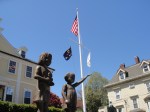
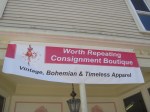











I am technically on restriction from all thrift stores since I do not need or want anything. On holiday I do fall off the wagon from time to time, thinking I need a souvenir of the place. Yesterday I discovered a palace of super fly thrift in East Greenwich, RI, where I went to check on my ancestors. On Main Street, right next to the Town Hall, is Worth Repeating Consignment Boutique. I knew right away I had to do it. I had in mind to find something for my neighbor Heidi to give a a gift, but she has very specific fashion needs. I asked Arlette Cornwall, the shop curator and owner if she had any chicken specific gear. It turned out that, tragically, she had just sold a fabulous purse featuring a Rhode Island Red…it would have been the bomb for Heids, because she is so into her chickens. We also checked out a very cool turban hat that Heidi might have worn, but it was very small and I have no idea about my neighbor’s head size. Having exhausted the gift search I knew from the feel of the place that I had to succumb to the call of the vintage. I have only bought one thrift item in the entire two weeks I have been on the Rhode Island rode. I did score a fun lightweight silk skirt and then hightailed it before I went any deeper. If you are not on restriction from thrift shopping I highly recommend a visit to Worth Repeating. If you are, well the, like me, you probably need to cheat once in a while in a very worthwhile, and perhaps historical setting. Arlette is there to make your shopping fun complete. She knows her stuff and prices things in a very attractive way. I left town without the graveyard visit to my dead peeps, so I can almost feel myself being drawn back for another visit. Arlette is a siren..be careful…she can read your mind.



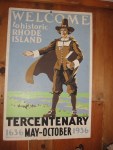






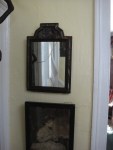

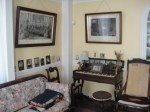
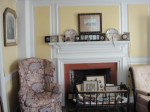




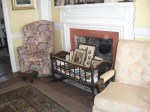

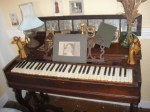


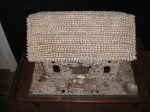


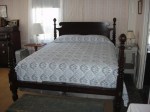


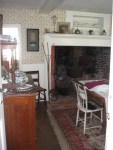

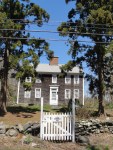


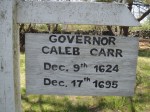
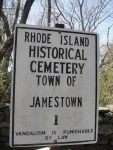
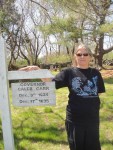

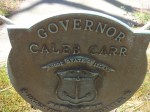
I came to Rhode Island to visit the land of my ancestors. Today we set out for Newport, where some of mine are buried, but we did not make it. I wanted to explore Jamestown, a small island between the mainland and Newport. I knew that Caleb Carr, my ancestor and the first governor of Rhode Island, was buried there with his family. My friend Deborah from Boston was my companion on this day trip. We drove through downtown Jamestown and followed the main road north just looking at scenery. We passed Carr Rd, and I felt a true excitement which I noted to Deborah. We had entered a designated historic district with beautiful stone walls and working farms. I was entranced as I am everywhere in New England right now with the flowering trees and the architecture. When we headed back toward the Newport bridge I turned onto Carr Rd and drove toward the ocean. On my left I saw Carr homestead circa 1690, and I had a giant chill/thrill/goose bump kind of an experience. I found a place to make a U turn to take a look. The narrow road had no real place to park, but the lady in the yard next door saw me and beckoned me to park in her drive. I felt lucky, but I had no idea how extravagant the jackpot was going to be.
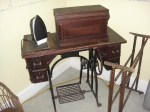
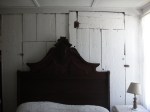
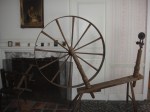
I told her I had come because Caleb Carr is my ancestor. She welcomed me and said she is a Carr also. Then she blew my mind completely by asking if I wanted to see the inside of the house. She and a group of the family still keeps the house in tact by taking care of it, then renting it in the summer months by the week. The rent paid by these shareholders when they bring their families to visit pays state taxes and upkeep expenses. It has never left the care and ownership of the family. She graciously toured us through the house which was THE peak experience of all my museum/travel/adventure life up to this point. I had an extreme love for all the rooms, and the trees in the yard which were brought from Japan. I was guided to be there when by botany loving cousin, however many times removed, was outside gardening. Although the farm had initially been a working dairy farm, at some time two lovely evergreens were imported from Japan to grace the front yard. I wondered how much plant love we both might have inherited from the Carrs. She said the land had all been cleared for pasture, but now the 10 acres that remain are wooded. It is one of the most beautiful places I have ever been. We stopped around the corner to see the family graves. It was all much more than I expected. Jamestown is a very special place for me.
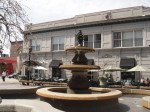

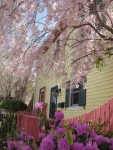





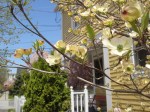




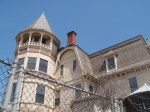

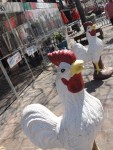


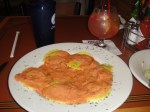
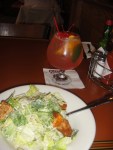
My initial impression of Rhode Island after spending one night at the airport and driving through Providence today is that it is beautiful. I am thrilled to see all the trees in bloom, but what I like best is the friendly people. The front desk at my Best Western airport hotel gave me a lender umbrella and sent me to a great bar and grill across the street. I appreciated that it was a local, not a chain, business with excellent service and cuisine. My giant meal of ravioli and pink sauce with salad was only ten bucks. It was totally pleasant and flavorful. After my brief experience I feel very welcome in the area. I drove through the state to reach Cape Cod and found a new reason to love Rhode Island. They have a wonderful system of roads and today there was NO traffic on them. Forsythia, magnolia, and azaleas in bloom, and water everywhere make this place a fantasy land for me. I look forward to learning more about Rhode Island and the Providence Plantations. Now I am enjoying the Atlantic Ocean and the friendly folks on Cape Cod. Tomorrow we party.

Portsmouth Compact
The Puritans left England for religious freedom. As soon as they arrived in New England some of them needed to be religiously free of the Puritans in Plymouth. These ultra free people formed their own “Plantations” in Rhode Island. One such Bodie Politick was Portsmouth, which made it’s political agreement in 1638 with God Himself.
The Portsmouth Compact
The following is quoted from the book Story of Dr. John Clarke; The Founder of The First Free Commonwealth of the World; on the Basis of “Full Liberty in Religious Concernments” by Thomas W. Bickness, published by the Author, Providence, R. I., 1915; third edition. Note: In the book is a picture of the compact which has been scanned in color for these pages. The transciption has been corrected to spell Phillip Shearman’s name with two “L”s and to add the words “his mark” as they appear next to Henry Bull’s name and under his mark “+”.
Prior to leaving Boston, a compact was drawn up, under date of March 7, 1638, by which a number of the leading men of the proposed Colony incorporated themselves into “A Bodie Politik” to the end that they might go to their new Plantation in a formal organization, under a chosen leader or Governor.
The compact is as follows:
The 7th Day of the First Month, 1638
We whose names are underwritten do hereby solemnly in the presence of Jehovah incorporate ourselves into a Bodie Politick and as He shall help, will sub- mit our persons, lives and estates unto our Lord Jesus Christ, the King of Kings, and Lord of Lords, and to all those perfect and most absolute laws of His given in His Holy Word of truth, to be guided and judged thereby. William Coddington John Clarke William Hutchinson, Jr. John Coggeshall W illiam Aspinwall Sa muel Wilbore John Porter John Sanford Edwa rd Hutchinson, Jr. Esq. Thomas Savage Willi am Dyre William Freeborne Ph illip Shearman [ John Walker Richa rd Carder Willi am Baulston Edw ard Hutchinson, Sr. + H enry Bull [“his mark” written next to name] Randal l Holden
Exodus, 24c., 3:4.II Cron., 11c., 3. II Kings, 11:17.
This compact was signed originally by twenty-three persons. The original paper is in the keeping of the Secretary of State, at the State House, Providence, a photograph of which appears on the opposite page. Four names,– Thomas Clarke, brother of John, John Johnson, William Hall and John Bright-man, Esq.,– follow the nineteen that appear above. Erasure marks have been made over these names, the reason for which it is not easy to understand as the first three were among the first recorded settlers of Newport, and Mr. Brightman may have been.
Neither was a Constitution nor a Bill of Rights for a Colony. Boston called the compact an act of incorporation. Plymouth called theirs a covenant, Boston did the act in “the presence of Jehovah,” Plymouth wrote “in the presence of God.” Boston formed a “Bodie Politick,” Plymouth called theirs a “Civill Bodie Politick.” Boston submitted their “persons, lives and estates unto our Lord Jesus Christ.” * * * ** “And to all those perfect and most absolute lawes of His given us in His Holy word of truth, to be guided and judged thereby.” Plymouth promised submission and obedience to such “just and equal lawes, ordinances, acts, constitutions and offices” as might be enacted, constituted and framed. Each compact had for its purpose the formation of a civil state under an orderly government. The Boston paper was probably written by Dr. John Clarke, whose piety and purpose lent a strongly religious sentiment to the document, so much so that some historians have called it theocratic. But Dr. Clarke did not classify The Christ as a theocrat, for all his writings make the great Teacher the interpreter of a new Democracy in which soul-liberty is established and enforced.
Samuel G. Arnold, our Rhode Island historian, has given a very clear and just interpretation of the Portsmouth Compact. He says, “So prominent indeed is the religious character of this instrument, that it has by some been considered, although erroneously, as being itself ‘a church covenant, which also embodied a civil compact.’ Their plans were more matured than those of the Providence settlers. To establish a Colony independent of every other was their avowed intention, and the organization of a regular government was their initial step. That their object was to lay the foundation of a Christian state, where all who bore the name might worship God according to the dictates of conscience, untrammelled by written articles of faith, and unawed by the civil power, is proved by their declarations and by their subsequent conduct.” * * * *
My 10th great grandfather was on the list signing the document breaking up totally with England, church and state. They were disarmed and put in jail by the Puritans for praying in the home of Anne Hutchinson. They decided to leave.
Richard Carder (1604 – 1675)
is my 10th great grandfather

Portsmouth Compact

Ship Bevis log

Old Rehoboth Cemetery
William Carpenter was a notable town clerk of Rehoboth, Massachusetts. He is from the Carpenter family that became large and influential in Rhode Island and southeastern Massachusetts by the 1700s.
Early Life
William Carpenter, Jr. was baptized on November 22, 1631. His parents were William Carpenter, III and Abigail Briant (sometimes erroneously reported as Bennett or Sale/Seals/Searles), both originally from Wiltshire. Since his family was able to bring a servant with them to Plymouth Colony, it is likely that they came from some affluence.
Carpenter’s place of baptism is variously recorded as Shalbourne, Berkshire, England or Southampton, Wiltshire, England. (Sources also differ on whether it was the Shalbourne in Berkshire, Wiltshire, or the non-existent “Whitshire.”) Professional genealogist Eugene Cole Zubrinsky, author of the Carpenters’ Encyclopedia, maintains that it was Shalbourne, Berkshire based on primary source records. The confusion could be blamed on Shalbourne having been split between Berkshire and Wiltshire around 1841, since it had straddled the line, with some records going to one county and some going to the other. Southampton, meanwhile, was the family’s departure port from England, explaining why some list Carpenter as having been born there.
Arrival in America
By May 2, 1638, Carpenter and his family set sail from Southampton, Hampshire, England on the Bevis, arriving at Boston in July or July. (The passenger list said that by May 2, “they had been some Dayes gone to sea,” so the exact date of departure is unknown.) The family’s full entry said:
William Carpenter 62 Carpenter of Horwell, William Carpenter Jr. 33 Carpenter of Horwell, Abigael Carpenter 32 and 4 children 10 and under, Tho: Banshott 14 Servant
A scan of the log can be seen in the “Photos” section of this profile; a more legible transcription is available throughOlive Tree Genealogy.
The family first settled in Weymouth, and then moved to Rehoboth in 1644.
Marriages & Children
Carpenter’s first marriage was to Priscilla Bennett on October 5, 1651 at Rehoboth. It is unclear whether she was the daughter or widow of Edward Bennett of Weymouth, Massachusetts Bay Colony. She died on October 20, 1663 in Rehoboth.
His second marriage was to Miriam Sale on February 10, 1663/4. (It is sometimes recorded as December since the original record, following the old calendar, called February the “12 month.”) She was born c. 1645 and died on May 1, 1722 at Rehoboth. She was the daughter of Edward sale of Weymouth and Rehoboth and was approximately 20 years old at the time of her marriage.
With his first wife, Carpenter had (all in Rehoboth):
John Carpenter, b. October 19, 1652, d. probably April 9, 1713 in Dedham, Massachusetts
William Carpenter, b. June 20, 1659, d. March 10, 1718/9 in Attleborough, Massachusetts
Priscilla Carpenter Sweet, b. July 24, 1661, d. 1745 in East Greenwich, Rhode Island
Benjamin Carpenter, b. October 20, 1663, d. April 18, 1738 in Coventry, Connecticut
With his second wife, Carpenter had (all in Rehoboth):
Josiah Carpenter, b. December 18, 1664, d. February 28 or 29, 1727/8 in Rehoboth
Nathaniel Carpenter, b. May 12, 1667, d. Rehoboth or Attleborough
Daniel Carpenter, b. October 8, 1669, d. September 14, 1721 in Rehoboth
Noah Carpenter, b. March 28, 1672, d. Attleborough
Miriam Carpenter Bliss, b. October 26, 1674, d. May 21, 1706 in Rehoboth
Obadiah Carpenter, b. March 12, 1677/8, d. October 25, 1749 in Rehoboth
Lt. Ephraim Carpenter, b. April 25, 1681, d. April 30, 1743 in Rehoboth
Hannah Carpenter Chaffee, b. April 10, 1684, d. after January 19, 1767 probably in Rehoboth
Abigail Carpenter Perrin, b. April 15, 1687, d. January 15, 1781 in Rehoboth
The Carpenter family house was on the left-hand side of the road from Rehoboth to the East Providence meetinghouse, “some 50 or 60 rods from the crossing of the Ten Mile river.”
Professional Life
Carpenter was propounded on June 6, 1660 in Weymouth but not admitted as a freeman until June 1, 1663.
Fitting with his surname, Carpenter was originally a carpenter. Records show him owning a “long Cross cutt saw” that he used at his home and which he later willed, along with assorted tools, to his son John, also a carpenter.
For nearly 35 years, Carpenter served as the town clerk of Rehoboth. His records are notable due to his exceptional handwriting and general literacy, which point to some formal education in his background. He also owned a small library of mostly theological books.
Records show that, while serving as clerk, he oversaw the highways, served as constable and juryman, was appointed to settle boundary disputes, helped hired the schoolmaster, served as magistrate, and was otherwise involved in all aspects of local governance.
Deacon or Deputy?
In his 1898 genealogy, Amos Carpenter said that William Carpenter was a deacon of the Rehoboth church and a deputy to the General Court of Plymouth Colony in 1668. Although these “facts” continue to be passed down through some branches of the family, Zubrinsky has conclusively shown that neither could have been true. Although Carpenter’s father served as deputy to the General Court in 1656, Carpenter himself never appears on any list of deputies. Furthermore, the original records of the Rehoboth church list a Deacon Cooper, not Carpenter. Even though he served as neither deacon nor deputy, he continues to be popularly known as “Deacon” simply due to the number of years for which the myth was propagated.
Death & Legacy
Carpenter’s will was dated November 10, 1702 and was proved April 20, 1703. His entire estate, including housing and lands, was worth £215 5s. 4d., or roughly £16,500/US$27,700 in 2011 figures.
Carpenter was buried at Newman Cemetery, one of the oldest (established in 1643) in present-day Rhode Island but which was, at the time of its founding, part of Rehoboth and Plymouth Colony. His parents are also buried in the same cemetery.
Additional Reading
Zubrinsky’s profile of William is perhaps the best available. It is uploaded in the “Documents” section of this profile.
The Wikipedia on the Rehoboth Carpenter family is a good starting point for learning about the family’s spread and influence over time.
Amos Carpenter’s A Genealogical History of the Rehoboth Branch of the Carpenter Family in America, often referred to as “The Carpenter Memorial,” was printed in 1898 and serves as the basis for most modern genealogies. Press of Carpenter & Morehouse, Amherst, Mass., 1898) However, due to the problems noted above with his biographical sketch of Carpenter, it must be read with caution.
Sources
Beers, J. H. Representative Men and Old Families of Southeastern Massachusetts. Chicago: J. H. Beers & Co., 1912.
Carpenter, Amos B. A Genealogical History of the Rehoboth Branch of the Carpenter Family in America. Amherst, Mass.: Carpenter & Morehouse Press, 1898.
Zubrinsky, Eugene Cole. “William Carpenter of Rehoboth, Massachusetts.” Carpenters’ Encyclopedia, updated January 18, 2011.
This biographical profile was written in May 2011 by J. Ashley Odell for Geni. It should not be reposted elsewhere without full attribution.

Grave of William Carpenter
 mermaidcamp