mermaidcamp
Keeping current in wellness, in and out of the water
You can scroll the shelf using ← and → keys
You can scroll the shelf using ← and → keys
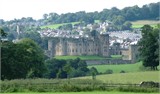
Alnwick Castle
My 16th great grandfather was born into a fancy Scottish family. Politics, diplomacy and treason were part of life in Scotland under King James III:
Robert Boyd (d.c.1470) Lord Boyd, was a Scottish Statesman.
A son of Sir Thomas Boyd (d. 1439), Robert Boyd belonged to an old distinguished family, of which one earlier Sir Robert Boyd, had fought with Sir William Wallace and Robert the Bruce.
Created Lord Boyd in 1454, he was one of the Regents during the minority of King James III, in 1460. He conspired with his brother, Sir Alexander Boyd, and obtained possession of the King’s person in 1466 and was made by Act of Parliament sole Governor of the Realm.
He negotiated the marraige between James and Margaret of Norway in 1469 and secured with it the cession of the Orkney Islands by Norway. He was appointed Great Chamberlain for life, and Lord Justice General in 1467.
Conflict broke out between the King and Boyd family. Robert, and his son Thomas Boyd, 1st Earl of Arran (who was married to Princess Mary), were out of the country involved in diplomatic activities when their regime was overthrown. Robert, 1st Lord Boyd was pronounced guilty of treason and fled firstly to Alnwick, Northumberland. His brother and assistant, Sir Alexander Boyd, was captured and beheaded on November 22, 1469.
Robert 1st Lord Boyd fought in the English service in the French wars, and died in exile.
He married Mariotta, daughter of Sir John Maxwell of Calderwood, and had numerous issue. One of his daughters, Elizabeth, married Archibald Douglas, 5th Earl of Angus.
Robert Boyd (1425 – 1470)
Lord Boyd conspired with his brother, Sir Alexander Boyd, and obtained possession of the young King’s person in 1466 and was made by Act of Parliament sole Governor of the Realm; and Great Chamberlain for life, and Lord Justice General in 1467.[4] Early in that year he procured the marriage of his eldest son, Thomas, (created Earl of Arran for that occasion) with Mary, elder sister of James III, which aroused the jealousy of the other nobles[1] and made his eventual downfall inevitable since the King regarded the marriage as an unforgivable insult.
Lord Boyd obtained the cession of the Orkney Islands to Scotland, 8 September 1468, from Christian I, King of Norway, for whose daughter Margaret, he negotiated a marriage with James III. While absent for that purpose he and his son Thomas (the Earl of Arran) and his brother (and coadjutor) Sir Alexander Boyd, were attainted for high treason, whereby his peerage became forfeited. He was living Easter 1480/1, and died before October 1482, it is said, at Alnwick in Northumberland where he had fled in 1469.[1]
James III’s biographer sums Boyd up as an unscrupulous political gambler and an inveterate optimist. To forcibly assume guardianship of an underage King was, indeed, a familiar path to power in mediaeval Scotland, but it was also a dangerous path. Boyd underestimated the dangers, overestimated his support, and made the fatal mistake of marrying his son to the King’s sister, an insult the King would not forgive.[5]
FamilyRobert Boyd belonged to an old and distinguished family, of which one earlier Sir Robert Boyd, had fought with Sir William Wallace and Robert The Bruce.[4] He was the son and heir of Sir Thomas Boyd of Kilmarnock (died 9 July 1439).[1] Robert married Mariot (or Janet), daughter of Sir Robert Maxwell of Calderwood. She died after 25 June 1472, apparently early in 1473.[1] They had three sons:[6]
[ edit] References
Attribution
 This article incorporates text from a publication now in the public domain: Chisholm, Hugh, ed. (1911). “Boyd, Robert Boyd”. Encyclopædia Britannica. 4 (11th ed.). Cambridge University Press. pp. 353,354. http://www.archive.org/stream/encyclopaediabri04chisrich#page/353/mode/1up. This article incorporates text from a publication now in the public domain: Cokayne, George Edward, ed. (1912). Complete peerage of England, Scotland, Ireland, Great Britain and the United Kingdom, extant, extinct or dormant (Bass to Canning). 2. London: The St. Catherine Press, ltd.. pp. 260,261. http://www.archive.org/details/completepeerageo02coka. This article incorporates text from a publication now in the public domain: Balfour, Paul, James (1904). The Scots peerage; founded on Wood’s edition of Sir Robert Douglas’s peerage of Scotland; containing an historical and genealogical account of the nobility of that kingdom. 5. Edinburgh: D. Douglas. pp. 145,146.
Peerage of ScotlandPre ceded byNew Creation Lord Boyd1454–1482Succeeded byJames Boyd
Indeed, you have blue blood.
LikeLike

got to love all the details you manage to ferret out of your geneaology!!
LikeLike

 mermaidcamp