mermaidcamp
Keeping current in wellness, in and out of the water
You can scroll the shelf using ← and → keys
You can scroll the shelf using ← and → keys


My study of poetry and the lives of poets has enlightened as well as encouraged me to continue my poetic practice. I also loved hearing the news about the secret manuscript discovered that was written by Harper Lee, famous reclusive author. The story of her one big hit, To Kill a Mockingbird, followed by a life out of the public eye entirely is compelling. She never spoke to press people, but her sister did. Now that her sister has died this old copy of a typewritten story was found in the safe deposit box attached to the original of the published novel. It is super romantic because her fans have hoped to make her write again, but she had done it even before they knew her work. Truly a blast from the past for all involved, the publication with cause all manner of excitement. It has captured my imagination about finding the writing of my ancestors in the safe deposit box of history.
I found a poem about writing that has a deeply funny sense of humor. Anne Bradstreet, my 9th great-grandmother, wrote a poem to her published book in which she describes the work as a child of hers. Although her work is usually pretty serious, this one strikes me as not only funny, but also prescient. The book of which she speaks made her a famous person in the history of poetry, but she is both humble and comical in her description of the work:
Thou ill-formed offspring of my feeble brain,
Who after birth did’st by my side remain,
Till snatcht from thence by friends, less wise than true,
Who thee abroad exposed to public view,
Made thee in rags, halting to th’ press to trudge,
Where errors were not lessened (all may judge).
At thy return my blushing was not small,
My rambling brat (in print) should mother call.
I cast thee by as one unfit for light,
The visage was so irksome in my sight,
Yet being mine own, at length affection would
Thy blemishes amend, if so I could.
I washed thy face, but more defects I saw,
And rubbing off a spot, still made a flaw.
I stretcht thy joints to make thee even feet,
Yet still thou run’st more hobbling than is meet.
In better dress to trim thee was my mind,
But nought save home-spun cloth, i’ th’ house I find.
In this array, ‘mongst vulgars may’st thou roam.
In critic’s hands, beware thou dost not come,
And take thy way where yet thou art not known.
If for thy father askt, say, thou hadst none;
And for thy mother, she alas is poor,
Which caused her thus to send thee out of door.

Anne Bradstreet’s poems
I really get the way she edits and finds more fault. She calls her book a bastard and herself poverty stricken, which I think she knows is a joke. She warns it to stay away from critics, then lets it go. By animating the book to human stature she paints a picture of an underprivileged child, some awkward and unpolished brat. At the publication (return) her blushing was not small. She was proud to be published, and yet as a Pilgrim could take no personal credit for the art. This has become my favorite work by Mistress Bradstreet because I clearly relate to her sense of comedy. In 1678 some of her work was published posthumously. She was, in a certain sense, a feminist. Now we learn she was also something of a comic, concerned about the cosmic.
Birth: 1612 Death: Sep. 16, 1672 Poet.
Born Anne Dudley to nonconformist parents Thomas Dudley and Dorothy Yorke Dudley in Northampton, England. Her father was the steward for the Earl of Lincoln and afforded his daughter an unusually complete education. About 1620 she married Simon Bradstreet, her father’s assistant. On March 29, 1630, Bradstreet and her family sailed for the New World. After several years, they finally settled on a farm in North Andover, Massachusetts in 1644. Simon Bradstreet became a judge, royal councilor, and twice a governor of the colony. Anne Bradstreet became mother to eight children and wrote only privately. She was frequently ill and apparently developed a vaguely morbid mind set and was continually distressed by the culturally ingrained condescension toward women. Her first public work may well have been the epitaph she penned for her mother in 1643. Four years later, her brother-in-law carried a collection of her poems with him to England where he had them published. They appeared as ‘The Tenth Muse Lately Sprung Up in America, By a Gentlewoman of Those Parts’ in the New World in 1650. While it did sell in England, the volume was not well received in Massachusetts. Although she continued to write for herself and her family, no more of her work was published in her lifetime. She was purportedly buried in the Old Burying Point in Salem, Massachusetts beside her husband, though other locations for her grave have also been proposed. In 1678 her ‘Several Poems Compiled with Great Variety of Wit and Learning’ was posthumously published followed by ‘The Works of Anne Bradstreet in Prose and Verse.’ She is now considered the earliest of American poets and among the finest of her age. (bio by: Iola)
Now that Anne is a little bit funny she is a better poetry muse to me. Dorothy Parker, as my muse, as nixed the whole #Trwurse and #Twessings concept. She did wonderful intricate play on words before twitter and is not at all amused by the substitution of tw to indicate twitter being witty. She is right, of course. Nursing mothers are already occupying the #Twursing hashtag, as is the PGA. Back to the word board, sans #tw. I still like the blessings and curses for twitter, but am now inclined to call them just that. I have also realized that February is the perfect time to write short and funny rhymes..on Valentines. I feel okay about breaking out of my impersonal poetic rut because I have written a food poem and one Valentine that are in new territory. I have not said anything very funny yet, but think I will sometime soon. I aspire to write jokes that would be understood hundreds of years into the future, in case they are discovered, but still be funny now. Contrived twitter words will not be funny enough to last hundreds of years, but will seem like Olde English does to us now. Best to go for eternal when crafting a joke or a pun….

ROW80

Joan Fitzalan
My 18th paternal great-grandmother is also the ancestor of my famous poet, Anne Dudley Bradstreet. Her father was beheaded at the Tower of London by Richard II. I wonder if I have a record number of ancestors beheaded at the Tower. When Henry IV came to the throne Joan and her sisters were restored to wealth and power. Her sister Elizabeth is my mother’s ancestor, so this cozy castle was once home to both my bloodlines:

Arundel Castle
Joan Fitzalan (1360 – 1435)
is my 18th great grandmother
Joan Elizabeth Beauchamp (1396 – 1430)
daughter of Joan Fitzalan
Elizabeth Butler (1420 – 1473)
daughter of Joan Elizabeth Beauchamp
Isabel Talbot (1444 – 1531)
daughter of Elizabeth Butler
Sir Richard Ashton (1460 – 1549)
son of Isabel Talbot
Sir Christopher Ashton (1493 – 1519)
son of Sir Richard Ashton
Lady Elizabeth Ashton (1524 – 1588)
daughter of Sir Christopher Ashton
Capt Roger Dudley (1535 – 1585)
son of Lady Elizabeth Ashton
Gov Thomas Dudley (1576 – 1653)
son of Capt Roger Dudley
Anne Dudley (1612 – 1672)
daughter of Gov Thomas Dudley
John Bradstreet (1652 – 1718)
son of Anne Dudley
Mercy Bradstreet (1689 – 1725)
daughter of John Bradstreet
Caleb Hazen (1720 – 1777)
son of Mercy Bradstreet
Mercy Hazen (1747 – 1819)
daughter of Caleb Hazen
Martha Mead (1784 – 1860)
daughter of Mercy Hazen
Abner Morse (1808 – 1838)
son of Martha Mead
Daniel Rowland Morse (1838 – 1910)
son of Abner Morse
Jason A Morse (1862 – 1932)
son of Daniel Rowland Morse
Ernest Abner Morse (1890 – 1965)
son of Jason A Morse
Richard Arden Morse (1920 – 2004)
son of Ernest Abner Morse
Pamela Morse
I am the daughter of Richard Arden Morse
Joan FitzAlan, Baroness Bergavenny (1375 – 14 November 1435) was an English noblewoman, and the wife of William de Beauchamp, 1st Baron Bergavenny of the Welsh Marches.
Family and Lineage
Lady Joan FitzAlan was born in 1375, at Arundel Castle, Sussex, England, one of the seven children of Richard Fitzalan, 11th Earl of Arundel, Earl of Surrey, and his first wife Elizabeth de Bohun. Her only surviving brother was Thomas Fitzalan, 12th Earl of Arundel, of whom Joan was his co-heiress. She had an older sister Lady Elizabeth FitzAlan who married as her second husband Thomas Mowbray, 1st Duke of Norfolk. Her paternal grandparents were Richard Fitzalan, 10th Earl of Arundel and Eleanor of Lancaster, and her maternal grandparents were William de Bohun, 1st Earl of Northampton and Elizabeth de Badlesmere. On 3 April 1385, her mother died. Joan was about ten years old. Her father married secondly, Philippa Mortimer on 15 August 1390, by whom he had a son, John Fitzalan, who was born in 1394. John died sometime after 1397.
On 21 September 1397, Joan’s father, the Earl of Arundel, who was also one of the Lords Appellant, was beheaded on Tower Hill, London, on charges of high treason against King Richard II of England. The Earl had always enjoyed much popularity with the citizens of London. His titles and estates were forfeited to the Crown.
In October 1400, the new king Henry IV who had ascended the throne following Richard’s deposition in 1399, restored the titles and estates to Thomas Fitzalan, Joan’s brother. He became the 12th Earl of Arundel and Earl of Surrey. Although he married Beatrice, an illegitimate daughter of King John I of Portugal and Inez Perez Esteves, he died childless on 13 October 1415. The Earldom and castle of Arundel passed to a cousin John Fitzalan, 13th Earl of Arundel, the rest of his inheritance was divided among Joan and her two surviving sisters, Elizabeth and Margaret.
Marriage and Issue
On 23 July 1392, Joan was married to William de Beauchamp, 1st Baron Bergavenny (c.1344- 8 May 1411) the son of Thomas de Beauchamp, 11th Earl of Warwick and Katherine Mortimer. He was more than thirty years Joan’s senior.
The marriage produced a son and a daughter:
· Richard de Beauchamp, 1st Earl of Worcester, 2nd Baron Bergavenny (born before 1397- 1422), married Isabel le Despenser, daughter of Thomas le Despenser, 1st Earl of Gloucester and Constance of York, by whom he had one daughter Elizabeth de Beauchamp, Lady of Abergavenny.
· Joan de Beauchamp (1396- 3 August 1430), married on 28 August 1413 James Butler, 4th Earl of Ormond, son of James Butler, 3rd Earl of Ormond and Anne Welles, by whom she had five children, including Thomas Butler, 7th Earl of Ormond. Anne Boleyn and Mary Boleyn were notable descendants.
Joan FitzAlan died on 14 November 1435, at the age of sixty. She was buried in Black Friars, Hereford.
References
Charles Cawley,Medieval Lands, Earls of Arundel 1289–1580 (Fitzalan).
Thomas B. Costain,The Last Plantagenets, pages 196–201
thePeerage.com
Charles Cawley,Medieval Lands, Earls of Arundel 1289- 1580 (Fitzalan)

Lady Elizabeth Fitzalan, Duchess of Norfolk
Elizabeth Fitzalan as well as her sister Joan are both my ancestors, on maternal and paternal sides of my family. Elizabeth is my mother’s ancestor. She had a remarkable life, outliving 4 husbands. She is probably buried in an alabaster tomb in the church in village of Hoveringham, England with my 17th great-grandfather who died in battle. She married him without a license, which angered the king.
I am lucky that Bruce Morrison is her descendant also. He has devoted time and study to give us many details about her life. Here is his research:
FOREWORD: The early 15th century alabaster tomb and effigies of Sir Robert Goushill and his wife Elizabeth Fitz-Alan Duchess of Norfolk are found at the parish church of the village of Hoveringham in Nottinghamshire, England. The tomb is located just to the right as you enter the church. The original medieval St. Michael church at Hoveringham was razed in 1865, and the present plain, small brick church was erected in it’s place. The above copyright photographs were taken during a visit to Hoveringham in 1991 by Bruce Morrison of Lexington, Kentucky, a descendant of Robert Goushill and Elizabeth Fitz-Alan. (I do not have Bruce’s photos)
THE TOMB & EFFIGIES: The effigies show effects of earlier vandalism and mutilation incurred during earlier centuries. The right arms of both effigies are broken and missing–they originally were holding hands. Some damage also occured when the monumemt was relocated when the present church was erected. The figures are of alabaster with Sir Robert Goushill shown wearing a camail and hawberk and plate armor on his arms and legs. His feet rest upon the figure of a dog, and his collar shows the badge of his Lancastrian loyalty. He wears a Bacinet on his head with a wreath which rests on a crowned Saracen’s head. The Saracen’s head was derived from the Goushill family crest. The Goushill of Hoveringham coat of arms was a barry of six or and gules with a canton ermine. The figure of Elizabeth Fitz-Alan is shown wearing a peeress gown with a coronet on her head emblematic of her rank as a duchess. The tomb was created after Sir Robert Goushill’s tragic death in 1403, probably by the design of his widow Elizabeth Fitz-Alan who lived to 1425. It is likely that she was also buried in the tomb, but no definitive proof or evidence exists. Robert Thoroton’s description of the tomb in the 17th century states that about the fair tomb were the arms of Leek, Longford, Babington, Chaworth impaling Caltofts, Remptons, and divers others. These are long lost as well as the tomb of Sir Nicholas Goushill, the son of Sir Thomas Goushill, who died in 1393. This stone was in the south isle of the original St. Michael Church. The lower base portion of the Goushill Fitz-Alan tomb is decorated by a series of shields on all sides which were probably the location of the large number of now lost coats of arms described in Thoroton’s History.
ROBERT GOUSHILL: Sir Robet Goushill was knighted by King Henry IV at the battle of Shrewsbury on July 21,1403. At the Battle of Shrewsbury the loyalist forces of Henry IV were opposed by the rebel army of Henry Percy (Hotspur). The army of King Henry IV won the day with the killing of Hotspur during the conflict. Casulties on both sides were high with estimates of 3000 killed or wounded on each side. Sir Robert Goushill was knighted the day of the battle for his gallantry, but was badly wounded in the side. Found lying wounded by his servant on the eve of the battle, Goushill asked that his armor be removed and a note sent to his wife Elizabeth in case of his death. The servant then stabbed and murdered Sir Robert Goushill and made off with his purse and ring. Another wounded man lying nearby recognized the servant, and he was later caught and hanged for the crime. The arms of Sir Robert Goushill would be placed in the Shrewsbury Battlefield Church by King Henry IV.
Robert Goushill was the son and heir of Sir Nicholas Goushill of Hoveringham. The date of his birth is unknown, but can be estimated to be circa 1360-1365. Likewise, the name of his mother also remains unknown. The Goushill family had held extensive lands in Nottinghamshire and Derbyshire since the 13th century. Walter Goushill, an early ancestor in the direct line, gained a number of these considerable holdings for the Goushills through his marriage to Maud (Matilda) Hathersage, the co-heiress of Mathew Hathersage in Derbyshire. (The early pedigree of the Goushill family of Hoveringham can be found in the History of Nottinghamshire by Dr. Robert Thoroton). In the calendar of patent rolls of Richard II on March 12, 1386, the King orders the arrest of Sir Nicholas Goushill the elder and his son Robert Goushill to answer the suit brought by William Birkes accusing the Goushills of threatning him with the loss of life and limb that he dare go about his business. On July 16, 1385, Sir Nicholas Goushill received the King’s pardon. During 1387, Nicholas Goushill knight of Hoveringham and his son Robert Goushill are found in the chancery records to owe a debt of 22 pounds to Robert Wells of London. The next mention of Robert Goushill occurs in 1390 when he receives the King’s pardon for alleged outlawry and other felonies through the supplication of Thomas Mowbray. Thomas Mowbray was at that time Earl of Nottingham and later would become the Duke of Norfolk. This evidences that Robert Goushill was already a supporter of Thomas Mowbray of whom he would be an employee of for the next decade. Elizabeth Fitz-Alan, the future wife of Robert Goushill, had been the wife of Mowbray since 1384.
During the 1390’s, Robert Goushill would be in the retinue of Thomas Mowbray, Earl of Nottingham, Marshal of England, and Duke of Norfolk, serving as Mowbray’s esquire and attorney. When Thomas Mowbray received his ducal elevation in 1397, he gave to his esquire Robert Goushill a 20 pound annuity for life from his manor at Willington. This grant was confirmed by Henry IV in November of 1399. In 1398, after the Duke of Norfolk was banished by Richard II, Robert Goushill was appointed one of the attorneys for Mowbray. At the coronation of King Edward IV on October 13, 1399, Robert Goushill would make a plea for the return of the banished Duke of Norfolk as Earl Marshall, not knowing Mowbray had already died of the plague in Venice, Italy on September 22, 1399. In the mid 1390’s, Robert Goushill had married as a first wife Joan Bracebrugge, who was the widow of Sir Ralph Bracebrugge of Kingsbury, Warwickshire. Joan (maiden name unknown) had married Ralph Bracebrugge in 1380 and his death occured in August, 1395. The marriage of Robert Goushill and Joan Bracebrugge likely was in 1396, and Joan would die early in the year 1400. (IPM Henry IV, 1-6). In 1397 Richard II appointed Sir William Bagot and Robert Goushill to seize into his hands the goods and chattels of Thomas the late Earl of Warwick. (Goushill served as Warwickshire sheriff in 1396/97). After Richard II was deposed, the new King Henry IV made a grant on Feb. 23, 1400 to his kinswoman Elizabeth, the wife of the late Duke of Norfolk, of the remaining goods of the late Duke as well as clearing the debts that the Duke had owed to the deposed Richard II. Others to share in the remaining goods of the deceased Duke of Norfolk included Robert Goushill.
Robert Goushill would marry the widowed Elizabeth Fitz-Alan, Duchess of Norfolk, in the latter part of 1400 or early 1401 without license. On August 19, 1401, King Henry IV seized the lands of Elizabeth, late widow of Thomas Mowbray, for marrying Robert Goushill without license. On September 28, 1401, Henry IV would pardon Robert Goushill esquire and Elizabeth, late wife of Thomas, duke of Norfolk, for their trespass for inter-marrying without license and that they shall have restitution of all lands assigned to her in dower with the issues from the time of their marriage. Joan Goushill, the 1st daughter of Robert and Elizabeth, would be born in 1401, and a 2nd daughter Elizabeth Goushill would be born in 1402. Many present day descendants of these two daughters trace their ancestry to the Plantagenet Kings of England through Joan Goushill who married Sir Thomas Stanley, 1st Baron Stanley, and Elizabeth Goushill who married Sir Robert Wingfield of Letheringham, Suffolk. (My own descent is through the Goushill-Wingfield marriage). A 3rd daughter named Joyce is now credited to Robert and Elizabeth. She was found in a 1407 lawsuit being named after older daughters Joan and Elizabeth. As she is not named in Robert Goushill’s Inq. Post Mortum of 1403, she would certainly seem to have been born after Robert Goushill’s death. No futher trace of Joyce Goushill has been found. After the tragic death of Sir Robert Goushill at the battle of Shrewsbury on July 21, 1403, his Inquisition Post Mortum was held August 6, 1403. His heirs are given as his daughters Joan and Elizabeth, aged two years and one year respectively. A final thought regarding the pedigree of the Goushill family of Hoveringham as given by Thoroton: the pedigree lists the Sir Nicholas Goushill dying in 1393 as the grandfather of Robert Goushill and Robert’s father as another Nicholas Goushill. This 2nd Nicholas Goushill listed in the pedigree was very likely confused with the Sir Nicholas Goushill of Barlborough, Derbyshire who was also at the battle of Shrewsbury. He was certainly a relative and contemporary of Robert Goushill and either brother or first cousin, but not his father. The first 1380’s records that mention Robert Goushill appear with Sir Nicholas Goushill the ELDER given as the father of Robert Goushill. I believe the evidence stongly suggests that the father of Robert Goushill was the Sir Nicholas Goushill who died in 1393 and was buried at St. Michael’s church Hoveringham.
ELIZABETH FITZ-ALAN: Elizabeth was the eldest daughter of Richard Fitz-Alan the 11th Earl of Arundel and his wife Elizabeth de Bohun. Both the Fitz-Alan and Bohun family lines were among the highest in the peerage of medieval England. Elizabeth Fitz-Alan had a double line of direct descent from the Plantagenet Kings of England. Through her mother’s Bohun line she was a direct descendant of King Edward I and Eleanor of Castile, and through her Fitz-Alan ancestry a direct descendant of King Henry III and Eleanor of Provence. She was also related by cousinship to both King Henry IV and to his first wife Mary Bohun. Elizabeth was born before 1372, (in 1415 she was given as aged 40 or more), and a best estimate would be closer to 1367. By December of 1378 she would be married to her first husband William de Montagu, son of the Earl of Salisbury. This marriage for Elizabeth would certainly have been in her childhood. William de Montagu was killed in a tilting match at Windsor in 1382. Elizabeth Fitz-Alan would marry as her 2nd husband Thomas Mowbray, the Earl of Nottingham and later the Duke of Norfolk, in July of 1384. This marriage would last for 15 years until Thomas Mowbray’s death in Venice on September 22, 1399. Elizabeth would have 2 sons and 2 daughters during her marriage with Thomas Mowbray. The sons were Thomas Mowbray 1385-1405 and John Mowbray 1390-1432, (both of these sons would assume the title Earl of Nottingham), the 2 daughters were Margaret who married Sir Robert Howard, and Isabel who married Henry Ferrers. In 1397 Thomas Mowbray was among those who accused and condemed Elizabeth’s father Richard Fitz-Alan, the Earl of Arundel. Richard Fitz-Alan was found guilty of treason and be-headed at Cheapside on September 21, 1397. One apocryphal rumor even had Thomas Mowbray as the actual executioner of his father-in-law Richard Fitz-Alan. The now twice widowed Duchess of Norfolk would next marry Sir Robert Goushill as previously discussed in length. After the death of Sir Robert Goushill at Shrewsbury in 1403, she would marry Sir Gerald Usflete of Yorkshire as her fourth husband before April 18, 1411. Sir Gerald Usflete was the steward of the Duchy of Lancaster in Lincolnshire. Elizabeth Fitz-Alan would become a co-heiress of her brother Thomas, Earl of Arundel and Surrey, in 1415. (Thomas had died sans progeny on October 13, 1415, and his sisters had become his heirs). Sir Gerald Usflete died by Feb. 1420/21, having written his will on September 13, 1420. No children were born to Elizabeth Fitz-Alan and Gerald Usflete.
Bruce Morrison is a professor emeritus of the University of Kentucky and lives in Lexington, Ky. He and his wife Barbara have been engaged in genealogical research since 1985, and have published a number of genealogy and biographical web sites in recent years. The photographs of the Hoveringham tomb were taken in May of 1991 during one of several genealogy related trips to Europe between 1985 and 2008. It is hoped that this site will be of interest to all of the many Goushill-Fitz-Alan descendants.
•Bruce & Barbara Morrison
•3488 Elmendorf Way
•Lexington, Ky. USA 40517
•859-272-4192
•© 2008
Elizabeth Duchess Norfolk Fitzalan (1366 – 1425)
is my 17th great grandmother
Lady Joan De Goushill Baroness Stanley (1402 – 1459)
daughter of Elizabeth Duchess Norfolk Fitzalan
Countess Elizabeth Sefton Stanley (1429 – 1459)
daughter of Lady Joan De Goushill Baroness Stanley
Thomas Sir 8th Earl of Sefton Molyneux (1445 – 1483)
son of Countess Elizabeth Sefton Stanley
Lawrence Castellan of Liverpool Mollenaux (1490 – 1550)
son of Thomas Sir 8th Earl of Sefton Molyneux
John Mollenax (1542 – 1583)
son of Lawrence Castellan of Liverpool Mollenaux
Mary Mollenax (1559 – 1598)
daughter of John Mollenax
Gabriell Francis Holland (1596 – 1660)
son of Mary Mollenax
John Holland (1628 – 1710)
son of Gabriell Francis Holland
Mary Elizabeth Holland (1620 – 1681)
daughter of John Holland
Richard Dearden (1645 – 1747)
son of Mary Elizabeth Holland
George Dearden (1705 – 1749)
son of Richard Dearden
George Darden (1734 – 1807)
son of George Dearden
David Darden (1770 – 1820)
son of George Darden
Minerva Truly Darden (1806 – 1837)
daughter of David Darden
Sarah E Hughes (1829 – 1911)
daughter of Minerva Truly Darden
Lucinda Jane Armer (1847 – 1939)
daughter of Sarah E Hughes
George Harvey Taylor (1884 – 1941)
son of Lucinda Jane Armer
Ruby Lee Taylor (1922 – 2008)
daughter of George Harvey Taylor
Pamela Morse
I am the daughter of Ruby Lee Taylor
ROW80
By joining the Round of Words in 80 Days writers I have been given the opportunity to peek into the process used by different people. Initially revealing goals, and now following the theme for 80 days of pursuit of those goals, we let each other know how our lives are proceeding. Some have chosen more personal ideals, and others are achieving astonishing numbers of words/outlines/rewrites and characters developed. I am impressed with all of the participants, and have started to think more about character development. I have not done this, but am now seeing the merit of telling stories of well-developed characters. From fairy tales to murder mysteries the characters hold our attention, and in some cases can bring about new stories or a series of tales. I live tweeted Downton Abbey last week and find it highly amusing to see how emotional the audience is about the characters. I also noticed that my own poetry is void of any characters. I make it all about the cosmos, memory, psyche, all very general and without personality. I need to work on this aspect of my poems.
There are three levels of character development I can identify in this challenge:
These three have all been at work in my life this week. I have been reading about Dorothy Parker, her life and times. Her character has been made larger than life since the internet. It dawned on me that Mrs Parker was a feminist in the early 20th century. She was a contemporary of my grandmother Olga, who got a masters in education and taught shorthand and typing. I was thinking about how odd it must have been to have no vote and be better educated than your husband. I wondered if Olga read Dorothy in Vanity Fair. I still prefer Mrs. Parker as my muse in poetry, but I must admit my grandmother was a feminist in a different part of the country. They were both strong characters, but I have real memories of Olga. I did write a poem about my grandmother, although it is short and sweet. This whole process has brought me to think it is very wise for me to use these characters in my family tree about whom I know so much. They inhabit my dreams and imagination, so I might as well use them as characters in my poems. I have written plenty about the facts in their lives, but I could focus on a more essential theme.
I gave myself two poetry days off this week, which I regret. I took a birthday holiday. This aspect goes back to number one on the list above, discipline and character. It is actually pleasurable to write a poem each day. The mindset that tells me I deserve a day off from this grueling task is quite bogus. I don’t plan to make up in penance for the lapse, or enhance guilt over this. I do notice that some silly side of my psyche wants to claim that poetry is hard and working on it is, oh my, such a burden on my important schedule. This is obviously rubbish made by some shadow character. I reject the claims of this looser. That character will not be developed. I will write about this poetic couple on the left in the photo below:

My grandparents on a double date
ROW80
I have managed to slip out of my creativity rut, just a bit. I admire the way so many writers in this program work on several books or projects at once. I rarely start a post that I do not finish in a day, so this longer attention span on a written piece is intriguing. I heard an interview on PBS radio with a professor of creative writing. He shall remain nameless, in part because I do not remember his name. He described two distinct ways of working on a story. He starts by just grinding out the words, and later in the day he edits them. He says the later session in which he edits can be relaxing and easy. I see this advice as a basic guide for me to expand my ability to tackle different subjects and new kinds of forms. I not only need to just do it, as they say at Nike. I also need to just edit it. I have written poetry this week that is not all about soul and butterflies, so that is a start. I spun a little story into a poem about real life. This is something I might try with matching prose and poetry posts. Starting with beheading was just too tricky, but I did relate to my grandmother’s craft work and extreme busy-ness with a short tribute. I still reserve judgement because I have not been doing this for very long.
Two goals are eluding me, but I think I can find ways to accomplish them. I want to be loyal to my dream journal by writing before I get out of bed, or even stir. This worked well for a while, but during the last week my dog, who has end of life issues, needed me to let her out during the night 4 or 5 times, including first thing in the morning. I can keep a little bit of the memory while I walk down the stairs and give her the relief she needs, but it is difficult. I have tried to capture specific words and colors from dreams to inspire the poems. I am sad about the kidney failure of my darling dog, so a certain sorrow takes over as soon as I think about how often she needs to go and how much water she is drinking. She has had a good life, and is not in pain, but this is a shadow covering the early morning dream memory. Maybe I need to write about my dog. I have also failed to physically visit the U of A Poetry Center. I keep planning to dedicate Friday to Venus, to revere all things of beauty and love. I think sitting around the Poetry Center reading is a total dedication to beauty, but my daily routine has not capitulated enough to allow this to occur. I will overcome, although maybe not on a Friday. I know that once I establish a habit, a ritual, I will enjoy it. I do love the podcasts and the apps that read to me in the comfort of my home, but I believe the pilgrimage to the poets’ place will change my perspective. I am not taking these failures too much to heart because the whole point was to write poems, and I am doing that. Onward and upward..
I am chiming in one day later than some because yesterday I made a stunning discovery in my family tree. I do think that since many of my real family members have been the subjects of fiction and even operas and poems, I should look more closely at making stories based on fact, or even on imagination. These characters are already alive in my thoughts and dreams and do some predictable stuff. I enjoy all the time I spend learning about the family facts and the supporting evidence. I notice that fiction writers develop their characters out of thin air, perhaps with a culture or time in history in mind. I can start with facts and the skeleton of what is known to make my stories real. I can also write about my dog and stop whining about my precious dream journal. Soon enough she will be only in my dreams. Now is my chance to see her in real life and help her with her dreams.
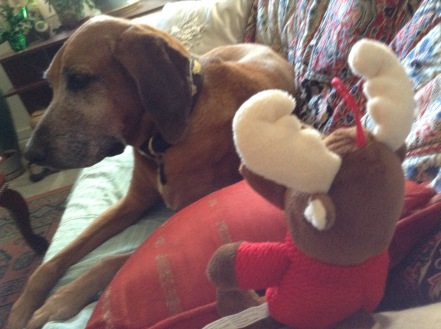
Artemisia the wonder hound
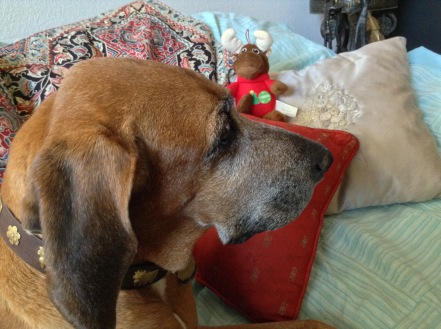
Artemisia the wonder hound


My 27th great-grandfather is buried in a very famous church. I have been inside this church, but was completely unaware that there were graves of other people at the Church of the Holy Sepulchre in Jerusalem. Orthodox religions say that Jesus of Nazareth was buried here, and arose from the dead in this location. Protestant churches have another site for their resurrection, which is outside of the city. My ancestor was there in the capacity of King of Jerusalem. Since he was knight from France the idea seems preposterous, but the history of the Crusades and the people who created them is a wild and crazy story. After Fulk’s wife died he hit the road for the Holy Land because it was totally the thing to do for rich Euros at the time. He found fame and fortune through his wife, whom he did not defy. She ruled and he did her bidding, as it was reported. He died in a hunting accident on holiday, which does sound normal for a Euro monarch.
Count of Anjou
Fulk was born in Angers between 1089 and 1092, the son of Count Fulk IV of Anjou and Bertrade de Montfort. In 1092, Bertrade deserted her husband and bigamously married King Philip I of France.
He became count of Anjou upon his father’s death in 1109. In the next year, he married Erembourg of Maine, cementing Angevin control over the County of Maine.
He was originally an opponent of King Henry I of England and a supporter of King Louis VI of France, but in 1118 or 1119 he had allied with Henry when Henry arranged for his son and heir William Adelin to marry Fulk’s daughter Matilda. Fulk went on crusade in 1119 or 1120, and became attached to the Knights Templar. (Orderic Vitalis) He returned, late in 1121, after which he began to subsidize the Templars, maintaining two knights in the Holy Land for a year. Much later, Henry arranged for his daughter Matilda to marry Fulk’s son Geoffrey of Anjou, which she did in 1127 or 1128.
Crusader and King
By 1127 Fulk was preparing to return to Anjou when he received an embassy from King Baldwin II of Jerusalem. Baldwin II had no male heirs but had already designated his daughter Melisende to succeed him. Baldwin II wanted to safeguard his daughter’s inheritance by marrying her to a powerful lord. Fulk was a wealthy crusader and experienced military commander, and a widower. His experience in the field would prove invaluable in a frontier state always in the grip of war.
However, Fulk held out for better terms than mere consort of the Queen; he wanted to be king alongside Melisende. Baldwin II, reflecting on Fulk’s fortune and military exploits, acquiesced. Fulk abdicated his county seat of Anjou to his son Geoffrey and left for Jerusalem, where he married Melisende on 2 June 1129. Later Baldwin II bolstered Melisende’s position in the kingdom by making her sole guardian of her son by Fulk, Baldwin III, born in 1130.
Fulk and Melisende became joint rulers of Jerusalem in 1131 with Baldwin II’s death. From the start Fulk assumed sole control of the government, excluding Melisende altogether. He favored fellow countrymen from Anjou to the native nobility. The other crusader states to the north feared that Fulk would attempt to impose the suzerainty of Jerusalem over them, as Baldwin II had done; but as Fulk was far less powerful than his deceased father-in-law, the northern states rejected his authority. Melisende’s sister Alice of Antioch, exiled from the Principality by Baldwin II, took control of Antioch once more after the death of her father. She allied with Pons of Tripoli and Joscelin II of Edessa to prevent Fulk from marching north in 1132; Fulk and Pons fought a brief battle before peace was made and Alice was exiled again.
In Jerusalem as well, Fulk was resented by the second generation of Jerusalem Christians who had grown up there since the First Crusade. These “natives” focused on Melisende’s cousin, the popular Hugh II of Le Puiset, count of Jaffa, who was devotedly loyal to the Queen. Fulk saw Hugh as a rival, and it did not help matters when Hugh’s own stepson accused him of disloyalty. In 1134, in order to expose Hugh, Fulk accused him of infidelity with Melisende. Hugh rebelled in protest. Hugh secured himself to Jaffa, and allied himself with the Muslims of Ascalon. He was able to defeat the army set against him by Fulk, but this situation could not hold. The Patriarch interceded in the conflict, perhaps at the behest of Melisende. Fulk agreed to peace and Hugh was exiled from the kingdom for three years, a lenient sentence.
However, an assassination attempt was made against Hugh. Fulk, or his supporters, were commonly believed responsible, though direct proof never surfaced. The scandal was all that was needed for the queen’s party to take over the government in what amounted to a palace coup. Author and historian Bernard Hamilton wrote that the Fulk’s supporters “went in terror of their lives” in the palace. Contemporary author and historian William of Tyre wrote of Fulk “he never attempted to take the initiative, even in trivial matters, without (Melisende’s) consent”. The result was that Melisende held direct and unquestioned control over the government from 1136 onwards. Sometime before 1136 Fulk reconciled with his wife, and a second son, Amalric was born.
Securing the borders
Jerusalem’s northern border was of great concern. Fulk had been appointed regent of the Principality of Antioch by Baldwin II. As regent he had Raymund of Poitou marry the infant Constance of Antioch, daughter of Bohemund II and Alice of Antioch, and niece to Melisende. However, the greatest concern during Fulk’s reign was the rise of Atabeg Zengi of Mosul.
In 1137 Fulk was defeated in battle near Barin but allied with Mu’in ad-Din Unur, the vizier of Damascus. Damascus was also threatened by Zengi. Fulk captured the fort of Banias, to the north of Lake Tiberias and thus secured the northern frontier.
Fulk also strengthened the kingdom’s southern border. His butler Paganus built the fortress of Kerak to the south of the Dead Sea, and to help give the kingdom access to the Red Sea, Fulk had Blanche Garde, Ibelin, and other forts built in the south-west to overpower the Egyptian fortress at Ascalon. This city was a base from which the Egyptian Fatimids launched frequent raids on the Kingdom of Jerusalem and Fulk sought to neutralise this threat.
In 1137 and 1142, Byzantine emperor John II Comnenus arrived in Syria attempting to impose Byzantine control over the crusader states. John’s arrival was ignored by Fulk, who declined an invitation to meet the emperor in Jerusalem.
Death
In 1143, while the king and queen were on holiday in Acre, Fulk was killed in a hunting accident. His horse stumbled, fell, and Fulk’s skull was crushed by the saddle, “and his brains gushed forth from both ears and nostrils”, as William of Tyre describes. He was carried back to Acre, where he lay unconscious for three days before he died. He was buried in the Church of the Holy Sepulchre in Jerusalem. Though their marriage started in conflict, Melisende mourned for him privately as well as publicly. Fulk was survived by his son Geoffrey of Anjou by his first wife, and Baldwin III and Amalric I by Melisende.
Depictions
According to William, Fulk was “a ruddy man, like David… faithful and gentle, affable and kind… an experienced warrior full of patience and wisdom in military affairs.” His chief fault was an inability to remember names and faces.
William of Tyre described Fulk as a capable soldier and able politician, but observed that Fulk did not adequately attend to the defense of the crusader states to the north. Ibn al-Qalanisi (who calls him al-Kund Anjur, an Arabic rendering of “Count of Anjou”) says that “he was not sound in his judgment nor was he successful in his administration.” The Zengids continued their march on the crusader states, culminating in the fall of the County of Edessa in 1144, which led to the Second Crusade (see Siege of Edessa).
Family
In 1110, Fulk married Ermengarde of Maine (died 1126), the daughter of Elias I of Maine. Their four children were:
Geoffrey V of Anjou (1113–1151, father of Henry II of England.
Sibylla of Anjou (1112–1165, Bethlehem), married in 1123 William Clito (div. 1124), married in 1134 Thierry, Count of Flanders.
Alice (or Isabella) (1111–1154, Fontevrault), married William Adelin; after his death in the White Ship she became a nun and later Abbess of Fontevrault.
Elias II of Maine (died 1151)
His second wife was Melisende, Queen of Jerusalem
Baldwin III of Jerusalem
Amalric I of Jerusalem

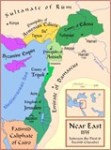

Fulk V The Younger King of Jerusalem Anjou * (1092 – 1143)
is my 27th great grandfather
Sibilla Anjou (1105 – 1165)
daughter of FULK V The Younger King of Jerusalem ANJOU *
Marguerite De LORRAINE (1135 – 1194)
daughter of Sibilla Anjou
Isabelle De Hainault (1170 – 1190)
daughter of Marguerite De LORRAINE
Louis VIII France (1187 – 1226)
son of Isabelle De Hainault
Charles I King of Jerusalem and Naples (1227 – 1285)
son of Louis VIII France
Charles NAPLES (1254 – 1309)
son of Charles I King of Jerusalem and Naples
Marguerite Sicily Naples (1273 – 1299)
daughter of Charles NAPLES
Jeanne DeVALOIS (1294 – 1342)
daughter of Marguerite Sicily Naples
Philippa deHainault (1311 – 1369)
daughter of Jeanne DeVALOIS
John of Gaunt – Duke of Lancaster – Plantagenet (1340 – 1399)
son of Philippa deHainault
Elizabeth Plantagenet (1363 – 1425)
daughter of John of Gaunt – Duke of Lancaster – Plantagenet
John Holland (1395 – 1447)
son of Elizabeth Plantagenet
Henry Holland (1430 – 1475)
son of John Holland
Henry Holland (1485 – 1561)
son of Henry Holland
Henry Holland (1527 – 1561)
son of Henry Holland
John Holland (1556 – 1628)
son of Henry Holland
Gabriell Francis Holland (1596 – 1660)
son of John Holland
John Holland (1628 – 1710)
son of Gabriell Francis Holland
Mary Elizabeth Holland (1620 – 1681)
daughter of John Holland
Richard Dearden (1645 – 1747)
son of Mary Elizabeth Holland
George Dearden (1705 – 1749)
son of Richard Dearden
George Darden (1734 – 1807)
son of George Dearden
David Darden (1770 – 1820)
son of George Darden
Minerva Truly Darden (1806 – 1837)
daughter of David Darden
Sarah E Hughes (1829 – 1911)
daughter of Minerva Truly Darden
Lucinda Jane Armer (1847 – 1939)
daughter of Sarah E Hughes
George Harvey Taylor (1884 – 1941)
son of Lucinda Jane Armer
Ruby Lee Taylor (1922 – 2008)
daughter of George Harvey Taylor
Pamela Morse
I am the daughter of Ruby Lee Taylor

marries Queen of Jerusalem
Today our teleporting cloaks will be hung in the cloak room of the spacious light filled Museum of Modern Art in New York City. I want to go to this cafe for our weekend chat because it is the perfect place to ponder modernism. After some time with the art let us gather to talk over coffee and a snack. I like to stay at museums much longer than most people. Taking a break for social time and tasty treats gives me a second wind to examine more of the collections. Surrounded by what is considered to be modern art we are also surrounded by the city of New York. The stately gothic St Patrick’s Cathedral is right around the corner, a few blocks down Fifth Avenue. In the museum light is abundant, structure is open. The design of the building brings us into connection with nature and the sculpture garden patio. In St. Patrick’s the light is all filtered through ornate, colorful stained glass. It has a very blue feeling from the window placement. The gothic ceiling implies lofty access, but we are enclosed and encircled by religion. Heaven is a formula to be achieved by following ritual. It is a beautiful eternal ritual.
I invited you to meet me here today because I wonder if you have some of the same questions I have about history, philosophy, art, and communication. While I study my family tree and the poets in it I have noticed that I enjoy their works much better when I hear them. Reading the old English style, along with the heavy religious tone, is not my cup of tea. The sound of the words as they are spoken, however, reveals to me the art and skill of these poetic ancestors. When they wrote, 1500s and 1600s, I think most poetry would be read aloud or recited more that individuals reading from books. Literacy was limited. These poets were lucky enough to read and write because of their social status. The views, the philosophy, the relationship with God which they explain in writing are a wonderful way to really know them. I keep thinking about the fact that when they were alive they were modern, progressive, and Mistress Bradstreet was something of a feminist, for publishing poetry. Bibles, priests and vicars were the order of the day. Reading and writing were not for everyone. It was a walk on the wild side, especially for a Pilgrim woman.
After our visit I plan to spend a long time with Gustav Klimt, an Austrian artist I love. I have visited Vienna to see many of his works in person. His use of gold and highly decorative style is recognizable by those who don’t know his name. His images are popular. A painting of his patron, Adele Bloch-Baeur II, is on display now at the MoMa. I have not seen this one. I saved it for after the break because I look forward to a close inspection, and deeply serious interaction. I hope to write an ekphrastic poem about her life, her fortune, and her painting that was stolen by Nazis. You can join me if you like. I do want to hear about your week and projects you are creating. Do you ever link what you do now with centuries past in order to define modern for yourself? Modern when this museum was constructed is already different from modern today. Do you think of yourself as modern, gentle reader?

#Weekendcoffeeshare


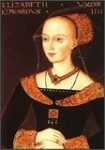
My 17th great-grandmother married well. She is one of the few women in my tree who managed to survive and live a good life after one of her husbands was beheaded for treason at the Tower of London. She married the new king’s uncle to secure her future. She is one of three siblings from her family that are my ancestors on my father’s side.
Katherine Wydeville (1458 – 1525)
is my 17th great grandmother
Edward Richard Buckingham Stafford (1479 – 1521)
son of Katherine Wydeville
Elizabeth Dutchess Norfolk Stafford Howard (1497 – 1558)
daughter of Edward Richard Buckingham Stafford
Lady Katherine Howard Duchess Bridgewater (1495 – 1554)
daughter of Elizabeth Dutchess Norfolk Stafford Howard
William ApRhys (1522 – 1588)
son of Lady Katherine Howard Duchess Bridgewater
Henry Rice (1555 – 1621)
son of William ApRhys
Edmund Rice (1594 – 1663)
son of Henry Rice
Edward Rice (1622 – 1712)
son of Edmund Rice
Lydia Rice (1649 – 1723)
daughter of Edward Rice
Lydia Woods (1672 – 1738)
daughter of Lydia Rice
Lydia Eager (1696 – 1735)
daughter of Lydia Woods
Mary Thomas (1729 – 1801)
daughter of Lydia Eager
Joseph Morse III (1752 – 1835)
son of Mary Thomas
John Henry Morse (1775 – 1864)
son of Joseph Morse III
Abner Morse (1808 – 1838)
son of John Henry Morse
Daniel Rowland Morse (1838 – 1910)
son of Abner Morse
Jason A Morse (1862 – 1932)
son of Daniel Rowland Morse
Ernest Abner Morse (1890 – 1965)
son of Jason A Morse
Richard Arden Morse (1920 – 2004)
son of Ernest Abner Morse
Pamela Morse
I am the daughter of Richard Arden Morse
Catherine Woodville, Duchess of Buckingham
From Wikipedia, the free encyclopedia
Catherine Woodville or Katherine Woodville(c. 1458 – 18 May 1497) was an English medieval noblewoman, best known for her strategic marriages. She was the sister-in-law of King Edward IV of England and gave birth to several illustrious children.
Catherine was the daughter of Richard Woodville, 1st Earl Rivers, and Jacquetta of Luxembourg. When her sister Elizabeth married King Edward IV, the King elevated and promoted many members of the Woodville family. Elizabeth Woodville’s household records for 1466/67 indicate that Catherine was being raised in the queen’s household.
Sometime before the coronation of Elizabeth in May 1465, Catherine was married to Henry Stafford, 2nd Duke of Buckingham; both were still children. A contemporary description of Elizabeth Woodville’s coronation relates that Catherine and her husband were carried on squires’ shoulders. According to Dominic Mancini, Buckingham resented his marriage to a woman of inferior birth. The couple had four children: Her husband Buckingham raised interest for Richard III’s claim to the throne, later they quarreled and hearsay was that it was because of the princes in the tower.
Edward Stafford, 3rd Duke of Buckingham (3 February 1478 – 17 May 1521)
Elizabeth Stafford, Countess of Sussex (ca. 1479 – 11 May 1532)
Henry Stafford, 3rd Earl of Wiltshire (c. 1479 – 6 April 1523)
Anne Stafford, Countess of Huntingdon (c. 1483–1544)
In 1483, Buckingham first allied himself to the Richard, Duke of Gloucester, helping him succeed to the throne as Richard III, and then to Henry Tudor, leading an unsuccessful rebellion in his name. Buckingham was executed for treason on 2 November 1483.
After Richard III was defeated by Henry Tudor at Bosworth in 1485, Catherine married the new king’s uncle Jasper Tudor on 7 November 1485.
After Jasper’s death in 1495 – not later than 24 February 1496, – Catherine married Richard Wingfield, who outlived her.
Depiction in fiction
Catherine is the main protagonist in Susan Higginbotham’s 2010 historical novel The Stolen Crown. She is briefly mentioned in Philippa Gregory’s historical novels The White Queen and The Red Queen.

Katherine Wydeville and Jasper Tudor
ROW80
My adventure into poetry continues, and the plot thickens. I learn about the lives of poets from my podcasts and reading. I am highly encouraged by the diversity found in the population. Any and every kind of person has written poetry in the past, and the platform only expands now. There were people who worked in mundane industry who took up writing after retirement and found smashing success. There are prisoners, idealists, and students working diligently to create verse and other written art forms. Many of my fellow writers involved in #ROW80 have years of experience and much more instruction under their belts as poets. This feels like a good place to learn from those who have already mastered and shared words carefully placed and edited, intended to express something beyond what the reader can see. I notice that I might be better instructed by poems that do not suit my fancy than by those I instantly like. I also notice my subject matter is similar every time I work on my poetry. I am like Claude Monet and the water lilies, just can’t stop.
I see merit in making series or building on a theme, but in a couple of weeks of daily poetic practice I seemed to be pleasantly slipping into a rut. My drawings are mostly stylized butterflies, and the poems related dream images and psyche flying around the world bringing messages to daytime consciousness. I did say I was not entering this practice to be self critical, but I did need to nudge myself to move beyond the butterflies and tell some kind of poetic story. All the poems I hear and read show contrast and variety, while mine are running flat in a straight line, going nowhere. I aspire to be like Monty Python and Dorothy Parker, yet my current offerings look like rorschach tests with brief captions in explanation of my personality. I do hope we can improve on that.
I made an attempt to write a witty little ditty about the execution of my famous poet ancestor as a story. This truly haunted my dreams and daily life for a couple of days after I learned about the incident in history. We know details of his life and death because he was an aristocrat. We even have several portraits of him. Reading his work and imagining his last 6 days in the Tower of London in January freaked me out to the bone. I skipped a day of poetry writing because I could not come up with any angle from which to create this story. I know I dreamed about him, and developed sympathy for his plight, but nothing carried over into my writing. I found that my boundaries restrict my creative muse. My desire to capture emotions was not as great as my will to make a statement and be done. I finally wrote a short poem with him in mind, but it was not the big leap I wanted to take. I have decided to keep Henry Howard with me as my ancestral muse. I will confer with him before and after I write. I think that by reading more of his work and keeping his memory alive in my dreams I have a chance of expanding beyond my comfort zone as it is now.
I am grateful to all the writers in the #ROW80 challenge for showing me that all of us have similar issues, both helpful and obstructive to our process. The support and sharing within the group is a great incentive to keep the faith. Thanks to all who check in on Sundays and Wednesdays on this adventure of ours. I appreciate knowing we are in this as a team. I have high hopes for all of us.

#Weekendcoffeeshare
If we were meeting for coffee we would use our teleporting cloaks to visit different parts of the world. This is a weekend to take an imaginary trip to a Paris coffee house. The pace of current events has been swift and frightening. Sophisticated cosmopolitan citizens are shaken. Let us sit in the corner with scarves drinking dark roast coffee with hot frothy milk. At this moment let’s take in the vibe of our fellow customers and feel the anxiety flowing through the waiter, and into the pastries on the counter. Our conversation is hushed and our gazes are focused on each other. I feel a refuge in the stories you tell me about your week, your writing, your will to survive in grace and beauty. We are comfortable gently criticizing or joking about our private lives, but are concerned about public life. This is a propitious time in history.
I often think about history because of my study of my family tree. This hobby/obsession has improved my knowledge and sense of history by revealing the stories of my ancestors. I frequently notice the differences as well as the similarities between my ancestors alive at the same time. This week I have done research on two topics that have given me superb insights into historical events. I learned that my 15th great-grandfather was a famous poet who was executed by Henry VIII on 19 Jan., 1547 at the Tower of London. I read and listened to his poetry, which I admire and like. I decided to write a poem in honor of his beheading. I hoped to create a Monty Python or Dorothy Parker style witty ditty about Henry Howard, Earl of Surrey to commemorate the 1468th anniversary of his death. Nothing rhymes with beheading. Howard and Surrey both summon up a set of unflattering words that are not very funny at all. This comedy execution poem haunted me for a couple of days before I gave up the limerick format. I wrote one today, but it contains no humor.
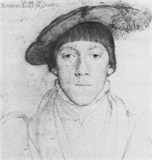
Henry Howard, Earl of Surrey
The other subject of my genealogy research this week has been my own Confederate soldier ancestors and the ownership of slaves. I have searched through census records before the Civil War and learned that my 3rd great-grandmother owned land before the war in Old Cahawba, Alabama. This is now suburban Selma. Her husband died young and she had a patent on119.91 acres of land in the old capital of Dallas County. Her family lived with her until after the war, when they all moved to Texas. The family arrived in Texas by oxcart and bought land with gold. Her son and grandson both served the Confederacy, but there is no sign that this family ever owned slaves. I looked back in time until I did find slaves in Mississippi on the maternal side, but the Taylors were too poor or morally opposed to the idea. When they moved to Texas they started a church and deeded part of their property to the church. I have wondered a lot about the journey and the gold, but now that I know how difficult story poems are to write, have not dedicated myself to telling this history in a poem.

Elizabeth Armer’s land
Thanks for hanging out this weekend in our imaginary coffee house. I look forward to hearing your stories and finding out how you are feeling this week. I appreciate sharing this delicious time with you, gentle reader.
 mermaidcamp