mermaidcamp

mermaidcamp

Keeping current in wellness, in and out of the water

You can scroll the shelf using and keys

Robert Glen, 20th Great-Grandfather

April 14, 2013 3 Comments

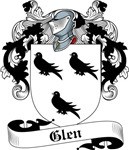
Glen Coat of Arms

Glen Coat of Arms

My 20th great grandfather married the illegitimate daughter of Robert the Bruce, Margaret. His legitimate daughter Marjorie is also my ancestor.  This is the kind of thing that gets the branches of your tree tangled. I wonder if he really accompanied the heart of Robert the Bruce to the holy land.  What a totally bizarre mission.  There is some confusion, but we know a lot, considering that he was born in 1303.

Robert, son of John de le Glen, married Margaret, illegitimate daughter of Robert Bruce Robert de Glen and ” Margaret Bruce the King’s sister,” his spouse, had a grant from David II., undated, of Nether Pitedye, Kinghorn, Fife (adjoining Balmuto) Robertson notes three other charters from David to this Robert de Glen, of the lands of Glasgow Forest, thanedom of Kintore, Aberdeen.  Wood  gives Margaret as legitimate, and says that she married, secondly, William, Earl of Sutherland.  The latter did marry as his second wife, Margaret Bruce; but it is impossible that she was the widow of Glen, and an authority points out that the arms quartered by Glen, and attributed to the co-heiress of Abernethy, were not the Abernethy arms, but those of Scotland with the Scottish mark of illegitimacy, which agrees with a tradition preserved in several branches of the family, and is conclusive. Another tradition, traceable for four centuries, insists that Robert de Glen was  one of those who accompanied the heart of Bruce to the Holy Land, and the Linlithgow  line used two crests, one a martlet; the other an arm, the hand grasping a heart, in commemoration of that event. Moreover, the Glens of Bar possessed the sword of Bruce, which a descendant carried to Ireland, in 1606, where it was seen a few years since, the inscription on the blade leaving no doubt as to its original ownership.

Robert Glen (1303 – 1345)
is my 20th great grandfather
John Glen (1349 – 1419)
son of Robert Glen
Isabel Glen (1380 – 1421)
daughter of John Glen
Isabel Ogilvie (1406 – 1484)
daughter of Isabel Glen
Elizabeth Kennedy (1434 – 1475)
daughter of Isabel Ogilvie
Isabella Vaus (1451 – 1510)
daughter of Elizabeth Kennedy
Marion Accarson (1478 – 1538)
daughter of Isabella Vaus
Catherine Gordon (1497 – 1537)
daughter of Marion Accarson
Lady Elizabeth Ashton (1524 – 1588)
daughter of CATHERINE GORDON
Capt Roger Dudley (1535 – 1585)
son of Lady Elizabeth Ashton
Gov Thomas Dudley (1576 – 1653)
son of Capt Roger Dudley
Anne Dudley (1612 – 1672)
daughter of Gov Thomas Dudley
John Bradstreet (1652 – 1718)
son of Anne Dudley
Mercy Bradstreet (1689 – 1725)
daughter of John Bradstreet
Caleb Hazen (1720 – 1777)
son of Mercy Bradstreet
Mercy Hazen (1747 – 1819)
daughter of Caleb Hazen
Martha Mead (1784 – 1860)
daughter of Mercy Hazen
Abner Morse (1808 – 1838)
son of Martha Mead
Daniel Rowland Morse (1838 – 1910)
son of Abner Morse
Jason A Morse (1862 – 1932)
son of Daniel Rowland Morse
Ernest Abner Morse (1890 – 1965)
son of Jason A Morse
Richard Arden Morse (1920 – 2004)
son of Ernest Abner Morse
Pamela Morse
I am the daughter of Richard Arden Morse

Anne Devereux, 18th Great-Grandmother

April 13, 2013

Anne Devereux

Anne Devereux

Anne’s father Walter was a big Yorkist knight in the War of the Roses.  She married a knight who was mixed up in this royal Lancaster/York mess as well.  Her husband, William Herbert, was lord of a giant castle, Raglan.  She had nice digs in Wales at this castle while the Brits were embroiled in their Rose thing.  I am still having trouble sorting out the royal roses and why the people of Wales would care, but they got into it too.

Anne Devereux (1410 – 1486)
is my 18th great grandmother
daughter of Anne Devereux
daughter of Maud Herbert
daughter of Eleanor Dutchess Buckingham Percy
daughter of Elizabeth Dutchess Norfolk Stafford Howard
son of Lady Katherine Howard Duchess Bridgewater
son of William ApRhys
son of Henry Rice
son of Edmund Rice
daughter of Edward Rice
daughter of Lydia Rice
daughter of Lydia Woods
daughter of Lydia Eager
son of Mary Thomas
son of Joseph Morse III
son of John Henry Morse
son of Abner Morse
son of Daniel Rowland Morse
son of Jason A Morse
son of Ernest Abner Morse
I am the daughter of Richard Arden Morse

Anne Devereux is the daughter of Sir Walter Devereux and Elizabeth Merbury. 2 She married William Herbert, 1st Earl of Pembroke, son of Sir William ap Thomas. Her married name became Herbert.
Children of Anne Devereux and William Herbert , 1st Earl of Pembroke
Lady Catherine Herbert + 3 d. b 8 May 1504
Lady Maud Herbert + 1 b. 1448, d. a 1485
Citations
[1] Richard Glanville-Brown, online , Richard Glanville-Brown (RR 2, Milton, Ontario, Canada), downloaded 17 August 2005.
[2] Tim Boyle, “re: Boyle Family,” e-mail message to Darryl Roger Lundy, 16 September 2006. Hereinafter cited as “re: Boyle Family.”
[3] G.E. Cokayne; with Vicary Gibbs, H.A. Doubleday, Geoffrey H. White, Duncan Warrand and Lord Howard de Walden, editors, The Complete Peerage of England, Scotland, Ireland, Great Britain and the United Kingdom, Extant, Extinct or Dormant, new ed., 13 volumes in 14 (1910-1959; reprint in 6 volumes, Gloucester, U.K.: Alan Sutton Publishing, 2000), volume VII, page 167. Hereinafter cited as The Complete Peerage.

John McGalliard and Human Error

April 9, 2013 7 Comments

Coat of Arms

Coat of Arms

Although I love this family from Ireland, alas, Roger has helped me see that the last reliable information in this tree belongs to Mary Wright of Somerset, PA, so this is NOT my ancestor.  I am leaving the post for those seeking John and what I have found about him..but I have to kiss him goodbye.

John McGalliard was a teacher who was trained as a minister in Ireland. He settled in New Jersey about 1750, and survived for 17 years in the new world. His son was a tailor who took off for Ohio and became a postmaster.  Ohio was extreme wilderness at the time. These Irish came to America long before the potato famine to seek a new adventure in New Jersey. What inspired them we will never know.

John, Sr. McGalliard (1710 – 1767)

is NOT my 9th great grandfather
son of John, Sr. McGalliard
son of John McGilliard Jr
daughter of John McGilliard III
son of Mary McGill
This is where the mistake was found…starting over from here..such is the nature of research.
daughter of John Wright
daughter of Mary Wright
daughter of Emiline P Nicholls
daughter of Harriet Peterson
daughter of Sarah Helena Byrne
son of Olga Fern Scott
I am the daughter of Richard Arden Morse
John McGalliard and some of his descendants
John McGalliard, educated abroad for the Gospel ministry of the Presbyterian church, came to this country from Ireland and settled at Greenwich, N.J. about 1750. Although trained for the ministry, there is no known record that he served here as either a preacher or pastor. In those old days, however, it was no small part of the minister’s craft to be the teacher of Latin and Greek and other branches of higher learning of the time. Accordingly, we find John McGalliard, early the teacher of a grammer school in Greenwich. This being suggestive of his literary and cultural ability, as well as his spiritual influence and leadership.
From the “Story of the Cumberland County Tea Burners of 1774″, we learn that Joel Fithins, born September 20, 1746, had the advantage of a good education, his preceptor being John McGalliard, who having prepared of the ministry inculcated into his pupils minds the love for English and the literature of the period”.
In 1758, John McGalliard married Hanna Reeves, another native of Ireland, who had come here around 1750. To them were born two sons, John and James and one daughter, Hanna. The children were left orphans before they were ten years old. The father died in 1767 and the mother about two years later.
John McGalliard II
This elder son of John McGalliard was born July 3, 1759. While yet a young man, he set out for the West, going as far as Springfield, Ohio, where he settled and made his permanent home. There he married and became the father of three children. It is easily possible that Miss Virginia McGilliard, one of our Presbyterian Missionaries in Africa, and who hails from Ohio, is a descendant of this family. John McGalliard was by trade a tailor. He also served for many years as Postmaster of his city and community. He died February 26, 1837.
James McGalliard II
James, the second son of the original John McGalliard, was born December 11, 1761. Left an orphan, he was reared by a Mr. Mulford who lived near Roadstown. He took up the then popular avocation of Wheelwright and Cabinet maker. He followed his craft in part at the home and on the farm of Benjamin Keen. After the death of Mr. Keen, this guest craftsman performed the double service of purchasing the farm and later marrying the widow of the said Mr. Keen. The wedding bells were rung on December 5, 1789. They had children, James and Hannah (twins), Eliza, Anna, John and Benjamin Keen. Of only the older son in this family will we be able to write in this brief sketch.
James __ McGalliard
This James was the grandson of John McGalliard whose name and memory we are seeking to honor in this sketch. He married Amy, the daughter of John and Phebe Hires. To them were born eight sons and four daughters, a number of whom died in infancy, or before reaching middle life.
John McGalliard
John, the fourth son of this large family, came into possession of the family home and farm, commonly referred to as the “old home place” at the death of his father, James McGalliard just named. He married Susan Davis. Thier children were Benjamin, Fannie J., Mary and James. Benjamin became a practicing physician in Trenton and was an officer in the First Presbyterian church there. He married Lillian Vannote. They both have died. Thier only child, Elizabeth follows the profession of nursing, and is serving in connection with the Henry Street Settlement House in New York City. Mary married Ephraim Bonham and their children are Chester S. and Susan. Chester married Lottie Simpson of Philadelphia. Their children are Chester, Mary, Charlotte and John. They reside on the old home place.
(note: Elizabeth McGalliard now living at 3333 Madrona Lane, Medford, Oregon
Miss Fannie McGalliard whose vision, painstaking and devotion to the great idea of __ have made possible the consummation of this memorial, resides on Broad Street in Bridgeton. Joseph, the next in this family of James and Amy Hires McGalliard, married Mary Shull. Their children are Lewis, Amy, Esther, Anna and Ella. The next member of the family whose record we are able to enter here was George. He married ___. Their son, George, resides in the Bridgeton area. Thier daughter, Elizabeth, is the wife of Rev. Isaac Compton, a Baptist minister serving a church in Vermont.
The youngest of the family of James McGalliard and Amy Hires McGalliard was Lewis. He married Anna Nichols. Children born to them were Frank, Mary Edna, Bertha and Laura. Laura died in early childhood and Bertha passed away in her upper teens. Frank married Louise Rasohke in 1927. On December 28, 1910, Edna married the minister of the West Presbyterian church, Bridgeton, and now resides at Rahway, N.J. Their son, Maxwell? McGalliard Ewing married Eleanor Shillinger in 1934.
Other McGalliards
The writer here takes the liberty of referring to some other McGalliard, not known to be connected with the family line we have been following in this sketch.
The history of the Old Tennent Church near Freehold, yields some information of value. That record shows that one John McGalliard as early as 1735 was received into the membership of the Old Tennent Church. Please remember that it was John McGalliard who arrived in Greenwich in 1750, just fifteen years later. It could have been the same John, settling first in Monmouth County and later coming to Cumberland, I think, however, that there is evidence to disprove this possibility. Then there is a William McGalliard on record as contributing to the erection of the new church edifice, about 1750, the sum of one pound and ten shillings, and again of Robert McGalliard contribution one pound to the support of the church. There are records of a number of baptisms of infants named McGalliard, and of burials, and near the preserved stones marking the earthly resting places of three members of the family of McGalliard, some of whom are named in this paragraph.
Two other McGalliards, Edward and William, known to the writer, reside in Mercer County in the suburbs of Trenton, both active in the life and work of the Hamilton Square Presbyterian church. Edward, the younger of the two is a ruling elder of that church and is actively identified with the work of the Presbytery of New Brunswick. What connection the Trenton or the Tennont McGalliards have with each other and how either relate to the Greenwich branch, the writer does not know. It is his judgement, however, that by a little research, connection night easily be established.
But a concluding word – – – Those interested in this sketch, could well join in the word of Holy Writ, “Yea, we have a goodly heritage”. A heritage of faith in God, a heritage of loyalty to community and of love of country. John McGalliard came here from Ireland, and there is a tradition that he had previously resided in Scotland. His helpmeet was also reared on the other side. Early influences around him, and the creation in him by the grace of God, turned him toward the Gospel ministry as a life calling. He settled in this country among churchmen. In as brief as possible, let me sense conditions here in those old days. Here at Greenwich were the Padgetts and the Fithians and the Shepards and the Ewings and the Maskells, in the day when John McGalliard and Hannah Reeves arrived. We know something of the intimate, even private lives of at least some of those early folk. Here were Maskell Ewing and Mary Padget, typical young people of the community, they married away back there and became the antecedents of a large and far reaching family line. Before their marriage, in their teens, those young people were “Converted and gave their hearts to God under the powerful Gospel preaching of the celebrated George Whitfield, who frequently visited Greenwich and preached, not in the church, for there was not room there for the throngs that came in that revival time, but in the open air in front of the meeting house. Maskell Ewing became an elder of the church, and served in that capacity for a period of forty years. Of the lives of the said Maskell and Mary, his beloved wife, who were no more than just average people of the community, we have this record that “Their soul’s delight was in the Word of God, and they regarded the divine Savior, as the only foundation of a sinner’s hope”.
I mention this incident of the preaching of Whitefield, which is known to have reached great throngs of people in those early Greenwich days, as evidence of the kind of life John McGalliard and his good wife found when they arrived here from abroad. A man rained abroad for the ministry, settling in a community a thrill with the Christian faith, and naturally becoming the head of the Grammar school, which in those times was practically a living branch of the Christian church, settling indeed where strong Christian faith and desire for the higher, better things, were woven in the warp and woof of the thinking and the living of the people. John McGalliard, with the background he had and settling here in such a midst ?, it takes no more imagination to sense that over into his sons and daughter, and thence on to later progeny, there flowed from his godly life a great sanctifying influence.
Local influences have not a little to do with trends of social and religious connection. Denominational relationships are easily affected by the exigencies of changed location and by the forming of family groups. Even through all of those in their family line we hastily run down, may there not be traced the stream of Christian faith and Christian devotion from generation to generation. John McGalliard came trained for
the Gospel ministry. He practiced his calling in the Greenwich Grammar school. Records of strong faith, deep piety and loyalty to the body of Christ have not been lacking down the years. At Roadstown and Shiloh churches the McGalliard numbers high among church folk, down through history. Dr. Benjamin McGalliard, a lineal descendent, served in the years just prior to his death as a ruling elder in the First church of Trenton. A next generation descendant is a ruling elder in the West Church of Bridgeton, another is the wife and helpmeet of the Rev.. Isaac Compton in Vermont, another is the wife of the Superintendent of National Missions in the Synod of New Jersey.
A good foundation, laid in faith of the kind that stands the tests. Such seems to have been the antecedent strength and background of this family passing today in review. But how about us here to carry on today? What of tomorrow and us? There are the great tests to meet. How should we make good? We can if we will. Hence let us honor the goodly heritage we have. And as there has been set this bit of stone to memorialize our great ancestor, shall we not dedicate anew those lives given us to live her, to be all that God would have them, in the meeting of His holy purposes.
Our ancestors belong to us by affectionate retrospect. Yes, we have a goodly heritage. In the great Book we are enjoined to “remember the days of old and consider the years of many generations”. God make today, with its simple historical memorial event a great day, even a new day to rejoice in those blessings that have come by the channels of the faith of our fathers, and are sealed to us by the Holy Spirit, through the faith of our own hearts!
We come unto our father’s God
Their Rock is our salvation,
The eternal Arms their dear abode
We make our habitation.
We bring Thee, Lord, the praises they bought.
We seek Thee as thy saints have sought,
In every generation.
Blessed be God, for the Glorious Gospel of His grace, vouchsafed to us.
For all the saints who from their labors rest,
Who Thee, by faith, before the world confessed.
Thy name, O Jesus, be forever blest!
And grant us Lord like precious faith
With those who went before.
That we may keep our garments white
Until the conflict’s o’er.
Nor faint nor fail nor turn aside
Until the day is done
And we shall see Thee, face to face
And hear Thee say, well done!
Paper read at unveiling of Memorial Tablet at Greenwich, N.J., July 11, 1935, by Joseph Lyons Ewing.

Elizabeth Henchman, 10th Great Grandmother

April 8, 2013

gravestone

grave of Elizabeth Henchman

Elizabeth Henchman has a birthplace on file of Plymouth, MA.  I doubt this is true, since in 1612 the Mayflower had not yet landed.  She came from England with her parents, I believe.  She married my 10th great grandfather in Plymouth in 1634.  Her second husband, Richard Hildreth, was prominent in Cambridge, MA. They married in Cambridge in 1645. Her grave can still be located in Malden, MA.

The origin of the name is really from being a royal henchmen in history:

ENGLISH ORIGINS

The origin, genealogy, history, and traditions of the Henchman, Hensman, Hinchman, and Hincksman families are known to many family members today, because of the research and dedication of Robert Hinchman, Jr. (1921-1996), of Dallas, Texas, the founder and first president of the Hinchman Heritage Society.  It is from this beginning in England that we may someday find connections to The Hinchman Family in America.  The following two paragraphs were written by Robert for the October 1992 Hinchman Heritage Week in England.

“Legend has it that Thomas Crosborough of Magna Doddington, Northamptonshire, saved the life of King Henry VII during a hunt.  Upon being rescued from the tusks of a wild boar the King said to him:  “Truly, thou art my veritable henchman.”  Thomas thereupon, changed his name to Henchman, and thus, the family began.  His great grandson, Thomas, was apprenticed at the age of 12 to William Cokayne, Master of the Skinners’ Guild, and subsequently became a prominent merchant and Freeman of the City of London during the latter part of the reign of Elizabeth I.  Thomas was the father of Humfry who was instrumental in aiding Charles II escape to France during the English Civil War.  Thus, two Henchmans have helped save the lives of two English kings.”

“The scions of Thomas Crosborough Henchman are the progenitors of the Henchman/Hinchman and Hensman Families of today.  The variations in spellings began to stabilize during the reign of James I and by the time of the restoration of Charles II in 1660, the orthography had become almost set .. but as a Hinchman, you well know that confusion still exists.  The family began its migration to New England in 1637, to Maryland in 1664, and to Australia in the 1860’s.  And, of course, English members  continued down to this day.  Our generation, wherever we live, are descendants of Thomas Crosborough Henchman, his sons and grandsons.  It is an adventure for each of us to discover our particular origins.”

Elizabeth Henchman (1612 – 1693)
is my 10th great grandmother
Mercy Vaughn (1630 – 1675)
daughter of Elizabeth Henchman
Sarah Carr (1682 – 1765)
daughter of Mercy Vaughn
John Hammett (1705 – 1752)
son of Sarah Carr
MARGARET HAMMETT (1721 – 1753)
daughter of John Hammett
Benjamin Sweet (1722 – 1789)
son of MARGARET HAMMETT
Paul Sweet (1762 – 1836)
son of Benjamin Sweet
Valentine Sweet (1791 – 1858)
son of Paul Sweet
Sarah LaVina Sweet (1840 – 1923)
daughter of Valentine Sweet
Jason A Morse (1862 – 1932)
son of Sarah LaVina Sweet
Ernest Abner Morse (1890 – 1965)
son of Jason A Morse
Richard Arden Morse (1920 – 2004)
son of Ernest Abner Morse
Pamela Morse
I am the daughter of Richard Arden Morse

Art and Practice

April 4, 2013

This month many writers are writing a poem a day in NaPoWriMo..the poetry challenge.  I am accomplished in a few expressive ways, but I have not visited my poet for years.  I was a prolific song writer as a teenager, and wrote poetry every day of some kind.  I am a language fan, loving words because they sound funny or because they have obscure specific meanings.  Being poetic, or even doing rhymes as improvisational humor, sharpens the wit, grows the vocabulary and enhances connections and metaphoric images.

When I was young I heard my father recite the Cremation of Sam McGee by Robert W Service.  He knew it by heart. After a couple of drinks he liked to sing, dance or recite that poem. It was always entertaining. He was a research scientist by profession, but my parents loved music and dance more than anything.  We had a player piano which was the scene of many sing a long parties.  What was truly admirable about my parents was their artistry.  They had regular suburban lives, but my dad was an accomplished musician, and my mother designed and executed both landscape environments and fashion with amazing professionalism.  My mother was a prize-winning floral arranger, and avid flower show horticulturist.

I was encouraged , and in some cases forced, to practice art.  Piano was a mandatory 30 minutes every day of my life, and a legal pad sheet of cursive handwriting had to be inspected by my father each night.  I eventually realized I could recycle some of the handwriting, but there was no faking the piano.  My guitar and voice lessons came with mandatory practice sessions when I was in high school.  I learned the power of practice at a very young age.  Discipline is never natural to kids and maybe my parents overdid the whole rigidity thing.  Today, however, I thank Dick and Ruby Morse, the living artists, who gave me the self confidence to know that I can be any kind of artist I care to be.  My art will reflect my practice, and with practice I will improve.  All poems, all songs, all dances are alive and need to be brought forth.  Practice is the vehicle in which they travel into the light.
Sir Thomas Forster, Judge of Common Pleas

April 2, 2013 7 Comments

Thomas Forster monument

Thomas Forster monument

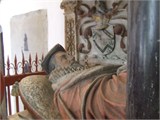
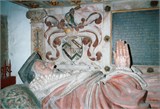
The Monument to Sir Thomas Forster A.D. 161 shows him in his judge’s robes, is a perfect example of the period with fine contemporary wrought-iron railings. He was born in 1548 and joined the Inner Temple in 1571 and was made Sergeant before Elizabeth’s death in 1603. He was knighted ii 1604 and appointed Judge of Common Pleas in 1607. Sir Thomas was one of the first Governors of Charterhouse and was counsel to Queen Ann and Prince Henry. He died on May 18th, 1612 at Clerkenwell and was buried in Hunsdon on May 20th, 1612.

Sir Thomas Forster (1548 – 1612)
is my 14th great grandfather
Christopher Lynn Foster (1603 – 1687)
son of Sir Thomas Foster
John Christopher Foster (1634 – 1687)
son of Christopher Lynn Foster
Rachel Foster (1675 – 1751)
daughter of John Christopher Foster
Abraham Sr Reeves (1699 – 1761)
son of Rachel Foster
Hannah Reeves (1720 – 1769)
daughter of Abraham Sr Reeves
John McGilliard Jr (1759 – 1832)
son of Hannah Reeves
John McGilliard III (1788 – 1878)
son of John McGilliard Jr
Mary McGill (1804 – 1898)
daughter of John McGilliard III
John Wright (1800 – 1870)
son of Mary McGill
Mary Wright (1814 – 1873)
daughter of John Wright
Emiline P Nicholls (1837 – )
daughter of Mary Wright
Harriet Peterson (1856 – 1933)
daughter of Emiline P Nicholls
Sarah Helena Byrne (1878 – 1962)
daughter of Harriet Peterson
Olga Fern Scott (1897 – 1968)
daughter of Sarah Helena Byrne
Richard Arden Morse (1920 – 2004)
son of Olga Fern Scott
Pamela Morse
I am the daughter of Richard Arden Morse
Judge in grave

Judge in grave

F orsters continued to serve the Kings of England. Sir Richard Forster fought in the Hundred Years’War against France with King Edward III at Bordeaux and Crecy. Richard participated in the Battle ofPoictiers in 1356 and was knighted for his part in the battle.Sir Richard’s son, William, was born about 1355 and married Elizabeth De Orde about 1400 inBuckton, Northumberland, England. William was knighted for service to King Henry V and served asa General in the battle against France.Their son Thomas Forster married Joan De Elmerdon about 1430. Thomas and Joan’s son, alsonamed Thomas Forster, married Elizabeth Featherstone of Stanhope Hall, Durham, England. Theyhad Roger Forster, although records show that he spelled the name Foster rather than Forster.Roger Foster married Joan Hussey in 1540. 

Genealogy of the Descendants of Roger Foster of Edreston, Northumberlandwas compiled by Alkman Henryson Foster-Barham and published in London in 1897. Roger was 17 when he fled from Northumberland, as explained in a letter from Sir John Forster of Bamburgh, dated 17 April 1590.  The letter below was written by Sir John to Roger Foster’s grandson, Thomas Foster of Hunsdon. 

” Dear Cousin,  After right hearty commendations unto you, ye shall understand I have received yourletter wherein you desire to know of your pedigree. Your grandfather, as ye havelearned, was descended out of the house of Etherstone – whether he was the elder,second, or third, or fourth brother – and fled the country of Northumberland. I assure you I can truly satisfy you therein. Your grandfather, called Roger Foster,was my great uncle. His father was called Thomas Forster and his mother’s namewas Featherstonehaugh. His eldest son was called Thomas Forster, my greatgrandfather. It happened that four of the said brethren had been at a-hunting and were ridinghomeward through a town called Newham. They and a company of Scottish Kerrs fellout and there began bloodshed and feuds which continued until there was but oneKerr living.  During this time my grandfather and yours and another brother of theirs calledNicholas Forster (mine being twenty years old, yours 17 years, and Nicholas, a childof 14) being a-hunting – were waited upon by one of the Kerrs and two of theiralliance called Too and King. They set upon the three brothers and were thought tohave slain them at a place near Branton where a cross still stands.Two were slain there and Kerr fled. After the slaughter my grandfather fled toRidsdale in the county because he was safe there and yours fled to southern parts.”  At my house near Alnwick, 17th April 1590,   your loving cousin,John Forster.”

  Roger Foster’s son was Thomas Foster (1515-1599) of Hunsdon, Hertfordshire, England, whomarried Margaret Browning (1520-1599). Thomas and Margaret had a son who was also named Thomas Foster (1548-1612), who married Susannah Forster(1555-1625).

 

Sister Kelly and Ishtar

March 31, 2013 2 Comments

True religion is a concept hard to grasp. The idea seems to be that divine providence has finally brought all wisdom and knowledge into the possession of one exclusive (chosen) group. This group, who thinks it is all that, persecutes other groups because they are not in possession of true religion. In some places one needs to handle snakes or fall down on the floor speaking in tongues to satisfy the veracity of one’s religion.  In other places one only has to donate funds, and then is totally off the hook. True religions distinguish themselves by claiming not to be connected or influenced by religions in history.  They often have dead or living prophets that rule the roost.  In the south they also have radio shows.  Sister Kelly uses her pulpit to explain how the Babylonian fertility and war goddess, Ishtar, got mixed up into Easter. Kelly McGinley of Mobile, Alabama  wants to get to the bottom of all this history and evil.

Yes, Sister Kelly, there is an Ishtar, and her fertility symbols are used in a mixed metaphor called Easter.  It is fine if you want to stay home while the rest of us go out to brunch and eat chocolate bunnies.  We have no need to cast aspersions on your beliefs.
Henry Burt, 13th Great Grandfather

March 31, 2013

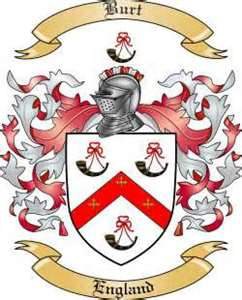
Burt Coat of Arms

Burt Coat of Arms

Henry Burt (1595 – 1662)

is my 13th great grandfather
Mary Burt (1635 – 1689)
daughter of Henry Burt
Abigail Brooks (1665 – 1746)
daughter of Mary Burt
Isaac Preston (1707 – 1748)
son of Abigail Brooks
William Preston (1737 – 1802)
son of Isaac Preston
Susannah Preston (1780 – )
daughter of William Preston
John McGilliard (1788 – 1878)
son of Susannah Preston
Mary McGill (1804 – 1898)
daughter of John McGilliard
John Wright (1800 – 1870)
son of Mary McGill
Mary Wright (1814 – 1873)
daughter of John Wright
Emiline P Nicholls (1837 – )
daughter of Mary Wright
Harriet Peterson (1856 – 1933)
daughter of Emiline P Nicholls
Sarah Helena Byrne (1878 – 1962)
daughter of Harriet Peterson
Olga Fern Scott (1897 – 1968)
daughter of Sarah Helena Byrne
Richard Arden Morse (1920 – 2004)
son of Olga Fern Scott
Pamela Morse
I am the daughter of Richard Arden Morse

Henry Burt was born about 1595 at Harberton, Devon Co, probably the second son of Henry. He married Ulalia March at Dean Prior, Devon County on December 28, 1619. He came to New England in the Spring or Summer of 1639, and with his wife and seven children settled at Roxbury, MA. Shortly after he settled there, his house was burned, for whatever reason, and, in November of 1639, the General Court made a grant to the town in the amount of 8 Pounds because of the loss . He moved to Springfield in 1640 and was Clerk of the writs (aparently the town recorder). But it is strange that his own childrens’ births are not recorded in the town. He died in Springfield, April 30, 1662.
Henry Burt, Jr
Born: About 1595 in: Harberton, Devon, England Married: December 28, 1619 in: Dean Prior, Devon, England Died: April 30, 1662 in: Springfield, MA

Ulalia March Born: About 1598 in: England Died: August 29, 1690 in: Springfield, MA

We know a lot about his life:

Documented events in his life were:

1. Mention in Will, Inv. or Prob.; 10 Jul 1617; Harberton, Devon, ENG 2. Legacy in father’s will.
2. Parish Record; 28 Dec 1619; Dean Prior, Devon, ENG 2. Record of Marriage.
3. Emigrant Ancestor; Between 1638-1639. One source say that he may have come on the Ship James in 1635, but he isn’t listed among the passengers.
4. Lawsuit; 13 Jan 1641/42; Springfield, Hampden Co., MA 5. Henry Burt Complaines against Judith Gregory in an action of the Case for breach of Covenant in Molestinge him in his daughter Sara[h] Burt. Judith Gretory was 3 tymes caled by the Constable to answer the action abovesaid and she appeared not.
5. Town Office; 26 Sep 1644; Springfield, Hampden Co., MA 6. By general vote of the town, Henry Smith, Thomas Cooper, Samuel Chapin, Richard Sikes, & Henry Burt were elected Selectmen with power “to order in all the prudential affaires of the Towne, to prevent anythnge they shall judge to be to the dammage of the Towne or to ordr anything they shall judge to be for the good of the Towne: and in these affaires they shall have power for a yeere space and that they, 5, or any three of them shall also be given full power and virtue, alsoe to here complaints, to Arbitrate controversies, to lay out High ways, to make Bridges, to repayr High wais … to see to the Scouring of Ditches, and to the killing of wolves, and to training up of children in some good caling, or any other thing they shall judge to be to the profitt of the Towne.
6. Oath of Freemanship/Allegiance; 14 Apr 1648; Springfield, Hampden Co., MA 5. Henry Burt was sworne to be Freeman
7. Military Service; 7 Nov 1648; Springfield, Hampden Co., MA 5. “Henry Burt was this day sworne Clarke of the Band”
8. Town Office; 29 May 1649; Springfield, Hampden Co., MA 5. “Henry Burt was chosen Clark of the writts for this Towne. This day all the printed lawes were read: the whole Towne being present:”
9. Lawsuit; 29 Mar 1659; Springfield, Hampden Co., MA 5. Henry Burt Plantiff contra James Bridgman defendant in an action of debt to the vallue of 27 19s 4d.
10. Credit; 16 Sep 1659; Springfield, Hampden Co., MA 7. Henry Burt CR
Sept 16 1659
By Wm. Deines 00 02 00
11. Jury Duty; 7 Apr 1660; Springfield, Hampden Co., MA 5. Served on the jury investigating the death by drowning of Ebenezer Herman, youngest child of John Herman who was found dead in the brook in Nathaneell Pritchard’s yard. The death was ruled accidental.
12. Jury Duty; 25 Sep 1660; Springfield, Hampden Co., MA 5.
13. Lawsuit; 14 May 1661; Springfield, Hampden Co., MA 5. “Henry Burt Complaines against John Henryson for not paying of Three bushells of wheate according to promise for spinning and knitting of Stockens. To which John Henryson says that the debt which he owes Henry Burt is but 10s and this he ingaged 2 bushells of wheate towards it and noe more: and he hat paid Henry Burt in worke so that Henry Burt owes him 8x for worke: Henry Burt ownes owing him 8s which says he John Henryson was to have a shurt cloth for and John owning it is adjudged to take the shurt cloth: and for the other 10s John Henryson is adjudged to pay Henry Burt Two bushells ow wheate (7s) and Three shillings in a day and halfe worke.”
14. Jury Duty; 24 Sep 1661; Springfield, Hampden Co., MA 5.
15. Will; 30 Apr 1662; Springfield, Hampden Co., MA 5. “Henry Burt of Springfeild who departed this life Aprill 30th 1662, not leavinge any will under his owne hand for the disposing of his leigh, estate yet for that he did by words express his mind therein before Ensigne Thomas Cooper and Jonathan Burt who by a writing under their hands presented the Same unto this Corte: a coppy whereof hereafter follows, the Widdow Burt before the Corte consenting thereunto The Corte allowed the same to stand as the Last will and testament of the said Henry Burt.
We Thomas Cooper and Jonathan Burt doe testify, That after Henry Burt now deceastl had disposed of part of his estate to his Son Nathaneell, the said Henry had Such expressions as these. vizt. that what estate he had then left should be at his wifes dispose as witness our hand This 29th of September 1662.
Thomas Cooper: Jonathan Burt
To the truth hereof in the mind of the said Henry Burt the said Ensigne Cooper & Jonathan Burt tooke thier oath in the presence of the Corte:
16. VR – Death; 30 Apr 1662; Springfield, Hampden Co., MA 8. Burt, Henry “the Clark of ye Writtts”, d. 30th of Apr. in ye evening and buried May 1, 1662
17. Inventory Taken; 11 Sep 1662; Springfield, Hampden Co., MA 5. An Inventory of ye estate of Henry Burt of Springfield, deceased, taken Sept. 11, 1662. Also the Widow Burt before the Corte made oath that this is a true Inventory of her said deceased husband’s estate.
A remnent of broadcloth œ1.00
One remnent of gray kersey 10s
One cloak 10s
One suit of clothes 1.00
One hat, 12s–chest–10s 1.02
One Jackett 5
A pound of hemp and flax œ0.12
Several other small things 1.00
Other particular things 10
The housing and land at ye town 45,00
Corn at ye town 1.00
5 pair of sheets 2.10
2 pillow cases 5
2 bed ticks, 20s–one bed, 20s 2.00
3 blankets and 1 rug 2.10
Pillows 1.00
Brass pan and kettles 5.00
One iron pott 12s–pewter 30s 2.02
A warming pan and frying pan 15
Wooden wear 40s, 3 bottles 5s 2.05
Books 10s–2 wheels 8s 18
1 smoothing iron 4s, a hatchell 8s 12
A branding, 3 bellows and clevis 09 72.15
3 Seves .04s
Sellers and fencing œ5.00
2 axes, 3 sithes, 1 beetle ring 1.00
Swine 4.10
2 oxen 14.00
3 cows 11 00
3 young cattle 5 00
15 acres of land 22.00
5 acres of land 7.10
18 acres corne 20.00
16 loads of hay 8.00
Yarn 7 lbs., bedclothes 8.00
One chest .05
Two guns 2.10
Taken by Geo Colton 108.19
” “Benj Cooley 72.15
Total 181.14
Debts. To Mr Pynchon 45.00
To John Drake 1.07
To Mr. Hab. Glover 17
Sam Maudford 16
John Stewart 15
Total 50.10

Cycles of Rebirth

March 30, 2013 6 Comments

Aesculapius

Aesculapius

I: And the crown? Solve the riddle of the crown for me!”

Soul Bird: “The crown and serpent are opposites, and are one. Did you not see the serpent that crowned the head of the crucified?”

I: “What, I don’t understand you.”

Soul Bird: “What words did the crown bring you?

“Love never ends”-that is the mystery of the crown and the serpent.” ~Carl Jung; Red Book.

Carl Jung was the son of a reform minister who grappled with his own religion throughout his life.  He had high aspirations and did some deep Dante style soul searching.  His final spiritual expression was the Red Book, published after his death.  In it he links symbols to deeper meaning.  He was a student not only of mythology and history, but also of the ancient sciences.  He studied the astrologers and the work of the alchemists to find clues to the collective consciousness as it has passed down through history.  He was interested in Kundalini, the serpent coiled at the base of the energetic spine.

During the time of Christ the GrecoRoman god of healing Aesculapius was still popular. Cures and diagnosis in the cult of this demi god involved dreams and dream healing.  His symbol, and indeed his assistants in healing temples, were the snakes.  They were deemed to be powerful psychics.  The symbol of the snake as natural healer was traded for the image of snake, the temptation of Eve, which got everyone thrown out of the Garden of Eden, reptiles included. We are not sure who lives there now..

If you have dreams of crowns or serpents, pay special attention. Something may be attempting rebirth within your soul.

Wealth

March 29, 2013 3 Comments

Andrew Carnegie wrote an essay he called  The Gospel of Wealth.  This idea came to him after Carnegie had become the wealthiest man in the world.  As we check the biblical Gospel for Easter, we should check the reality gospel that is practiced in our nations and neighborhoods. The most disgraceful have been hogging the assets of society, and ultimately of the planet. Symbols of power and politics today are all about over consumption. It does not matter which one— fraud, health care scandals, or useless government busy work are the source of the waste. The point is that our wealth is being used to destroy the general good of the entire society. Our assets are spent to promote shameless partisan destruction of our best interests. We are going morally broke. In 1889 Carnegie wrote:

Thus is the problem of Rich and Poor to be solved. The laws of accumulation will be left free ; the laws of distribution free. Individualism will continue, but the millionaire will be but a trustee for the poor; intrusted for a season with a great part of the increased wealth of the community, but administering it for the community far better than it could or would have done for itself. The best minds will thus have reached a stage in the development of the race in which it is clearly seen that there is no mode of disposing of surplus wealth creditable to thoughtful and earnest men into whose hands it flows save by using it year by year for the general good. This day already dawns. But a little while, and although, without incurring the pity of their fellows, men may die sharers in great business enterprises from which their capital cannot be or has not been withdrawn, and is left chiefly at death for public uses, yet the man who dies leaving behind many millions of available wealth, which was his to administer during life, will pass away ” unwept, unhonored, and unsung,” no matter to what uses he leaves the dross which he cannot take with him. Of such as these the public verdict will then be : “The man who dies thus rich dies disgraced.” ~Andrew Carnegie