mermaidcamp

mermaidcamp

Keeping current in wellness, in and out of the water

You can scroll the shelf using and keys

John McGalliard and Human Error

April 9, 2013 7 Comments

Coat of Arms

Coat of Arms

Although I love this family from Ireland, alas, Roger has helped me see that the last reliable information in this tree belongs to Mary Wright of Somerset, PA, so this is NOT my ancestor.  I am leaving the post for those seeking John and what I have found about him..but I have to kiss him goodbye.

John McGalliard was a teacher who was trained as a minister in Ireland. He settled in New Jersey about 1750, and survived for 17 years in the new world. His son was a tailor who took off for Ohio and became a postmaster.  Ohio was extreme wilderness at the time. These Irish came to America long before the potato famine to seek a new adventure in New Jersey. What inspired them we will never know.

John, Sr. McGalliard (1710 – 1767)

is NOT my 9th great grandfather
son of John, Sr. McGalliard
son of John McGilliard Jr
daughter of John McGilliard III
son of Mary McGill
This is where the mistake was found…starting over from here..such is the nature of research.
daughter of John Wright
daughter of Mary Wright
daughter of Emiline P Nicholls
daughter of Harriet Peterson
daughter of Sarah Helena Byrne
son of Olga Fern Scott
I am the daughter of Richard Arden Morse
John McGalliard and some of his descendants
John McGalliard, educated abroad for the Gospel ministry of the Presbyterian church, came to this country from Ireland and settled at Greenwich, N.J. about 1750. Although trained for the ministry, there is no known record that he served here as either a preacher or pastor. In those old days, however, it was no small part of the minister’s craft to be the teacher of Latin and Greek and other branches of higher learning of the time. Accordingly, we find John McGalliard, early the teacher of a grammer school in Greenwich. This being suggestive of his literary and cultural ability, as well as his spiritual influence and leadership.
From the “Story of the Cumberland County Tea Burners of 1774″, we learn that Joel Fithins, born September 20, 1746, had the advantage of a good education, his preceptor being John McGalliard, who having prepared of the ministry inculcated into his pupils minds the love for English and the literature of the period”.
In 1758, John McGalliard married Hanna Reeves, another native of Ireland, who had come here around 1750. To them were born two sons, John and James and one daughter, Hanna. The children were left orphans before they were ten years old. The father died in 1767 and the mother about two years later.
John McGalliard II
This elder son of John McGalliard was born July 3, 1759. While yet a young man, he set out for the West, going as far as Springfield, Ohio, where he settled and made his permanent home. There he married and became the father of three children. It is easily possible that Miss Virginia McGilliard, one of our Presbyterian Missionaries in Africa, and who hails from Ohio, is a descendant of this family. John McGalliard was by trade a tailor. He also served for many years as Postmaster of his city and community. He died February 26, 1837.
James McGalliard II
James, the second son of the original John McGalliard, was born December 11, 1761. Left an orphan, he was reared by a Mr. Mulford who lived near Roadstown. He took up the then popular avocation of Wheelwright and Cabinet maker. He followed his craft in part at the home and on the farm of Benjamin Keen. After the death of Mr. Keen, this guest craftsman performed the double service of purchasing the farm and later marrying the widow of the said Mr. Keen. The wedding bells were rung on December 5, 1789. They had children, James and Hannah (twins), Eliza, Anna, John and Benjamin Keen. Of only the older son in this family will we be able to write in this brief sketch.
James __ McGalliard
This James was the grandson of John McGalliard whose name and memory we are seeking to honor in this sketch. He married Amy, the daughter of John and Phebe Hires. To them were born eight sons and four daughters, a number of whom died in infancy, or before reaching middle life.
John McGalliard
John, the fourth son of this large family, came into possession of the family home and farm, commonly referred to as the “old home place” at the death of his father, James McGalliard just named. He married Susan Davis. Thier children were Benjamin, Fannie J., Mary and James. Benjamin became a practicing physician in Trenton and was an officer in the First Presbyterian church there. He married Lillian Vannote. They both have died. Thier only child, Elizabeth follows the profession of nursing, and is serving in connection with the Henry Street Settlement House in New York City. Mary married Ephraim Bonham and their children are Chester S. and Susan. Chester married Lottie Simpson of Philadelphia. Their children are Chester, Mary, Charlotte and John. They reside on the old home place.
(note: Elizabeth McGalliard now living at 3333 Madrona Lane, Medford, Oregon
Miss Fannie McGalliard whose vision, painstaking and devotion to the great idea of __ have made possible the consummation of this memorial, resides on Broad Street in Bridgeton. Joseph, the next in this family of James and Amy Hires McGalliard, married Mary Shull. Their children are Lewis, Amy, Esther, Anna and Ella. The next member of the family whose record we are able to enter here was George. He married ___. Their son, George, resides in the Bridgeton area. Thier daughter, Elizabeth, is the wife of Rev. Isaac Compton, a Baptist minister serving a church in Vermont.
The youngest of the family of James McGalliard and Amy Hires McGalliard was Lewis. He married Anna Nichols. Children born to them were Frank, Mary Edna, Bertha and Laura. Laura died in early childhood and Bertha passed away in her upper teens. Frank married Louise Rasohke in 1927. On December 28, 1910, Edna married the minister of the West Presbyterian church, Bridgeton, and now resides at Rahway, N.J. Their son, Maxwell? McGalliard Ewing married Eleanor Shillinger in 1934.
Other McGalliards
The writer here takes the liberty of referring to some other McGalliard, not known to be connected with the family line we have been following in this sketch.
The history of the Old Tennent Church near Freehold, yields some information of value. That record shows that one John McGalliard as early as 1735 was received into the membership of the Old Tennent Church. Please remember that it was John McGalliard who arrived in Greenwich in 1750, just fifteen years later. It could have been the same John, settling first in Monmouth County and later coming to Cumberland, I think, however, that there is evidence to disprove this possibility. Then there is a William McGalliard on record as contributing to the erection of the new church edifice, about 1750, the sum of one pound and ten shillings, and again of Robert McGalliard contribution one pound to the support of the church. There are records of a number of baptisms of infants named McGalliard, and of burials, and near the preserved stones marking the earthly resting places of three members of the family of McGalliard, some of whom are named in this paragraph.
Two other McGalliards, Edward and William, known to the writer, reside in Mercer County in the suburbs of Trenton, both active in the life and work of the Hamilton Square Presbyterian church. Edward, the younger of the two is a ruling elder of that church and is actively identified with the work of the Presbytery of New Brunswick. What connection the Trenton or the Tennont McGalliards have with each other and how either relate to the Greenwich branch, the writer does not know. It is his judgement, however, that by a little research, connection night easily be established.
But a concluding word – – – Those interested in this sketch, could well join in the word of Holy Writ, “Yea, we have a goodly heritage”. A heritage of faith in God, a heritage of loyalty to community and of love of country. John McGalliard came here from Ireland, and there is a tradition that he had previously resided in Scotland. His helpmeet was also reared on the other side. Early influences around him, and the creation in him by the grace of God, turned him toward the Gospel ministry as a life calling. He settled in this country among churchmen. In as brief as possible, let me sense conditions here in those old days. Here at Greenwich were the Padgetts and the Fithians and the Shepards and the Ewings and the Maskells, in the day when John McGalliard and Hannah Reeves arrived. We know something of the intimate, even private lives of at least some of those early folk. Here were Maskell Ewing and Mary Padget, typical young people of the community, they married away back there and became the antecedents of a large and far reaching family line. Before their marriage, in their teens, those young people were “Converted and gave their hearts to God under the powerful Gospel preaching of the celebrated George Whitfield, who frequently visited Greenwich and preached, not in the church, for there was not room there for the throngs that came in that revival time, but in the open air in front of the meeting house. Maskell Ewing became an elder of the church, and served in that capacity for a period of forty years. Of the lives of the said Maskell and Mary, his beloved wife, who were no more than just average people of the community, we have this record that “Their soul’s delight was in the Word of God, and they regarded the divine Savior, as the only foundation of a sinner’s hope”.
I mention this incident of the preaching of Whitefield, which is known to have reached great throngs of people in those early Greenwich days, as evidence of the kind of life John McGalliard and his good wife found when they arrived here from abroad. A man rained abroad for the ministry, settling in a community a thrill with the Christian faith, and naturally becoming the head of the Grammar school, which in those times was practically a living branch of the Christian church, settling indeed where strong Christian faith and desire for the higher, better things, were woven in the warp and woof of the thinking and the living of the people. John McGalliard, with the background he had and settling here in such a midst ?, it takes no more imagination to sense that over into his sons and daughter, and thence on to later progeny, there flowed from his godly life a great sanctifying influence.
Local influences have not a little to do with trends of social and religious connection. Denominational relationships are easily affected by the exigencies of changed location and by the forming of family groups. Even through all of those in their family line we hastily run down, may there not be traced the stream of Christian faith and Christian devotion from generation to generation. John McGalliard came trained for
the Gospel ministry. He practiced his calling in the Greenwich Grammar school. Records of strong faith, deep piety and loyalty to the body of Christ have not been lacking down the years. At Roadstown and Shiloh churches the McGalliard numbers high among church folk, down through history. Dr. Benjamin McGalliard, a lineal descendent, served in the years just prior to his death as a ruling elder in the First church of Trenton. A next generation descendant is a ruling elder in the West Church of Bridgeton, another is the wife and helpmeet of the Rev.. Isaac Compton in Vermont, another is the wife of the Superintendent of National Missions in the Synod of New Jersey.
A good foundation, laid in faith of the kind that stands the tests. Such seems to have been the antecedent strength and background of this family passing today in review. But how about us here to carry on today? What of tomorrow and us? There are the great tests to meet. How should we make good? We can if we will. Hence let us honor the goodly heritage we have. And as there has been set this bit of stone to memorialize our great ancestor, shall we not dedicate anew those lives given us to live her, to be all that God would have them, in the meeting of His holy purposes.
Our ancestors belong to us by affectionate retrospect. Yes, we have a goodly heritage. In the great Book we are enjoined to “remember the days of old and consider the years of many generations”. God make today, with its simple historical memorial event a great day, even a new day to rejoice in those blessings that have come by the channels of the faith of our fathers, and are sealed to us by the Holy Spirit, through the faith of our own hearts!
We come unto our father’s God
Their Rock is our salvation,
The eternal Arms their dear abode
We make our habitation.
We bring Thee, Lord, the praises they bought.
We seek Thee as thy saints have sought,
In every generation.
Blessed be God, for the Glorious Gospel of His grace, vouchsafed to us.
For all the saints who from their labors rest,
Who Thee, by faith, before the world confessed.
Thy name, O Jesus, be forever blest!
And grant us Lord like precious faith
With those who went before.
That we may keep our garments white
Until the conflict’s o’er.
Nor faint nor fail nor turn aside
Until the day is done
And we shall see Thee, face to face
And hear Thee say, well done!
Paper read at unveiling of Memorial Tablet at Greenwich, N.J., July 11, 1935, by Joseph Lyons Ewing.

Queen Maeve

March 13, 2013

Tara is the magical center of the Emerald Isle. Maeve is the goddess of Tara. A self affirming magical Irish legend, Maeve was the sensual primal woman. Her name means intoxicated woman. She rules sovereignty as well as sexuality. As a symbol of the sovereign, she temporarily married the Kings of Ireland, and rejected those not up to the job.  She is perhaps all legend and may have been a real queen.

Celtic women did not suffer the same unequal status as other Euro women.  They held property and went to war. Queen Maeve granted sexual favors to the most valiant members of her army as part of standard operating procedures. She, like Cleopatra, was said to have had a multitude of lovers.  Her husband had extramarital activity also.  They went to war with each other over a bull.  She felt the need to have exactly as much property as her husband, and allowed her lusty passion to turn to war.  Her story, not recorded, but passed down in Celtic mythology, warns that hot passion can go either way.  This wild, drunken, sexy queen had her way with Ireland, and perhaps still does.

Race Riots

March 11, 2013

Tulsa race riot 1921

Tulsa race riot 1921

Race riot Tulsa 1921

Race riot Tulsa 1921

My father, Richard Arden Morse, was a bit of a racist, but did not have any idea of his own pedigree. His great-grandfather came to New York from Ireland during the potato famine with his O’Byrne parents and siblings, who dropped the O’ to assimilate. When asked, my father would say he was Scots Irish.  This American term refers to the Ulster Scots, who have all those Orange issues in Northern Ireland.  A little flash of orange ribbon drives these people, and their neighbors, completely batty.  You would need to be born in Ulster to understand this, I think. The troubles are a completely local phenomena, although both sides have supporters elsewhere.

Richard Arden was born in Independence, Kansas on Feb 18, 1920.  In December of 1920 armed violence broke out between white and black citizens of that town.  It was a very small town, and this had to be a big impact on the area.  In 1921 the city of Tulsa, where I was born, was host to one of the most violent of race wars of all time. The Tulsa racial violence of 2 June, 1921 was distinctly ignored by Oklahoma official history until very recently.  I only lived in Tulsa for about 4 years, and my dad also left Independence with his family to live near Ponca City, Oklahoma during his school years.

He was for sure Irish, and when Mr. Scott married Ms Byrne, he was trending Scot again.  However, I do not think he knew what any of this meant. I believe that my father’s racial prejudice was a karmic and cultural affliction.  He did not openly dislike anyone because of race, but his actions betrayed his deeper ethics.   To his credit, he and my mom made an effort not to pass the racist culture on to my brother and me.

Bridget OByrne (1808 – 1880)
is my 3rd great grandmother
James Oscar Byrne (1840 – 1879)
son of Bridget OByrne
Sarah Helena Byrne (1878 – 1962)
daughter of James Oscar Byrne
Olga Fern Scott (1897 – 1968)
daughter of Sarah Helena Byrne
Richard Arden Morse (1920 – 2004)
son of Olga Fern Scott
Pamela Morse
I am the daughter of Richard Arden Morse

Bridget O’Byrne was typical, but lucky.  She survived the passage to New York, and most of her kids did also. She had a home in upstate New York.  Sarah Helena, her daughter in law, wrote the notes I used to start my tree.  The O’Byrnes of Wilna, Jefferson, NY gave their estate to a Catholic church there, and left the records of their family history with that church. A treasure hunt awaits me in upstate New York that may reveal all the Irish information I can handle, including Bridget’s family name. The Catholics of Wilna have my bingo card, and I am grateful.

Irish Heritage

March 10, 2013 7 Comments

Grandmothers

Grandmothers

The lady on the far right, Emiline P Nichols, was born in Pennsylvania in 1837, moved to Ohio, and then to Kansas. Her daughter, Harriet Peterson (to her left) married an Irishman, James Oscar Byrne, of County Meath.  James died the year his daughter, Sarah Helena Byrne (big lady in the middle) was born.  He is buried in a Catholic graveyard in Kansas.  Without the hardship and adventure endured by James O’Byrne I would not have the luck of the Irish, so I am eternally grateful.
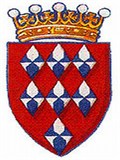
Joan de Burgh, Baronnes D’Arcy, Countess of Kildare

March 7, 2013 16 Comments

Coat of Arms

De Burgh Coat of Arms

My 20th great grandmother was born in Ulster, and died in Kildare, Ireland.  Her father,Richard Og, was Earl of Ulster and a very powerful man:

Richard Og de Burgh, 2nd earl of Ulster (1259 – July 29, 1326), called The Red Earl, was one of the most powerful Irish nobles of the late 13th and early 14th centuries, a son of Walter de Burgh, the 1st Earl of Ulster (of the second creation) and Lord of Connacht.[1] His name, “Richard Og”, meant Richard the Young, probably a reference to his youth when he became earl in 1271, or to differentiate him from his grandfather, Richard Mor. He was also known as the Red Earl.

Richard Og was the most powerful of the de Burgh Earls of Ulster, succeeding his father in Ulster and Connacht upon reaching his majority in 1280.[1] He was a friend of King Edward I of England, and ranked first among the Earls of Ireland. Richard’s wife Marguerite de Guînes was the cousin of King Edward’s queen. He pursued expansionist policies that often left him at odds with fellow Anglo-Irish lords.

His daughter Elizabeth was to become the second wife of King Robert the Bruce of Scotland. However, this did not stop him leading his forces from Ireland to support England’s King Edward I in his Scottish campaigns and when the forces of Edward Bruce invaded Ulster in 1315, the Earl led a force against him, but was beaten at Connor in Antrim. The invasion of Bruce and the uprising of Felim O’Connor in Connacht left him virtually without authority in his lands, but O’Connor was killed in 1316 at the Second Battle of Athenry, and he was able to recover Ulster after the defeat of Bruce at Faughart.[1]

He died July 29, 1326 at Athassel Priory, near Cashel, County Tipperary.

Children and family

  • Aveline de Burgh (b. c. 1280), married John de Bermingham, 1st Earl of Louth
  • Eleanor de Burgh (1282 – aft. August 1324)
  • Elizabeth de Burgh (c. 1284 – 26 October 1327), married Robert I of Scotland
  • Walter de Burgh (c. 1285–1304)
  • John de Burgh (c. 1286 – 18 January 1313)
  • Matilda de Burgh (c. 1288–1320), married Gilbert de Clare, 8th Earl of Hertford
  • Thomas de Burgh (c. 1288–1316)
  • Catherine de Burgh (c. 1296 – 1 November 1331), married Maurice Fitzgerald, 1st Earl of Desmond
  • Edmond de Burgh (b. c. 1298)
  • Joan de Burgh (c. 1300 – 23 April 1359), married Maurice FitzThomas FitzGerald, 4th Earl of Kildare

Lady Joan De Burgh, Baroness Darcy (1290 – 1359)

is my 20th great grandmother
Elizabeth Darcy (1331 – 1390)
daughter of Lady Joan De Burgh, Baroness Darcy
Johanna Hertforth (1345 – 1428)
daughter of Elizabeth Darcy
Ellen Urswick (1364 – 1459)
daughter of Johanna Hertforth
Richard Molyneux (1386 – 1460)
son of Ellen Urswick
Sir Richard Earl Sefton Molyneux (1422 – 1459)
son of Richard Molyneux
Thomas Sir 8th Earl of Sefton Molyneux (1445 – 1483)
son of Sir Richard Earl Sefton Molyneux
Lawrence Castellan of Liverpool Mollenaux (1490 – 1550)
son of Thomas Sir 8th Earl of Sefton Molyneux
John Mollenax (1542 – 1583)
son of Lawrence Castellan of Liverpool Mollenaux
Mary Mollenax (1559 – 1575)
daughter of John Mollenax
Francis Gabriell Holland (1596 – 1660)
son of Mary Mollenax
John Holland (1628 – 1710)
son of Francis Gabriell Holland
Elizabeth Holland (1652 – 1737)
daughter of John Holland
Richard Dearden (1645 – 1747)
son of Elizabeth Holland
George Dearden (1705 – 1749)
son of Richard Dearden
George Darden (1734 – 1807)
son of George Dearden
David Darden (1770 – 1820)
son of George Darden
Minerva Truly Darden (1806 – )
daughter of David Darden
Sarah E Hughes (1829 – 1911)
daughter of Minerva Truly Darden
Lucinda Jane Armer (1847 – 1939)
daughter of Sarah E Hughes
George Harvey Taylor (1884 – 1941)
son of Lucinda Jane Armer
Ruby Lee Taylor (1922 – 2008)
daughter of George Harvey Taylor
Pamela Morse
I am the daughter of Ruby Lee Taylor

Lady Joan de Burgh was the daughter of Richard de Burgh, 2nd Earl of Ulster and Margaret.1 She married, firstly, Thomas FitzJohn FitzGerald, 2nd Earl of Kildare, son of John FitzThomas FitzGerald, 1st Earl of Kildare and Blanche de la Roche, on 16 August 1312 at Greencastle, County Down, Ireland.2 She married, secondly, Sir John Darcy, 1st Lord Darcy de Knayth, son of Sir Roger Darcy and Isabel d’Aton, on 3 July 1329.3 She died on 23 April 1359.1 From 16 August 1312, her married name became FitzGerald.1 As a result of her marriage, Lady Joan de Burgh was styled as Countess of Kildare on 12 September 1316. From 3 July 1329, her married name became Darcy.3

Children of Lady Joan de Burgh and Thomas FitzJohn FitzGerald, 2nd Earl of Kildare

· John FitzGerald2 b. 1314, d. 1323

· Maurice FitzThomas FitzGerald, 4th Earl of Kildare+1 b. 1318, d. 15 Aug 1390

· Richard FitzGerald, 3rd Earl of Kildare2 b. c 1319, d. 7 Jul 1333

Children of Lady Joan de Burgh and Sir John Darcy, 1st Lord Darcy de Knayth

· Elizabeth Darcy+3

· Aymer Darcy3

· Roger Darcy3

· Sir William D’Arcy+3 b. 1330

Citations

1. G.E. Cokayne; with Vicary Gibbs, H.A. Doubleday, Geoffrey H. White, Duncan Warrand and Lord Howard de Walden, editors, The Complete Peerage of England, Scotland, Ireland, Great Britain and the United Kingdom, Extant, Extinct or Dormant, new ed., 13 volumes in 14 (1910-1959; reprint in 6 volumes, Gloucester, U.K.: Alan Sutton Publishing, 2000), volume VII, page 222. Hereinafter cited as The Complete Peerage.

2. Charles Mosley, editor, Burke’s Peerage, Baronetage & Knightage, 107th edition, 3 volumes (Wilmington, Delaware, U.S.A.: Burke’s Peerage (Genealogical Books) Ltd, 2003), volume 2, page 2298. Hereinafter cited as Burke’s Peerage and Baronetage, 107th edition.

3. Charles Mosley, Burke’s Peerage and Baronetage, 107th edition, volume 1, page 1027.