mermaidcamp
Keeping current in wellness, in and out of the water
You can scroll the shelf using ← and → keys
You can scroll the shelf using ← and → keys

headstone
My 8th great-grandfather came to America as young boy with his parents and became a founder of Hartford, Connecticut.
John was born about 1628 in England and came to Connecticut with his parents as a young child. He married Hannah Potter, daughter (or possibly stepdaughter) of William Potter of Stamford. John and his brother Joseph moved from Stamford to Hempstead, Long Island, and returned to Connecticut by 1664. John died 5 Feb 1699, probably in Connecticut. John was one of seven original proprietors of Greenwich, CT, as described at http://www.rootsweb.com/~ctfairfi/pages/greenwich/greenwich_index.htm
“On February 5, 1664, the Seven Proprietors made a formal request to the General Assembly in Hartford to be allowed to separate from Stamford and to support its own minister and lay out its own lands. The Seven Proprietors were John MEAD, Jonathan RENALDS, John HOBBY, Joseph FERRIS, Joshua KNAPP, Angell HUSTED, and Jeffrey FERRIS.
On May 11, 1665, the General Assembly in Hartford declared Greenwich a separate township, and authorized funds for the hiring and support of an orthodox minister. In 1672, the so-called “27 Proprietors” bought land from the few remaining Indians to the west of the “Myanos River.” This land became known as “Horseneck” because of the neck of land now known as Field Point was the common HORSE PASTURE. ”
John signed all documents with a mark, but had several books in his estate inventory, so he could probably read but not write.
John and Hannah had eleven children:
John, b. abt 1658, married Ruth Hardey in 1681.
Joseph, b. 2 May 1660, married Mary.
Hannah, b. abt 1661, married John Scofield 12 Jul 1677.
Ebenezer, b. 1663, married Sarah Knapp in 1691.
JONATHAN, b. abt 1665, married Martha Finch.
David, b. abt 1665, married Abigail Leane 16 Dec 1707.
Benjamin, b. May 1666, married first Sarah Waterbury, second Rachel Brown.
Nathaniel, b. abt 1669, married Rachel.
Samuel, b. abt 1673, married Hannah.
Abigail, b. abt 1675. Fairfield Probate Records cited in The Ancestry of Elizabeth Barret Gillespie, “reveal that she was incompetent to manage her own affairs: ‘Whereas John Mead Sen’r, deceased, of Greenwich, haveing not made Satisfieing provision in his will for his daughter Abegaile Mead, She being not Capable of doing for her Self as may be desired by Reason, whearof Ebeneaz Mead of Greenwich dos hereby, in the presence of ye Prerogative Court, Engage to pay unto ye s’d Abegaile Mead, his sister, ye Sum of therty and five pounds, to be paid unto her According as he Shall Apprehend She Shall stand in Need of it for her Comfortable subsistence.”

Tomac Burying Ground
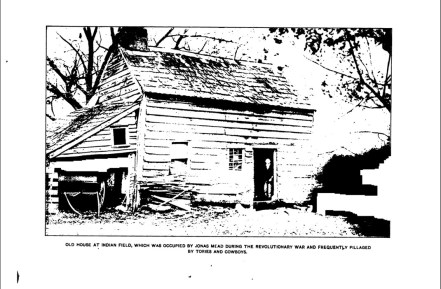
John Mead’s House
John Mead (1634 – 1699)
8th great-grandfather
Benjamin Daniel Mead (1667 – 1746)
son of John Mead
Mary Mead (1724 – 1787)
daughter of Benjamin Daniel Mead
Abner Mead (1749 – 1810)
son of Mary Mead
Martha Mead (1784 – 1860)
daughter of Abner Mead
Abner Morse (1808 – 1838)
son of Martha Mead
Daniel Rowland Morse (1838 – 1910)
son of Abner Morse
Jason A Morse (1862 – 1932)
son of Daniel Rowland Morse
Ernest Abner Morse (1890 – 1965)
son of Jason A Morse
Richard Arden Morse (1920 – 2004)
son of Ernest Abner Morse
Pamela Morse
I am the daughter of Richard Arden Morse
The following anecdote, which has been preserved by tradition, shows his character: One day when he was quite an old man, as he was going for his grist on horseback to the mill at Dumpling Pond, before he reached the Mianus River he overtook and old Quaker jogging slowly along, loaded with a heavy budget. In a real spirit of kindness he offered to take the Quaker’s load upon his horse, and thus give him a lift on his journey. No,replied the Quaker, thee don’t get my bundle, for I can read men’s thoughts. Thee wants to get my bundle, and then thee’ll run off. Thee don’t get my bundle. Very well, was the simple reply, and so they went slowly on together. At last they came to the brink of the Mianus River. Here the Quaker was really in trouble. How to cross a river, two or three feet deep, dry shod, was quite a puzzle. But he gladly accepted a second offer of assistance from the horseman. The bundle was mounted in front, John in the middle, and the Quaker behind. Arriving at the centre of the river, in pretending to adjust his stirrup John caught the Quaker by the heel and gave him a gratuitous bath. Such treatment was too much, even for Quaker forbearance, and the victim, with his hands full of pebbles, would have taken summary vengeance, had not the other party threatened to put the bundle under a similar course of treatment. This threat, and the lecture following it, gradually cooled off the Quaker’s anger. John informed him that all had been done for his good, to teach him a lesson. And the lecturer said he hoped the stranger would never again profess to read men’s thoughts. For, said he, I asked you to ride, kindly in the first place, when you refused; but at the second time of asking, I really intended to do as I have just done. So saying, and tossing the bundle back, he rose on, leaving his companion to apply the moral as he thought best.

“America, God shed his grace on thee and crown thy good with brotherhood…from sea to shining sea!” Happy 240th Birthday America! “The cost of freedom is always high, but Americans have always paid it. And one path we shall never choose, and that is the path of surrender, or submission.” President John F. Kennedy Freedom […]
via Happy 240th Birthday America! — Cherokee Billie Spiritual Advisor
Patriotic Poetry by the Man in Black, Johnny Cash

Margaret Howard
Margaret Howard was the daughter of Thomas Howard, 4th duke of Norfolk (March 10, 1538-June 2, 1572) and his second wife, Margaret Audley (1539-January 10, 1564). Her father’s execution for treason when she was ten limited her choice of husbands but in February 1569 she married Robert Sackville of Bolbrooke and Buckhurst, Sussex and Knole, Kent (1561-February 27, 1609), later Lord Buckhurst and earl of Dorset. They had three sons and three daughters, including Richard (1590-1624), Edward (1591-1652), Anne, and Cecily. After her death, Robert Southwell published a small volume in her honor and Sackville described his late wife as “a lady . . . of as great virtue . . . as is possible for any man to wish to be matched withal.” He asked to be buried at Withyham “as near to my first dearly beloved wife . . . as can be” and ordered that £200 to £300 be spent on their tomb, with effigies of them both. A devout Catholic, she influenced his religious beliefs.

Robert Sackville and Margaret Howard
Margaret Howard (1561 – 1591)
13th great-grandmother
Lady Ann Dorset (1552 – 1680)
daughter of Margaret Howard
Robert Lewis (1574 – 1656)
son of Lady Ann Dorset
Robert Lewis (1607 – 1644)
son of Robert Lewis
Ann Lewis (1631 – 1686)
daughter of Robert Lewis
Joshua Morse (1669 – 1753)
son of Ann Lewis
Joseph Morse (1692 – 1759)
son of Joshua Morse
Joseph Morse (1721 – 1776)
son of Joseph Morse
Joseph Morse III (1756 – 1835)
son of Joseph Morse
John Henry Morse (1775 – 1864)
son of Joseph Morse III
Abner Morse (1808 – 1838)
son of John Henry Morse
Daniel Rowland Morse (1838 – 1910)
son of Abner Morse
Jason A Morse (1862 – 1932)
son of Daniel Rowland Morse
Ernest Abner Morse (1890 – 1965)
son of Jason A Morse
Richard Arden Morse (1920 – 2004)
son of Ernest Abner Morse
Pamela Morse
I am the daughter of Richard Arden Morse
Robert Sackville, 2nd Earl of Dorset, married first, in February 1580, Lady Margaret, by then only surviving daughter of Thomas Howard, 4th Duke of Norfolk, then suspected as a crypto-Catholic. By her he had six children, including:
Richard Sackville, 3rd Earl of Dorset (18 March 1589 – 28 March 1624)
Edward Sackville, 4th Earl of Dorset (1591 – 17 July 1652)
Anne, married Sir Edward Seymour, eldest son of Edward Seymour, Viscount Beauchamp, and, secondly, Sir Edward Lewis (d.1630) by whom she had issue
Cecily, married Sir Henry Compton, K.B.
Lady Margaret died on 19 August 1591; Robert Southwell, who never met her, published in her honour, in 1596, Triumphs over Death, with dedicatory verses to her surviving children
My 15th great-uncle, Thomas Sackville, inherited a calendar house, Knole House, in Kent, where they, no doubt, all visited. The house became famous:
Knole is an English country house in the town of Sevenoaks in west Kent, surrounded by a 1,000-acre (4.0 km2) deer park. One of England’s largest houses, it is reputed to be a calendar house, having 365 rooms, 52 staircases, 12 entrances and 7 courtyards. It is known for the degree to which its early 17th-century appearance is preserved, particularly in the case of the state rooms: the exteriors and interiors of many houses of this period, such as Clandon Park in Surrey, were dramatically altered later on. The surrounding deer park has also survived with little having changed over the past 400 years except for the loss of over 70% of its trees in the Great Storm of 1987.
In 1566, during the reign of Queen Elizabeth I, it came into the possession of her cousin Thomas Sackville whose descendants the Earls and Dukes of Dorset and Barons Sackville have lived there since 1603 (the intervening years saw the house let to the Lennard family). Most notably, these include writer Vita Sackville-West (her Knole and the Sackvilles, published 1922, is regarded as a classic in the literature of English country houses); her friend and lover Virginia Woolf wrote the novel Orlando drawing on the history of the house and Sackville-West’s ancestors. The Sackville family custom of following the Salic rules of primogeniture prevented Sackville-West herself from inheriting Knole upon the death of her father Lionel (1867–1930), the 3rd Lord Sackville, and her father bequeathed the estate to his brother Charles (1870–1962).

Dropping the truth bomb
In Tucson we experience a major dilution of our tattle as it passes through needless layers of middlemen to reach law enforcement central. We report one thing and the bureaucrats report quite another, which results in chronic problems that might be solved by collecting really reliable intelligence in the first place. Pure tattle goes from your lips to the ears of the principal. It does not travel through the teachers, the students, or the PTA. Tattle, and the need to deliver pure, unadulterated tattle, is not only a basic human right, but a basic human instinct. To make use of this instinct one simply needs to direct and manage it professionally. A vessel, a place, and a time must be established for the task of collecting pure intelligence from citizens and using it to both prevent and stop chronic crime.
I am urging my police department to initiate a program on-line as well as in person at the station near me to give folks a chance to express themselves for ten minutes at ten a.m. each Tuesday. I am choosing this increment of time because they always say they are too busy to try new communication methods. They can’t possibly argue that they don’t have 10 minutes a week. Citizens in my neighborhood have gone to the station with evidence of black tar heroin in a vial and a report of on going crime near their home, but were turned away at the window of the cop shop and the vial of evidence was thrown in the trash in front of the two ladies. We need a system that works much better than that. We need to trust that what we report and evidence we submit is used to help solve the crime problems here. I think a funnel that directs intelligence to the attention of the police live on a regular basis will make a difference to the level of trust in the whole operation. I believe intelligence is the most valuable commodity police can have. It protects both them and us.
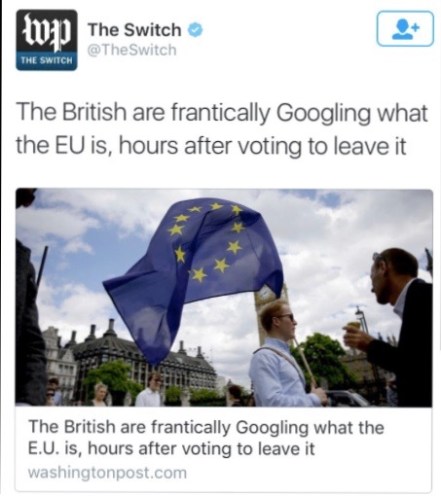
Brits become curious
https://twitter.com/biancatesfaye1/status/746394668485742593
The British voted to leave the European Union and then started to google “What is the EU?” They also started to inquire into getting Irish passports, since Ireland is in the EU. The vote was dramatically divided between young and old in the electorate. Scotland is furious because they stayed in Great Britain recently because the Brits told them that by leaving Britain they would leave the EU. Now they voted overwhelmingly to stay, and feel mighty baited and switched. To add insult to injury Donald Trump flew to Scotland to “celebrate” the Brexit with his peeps. Ever the party boy, he started tweeting his glee to the horror of Scottish people. He has run into controversy in that country with conservation groups. Now he is indicating he is thrilled at the collapse of the currency because more people will visit his golf course. He knows how to make a point. Sometimes the only way to deal with current events is to laugh at them.
https://twitter.com/Jenn_Abrams/status/746388211195248641
https://twitter.com/RosieBlackadder/status/746392996682285058
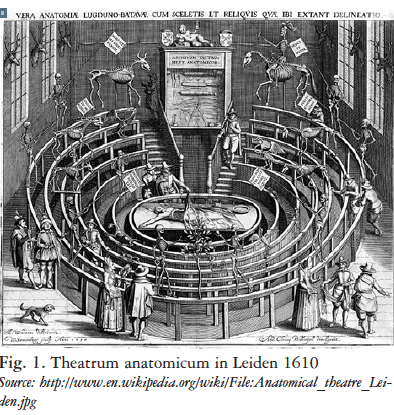
Anatomical theater Leiden 1610

Anatomical theater in Padua 1594
The dead teach the living is the meaning of the phrase mortui vivos docent. It was used to justify dissection of human bodies for science. In the middle ages there was fear of dead bodies that, coupled with real danger present in corpses, made dissection dangerous. The biggest danger faced by science, however, was the long arm of Catholic Church. Miguel Serveto (1511-1553), was a physician and theologist who studied medicine in Paris at Sylvius’. He published work describing post mortem examinations of corpses. For this sin Serveto was burnt at the stake along with his books, both medical and religious, sentenced to death by the Holy Inquisition.
The Greek physician Gallen taught anatomy in the second century, teaching by direct empirical observation. Ironically, his teachings were used to dissect one or two executed prisoners a year in the Middle Ages, but this practice was done more for theater than for research. In 1543 of Andreas Vesalius published his masterpiece, De Humani Corporis Fabrica. Vesalius, a young physician and professor at the University of Padua, changed the course of medical history. He demonstrated the importance of direct observation, creating illustrations of anatomy in action, teaching the secrets of the inner workings of the human body. Public dissection for educational purposes became popular.
The Middle Ages were plagued by the black death. Those dark ages were characterized by superstition and ignorance. The Renaissance occurred when science, art, and humanism gave rise to new philosophies. Some of these same ideas drove my ancestors to colonial America in the 1600’s. One of my ancestors, Dr John Greene, was perhaps the first surgeon in America. I have to wonder if he ever did any dissection in his training. I have not. I puked in the clay bucket for the art class (located right next to the science lab) in the 10th grade and was excused for frog dissection. It was never mentioned again, and boy was I glad.
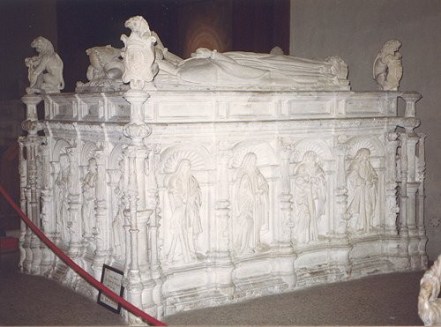
Tomb of Thomas Howard – 3rd Duke of Norfolk St. Michael’s Church; Suffolk,England Thomas Howard was buried here after his death on Aug. 25, 1554. It is possibly the best preserved ornate stonework in Europe. Although both Thomas and his wife, Elizabeth Stafford appear on the same monument, only he is buried there. She was interred in the Howard Chapel in St. Mary’s Church, Lambeth. This was due to the unhappy marriage and final separation.
Thomas Howard, 3rd Duke of Norfolk (1473 – 25 August 1554) was a prominent Tudor politician. He was uncle to two of the wives of Henry VIII, Anne Boleyn and Catherine Howard, and played a major role in the machinations behind these relationships. After falling from favor he was imprisoned in the Tower of London with his dukedom forfeit, and was released on the accession of Mary I. He aided in securing Mary’s throne, setting the stage for alienation between his Catholic family and the Protestant royal line that would be continued by Elizabeth I.
As with all the Dukes of Norfolk, Thomas Howard was descended from Edward I. He was the son of Thomas Howard, 2nd Duke of Norfolk, and Elizabeth Tilney. Thomas Howard succeeded his younger brother Edward as Lord High Admiral in 1513. Until 1524 he was styled Earl of Surrey.
Norfolk first married Anne of York, daughter of Edward IV of England and Elizabeth Woodville on 4 February 1494 at Greenwich Palace. The couple had at least two children: Thomas Howard (c. 1496-1508) and a stillborn child (c. 1499). There are also suggestions of short-lived Henry Howard and William Howard resulting from this marriage.
Following Anne’s death in 1511 he married Elizabeth Stafford, daughter of Edward Stafford, 3rd Duke of Buckingham and Alianore Percy on 8 January 1512. They had three children: Lady Mary Howard (c. 1513-1555) who married Henry Fitzroy, illegitimate son of Henry VIII; Henry Howard (1517-1547) was one of the founders of Renaissance poetry; and Thomas Howard (c.1520-1582). The marriage with Elizabeth was unhappy. When Elizabeth complained about his mistress, Bess Holland, the Duke beat her. The couple remained estranged until Norfolk’s death.
On his father’s death in 1524 he inherited the dukedom of Norfolk and was named Lord High Treasurer and Earl Marshal, making Howard one of the most premier nobles in the kingdom. He distinguished himself many times in battle, and was an able soldier. His power increased somewhat after his niece Anne Boleyn became Henry VIII’s mistress, sometime around 1527. However, their relationship was fraught with difficulty since Anne found her uncle to be selfish and untrustworthy. Although they were political allies throughout the late 1520s alongside Howard’s brother-in-law Thomas Boleyn, Anne’s father, Norfolk once complained that Anne used words to him “that one would not use to a dog.” She was crowned queen in 1533, and was probably influential along with Queen Anne in securing the marriage of Norfolk’s daughter Mary to Henry Fitzroy.
Queen Anne’s religious and political vision was more radical than Norfolk’s, and their relationship deteriorated throughout 1535 and 1536 as Henry VIII became increasingly unfaithful, including with Anne’s cousin, Mary Shelton. Putting his own security before family loyalties, he presided over Queen Anne’s trial in 1536, giving a death sentence despite her probable innocence. The next day, he condemned to death his nephew, Anne’s brother George for the crime of incest with his own sister, the Queen.
After the death of Jane Seymour he used another of his nieces, the teenaged Catherine Howard to strengthen his power at court by orchestrating an affair between her and the 48 year-old king. He used Henry’s subsequent marriage to Catherine as an opportunity to dispose of his long-term enemy Thomas Cromwell, who was beheaded in 1540. Queen Catherine’s reign was a short one, however, since Thomas Cranmer, the Archbishop of Canterbury, discovered that she was already secretly betrothed before her marriage to Henry and had been extremely indiscreet since. Catherine was beheaded in February 1542, and numerous other Howards were imprisoned in the Tower – including the duke’s stepmother, brother, two sisters-in-law and numerous servants.
Catherine Howard’s execution was his downfall, despite Norfolk’s desperate efforts to heal the rift. He had become the leader of the premier family in England; as the uncle of Anne Boleyn and Catherine Howard, and the great-uncle of Jane Seymour[1] He had also benefited from the influence of several of the King’s mistresses, his nieces Mary Boleyn and Elizabeth Carew and his wife’s aunt, Anne Stafford, Countess of Huntingdon. In 1546, Norfolk allegedly hatched a plot to make his daughter, Mary Howard, the King’s mistress, even though she was the widow of Henry’s illegitimate son.[2] In December 1546, he was arrested in company with his son Henry and charged with treason. Henry VIII died the day before the execution was due to take place, and Norfolk’s sentence was commuted to imprisonment. The Earl of Surrey was less fortunate and had been executed a few days previously.
Norfolk remained in the Tower throughout the reign of Edward VI of England and his dukedom remained forfeit. He was released by Mary I in 1553, due to the Howards being an important Catholic family, and the dukedom was restored. The Duke showed his gratitude by leading the forces sent to put down the rebellion of Thomas Wyatt, who had protested against the Queen’s forthcoming marriage to Philip II of Spain and had planned to put Anne Boleyn’s daughter, the future Elizabeth I on the throne in Mary’s place. The result of Norfolk’s suppression of the Wyatt Rebellion was Princess Elizabeth’s imprisonment in the Tower (although there was not enough evidence to convict her on treason, since she clearly had not been party to the rebels’ precise intentions) and the execution of the Queen’s cousin Lady Jane Grey. Norfolk died not long after the Wyatt Rebellion and was succeeded by his grandson Thomas. The 4th Duke, also a Catholic, was executed on Elizabeth’s orders for illegally plotting to marry Mary Queen of Scots.
Thomas Howard’s tomb is situated in Framlingham Church, Suffolk. It is among the best preserved example of ornate stonework in Europe
Lord Thomas Howard (1473 – 1554)
15th great-grandfather
Lady Katherine Howard Duchess Bridgewater (1495 – 1554)
daughter of Lord Thomas Howard
William ApRhys (1522 – 1588)
son of Lady Katherine Howard Duchess Bridgewater
Henry Rice (1555 – 1621)
son of William ApRhys
Edmund Rice (1594 – 1663)
son of Henry Rice
Edward Rice (1622 – 1712)
son of Edmund Rice
Lydia Rice (1649 – 1723)
daughter of Edward Rice
Lydia Woods (1672 – 1738)
daughter of Lydia Rice
Lydia Eager (1696 – 1735)
daughter of Lydia Woods
Mary Thomas (1729 – 1801)
daughter of Lydia Eager
Joseph Morse III (1756 – 1835)
son of Mary Thomas
John Henry Morse (1775 – 1864)
son of Joseph Morse III
Abner Morse (1808 – 1838)
son of John Henry Morse
Daniel Rowland Morse (1838 – 1910)
son of Abner Morse
Jason A Morse (1862 – 1932)
son of Daniel Rowland Morse
Ernest Abner Morse (1890 – 1965)
son of Jason A Morse
Richard Arden Morse (1920 – 2004)
son of Ernest Abner Morse
Pamela Morse
I am the daughter of Richard Arden Morse
My 15th great-grandfather, Thomas Howard, 3rd Duke of Norfolk, KG (1473 – 25 August 1554) aided Mary in securing her throne, which ended him and his family in a world of trouble. He was fully immersed in the politics of Henry VIII, and paid the price for it. Those were treacherous times to be close to the king.

Thomas Howard
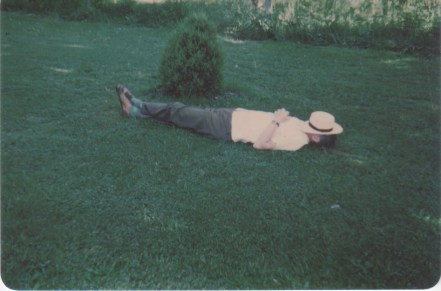
Richard Arden Morse snoozing
My dad loved to smoke food outside on his Hasty Bake. He collected his hickory wood in Arkansas and cured it by soaking it in water in small pieces. He was serious about his ribs, but smoked lots of fish too because he was a fisherman. In fact, fishing and cooking were my dad’s only hobbies until he took up hot air ballooning with my mom in his 60’s. We lived blocks from a famous golf club, and our town was golf obsessed, but my parents did not play the game. They were dancers. They like to have friends over to sing at the player piano.
He did not play competitive sports except when he was on a bolas criollas (bocce) team in Venezuela for a few years. He never went hunting, owned no guns, and had very poor eyesight. He was obsessed with catching fish. Money was no object when fishing was involved. Deep sea, tropical jungle, or lake..it made no difference to my dad. He did not fly fish..that was not his thing. He flew to South America and spent tons of money to go on jungle fishing trips with his friends. I did some fishing with him in my childhood, but not very much. I took up fishing seriously later in life with a hand line in the Bahamas. I never liked the rod and reel system. I did not like the complication of it. You can feel the fish on a hand line, but your choices are fewer. His parents both liked to fish, and there are written reports I have that his mother was an expert angler in her childhood in Kansas.
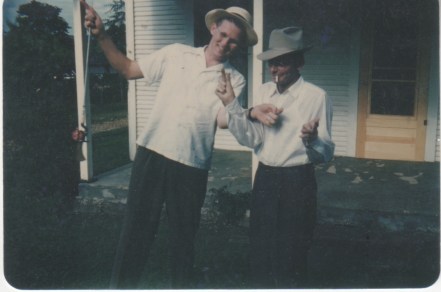
My father and his father

Dick on a family fishing grip
What I remember doing as a team sport with my father was brunch. We made crepes Suzettes and broiled grapefruit from his Wolf in Chef’s Clothing cookbook. We had a small kitchen so there was just enough room for the two of us to make the crepes and the set them on fire in a chafing dish. Our regular menu had nothing so exciting as flambé food. I used to beg for that brunch, but it only came around on very rare occasions. The other popular dish, for which my dad got credit but was actually concocted by my mom, was home-made ice cream. We had the only ice cream freezer in my immediate neighborhood, so this memorable dish made my back yard a very popular place to be. My friends and I would sit on the top of the freezer when it got harder to turn the handle. This usually happened during a barbecue while he was watching the smoker.
I have some very fond memories of cooking with my dad. His repertoire was small, but each dish was very special. Did you cook with your father in your childhood, gentle reader?

sunset
Celeritas et veritas is my new favorite Latin phrase. It means promptness and truth. My father had a catch phrase by which he was known during his career which was, “Hurry every chance you get.” I think hurrying is overrated, and truth underrated. If I create my own coat of arms I will make Celeritous et Veritas my motto. I have been very attached to my 3 P’s for decades. They are:
In my mind these are the tenants that apply to best practices in business, pleasure, and civic matters. I judge people on their ability to be prompt, allowing for circumstances. Some folks have erratic schedules and responsibility loads based on family or career. I have been in that position myself, juggling multiple tasks. We are not always able to be perfectly prompt, but if tardiness is a chronic habit politeness and professionalism are completely destroyed. Those who never show up on time are passively aggressive and are shunned in my world after a reasonable trail period. All relationships would benefit from more promptness and truth. What is your Latin motto, gentle reader?

Marriage of Henry I of England (1068-1135) to Princess (Eadgyth) Matilda of Scotland. Engraving c1880.
My 27th great-grandmother was Princess of Alba/Albany. She was christened Edith, but adopted the name Matilda upon her marriage to Henry. It was thought the Norman barons might not respect a queen with a Saxon name.
The marriage to Henry represented the union of Norman & Saxon royal lines.
She was crowned Queen Consort 11/14 Nov 1100 at Westminster Abbey.
Henry married Matilda (daughter of Margaret) to appease his Saxon subjects. She is interred at Westminster Abbey, London, England (or Winchester).
Christened Edith, but adopted the name Matilda upon her marriage to Henry I. It was thought the Norman barons might not respect a queen with aSaxon name. The marriage to Henry represented the union of the Norman &Saxon royal lines. She is also known by the diminutive of that name – Maud (which had been the name of Henry’s mother). She was the sister of Edgar, King of Scotland 1098-1107.
Edith – Margaret (Matilda) of Scotland, born in 1080 and died in 1118, married Henry I. Beauclerc, King of England, son of William I The Conqueror (ruler from 1066 to 1087) and his wife, Matilda of Flanders,who died in 1083… Matilda was educated at Wilton and Romsey Abbey where she said that her aunt, Christina, forced her to wear a black veil. She threw it on the ground whenever left alone, in spite of beatings. When her mother died she came to England to Edgar Atheling, her uncle. She was a sister of King David of Scotland; she was a correspondent of Anselm and Hildebert, Bishop of Le Mans, who wrote poetry about her. She was asymbol of the union of Saxon and Norman. She was Henry’s Queen for seventeen years and six months, and died in her prime like most of herfamily. Henry and Matilda had a son and a daughter.

Matilda Princess of Scotland
Matilda of Scotland (born Edith; c. 1080 – 1 May 1118) was the first wife and queen consort of Henry I of England. Matilda was born around 1080 in Dunfermline, the daughter of Malcolm III of Scotland and Saint Margaret. She was christened Edith, and Robert Curthose stood as godfather at her christening. Queen Matilda was also present at the font and may have been her godmother.When she was about six years old, Matilda (or Edith as she was then probably still called) and her sister Mary were sent to Romsey, where their aunt Cristina was abbess. During her stay at Romsey and Wilton, the Scottish princess was much sought-after as a bride; refusing proposals from William de Warenne, 2nd Earl of Surrey, and Alan Rufus, Lord of Richmond. Hermann of Tournai even claims that William II Rufus considered marrying her.She had left the monastery by 1093, when Anselm, Archbishop of Canterbury, wrote to the Bishop of Salisbury ordering that the daughter of the king of Scotland be returned to the monastery that she had left. After the death of William II Rufus in August 1100, his brother, Henry, soon seized the royal treasury and crown. His next task was to marry and Henry’s choice was Matilda. Because Matilda had spent most of her life in a convent, there was some controversy over whether she was a nun and thus ineligible for marriage. Henry sought permission for the marriage from Archbishop Anselm of Canterbury, who returned to England in September 1100 after a long exile. Professing himself unwilling to decide so weighty a matter on his own, Anselm called a council of bishops in order to determine the legality of the proposed marriage. Matilda testified that she had never taken holy vows, insisting that her parents had sent her and her sister to England for educational purposes, and her aunt Cristina had veiled her to protect her “from the lust of the Normans.” Matilda claimed she had pulled the veil off and stamped on it, and her aunt beat and scolded her for it. The council concluded that Matilda was not a nun, never had been and her parents had not intended that she become one, giving their permission for the marriage. Matilda and Henry seem to have known one another for some time before their marriage — William of Malmesbury states that Henry had “long been attached” to her, and Orderic Vitalis says that Henry had “long adored” Edith’s character.Her mother was the sister of Edgar the Ætheling, proclaimed but uncrowned King of England after Harold, and through her, Matilda was descended from Edmund Ironside and thus from the ancient royal family of Wessex, which in the 10th century, became the royal family of a united England. This was very important as Henry wanted to make himself more popular with the English people and Matilda represented the old English dynasty. In their children, the Norman and English dynasties would be united. Another benefit was that England and Scotland became politically closer; three of her brothers became kings of Scotland and were unusually friendly to England during this period.After Matilda and Henry were married on 11 November 1100 at Westminster Abbey by Archbishop Anselm of Canterbury, she was crowned as “Matilda”, a fashionable Norman name. She gave birth to a daughter, Matilda, in February 1102, and a son, William, in November 1103.As queen, she maintained her court primarily at Westminster, but accompanied her husband on his travels around England, and, circa 1106–1107, probably visited Normandy with him. She also served in a vice-regal capacity when Henry was away. Her court was filled with musicians and poets; she commissioned a monk, probably Thurgot, to write a biography of her mother, Saint Margaret. She was an active queen and, like her mother, was renowned for her devotion to religion and the poor. William of Malmesbury describes her as attending church barefoot at Lent, and washing the feet and kissing the hands of the sick. She also administered extensive dower properties and was known as a patron of the arts, especially music.After Matilda died on 1 May 1118 at Westminster Palace, she was buried at Westminster Abbey. The death of her only adult son and Henry’s failure to produce a legitimate son from his second marriage led to the succession crisis of The Anarchy.After her death, she was remembered by her subjects as “Matilda the Good Queen” and “Matilda of Blessed Memory”, and for a time sainthood was sought for her, though she was never canonized.Matilda and Henry had four children:
Matilda of England (c. February 1102 – 10 September 1167), Holy Roman Empress, Countess consort of Anjou, called Lady of the English
William Adelin, (5 August 1103 – 25 November 1120), sometimes called Duke of Normandy, who married Matilda (d.1154), daughter of Fulk V, Count of Anjou.
Euphemia, died young.
Richard, died young.
She is known to have been given the name “Edith” (the Old English Eadgyth, meaning “Fortune-Battle”) at birth, and was baptized under that name. She is known to have been crowned under a name favored by the Normans, “Matilda” (from the Germanic Mahthilda, meaning “Might-Battle”), and was referred to as such throughout her husband’s reign. It is unclear, however, when her name was changed, or why. Accordingly, her later name is used in this article. Historians generally refer to her as “Matilda of Scotland”; in popular usage, she is referred to equally as “Matilda” or “Edith”. References
Chibnall, Marjorie. The Empress Matilda: Queen Consort, Queen Mother, and Lady of the English, 1992
Hollister, Warren C. Henry I, 2001
Parsons, John Carmi. Medieval Mothering, 1996
Parsons, John Carmi. Medieval Queenship, 1997
Huneycutt, Lois L. “Matilda of Scotland: A Study in Medieval Queenship”.” 2004.
Matilda Princess of Scotland (1079 – 1118)
27th great-grandmother
Matilda, Empress of England Beauclerc (1102 – 1167)
daughter of Matilda Princess of Scotland
Henry II “Curtmantel” PLANTAGENET, “King of England” (1133 – 1189)
son of Matilda, Empress of England Beauclerc
Eleanor Spain Plantagenet (1162 – 1214)
daughter of Henry II “Curtmantel” PLANTAGENET, “King of England”
Berenguela CASTILE LEON (1181 – 1244)
daughter of Eleanor Spain Plantagenet
Saint Ferdinand Castile amp Leon (1199 – 1252)
son of Berenguela CASTILE LEON
Alfonso X Wise Castile Leon amp Galicia (1221 – 1284)
son of Saint Ferdinand Castile amp Leon
Sancho Brave Castile Leon (1258 – 1295)
son of Alfonso X Wise Castile Leon amp Galicia
Beatrice Sanchez Infanta Castile (1293 – 1359)
daughter of Sancho Brave Castile Leon
Peter I Portugal Cruel Algarve (1320 – 1367)
son of Beatrice Sanchez Infanta Castile
John I DePinto (1358 – 1433)
son of Peter I Portugal Cruel Algarve
Beatrix DePinto (1403 – 1447)
daughter of John I DePinto
John Fettiplace (1427 – 1464)
son of Beatrix DePinto
Richard Fettiplace (1460 – 1511)
son of John Fettiplace
Anne Fettiplace (1496 – 1567)
daughter of Richard Fettiplace
Mary Purefoy (1533 – 1579)
daughter of Anne Fettiplace
Susanna Thorne (1559 – 1586)
daughter of Mary Purefoy
Gov Thomas Dudley (1576 – 1653)
son of Susanna Thorne
Anne Dudley (1612 – 1672)
daughter of Gov Thomas Dudley
John Bradstreet (1652 – 1718)
son of Anne Dudley
Mercy Bradstreet (1689 – 1725)
daughter of John Bradstreet
Caleb Hazen (1720 – 1777)
son of Mercy Bradstreet
Mercy Hazen (1747 – 1819)
daughter of Caleb Hazen
Martha Mead (1784 – 1860)
daughter of Mercy Hazen
Abner Morse (1808 – 1838)
son of Martha Mead
Daniel Rowland Morse (1838 – 1910)
son of Abner Morse
Jason A Morse (1862 – 1932)
son of Daniel Rowland Morse
Ernest Abner Morse (1890 – 1965)
son of Jason A Morse
Richard Arden Morse (1920 – 2004)
son of Ernest Abner Morse
Pamela Morse
I am the daughter of Richard Arden Morse
 mermaidcamp