mermaidcamp
Keeping current in wellness, in and out of the water
You can scroll the shelf using ← and → keys
You can scroll the shelf using ← and → keys


My 8th great-grandmother was born in Salisbury, Witlshire in 1633. She was baptized in St Thomas church in Salisbury. She was sailing on the ship James through a hurricane when she landed in America in 1635, as an infant traveling with her parents:
1635 voyage
The ship James of London sailed from Southhampton on April 5, 1635 and arrived in Massachusetts Bay on June 3,[5] 1635 with master William Cooper[disambiguation needed] at the helm.
The ship James left King’s Road in Bristol on May 23, 1635 with master John Taylor[disambiguation needed] at the helm. From England to Massachusetts in a fleet of five ships, the Angel Gabriel, the Elizabeth (Bess), the Mary and the Diligence.
On June 3, 1635, the James joined four other ships, and set sail for the New World with just over 100 passengers as part of a fleet of five ships, including the families of Richard Mather, Captain John Evered and John Ayer. As they approached New England, a hurricane struck and they were forced to ride it out just off the coast of modern-day Hampton, New Hampshire. According to the ship’s log and the journal of Increase Mather, whose father Richard Mather and family were passengers, the following was recorded;
“At this moment,… their lives were given up for lost; but then, in an instant of time, God turned the wind about, which carried them from the rocks of death before their eyes. …her sails rent in sunder, and split in pieces, as if they had been rotten ragges…”
They tried to stand down during the storm just outside the Isles of Shoals, but lost all three anchors, as no canvas or rope would hold, but on Aug 13, 1635, torn to pieces, and not one death, all one hundred plus passengers the James manages to make it to Boston Harbor two days later.
The Angel Gabriel was wrecked off the coast of Maine, but the smaller, faster ships, the Mary, the Bess, and the Diligence outran the storm, and landed in Newfoundland on August 15, 1635.
Mary Greene (1633 – 1686)
is my 8th great grandmother
Benoni Sweet (1663 – 1751)
son of Mary Greene
Dr. James Sweet (1686 – 1751)
son of Benoni Sweet
Thomas Sweet (1732 – 1813)
son of Dr. James Sweet
Thomas Sweet (1759 – 1844)
son of Thomas Sweet
Valentine Sweet (1791 – 1858)
son of Thomas Sweet
Sarah LaVina Sweet (1840 – 1923)
daughter of Valentine Sweet
Jason A Morse (1862 – 1932)
son of Sarah LaVina Sweet
Ernest Abner Morse (1890 – 1965)
son of Jason A Morse
Richard Arden Morse (1920 – 2004)
son of Ernest Abner Morse
Pamela Morse
I am the daughter of Richard Arden Morse
Her father was a physician and surgeon in Rhode Island. She married James Sweet when she was 17 and began a healing practice:
“This Sweet family is known as the Bone-Setting Sweets. This gift is said to be inherited from Mary Greene, wife of James Sweet 1622-1698, who was the daughter of Surgeon John Greene. They also had another gift, the faculty of compounding linaments and washes from the roots and barks found in almost every neighborhood, and are very efficacious in reducing inflammation and swellings and in preventing mortification.”
Her husband James had also arrived as a child with his parents, and was an early settler of Rhode Island.
Birth: 1622 Death: Jun. 18, 1698South Kingstown
Washington County
Rhode Island, USA
The second son of JOHN & MARY SWEET, James Sweet came with his parents to America in 1632. He worked at a grist mill with his step-father, Ezekiel Holliman. He was an inhabitant of Warwick in 1648, Commissioner in 1653/1658/1659, freeman in 1655, juryman in 1656 and lived at the estate of the late William Congdon at the foot of Ridge Hill. He married MARY GREENE, daughter of JOHN GREENE & JOANE (TATTERSOL) GREENE, about 1654 in Providence, RI. On Sept. 30, 1660, he sold to Thomas Greene, the lot he had received from the town of Warwick along with meadow land. Later, the family moved to Prudence Island in Portsmouth Twp. about four miles soutwest of Bristol in 1664 being one of the first families to live on the island from 1664 to about 1685. Several family members are buried in the old family burying ground in the center of the island.
On November 8, 1686, he deeded his land in Providence that he had inherited from his father to eldlest son, Philip of Prudence Island. On the same date, he deeded to son, Benoni, certain land in Mashiantatack, and to son, James of Prudence Island, Valentine of Kingstown, and Samuel & Mary Sweet living with their parents, land in Mashiantatack. In 1695, James deposed and gave his age as 73. He died at age 93 years.
All the “bone-setter” family lines originate with James Sweet and his wife, Mary, who learned the art of bone-setting from her surgeon father, JOHN GREENE. James Sweet & his brother, John Sweet were interpreters to the Indians for first settlers and their names can be found on early Indian deeds. James Sweet signed with his mark.
Family links:
Parents:
John Sweet (1603 – 1637)
Mary Periam Sweet (1600 – 1681)
Spouse:
Mary Greene Sweet (1633 – 1686)
Children:
Benoni Sweet (1663 – 1751)*
Valentine Sweet (1664 – 1725)*
Samuel Sweet (1667 – 1728)*
Burial:
Sweet – Austin Lot
North Kingstown
Washington CountyRhode Island, USA
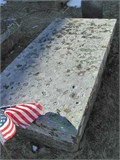
grave

Dr John
My 9th great-grandfather bought Shawomet, Warwick, RI for 144 fathoms of wampum:
Dr. John Greene was the fourth and youngest son of Sir Richard Greene, of Bowridge Hall. He was born in 9 Feb 1597 at Salisbury, Wiltshire, England. He came to Warwick, Rhode Island, sailing on the ship “James” 5 April 1635, arriving in Boston, Massachusetts, 3 June 1635. He moved his family to Providence, Rhode Island in 1637 all four of his sons being born in England. John born 15 Aug 1620, Peter born 10 Mar 1622, James born 21 Jun 1626, Thomas born 4 Jun 1628. His wife and sons all lived out their lives and are buried in Warwick, Rhode Island. He was one of the original 12 members of the Baptist Church. In January 1643, he and 10 others bought from Miantonimoh, Chief of the Narrowgansets (Native American Tribe), for 144 fathoms of Wampun, the tract of land called Shawomet (Warwick, Rhode Island). — A fathom (six feet of strung beads) of white wampum was worth ten shillings and double that for purple beads. A coat andBuskins “set thick with these Beads in pleasant wild works and a broad Belt of the same (Josselyn 1988: 101)” belonging to King Philip (Wampanoag) was valued at Twenty pounds. Even in the 1600s there was noted distinctiveness of Native-made wampum and the inability of others to counterfeit it, although attempts at imitations included beads of stone and other materials. — In 1644 Dr. John Greene went to England with Samuel Gorton and Randall Holden, returning in 1646, their mission successful. John Greene was Commissioner from 1654-57, Deputy Governer 1654. He married his first wife, Joan Tattersall, at Salisbury, England in St. Thomas Church, 4 Nov. 1619. Dr. John Greene died 11 Mar 1658. He is buried next to his wife Joan.
He married often and well:
JOHN GREENE, Surgeon, the progenitor of the Warwick Greenes, was the son of Richard and Mary (Hooker) Greene, and was born on his father’s estate at Bowridge Hill in the parish of Gillingham, County Dorset, England, about 1590. Though not so recorded, dates before and after him would seem to determine this as the year of his birth. His father, Richard, grandfather Richard, and great-grandfather, Robert, had for nearly one hundred years before him resided at Bowridge Hill, and were undoubtedly a branch of the Northamptonshire family of Greene through a younger son.
The mother of John Greene, surgeon, Mary Hooker, was the daughter of John Hooker (alias Vowell), who was born at Exeter, England, about 1524, his father, Robert Hooker, having been mayor of that city in 1520.
John Greene removed early to Sarum (Salisbury), the county town of Wiltshire, and was there married at St. Thomas’s Church,’ November 4, 1619, to Joanne Tattershall (or, as it was written on the church register, “Tatarsole”). Nothing is definitely known of her English connections. The name is frequently found in early records among post-mortem examinations, parliamentary writs, and charters, and is variously written Tatersall, Tateshall, Tatashall, Tatershal, and Tattershall. The first of the family of whom we have mention came in with William the Conqueror and obtained the lordship of Tattershall in Lincolnshire, where he seated himself and from which he took his surname. His descendants were seated in Berkshire and Norfolkshire, and were held in high repute. It is probable that other branches located in other counties, and it is not improbable to suppose that Joanne the wife of John Greene, who emigrated to America from Salisbury, County Wilts, was a connection of the family of George Tattershall, who was seated at Stapleford, County Wilts, which is about five miles distant from his Salisbury home ; but as yet this relationship has not been proved. The following note, recently received by the compiler in answer to an inquiry about records at Stapleford, may be of interest in this connection
“Stapleford Vicarage, Salisbury,” October 18, 1900.
“Madam: I have received your letter of the 25th September, but regret to say that I cannot help you in your research, as the Stapleford Register begins only with the year 1637. “J. F. D. HOERNLE, “Vicar of Stapleford.” [Joanne Tattershall ‘s marriage date was 1619, eighteen years earlier.]
The marriage of John Greene and the baptisms of all his seven children, recorded in the Parish Register of St. Thomas’s Church at Salisbury, England, are still extant. He is therein styled “Mr.” and “Gent,” a mark of some distinction at that date.” He resided at Salisbury with his family, following his profession, for about sixteen years. On April 6, 1635, he was registered for embarkation at Hampton, England with his wife and six children (one having probably died in England before this date),” in the ship James, of 200 tons, William Cooper, Master, for New England.” After a voyage of fifty-eight days he arrived at Boston, Mass., June 3, 1635. He first settled at Salem, Mass., where he was associated with Roger Williams, purchasing or building a house there, but soon after Mr. Williams’s flight from Salem (1636) he sold it and, joining Williams at Providence, secured his home lot, No.15, on the main street. He was one of eleven men baptized by Roger Williams, and one of the twelve original members of the first Baptist church on this continent, organized at Providence, R. I. He was the first professional medical man in Providence Plantations. He is alluded to in Goodwin’s Pilgrim Republic (p. 407) as “one of the two local surgeons” at Providence in 1638, though we are told “the people of Providence relied solely upon him for surgical aid long after his removal to Warwick in 1643.”
His first wife, Joanne Tattershall , the mother of all his children, died soon after his removal to Rhode Island and it is supposed was buried at Conimicut, Old Warwick (?). He married (2) ” Ailsce (Alice) Daniels, a widow” (recorded as proprietor of a home lot in Providence, 1637). They removed to Warwick, 1642-3. At the time of the persecution of the Shawomet pioneers (October, 1643), when “forty mounted and armed men,” sent from Boston to arrest them, fired over their houses, the women and children fled to the woods. Fright and exposure caused the death of the (second) wife of John Greene. (It seems more probable that this was the wife who was buried at Conimicut.) Samuel Gorton wrote of this attack of the Massachusetts troops: ” Afflicting our wives and children, forcing them to betake themselves some into the woods among the Indians, suffering such hardships as occasioned the death of divers of them, as the wife of John Greene, as also the wife of Robert Potter.” Judge Staples, in his Annals of Providence, mentions the fact that the second marriage of John Greene was not recorded, but he found evidence in Probate Records, where mention is made of the son of Alice Daniels as “John Greene’s stepson.”
Evidence of this marriage is also given in the following item:
“In the division of 52 House lots John Greene senior had lot between Thomas James on the North and John Smith on the South, and he inherited the lot of Alice Daniels his second wife between Wm. Harris on the North and John Sweet on the South” {Rhode Island Colonial Records [Printed], vol. i., p. 24).
In files. City Clerk’s office. Providence, is a book containing “A revised List of Lands and Meadows as they were originally lotted for the beginning of the Plantations of Providence in the Narragansett Bay in New England unto the [then] inhabitants of the said Plantations until anno i6—-.”
First in order are the “home lots,” beginning at the Mile-end Cove, south end of town, between Fox Point and Wickenden Streets, lots all bounded by Town (Main) Street on the west and by what is now Hope Street on the east. The name of Alice Daniels is found on this list.
Mr. Greene was married (3) in London, England, about 1644, to Phillippa (always written Phillip), who returned with him to Warwick, R. I., 1646. Her family name is not known. She died at Warwick, March 11, 1687, aged about eighty-seven years, having survived her husband for nearly thirty years.’ In further support that his third wife was from London we quote the words of Samuel Gorton, who, in a letter from Warwick addressed ” to Edward Calverly at his house by the east end of Christ Church in Newgate Market, London,” and dated November 20, 1649, wrote of this last wife of John Greene: ” Your auld neighbour, our loving friend, Mrs. Greene, hath writ a letter of advise to you [which] made me laugh not a little, which I heartily wish may come to your hands. She laies out the benefights of these parts better than I could have advised to have done. She takes well with the country and cheerfully performs her place [part], hath the love of all, non can open their mouth against her, which is a rare thing in these parts.”
Excerpt from the Book Title: The Greenes of Rhode Island, with historical records of English ancestry, 1534-1902 Author: General George Sears Greene (1801-1899) Publisher: Knickerbocker press Published in: New York Date of Publication: 1903 The Excerpt is Pages 54 – 56 The Document was retrieved from http://www.archive.org/details/greenesofrhodeis00gree
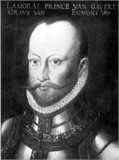
The Count

his statue in Brussels
My 12th great grandfather was a count who was very political and fancy. He was beheaded in Brussels in front of the town hall. He is the ancestor of the Pilgrim Richard Sears, who was fancy and political in Plymouth Colony. He has been immortalized by Goethe and Beethoven. He came before William of Orange, and was a big part of the history of Dutch independence.
from Wikipedia: http://en.wikipedia.org/wiki/Lamoral,_Count_of_Egmont
Lamoral, Count of Egmont, Prince of Gavere (November 18, 1522 – June 5, 1568) was a general and statesman in Flanders just before the start of the Eighty Years’ War, whose execution helped spark the national uprising that eventually led to the independence of the Netherlands.
The Count of Egmont headed one of the wealthiest and most powerful families in the Low Countries. Paternally, a branch of the Egmonts ruled the sovereign duchy of Guelders until 1538. Lamoral was born in La Hamaide near Ellezelles. His father was John IV of Egmont, knight in the Order of the Golden Fleece. His mother belonged to a cadet branch of the House of Luxembourg, and through her he inherited the title prince de Gavere.[2] During his youth, he received a military education in Spain. In 1542, he inherited the estates of his elder brother Charles inHolland. His family’s stature increased further in 1544 when he wed, in the presence of the Holy Roman Emperor Charles V and of the Archduke Ferdinand Iat Spires, the Countess Palatine Sabine of Simmern, whose brother became theElector Palatine Frederick III.[1]
In the service of the Spanish army, he defeated the French in the battles of Saint-Quentin (1557) and Gravelines (1558). Egmont was appointed stadtholder of Flanders and Artois in 1559, aged only 37.
As a leading Flemish nobleman, Egmont was a member of King Philip II of Spain‘s official Council of State for Flanders and Artois. Together with William, Prince of Orange and the Count of Horn, he protested against the introduction of theinquisition in Flanders by the cardinal Antoine Perrenot Granvelle, bishop of Arras. Egmont even threatened to resign, but after Granvelle left, there was a reconciliation with the king. In 1565, Egmont went to Madrid to beseech Philip II, the king of Spain, for a change of policy in the Netherlands, but met with little more than courtesy.[1]
Soon thereafter, the Iconoclasm started, and resistance against the Spanish rule in the Netherlands increased. As a devout Catholic, Egmont deplored the iconoclasm, and remained faithful to the Spanish king.
After Philip II sent the Duke of Alba to the Netherlands, William of Orange decided to flee Brussels. Having always declined to do anything that smacked of lèse majesté, Egmont refused to heed Orange’s warning, thus he and Horn decided to stay in the city. Upon arrival, Alba almost immediately had the counts of Egmont and Horn arrested on charges of treason, and imprisoned them in a castle inGhent, prompting Egmont’s wife and eleven children to seek refuge in a convent. Pleas for amnesty came to the Spanish king from throughout Europe, including from many reigning sovereigns, the Order of the Golden Fleece, and the king’s kinsman the Emperor Maximilian II, all to no avail.
On 4 June Egmont and Horn were condemned to death, and lodged that night in the maison du roi. On June 5, 1568, both men, aged only 46 and 44 respectively, were beheaded in the Grote Markt in Brussels, Egmont’s uncomplaining dignity on the occasion being widely noted. Their deaths led to public protests throughout the Netherlands, and contributed to the resistance against the Spaniards. The Count of Egmont lies buried in Zottegem.[3]
Nowadays, a statue erected on the Petit Sablon / Kleine Zavel Square in Brussels commemorates the Counts of Egmont and Horn, in historical overview usually mentioned together as “Egmond en Hoorne” and hailed as the first leaders of the Dutch revolt, as the predecessors of William of Orange, who grew to importance and obtained the leadership after their execution, and who was assassinated in 1584 in Delft, having succeeded in liberating parts of The Netherlands in the early years of the Eighty Years’ War (1568–1648).
Egmont’s offices and vast estates were forfeited upon his execution. By inheritance he had been count of Egmont (or Egmond), prince de Gavre and van Steenhuysen, baron de Fiennes, Gaesbeke and La Hamaide, seigneur de Purmerent, Hoogwoude, Aertswoude, Beyerland, Sottenghien, Dondes, Auxy and Baer. Some of these lands were eventually returned to his heirs. By appointment, he was Captain General of the Lowlands under Charles V, knight of the Golden Fleece since 1546, and Imperial Chamberlain. Despite the taint of treason and the family’s impoverishment, his niece Louise of Lorraine-Mercouer, was chosen to became the Queen consort of Henry III of France in 1575.
Literary treatments
The Count of Egmont is the main character in a play by Goethe, Egmont. In 1810Ludwig van Beethoven composed an overture and incidental music for a revival of the play.
Phillip Lamoral VanEgmond (1530 – 1568)
is my 12th great grandfather
Marie L Egmond (1564 – 1584)
daughter of Phillip Lamoral VanEgmond
Richard Sears (1590 – 1676)
son of Marie L Egmond
Silas Sears (1638 – 1697)
son of Richard Sears
Silas Sears (1661 – 1732)
son of Silas Sears
Sarah Sears (1697 – 1785)
daughter of Silas Sears
Sarah Hamblin (1721 – 1814)
daughter of Sarah Sears
Mercy Hazen (1747 – 1819)
daughter of Sarah Hamblin
Martha Mead (1784 – 1860)
daughter of Mercy Hazen
Abner Morse (1808 – 1838)
son of Martha Mead
Daniel Rowland Morse (1838 – 1910)
son of Abner Morse
Jason A Morse (1862 – 1932)
son of Daniel Rowland Morse
Ernest Abner Morse (1890 – 1965)
son of Jason A Morse
Richard Arden Morse (1920 – 2004)
son of Ernest Abner Morse
Pamela Morse
I am the daughter of Richard Arden Morse


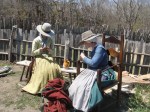
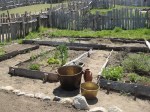
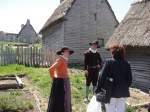
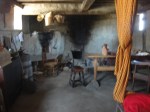
My ancestors attended the first Thanksgiving party in Plimouth Colony. Most of my heritage is English, and the Mayflower was full of my peeps. My 11th great-grandfather attended the feast as a representative of the Wampanoag people. When he first met the Pilgrims they gave him alcohol , which must have aroused his curiosity. The political system in New England was way different from the one in Europe. The local natives made friends with the Pilgrims with reservations (not the kind they have been granted by the US government). They had made contact with Brits before which had resulted in an outbreak of disease that killed a large number of the people. They saw the Mayflower, but kept a distance since they assumed these Brits would be diseased as well.
Quadequina is credited with bringing popcorn to the first Thanksgiving. The Wampanoags I met in Plymouth this year told me it was actually parched corn. Either way, there was a potluck dinner and Quadequina brought corn as his dish. He acted in good faith, was a respectful and polite guest, even allowing the Pilgrims to occupy his homeland and build a fort around their town. It was fairly impossible for the American natives to do due diligence on these religious Pilgrims who had arrived and planned to stay. Squanto, the famous translator, was about all the interface available. The Natives of New England were stuck with this highly unnatural situation through no fault of their own. They just happened to be where the Mayflower got stuck on the rocks. It was their luck.
When my 10th great-grandfather Gabriel Wheldon wanted to marry Quadequina’s daughter he gave his consent and helped the couple avoid disaster from the Pilgrims:
Gordon B. Hinckley, Shoulder for the Lord” by George M. McCune page 35- ” Two of the early immigrants to Plymouth colony were Gabriel Wheldon, of Arnold, Nottingham, England, and his brother (name unknown). Gabriel had been married in England before sailing to America but his first wife named Margaret evidentally was deceased at the time of his migration. Both brothers had a free spirit much like Stephen Hopkins and found their way to the camps of the Wampanoags. There they both fell in love with two of the daughters of chief Quadequina, younger brother of the Great Chief. They each married and Gabriel gave his second wife the English name ‘Margaret’ after his first spouse. The two counseled with their father-in-law and his older brother Massasoit regarding what to do. The Plymouth Colony would probably punish them for their intermarriage. Massasoit advised them to return to the colyn and all would be well. The Plymouth Colony tribunals saved face by banishing the couples from Plymouth for life but did not send them back to England. Gabriel and Margaret established their home in Barnstable where the Hinckleys came in late 1630’s and here Gabriel and Margaret raised a large family of girls. One of these was Catherine “Catone” Wheldon who married Stephen Hopkins'(First to build a house in Mattachesse Villiage/Yarmouth) oldest son Giles on October 9, 1639. Giles had been given the home his father had build in Yarmouth and the couple established their home and raised four children there. When Giles’ father Stephen passed away about July 1644, his father left an estate.. Some records give Margaret as the wife of Gabriel Wheldon. It seems she was his second wife, who, after his death, may have returned to England with Rev. Marmaduke Matthews and his wife. Other records state that Margaret was an Indian Princess, Wampanoag, and give her lineage for several generations. He _may_ have been Margaret’s brother. He immigrated 1638, aPreacher of the Church of Malden. He returned to England in 1655, and Several of the Malden Church members went with him. Of these returning pilgrims, the widow Margaret Wheldon, who left a law-suit over the estate of her deceased husband, Gabriel, also went to England. (from: Pg 155 The History of Malden, Massachusetts, 1633-1785). Rev Matthews died 1683 in England.
I don’t believe he is partial to either pecan or pumpkin pie. I think Quadequina would have liked to see us celebrate equal rights and justice each November. The story of Thanksgiving is mostly mythical, since very little was recorded at the time. Turkeys may not be the best logo for American seasonal gratitude. Popcorn deserves a place at the table.

Themis on Delphic tripod
Themis is the Titan goddess of law, order, and prophecy. She gave birth to the Horae, the seasons, who determine the timing of all things in this world and beyond. The scales of justice are associated with her. The oracle at Delphi was founded by Themis and her mother Gaia. both of them are in associated with prophecy. She was an early bride of Zeus, and acted as his councilor, instructing him in divine law. Man made law often is in direct conflict with divine law. Themis defends her mother Gaia, the earth. In this age of eco-consciousness and efforts to both save and restore natural resources in peril, Themis is the pure spirit of ecology. She defends the beings, all the animal, mineral, and vegetable offspring of the Earth. In the War of the Titans, she took the side of the Olympians. She was the most important goddess in the first generation of Olympians. Today her significance is as a defender of our earthly mother. Can you think of people or institutions that embody divine justice?
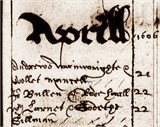
marriage record

coat of arms (with leg)

Goodith’s grave
My 12th great-grandmother arrived in Massachusetts Colony before 1632, and joined the church in Charlestown with her well respected husband. Her unusual first name is often misspelled in records, but it is an old English name.
Note: From “The Great Migration Begins…”: :’Goodith’ was a distinct given name, not to be confused with ‘Judith’, and not to be interpreted as ‘Goodwife,’ as has been done. “The Winthrop Society shows Goodith’s birth as circa 1585 and death as before 1632.
Judith Gillman was also known as Goodith Gillman. She was born in 1594 at Bermondsey, London, England. On 22 April 1606 at St. Olive, Southwork, Surrey, England, Judith married William Learned. Judith Gillman and William Learned were admitted to the church on 6 December 1632 at Woburn, Middlesex County, Massachusetts. Judith Gillman died on Friday, 24 June 1661 at Malden, Middlesex County, Massachusetts, at age 67 years.
[S466] Ancestral File. Family History Library, Salt Lake City, Salt Lake County, Utah, 1994. [S14] Wyman, Thomas Bellows. The Genealogies and Estates of Charlestown, Massachusetts 1629-1818. 1879. Reprint Somersworth, New Hampshire: New England History Press, 1982.
WILLIAM LEARNED d. Woburn, MA 1 Mar 1646, m. GOODITH GILMAN, d. 24 Jan 1661.
William Learned came from Bermondsey, Surrey, England and settled at Charlestown in the Massachusetts Bay in or before 1632, possibly in 1630 with the Winthrop fleet. He and his wife Judith were admitted to the First Church of Charlestown on Dec. 6, 1632, their names being the first two on the list of members. “1632, 10 mo., day 6, William Learned and Goodeth, his wife, were admitted”, being the first admissions after the separation from the Boston Church. He became a freeman on May 14, 1634 and a Selectman on Feb. 13, 1635-6. On March 2, 1637 he was chosen one of four to divide, for stinting, the common land, and on Feb. 12, 1637-8 he and Mr. Greene were appointed to settle the wages of the school-master.[2] On April 26, 1638 William Learned and five others were on a committee “to consider of some things tending toward a body of laws”
William was a subscriber to the town orders for Woburn, drawn up at Charlestown Dec. 18, 1640. In 1641 William moved to Woburn where he was one of the seven original members of the church on August 14, 1642. He was chosen constable April 13, 1643 and Selectman of Woburn in 1643 and 1645. These offices were only given to trusted and respected men.
Goodith Gillman (1592 – 1661)
is my 12th great grandmother
Sarah Learned (1604 – 1652)
daughter of Goodith Gillman
Mary Ewer (1637 – 1693)
daughter of Sarah Learned
Mehitable Jenkins (1655 – 1684)
daughter of Mary Ewer
Isaac Hamblin (1676 – 1710)
son of Mehitable Jenkins
Eleazer Hamblin (1699 – 1771)
son of Isaac Hamblin
Sarah Hamblin (1721 – 1814)
daughter of Eleazer Hamblin
Mercy Hazen (1747 – 1819)
daughter of Sarah Hamblin
Martha Mead (1784 – 1860)
daughter of Mercy Hazen
Abner Morse (1808 – 1838)
son of Martha Mead
Daniel Rowland Morse (1838 – 1910)
son of Abner Morse
Jason A Morse (1862 – 1932)
son of Daniel Rowland Morse
Ernest Abner Morse (1890 – 1965)
son of Jason A Morse
Richard Arden Morse (1920 – 2004)
son of Ernest Abner Morse
Pamela Morse
I am the daughter of Richard Arden Morse
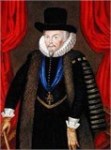


John Neville, 3rd Baron Neville de Raby
John Neville Baron Neville de Raby Spouse (s) Maud Percy
Elizabeth Latimer, 5th Baroness Latimer Issue Ralph Neville, 1st Earl of Westmorland
Thomas Neville, 5th Baron Furnivall
Elizabeth Neville
Alice Nevile
Maud Neville
Eleanor Neville
John Neville, 6th Baron Latimer
Elizabeth Neville Noble family House of Neville Father Ralph Neville, 2nd Baron Neville de Raby Mother Alice Audley Born 1328 Died 17 October 1388
John Neville, 3rd Baron Neville de Raby, KG (1328 – 17 October 1388) was born at Castle Raby, County Durham, England to Ralph Neville, 2nd Baron Neville de Raby and Alice de Audley. He fought in the Battle of Neville’s Cross on 17 October 1346 as a Captain in his father’s division. He was Knighted in 1360 and after his father’s death in 1367 he succeeded to the title of 3rd Baron Neville of Raby. In 1368 he served as the English ambassdor to France. He was Admiral of the King’s fleet and served in the wars against the Scots and French. He was made a Knight of the Garter in 1369. Neville married Maud Percy, daughter of Henry de Percy, 2nd Baron Percy and Idoine de Clifford. After Maud died in 1379 John married a second time to Elizabeth Latimer, daughter of William Latimer, 4th Baron Latimer.
Children
Six children by Maud Percy
Ralph de Neville, 1st Earl of Westmorland (1364–1425)
Thomas de Nevill, 5th Baron Furnivall (1377–1406)
Elizabeth de Neville (b. 1379)
Alice de Nevile (1379–1433)
Maud de Neville (b. 1379)
Eleanor de Neville (1379–1441), married Ralph de Lumley, 1st Baron Lumley. They were parents to Catherine de Lumley.
Two Children by Elizabeth Latimer
John de Neville, 6th Lord Latimer (1382–1430)
Elizabeth de Neville, Baroness Latimer (b. 1388)
Baron Percy
References
thePeerage.com Accessed May 13, 2007
Peerage of England Preceded by
Ralph Neville Baron Neville de Raby
1367–1388 Succeeded by
Ralph Neville
I was born in 1951 when this map had very little activity. We had drills in my elementary school for bomb preparedness. My parents voted Republican, and strongly opposed JFK. I remember the cold war well as a formative part of my thinking. My parents, and later the national government, seemed either unaware or unethical to me. In my family history there are knights and military heroes. In modern times my uncles fought in WWII, but my father was nearly blind, so he did not serve. I believe the atom bomb has changed the potential for corruption, destruction, and total Armageddon. What was settled with swords in the middle ages is now settled by dangerous committee. Human nature has not changed all that much, but the swiftness and anonymity with which all creation can now be destroyed is daunting.
Maude
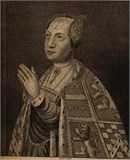
My 17th great-grandmother is buried in Nottinghamshire, England. She was a baroness. I can tell we are headed for confusion because my mother is also related to these de Nevilles. My mother’s ended up in Jamestown, Virginia, while these Nevilles on my dad’s side are all ancestors of the poet, Anne Dudley Bradstreet.
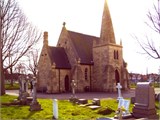
resting place
Maud NEVILLE , 6th Baroness Furnival Sex: F Birth: ABT 1392 in Worksop, Nottinghamshire, England Death: ABT 1423 in Worksop Priory, Nottinghamshire, England
Maud, Baroness Furnivall(e) in her own right according to later doctrine (d. c 1423), daughter and heiress of Thomas Neville, 5th Lord (Baron) Furnivall(e) in right of his 1st wife. [Burke’s Peerage]
Maud de Nevill(e), de jure Baroness Furinvall(e) in her own right; b. c 1392; m. by 12 Mar 1306/7, as his 1st wife, Sir John Talbot, 1st Earl of Shrewsbury and Waterford, who, however, before his creation as Earl in 1442 was called to Parliament as Lord (Baron) De Furnyvall or De Halomshire (sic.) in right of his wife 26 Oct 1409, and d. c 1423. [Burke’s Peerage, p. 2241]
————————-
Maud de Neville, Lady Furnivall, b. c 1392, d. c 1423, daughter of Thomas Nevill, Lord Furnivall, by his wife, Joan Furinvall, Lady Furnivall. [Magna Charta Sureties]
————————-
He [John Talbot] m. 1stly, bef. 12 Mar 1406/7, Maud, according to modern doctrine suo jure Baroness Furnivalle, elder daughter of Thomas (Neville), Lord Furnivalle, and only child and heir of (his 1st wife) Joan, according to modern doctrine suo jure Baroness Furnivalle, only daughter and heir of William (de Furnivalle), Lrod Furnivalle. She, who was b. c 1392 sat at Queen Katherine’s Coronation banquet in Westminster Hall, 21 Feb 1420/1. She d. about 1423 and was buried in Worksop Priory, Notts. [Complete Peerage XI:698-704]
————————-
BARONY of FURNIVALLE (VI)
MAUD NEVILLE, suo jure Baroness FURNIVALLE, elder daughter and heir of Thomas NEVILLE, LORD FURNIVALLE, and only child of her mother Joan, daughter and heir of William, LORD FURNIVALLE. She married, before 12 March 1406/7, as 1st wife, John TALBOT, 2nd son of Sir Richard TALBOT, of Goodrich [LORD TALBOT], by Ankarette, his wife. She was aged 15 and more at her father’s death. On 3 May 1407 the King took the fealty of John Talbot, and John and his wife, the said Maud, had livery of all the lands which her father had held by the courtesy after the death of Joan his wife, and also of Maud’s moiety of the tenements which her father had held in his demesne as of fee. [Complete Peerage V:591, (transcribed by Dave Utzinger)]
From jweber site
Maud Neville , 6th Baroness Furnival
The article on Maud in CP V reads (in full):
FURNIVALLE
BARONY BY WRIT.
VI. 1407. 1. Maude Neville, elder da. and h. of Thomas Neville, Lord Furnivalle, and only child of her mother, Joan, da. and h. of William, Lord Furnivalle, all above named. She m., before 12 Mar. 1406/7, as 1st wife, John Talbot, 2nd son of Sir Richard Talbot, of Goodrich [LORD TALBOT], by Ankarette, his wife, both above named. She was aged 15 and more at her father’s death. On 3 May 1407 the King took the fealty of John Talbot, and John and his wife, the said Maud, had livery of all the lands which her father had held by the courtesy after the death of Joan his wife,(d) and also of Maud’s moiety of the tenements which her father had held in his demesne as of fee.(e) John Talbot was sum. to Parl. from 26 Oct. (1409) 11 Hen. IV to 26 Feb. (1420/1) 8 Hen. V, by writs directed _Johanni Talbot_, with the additions, _domino de Furnyvall’, de Furnyvall’_, or _de Halomshire_. He was heir of his niece, Ankarette, da. of his elder br., Sir Gilbert Talbot, of Goodrich and Whitchurch [Lord Talbot]: she d. 13 Dec. 1421,(f) after which date the writs summoning him to Parl. were directed _Johanni Talbot_, with the addition of _militi_ or _chivaler_, only. His 1st wife, the said Maud, was bur. in Worksop Priory.(g) On 20 May 1442 he was cr. EARL OF SHROPSHIRE, but is commonly known as Earl of Shrewsbury. He was slain in battle at Castillon on the Dordogne, 17 July 1453, and was bur. at Whitchurch, Salop: M.I.* See Shrewsbury, Earldom.
(d) _Fine Roll_, 8 Hen. IV, m. 11.
(e) All Thomas Neville had thus held was three messuages and a virgate of land in Peaton and Diddlebury, in Corve, Dale, Salop. (_Close Roll_, 8 Hen. IV, m. 12).
(f) Ch. _Inq. p. m._ (on Ankarette, da. and h. of Gilbert Talbot chr.), Henry V, file 58, no. 44. See Talbot. [Ref: CP V:591]
(g) _Monasticon_, vol. vi, p. 123.
Maude de Neville (1392 – 1421)
is my 17th great grandmother
John Talbot (1413 – 1460)
son of Maude de Neville
Isabel Talbot (1444 – 1531)
daughter of John Talbot
Sir Richard Ashton (1460 – 1549)
son of Isabel Talbot
Sir Christopher Ashton (1493 – 1519)
son of Sir Richard Ashton
Lady Elizabeth Ashton (1524 – 1588)
daughter of Sir Christopher Ashton
Capt Roger Dudley (1535 – 1585)
son of Lady Elizabeth Ashton
Gov Thomas Dudley (1576 – 1653)
son of Capt Roger Dudley
Anne Dudley (1612 – 1672)
daughter of Gov Thomas Dudley
John Bradstreet (1652 – 1718)
son of Anne Dudley
Mercy Bradstreet (1689 – 1725)
daughter of John Bradstreet
Caleb Hazen (1720 – 1777)
son of Mercy Bradstreet
Mercy Hazen (1747 – 1819)
daughter of Caleb Hazen
Martha Mead (1784 – 1860)
daughter of Mercy Hazen
Abner Morse (1808 – 1838)
son of Martha Mead
Daniel Rowland Morse (1838 – 1910)
son of Abner Morse
Jason A Morse (1862 – 1932)
son of Daniel Rowland Morse
Ernest Abner Morse (1890 – 1965)
son of Jason A Morse
Richard Arden Morse (1920 – 2004)
son of Ernest Abner Morse
Pamela Morse
I am the daughter of Richard Arden Morse
pedigree

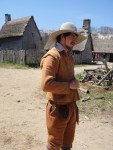




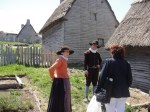


Since last November I have visited my ancestral homeland at Plimouth Colony in Massachusetts. The museum and displays helped me to more vividly picture what those Pilgrims were doing in the 1600s. I have many ancestors who arrived on the Mayflower, and I am not overly impressed with that fact. I am, however, truly grateful to learn that I am Wampanoag. I study history by learning about my family tree. Thanksgiving, as taught in elementary school, has very little to do with the real events that took place at the time. There was a feast and celebration, and there was a great deal of unease about these English people who built a fort around their town and put cannons on the second story of their church. These Pilgrims, who are depicted to children as seeking religious freedom, only believed in religious freedom for themselves. They had been repressed in Holland for their beliefs and wanted a place where their somewhat radical thinking would not clash with any royal Euros. They did not propose to extend religious freedom and tolerance to the native people they encountered in America. They proposed to convert them to Christianity, their own style of Christianity.

Thomas Dudley
Harvard was endowed and sustained in business by conversion of native people. The Indian College was used to educate and convert natives. If they had not come up with donations based on this premise, Harvard may never have become the institution it is today. My tenth great grandfather Thomas Dudley signed the charter for Harvard because he was the colonial governor when it opened. His daughter and my 9th great grandmother, Anne Bradstreet, was a poet and wife of Simon Bradstreet, also a colonial governor.

Harvard College Charter
I am not as proud of them as I am of Quadequina. I have taken sides in the Thanksgiving story. I think the Pilgrims were rude to say the least. We build it up as a story about peace and religion, but it was a story of imperialism. When I learned that all the historic wampum belts have gone to England to be kept in museums I became angry. A very cool Wampanoag elder who worked at Plimouth gave me some very wise advise about that. She told me there was no point in being angry about the past. She is obviously correct, but my feelings have changed about history, Massachusetts Colony and all that it meant, and the fable of Thanksgiving. There is more bitterness that the peach pie reveals. It makes me wonder exactly how my tribe feels when they celebrate this holiday. It looks like the tribe may open a casino on Martha’s Vineyard. It is fair to give them access to the wealth and the weakness of the white people on that island. There is plenty for everyone. Turn about is fair play, even if it comes hundreds of years later.
 mermaidcamp